What is Argentine Gaucho (Pampas Mate Culture)?
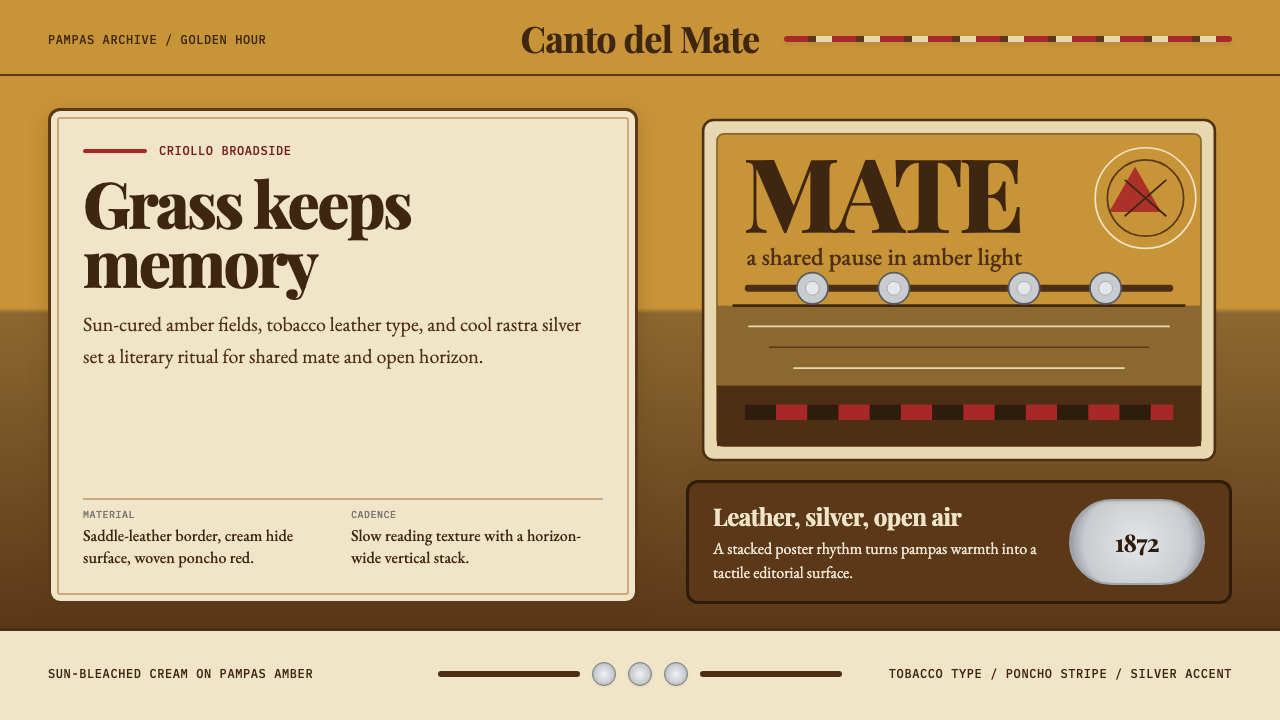
The Argentine gaucho distills a century of open-sky cattle culture into warm amber grounds, hand-tooled silver accents, and the unhurried hospitality of shared mate.
Argentine Gaucho (Pampas Mate Culture) in brief
Argentine Gaucho (Pampas Mate Culture) is a design aesthetic rooted in the visual and material world of the nineteenth-century South American cattle herder. It draws on the warm amber light that floods the pampas at dusk, the dark tobacco-brown of worn saddle leather, the cold glint of silver rastra belt ornaments, and the sun-bleached cream of estancia walls — translating a living rural tradition into a cohesive typographic and compositional language.
At its core, the style is about warmth and weight. Every surface carries the temperature of the grassland: backgrounds glow with amber or aged parchment tones, structural elements take on the density of hand-stitched hide, and accents catch the eye the way firelight catches silver. The overall impression is neither rustic nor primitive — it is dignified, deliberate, and deeply literary, reflecting the gaucho's dual existence as both working horseman and romantic national symbol.
The aesthetic reached its fullest cultural articulation in the criollismo movement of late nineteenth-century Argentine letters, which elevated the gaucho from a marginal outlaw figure to the country's defining archetype. José Hernández's epic poem Martín Fierro (1872) and Ricardo Güiraldes's novel Don Segundo Sombra (1926) gave the gaucho moral gravity and lyrical weight. The design system inherits that literary seriousness: it favors typefaces with traditional serif authority, compositional patience, and a restrained palette that speaks of endurance rather than spectacle.
See the Argentine Gaucho (Pampas Mate Culture) design system
Where does Argentine Gaucho (Pampas Mate Culture) come from?
The gaucho emerged as a distinct social type on the Río de la Plata plains during the seventeenth century, as feral cattle — descendants of stock brought by Spanish colonizers — multiplied across the vast grasslands of what would become Argentina, Uruguay, and southern Brazil. These horsemen lived outside the formal colonial economy, hunting wild cattle for their hides, camping under the Southern Cross, and developing a material culture shaped entirely by what the pampas provided: leather for clothing and shelter, silver traded from the Andean mining routes for ornamentation, and the yerba mate plant for the communal drink that structured their social life.
The rastra, a wide belt composed of interlocking silver coins or medallions, became the gaucho's most distinctive ornament — at once a display of accumulated wealth, a functional tool, and a marker of identity. Similarly, the mate gourd and its silver bombilla straw were objects of daily ritual: shared in a circle, passed in order, and governed by unspoken etiquette that defined community belonging. These objects — the rastra, the mate, the facón knife, the poncho — became the visual vocabulary of gaucho identity and remain its most recognizable design references.
By the mid-nineteenth century, the gaucho's way of life was being systematically erased by the expansion of wire fencing, agricultural settlement, and the military campaigns that pacified the pampas. It was precisely at the moment of its disappearance that the gaucho became a national symbol. The Argentine government and literary intelligentsia, seeking a distinctly American identity separate from both Spanish colonial heritage and European modernism, found it in the idealized figure of the horseman who lived by his own code in open country. José Hernández's Martín Fierro, published in two parts in 1872 and 1879, gave this idealization its definitive literary form: a first-person lament from a gaucho driven off his land, resisting conscription, and ultimately reconciling himself to a settled life.
Ricardo Güiraldes's Don Segundo Sombra (1926) completed the literary canonization, presenting the gaucho not as a victim of history but as a teacher of stoic wisdom. By this point, gaucho imagery — the warm earth tones, the silver ornament, the wide horizon — had become a stable visual code circulating across Argentine painting, illustration, and graphic arts. The national poet Leopoldo Lugones declared Martín Fierro the Argentine national epic in 1913, formally installing the gaucho at the center of the country's cultural identity. The design aesthetic that carries this heritage forward is one of earned warmth: nothing flashy, everything meaningful.
What defines the Argentine Gaucho (Pampas Mate Culture) look?
Color Palette
The palette is built from the pampas itself. Warm amber and golden ochre serve as primary grounds, evoking the grassland at midday. Deep tobacco brown anchors structural elements — panels, dividers, and borders — with the weight of aged saddle leather. Sun-bleached cream or off-white provides a quiet field for body text and content areas. Accents arrive in two forms: a deep poncho red for emotional warmth and calls to action, and a cool metallic silver-gray for navigational or decorative details that reference the silver ornaments of gaucho dress. The overall temperature is consistently warm and earthen; no cool blues or synthetic brights enter the system.
Typography
Type choices carry the literary weight of criollismo. Display headings call for serif faces with traditional authority — letterforms that recall the hand-set type of nineteenth-century Argentine broadsheets and the gravity of Martín Fierro's printed editions. Body text pairs warm, readable serif letterforms that reward extended reading rather than scanning. The typographic voice is unhurried: generous line spacing, moderate measure, and a clear hierarchy between title, subtitle, and body that unfolds like the stanzas of a payada (the gaucho improvised song duel). Decorative capitals and occasional use of italic convey the rhetorical richness of oral tradition translated into print.
Texture and Surface
Unlike austere minimal styles that insist on flat surfaces, the gaucho aesthetic embraces tactile depth. Subtle grain textures evoke the pressed hide, woven wool, or aged paper of pampas material culture. These textures are never photorealistic — they read as an atmospheric quality, like the slight tooth of watercolor paper or the worn surface of a field journal. Card components and panel backgrounds carry this grain quality, making the interface feel like it has been held in many hands over many years. The texture is purposeful: it reinforces warmth and signals craft rather than manufacturing.
Composition and Horizon
Gaucho composition is horizontal and expansive, mirroring the pampas horizon. Wide-format hero sections make full use of lateral space; the eye is invited to sweep across the field before settling on a focal point. Visual hierarchy moves from left to right or from a wide establishing shot to a concentrated detail — much like the gaucho's gaze that reads the landscape before pinpointing a single calf. Panel divisions often reference the strong horizontal bands of the Argentine landscape: sky above, grassland below, the estancia buildings as a thin stripe between them. This orientation gives even dense content layouts a quality of openness and breathing room.
Silver Accent System
Just as the gaucho's rastra belt and mate bombilla provided flashes of precious metal against earthy clothing, the design system uses cool silver tones as a precise accent against warm grounds. These silver elements are used sparingly: border highlights on interactive components, fine rule lines between sections, icon strokes, or the occasional decorative geometric that references the medallion patterns of the rastra. The restraint is essential — overuse flattens the contrast. Silver is a surprise; it should feel earned, the way the glint of a belt ornament registers in peripheral vision during a long ride.
Ornament as Craft
Unlike movements that reject ornament entirely, the gaucho aesthetic treats decoration as evidence of craft skill and cultural pride. But this ornament is always structural or thematic — it references actual gaucho material culture (the braided leather patterns of sogas, the geometric stamping of silver work, the diamond patterns of woven ponchos) rather than being applied arbitrarily. Decorative borders, section dividers, and pull-quote ornaments derive from these craft sources. The distinction from pastiche is intentionality: every decorative choice should trace back to a specific material or cultural tradition of the pampas.
Mood: Solitude and Hospitality
The gaucho aesthetic holds two apparently contradictory emotional registers in balance. On one hand, it evokes the solitude of the open pampas — vast negative space, unhurried pacing, the long unbroken horizon. On the other, it carries the warmth of mate circle hospitality — generous spacing between elements as an act of welcome, the amber warmth of firelight, the sense that there is always room for one more at the fire. This duality means the style can serve both contemplative, long-form reading experiences and genuinely welcoming product surfaces. The key is that the warmth always feels earned rather than manufactured.
See the Argentine Gaucho (Pampas Mate Culture) design system
Who shaped Argentine Gaucho (Pampas Mate Culture)?
Hernández (1834–1886) was the journalist, politician, and poet who wrote Martín Fierro, the two-part epic poem published in 1872 and 1879 that became the foundational text of Argentine national literature. Hernández was himself from the province of Buenos Aires and had spent time among gaucho communities; his poem gave the gaucho a voice rather than merely an image, documenting the herder's dialect, oral poetic traditions, and social grievances with an intimacy that subsequent writers and artists have drawn from ever since. The poem's formal structure — the payada verse form, the six-line décima stanza — provided a template for how criollismo aesthetics would balance folk tradition with literary ambition, a balance that the visual design system inherits.
Güiraldes (1886–1927) was a Buenos Aires patrician who became the gaucho tradition's most sophisticated literary champion. His novel Don Segundo Sombra (1926) presented the gaucho not as a tragic outlaw but as a figure of stoic dignity and practical wisdom — a mentor to a younger generation learning how to live with integrity in a world of change. Güiraldes wrote with a modernist sensibility while drawing on authentic gaucho oral traditions he had absorbed on his family estancia in San Antonio de Areco. That town became, and remains, the spiritual capital of gaucho culture in Argentina — its silversmith workshops, leather artisans, and annual festival providing the living material culture that the design aesthetic directly references.
Juan Moreira was a real historical gaucho (1819–1874) who became Argentina's first popular culture legend. Originally a small landowner who turned outlaw after a series of injustices, he was dramatized in Eduardo Gutiérrez's serialized novel of 1879–1880 and subsequently adapted into Argentina's first circus drama in 1884 — widely considered the origin of Argentine national theater. Moreira represents the gaucho as tragic rebel: the man who lives by the code of the pampas in a society that has stopped honoring it. In visual and design terms, his story underlies the aesthetic's tension between the warm amber of community and the steely silver of defiance.
Slatta is the American historian whose comparative study Gauchos and the Vanishing Frontier (1983) provided the most rigorous scholarly account of gaucho social history across the Rio de la Plata region. His work documented the gaucho's actual material culture — the tools, dress, customs, and daily routines — with ethnographic precision, separating the historical reality from the romantic mythology that Argentine literature had constructed around it. For designers working with the gaucho aesthetic, Slatta's scholarship is indispensable: it grounds the color palette, the ornamental vocabulary, and the compositional logic in documented historical practice rather than mere romanticization.
Pueyrredón (1823–1870) was the Argentine painter whose canvases provided the first sustained visual record of gaucho life. Trained in Europe but deeply attached to the Argentine landscape, he painted the pampas with both ethnographic fidelity and romantic warmth: the amber afternoon light, the dark-skinned horsemen in their bright ponchos, the estancia buildings low against the horizon. His paintings established the canonical color palette of gaucho visual culture — the warm earth tones, the sky made luminous by the flat grassland beneath it — and remain the most direct precedent for the design system's color and compositional vocabulary.
How do you use Argentine Gaucho (Pampas Mate Culture) today?
The Argentine Gaucho aesthetic is well suited to products that want to communicate warmth, craft, heritage, and unhurried quality — without sacrificing legibility or contemporary usability. It is a particularly strong fit for food and beverage brands, travel and hospitality products, artisanal goods platforms, cultural institutions, and any project that wants to convey a sense of earned authenticity rather than manufactured lifestyle appeal.
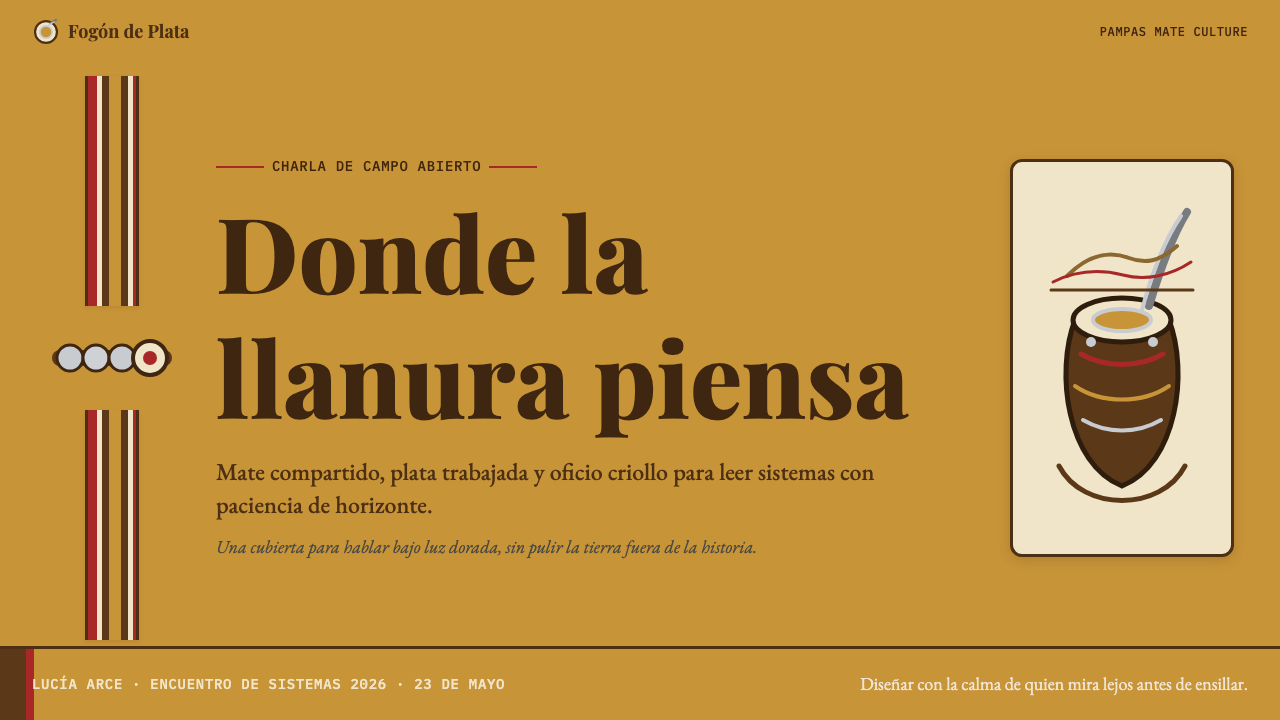
For presentation slides, the style works best when the cover is treated as a wide-canvas composition: the amber or ochre ground fills the full frame, a subtle grain texture gives it presence, and the title sits in a generous serif display face. Subheadings and body text on content slides should stay in the cream-to-off-white range, with tobacco-brown or deep amber used for structural rules and section dividers. Data slides benefit from the palette's warmth: bar charts and area charts in amber and brown read as more considered than the default chart palettes most tools provide. Reserve the poncho red for single data points or call-out annotations that need to draw the eye.
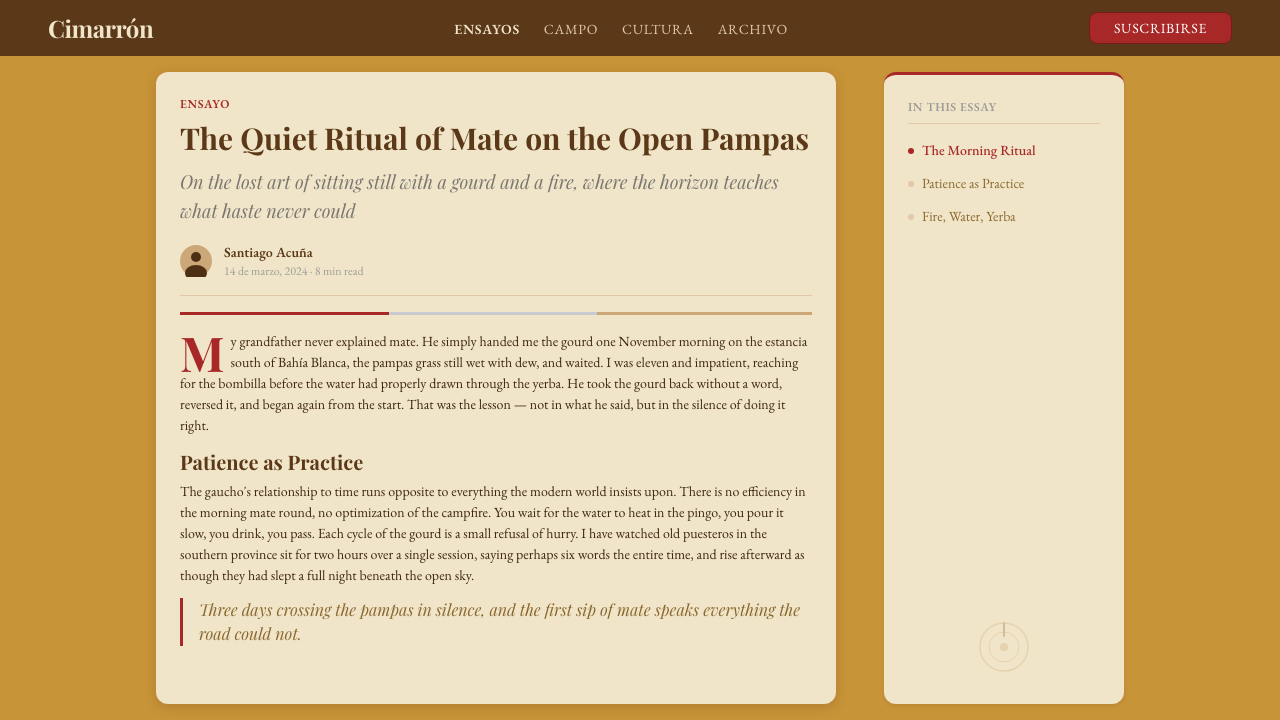
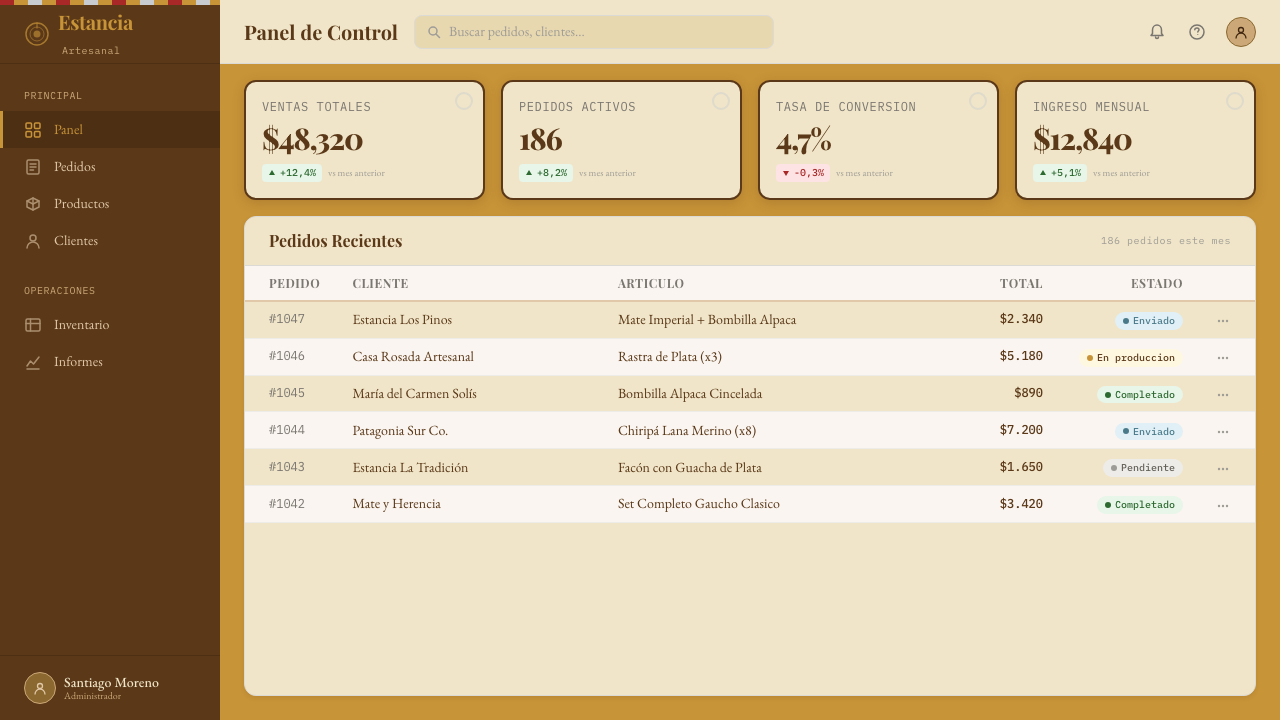
For web interfaces, the gaucho aesthetic translates best into editorial layouts, long-form content pages, and product detail pages where the user is expected to spend time rather than scan. Navigation should be typographic and restrained — word-level labeling in a warm serif, with a silver accent on the active state. Hero sections should use the full horizontal width to establish the pampas-horizon sense of scale, then resolve into a tight content column. Dashboards and analytics interfaces can use the palette, but the texture should be reduced or eliminated so that data legibility remains primary; let the amber ground and careful typography carry the character.
For editorial and marketing work, the gaucho style excels at establishing a voice of authority and tradition. A long-form article or brand story benefits enormously from generous margins (evoking the wide pampas), a readable serif body face, and section breaks marked by a fine silver or tobacco-brown rule rather than bold typographic intrusion. Marketing pages can take advantage of the style's poster sensibility: alternating full-width blocks in amber-on-cream and cream-on-deep-brown, with poncho red reserved strictly for primary calls to action. The silver accent system adds a premium quality signal without resorting to gradient or glow effects.
The most common mistake when applying this style is pushing the warmth so far that legibility suffers — amber on amber, brown on brown, a system so committed to its earth tones that contrast disappears. Authentic gaucho material culture always resolved this through the sharp contrast of the silver rastra against the brown hide: every warm ground needs a cool or bright point of contrast to give the eye a landing place. A secondary error is applying the grain texture everywhere at full intensity, which reads as noise rather than craft. Texture should be present on backgrounds and panel surfaces but reduced or absent on interactive elements such as buttons, form fields, and data components where clarity trumps atmosphere.
See the Argentine Gaucho (Pampas Mate Culture) design system
Argentine Gaucho (Pampas Mate Culture) — FAQ
How does the gaucho aesthetic differ from general Latin American rustic styles?
The gaucho aesthetic is specifically pampas-derived and carries the visual vocabulary of a particular material culture: the silver ornament, the amber grassland light, the horizontal horizon composition, and the literary gravity of the criollismo movement. General Latin American rustic styles tend to draw from a much wider range of sources — Andean weaving patterns, colonial architecture, Mesoamerican motifs, tropical color palettes — and lack the specificity of historical and cultural grounding that makes the gaucho style coherent. The gaucho palette is warm but controlled; it does not use the saturated terracotta, vivid turquoise, or celebratory polychromy associated with other Latin American vernacular traditions. The restraint is the tell.
Is this style appropriate for digital product interfaces, or is it better suited to print and branding?
The gaucho style adapts well to digital interfaces, but it requires deliberate choices about where warmth and where clarity take priority. The amber-and-cream palette maintains excellent legibility for text-heavy interfaces when contrast is preserved. The horizontal compositional logic maps naturally to wide-screen web layouts. The texture system needs to be used with restraint on interactive elements — buttons, inputs, and data components work better with flat, clean surfaces — while backgrounds and decorative panels benefit from the grain. The style is especially strong for content-heavy editorial interfaces, e-commerce product pages, and hospitality booking flows where the design is expected to build mood as much as convey information.
How should the mate ritual inform the design's sense of pacing and interaction?
The mate circle — where a gourd is prepared, passed in order, and received without rushing — is one of the most useful conceptual models the gaucho aesthetic offers to user experience design. It suggests an interaction philosophy of deliberate sequence rather than simultaneous overwhelm: one thing at a time, completed before the next begins, with pauses treated as part of the experience rather than dead time to be filled. In practice, this translates to generous whitespace between content sections, single-action screens rather than multi-modal interfaces, progressive disclosure of information rather than front-loading, and transitions that feel measured rather than instant. The mate model also implies hospitality: the interface should feel like it is anticipating the user's needs and accommodating them, not demanding that the user navigate a system designed for internal efficiency.
Can the gaucho aesthetic work for a dark-mode interface?
A dark inversion of the gaucho palette is possible but requires careful recalibration. The canonical version is light-ground — warm amber and cream — because that matches the actual experience of pampas light. A dark variant works best when it uses deep tobacco brown or very dark amber as the background rather than pure black, preserving the warmth of the palette rather than abandoning it. On these dark grounds, cream and off-white serve as body text, amber-gold works as an accent or highlight, and silver remains effective as a precise detail color. The poncho red reads more aggressively on dark grounds and should be used even more sparingly. The grain texture actually becomes more atmospheric on dark grounds, making the interface feel like a candlelit estancia interior rather than a digital screen.
What is the difference between using this style authentically versus producing a cliché?
Authentic gaucho-derived design is grounded in specific material and cultural references — the rastra's medallion geometry, the mate gourd's organic oval form, the estancia's horizontal massing, the criollismo literary tradition's balance of folk and literary — and makes visual decisions that can trace back to these sources. Cliché arrives when designers reach for surface signals — a lasso graphic, a cowboy hat silhouette, a spur icon — without understanding the deeper visual culture those objects come from. The authentic approach treats the gaucho aesthetic as a complete typographic and compositional language rather than a costume applied to a generic layout. The warmth should come from the palette and typography, the craft from the texture and ornament system, the scale from the horizontal composition — not from a stock image of the pampas dropped into an otherwise undifferentiated template.
Related design styles
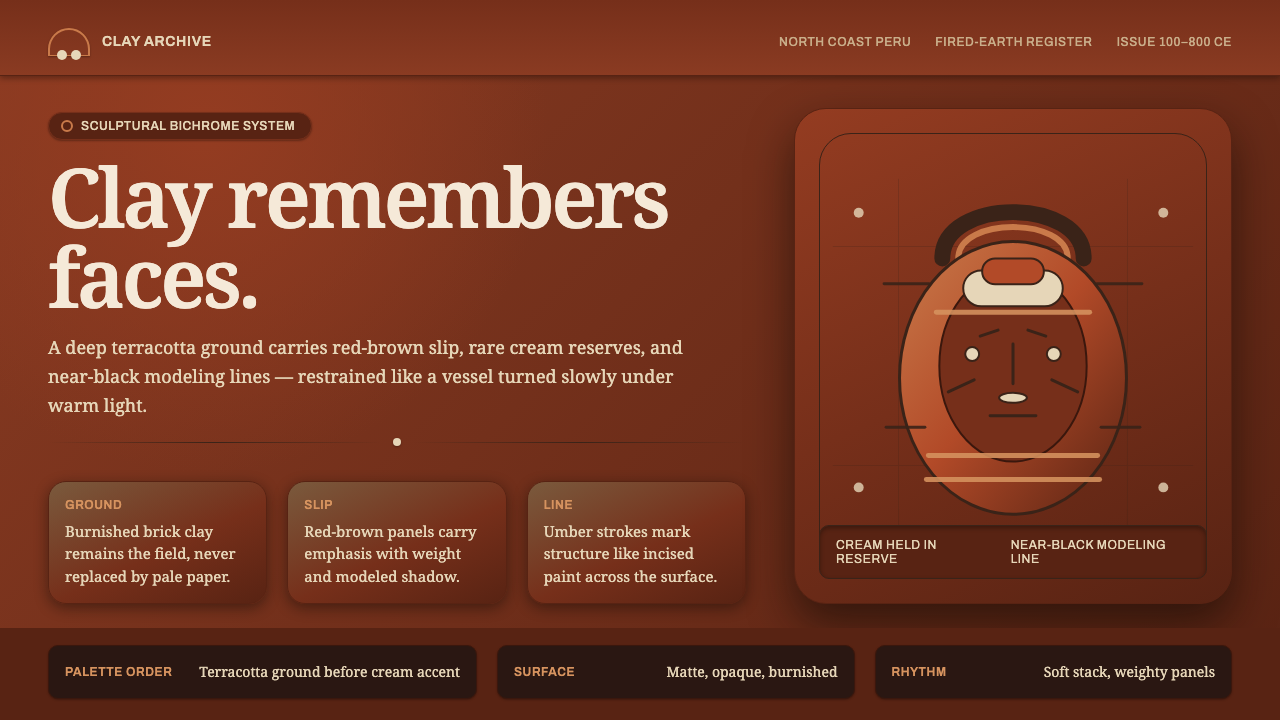 Moche Portrait VesselClay carries the likeness. Terracotta ground, red-brown slip, cream accents,…
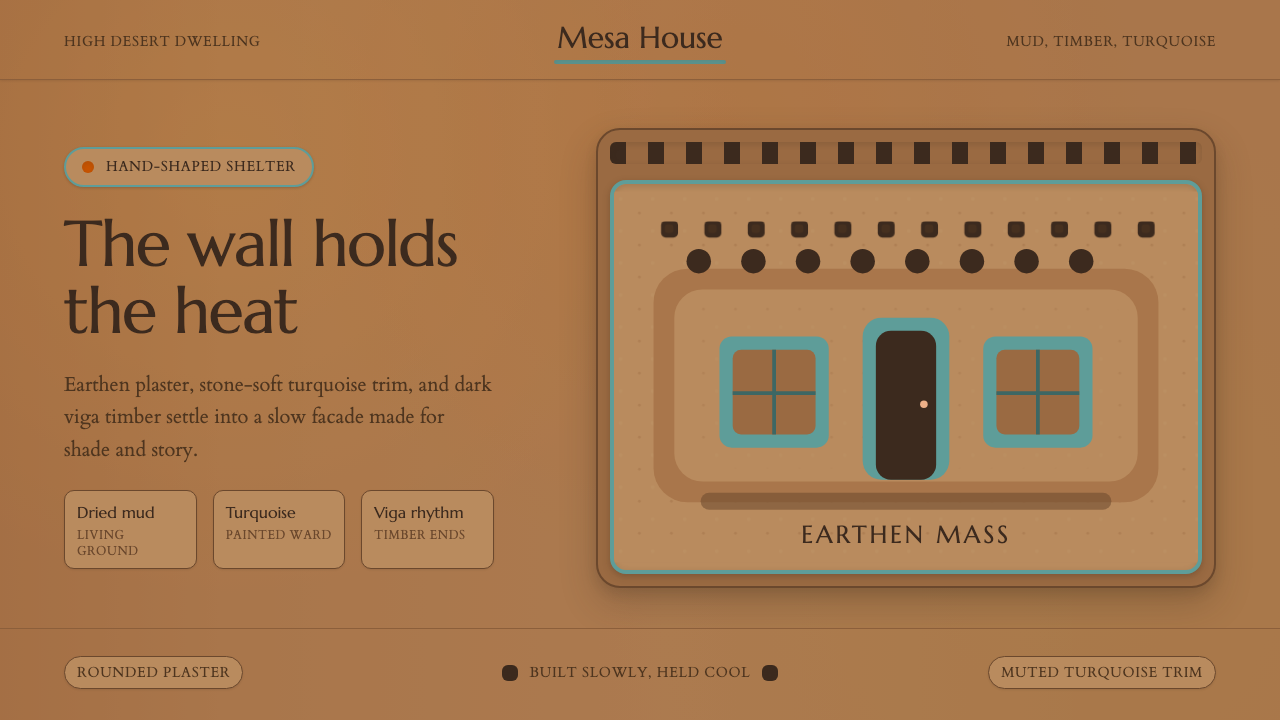 Adobe Pueblo SouthwestFeels made by hand. Earthen tan, turquoise trim, and viga rhythm shape the fr…
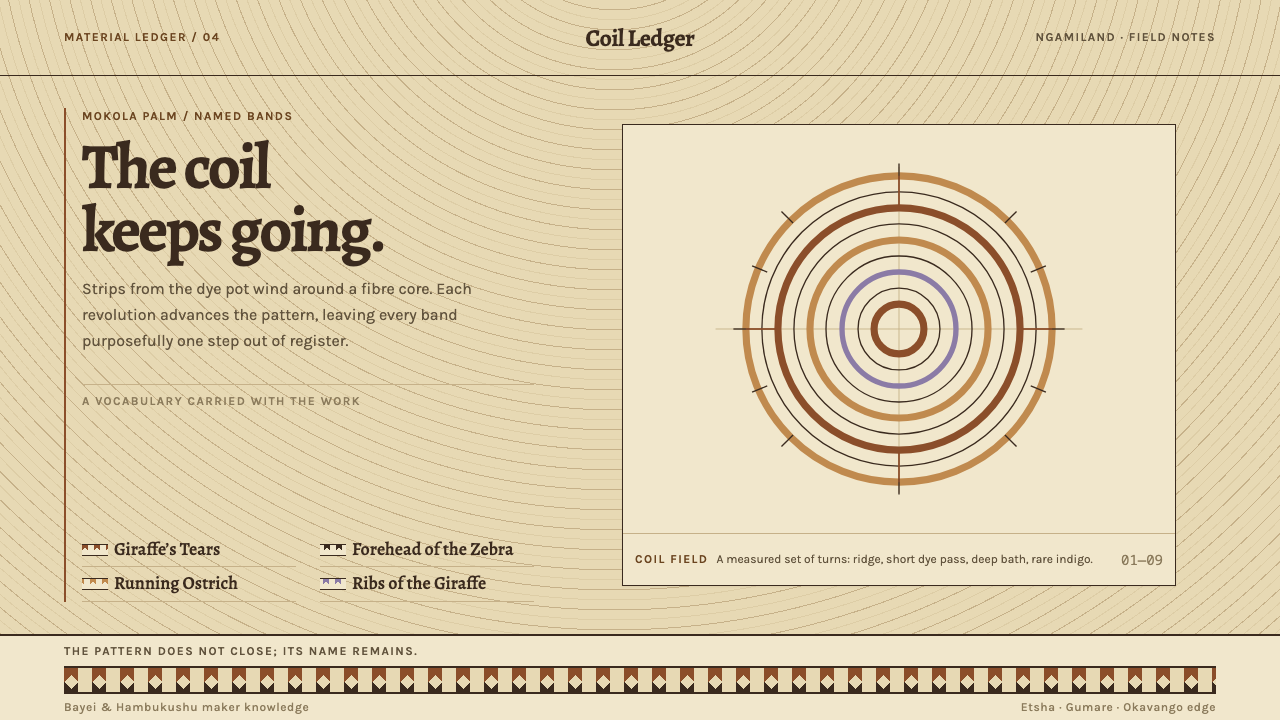 Botswana Coiled BasketThe pattern keeps travelling. Bark-brown stepped bands wind across a straw co…
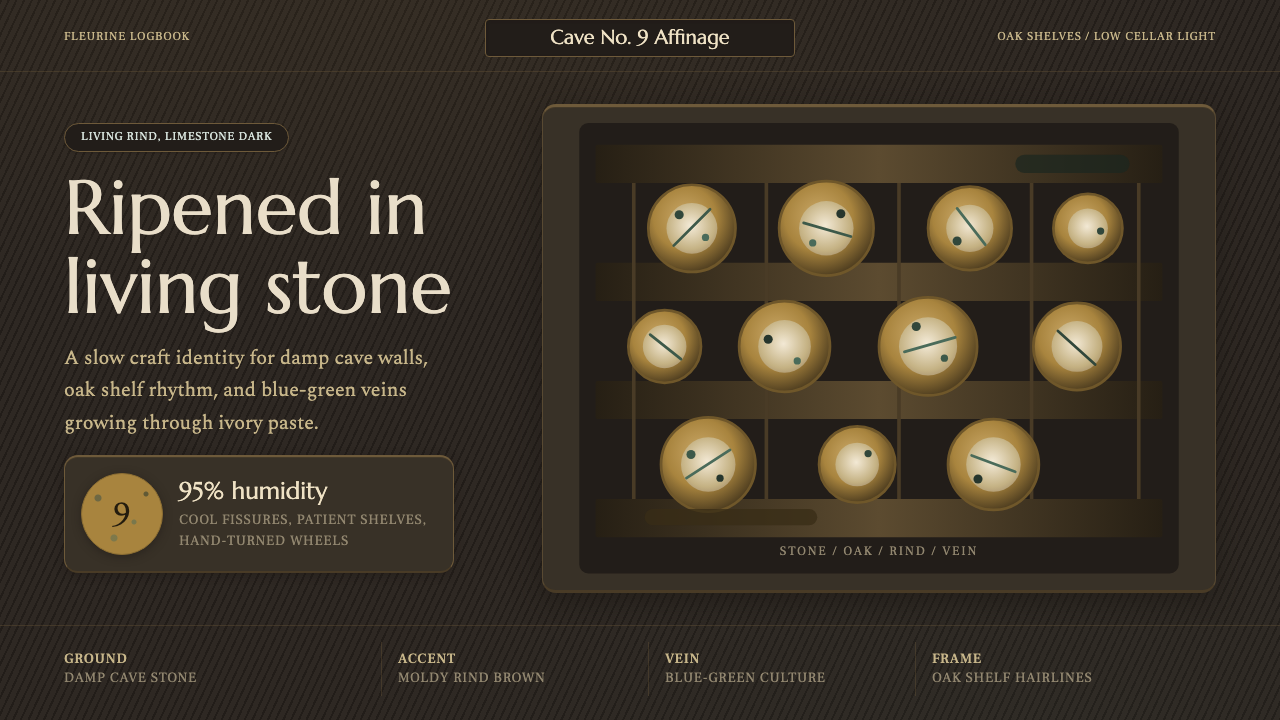 Cheese Affinage CavePatience reads as stone. Rind brown, mold green, and oak shelf grids glow in…
 Desert VarnishStone remembers. Sandstone glyphs cut through near-black varnish in stacked f…
 Dogon Toguna Shelter MaliGravity made visible. Deep umber ground, low roof band, chestnut posts in sha…