What is Odisha Saura Tribal Mural?
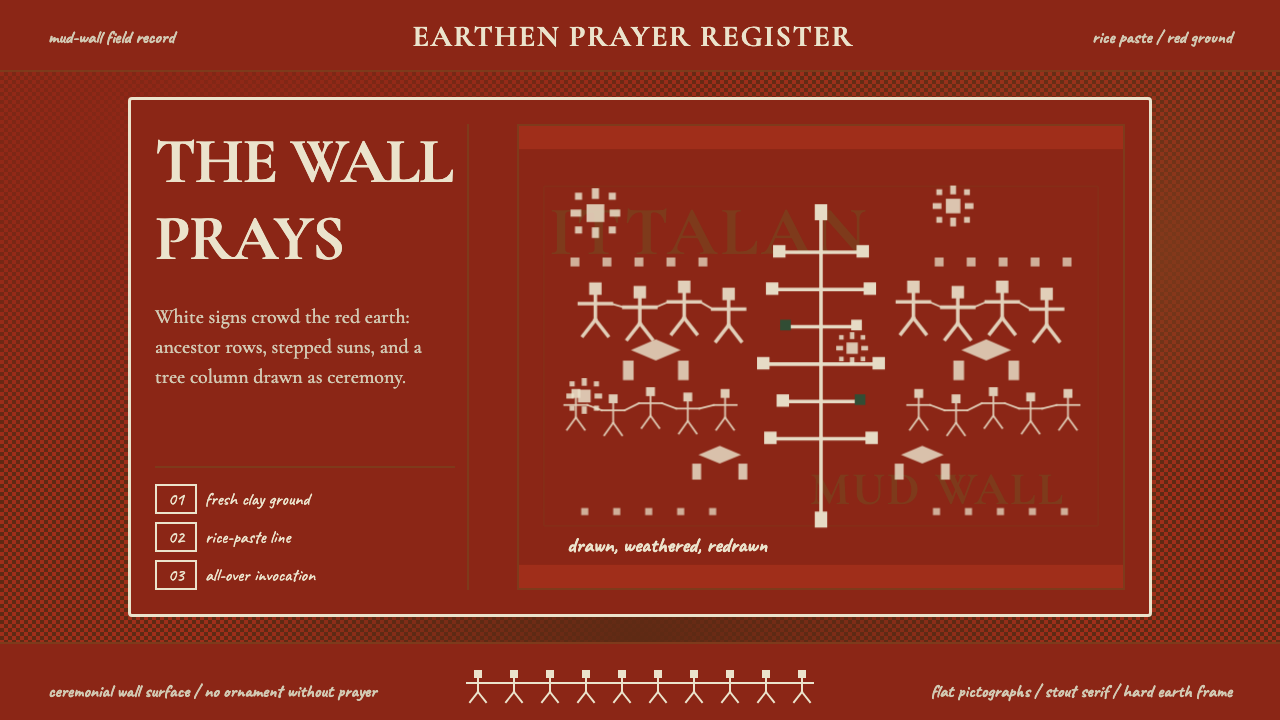
Sacred density — rice-white pictographs crowding a red-earth wall in ritual rhythm — is what the Saura people of southern Odisha have been painting for over a thousand years, and what makes their ittalan tradition one of the most visually singular surviving ritual art forms in the world.
Odisha Saura Tribal Mural in brief
Saura ittalan is the ancestral wall-painting tradition of the Saura (also written Sora) tribal community of southern Odisha, in eastern India. Practiced for at least fifteen centuries in documented form — and likely far older in oral memory — these murals are not decorative in any casual sense. They are sacred communications addressed to Idital, the Saura ancestor spirits, and they are painted directly onto the freshly mud-plastered interior walls of homes at life's threshold moments: weddings, births, deaths, and the harvest cycle.
The visual language of ittalan is built on a tension between abundance and constraint. The painter — traditionally a woman, an ittalmar — has only two materials: red earth for the ground and white rice-paste for the line. Within that austere two-pigment limit, she fills every available surface with registers of hand-holding human figures, galloping horses, elephants, peacocks, the branching tree of life, and geometric solar motifs arranged in dense, interlocking rows. Nothing is left empty; the horror-vacui density is not restlessness but reverence, an insistence that spiritual presence must fill all available space.
What distinguishes ittalan from merely ornamental folk painting is its dual function as both image and text. Each composition encodes the identity of the deceased or honored ancestor, the ritual purpose of the occasion, and the genealogical relationships of the living community. The figures are not portraits but glyphs — abstract, stick-like, reduced to their barest communicative essence — and the overall arrangement reads less like a picture and more like a structured document whose grammar is known only to the community that made it.
Where does Odisha Saura Tribal Mural come from?
The Saura are an Adivasi (indigenous) people whose homeland spans the hill districts of southern Odisha — primarily Rayagada, Gajapati, and Koraput — along with adjacent parts of Andhra Pradesh and Chhattisgarh. They speak Sora, a Munda language of the Austroasiatic family, which marks them as belonging to one of the oldest surviving linguistic groups on the Indian subcontinent. Their cultural practices, including ittalan, predate both Brahminic Hinduism's penetration into tribal territories and the colonial reorganization of Indian religious life.
The ittalan tradition is specifically tied to the Saura practice of communicating with ancestor spirits through a shaman-medium called a kuranmaran. When a community member dies, the spirit is believed to remain unsettled until it is properly invited into the ancestral world through ritual. The ittalan murals painted during the funeral and subsequent memorial ceremonies are a visual component of this invitation — they give the ancestor spirit a depicted home and a witnessed identity. The paintings are made fresh for each ceremony and are not intended to endure; when the next occasion arises, the wall is re-mudded and painted again, layer upon layer, across generations.
Western academic attention arrived through the mid-twentieth century ethnographers Verrier Elwin and Christoph von Fürer-Haimendorf, both of whom documented tribal cultures of central and eastern India with unusual depth and sympathy. Elwin in particular wrote extensively about Saura society, and his records provide the earliest systematic descriptions of ittalan as an ongoing living tradition rather than a relic. Their ethnographic work also drew the attention of Indian art historians, and by the 1970s and 1980s, government cultural programs began bringing ittalan painters to urban festivals and galleries — a shift that introduced the tradition to a national audience but also began the complex process of adapting a ceremonial art form to display contexts.
That adaptation has continued unevenly. Some ittalmārs, working with cultural organizations and individual patrons, have developed portable paper and canvas versions of the murals that retain the two-pigment palette and horror-vacui density while making the work sellable and transportable. These works have entered museum collections and international exhibitions, bringing sustained scholarly and design attention to a tradition that might otherwise have remained invisible outside its home districts. The tension between ceremonial function and artistic commodity is one that Saura painters and community elders continue to negotiate, often carefully, sometimes uncomfortably.
What defines the Odisha Saura Tribal Mural look?
Two-Pigment Palette
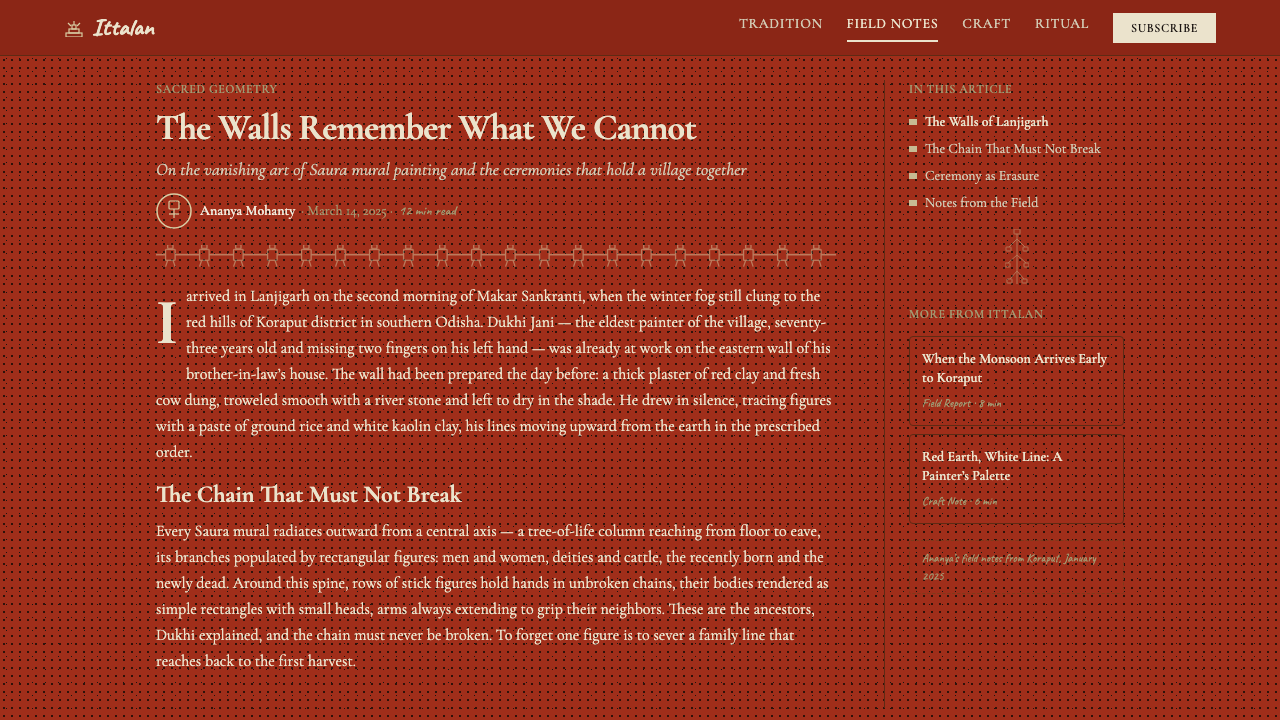
The entire visual system rests on exactly two chromatic values: a warm red-earth ground — the color of the dried mud wall itself — and an opaque rice-paste white for every drawn element. There is no gradation, no mixing, no third tone. The white line reads against the red ground with the clarity of a photographic negative, giving even the most complex compositions an immediate legibility at a distance. This chromatic austerity is not poverty but precision: the two-pigment limit is the tradition's defining structural constraint, the discipline from which everything else follows.
Horror-Vacui Density
Empty space carries no positive value in ittalan; on the contrary, unfilled ground reads as spiritual absence. The painter fills every register of the composition with figures, motifs, and geometric patterns arranged in horizontal bands. Human figures march in rows, animals fill the intervals between rows, and geometric sun-discs or tree-of-life columns punctuate the overall composition vertically. The cumulative effect is dense and rhythmic rather than cluttered — the density is organized, not chaotic, because the underlying structure of horizontal registers creates consistent reading direction across the surface.
Stick-Figure Glyphs
Human and animal figures are reduced to their most abstract communicative minimum: rectangular torsos, straight limbs, rudimentary heads with triangular or circular features. These are not attempts at naturalism that fell short — they are deliberate glyphs, where identity is conveyed through arrangement and context rather than individual physiognomic detail. A row of figures holding hands reads as community; a figure on horseback reads as a specific social role. The stick-figure convention keeps the imagery non-hierarchical and endlessly repeatable, which is exactly what a tradition of ritual, rather than artistic ego, requires.
Tree of Life as Structural Axis
The branching tree — referred to in scholarship as the tree of life — appears as the dominant vertical organizing element in many ittalan compositions. Its trunk provides a central axis around which human figures, animals, and geometric motifs are symmetrically or semi-symmetrically arranged. The tree is simultaneously cosmological symbol and compositional device: it represents the connection between the living and ancestral worlds, and it gives the painter a scaffolding around which to organize an otherwise potentially chaotic density of elements. Where the tree appears, the composition gains a legible center of gravity.
Geometric Solar and Animal Motifs
Beyond the human figure, the recurring formal vocabulary includes stepped sun-discs, concentric geometric diamonds, galloping horses drawn in pure profile, elephants reduced to broad curving outlines, and peacock silhouettes with fanned tails rendered as radiating lines. These elements appear both as symbolic content — the horse and elephant carry specific ritual meanings — and as compositional filler that maintains the density requirement across large wall surfaces. Their geometric reduction gives them a pattern-like quality that holds together even when isolated from their original ceremonial context.
Hand-Rendered Line Quality
Because rice-paste is applied with a pointed stick or a cloth bundle rather than a brush, and because the painter works on a textured mud surface that absorbs unevenly, every line in ittalan carries a slight tremor and variation in thickness. Edges are not mechanically clean; they feather at the margins and swell where the applicator pressed more firmly. This hand-rendered quality is not incidental — it is the surface evidence of an embodied practice, of a person in ritual relationship with a wall, and it gives ittalan-derived design a warmth and presence that vector-smooth equivalents cannot replicate.
Horizontal Register Composition
Ittalan organizes its dense figure-world into horizontal bands or registers stacked from the lower portion of the wall upward toward the ceiling. Each register contains a self-contained row of related figures or motifs, and the bands are separated by thin ruled lines or simply by the gap between one row's heads and the next row's feet. This register system — familiar from ancient Egyptian wall painting and Mesopotamian relief — is not borrowed; it is an independent invention that solves the same compositional problem: how to organize a large quantity of meaning-bearing imagery across a flat surface while maintaining both legibility and ritual completeness.
Who shaped Odisha Saura Tribal Mural?
In Saura society, ittalan is historically the domain of women, specifically those women who have been taught by older relatives and who have established a ceremonial relationship with the community they serve. The ittalmar is not a professional artist in any mercantile sense; her role is ritual and relational. She knows the genealogies, she knows which motifs belong to which ancestors, and she paints not from individual creative expression but from accumulated communal knowledge. As urbanization and changing ritual practices have reduced the ceremonial occasions for ittalan, some ittalmārs have translated their practice into paper and canvas works — a necessary adaptation that has also introduced genuine tensions around authorship, commodification, and the meaning of a sacred image removed from its sacred context.
The British-born anthropologist Verrier Elwin spent decades living among tribal communities of central and eastern India, eventually becoming an Indian citizen and a key architect of India's early post-independence tribal affairs policy. His ethnographic writing on the Saura, published in the 1950s, provided the first detailed academic accounts of ittalan as a living ceremonial system — describing not just the visual forms but the ritual occasions, the roles of the ittalmar, and the cosmological beliefs that animate the paintings. Without Elwin's documentation, much of the early understanding of ittalan's function and grammar would have been lost to non-Saura audiences entirely.
The Austrian social anthropologist Christoph von Fürer-Haimendorf conducted extensive fieldwork among tribal communities of India from the 1940s onward, with particular focus on the Naga of northeast India and the Adivasi peoples of the Deccan and Orissa. His comparative work on tribal societies placed the Saura within a broader framework of South Asian indigenous practice and helped establish the scholarly vocabulary through which ittalan came to be discussed in art history and anthropology. His approach — treating tribal art as a fully coherent cultural system rather than a curiosity or survival — influenced subsequent generations of ethnographers and curators.
Individual ittalmar practitioners are rarely named in Western art historical accounts — a consequence of the tradition's collective and ceremonial rather than individual-artist orientation. Sukari Sita and women like her in Rayagada and Gajapati districts represent the living custodians of the tradition who, in recent decades, have navigated the shift toward paper-format works without losing the fundamental compositional and symbolic grammar of the original wall practice. Their work in contemporary formats has been documented by organizations including the Crafts Council of India and various state-level cultural bodies, and represents the primary evidence of how ittalan adapts while retaining its core visual logic.
How do you use Odisha Saura Tribal Mural today?
Applying Odisha Saura Tribal Mural as a design reference requires understanding what the tradition is actually doing: generating authority through density, structure through horizontal registers, and warmth through hand-rendered imperfection. Designers who borrow only the surface — red grounds, white line drawings — without understanding the compositional grammar produce work that reads as generic ethnic decoration. The tradition's power comes from its internal logic, and that logic is transferable.
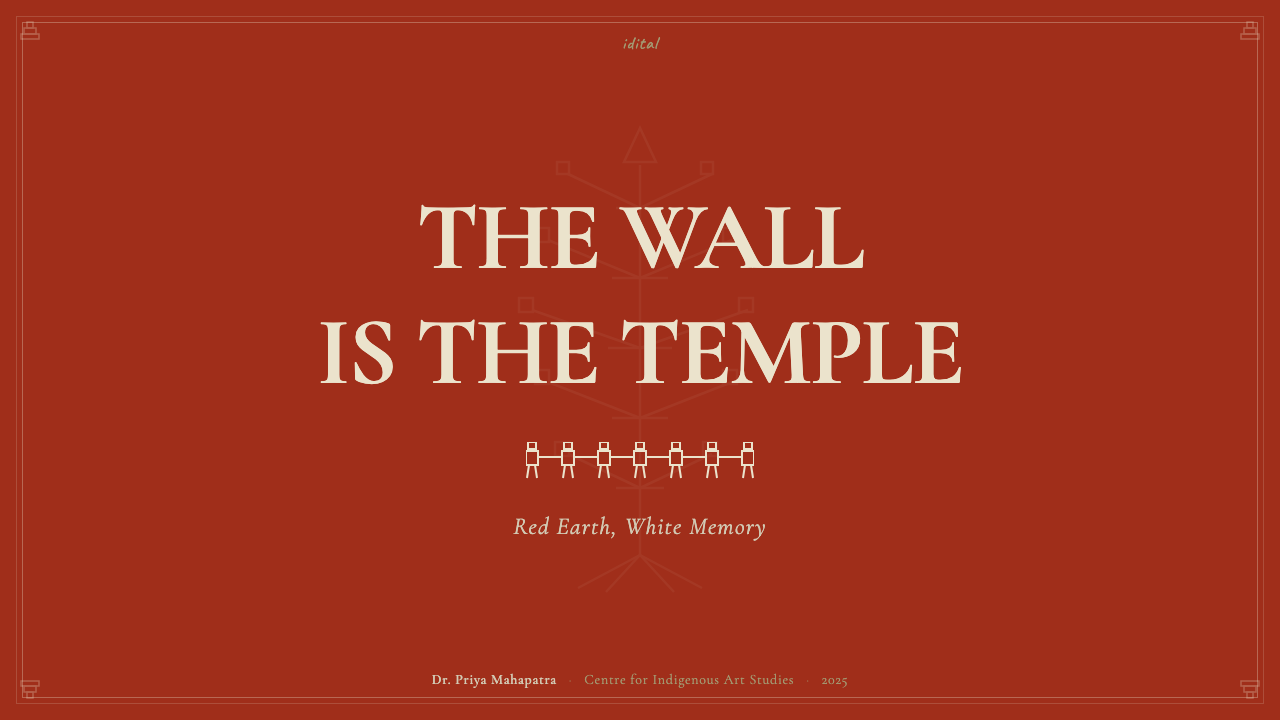
For presentation slides, the style suits covers and section dividers particularly well. A cover page built on a deep red-earth ground with a central white pictographic motif — a branching tree, a row of stylized figures — establishes immediate visual identity and cultural weight. Content slides benefit from the register principle: organize information in clear horizontal bands separated by thin rules, use a warm off-white for primary text, and resist the temptation to mix many colors. The two-pigment discipline is a restraint that, applied to presentations, produces remarkable coherence. Data visualization takes on a diagrammatic, almost ceremonial quality when bar charts are rendered in white against the red ground and annotated with hand-drawn-feeling callout lines.
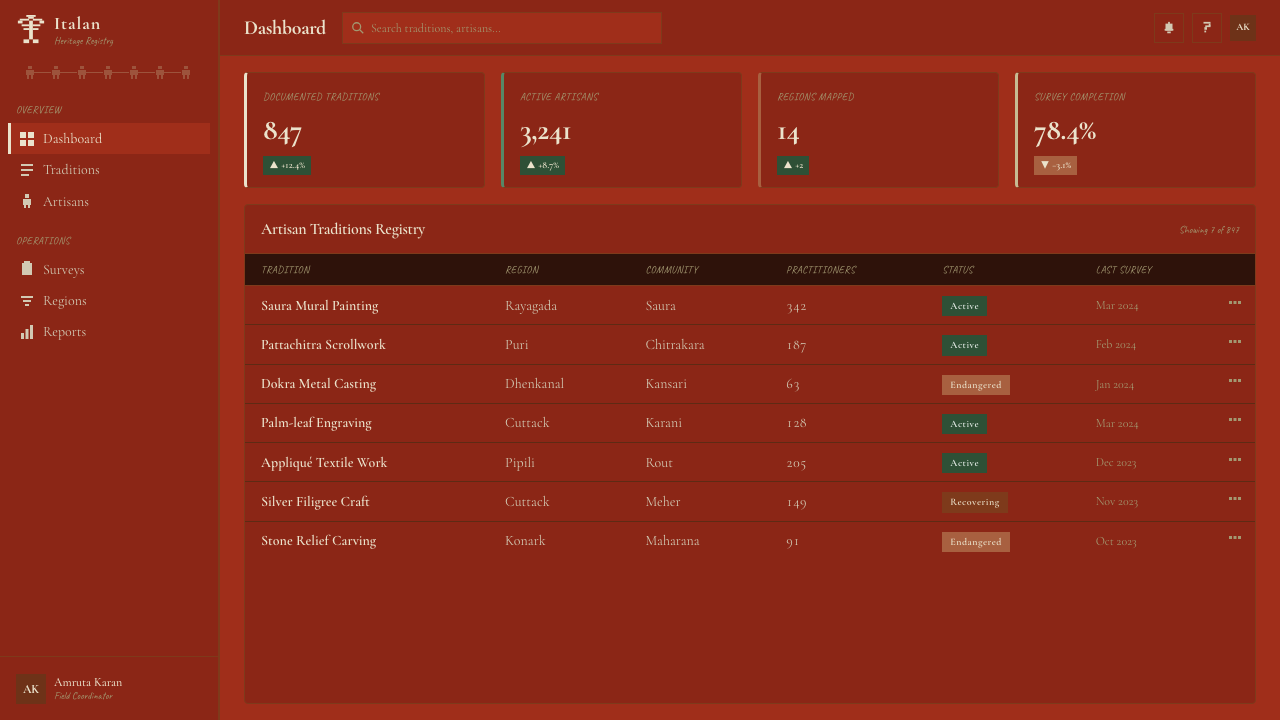
For web interfaces and dashboards, ittalan principles translate into a surface language rather than a full system. Use the earthy red-and-white pairing as a primary brand accent — hero backgrounds, section dividers, icon systems — while keeping data-heavy areas in neutral grounds for legibility. Navigation systems can borrow the register concept: horizontal bands of links or filter options organized in strict rows carry the right visual reference without reducing readability. Pricing pages and feature grids work well with this approach because the style's inherent density creates the impression of completeness and careful curation.
For editorial and marketing contexts, the style's cultural specificity is its strongest asset. Book covers, magazine feature openers, cultural event branding, and arts institution campaigns benefit from the visual distinctness of the ittalan palette and figure language. A full horror-vacui treatment — every available area filled with white-line pictographic elements on a red ground — reads as bold and intentional in poster contexts where conventional graphic design would feel anonymous. Packaging for products with a genuine artisan or ethically-sourced story can deploy selective ittalan motifs — the tree of life, the hand-holding figure row — as honest visual references to handmade and community-rooted production.
A common mistake when applying this style is treating the red-earth-and-white palette as a simple substitution — swapping it into a layout that was designed for a different visual system. Ittalan's density means it reads best when the compositional structure is also rethought: give elements less breathing room than a minimalist layout would, create consistent horizontal registers, and accept that white space will be an accent rather than a default. The opposite error is over-exoticizing: using ittalan motifs as surface pattern without acknowledging their ceremonial origin turns a sacred tradition into decoration. Restraint and intentionality — understanding what each borrowed element means and why it is placed where it is — are what distinguish respectful reference from appropriation.
Odisha Saura Tribal Mural — FAQ
Is ittalan the same as other Indian tribal art forms like Warli or Madhubani?
They share a family resemblance — all three use line-based figure systems, all have roots in ritual rather than decorative practice, and all have been brought into contemporary art markets — but they are distinct traditions from different communities, regions, and cosmological frameworks. Warli is from Maharashtra and uses a white-on-ochre palette with triangular human figures; Madhubani (Mithila) is from Bihar and is characterized by intricate multi-color botanical and figurative patterns. Saura ittalan is specific to Odisha's hill tribes, uses an exclusively two-pigment red-and-white system, and is tied to the Saura ancestor-spirit cosmology in ways that the other traditions are not. Conflating them is a common error that flattens meaningful cultural distinctions.
How does the horror-vacui density of ittalan translate to digital design without becoming overwhelming?
The key is understanding that ittalan's density is organized, not random. The horizontal register structure means that even in very dense compositions, the eye has a clear path: left to right along one band, then down to the next. When applying this principle to digital surfaces, preserve the register structure — organize content in discrete horizontal strata with clear separators — while scaling the overall density to the medium. A wall mural can absorb more visual information than a phone screen. Digital applications of the style work best when the horror-vacui treatment is contained within specific zones: a hero image or a feature section can carry full density while surrounding areas maintain more breathing room. The density functions as emphasis, not as default.
Can this style work on light backgrounds, or does it require the red-earth ground?
The red-earth ground is not a formal requirement so much as the tradition's most immediate visual signature. It is possible to work with ittalan-derived figure language on cream, warm white, or other earthy neutrals — and some contemporary adaptations do exactly this — but the result reads quite differently. The red ground creates the specific combination of warmth and contrast that makes the white line so legible and so charged; on a neutral light ground, the same white figures read as delicate rather than bold. If the red ground is removed entirely, the design must compensate through other means — bolder line weights, increased figure density, or texture — to maintain the tradition's characteristic presence. A partial approach — using the red ground as a deliberate accent zone rather than a universal background — often produces the most successful contemporary adaptations.
How should designers approach the ethical dimension of referencing a living ceremonial tradition?
The Saura ittalan tradition is not historical — it is practiced today, by living communities, in active ceremonial contexts. That status changes the ethical calculation relative to referencing, say, an ancient style whose practitioners are long gone. The most defensible approach is one of honest reference rather than reproduction: draw on the compositional principles, the two-pigment constraint, the register structure, the figure-language register — but do not replicate specific ceremonial motifs whose meaning belongs to particular genealogies or communities. Crediting the tradition by name, educating audiences about its origin, and, where possible, directing attention or resources toward Saura cultural organizations and living artists are concrete ways to make reference an act of recognition rather than extraction. The worst outcome is using the style with no acknowledgment, as though it were a freely available visual property with no living source.
Why do the figures in ittalan look similar to prehistoric cave paintings — is there a connection?
The visual similarity is real but most likely reflects independent convergence rather than direct descent. Stick-figure conventions — rectangular torsos, straight limbs, circular heads — appear in pictographic traditions across the world, from Saharan rock art to Scandinavian petroglyphs to indigenous American traditions. This convergence happens because the stick figure is the minimal viable solution to a shared problem: how to represent a human body in line, quickly and repeatably, at small scale. The Saura did not inherit this convention from any single ancient source; they arrived at it through the same logic. What makes ittalan distinct from ancient cave art is precisely its continuity as a living system: it is not a relic that stopped evolving thousands of years ago, but a tradition that has been actively maintained, transmitted, and adapted by specific communities up to the present day.
Related design styles
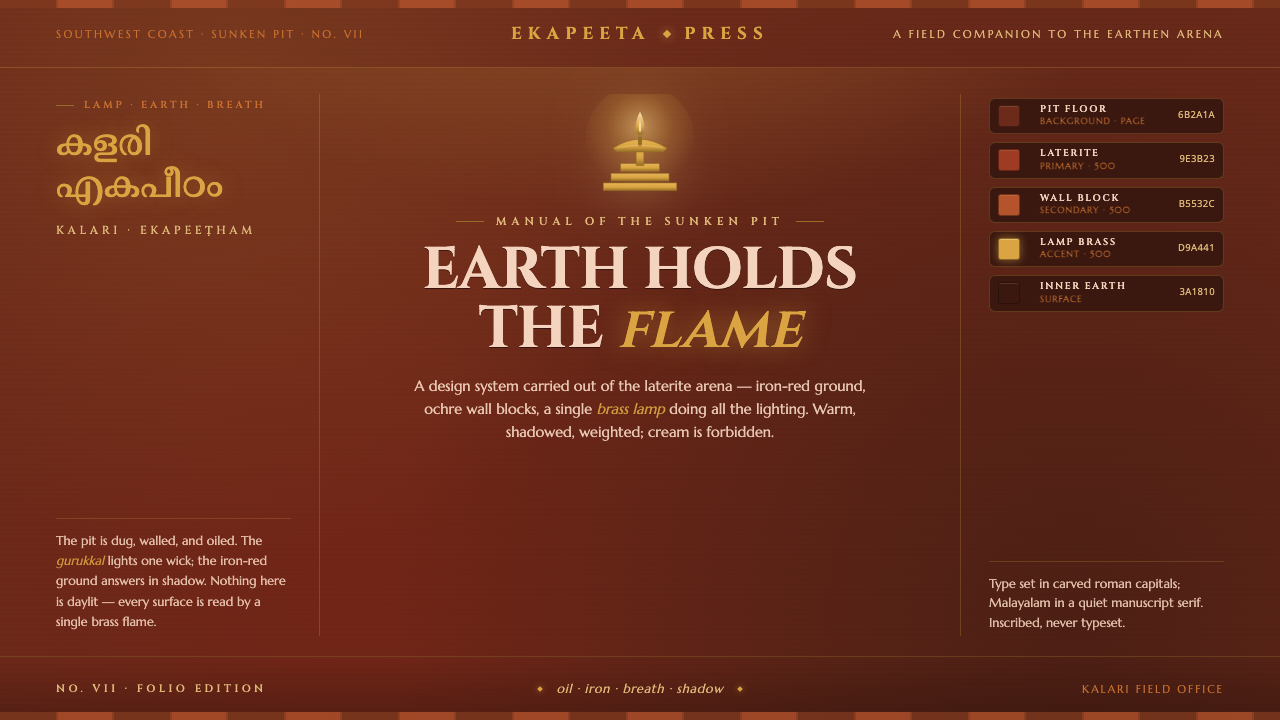 Kalaripayattu Kalari ArenaEarth holds the flame. Iron-red laterite, ochre wall blocks, a single brass l…
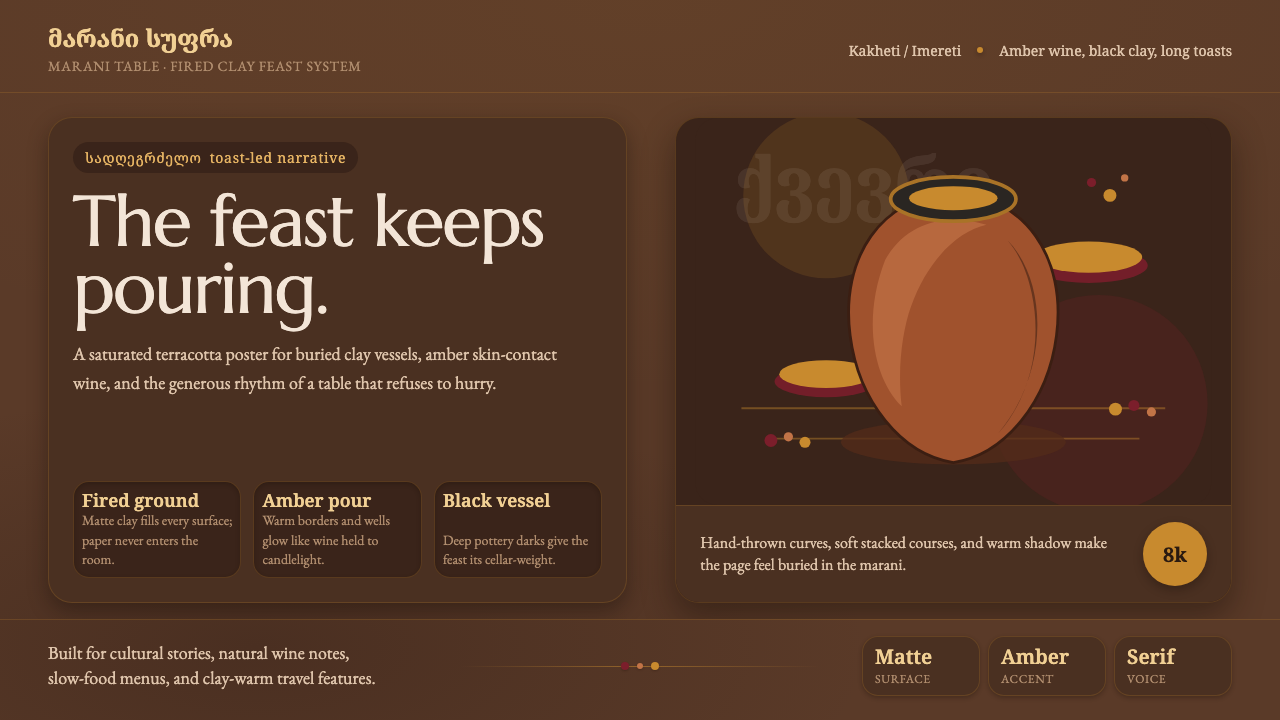 Georgian Qvevri Supra FeastHospitality made earthen. Terracotta ground, amber wine, Georgian serif curve…
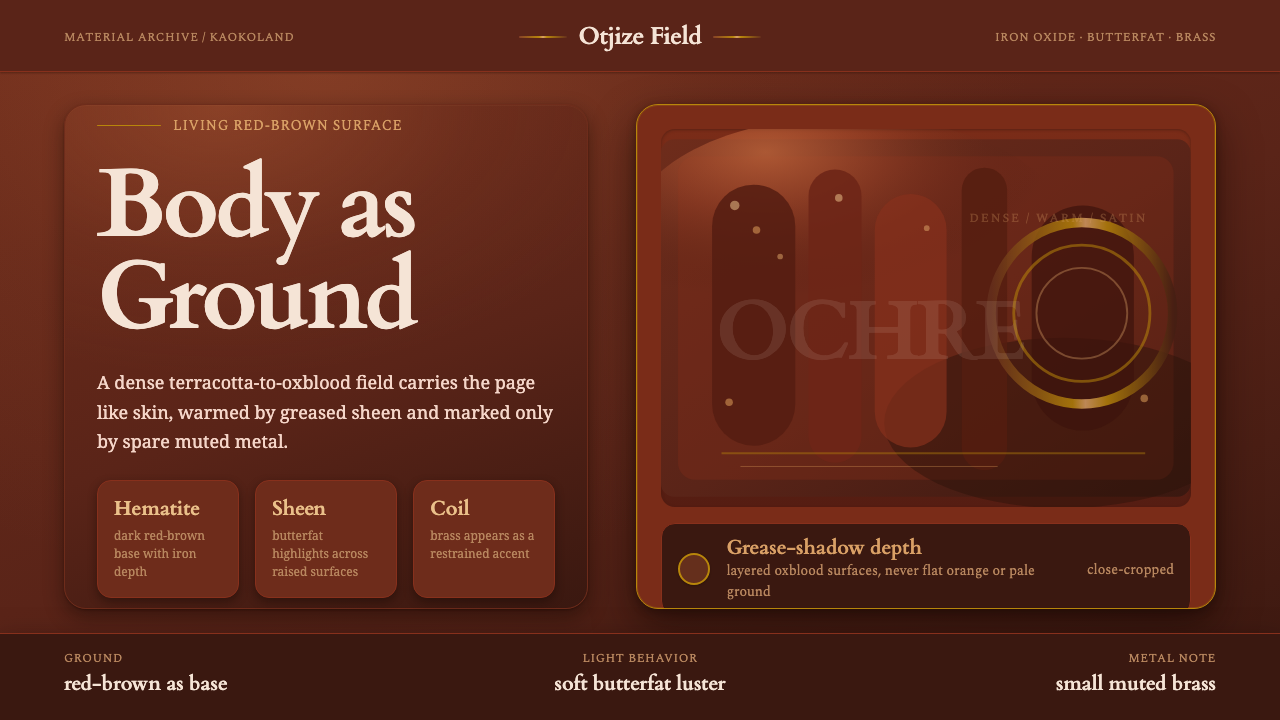 Himba Otjize Ochre NamibiaDense and ritual-warm. Oxblood ground, butterfat sheen, and sparse brass coil…
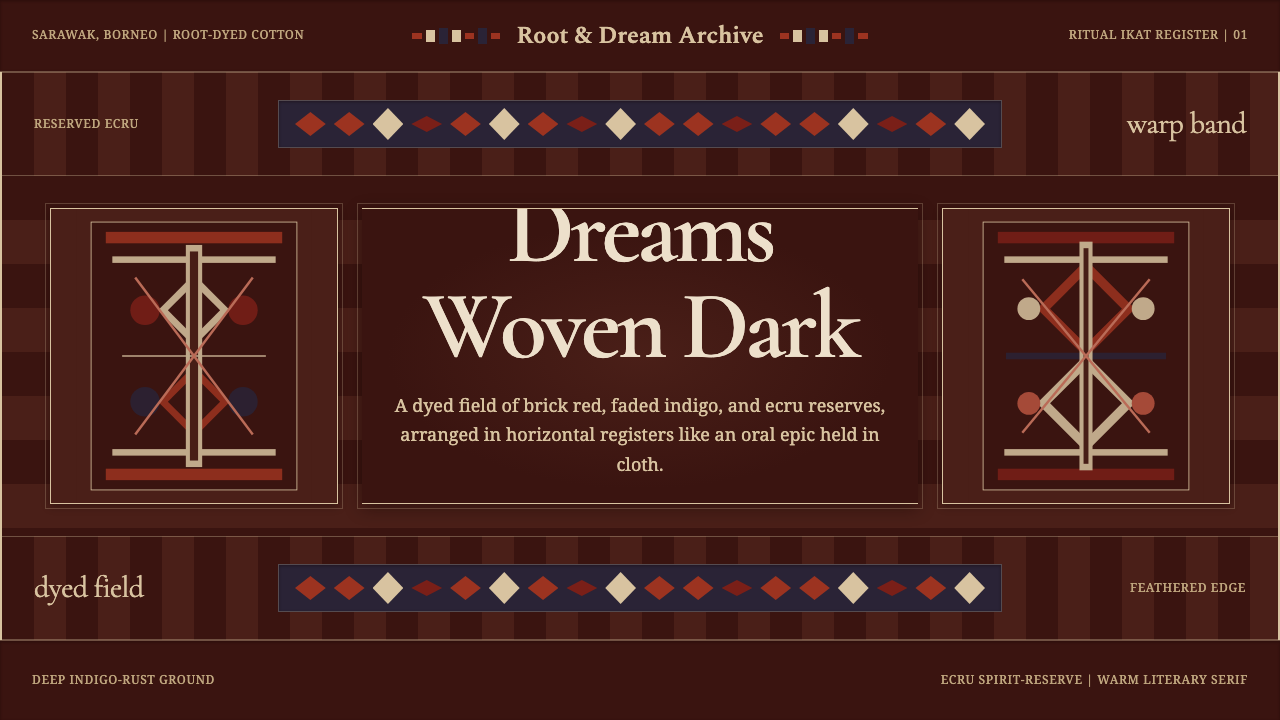 Iban Pua KumbuSacred cloth logic. Indigo-rust bands, ecru reserves, and blurred ikat edges…
 Maldivian Coir (Coconut Rope)Ocean-tested craft. Coir tan, coral cream, Cormorant type, and dashed seam ge…
 Moche Portrait VesselClay carries the likeness. Terracotta ground, red-brown slip, cream accents,…