What is Faroese Knit Pattern Island Grey?
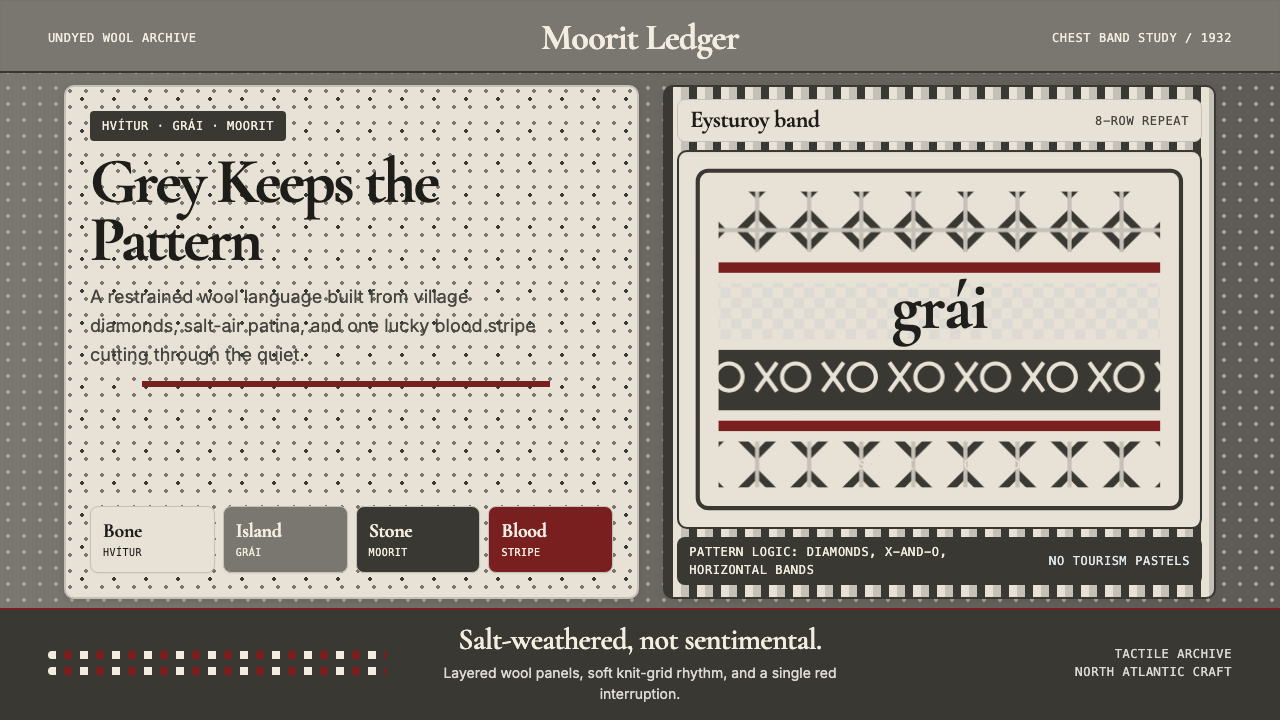
Woven from undyed island wool and centuries of Atlantic solitude, Faroese Knit Pattern Island Grey is a design language built on weathered restraint — where grey is not an absence of color but the full story of a landscape.
Faroese Knit Pattern Island Grey in brief
Faroese Knit Pattern Island Grey draws its visual identity from the stranded two-color knitting traditions of the Faroe Islands — eighteen windswept islands in the North Atlantic between Norway and Iceland. Its palette comes directly from the undyed fleece of the native Faroese sheep: natural greys running from pale ash-white through cool mid-grey to the deep brownish-grey islanders call moorit. Into this restrained field, a single thread of blood-red provides the sole saturated punctuation.
Unlike the warmth of Icelandic lopapeysa or the bright contrasts of Norwegian Selbu knitting, Faroese aesthetics resist cosiness. The visual register is tectonic: horizontal band compositions echo the archipelago's layered basalt cliffs; motif geometries — diamonds, crosses, X-and-O repeats — are named after specific islands, giving abstract pattern a geographic anchor. The texture implied throughout is that of wool fiber seen close: slightly irregular, gently napped, never glossy.
As a contemporary design system, Island Grey translates this craft heritage into interface and print while preserving its core: a near-monochrome grey palette with one deliberate accent, horizontally banded composition, motif-derived geometric ornament used sparingly, and tactile materiality that keeps the visual temperature cool without becoming clinical.
Where does Faroese Knit Pattern Island Grey come from?
Knitting in the Faroe Islands is documented from at least the seventeenth century, when woolen goods formed a significant part of the export economy under Danish administration. The Faroese sheep, descended from Norse settler stock, produces fleece naturally occurring in white, grey, and moorit — warm dark brown. Islanders learned that stranded knitting's drama came not from dye but from the counterpoint of two natural tones taken directly from the fleece.
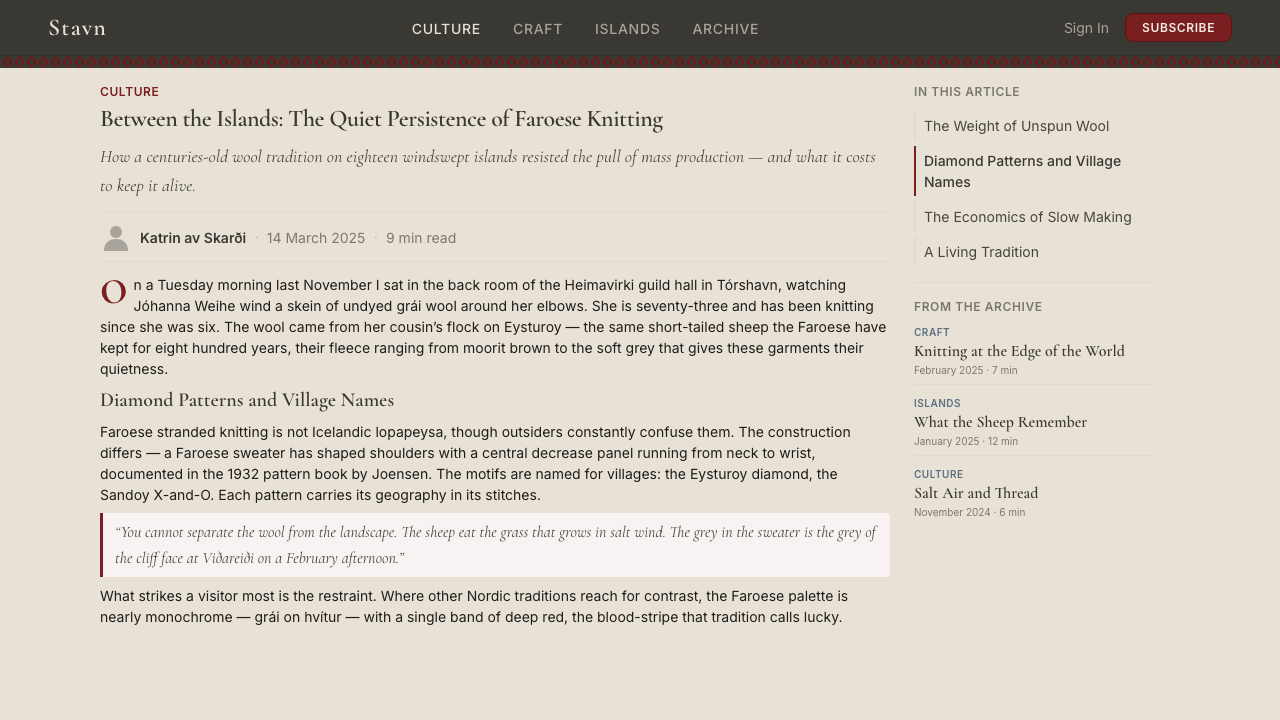
Faroese knit motifs carry geographic specificity unusual in Nordic textile traditions. The patterns are named after their communities of origin: the Eysturoy diamond, the Sandoy X-and-O, the broad geometric bands of Suðuroy. This place-naming suggests the motifs functioned as community identity markers — a village's pattern recognizable to anyone from the archipelago — and as geographic storytelling encoded in wool.
The critical moment of codification came in 1932, when Joensen published his systematic pattern book documenting the full vocabulary of Faroese knit motifs. By the 1930s, younger women were drawn toward imported textiles and traditional knitting faced the erosion sweeping Nordic cottage industries. Joensen fixed the motif names, the horizontal band system's logic, and color pairing conventions — establishing the canon from which all subsequent revival work drew.
A formal revival came with the 1998 founding of the Føroya Heimavirki guild, which produced updated pattern collections, established quality standards, and made the tradition legible internationally through craft tourism and export. Designers including Rógvadóttir, Ludvig, and Annika í Dáli then brought Faroese aesthetics into contemporary design and fashion, working the grey-on-grey palette and blood-red accent as deliberate artistic position — establishing the visual grammar that Island Grey translates into digital systems.
What defines the Faroese Knit Pattern Island Grey look?
Grey Palette as Full Language
The core palette spans the undyed natural range of Faroese fleece: near-white ash, cool mid-tone grey, and deep brownish-grey. These three tones carry all compositional weight without manufactured color. The palette reads as cool and elemental — close to basalt, cloud, and salt-bleached stone. Each grey carries a distinct warmth or coolness, functioning as a purposeful choice rather than a neutral default.
The Single Blood-Red Accent
Traditional Faroese knitting incorporates one stripe of deep saturated red — associated with good fortune and protection — into an otherwise grey composition. The design system makes this a structural rule: one saturated accent only, appearing as a horizontal band, a border, or a single typographic emphasis. When used correctly, the red carries extraordinary visual weight precisely because everything around it is grey.
Horizontal Band Composition
A traditional Faroese sweater is built from horizontal registers — bands of pattern from hem to shoulder, each self-contained while the whole creates a top-to-bottom reading sequence. The design system preserves this logic: layouts organize into full-width horizontal bands with distinct visual densities, guiding the eye in a sweep rather than a centripetal focus. This banding works naturally in long-form content, landing pages, and print.
Island-Named Geometric Motifs
The ornamental vocabulary derives from motifs named after specific Faroese islands: the Eysturoy diamond, the Sandoy X-and-O, the broad bands of Suðuroy. Built from knitting's binary logic — every stitch either foreground or background — these are small, repeating geometric units. In the design system they are micro-ornaments: a diamond band as divider, an X-and-O grid as background texture, a border framing a content block. Always small in scale, always contained within a band.
Tactile Materiality
A persistent quality in Island Grey is the suggestion of physical texture without literal simulation. Cool palette and rough natural origins evoke handled wool without skeuomorphic illustration or texture overlays. Layering slightly different greys creates a surface that reads as having depth — the way hand-knit fabric has depth not from shadow but from fiber variation. Tactile implication, not texture mimicry.
Craft Austerity Over Decoration
Faroese knitting developed under material scarcity: wool was plentiful, dye was imported luxury, pattern complexity bounded by two-color technique. The aesthetic severity of Island Grey is the direct residue of these constraints, not an artistic choice imposed from outside. Every element earns its presence; nothing was included by habit. When ornament appears it is structural — a band motif that marks a transition, a border that frames a reading area.
Typographic Coldness and Weight
The typographic register is anchored in deliberate weight and sobriety — letterforms that feel close to cut stone or stamped metal, with visible substance and no decorative curvature. Type sits at strong contrast against grey grounds; hierarchy is established through scale and weight, not color. The blood-red may mark one typographic element per composition — a date, a chapter number, a byline — never more. The effect is that of a formal inscription rather than a friendly label.
Who shaped Faroese Knit Pattern Island Grey?
Joensen's 1932 pattern book gave Faroese knit traditions a fixed canonical form. Documenting motif names, band structures, and color pairing conventions at the moment the practice was declining under industrial pressure, he created the reference grammar all subsequent revival work would measure itself against. Without it, the geographic specificity of the motifs might have dissolved into a generalized style with no community roots.
A central figure in the post-1998 revival, Rógvadóttir brought traditional knit patterns into contemporary clothing and design without smoothing away their geographic specificity. Her insistence on precise provenance — Eysturoy patterns as Eysturoy patterns, not generic Nordic geometry — established the principle that Island Grey authenticity requires naming each motif's source community.
Working at the intersection of craft practice and commercial legibility, Ludvig translated the traditional grey-and-red palette into products that reached international markets without losing their North Atlantic character. Her approach treated the blood-red as a signature of island identity that communicated instantly to insiders and read as striking austerity to everyone else.
Annika í Dáli brought Faroese aesthetics most directly into contemporary design thinking, working the visual grammar as a system rather than nostalgic motifs. Her practice explored how horizontal banding, the undyed palette, and geographic motif coding could transfer to print, identity work, and digital interfaces without losing the austere North Atlantic sensibility that separates the tradition from more decorative Nordic styles.
Founded in 1998, the Føroya Heimavirki is a collective institution whose documentation, standardization, and promotion created the conditions for Island Grey to function as a coherent, exportable design tradition. Its most important contribution was establishing provenance standards — insisting that a motif named after Sandoy must trace to Sandoy practice, not merely resemble it. That institutional care for provenance is central to Island Grey's gravity as a design reference.
How do you use Faroese Knit Pattern Island Grey today?
Applying Island Grey well means building with the same constraints that shaped the original craft — limited palette, horizontal structure, no decoration without purpose. The result is a design language that reads as grounded, serious, and materially honest, suited to contexts where craft heritage, premium provenance, or austere authority are desired values.
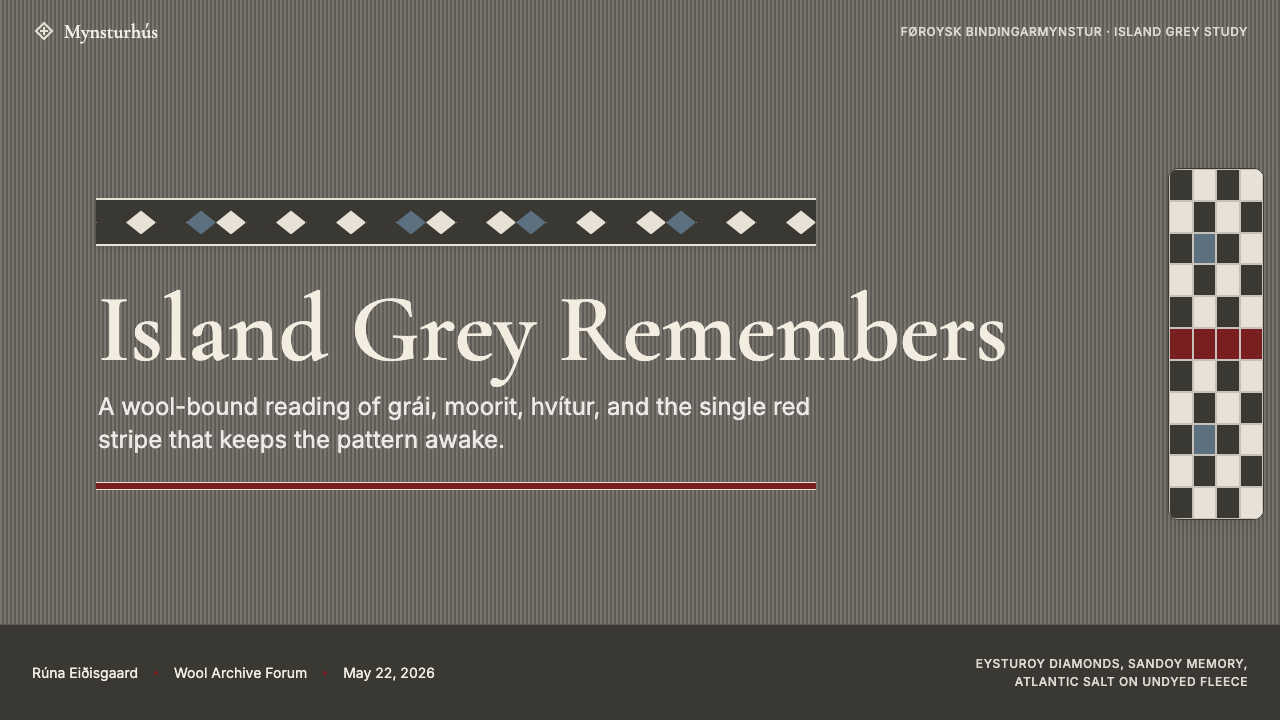
For presentation slides, Island Grey suits contexts where content authority is the priority. A cover benefits from full-width horizontal banding: near-white ash ground carrying heavy-type title, a deeper grey band separating a subtitle zone, and the blood-red marking a single detail — a date, a brand mark, a section label. Content slides work as registers with each information block in a defined horizontal zone. Data slides take on a diagrammatic quality, with charts as geometric objects against grey ground and the red reserved for the single most important data point.
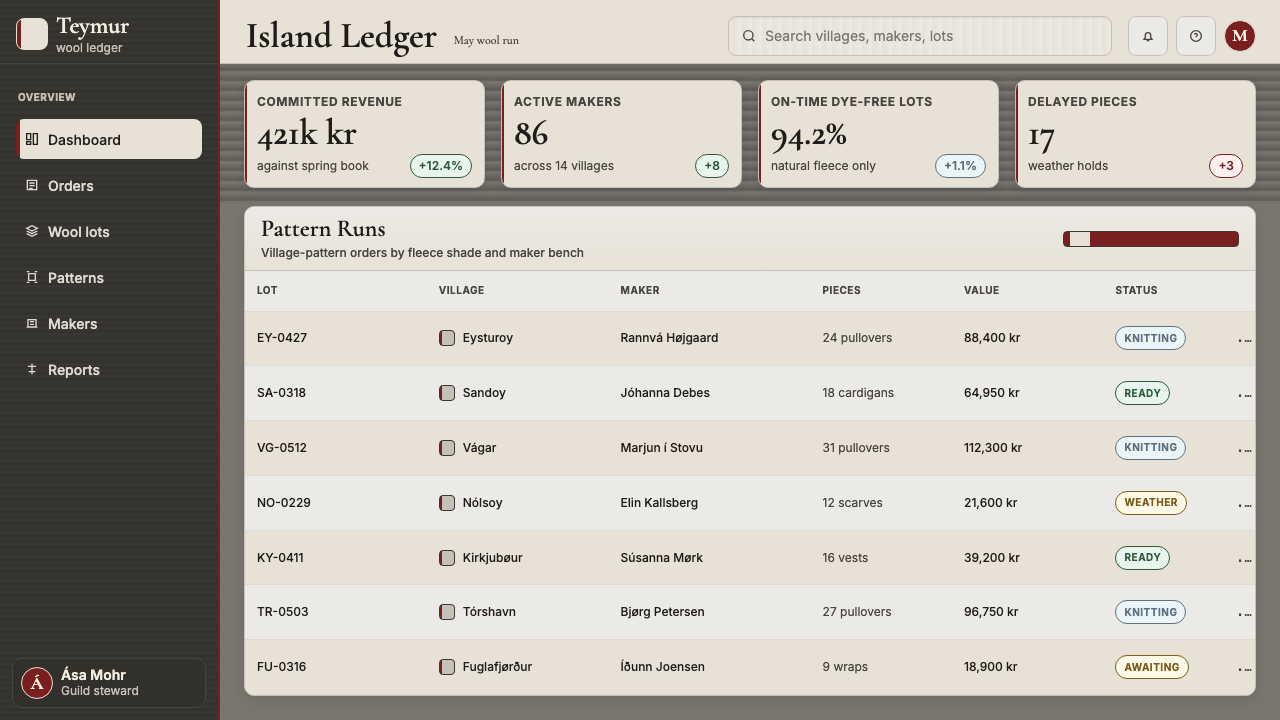
For web interfaces, the system suits editorial platforms, craft commerce, and brands where premium materiality and Northern European restraint are core to the proposition. Navigation should be typographically weighted — wordmarks and clean labels, no icon clutter. Card components work best with a subtle grey differential between card and page rather than shadow or border; the single red marks interactive states or editorial highlights. Avoid introducing a second accent color: the logic depends entirely on the blood-red being singular.
For editorial and marketing work, Island Grey carries authority for heritage brands, craft goods, and any brand positioned around authenticity rather than novelty. The horizontal banding logic suits long-form layouts: body text in a clear register, pull quotes in a narrower parallel band, section breaks marked by a thin rule. Marketing pages work with alternating light-grey and dark-grey sections, each a horizontal band with its own tonal ground — the red accent appearing once per page as a call to action.
The most common mistake is softening the grey palette toward warmer beiges or off-whites — the mineral coldness is essential; losing it loses the North Atlantic edge that separates Island Grey from generic Scandinavian minimalism. A second error is using geometric motifs at large scale; they are micro-ornaments by origin and must remain so. Third, introducing any second accent color destroys the central tension: the drama depends entirely on a single saturated interruption in a field of structural grey.
Faroese Knit Pattern Island Grey — FAQ
How is Island Grey different from other Nordic design traditions like Scandinavian minimalism or Norwegian folk craft?
Partly geographic, partly temperamental. Scandinavian minimalism tends toward warm neutrals, rounded forms, and domestic friendliness. Norwegian Selbu knitting uses a broader palette — strong blues and greens — and is more celebratory. Island Grey is more severe: its palette comes directly from undyed wool with no warmth added, the motifs are geographically coded to specific island communities rather than generalized, and the blood-red accent is a single deliberate interruption rather than part of a colorful language. Island Grey is North Atlantic, not Nordic-tourist-friendly.
Can Island Grey work in a dark or inverted layout?
It can, with care. The traditional palette puts lighter ash-white as background with moorit as foreground; an inversion reverses this, placing deep brownish-grey as ground and lighter tones as type. This works because Faroese wool's natural range includes very dark tones without becoming pure black. The blood-red accent grows more powerful on a dark ground and must be used even more sparingly — a single rule, a single label. The main risk is losing the textile depth of grey layering; tonal relationships need recalibration so the surface reads as having material weight rather than as flat near-black.
Is the single red accent always required, or can Island Grey work as a purely greyscale system?
A purely grey version is possible — particularly in formal or institutional applications where any saturated color would feel intrusive. But the blood-red is not merely decorative; it carries symbolic weight tied to island folk tradition and functions structurally as the palette's single point of human warmth. Removing it produces a colder, more austere system that is also less distinctively Faroese, at risk of dissolving into generic neutral minimalism. If red is omitted, something else must carry its weight: a tonal shift, a textural change, or a compositional asymmetry that signals deliberateness.
Why does Island Grey use geographically named motifs rather than generic geometric patterns?
Because the naming is part of the meaning. In Faroese knit tradition, a pattern named after Eysturoy is not just a diamond — it is a marker of origin and community identity. Using geographic names in a design context carries this forward: the patterns come from somewhere specific and are not generic Nordic geometry. A designer who knows that the X-and-O repeat is specifically Sandoy, not a generalized Faroese pattern, is using the system with the same care for provenance the original weavers exercised.
What kinds of products or brands should avoid Island Grey?
Island Grey is poorly suited to contexts where warmth, visual excitement, or broad approachability are primary values. Food and beverage brands targeting pleasure rather than craft provenance will find the palette too cold to evoke appetite. Children's products and educational platforms need color range the single-accent system cannot provide. Fashion and lifestyle brands that depend on trend responsiveness will find Island Grey too static. Its strongest suit is premium craft goods, Northern European or Atlantic heritage brands, and platforms whose authority rests on seriousness and longevity rather than novelty.
Related design styles
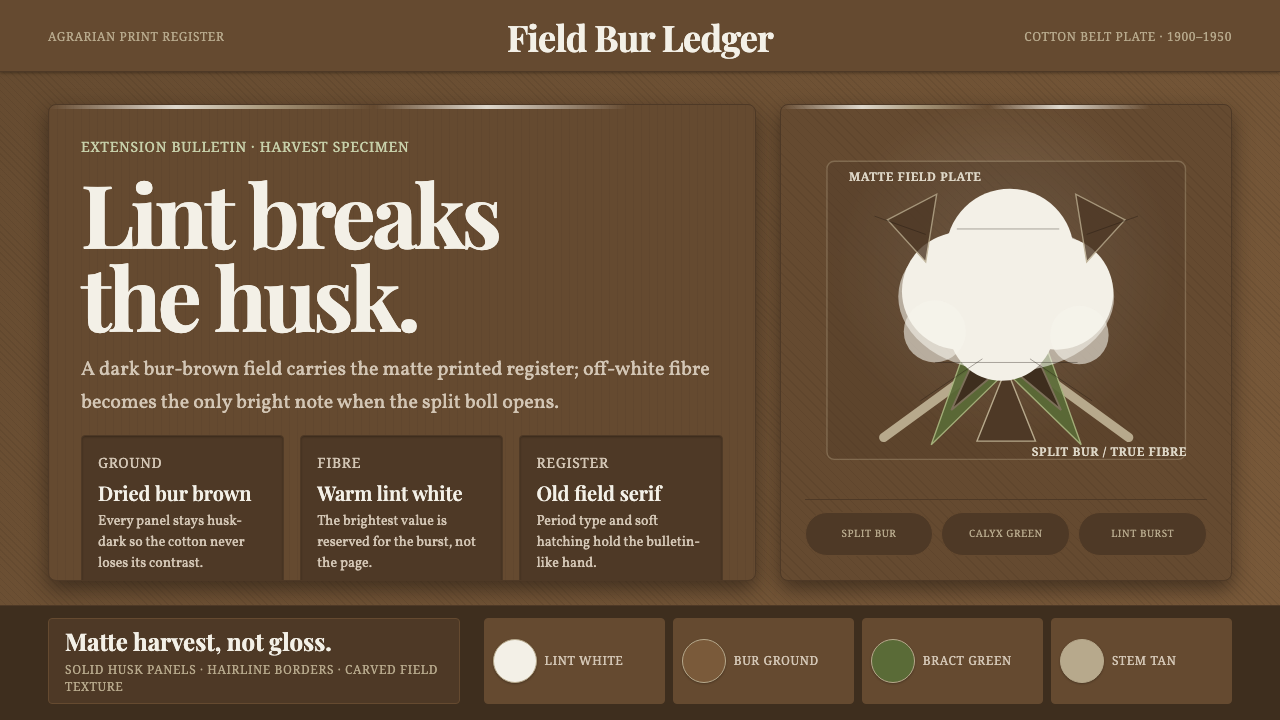 Cotton Boll HarvestHarvest contrast made matte. Off-white lint bursts from husk brown with field…
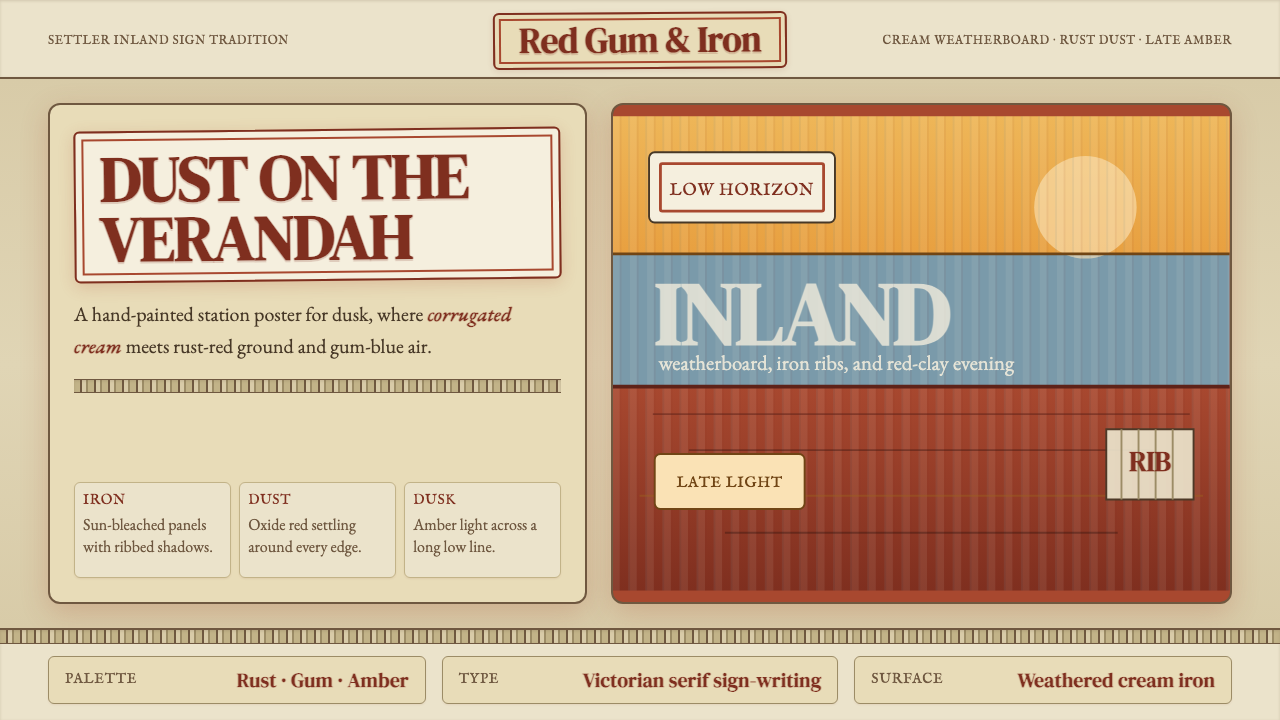 Australian Outback VernacularWeather is the voice. Rust dust, gum-blue bands, and serif sign-writing age t…
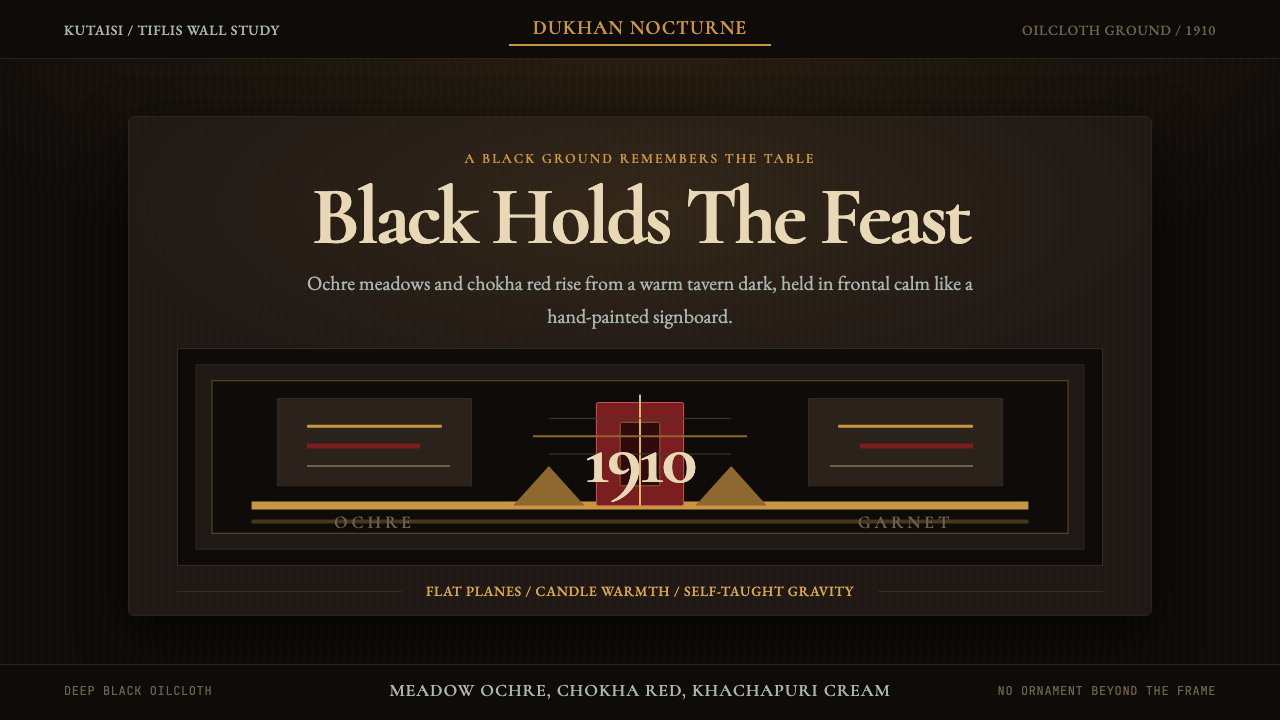 Georgian Pirosmani 1910Oilcloth black turns memory ceremonial. Ochre panels and Cormorant type hold…
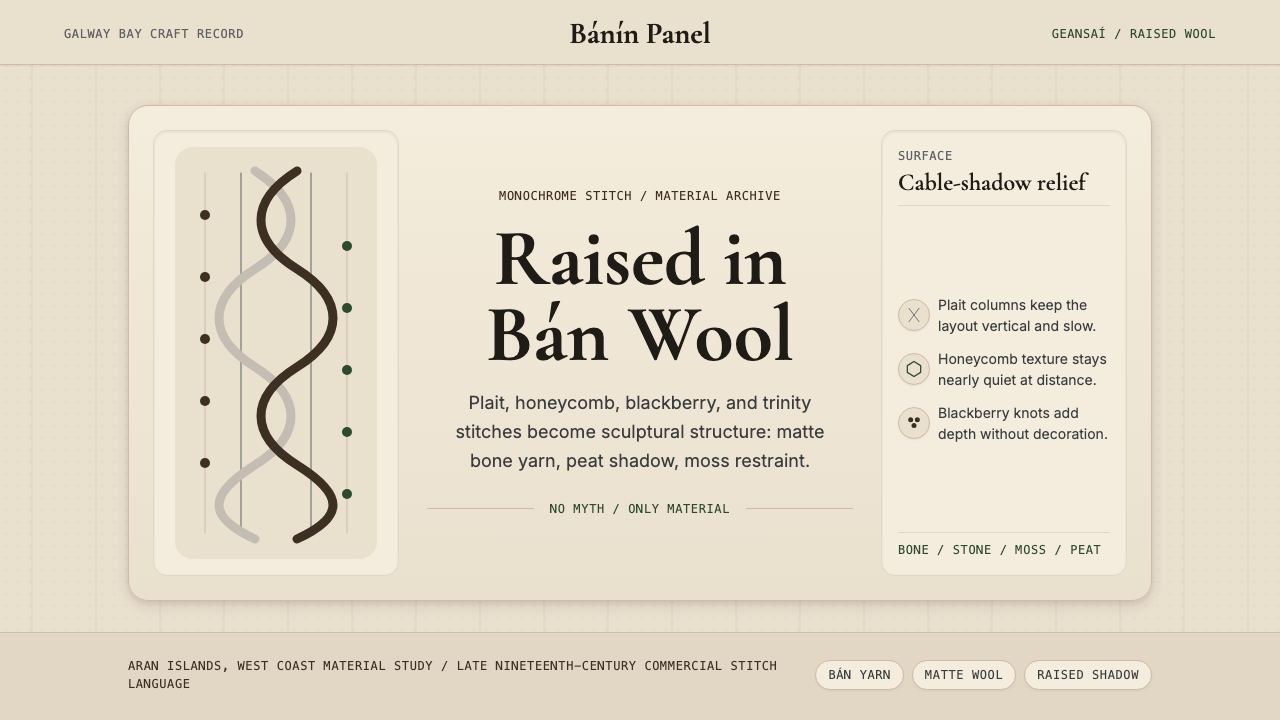 Irish Aran Island Cable KnitMaterial honesty raised in wool. Bone ground, moss ink, and cable columns cas…
 Jordanian Bedouin Black TentNight camp honesty. Goat-hair black, sadu crimson, brass lines.
 Knossos Minoan FrescoColour becomes wall. Six mineral fields meet swift contours and honest fragme…