What is Bulgarian Rose Attar (Valley of Roses)?
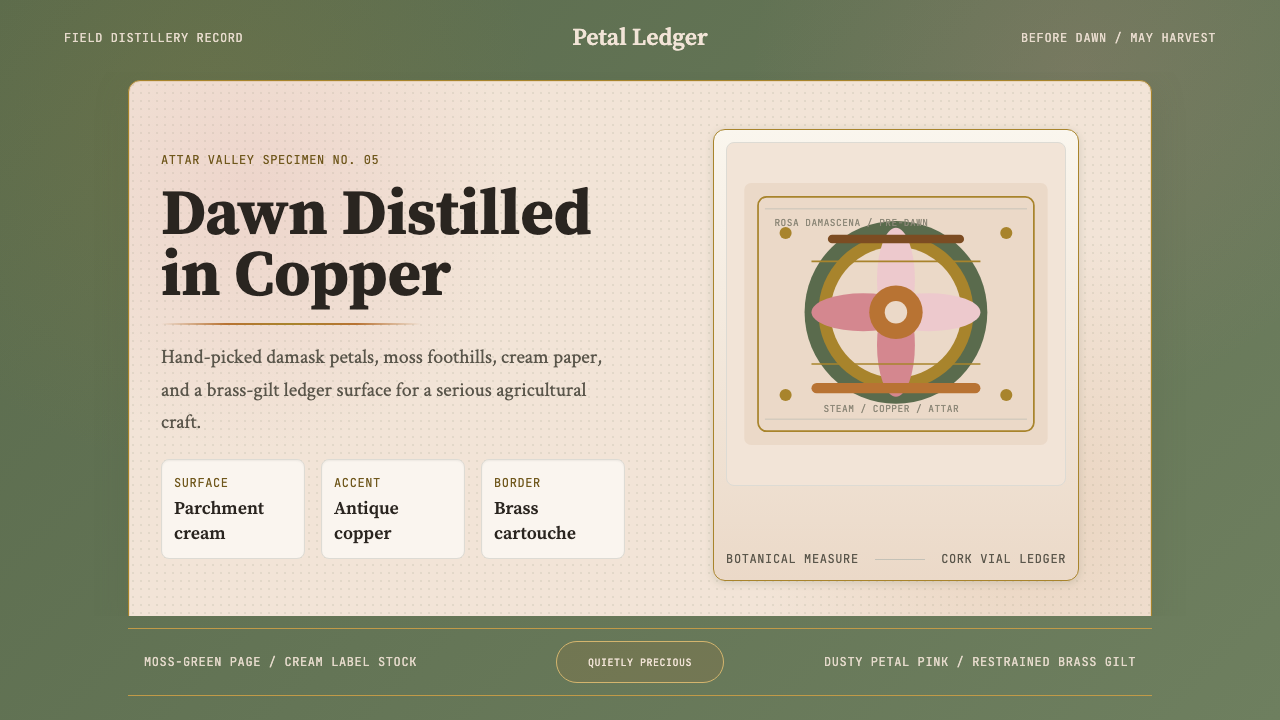
Where copper alembics have distilled the world's finest rose oil since the seventeenth century, an entire design language was born from the dawn harvest — dusty petal-pink, deep moss-green, warm brass, and the gravity of craft that treats every drop as precious.
Bulgarian Rose Attar (Valley of Roses) in brief
Bulgarian Rose Attar (Valley of Roses) is a design system rooted in the agricultural craft heritage of Bulgaria's Rozova Dolina — the Valley of Roses — where Rosa damascena has been cultivated and distilled continuously since the Ottoman era. The visual language translates this living tradition into screen-native form: warm parchment grounds, dusty rose and moss-green tones drawn from petal and foliage, antique copper highlights, and brass-gilded borders that recall the apothecary's careful hand.
The aesthetic is deliberately not glamorous in a commercial perfumery sense. It belongs instead to the world of the specimen plate, the distillery ledger, and the herbalist's cabinet — serious, warm, and quietly precious. Cards frame content as though mounting a botanical sample for archival examination. Surfaces carry the grain of aged paper. Every ornamental accent is restrained, echoing the brass weights and copper vessels of a working laboratory rather than the gloss of a luxury boutique.
What makes this system distinctive is the tension it holds between organic warmth and rigorous documentation. It is a craft tradition that is also a science — rose attar production involves precise harvest timing, controlled distillation temperatures, and careful measurement — and the design language carries both registers. Decorative warmth and documentary precision coexist without contradiction.
See the Bulgarian Rose Attar (Valley of Roses) design system
Where does Bulgarian Rose Attar (Valley of Roses) come from?
The Valley of Roses — Rozova Dolina — stretches between the Balkan Mountains (Stara Planina) and the Sredna Gora range, centered on the towns of Kazanlak and Karlovo. The Damascus rose, Rosa damascena, was introduced to this region during the Ottoman period, likely in the seventeenth century, brought along trade routes from the rose-growing gardens of Persia and the Near East. The valley's particular microclimate — cool nights, morning fog held in the mountain basin, mineral-rich soil — proved ideal for concentrating the floral compounds that make attar so rare and costly.
Distillation technology arrived alongside the rose. Early production used simple copper alembics, the standard still of Ottoman-era apothecaries across the empire, producing a small quantity of essential oil floating atop a much larger volume of rose water. As demand grew through the eighteenth and nineteenth centuries, Kazanlak developed into a specialist center: family-owned distilleries, cooperative processing houses, and eventually a guild-like culture of attar producers who jealously guarded their methods. The production peak came in the late nineteenth and early twentieth centuries, when Bulgarian attar supplied perfumers in Grasse, Paris, and London with a material that was genuinely irreplaceable.
Key figures in the tradition include Dobri Papazov and Iliya Vapchev, early industrial-era producers who systematized the distillation process and established quality standards that smaller cooperatives then adopted. The Khan Krum cooperative, founded in the region, represented the collective farming model that dominated Bulgarian rose production during the socialist era (1944–1989). The Kazanlak Rose Festival, held annually since 1903, crystallizes the cultural weight of the tradition: a public celebration that draws tourists from across the world while remaining, at its core, a working farmer's ritual — the crowning of a rose queen, the reenactment of the harvest, the sharing of rose-petal jam and rose-scented brandy.
The collapse of the socialist agricultural system in the early 1990s dealt severe disruption to the industry, as collective farms dissolved and the distribution infrastructure for Bulgarian attar fractured. A revival began in the 2000s and accelerated through the 2010s, led partly by the Bulgarian Rose Producers Association and partly by the global market's renewed appetite for natural, traceable ingredients — driven by the clean-beauty movement and the premiumization of natural perfumery. Today, Bulgarian attar is once again a prestige raw material, with certified-origin product commanding prices comparable to precious metals, and a new generation of distillers documenting their methods with the transparency that contemporary buyers expect. It is this revival — heritage craft meeting modern accountability — that gives the design system its particular combination of aged warmth and documentary seriousness.
What defines the Bulgarian Rose Attar (Valley of Roses) look?
Palette
The color palette derives directly from the valley landscape and distillery materials. The dominant ground tone is a warm parchment — the color of aged linen or unbleached paper — against which two signature hues operate: dusty rose, pulled from the half-opened Rosa damascena petal at early morning, and deep moss-green, drawn from the Stara Planina foothills visible from the valley floor. Antique copper and restrained brass function as accent metals, appearing in borders, dividers, and highlight elements. The overall register is muted and warm rather than saturated and bright — as though everything has been touched by morning mist and years of gentle use.
Surface and Texture
Surfaces throughout the system carry a subtle parchment or grain quality — the visual memory of aged paper, woven linen, and worn copper. This is not skeuomorphic decoration imposed on top of content; rather, it is an undertone that warmth the foundation without overwhelming the material placed on it. Cards feel archival rather than sterile, as though they belong in a naturalist's cabinet alongside preserved specimens. The texture is always subordinate to the content, present but never insistent.
Borders and Framing
Borders are a structural signature of the system, used with a confidence that is unusual in contemporary screen design. Brass-tinted or copper-toned rules frame cards, section headers, and decorative panels in the manner of apothecary labels and specimen plates. The borders are not mere outlines — they signal that content inside has been carefully contained and presented, worth the viewer's deliberate attention. Thin inner borders create matting effects that recall botanical illustration framing, adding visual depth without dimensional illusion.
Typography Register
Typographic choices favor serif letterforms with classical proportions — forms that carry the authority of printed botanical texts and historical scientific documentation. Headings adopt a restrained elegance, neither heavy-industrial nor delicately ornamental, sitting somewhere between a nineteenth-century field guide and a contemporary artisan label. Body text is set with generous line spacing and moderate measure, emphasizing readability and the sense that each word has been placed with care. Labels, metadata, and classification tags use refined small capitals or spaced letterspacing to evoke the precision of scientific nomenclature.
Ornamental Restraint
The system is not minimalist in the contemporary sense, yet its ornamentation is carefully rationed. Botanical-derived motifs — a simplified rose hip, a leaf outline, a distillation coil suggested in a border corner — appear sparingly, as details rather than dominant visual elements. They function as signatures of origin, reminding the viewer of the agricultural and alchemical roots of the tradition, without overloading the composition with decorative noise. Every ornamental element earns its presence by adding meaning, not merely visual richness.
Light and Warmth
Light in this system is soft and directional, evoking the diffused morning light of a mountain valley at harvest time rather than the crisp overhead illumination of a laboratory or studio. Shadows, when present, are warm-toned and gentle — neither the hard geometric shadows of Bauhaus-derived systems nor the complete flatness of contemporary utility design. This warmth is structural, distinguishing primary content zones from secondary metadata and contextual information, but it is always expressive of a particular time of day and a particular place: pre-dawn Kazanlak, copper vessels beginning to warm, petals releasing their fragrance into cool air.
Documentary Precision
Beneath the warmth and ornamental detail runs a counter-register of documentary precision inherited from the scientist's notebook and the apothecary's record book. Data tables, measurement records, and provenance information are rendered with clear grid alignment, consistent typographic hierarchy, and purposeful whitespace. This precision prevents the system from becoming merely nostalgic or decorative — it insists that the warmth of the palette is always in service of content that rewards careful attention. The interplay between the organic and the systematic is the system's defining quality.

See the Bulgarian Rose Attar (Valley of Roses) design system
Who shaped Bulgarian Rose Attar (Valley of Roses)?
One of the pioneering industrial-era rose attar producers in the Kazanlak region, Papazov helped systematize distillation practices that had previously varied widely between family operations. By establishing more consistent processing standards, he contributed to the regionalization of quality that allowed Bulgarian attar to compete as a premium international raw material. His work represents the transition from purely artisanal production to a craft industry that could operate at scale without sacrificing the essential character of the product.
Vapchev was central to the development of cooperative production models in the Valley of Roses during the late nineteenth and early twentieth centuries. Recognizing that the capital requirements for copper distillation equipment and the logistics of fresh-petal processing made purely individual production fragile, he worked to build shared infrastructure and collective quality standards. The cooperative traditions he helped establish became the structural template for how Bulgarian rose production was organized through much of the twentieth century.
The Khan Krum cooperative — named after the ninth-century Bulgarian ruler — embodied the collectivized phase of rose attar production under Bulgaria's socialist government. At its peak, cooperatives of this type pooled land, labor, and distillation infrastructure across entire villages, enabling a volume and consistency of production that supplied the global fragrance industry for decades. The cooperative model also shaped the visual culture of the industry: documentation, labeling, and quality certification became formalized during this period, contributing to the documentary aesthetic that the design system carries.
The annual Rose Festival in Kazanlak is among the oldest continuously-held agricultural festivals in southeastern Europe, established in 1903 as a formal celebration of the harvest and the trade that had made the valley prosperous. It combines the ritual elements of an agrarian folk ceremony — the crowning of a rose queen, the reenactment of the picking at dawn, the public distillation demonstration — with the civic functions of an industry showcase. The festival has shaped how the valley presents itself visually to the outside world, creating a public vocabulary of imagery: petal-strewn processions, copper vessels steaming in morning light, traditional embroidered garments, and the particular combination of natural abundance and artisanal care that the design system distills.
Established to protect and promote the interests of domestic attar producers following the post-socialist restructuring of the 1990s, the Bulgarian Rose Producers Association has played a central role in the contemporary revival of the industry. It lobbied for protected geographical indication status, established traceability standards that allow buyers to verify the origin of specific batches, and worked to position Bulgarian attar as a premium certified-origin product in an international market increasingly aware of authenticity and provenance. The association's emphasis on documentation, certification, and the communication of craft heritage is directly reflected in the design system's documentary and archival aesthetic register.
How do you use Bulgarian Rose Attar (Valley of Roses) today?
Bulgarian Rose Attar is among the most contextually specific design systems in the Curio library — it carries a strong cultural and sensory signature that rewards deliberate application. Using it correctly means understanding the values it embodies: agricultural craft, careful documentation, the coexistence of organic warmth and systematic precision. Applied to content that shares these values, the system feels inevitable. Applied to content that does not, it reads as affectation.
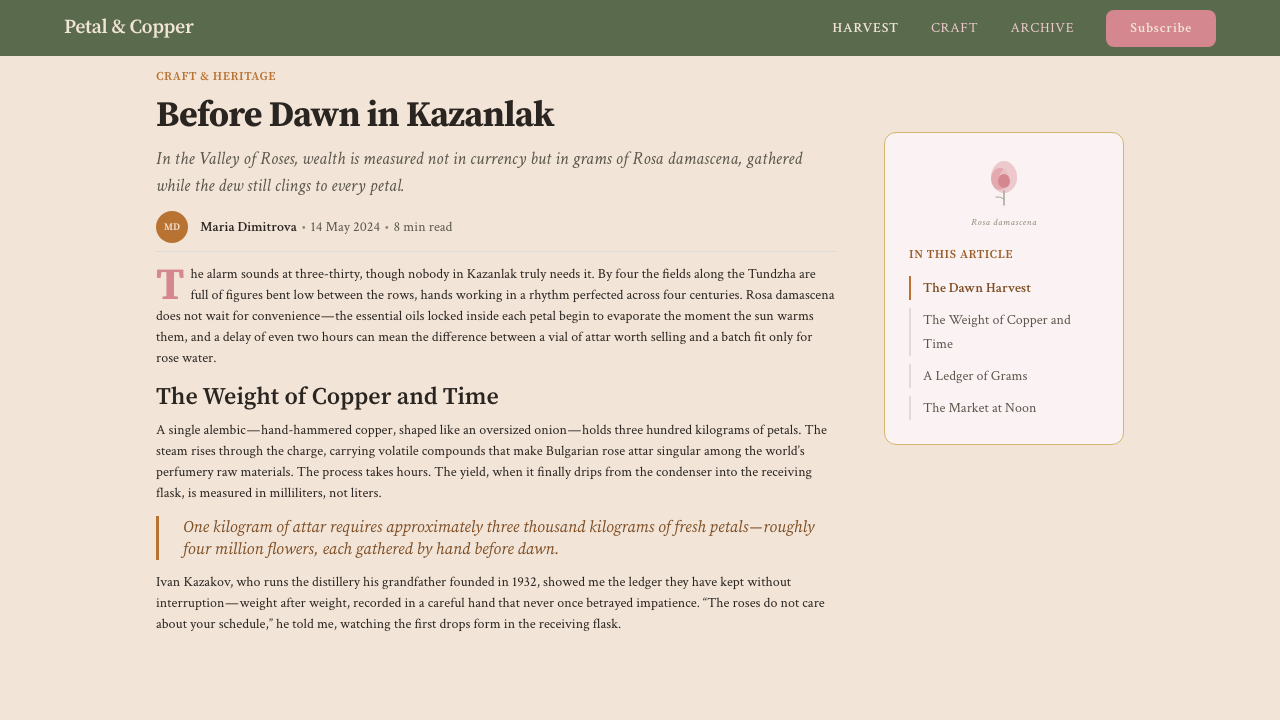
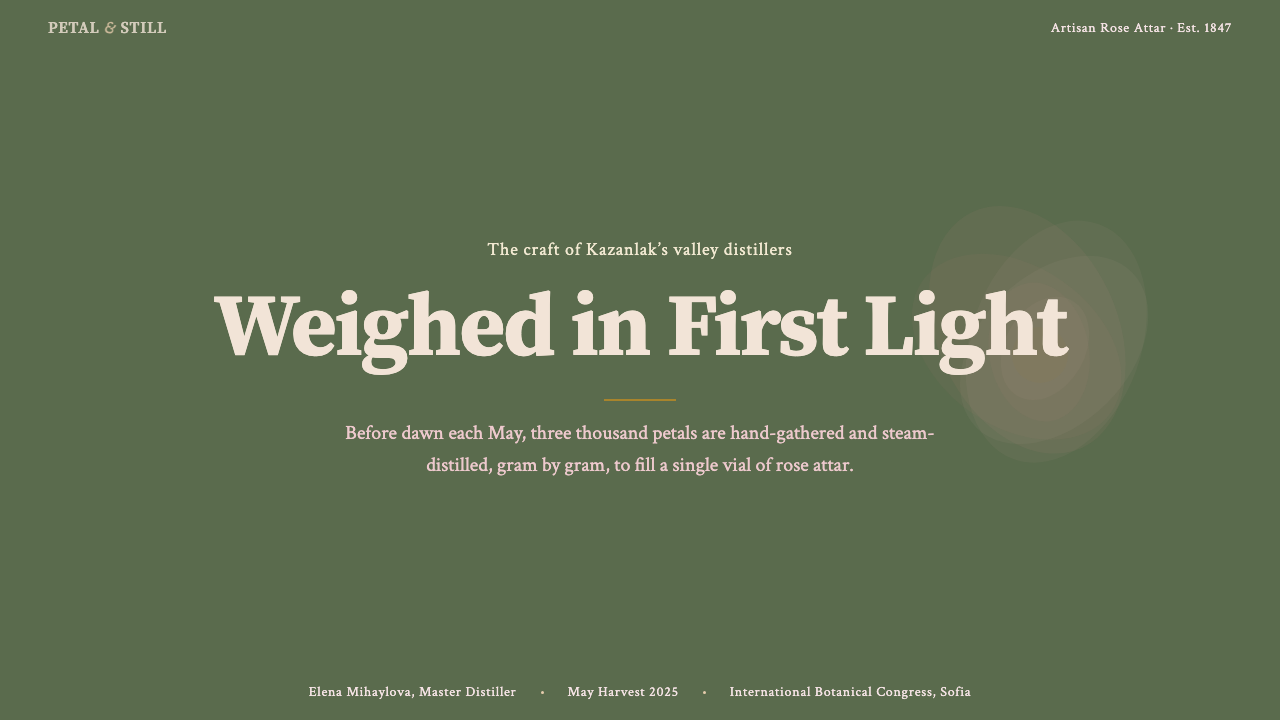
For presentation slides, the system suits cover and context-setting pages exceptionally well. A cover built in this language uses the warm parchment ground, a copper-toned or brass-tinted border framing the title area, and a single motif — a simplified botanical element or a distillery silhouette — positioned as a quiet accent rather than a dominant visual. Content slides benefit from the system's documentary register: generous margins, clear typographic hierarchy with classical serif proportions, and restrained use of the dusty-rose or moss-green tones to distinguish primary content from supplementary annotation. Data slides should treat charts as specimen plates — clearly labeled, bordered, and set against the parchment ground with no superfluous decoration.
For web interfaces, the system is best suited to contexts where craft provenance, natural ingredients, heritage products, or artisanal production are central themes. A product page for a luxury food, beverage, or personal-care brand; a marketplace for certified-origin materials; a cultural heritage organization's archive — these are natural homes for the visual language. In interface terms, this means: warm ground tones rather than clinical white, brass-accented interactive elements rather than flat neutral states, serif headings rather than geometric sans, and card components framed with thin warm-toned borders rather than hard shadows or borderless floating.
For editorial and marketing work, the system supports long-form content that rewards patient reading. An editorial spread that uses the full palette — parchment ground, dusty rose pull-quotes framed with brass rules, moss-green section dividers, antique copper drop initials — creates an atmosphere of considered craft that primes the reader to invest attention. Marketing materials for heritage or origin-certified products benefit from the system's emphasis on documentation: including harvest dates, distillery names, geographic coordinates, or certification marks as typographic details adds authenticity without resorting to generic luxury clichés.
A common mistake when applying this system is over-saturating the palette — pushing the rose and green tones toward full commercial vibrancy rather than holding them at the muted, dusty register that gives the system its gravity. The dusty quality of the signature tones is not a limitation; it is the character. Similarly, introducing too many ornamental botanical motifs risks tipping the aesthetic from archival elegance into decorative nostalgia. The most effective applications use ornament sparingly, as punctuation, trusting the palette and framing structure to do the expressive work.
See the Bulgarian Rose Attar (Valley of Roses) design system
Bulgarian Rose Attar (Valley of Roses) — FAQ
How is this style different from general vintage or apothecary aesthetics?
Generic vintage and apothecary aesthetics tend to borrow surface elements — aged paper textures, serif type, botanical motifs — as decorative veneer without the underlying structural logic. Bulgarian Rose Attar is grounded in a specific, historically documented agricultural and artisanal tradition with its own material culture, production environment, and documentary habits. The design choices in this system are motivated by that specificity: the copper and brass accents refer to actual distillation equipment, the moss-green connects to the actual landscape, the documentary precision reflects the actual record-keeping culture of certified-origin attar production. Surface-level vintage aesthetics feel nostalgic in a generic way; this system aims for the gravitas of a living craft tradition.
Can this system work for digital-first products, or is it only suited to heritage brands?
The system can work well for digital-first products, but the fit depends on whether the product's values align with the system's expressive register. A digital marketplace for verified natural ingredients, a subscription service for artisan food products, a platform documenting traditional crafts or agricultural heritage, a wellness application emphasizing natural provenance — these are digital-first contexts where the Bulgarian Rose Attar visual language feels motivated rather than imposed. The key is that the warmth and documentary quality of the system should reflect something true about the product's own relationship to craft, origin, and care. Using it purely as a visual style, without that underlying alignment, tends to feel unconvincing.
How should this style handle product photography or imagery?
Imagery in this system works best when it has the quality of documentation — botanical illustration, archival photography, still-life arrangement with natural light — rather than high-gloss commercial photography. Photographs should be warm-toned and diffuse-lit rather than crisp and studio-white. Still-life compositions featuring raw materials, tools, vessels, or landscape elements communicate more authentically than polished product shots. When the subject is the product itself, staging it against parchment, linen, or worn wood grounds — materials that echo the system's palette — is more effective than floating it on pure white. Illustration, when used, should favor the linearity and precision of botanical or scientific drawing over decorative looseness.
Is it appropriate to use this style for dark-mode interfaces?
A dark variant of this system is possible but requires careful reinterpretation rather than simple inversion. The canonical palette is light-ground — warm parchment — and the system's warmth derives substantially from that luminous base. A dark version works best by shifting the ground to a very deep, warm-tinted near-black rather than a neutral dark gray or pure black. Against this deep warm ground, the dusty rose and moss-green tones retain their character without competing against each other. Brass and copper accents continue to function as structural highlights. The documentary typographic register should be preserved regardless of ground tone — the shift to dark mode should affect light levels, not the archival gravity of the system.
What distinguishes authentic use of this system from merely decorative pastiche?
Authentic use is motivated by content alignment — the design choices serve to communicate something true about the subject matter. Pastiche borrows the surface: warm tones, brass borders, serif type, botanical motifs, without the underlying logic that gives those choices meaning. The test is whether the documentary precision of the system is being deployed or merely dressed around. An authentic application treats data, provenance information, and classification details with the same care as decorative elements — integrating them into the visual hierarchy rather than marginalizing them as footnotes. The ornamental details should feel like they are earning their presence by adding contextual meaning; if they feel like decoration applied to make something look artisanal, the application has slipped into pastiche.
Related design styles
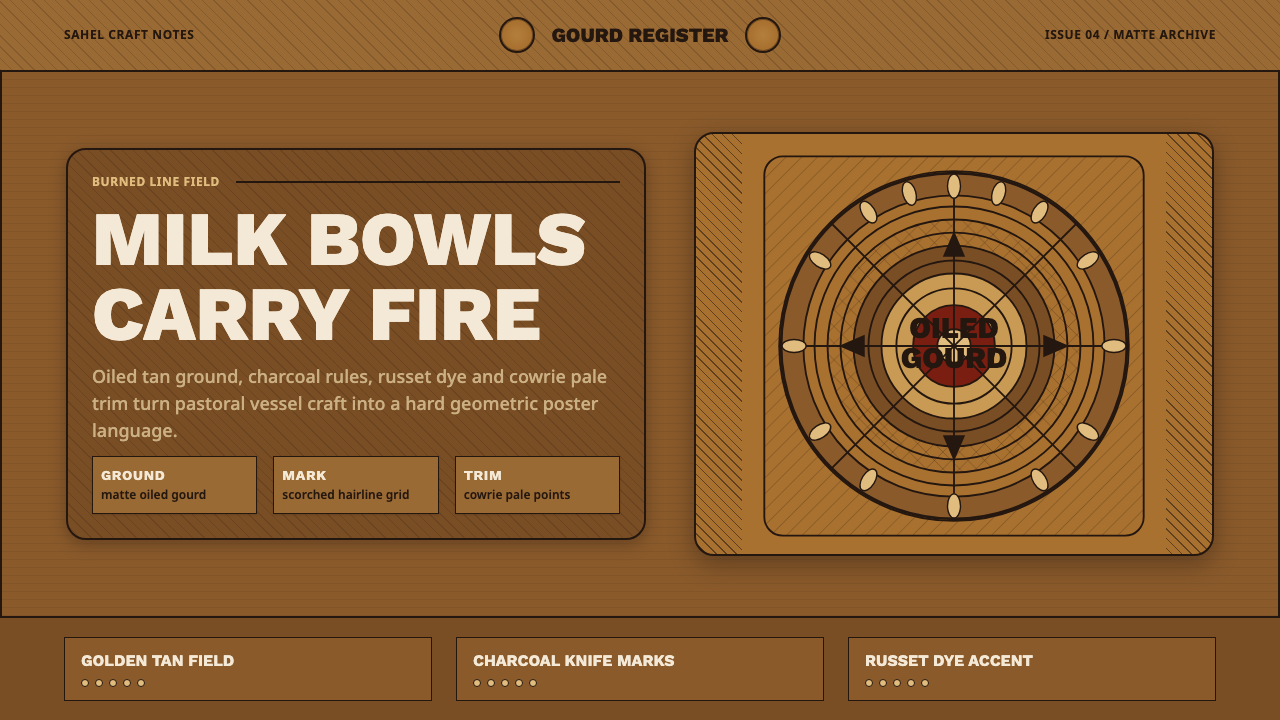 Fulani Milk CalabashMatte craft burns bright. Oiled gourd tan meets charred concentric linework.
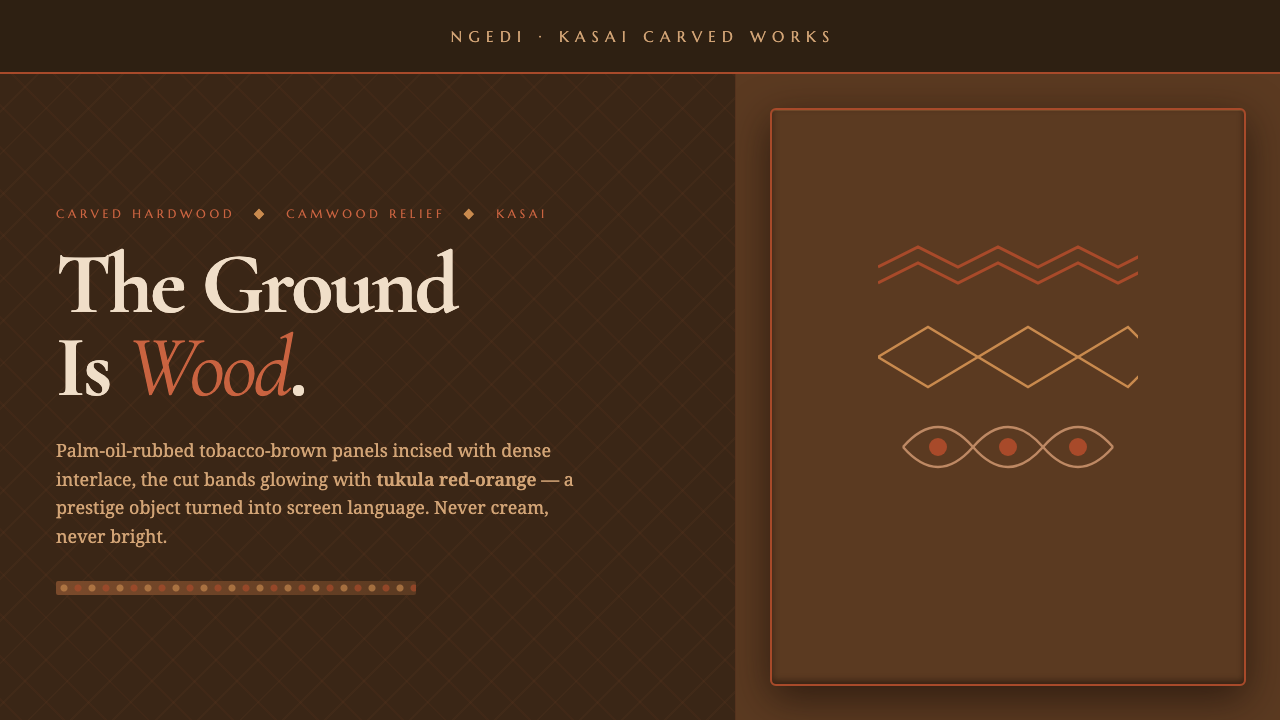 Kuba Calabash BrownPrestige in dark wood. Calabash brown ground, dense incisions, tukula red rel…
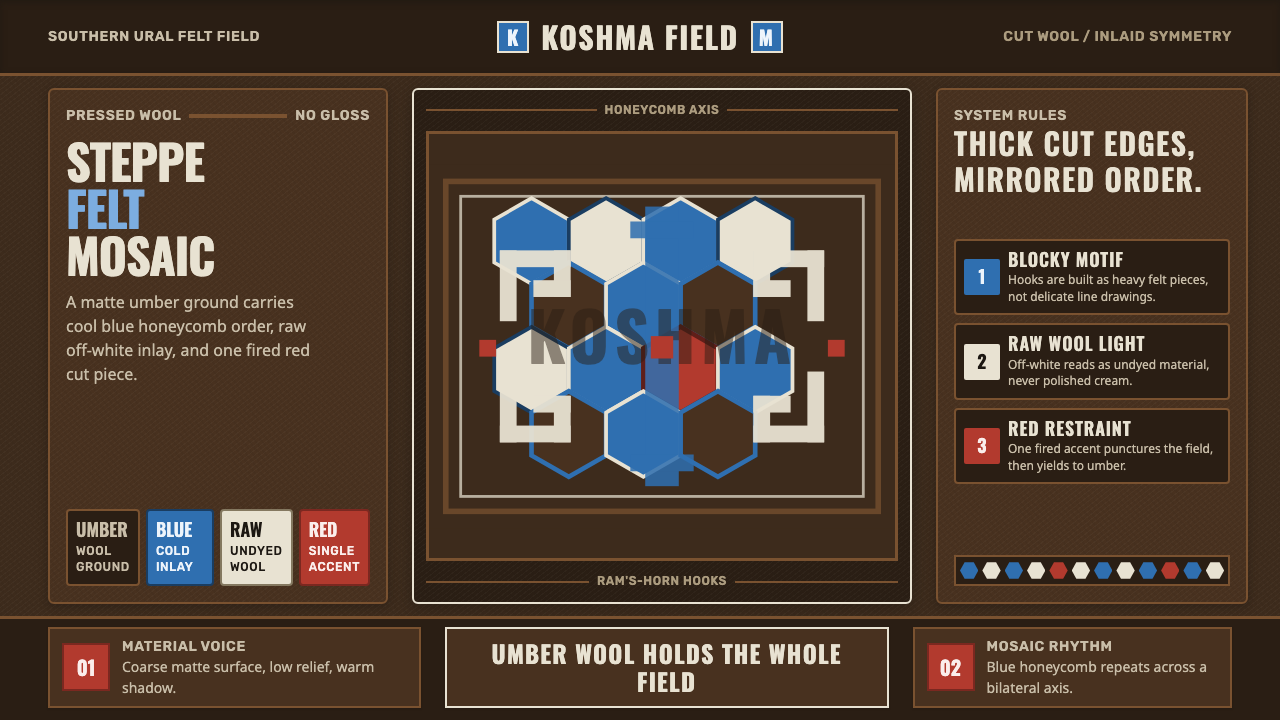 Bashkir Honeycomb Felt OrnamentSteppe craft feels weighty. Umber felt holds blue honeycomb and raw-wool hook…
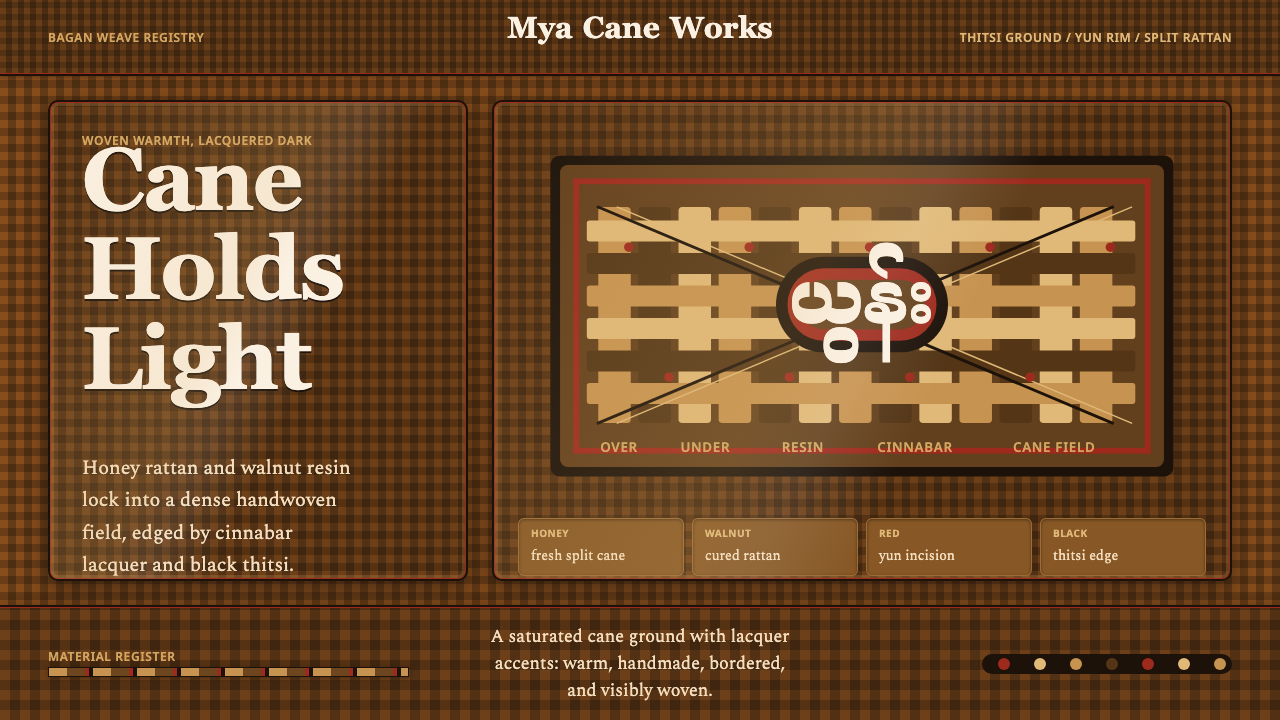 Burmese Cane RattanWoven warmth holds the page. Walnut cane lattice glows with cinnabar rim line…
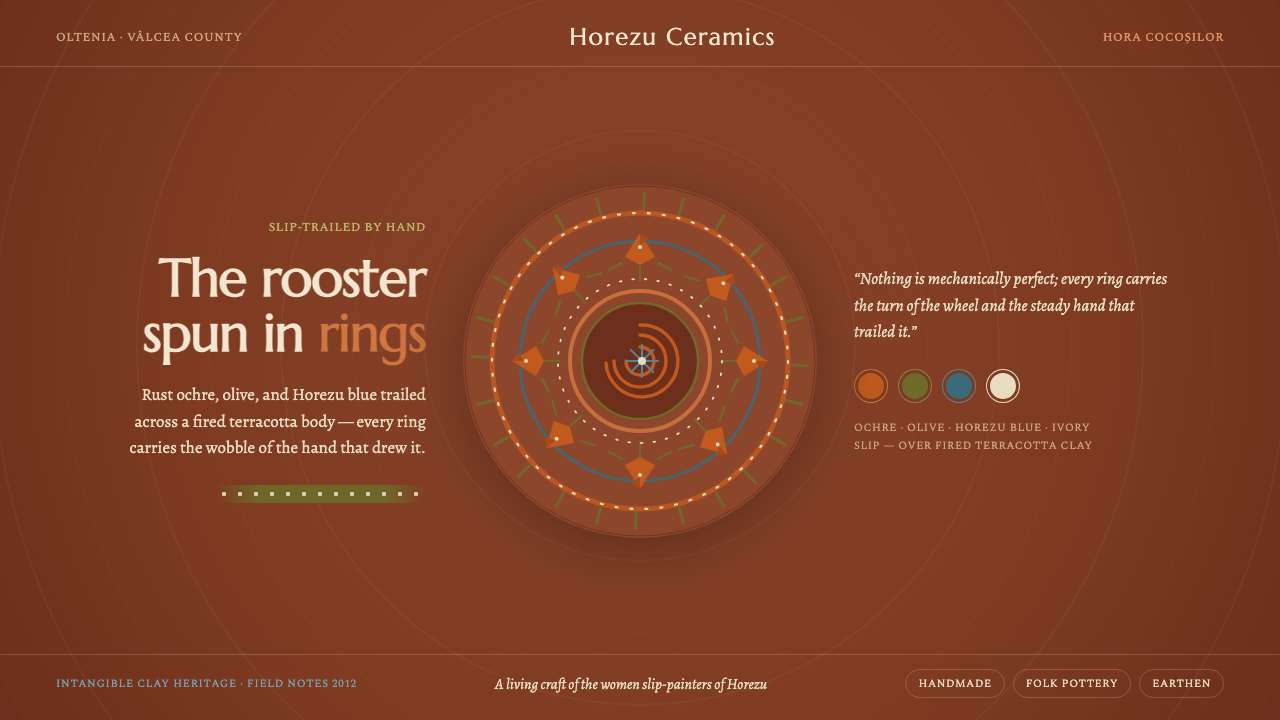 Horezu CeramicsWarm earth, steady hand. The Horezu rooster spun in ochre and olive slip acro…
 Kazakh Shanyrak Yurt FeltDomestic warmth, engineered. Ram-horn red felt curls around a radial shanyrak…