What is Bauhaus Textile (Anni Albers)?
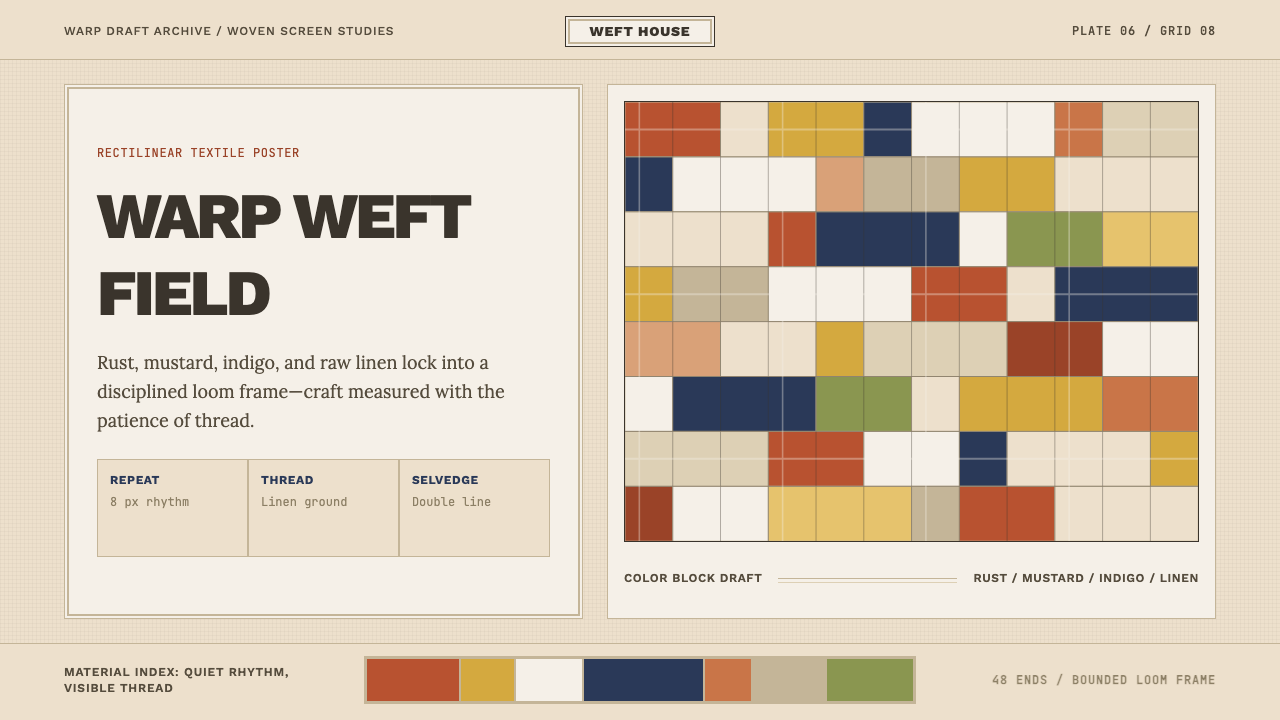
Anni Albers turned the loom into a design instrument as disciplined as any Bauhaus drafting table — proving that woven thread could carry the same formal ambition as architecture.
Bauhaus Textile (Anni Albers) in brief
Bauhaus Textile, as embodied in the work of Anni Albers, is a design language that translates the logic of the loom — warp meets weft in a modular, rectilinear grid — into a visual system of structured color blocks, visible material rhythm, and deliberate restraint. Where other Bauhaus workshops dealt in steel, glass, and printing ink, the weaving workshop treated thread itself as a formal medium: each interlacing of fibers a decision as considered as a brushstroke or a type choice.
The palette is earthy and saturated: rust, mustard, warm indigo, and unbleached linen are the characteristic tones. These are not the primary red-blue-yellow of the painting or printing workshops — they are the colors that emerge when pigment meets fiber, when dye settles into woven structure. Against these grounds, bands of contrasting tone create rhythm and hierarchy without ornament. The visual effect is of organized warmth: rigorous but not cold, structured but not mechanical.
What distinguishes this system from other textile traditions is its insistence on the grid as the primary organizing principle. Albers understood weaving as a binary logic — thread over, thread under — and this digital-before-digital structure gave her compositions a clarity that was simultaneously ancient and modern. Applied to contemporary interfaces, the system yields designs that feel materially grounded: rectilinear blocks that suggest woven panels, textures that evoke thread rather than pixel, color relationships built on contrast rather than gradient.

Where does Bauhaus Textile (Anni Albers) come from?
Anni Albers — born Annelise Fleischmann in Berlin in 1899 — enrolled at the Bauhaus in 1922, initially intending to study painting or glass. She was redirected to the weaving workshop, a fate she initially resisted and later credited as the formative accident of her creative life. The weaving workshop was, in the social geography of the Bauhaus, largely female territory: the school's leadership quietly steered women away from workshops it considered more technically demanding, despite the institution's nominal commitment to gender equality. What began as administrative sorting became a profound artistic discovery.
Under Gunta Stölzl, who became the weaving workshop's master in 1927, the workshop transformed from a craft atelier into a design laboratory. Stölzl introduced rigorous structural analysis of textile construction — students learned to understand weave diagrams as design blueprints, not merely as technical instructions. Albers absorbed this structural discipline completely. By the mid-1920s, she was designing wall hangings that applied the Bauhaus formal vocabulary — modular grid, limited palette, no decorative ornament — to woven structure with full technical mastery.
When the Bauhaus closed under Nazi pressure in 1933, Albers and her husband Josef Albers emigrated to the United States, where they joined the faculty of Black Mountain College in North Carolina. Black Mountain was an experimental liberal arts institution that, in the 1930s and 1940s, became a crucible of American modernism, hosting John Cage, Merce Cunningham, Buckminster Fuller, and Robert Rauschenberg at various points. Anni Albers led the weaving program there until 1949, applying and extending the Bauhaus textile vocabulary in a new cultural context. Her 1949 book 'On Weaving' — published the year she left Black Mountain — became the canonical pedagogical text for structural textile design.
In 1949, the Alberses moved to New Haven, Connecticut, when Josef accepted a position at Yale. Anni continued to produce woven works and prints, and in 1961 she became the first textile artist to be given a solo exhibition at the Museum of Modern Art in New York. Her later graphic prints — which translated the warp-and-weft grid logic into screenprint and lithography — extended her formal language beyond the loom into two-dimensional design, demonstrating the universality of the structural principles she had developed over decades. By the time of her death in 1994, her work had been recognized not as craft but as visual art of the first order, with the rigor of mathematics and the warmth of hand-made material.
What defines the Bauhaus Textile (Anni Albers) look?
Color Palette
The signature tones are earthen and warm: rust orange, mustard yellow, deep indigo, and undyed linen. These colors arise naturally from fiber-reactive dye traditions and from the visual logic of natural materials — they are not symbolic primaries but empirical choices grounded in material reality. Against a linen-white or warm cream ground, these saturated tones create blocks of strong contrast that read as structural divisions rather than decorative accents. The palette has an intrinsic warmth that distinguishes it sharply from the cooler, more primary palette of the painting workshops.
Rectilinear Grid Logic
The fundamental structure is the woven grid: horizontal and vertical divisions created by the interlacing of warp and weft threads. Every compositional element aligns to this orthogonal system — there are no diagonals, no curves, no organic shapes. Bands of color run the full width or full height of the composition, meeting at right angles to create rectangular fields. This grid is not imposed as an organizational overlay; it is intrinsic to the medium. In digital applications, the grid is made explicit through clear column and row structures, with color blocks that respect rather than bleed across grid boundaries.
Visible Texture and Material Honesty
A defining quality of Albers's work is the visibility of the weave itself — the texture of thread crossing thread is not hidden or smoothed away but celebrated as part of the composition's visual rhythm. In a flat-color painting, the surface is silent; in a woven textile, the surface speaks with the voice of the material. This principle, applied to digital surfaces, translates into the suggestion of physical texture: slightly varied tones within a color block, a grain that implies material presence, a surface that feels like it was made rather than rendered.
Modular Repetition and Rhythm
Weaving is an inherently repetitive process: the same sequence of thread crossings repeats across the width and length of the cloth. Albers exploited this repetition as a compositional tool — varying the width of color bands, alternating light and dark sequences, creating rhythm through measured recurrence rather than through focal point and decoration. The resulting compositions have the quality of music: structured variation within a repeating system. In visual design, this translates to layouts that use modular spacing and proportional relationships between elements rather than arbitrary placement.
Zero Ornament, Maximum Structure
In alignment with the broader Bauhaus commitment to functional purity, the textile vocabulary contains no decorative motifs, no representational imagery, no floral or figural ornament of any kind. Every visual element is structural: a color block is a woven interval, a band is a measured sequence of thread, a boundary between tones is where one color sequence ends and another begins. This absolute restraint produces a visual language of tremendous density and clarity — complex enough to sustain extended attention, simple enough to communicate immediately.
Warm-Cool Contrast
While the Bauhaus painting tradition built contrast through primary color opposition, Albers's textile palette operates on a different axis: the warmth of rust and mustard against the coolness of indigo and slate. This warm-cool tension is more subtle than primary color opposition — it creates depth and surface vibration without relying on hue contrast alone. Linen white functions as a temperature-neutral mediating tone, able to sit between warm and cool fields without belonging entirely to either. The result is a palette that reads as unified yet internally alive.
Proportional Restraint
Albers was precise about the proportional relationships between color bands and fields. The relative widths of horizontal bands, the ratios of dark to light areas, the density of thread crossings per unit — these were not intuitive decisions but calculated ones. This proportional discipline gives her compositions a mathematical underpinning that can be felt even when the calculations are not visible. In contemporary design terms, this means establishing and maintaining consistent proportional systems — spacing ratios, column widths, type scale relationships — rather than adjusting elements by eye.

Who shaped Bauhaus Textile (Anni Albers)?
Albers (1899–1994) is the central figure of this design system. After joining the Bauhaus weaving workshop in 1922, she developed a body of work that reframed textile as a legitimate medium for formal design research rather than a decorative craft. Her wall hangings of the mid-1920s through the 1930s applied Bauhaus compositional principles — grid, limited palette, structural honesty — to woven structure with complete technical command. At Black Mountain College (1933–1949) she taught and extended this vocabulary, and her book 'On Weaving' (1965) codified her structural approach for a generation of textile designers. Her 1961 MoMA retrospective was a landmark recognition of textile as fine art.
Stölzl (1897–1983) was the master of the Bauhaus weaving workshop from 1927 to 1931 — the first woman to hold a full master's title at the school. She transformed the workshop from a production studio into a design research environment, introducing systematic analysis of weave structures and establishing the intellectual framework that allowed Albers and others to treat textile as a formal design medium. Her own woven works, rich in geometric patterning and structural experimentation, set the workshop's ambitions at their highest point.
Berger (1898–1944) was one of the Bauhaus weaving workshop's most technically innovative figures, developing woven fabrics designed specifically for industrial reproduction and acoustic properties — textiles for theater curtains, for upholstery, for built environments. Where Albers worked toward the wall hanging as autonomous art object, Berger pushed toward applied design: textiles integrated into architecture and everyday life. Her work represents the pragmatic, functional pole of the workshop's output, and her 1930 essay on weave design remains a foundational text in functional textile theory.
Josef Albers (1888–1976), Anni's husband and fellow Bauhaus faculty member, is best known for his systematic paintings exploring simultaneous color contrast — work that directly parallels Anni's textile investigations into how adjacent tones affect each other's perceived warmth and saturation. At Black Mountain College and later at Yale, he taught color theory to generations of American designers, disseminating principles closely related to the textile workshop's palette logic. His influence on how contemporary designers think about color relationships — especially warm-cool and light-dark interaction — is profound and underappreciated.
Gropius (1883–1969) founded the Bauhaus in 1919 and wrote the founding manifesto calling for the reunion of fine art and craft. The institutional framework he created — workshops led by both a master craftsman and a master of form, a preliminary course in material exploration, a commitment to design as social practice — gave the weaving workshop the intellectual permission to pursue rigorous formal research rather than merely producing decorative goods. Without Gropius's insistence that every workshop deserved the same formal ambition as architecture itself, the textile program's transformation under Stölzl and Albers might not have occurred.
How do you use Bauhaus Textile (Anni Albers) today?
Applying the Bauhaus Textile vocabulary to contemporary design work requires understanding that its power comes from structural logic, not from surface texture alone. The system works because color, grid, and material rhythm are integrated into a single coherent language — borrowing one element without the others produces pastiche rather than the authentic visual discipline that makes the style compelling. Start by committing to the grid: orthogonal divisions, consistent proportional relationships, color blocks that align to structure rather than float freely.
For presentation slides, the Bauhaus Textile palette excels on both cover and section-divider pages. A cover composition might place a wide rust-colored band across the lower third of the frame, a narrow mustard accent band above it, and the title in a clean, unadorned type — dark on the linen-white upper field. Content slides should use the grid as an organizational system: blocks of earthy color define sidebar areas or callout zones, body text sits in a clearly bounded column, data labels are positioned by grid rather than by intuition. Data visualization becomes a natural extension — bar charts built from stacked color blocks in rust, indigo, and mustard read as designed objects rather than default software output. Avoid mixing this palette with drop shadows or any softening effect; hard edges are integral to the system.
For web interfaces and dashboards, the textile vocabulary translates particularly well to applications where content density is high and hierarchy must be immediately legible. A dashboard built on this system uses warm cream or off-white as the primary background, reserves the rust and indigo tones for data categories or navigation states, and uses mustard sparingly as an alert or emphasis color. Card components carry visible borders rather than shadow separation; table rows alternate between linen-white and a very slightly warmed near-white to suggest woven banding without literal texture. Pricing pages benefit from the system's natural ability to differentiate tiers: a rust tier, an indigo tier, and a mustard highlight tier each carry their own thermal identity without requiring large amounts of explanatory copy.
For editorial and marketing contexts, the Bauhaus Textile aesthetic supports strong typographic hierarchy combined with a material warmth that other Bauhaus-derived palettes lack. A magazine spread might use a full-bleed rust background for a section opener, with type reversed in linen-white and a single mustard pull-quote breaking the color field horizontally. Marketing pages translate the weave's banding logic into full-width alternating sections: rust on linen, linen on indigo, with carefully measured vertical spacing that echoes the proportional intervals of a woven textile. This systematic alternation creates visual momentum without requiring decorative device of any kind.
A common mistake when working with this system is to add soft texture effects — woven fabric overlays, grainy filters, or blurred backgrounds — in an attempt to reinforce the textile reference. This undermines the discipline of the style. Albers's work was rigorous precisely because it did not use texture as decoration; the texture emerged from structure. In digital application, the suggestion of material comes from color relationship and proportional clarity, not from photographic overlays. Similarly, expanding the palette to include terracotta, sage, or other trending earthy tones dilutes the system's internal logic: the rust-mustard-indigo triad is not arbitrary, and adding colors that were not part of the original compositional research produces incoherence. Work within the established palette, vary proportions rather than hues.

Bauhaus Textile (Anni Albers) — FAQ
How does Bauhaus Textile differ from the broader Bauhaus aesthetic?
The primary Bauhaus palette — primary red, blue, and yellow — derives from the painting and printing workshops and carries the symbolic color theory of Kandinsky and Itten. The textile palette is warmer and more empirical: rust, mustard, and indigo emerged from dye traditions and the visual properties of natural fiber. The grid logic is also different: where Bauhaus graphic design imposes a grid as an organizational overlay, textile design generates its grid intrinsically through the weave structure itself. This gives the textile vocabulary a material quality that the graphic vocabulary lacks — surfaces feel made rather than designed.
Can this style work in dark-mode interfaces?
The historic palette was light-ground — linen-white or warm cream backgrounds are canonical. A dark inversion is feasible, but requires different calibration. On a deep charcoal or near-black ground, indigo functions well as a mid-tone structural color, mustard reads strongly as an accent, and rust risks becoming too dominant. The warm-cool tension that animates the light-ground palette can survive in dark mode only if the warmth of rust and mustard is restrained to accent use rather than field use. Avoid inverting the full palette mechanically — the relationships between tones depend on the light ground to function as they were designed.
Is it appropriate to use literal woven-texture overlays to reinforce the textile reference?
No — and this is one of the most common ways designers misapply the style. Albers's work was rigorous precisely because texture was structural rather than decorative: the surface quality emerged from the logic of weave construction, not from an applied ornamental layer. Adding a photographic fabric texture overlay to a flat digital surface imports the appearance of textile without its logic, producing a result that is simultaneously redundant and superficial. The suggestion of material presence should come from color relationship and proportional precision — earthy tones in carefully measured bands — not from texture simulation.
How should typography be handled within this design system?
Albers's textile compositions contain no text, but the typography that accompanies this visual system should be consistent with its principles: clean, geometric sans-serif forms that do not compete with the structured color fields but integrate with them as another rectilinear element. Type scale should create clear hierarchy through size alone — a large, weighted headline against a smaller, lighter body text — without relying on decorative differentiation. Text color should typically be the darkest available tone, placed against the warmest light ground. Avoid mixing typefaces: a single family used at several weights will serve the system's internal logic far better than several families competing for attention.
What kinds of products or brands suit this style best?
Bauhaus Textile works best for products and brands that want to signal craft intelligence alongside modernist discipline — where warmth and rigor are both brand values. Design tools, architecture and interiors platforms, high-quality craft or materials brands, cultural institutions, and editorial publications that position themselves as thoughtful rather than trendy are natural fits. The warm earthy palette gives it an advantage over colder Bauhaus variants in contexts where emotional warmth matters — a design consultancy or a craft materials supplier can use this system without the coldness that sometimes accompanies the primary-color Bauhaus vocabulary. It is less suited to fast-moving consumer products, children's applications, or any context where the style's structural severity might read as uninviting.
Related design styles
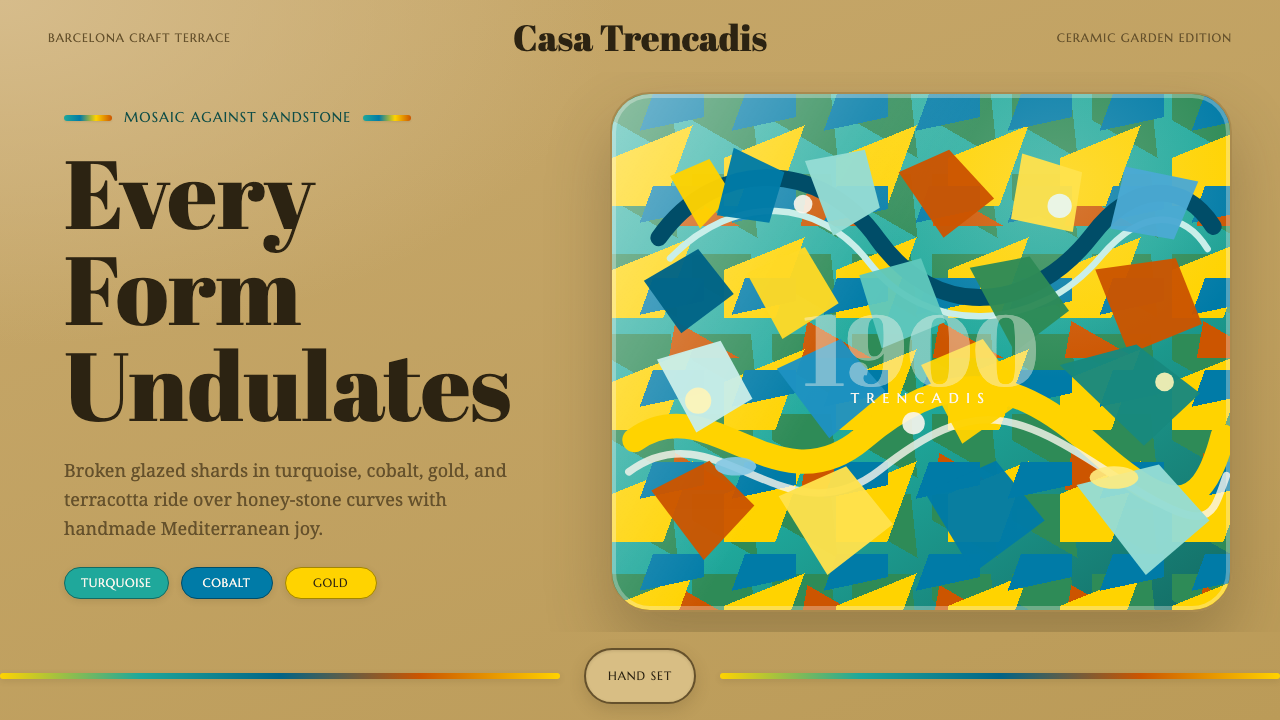 Gaudí ModernismeJoy made in shards. Turquoise, cobalt and gold tessellate over honey-sandston…
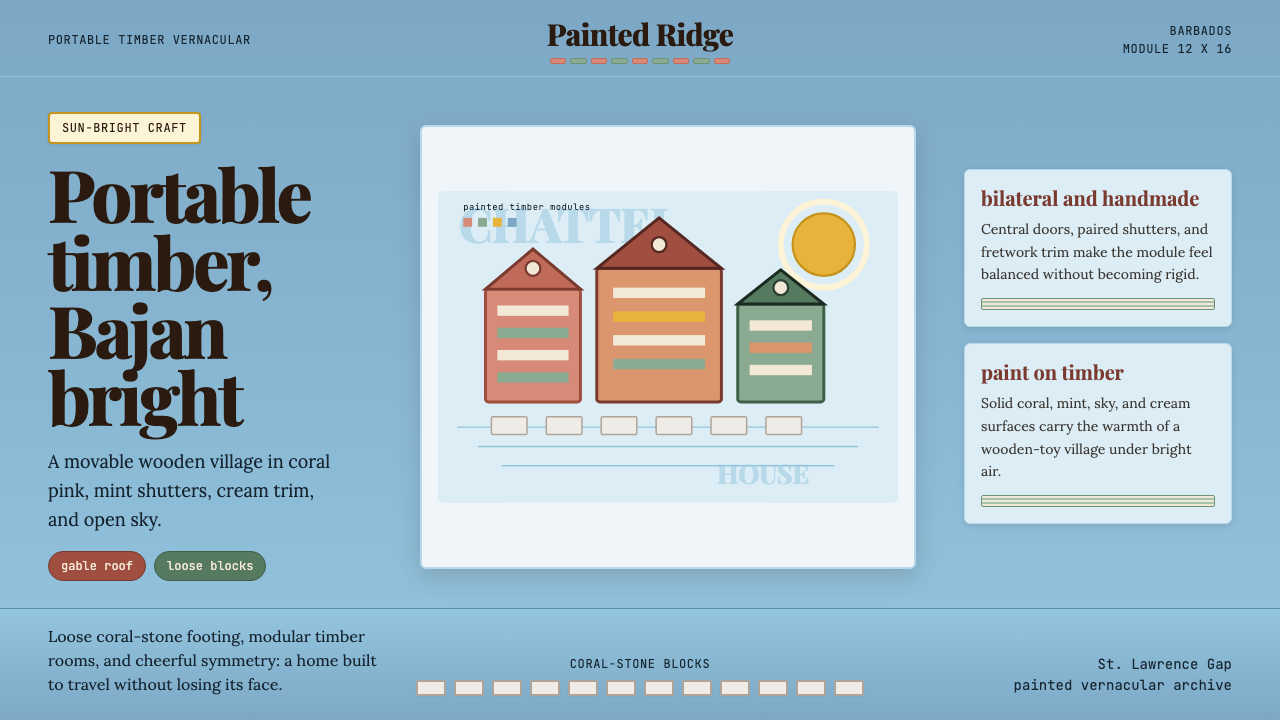 Barbadian Chattel HouseJoy made portable. Coral pink timber, mint shutters, sky-blue space, modular…
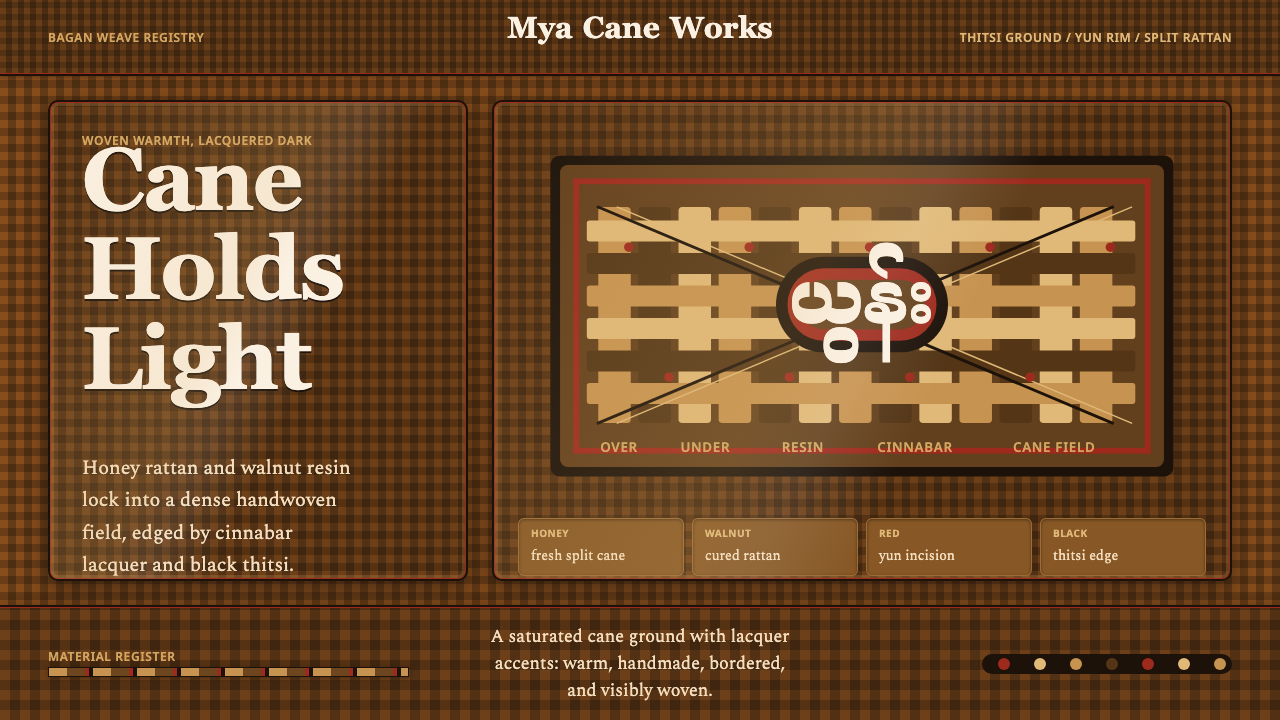 Burmese Cane RattanWoven warmth holds the page. Walnut cane lattice glows with cinnabar rim line…
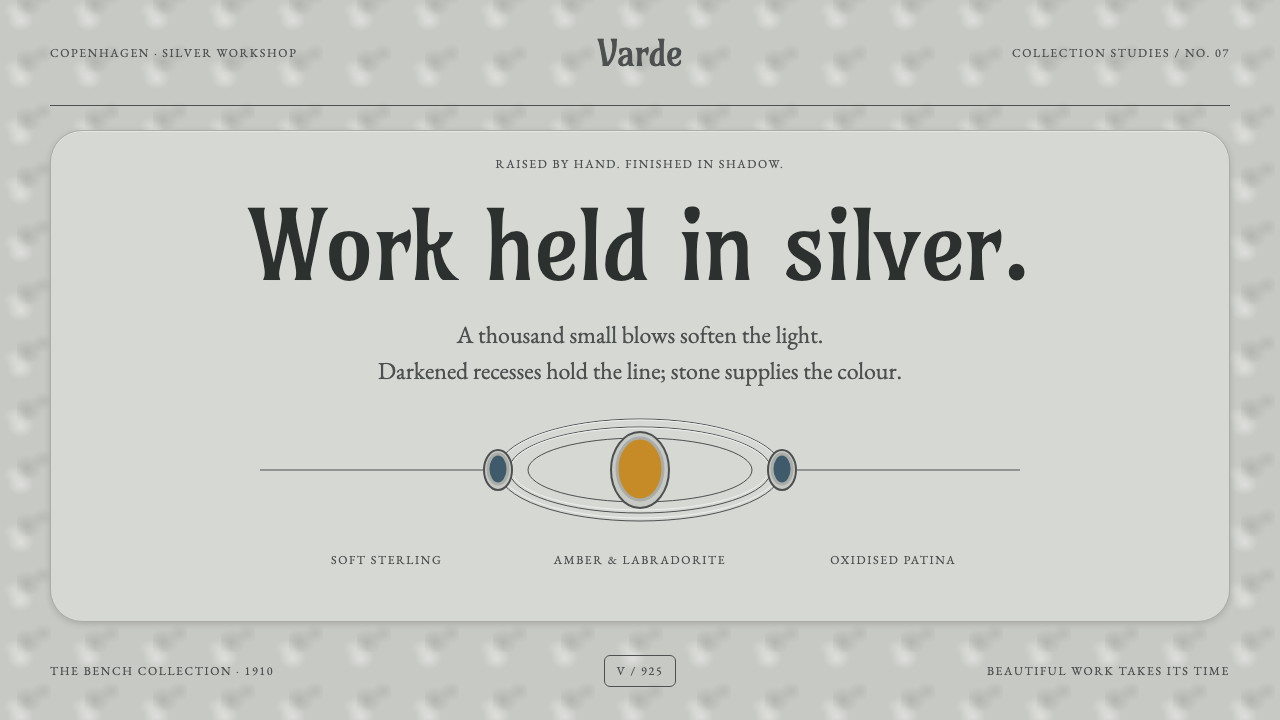 Danish Skønvirke SilverThe drawing is done in shadow. Amarante on soft silver, with amber held in bi…
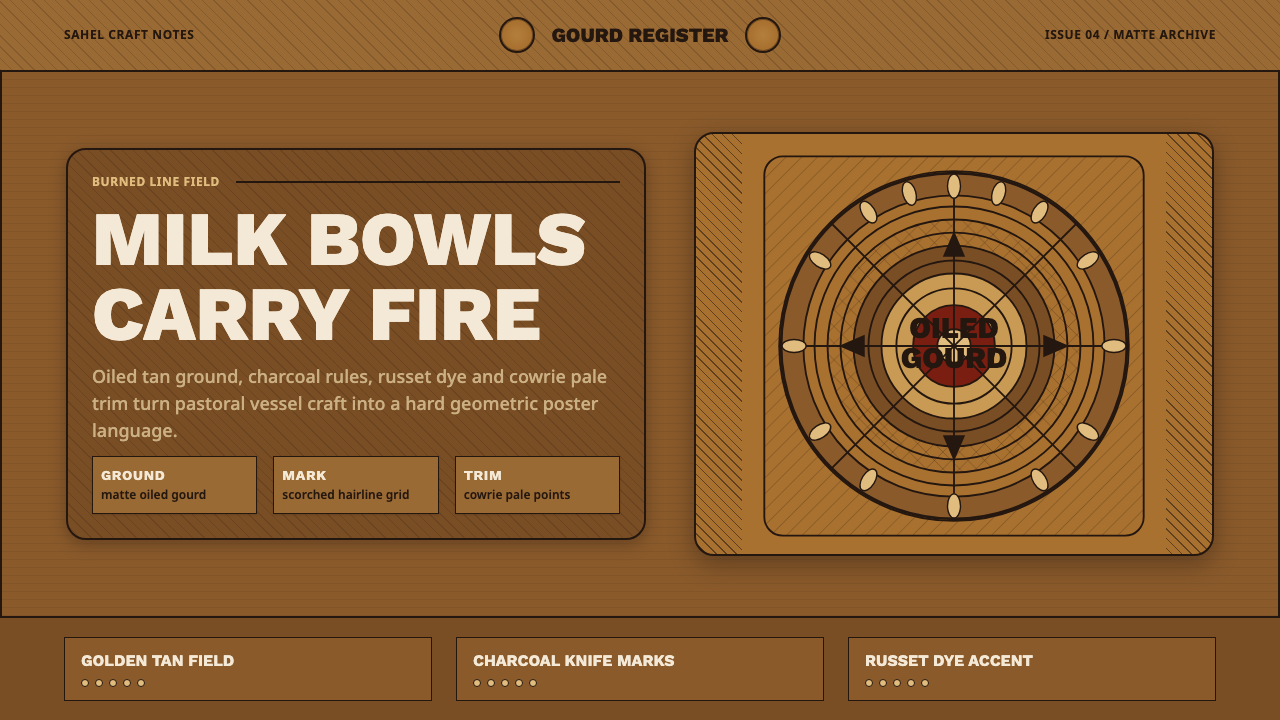 Fulani Milk CalabashMatte craft burns bright. Oiled gourd tan meets charred concentric linework.
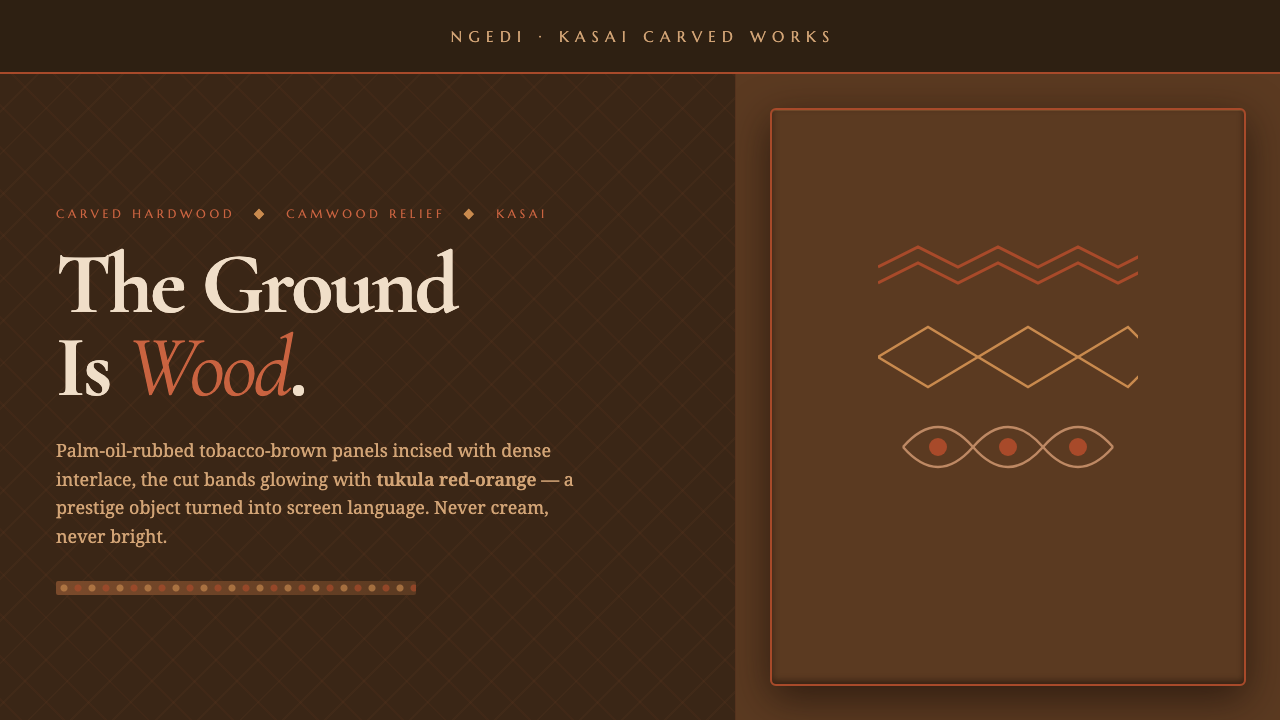 Kuba Calabash BrownPrestige in dark wood. Calabash brown ground, dense incisions, tukula red rel…