What is Costa Rican Oxcart Sarchí 1900?
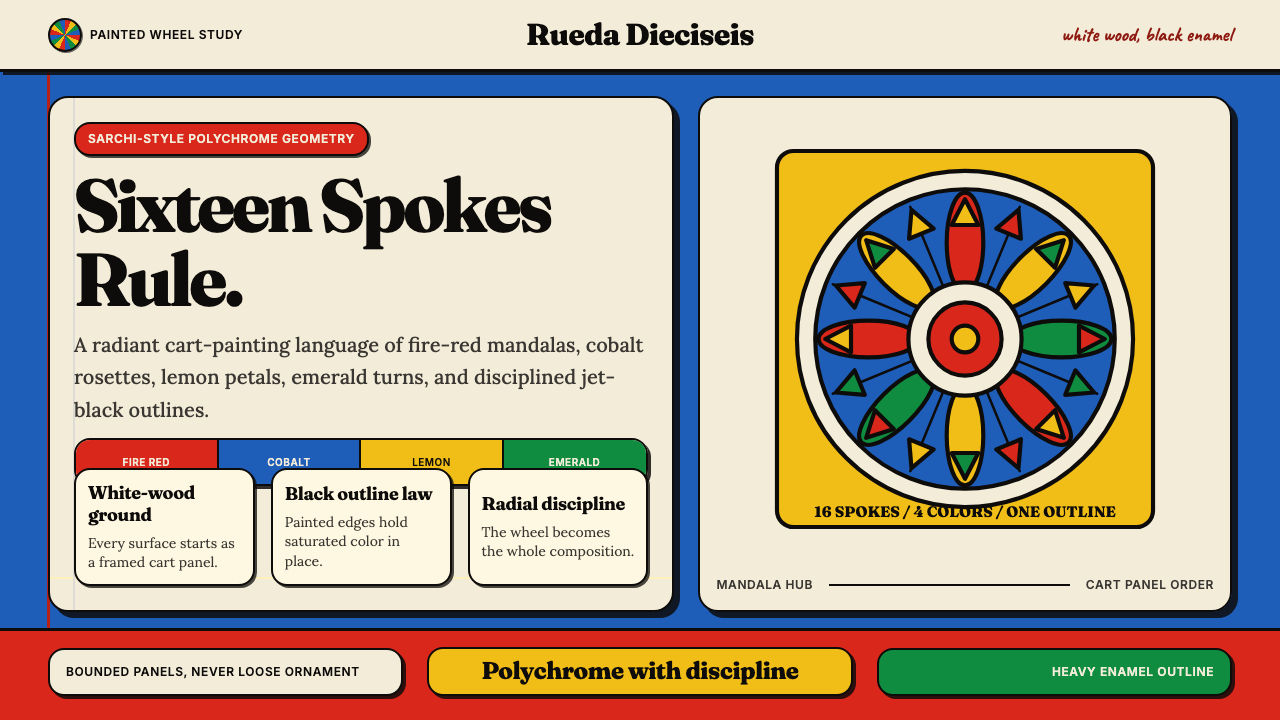
In the highland workshops of Sarchí, the painted oxcart transformed a working vehicle into one of the world's most disciplined expressions of radial symmetry and saturated folk color.
Costa Rican Oxcart Sarchí 1900 in brief
The Costa Rican oxcart painting tradition of Sarchí is a living craft system in which every structural surface of a wooden cart — wheel spokes, hub faces, side panels, axle braces, and undercarriage boards — is covered in an interlocking mosaic of geometric forms. The foundational motif is the mandala-like wheel face: concentric rings of petals, diamonds, and lozenges radiating outward from a central hub in fire red, cobalt blue, and lemon yellow, each shape outlined in bold black brushwork that gives the entire composition the precision of cloisonné enamel on a grand scale.
What makes this tradition visually distinctive is not simply its brightness but its governance. Every form is derived from the circle and from subdivision of the circle: the sixteen spokes of a standard carreta wheel impose a radial grid on every composition, and the painter works within that grid rather than against it. Petals align with spoke intervals, rosette rings follow the wheel's concentric geometry, and black outlines calibrate the weight of each element so that the whole reads as a unified field of color rather than a collection of competing shapes.
The style is not naïve folk art in the sense of being improvised or irregular. It is a rigorous compositional discipline passed from master to apprentice across generations. Each Sarchí workshop family maintains its own characteristic petal vocabulary and color sequencing, meaning that trained eyes can read the origin of a particular carreta from the specific arrangement of its decorative program — a tradition closer in spirit to a craft guild's signature mark than to individual artistic expression.
Where does Costa Rican Oxcart Sarchí 1900 come from?
The town of Sarchí, nestled in the Alajuela Province of Costa Rica's central highlands, became the epicenter of carreta production in the late nineteenth century, when Costa Rica's coffee export economy required a reliable method of transporting harvested beans from highland farms down to the Pacific port of Puntarenas. The oxcart — a two-wheeled wooden vehicle pulled by a pair of oxen — was the solution, and Sarchí's craftsmen became the nation's preeminent builders, refining the vehicle's wooden construction to survive the punishing mountain roads.
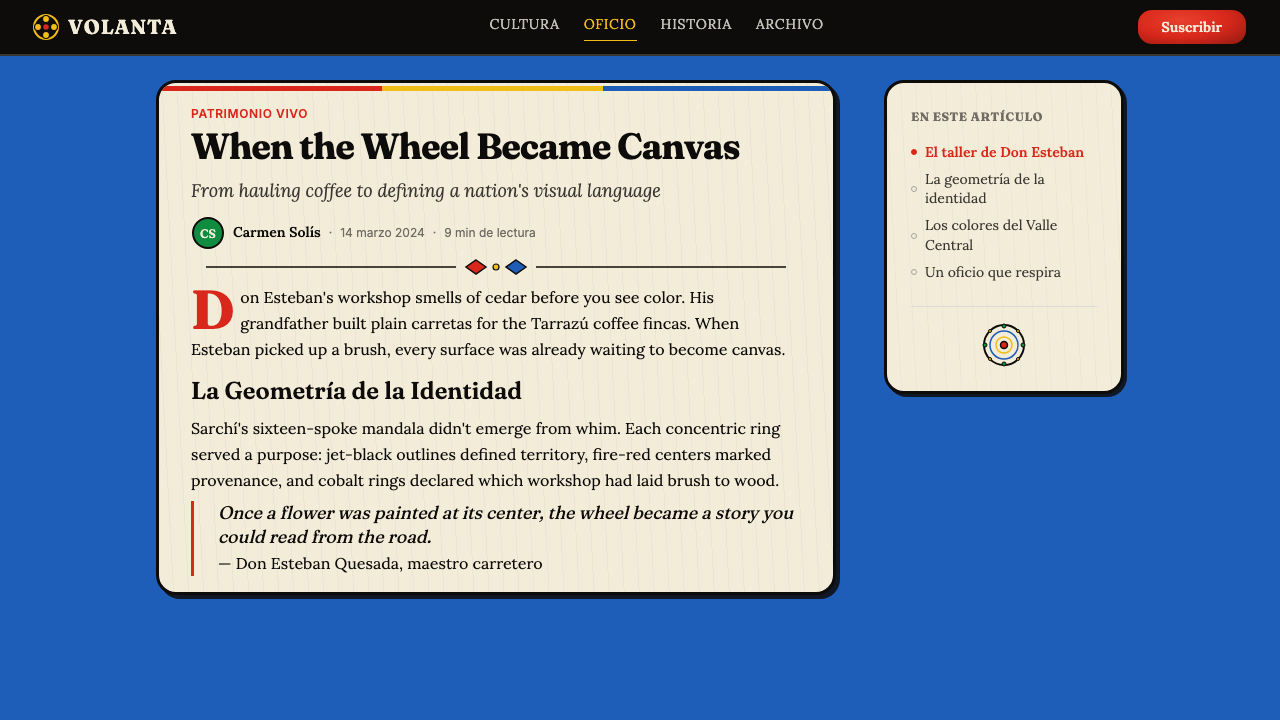
The precise origins of the painting tradition are debated, but the consensus among Costa Rican cultural historians places the flowering of the full decorative program around 1900, when artisans in Sarchí began applying increasingly elaborate geometric schemes to what had previously been utilitarian surfaces. The attribution of this decorative intensification to a single inventor is contested; the name Joaquín Chaverri Fonseca appears in several historical accounts as among the earliest systematic painters, and the Chaverri family workshop became one of the most influential of the early period. Eloy Alfaro Chaverri is also credited in the oral tradition of the craft community as a formative figure in the codification of the mandala wheel design.
By the mid-twentieth century, the carreta had outgrown its original transport function — rail and road infrastructure had displaced the oxcart as a practical freight vehicle — but rather than disappearing, the tradition intensified as a cultural and artistic practice. Workshops pivoted toward the production of decorative and ceremonial carretas, miniature models for the tourist and souvenir trade, and later toward the design vocabulary being exported into furniture, ceramics, and graphic applications. Carmen Naranjo, the Costa Rican writer and cultural minister, championed the carreta as a national symbol in her literary and public policy work, and in 1988 the Costa Rican government formally designated the painted oxcart a national symbol. The writer and intellectual Carlos Salazar Herrera had earlier documented the craft tradition in his widely read costumbrista sketches, giving the carreta a literary legitimacy that reinforced its cultural standing.
The tradition's global recognition arrived in 2005, when UNESCO inscribed the Oxcart Drivers and Oxcart Tradition of Costa Rica on its Representative List of the Intangible Cultural Heritage of Humanity. This inscription acknowledged not only the decorative art but the entire associated social practice: the oxcart processions, the religious festivals in which decorated carretas are central, the apprenticeship structure that transmits the craft, and the distinctive squealing sound produced by the wooden wheels — a sound once so embedded in Costa Rican daily life that it was used as a kind of acoustic identifier of place. The UNESCO recognition accelerated international interest in the visual vocabulary of the carreta and spurred renewed investment in Sarchí's living craft workshops.
What defines the Costa Rican Oxcart Sarchí 1900 look?
Radial Symmetry as Structural Law
The sixteen-spoke wheel is not merely a structural element — it is the compositional grid that governs every decorative decision. Petals, diamond fields, and rosette arcs are positioned at intervals derived from the spoke count, meaning the entire painted surface is a resolved subdivision of a circle. This makes the carreta wheel one of the most structurally disciplined ornamental systems in folk craft: no element is placed freely, and the symmetry is exact rather than approximate.
Bold Outline as Identity Mark
Every shape — whether a five-petal flower, a geometric diamond, or a concentric ring segment — is bordered by a hand-drawn black outline of consistent weight. This outline is not an afterthought but the system's defining visual gesture: it separates colors that would otherwise bleed or vibrate against each other, gives each geometric unit its individual legibility, and creates the impression of enamelwork or stained glass even on a wooden surface. The outline weight is calibrated to the scale of the motif — finer lines for small details, heavier strokes for primary shapes.
Saturated Primaries on White Ground
The classic carreta palette deploys fire red, cobalt blue, and lemon yellow at maximum saturation against white-painted wooden surfaces. The white ground is not neutral — it is an active compositional element, providing the contrast that makes the primaries read as luminous rather than flat. Unlike many folk traditions that mix colors on the surface or use earth tones, Sarchí painting keeps each hue pure and separated, relying on the black outline to manage visual transitions rather than blending or tonal gradation.
Petal and Rosette Vocabulary
The primary decorative units are flower-derived: five-petal and eight-petal rosettes occupy the large panel fields, while smaller diamond and teardrop forms fill the gaps between major elements. These botanical forms are always geometrized — a petal in carreta painting is a rounded lozenge, not a naturalistic leaf shape — so the vocabulary sits at the boundary between geometric abstraction and floral reference. Different workshop families maintain their own petal proportions and density patterns, creating subtle but legible house signatures.
All-Over Surface Coverage
Unlike many decorative traditions that leave significant plain ground, the carreta aesthetic favors complete surface coverage. Every visible wooden surface — spokes, panels, hubs, axle covers — carries decoration. The effect is one of dense, vibrant fullness in which no element reads as isolated. This all-over approach means the composition must be self-resolving at every scale: from a distance, the cart reads as a field of color; close up, individual motifs reveal their internal structure. The density is not chaotic because the grid enforces order beneath the visual richness.
Workshop-Family Signature Systems
The tradition's transmission through family workshops has produced a remarkable form of collective authorship: each major Sarchí workshop family holds a characteristic decorative program — a specific petal silhouette, a preferred color sequencing, a characteristic way of dividing the inner hub versus the outer wheel ring — that marks their work without requiring a literal signature. This is cultural information encoded in formal choices, and it means the tradition is simultaneously unified (all carretas share the same structural principles) and diversified (each workshop's output is identifiable to those who know how to read it).
Color Sequencing as Rhythm
The arrangement of colors across concentric rings and radiating segments follows patterns analogous to musical rhythm: a sequence established in the innermost ring is varied, inverted, or counterpointed in outer rings. A red-dominant inner hub might give way to a blue-dominant intermediate band and a yellow-dominant outer ring, creating a visual tempo that draws the eye from center to edge. These sequences are not arbitrary — they are tested compositional recipes refined over generations, and their disruption produces work that reads as technically inferior to practitioners of the tradition.

Who shaped Costa Rican Oxcart Sarchí 1900?
Chaverri Fonseca is among the earliest named practitioners of the full decorative program in Sarchí, active around the turn of the twentieth century. Historical accounts place the Chaverri family workshop at the center of the tradition's early codification, developing the consistent vocabulary of mandala-wheel geometry and black-outline enamel-work that would define the tradition. The workshop's approach — disciplined repetition of geometric modules within the wheel's radial grid — established a template that subsequent generations would elaborate rather than fundamentally revise.
Within the oral history of Sarchí's craft community, Eloy Alfaro Chaverri holds a prominent place as a codifier of the mandala wheel design — specifically the integration of the all-over petal-and-rosette vocabulary with the structural geometry of the spoke count. Whether his contribution was truly an invention or a consolidation of existing practice is debated, but his name is consistently invoked by later practitioners when accounting for the tradition's distinctive character. His legacy represents the kind of named-but-diffuse cultural authorship typical of living craft traditions.
Carmen Naranjo, one of Costa Rica's most celebrated writers and the country's Ambassador to Israel and later Minister of Culture, elevated the painted oxcart from a regional craft artifact to a symbol of national cultural identity in her literary and public work. Her advocacy contributed directly to the 1988 government designation of the painted oxcart as a national symbol. By insisting on the carreta's place in a serious cultural canon — alongside language, music, and landscape — she helped ensure that Sarchí's workshops received institutional support and that the tradition was understood internationally as serious cultural heritage rather than tourist handicraft.
Carlos Salazar Herrera, the Costa Rican short story writer and intellectual best known for his costumbrista sketches of rural life, provided some of the earliest serious literary documentation of the Sarchí carreta tradition. His work fixed the oxcart in the national literary imagination as a dignified emblem of Costa Rican rural identity rather than a merely picturesque curiosity. This literary legitimation proved important when the question of national-symbol designation arose: the carreta arrived in the political discussion with a cultural pedigree already established by literature, not just by craft practice.
The UNESCO inscription of 2005 was not the work of a single figure but of a coalition of Costa Rican cultural institutions, Sarchí workshop communities, and international heritage advocates. Its significance as a collective milestone warrants naming it as a formative moment: the inscription transformed the carreta's status from a nationally recognized symbol to an internationally documented human heritage, brought global design researchers and educators into contact with the tradition, and provided the legal and cultural framework that now governs its preservation and the conduct of Sarchí workshops that wish to be designated as authentic bearers of the tradition.
How do you use Costa Rican Oxcart Sarchí 1900 today?
The Sarchí oxcart visual system translates into contemporary design applications with unusual coherence, because its core logic — radial symmetry, bold primary color at maximum saturation, black outline separating every shape, all-over surface coverage — is already a complete compositional system rather than a collection of decorative motifs. Applying it correctly means understanding that the system governs structure as much as ornament: radial organization is the grammar, not merely the decoration.
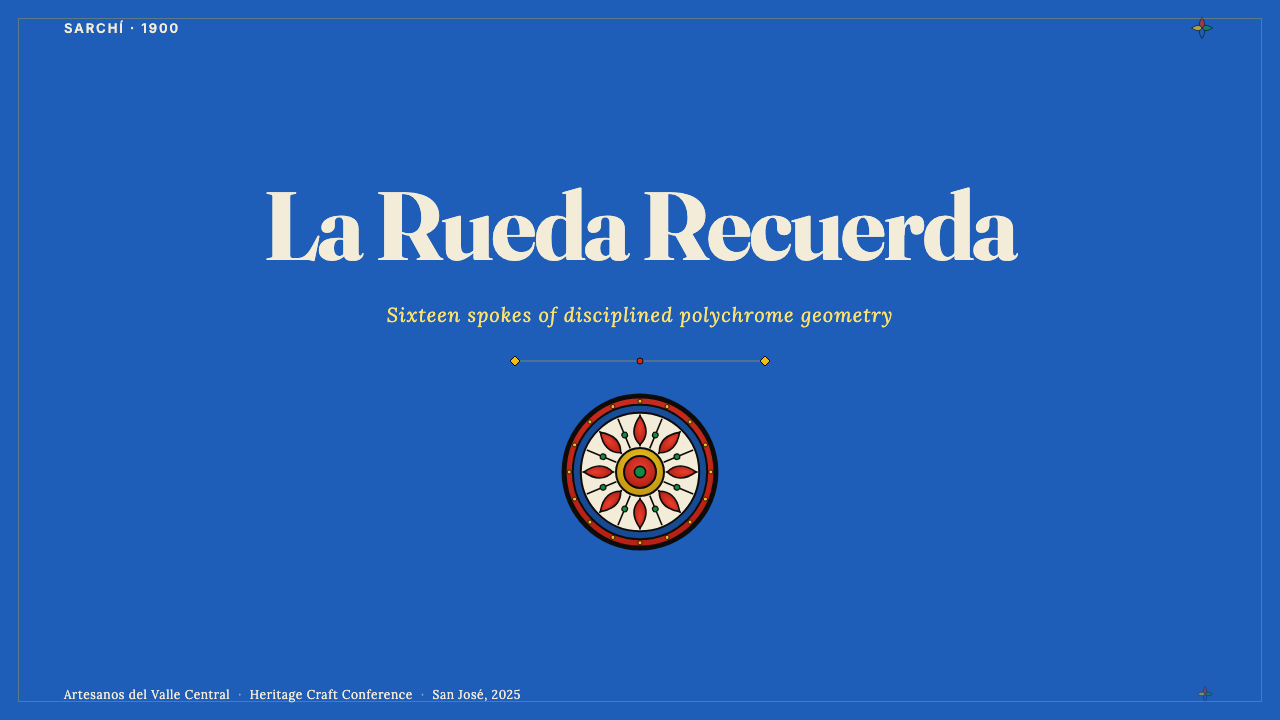
For presentation slides and document covers, the carreta vocabulary works most powerfully when the radial composition is centered and allowed to occupy most of the available surface. A cover slide modeled on the wheel face — a central identity mark from which concentric rings of color radiate outward, each ring outlined in strong black — produces an immediate sense of richness and authority. Content slides should use the all-over color logic more sparingly: a bordered frame in the primary palette, petal-derived ornamental dividers between sections, and color used to create hierarchy rather than decoration. Data visualizations benefit from the carreta's approach to color sequence: assigning each data category a distinct primary or derived color and maintaining those colors consistently with black outlines produces charts that read as designed objects rather than generic infographics.
For web interfaces and dashboards, the key is to honor the all-over quality without overwhelming the user. The approach that works best is to confine the dense carreta vocabulary to bounded zones — hero banners, card headers, section dividers — while keeping body content areas in clean white or cream with black typography. Interactive states can adopt the primary color sequencing: hover states in cobalt, active states in fire red, success indicators in lemon yellow, all with the characteristic black outline on border elements. This creates interfaces that feel culturally specific and visually rich without sacrificing the readability that functional screens require.
For editorial, marketing, and brand identity work, the carreta system offers a strong alternative to the more familiar folk vocabularies of Mexican or South Asian origin. Its discipline — geometric precision, clean separations, structured symmetry — means it scales across print and screen without the blurring that affects looser ornamental traditions. A brand identity built on the Sarchí vocabulary communicates handcrafted authenticity, tropical vibrancy, and structural rigor simultaneously, a combination rarely found in other folk-derived visual systems. The most effective marketing applications use the full radial mandala as a signature mark, then distribute the color palette and black-outline vocabulary across secondary materials.
A common mistake when working with this tradition is treating the saturated primary colors as the entire system, while neglecting the black outline and the geometric grid that give those colors their coherence. Without the outline, the primaries compete destructively; without the radial grid, the composition has no resolution. Another frequent error is reducing the palette to two colors in the name of restraint: the triadic tension between red, blue, and yellow is structural, not decorative — removing one of the three dismantles the harmonic system the tradition depends on. Authenticity also demands full-surface thinking: isolated carreta motifs floating against empty grounds lose the tradition's all-over character and can read as decontextualized ornament rather than as the complete compositional logic they represent in the original craft.
Costa Rican Oxcart Sarchí 1900 — FAQ
Is the Costa Rican oxcart tradition purely decorative, or does the geometric system have symbolic meaning?
The tradition sits in interesting tension between pure decoration and symbolic charge. The mandala-like radial structure invites symbolic readings — the wheel as cosmic order, the concentric rings as levels of existence — and some Sarchí artisans and cultural commentators have offered such interpretations. However, the craftspeople themselves tend to emphasize compositional logic and workshop inheritance rather than explicit iconographic programs: the primary constraint on petal placement is geometric resolution, not symbolic hierarchy. What is clear is that the tradition carries strong cultural identity weight — the carreta is Costa Rica's most recognizable national emblem — even where the individual motifs lack codified symbolic meaning.
How does the Sarchí tradition differ from other Latin American folk painting traditions like Mexican Talavera or Peruvian retablos?
The most significant difference is compositional: Sarchí is fundamentally a geometric and radial system, while Mexican Talavera (even in its most geometric phases) incorporates botanical and zoomorphic figuration, and Peruvian retablo work is primarily narrative and figurative. The carreta system contains no human figures, animals, or landscape elements — its entire vocabulary is abstract geometry. This gives the Sarchí tradition a visual character closer to Islamic geometric ornament or Celtic interlace than to the figural folk traditions of the Andean or Mesoamerican regions. The black-outline enamel quality is also distinctive: Talavera achieves a similar separation through the lead lines of the tin glaze process, but the carreta achieves this in painted wood through brushwork discipline alone.
Can the carreta color system work in a dark or night-mode context?
The historic palette is unambiguously light-ground: white-painted wood is the canonical substrate, and the composition depends on that white to separate the primary colors and give them their luminous quality. A dark-ground inversion is technically possible but requires significant adaptation. On a dark background, lemon yellow tends to dominate the composition disproportionately, disrupting the triadic balance; fire red darkens visually and loses the clarity of the outline; cobalt blue can become difficult to distinguish from the dark ground. A night-mode carreta adaptation works best when it shifts from white ground to a deep neutral and uses the primary colors primarily as outline and accent rather than as fill — essentially inverting the figure-ground relationship and letting the black outline become a light outline instead.
How does the UNESCO Intangible Heritage status affect how designers should engage with this tradition?
The UNESCO status confers cultural dignity and encourages engagement that acknowledges the tradition's living context — the Sarchí workshops, the artisan families, the apprenticeship structures — rather than treating it as a freely available decorative resource with no contemporary custodians. For designers, this means a few practical considerations: crediting the source tradition in design documentation and public-facing work, being attentive to the difference between inspiration and appropriation (particularly in commercial contexts), and where possible supporting or collaborating with contemporary Sarchí artisans rather than simply extracting the visual vocabulary. The tradition is not legally protected in the way trademarks are, but thoughtful engagement reflects the spirit of the UNESCO recognition and produces richer, more grounded work.
What contemporary design fields have most actively engaged with the carreta aesthetic?
The carreta vocabulary has found most sustained contemporary use in tourism branding, national identity design for Costa Rica, and craft-inspired packaging and textile design. Within the broader design world, the tradition has influenced surface pattern design — particularly in repeat patterns for wallpaper, fabric, and tile — where its geometric rigor and all-over coverage map naturally onto the demands of repeat structures. There has been growing engagement from digital product designers drawn to the system's clarity and visual distinction as markets become more crowded and undifferentiated. The tradition has seen comparatively little engagement from editorial and typographic design, perhaps because its all-over compositional logic is difficult to integrate with text-heavy layouts without overwhelming them.
Related design styles
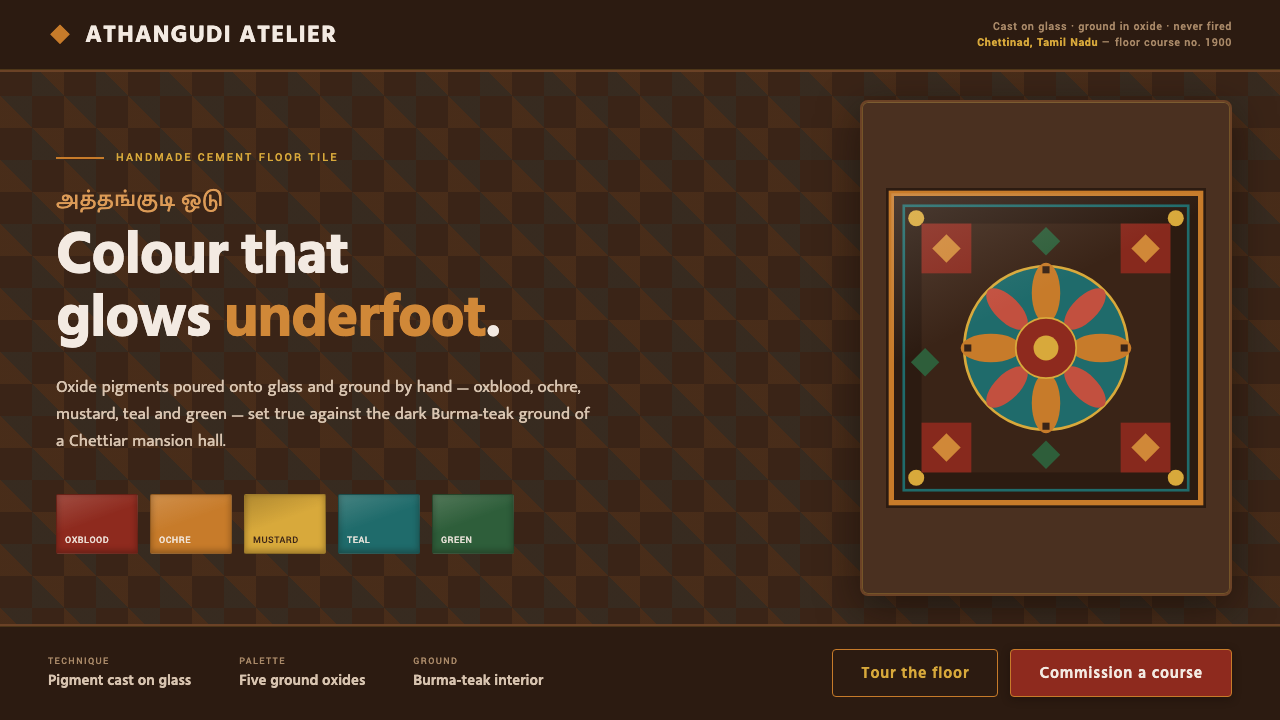 Chettinad Athangudi TilesColour that glows underfoot. Five ground-oxide tones on dark teak in bordered…
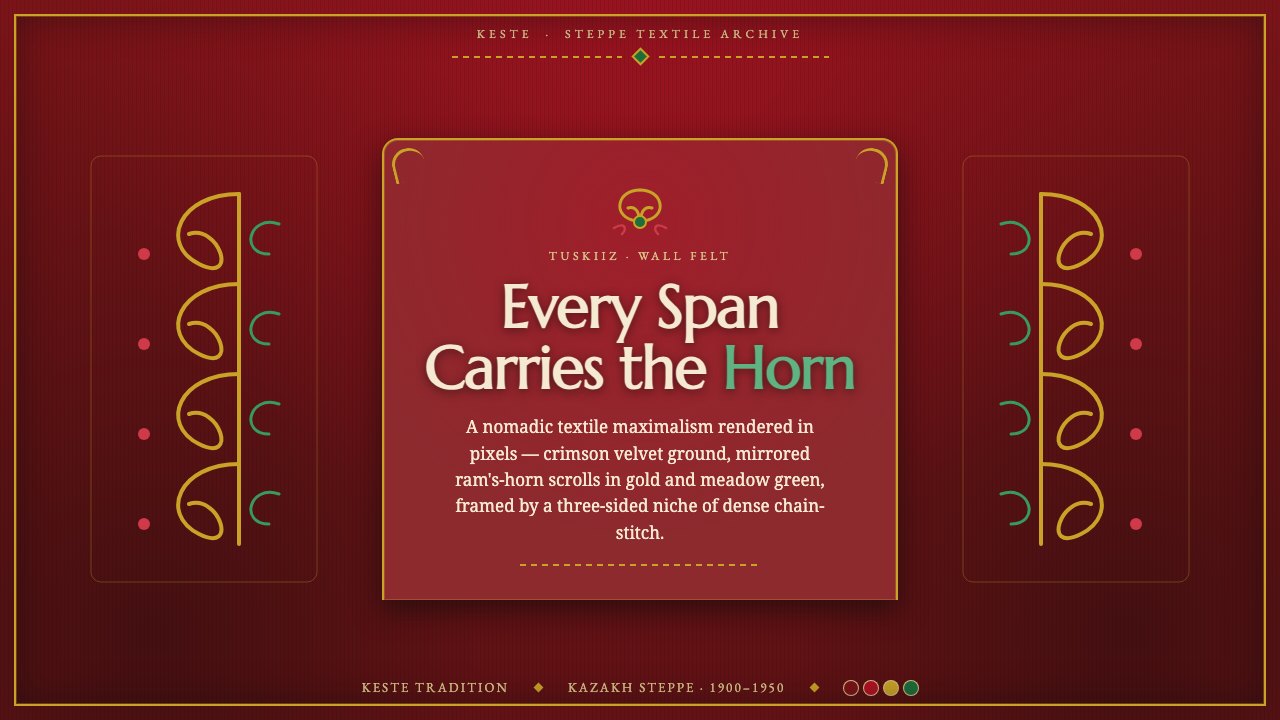 Kazakh Tuskiiz Wall HangingNothing flat, nothing empty. Crimson velvet, gold-green ram's-horn scrolls, a…
 Maldivian Liye Laa Jehun LacquerThree lac colours, nothing else. Glossy oxblood scraped through to yellow scr…
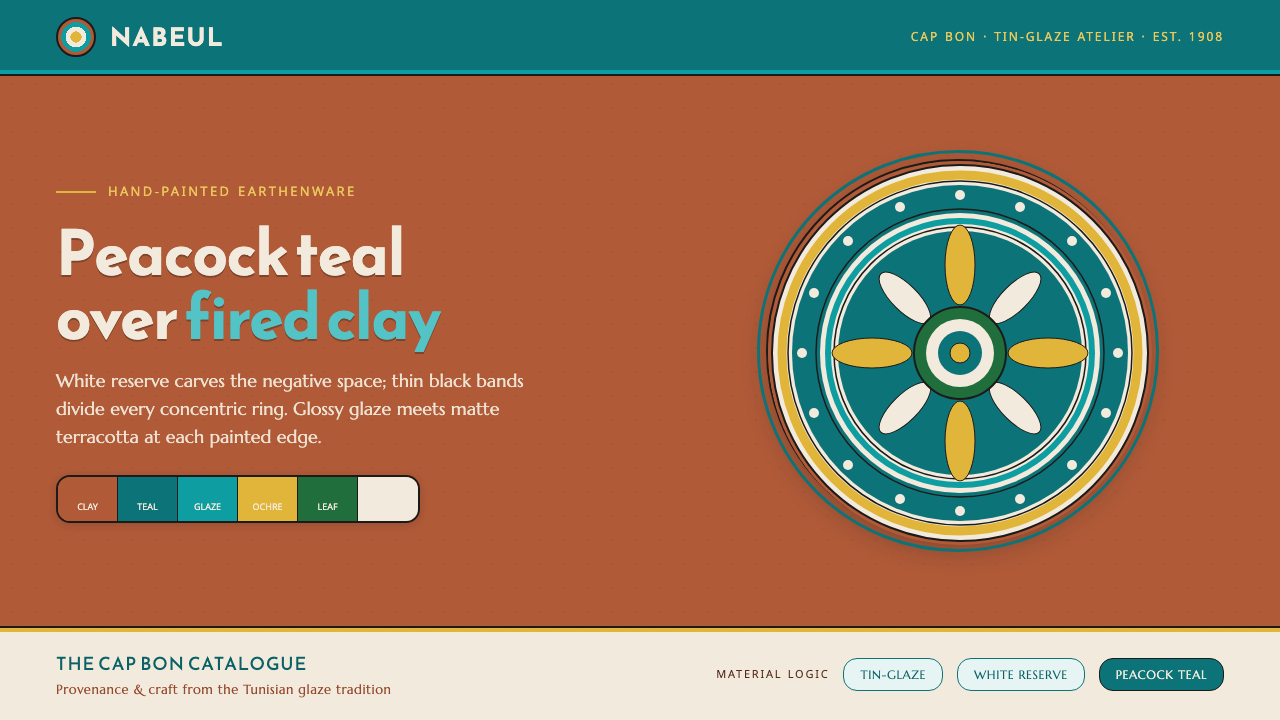 Nabeul Ceramic TealGlaze over fired clay. Peacock teal and white reserve banded in black on terr…
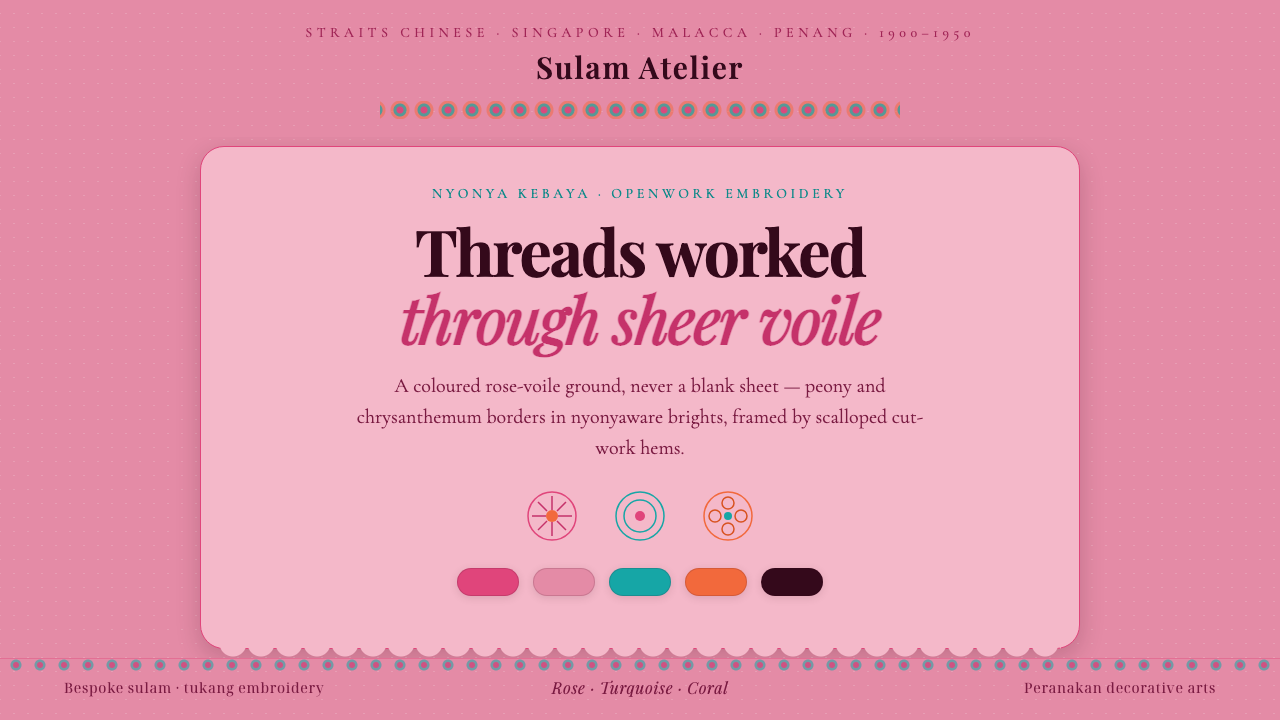 Nyonya Kebaya EmbroideryCraft, never a blank sheet. Rose-voile ground in turquoise sulam openwork, hi…
 Christmas ClassicTradition glows warmly. Evergreen panels, berry-red notes and burnished-gold…