What is Haitian Vodou Flag (Drapo Vodou)?
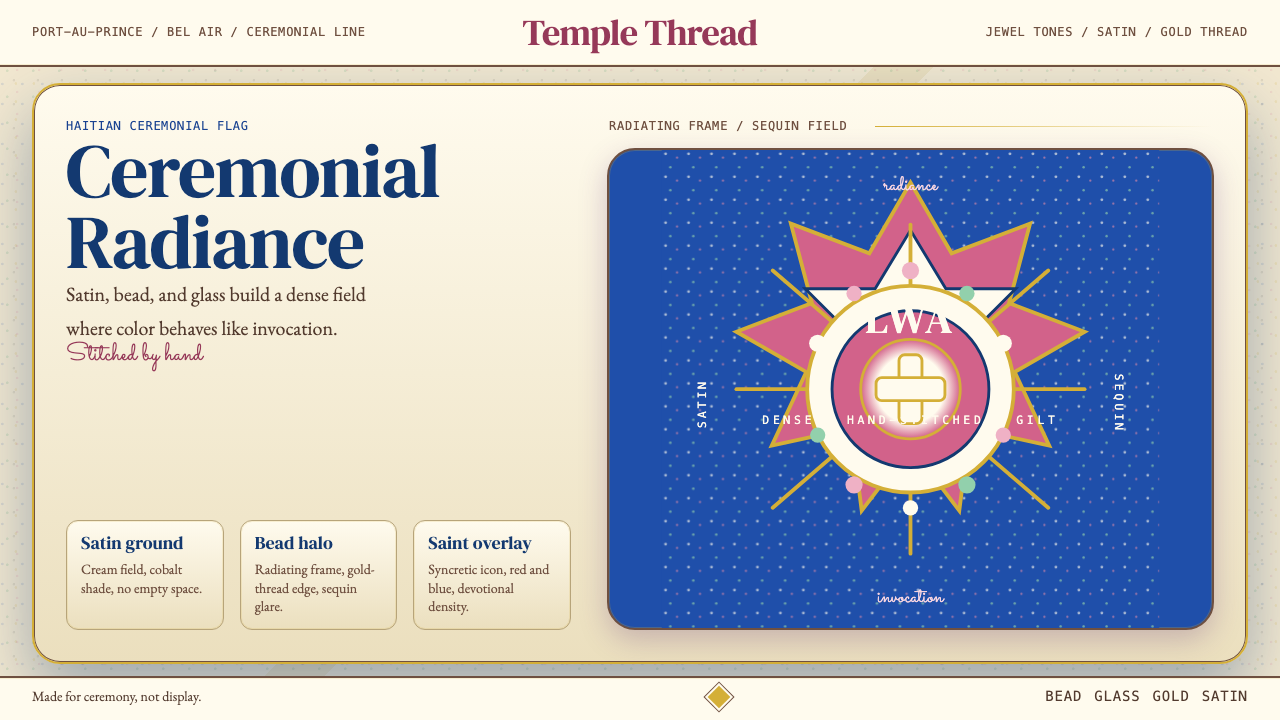
Drapo Vodou are Haiti's sacred sequin-and-bead ceremonial banners — maximally radiant, jewel-toned, and incapable of restraint.
Haitian Vodou Flag (Drapo Vodou) in brief
Drapo Vodou are hand-stitched ceremonial flags created for use in Haitian Vodou ritual. Each flag is made on a satin ground — typically a deep, saturated field of cobalt, magenta, emerald, vermilion, marigold, or royal blue — onto which an artisan hand-sews thousands of glass beads and metallic sequins to build up a portrait of a specific lwa, the divine spirits at the center of Vodou cosmology. The result is not a textile so much as a luminous mosaic: every surface catches and refracts light, so that the flags appear to pulse and shimmer when carried in procession.
The visual system is one of radical abundance rather than economy. Where minimalist traditions remove until nothing superfluous remains, Drapo Vodou accumulates — layer upon layer of beadwork fills every corner of the satin ground, leaving no field unoccupied. Central figural portraits of the lwa are framed by radiating star-bursts, concentric halos, heart motifs, cross forms, and geometric borders that simultaneously reference West African cosmological symbols and Catholic devotional iconography. This syncretic layering — African spiritual tradition fused with the Catholic imagery that enslaved Haitians encountered and repurposed — is not a visual accident but the theological signature of Vodou itself.
Contemporary Drapo Vodou are recognized as major works of global folk art. Major museum collections — including the Smithsonian and institutions across Europe — hold examples. The flags function simultaneously as sacred ritual objects, portable altars, and internationally exhibited artworks, occupying a position rare among folk traditions: equally at home in a Port-au-Prince peristil (Vodou temple) during a ceremony and under museum spotlights in Paris or New York.

Where does Haitian Vodou Flag (Drapo Vodou) come from?
The spiritual tradition that produces Drapo Vodou has roots in the forced transportation of West and Central African peoples to the Caribbean island of Hispaniola during the transatlantic slave trade. The Vodou religion that developed in Haiti is an Afro-Caribbean synthesis: at its core are beliefs and ritual practices inherited from Fon, Ewe, and Yoruba peoples of what are now Benin, Togo, and Nigeria, combined with influences from Central African Kongolese traditions and, crucially, the Catholic religious imagery that colonial and missionary structures imposed. The cross, the heart, the imagery of saints — all were absorbed and reinterpreted through an African cosmological framework. The lwa themselves are understood to inhabit the bodies of the same Catholic saints depicted in the very European devotional imagery available to enslaved Haitians.
The Haitian Revolution of 1791–1804 — the only successful slave revolt in history to produce an independent nation — gave Vodou a particular political and cultural gravity that distinguishes it from other Afro-Caribbean religions. The legendary ceremony at Bois Caïman in August 1791, at which Vodou rituals are said to have preceded the uprising that ignited the revolution, made the tradition inseparable from the story of Haitian national identity. Flags had a practical role in African-derived military organization and were present in the revolutionary context; the ceremonial banner tradition that developed in the peristils afterward carries the memory of that martial and spiritual mobilization.
Flag-making as a specialized craft within Vodou practice developed primarily across the nineteenth and early twentieth centuries, concentrated in Port-au-Prince and especially the historically significant Bel-Air neighborhood — a dense, working-class area that became a center of both Vodou practice and vernacular visual culture. The techniques of dense beadwork and sequin application that define the flags draw on broader Caribbean traditions of ornamental needlework as well as the specific materials available to Haitian artisans at different periods: glass beads from Europe, metallic sequins from trade channels, and the brightly colored satin that became foundational to the aesthetic.
International recognition arrived in force during the 1980s and 1990s, when collectors, curators, and folk-art scholars began acquiring Drapo Vodou for major institutional collections and mounting exhibitions that framed them explicitly as fine art. Masters such as Sylva Joseph and Antoine Oleyant became internationally known figures, their flags sold through galleries in New York, Paris, and Miami and exhibited in institutions across Europe and North America. This recognition transformed the economics of the tradition: what had been produced primarily for ritual use within communities began to be made in parallel for the art market, with consequences both generative — more resources for makers — and complicated — questions about the commercialization of sacred objects. The tradition continues in active practice among the Haitian diaspora in New York, Miami, Montreal, and Paris, where it maintains both its ritual function and its international artistic presence.
What defines the Haitian Vodou Flag (Drapo Vodou) look?
Jewel-Tone Palette
The color language of Drapo Vodou is built on deeply saturated, warm-luminous hues: cobalt blue, magenta, emerald green, vermilion, marigold yellow, and gold. These are not pastels or earth tones — they are colors pressed to near-maximum intensity, chosen partly for their visual power in candlelit or torchlit ceremonial spaces and partly because specific colors carry meanings associated with individual lwa. Erzulie Freda's flags lean toward pink and gold; Baron Samedi's incorporate black and violet; Ogou's flags favor red and iron-grey. The palette is always sovereign over background — the satin ground itself is chosen to vibrate at maximum saturation before a single bead is placed.
Maximalist Surface Density
No part of a finished Drapo Vodou is left bare. The satin ground disappears entirely beneath thousands of beads and sequins, each placed individually by hand. This total coverage is not merely decorative — in the Vodou aesthetic economy, density signals devotion and spiritual power. The more labor invested in a flag, the greater the honor shown to the lwa it depicts. In visual terms, the result is a surface that has no resting point: the eye is continuously engaged by the shifting shimmer of metallic sequins and the directional glitter of glass beads, producing an experience closer to cinematic motion than to static flat design.
Syncretic Iconography
The central image on a Drapo Vodou is almost always a recognizable Catholic saint, but the saint is understood and venerated as a visual vessel for a specific Vodou lwa. Saint Patrick drives away snakes and is understood as Damballa, the serpent lwa. The Virgin Mary merges with Erzulie Freda, lwa of love and beauty. This overlay is not deception but a sophisticated visual theology developed under conditions of cultural suppression: enslaved Haitians used the imagery that colonial authority permitted while practicing and preserving the spiritual tradition that authority sought to eradicate. The flags embody this history in their very structure.
Radiating Geometric Framing
Surrounding the central lwa portrait, the field of each flag is organized by radiating forms — star-bursts, concentric rings, triangular rays, and symmetrical cross structures that echo both West African cosmograms (particularly the Kongo cosmogram's four-part cross) and the halos of Catholic devotional art. These geometric frames are not background filler but carriers of cosmological meaning: the cross marks the intersection of the living and the dead, the radiating star signals divine presence, and the concentric circles suggest the rippling outward of spiritual energy. Every geometric decision is simultaneously formal and theological.
Light as Medium
Unlike flat pigment-based traditions, Drapo Vodou are designed to be experienced in motion and under changing light. The metallic sequins — laid at slightly varying angles — catch and release light as the flag moves in procession or sways during ceremony, producing a dynamic shimmer that still photography cannot fully capture. The glass beads contribute a different quality: a deeper, more directional sparkle. The two materials are combined not randomly but with knowledge of how each behaves under light, so that the flag's visual surface is in constant perceptual flux. This temporal, kinetic dimension is intrinsic to the medium.
Devotional Labor as Form
A large ceremonial Drapo Vodou can require hundreds of hours of hand-stitching — a single flag may contain tens of thousands of individually placed beads and sequins. This investment of time is not incidental but constitutive: the labor itself is understood as an act of devotion to the lwa the flag will serve. The aesthetic of richness and completeness — no shortcuts, no empty ground, no mechanical reproduction — is inseparable from the spiritual purpose. When the tradition encounters the art market, this understanding creates tension: a flag made for sale rather than ceremony may look identical but lacks the devotional dimension that is, for practitioners, part of the object's fundamental nature.
Ceremonial Scale and Presence
Drapo Vodou are made to be carried, raised, and moved through space — they are flags in the literal sense. Standard ceremonial flags are large enough to require two hands to carry and to be visible across a crowd. The scale is calibrated to the dimensions of the peristil and the processional space, not to the dimensions of a museum wall or a printed page. This origin in spatial, embodied ritual performance means that the aesthetic is always slightly over-scaled for conventional display contexts — which is itself part of its visual power when encountered in exhibition settings.

Who shaped Haitian Vodou Flag (Drapo Vodou)?
Among the most internationally recognized of all Drapo Vodou makers, Sylva Joseph worked from Port-au-Prince's Bel-Air neighborhood and became a central figure in the movement that brought the flags to global art world attention during the 1980s and 1990s. His flags are held in major institutional collections including the Smithsonian, and his work helped establish the vocabulary by which critics and curators discuss the tradition — the specific articulation of figural portraiture within radiating geometric framing, and the calibration of color fields to individual lwa symbolism. Joseph's career demonstrated that the tradition could accommodate both ritual authenticity and international exhibition without contradiction.
Antoine Oleyant was a Port-au-Prince master whose technical virtuosity — particularly in the density and precision of his beadwork — brought him international recognition alongside Sylva Joseph during the period of the tradition's greatest global exposure. Oleyant's flags are distinguished by their exceptional surface richness and by a compositional clarity that makes the central lwa figures immediately readable despite the surrounding visual complexity. His work was instrumental in the tradition's reception as serious fine art rather than merely decorative or ethnographic artifact, and his flags appear in collections in the United States and Europe.
A significant figure among the generation of makers who navigated the tradition's transition from primarily community-ritual use to international art market presence, Mireille Delismé brought both technical skill and a contextual understanding of the flags' ceremonial function that informed her practice. Her work represents the experience of women within the tradition — flag-making has historically included both male and female practitioners, with women playing essential roles in both the ritual and commercial dimensions of the craft. Delismé's contribution underscores that the tradition is not a single master's achievement but a community-held practice with multiple lineages.
Roudy Azor represents the contemporary generation of Drapo Vodou makers who continue the tradition in the twenty-first century, navigating its dual identity as living ritual practice and internationally marketed folk art. His work demonstrates the ongoing vitality of the tradition: not a preserved historical artifact but an evolving practice that maintains fidelity to the core visual vocabulary — dense beadwork, jewel-tone satin grounds, syncretic iconography — while engaging with the realities of a global audience and a changed Haitian diaspora context. Azor's presence in the field is part of the argument that the tradition remains generative rather than merely archival.
How do you use Haitian Vodou Flag (Drapo Vodou) today?
Drapo Vodou as a design reference presents a distinctive challenge: it is a tradition of maximum visual intensity, where every principle runs counter to the restraint that contemporary digital design typically prizes. Applying it thoughtfully requires understanding what the aesthetic is actually doing — using color at full saturation to signal spiritual gravity, using surface density to express devotion and honor, using syncretic layering to contain multiple meanings simultaneously — rather than simply reproducing the look of busy, bejeweled surfaces.
For presentation slides, the style is most powerful on cover or section-divider pages rather than content pages. A cover page can adopt the jewel-tone palette by selecting one deeply saturated ground color — cobalt, emerald, or magenta — and layering typographic and geometric elements over it with enough density to evoke the flag's visual richness without becoming illegible. Radiating geometric frames can function as organizational elements around a central headline or logo, echoing the star-burst framing of the lwa portrait. Content slides should pull back significantly: use the saturated palette as an accent — a colored rule, a highlighted data point, a section-indicator — rather than as a full-field experience. Data visualizations benefit from the tradition's approach to color hierarchy: assign each major category a distinct jewel tone drawn from the palette, so that the chart reads as a field of competing saturations rather than a conventional business-blue diagram.
For web interfaces, the aesthetic suits landing pages, cultural organization sites, event promotion, and any context calling for celebratory visual energy rather than analytical clarity. A dashboard or productivity application is rarely a good match — the tradition's resistance to negative space and its insistence on maximum surface engagement work against the rapid scanning that functional interfaces require. Where the style fits, it fits powerfully: hero sections with deeply saturated gradient-adjacent color fields, ornamental geometric border elements, and typography set at bold weight against vibrant grounds. A music platform celebrating Afro-Caribbean traditions, a cultural festival site, or an editorial publication covering art and diaspora culture are natural homes for the aesthetic. Pricing or marketing pages can use the palette for tier-differentiation — one jewel tone per tier — with the hero section carrying the full visual weight and the content sections moderating toward legibility.
For editorial and marketing work, the Drapo Vodou aesthetic is most effective when it is allowed to operate at its intended intensity rather than being diluted to a token color accent. A poster or event graphic that commits fully to the tradition — deep saturated ground, radiating geometric framing, layered typographic elements in contrasting jewel tones — will carry the cultural authority and visual impact of the reference. A marketing layout that borrows only the color palette without the density and layering will look merely bright without looking meaningful. The distinction matters: the style's power comes from accumulation, not from any single element in isolation. Editorial contexts should lean into the richness: full-bleed color fields, ornamental borders that frame editorial images, typographic layering that gives the page a woven, textile-like quality.
A common mistake when working with this aesthetic is treating it as a variant of general bright-color design — picking saturated colors without understanding the structural logic they serve. Drapo Vodou colors are not interchangeable: specific hues carry specific meanings within the tradition, and the flags' compositions are organized around those meanings. In a design context this means color assignments should feel intentional and consistent — the jewel tone chosen for a primary action or dominant section should recur with the same symbolic weight throughout. A second frequent error is under-committing to surface density: a single colorful element on an otherwise minimal page borrows the palette without honoring the aesthetic system that gives it meaning. The tradition does not do minimalism; any application that retains strong minimalist tendencies will read as a superficial color-overlay rather than a genuine engagement with the source.

Haitian Vodou Flag (Drapo Vodou) — FAQ
Is it appropriate to use Drapo Vodou aesthetics in commercial design work?
This requires careful thought. The flags are sacred ceremonial objects within a living religious tradition, not merely a historical folk-art style. Using the visual language in design work is not inherently disrespectful — Vodou has always been a tradition that absorbs and transforms external influence — but it does carry responsibility. The most important factors are context and intent: a design for a project genuinely connected to Haitian or Afro-Caribbean culture, or one that explicitly credits and celebrates the source tradition, sits on firmer ground than decorative appropriation for an unrelated commercial purpose. Where possible, working directly with Haitian artists or cultural consultants rather than simply harvesting the aesthetic transforms the engagement from extraction to collaboration.
How does Drapo Vodou relate to other beadwork traditions?
Drapo Vodou exists within a broader global tradition of ceremonial beadwork and textile art that spans West Africa, the Caribbean, and the Americas. West African antecedents — particularly Yoruba royal beadwork from what is now Nigeria and Benin — share the commitment to dense, saturated bead surfaces as markers of spiritual and temporal authority. The specific technique of sewing beads and sequins onto a fabric ground, organized around figural imagery, developed its distinctive form in the Haitian context and differs from purely geometric West African bead traditions. The flags have cousins in Brazilian Candomblé's ritual objects and in Cuban Santería's ritual cloths, all descended from the same West African religious heritage carried across the Atlantic by the same historical process.
What distinguishes an authentic ceremonial flag from one made for the art market?
From a purely visual standpoint, the distinction is often difficult to draw — skilled makers produce work of comparable technical quality for both contexts. The differences are more contextual and intentional than visual. A ceremonial flag is typically commissioned by a specific Vodou society or individual practitioner for use with a particular lwa in a particular peristil; it may be ritually prepared or consecrated before use, and its dimensions and iconographic choices may be dictated by ritual requirements. An art-market flag is typically made to a standard aesthetic without specific ritual commissioning, and while it may be technically excellent, it lacks the history of sacred use. Some makers maintain a strict separation between work made for ceremony and work made for sale; others understand both as legitimate expressions of the same tradition.
Can the visual language work in digital design given its origins in physical textile?
The translation from physical textile to digital surface involves genuine loss — the kinetic shimmer of metallic sequins and the tactile depth of beadwork cannot be directly replicated on a screen. However, what translates well is the color logic, the compositional structure, and the density principle. Deeply saturated color fields, radiating geometric elements, ornamental border structures, and layered typographic composition can all reproduce the visual character of the tradition in digital media. The key is understanding that the flags derive their visual power from accumulation and intensity — these qualities can be pursued in digital design, even if the specific material properties of bead and sequin cannot be reproduced. Some digital designers have found that subtle texture overlays, animated shimmer effects, and high-contrast layering can gesture toward the material quality without pretending to replicate it.
Which lwa are most commonly depicted, and how do their color associations work?
The most frequently depicted lwa in Drapo Vodou are Erzulie Freda (lwa of love and beauty, associated with pink, gold, and pale blue, depicted as the Virgin Mary or as a beautiful woman), Papa Legba (lwa of crossroads and communication, associated with earth tones and red, depicted as Saint Lazarus or an old man), Damballa (serpent lwa of purity and creation, associated with white and silver, depicted as Saint Patrick), Baron Samedi (lwa of death and resurrection, associated with black, purple, and white, depicted as Saint Martin de Porres or in top hat and formal dress), and Ogou (warrior lwa associated with fire and iron, associated with red and iron-grey, depicted as Saint James or Saint George). These color associations are not arbitrary decoration — they carry theological content about the nature and domain of each lwa, and skilled flag makers calibrate every color choice in the beadwork to reinforce these associations.
Related design styles
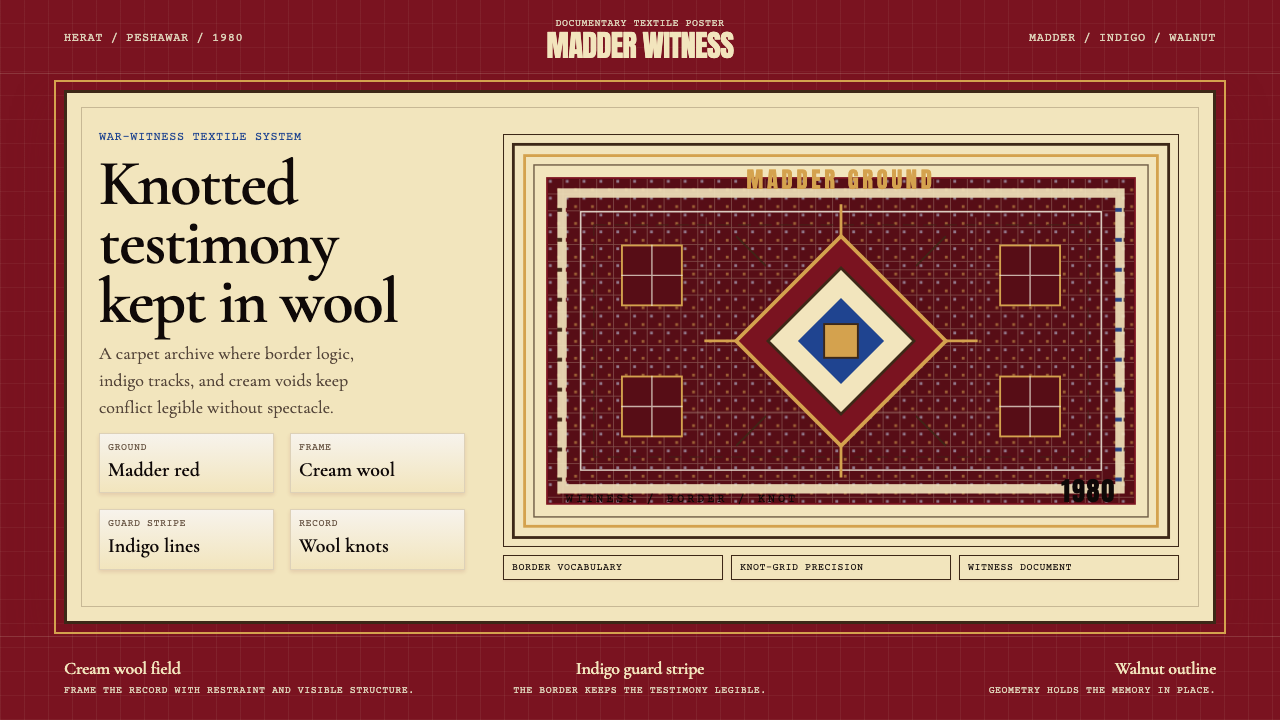 Afghan War Rug (1980)Witness in wool. Madder red, indigo, and cream borders knot testimony into a…
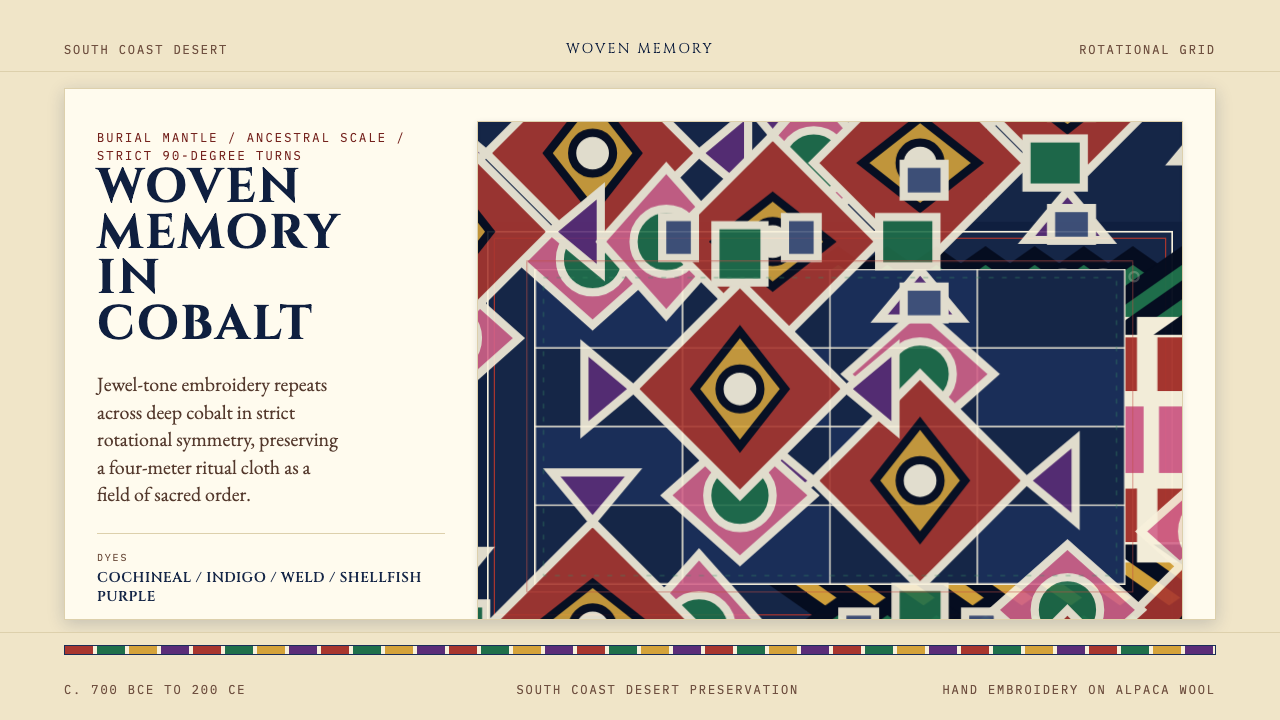 Paracas Andean TextileAncestral and exact. Jewel tones repeat on deep cobalt in strict 90° turns.
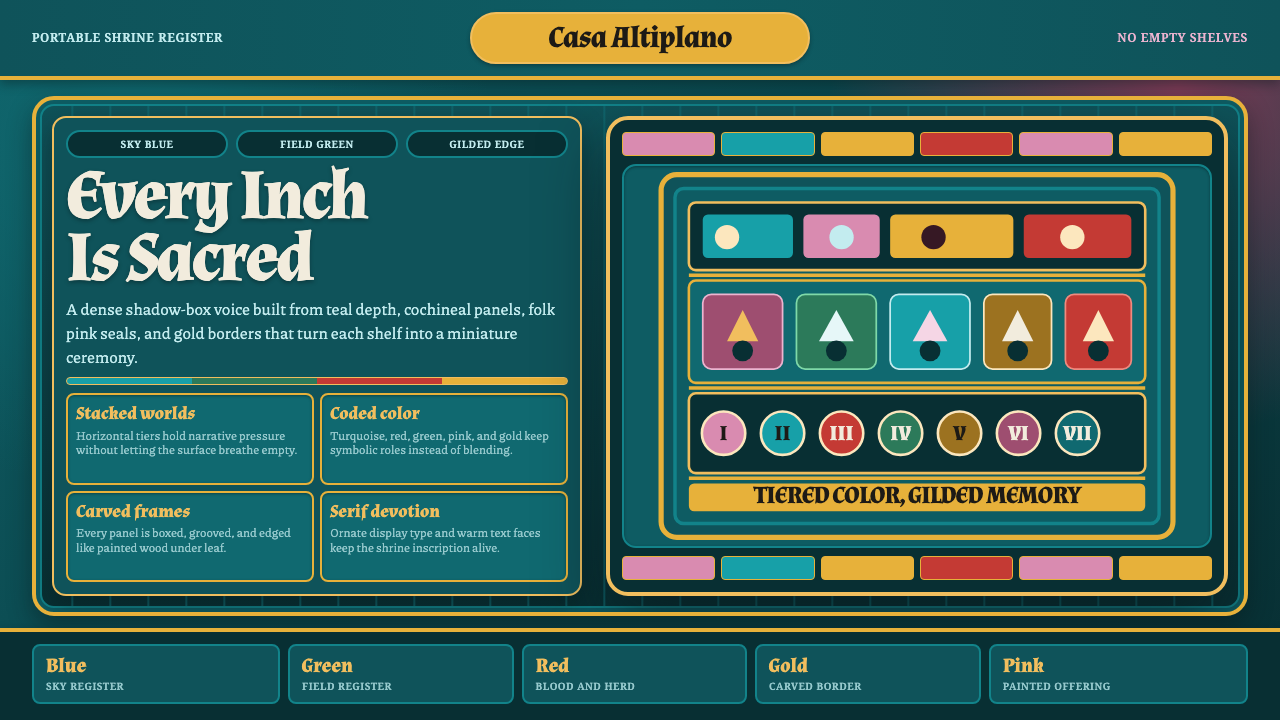 Ayacucho Retablo BoxSacred density. Deep teal shelves pack turquoise, cochineal, folk pink, and g…
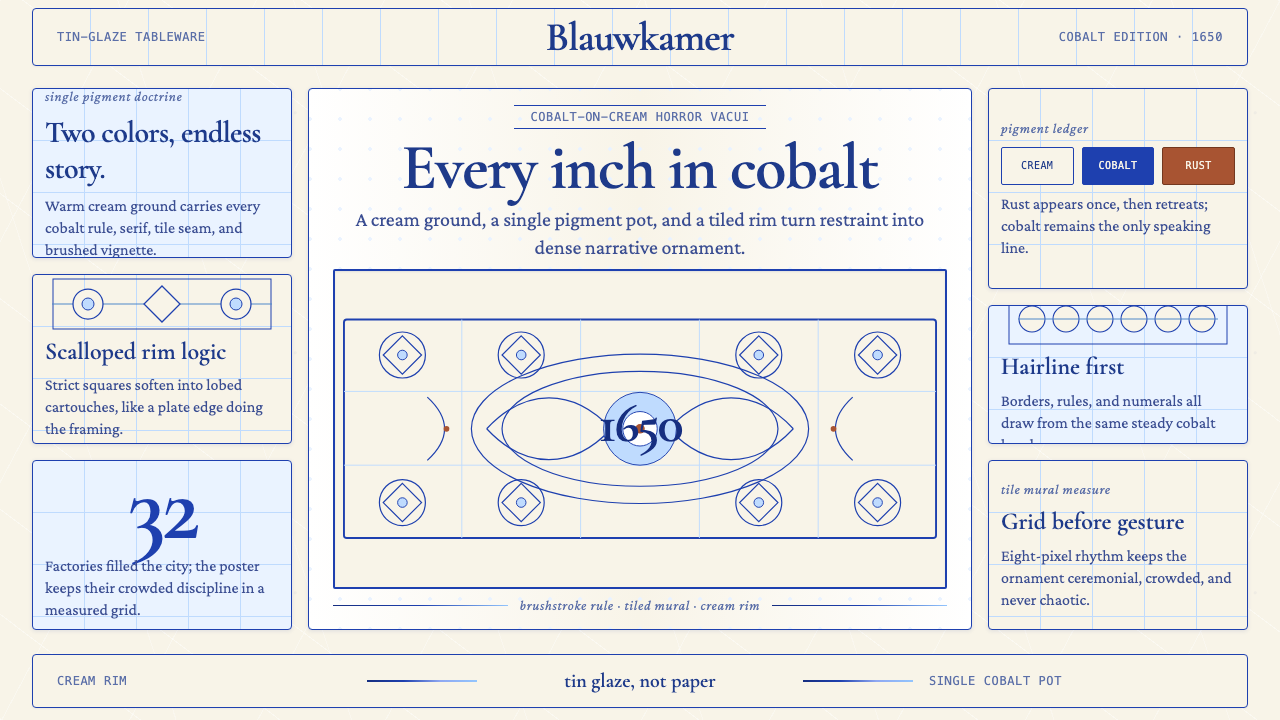 Delft Blue PotteryRestrained, yet every inch speaks. Cobalt hairlines crowd a cream tile grid.
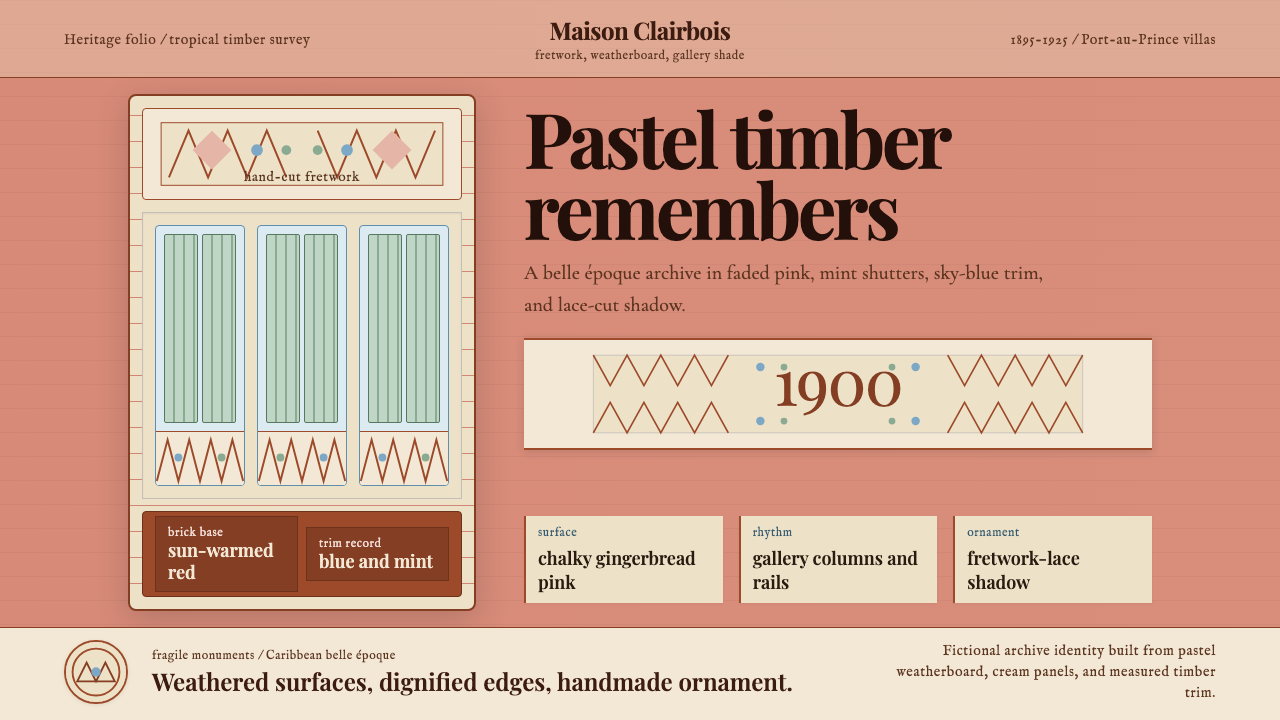 Haitian Gingerbread House (1900)Fragile elegance endures. Faded pink walls carry mint shutters and fretwork-l…
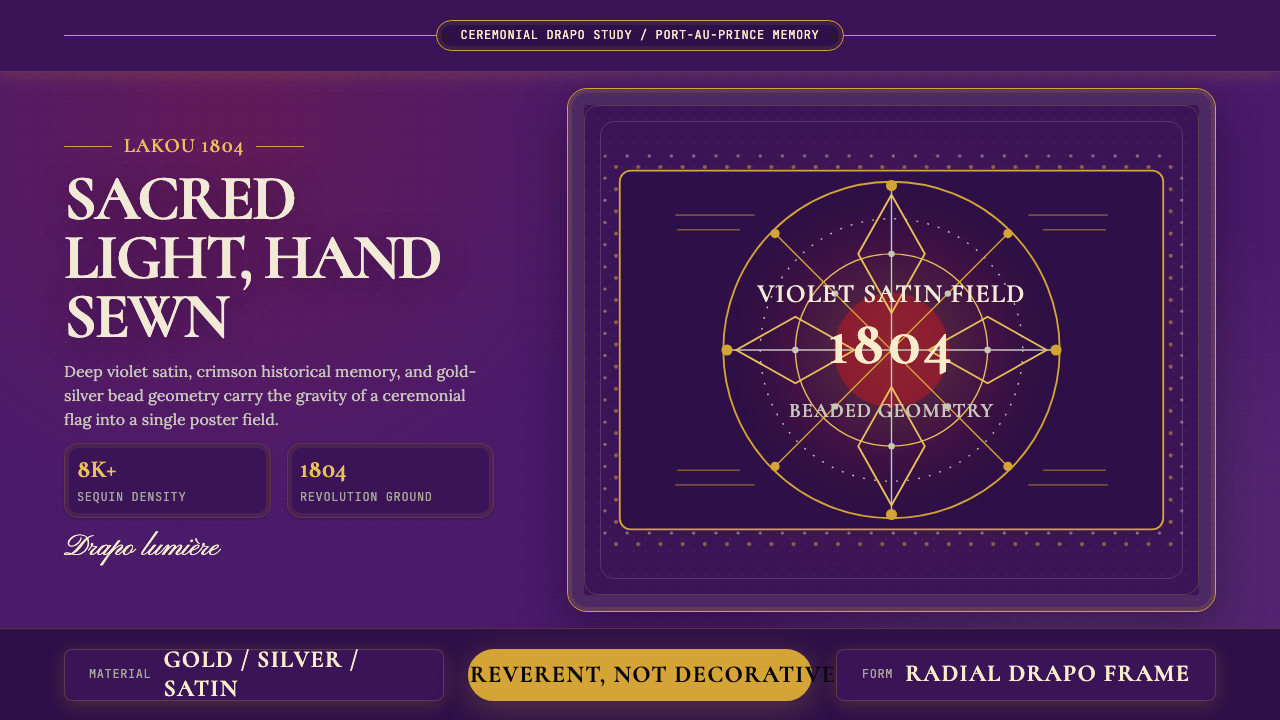 Haitian Vèvè Sequin Drapo 1804Sacred density. Violet satin, gold sequins, and radial geometry hold 1804 gra…