What is Haitian Gingerbread House (1900)?
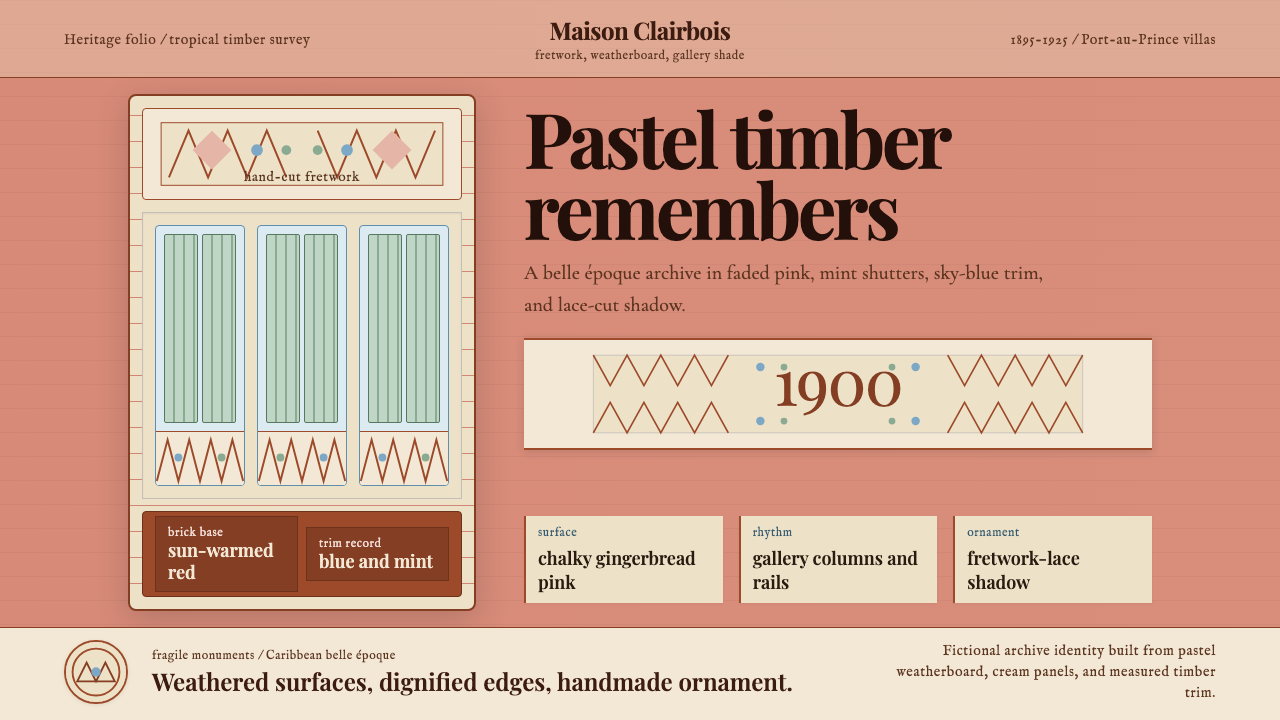
Port-au-Prince's gingerbread houses are a Caribbean belle époque in wood and plaster — faded pastel walls, hand-cut fretwork lace, and wrap-around galleries that turn every breeze into an architectural event.
Haitian Gingerbread House (1900) in brief
Haitian gingerbread architecture is a cluster of two-storey timber and brick villas built in Port-au-Prince between roughly 1895 and 1925. Their most recognizable features are steep mansard roofs, gabled dormer windows, octagonal corner towers, and the dense fretwork ornament — cut from tropical hardwood into lattice, floral, and geometric screens — that fills every gable, gallery rail, and eave bracket. The overall effect is lacy and exuberant, closer in spirit to a Victorian confection than to the stern grandeur of the French colonial buildings that inspired it.
The palette is characteristically soft and weathered: pinks that have faded toward dusty rose or salmon, shutters in mint green or sky blue, trim lines in cream or pale yellow, and occasional accents in deeper coral or terracotta. The colors are never saturated or uniform; they read as layered time — coats applied and aged over decades, bleached by Caribbean sun and tropical rain. Against these surfaces, the fretwork ornament creates an intricate play of shadow that shifts through the day as the sun moves, giving the buildings a quality of quiet animation entirely unlike the static facades of European counterparts.
As a design vocabulary, the style sits at a rare intersection: it carries European formal training (the architects studied in Paris), African spatial sensibility (the deep veranda as social and climatic mediator), and a distinctly Haitian improvisational energy visible in how no two gingerbread houses are identical — each applies the shared vocabulary of fretwork, galleries, and mansard forms in its own particular configuration.
Where does Haitian Gingerbread House (1900) come from?
The gingerbread house phenomenon grew out of a specific historical moment: the aftermath of Haitian independence (declared in 1804) and the slow consolidation of a Haitian educated elite in the late nineteenth century. By the 1890s, prosperous families in Port-au-Prince — merchants, professionals, government officials — had the means and the ambition to build permanent residences that announced their status. The chosen vocabulary was European in its aspirations but filtered through the Caribbean climate and the constraints of local materials.
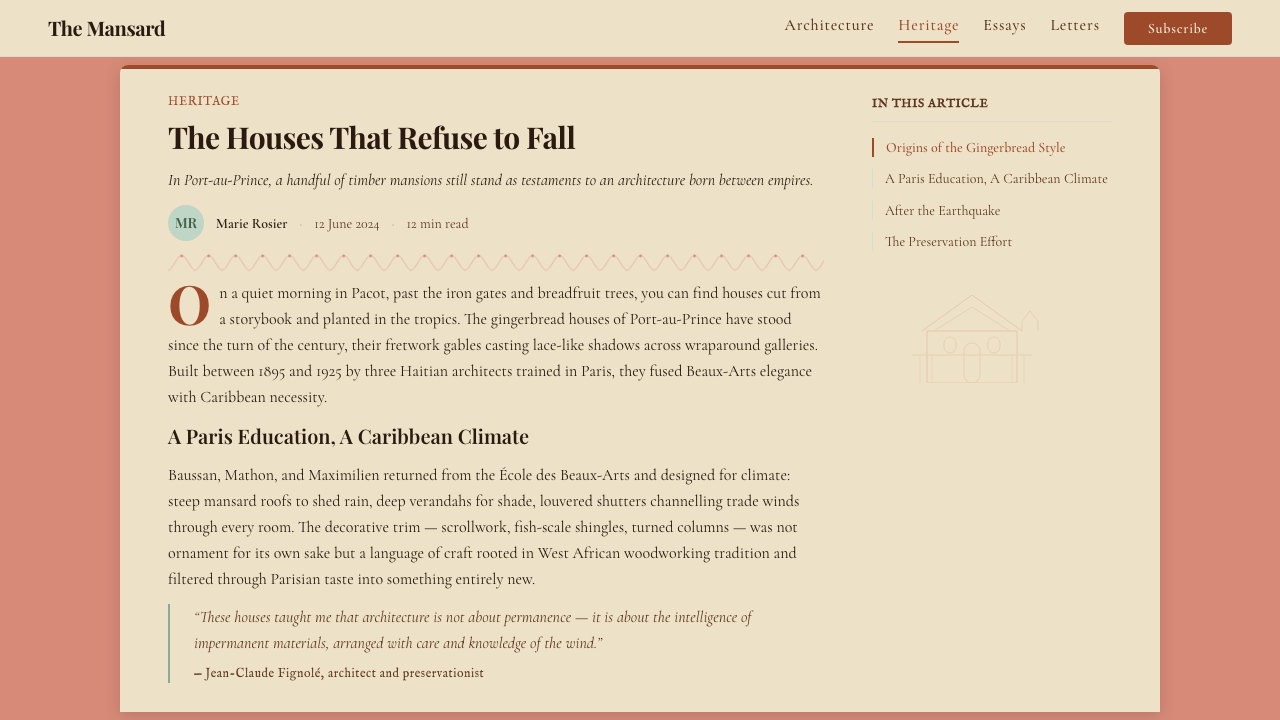
Three architects are central to the story. Léon Mathon, Georges Baussan, and Joseph-Eugène Maximilien all studied at the École des Beaux-Arts in Paris, absorbing the French Second Empire tradition of steep mansard roofs, prominent dormers, and formal symmetry. When they returned to Haiti, they adapted these forms radically. The deep wraparound gallery — borrowed from West African building traditions and already present in earlier Caribbean vernacular architecture — replaced the enclosed French salon as the primary social space. Fretwork ornament, which in French metropolitan architecture appeared sparingly on balcony railings, was expanded into entire decorative systems covering gables, eaves, and column capitals. The climate demanded it: the carved screens admit breeze while blocking direct equatorial sun, functioning as both ornament and passive ventilation.
The timber itself came from Haiti's tropical forests, and the fretwork was cut by local craftsmen working with hand tools. This is why no two gingerbread houses have identical ornamental patterns — each was site-built by artisans who improvised within a shared formal language, much as jazz musicians improvise within a harmonic structure. The American scholar Anghelen Arrington Phillips, who documented the buildings extensively in the late twentieth century, noted that the craftsmen had no templates: they worked from the architect's drawings but made hundreds of local decisions about proportions, depths, and decorative motifs on the site.
The peak construction period coincided with a broader Haitian cultural confidence during the early twentieth century — a period of political stability, economic recovery, and national pride that produced not only the gingerbread houses but also schools, public buildings, and a flourishing literary and artistic scene. After the American occupation of Haiti (1915–1934) and the subsequent economic turbulence of the mid-twentieth century, new construction in the gingerbread style largely ceased. The existing houses entered a long period of decline: subdivided into apartments, deprived of maintenance resources, and increasingly fragile. The 2010 earthquake destroyed or severely damaged dozens of the most significant surviving examples. The remaining houses — concentrated in the neighborhoods of Pacot, Bois Verna, and Turgeau — were placed on the UNESCO World Monuments Watch, and efforts to document and stabilize them have continued since.
What defines the Haitian Gingerbread House (1900) look?
Weathered Pastel Palette
The colors are soft and aged rather than fresh or saturated. Dusty rose, faded salmon, and pale pink dominate the main wall surfaces, while shutters and galleries tend toward mint green, sky blue, or pale aquamarine. Trim and fretwork details are often painted in cream, pale yellow, or off-white to create contrast without competing with the main surfaces. The defining quality is the sense of layered time — colors that have been repainted over decades and gently bleached by tropical sun and rain until they arrive at a state of quiet, imperfect beauty.
Fretwork Ornament
The carved wooden fretwork is the defining visual element of gingerbread architecture. Cut from tropical hardwood by hand, it appears as open screens filled with geometric lattice patterns, stylized floral forms, and interlocking curves. Its placement is systematic: gable peaks receive the most elaborate treatments, while gallery railings, column brackets, and eave edges carry lighter, repeating patterns. The effect is simultaneously structural and decorative — the screens provide shade and ventilation while creating dense shadow-play on the surfaces behind them. No two houses share identical fretwork patterns, giving each building an individual visual identity within the shared vocabulary.
Mansard Roofline and Dormers
The steep double-pitched mansard roof, borrowed from French Second Empire architecture, gives each gingerbread house its distinctive silhouette. The upper slope is nearly vertical, while the lower slope breaks at a sharp angle, creating an attic storey with full standing headroom. Dormer windows — often arched, pointed, or decorated with their own miniature gable ornament — punctuate the roofline at regular intervals and add visual rhythm to the profile. Octagonal corner towers with conical or faceted roofs frequently anchor the composition at building corners, giving even modest houses an almost castle-like presence on the street.
Wraparound Gallery
The deep veranda, wrapping one or more sides of the house, is both the functional core and the social heart of gingerbread architecture. Supported by slender wooden columns with decoratively carved capitals, the gallery creates a transitional zone between interior and exterior — sheltered from rain and direct sun, open to prevailing breezes. In a tropical climate, this is where household life unfolds: meals, conversation, watching the street. Architecturally, it serves as a visual base course that grounds the ornate upper storeys, and its repetitive column-and-fretwork rhythm gives the facade its horizontal legibility.
Shadow as Decoration
More than any other element, the shifting shadow patterns cast by fretwork screens define the visual character of gingerbread buildings across the day. In the morning, long directional shadows stripe the gallery floors and inner walls. At midday, the overhead sun creates dense, intricate lacework shadows on every surface the screens protect. In late afternoon, the quality of light turns golden and the shadow patterns deepen and dramatize. This time-dependent quality means that photographs of gingerbread houses taken at different hours can look almost like different buildings. The architecture is designed to collaborate with light rather than resist it.
Improvisational Individuality
Unlike industrial or mass-produced design systems, gingerbread architecture carries the marks of individual craft decisions at every scale. Fretwork patterns, tower placements, dormer shapes, gallery column spacing, and paint color choices were all made locally, by specific craftsmen and owners, resulting in a street-level diversity that reads as a collective conversation rather than a uniform style. Two houses on the same block might share the same roof type and gallery structure but vary completely in their ornamental details and color choices. This built-in variation is a feature rather than an inconsistency — it reflects the social reality of individual families expressing identity through a shared architectural language.
Structural Lightness
Despite the density of their ornament, gingerbread houses have a visual lightness that distinguishes them from the massive stone architecture of European formal buildings. This lightness comes from the combination of slender wooden columns, open fretwork screens, and elevated gallery floors that lift the main body of the house above street level. The buildings feel permeable rather than monumental — more like elaborate wooden pavilions than fortified residences. This quality of permeability is not incidental; it is a direct response to the tropical climate, where cross-ventilation and shade are more valuable than thermal mass.
Who shaped Haitian Gingerbread House (1900)?
Mathon is considered the founding figure of Haitian gingerbread architecture. After training in Paris, he returned to Port-au-Prince and began designing residences that adapted French Second Empire forms to the Haitian climate and local craft traditions. His buildings established the core vocabulary — mansard roofs, deep galleries, elaborate fretwork — that subsequent architects and craftsmen would develop and elaborate. Several of his works survive in the Pacot and Turgeau neighborhoods, though many have suffered earthquake and neglect.
Baussan worked alongside Mathon as one of the principal architects of the gingerbread era. His designs are notable for their compositional ambition — corner towers, complex rooflines, and particularly inventive fretwork patterns. He was also involved in the design of public buildings in Port-au-Prince, extending the gingerbread vocabulary beyond residential architecture into civic contexts. His work demonstrates the degree to which the style was understood as a legitimate and refined Haitian architectural identity, not merely a colonial imitation.
Maximilien completed the founding triad of gingerbread architects. His contributions include some of the most formally inventive surviving buildings in the Port-au-Prince gingerbread neighborhood, characterized by their octagonal towers and particularly fine fretwork carving. Together with Mathon and Baussan, he established an architectural tradition that was entirely Haitian in character despite its European training — a fusion of influences that produced something genuinely original.
An American architectural historian who devoted decades to documenting Port-au-Prince's gingerbread houses before many were destroyed in the 2010 earthquake. Phillips conducted extensive field research in the neighborhoods of Pacot, Bois Verna, and Turgeau, recording building histories, interviewing residents, and documenting the craft traditions of the original builders. Her work provided the primary scholarly foundation for subsequent preservation efforts and ensured that detailed records of many lost buildings exist even after the earthquake rendered them irretrievable.
How do you use Haitian Gingerbread House (1900) today?
Gingerbread architecture offers a design vocabulary that is simultaneously historically grounded and visually distinctive. Using it effectively requires understanding its core logic: the style is organized around contrast between delicate surface ornament and simple underlying forms, between warm weathered color and intricate white or cream fretwork detail, between the lightness of open screens and the solidity of the walls they protect. Applying it is not about literal reproduction of the architecture but about translating these principles into the medium at hand.
For presentation slides, the gingerbread palette works best on cover pages that establish a mood of faded elegance. A dusty rose or weathered salmon background with cream or pale mint text, accented by a fretwork-inspired geometric border or divider, communicates richness without ostentation. Content slides benefit from a simpler treatment: warm off-white backgrounds, one or two accent colors drawn from the palette, and typographic hierarchy achieved through weight and size rather than color variety. Data slides should use the palette sparingly — one warm accent color for primary data series, with other series in neutral tones — to preserve the style's restrained, aged quality. Avoid anything that reads as bright or saturated; the style's emotional register is one of beautiful imperfection, not freshness.
For web interfaces, the gingerbread vocabulary suits editorial contexts, portfolio sites, cultural organization pages, and heritage or hospitality brands where warmth and craftsmanship are valued over efficiency signals. A dashboard built entirely in gingerbread palette risks reading as decorative rather than functional; the better approach is to use the color vocabulary and ornamental sensibility as accent layers over an otherwise clean structure. Pricing pages can use fretwork-inspired dividers and warm background tints to soften what is often a clinical presentation, making the design feel considered and personal. Navigation and typographic elements should remain legible and clean — the ornament should support hierarchy, not compete with it.
For editorial and marketing work, the style's richest application is in full-page covers, feature headers, and backgrounds for pull quotes or call-out blocks. A large-scale fretwork pattern rendered in a very light tint over a warm ground creates depth and texture without visual noise. Marketing pages for artisanal, travel, or cultural brands benefit from the palette's warmth and the style's associations with craftsmanship and place. For longer editorial content, restraint is key: use the palette as atmosphere rather than decoration, appearing in section dividers, initial caps, and image borders rather than covering every surface.
The most common mistake when applying this aesthetic is oversaturation — using colors that are too fresh and uniform rather than the characteristically weathered, varied tones of actual gingerbread buildings. Equally problematic is applying fretwork ornament at too small a scale, where it becomes visual noise rather than intricate pattern. Fretwork works at large scales where its geometry reads clearly. A related mistake is treating the style as purely decorative and ignoring its underlying structural logic: the ornament in gingerbread architecture always follows the structural elements beneath it — galleries, gables, columns. When ornament appears without that structural anchor, it reads as costume rather than architecture.
Haitian Gingerbread House (1900) — FAQ
Is gingerbread architecture related to gingerbread houses in the fairy-tale sense?
The name is primarily descriptive and affectionate rather than etymologically precise. The fretwork ornament, steep rooflines, and general sense of elaborate sweetness reminded observers of decorated gingerbread confections — the nickname stuck and became the standard term both in Haiti and internationally. The architectural tradition has nothing to do with German fairy-tale imagery or holiday baking; it is a serious and sophisticated building tradition with deep roots in French academic training, West African spatial practice, and Haitian craft improvisation.
How does gingerbread architecture differ from Victorian architecture, which it superficially resembles?
The visual similarities are real — both traditions use elaborate wooden ornament, steep pitched roofs, and varied color — but the underlying logics are different. Victorian architecture in Britain and North America developed within a temperate climate, where ornament was primarily aesthetic rather than functional. Haitian gingerbread fretwork is climate-responsive: the carved screens provide shade and ventilation that are genuinely necessary in a tropical setting. The gallery, too, is a functional climate mediator rather than a decorative porch. Additionally, gingerbread architecture reflects West African spatial sensibilities imported through the Haitian population's ancestry, giving the tradition a cultural layering that is absent in metropolitan Victorian work.
Is this a dark or light design system?
Haitian gingerbread architecture is fundamentally a light-ground system. The main wall surfaces are light-toned pastels — faded pinks, salmons, and off-whites — and the fretwork ornament reads against them as light cream or white. This lightness is not incidental; it reflects the climate logic of reflecting sunlight rather than absorbing it. A dark inversion of the palette is possible but works against the style's essential character, which is warm, sun-drenched, and gently aged rather than dramatic or nocturnal. Applications using the style should generally work on light or warm neutral backgrounds.
What makes gingerbread architecture specifically Haitian rather than generically Caribbean or French colonial?
Several factors make the tradition specifically Haitian. First, it emerged from a generation of Haitian architects who had trained in Paris but were building for a newly independent nation with a strong sense of cultural identity — the aesthetic choices reflect both aspiration and distinction from French colonial authority. Second, the fretwork ornament at this scale and elaborateness is unique to Haiti; comparable Caribbean vernacular buildings use simpler lattice or louvered shutters without the dense carved screens. Third, the craft tradition — the improvised, non-templated carving of individual craftsmen — is distinctly Haitian in its improvisational character. Finally, the specific palette of weathered Caribbean pastels, combined with the tropical landscape context, reads unmistakably as Haitian in origin.
How should this style be used responsibly, given that the original buildings are endangered heritage?
Using the gingerbread aesthetic thoughtfully means engaging with it as a living tradition rather than extracting it as pure visual commodity. This includes understanding where it comes from and why — the specific historical and cultural context of post-independence Haiti, the named architects who created it, and the craftsmen whose work it celebrates. When using the style in professional contexts, acknowledging its origins is appropriate. More actively, awareness of the preservation situation — that many original buildings were lost in the 2010 earthquake, that survivors are at ongoing risk, and that organizations exist working to document and protect them — makes the engagement more honest. The style's use in design should be a form of recognition, not erasure.
Related design styles
 Peruvian Quechua Keros (Andean Cup)Hidden cosmology glows. Crimson lacquer and saffron tocapu grids frame the st…
 Slavic Firebird FolkloreNever bare paper. Crimson-gold firebird plumage glows in gilt folk borders on…
 Taiwanese Painted Tile VernacularGlaze refuses to fade. Rose ground, emerald modules, ochre borders form a til…
 Afghan War Rug (1980)Witness in wool. Madder red, indigo, and cream borders knot testimony into a…
 Ayacucho Retablo BoxSacred density. Deep teal shelves pack turquoise, cochineal, folk pink, and g…
 Haitian Vèvè Sequin Drapo 1804Sacred density. Violet satin, gold sequins, and radial geometry hold 1804 gra…