What is Taiwanese Painted Tile Vernacular?
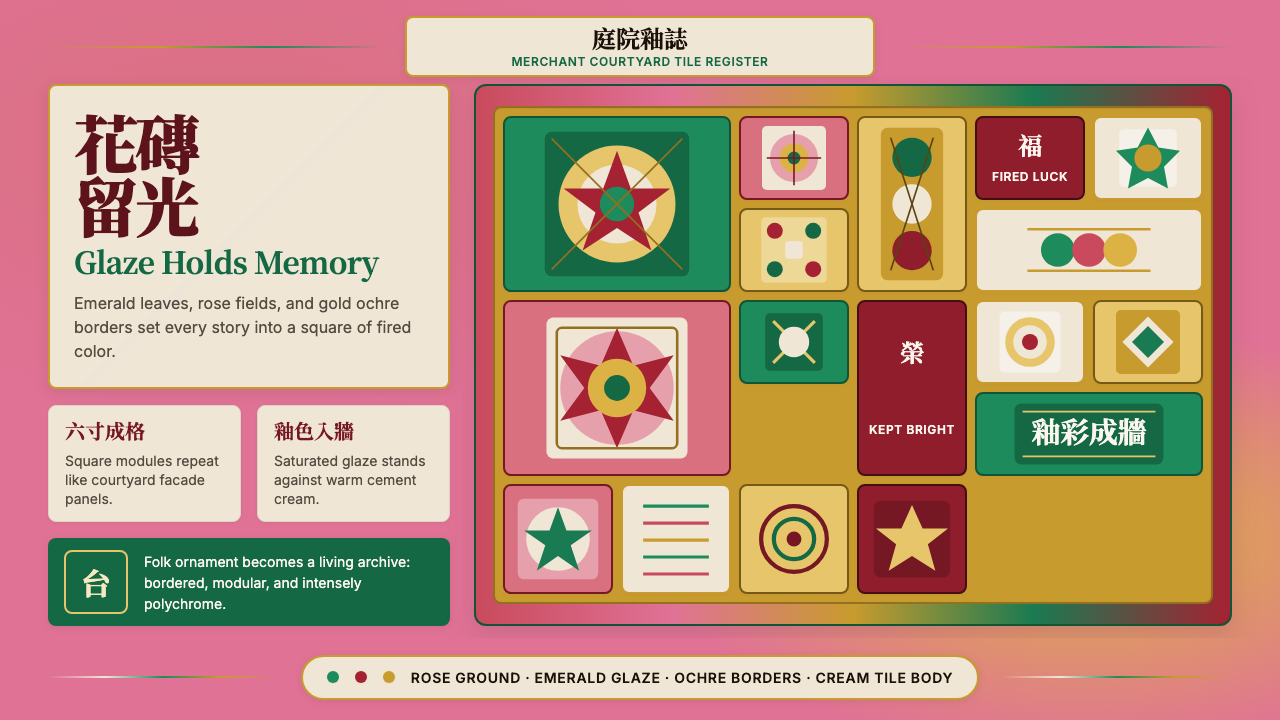
Fired in British and Japanese kilns but glazed in Taiwan's soul, the painted tile vernacular turned every merchant courtyard into a riotous garden of peonies, phoenixes, and folk-deity panels.
Taiwanese Painted Tile Vernacular in brief
The Taiwanese Painted Tile Vernacular is a folk-decorative design language rooted in the majolica glazed tiles that merchants and landowners embedded into the facades of their courtyard houses across western Taiwan from the 1870s through the 1940s. Each tile functions as a self-contained painting: saturated emerald greens, rose pinks, and warm gold-ochres fill compositions of garden flowers, mythological birds, auspicious deity figures, and interlocking geometric borders. The cumulative effect of dozens of tiles set into white-plastered cement render is at once encyclopedic and exuberant — a wall that tells stories.
Unlike the spare, monochromatic tile traditions found in Portuguese azulejo or Dutch Delft, the Taiwanese painted tile is unapologetically polychromatic. Color is not a supporting element; it is the primary communication. The richness of the glaze signals prosperity and abundance, the figurative imagery carries protective or congratulatory meaning, and the modular grid of individual tiles creates an architectural rhythm that organizes complexity without imposing silence. Every surface is populated; empty space is not a value here.
As a digital design language, this vernacular translates the tile's core qualities — vivid saturated palette, modular grid logic, figuration within a frame, and the tension between individual pictorial completeness and collective pattern — into interfaces that feel both culturally grounded and visually generous. It is a style suited to contexts where warmth, heritage, and decorative confidence are desirable, and where restraint would read as coldness.
Where does Taiwanese Painted Tile Vernacular come from?
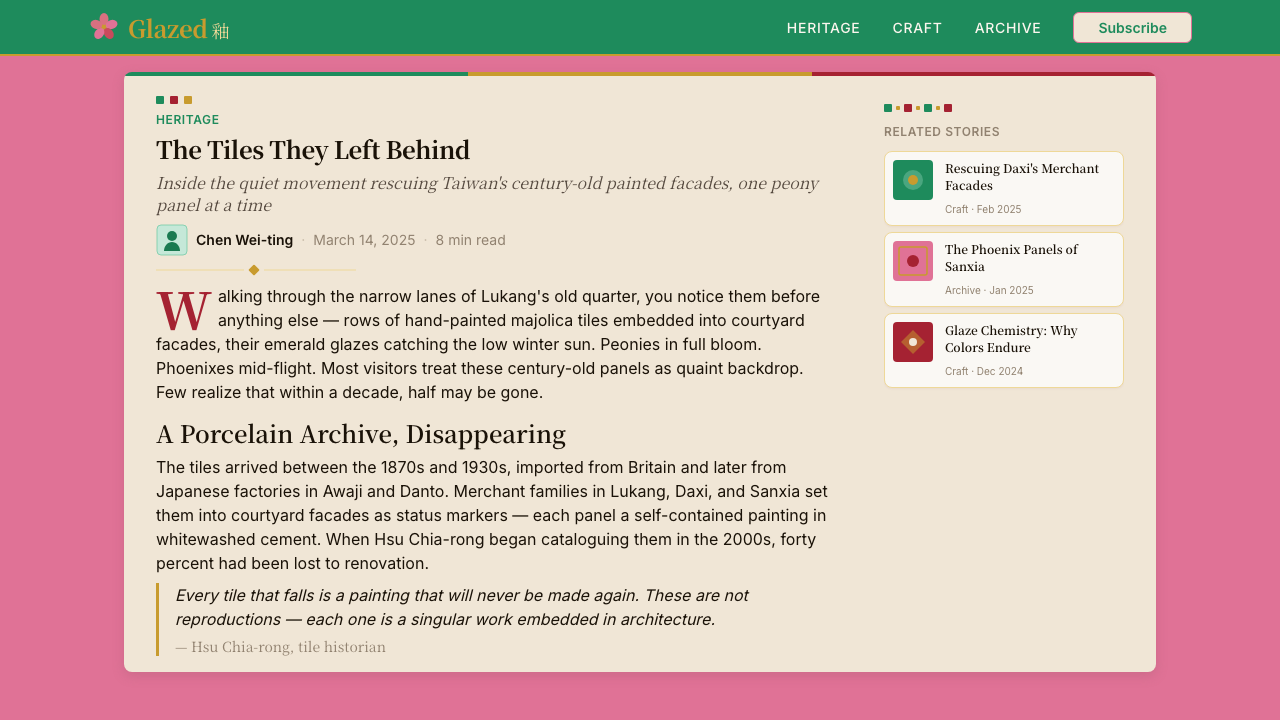
The story of the Taiwanese painted tile begins not in Taiwan but in England and Japan. From the 1870s onward, Staffordshire potteries — particularly firms based in Stoke-on-Trent — were exporting majolica-style tin-glazed tiles to Southeast Asia and the China coast as part of the broader commerce accompanying British industrial expansion. Japanese manufacturers, especially those centered in Aichi and later Mino, observed the demand and began producing competing tiles in the 1910s and 1920s with designs recalibrated to East Asian taste: more peonies, more auspicious birds, more deity imagery, and border motifs drawn from Chinese paper-cutting and embroidery traditions. Taiwan, under Japanese colonial administration from 1895, became a major destination for this Japanese-made tile production.
The buyers were the merchant and landowning class of Hokkien-Taiwanese society, who were constructing or renovating the san-ho-yuan and si-he-yuan courtyard houses that signified their social standing. Tiled facades served multiple purposes: they were durable against the subtropical climate, they were conspicuously expensive in a period before domestic tile production existed in Taiwan, and they carried dense iconographic programs — the peony for wealth, the phoenix for virtue, the bat for good fortune, Mazu for maritime protection — that communicated the family's values and aspirations to visitors entering the courtyard gate. Towns with active merchant populations, particularly Lukang, Daxi, Sanxia, and the Penghu Islands, accumulated the densest concentrations of tiled buildings.
The economic and political disruptions of the mid-twentieth century brought the tile era to an end. The Second World War interrupted imports; postwar reconstruction prioritized different materials; and successive decades of rapid modernization led many families to cover or demolish their tiled courtyard houses in favor of reinforced concrete buildings. By the late twentieth century, the tiles had been largely forgotten outside the scholarly community, and many remaining examples were in poor condition or had been sold off piece by piece to antique dealers.
The contemporary rescue of the Taiwanese painted tile is inseparable from the figure of Hsu Chia-rong, a former computer engineer from Tainan who spent more than twenty years — and a reported personal fortune — purchasing tiles from demolition sites and private collections and reassembling them into the Taiwan Tile Museum he founded in Chiayi. Hsu's effort, supported by researchers such as Hong Kun-fu, ceramics scholar Chen Tsuei-hua, and historian Lin Hsi-hsia, transformed the tile from a discarded architectural remnant into a recognized element of Taiwanese cultural identity. The 2010s old house renewal movement — a broader wave of civic interest in preserving Taiwanese vernacular architecture — amplified this rehabilitation, and the painted tile became one of its most visible symbols. Today the tile image appears on local craft goods, public murals, and digital design systems as an emblem of Taiwanese folk creativity.
What defines the Taiwanese Painted Tile Vernacular look?
Color
The palette is saturated and warm at its core: an emerald green derived from copper-based glazes, a rose pink verging on deep magenta, and a gold ochre that anchors the warmest register. These three hues carry the weight of the visual system, and together they read as unmistakably Taiwanese. Secondary accents — a deep cobalt blue, a soft ivory, a burnt orange — appear in figurative panels and border details. White is not a ground color in the Western minimalist sense; it is the plaster wall between tiles, a neutral separator that intensifies rather than dominates. Black outlines the figurative elements and border frames with ink-like precision, drawing on the same linear vocabulary as traditional Chinese painting and paper-cutting.
Modularity and the Grid
Each tile is a fixed square unit, and the design system's fundamental logic is the assembly of these units into larger compositions. This is not an arbitrary constraint but a structural principle inherited from the physical manufacturing process: tiles were produced in standardized dimensions, and facade compositions were planned around available inventory. In digital translation, this modular grid creates a natural rhythm — a predictable cadence of framed pictorial cells that carries the eye across a surface. Individual cells may contain single motifs; groups of four or nine tiles may complete a single large composition. The grid is always present, even when the imagery spans multiple cells.
Figuration and Iconography
The tile vocabulary is deeply figurative and iconographically coded. Peonies signal wealth and social standing; phoenixes signal virtue and renewal; mandarin ducks signal marital harmony; bats signal incoming fortune; Mazu and other folk deities signal protection. These are not decorative choices in an arbitrary sense — each figure was selected by the building owner for its specific meaning, and a literate Taiwanese viewer reading a facade would have decoded a deliberate program. In contemporary use, the figurative richness can be deployed literally (using the original motifs) or abstractly (extracting the compositional logic of a framed, centered, symmetrical motif without the specific imagery).
Border and Frame
Every tile — and every group of tiles — is typically bounded by a decorative border. These borders range from simple geometric bands in alternating colors to elaborate interlaced meander patterns, stepped key-fret motifs, and floral scrollwork. The border does double duty: it contains and completes the individual pictorial unit, and it creates visual continuity between adjacent tiles, knitting the individual pieces into a unified surface. In digital use, the border system is one of the most transferable elements — it provides a ready-made vocabulary for component framing, section dividers, and decorative edge treatments without requiring the full figurative apparatus of the style.
Symmetry and Bilateral Balance
Unlike the deliberate asymmetry of modernist design traditions, the Taiwanese tile vernacular is fundamentally symmetrical at the level of individual tiles and compositional groups. A single tile depicting a peony spray is typically composed around a central vertical axis. A panel of four tiles showing a phoenix will balance the bird against mirroring foliage on both sides. This bilateral symmetry carries social meaning — symmetry in Chinese folk visual culture signals completeness, good fortune, and the balanced harmonies of heaven and earth. Asymmetric arrangements within the tile system tend to be the result of material constraints or adaptive composition rather than aesthetic preference.
Texture and Glaze Quality
The physical majolica tile has a surface quality that flat digital reproduction struggles to fully convey: a slight convexity and surface relief within the painted areas, a matte-to-satin glaze that shifts in sunlight, and the visible brushwork or mold-pressed texture beneath the glaze. In digital applications, acknowledging this material quality — through subtle surface variation, gentle highlight effects, or deliberate imperfection in pattern repetition — prevents the style from reading as purely graphic pastiche. The style works best when it retains some of the warmth and slight irregularity of handmade ceramics rather than becoming a perfectly clean vector pattern.
Density and Generosity
The tile tradition does not aestheticize emptiness. Compositions fill their frames; surfaces fill their walls; borders fill the space between compositions. This is a design philosophy of abundance rather than restraint, and it has genuine cultural grounding: in Hokkien-Taiwanese folk aesthetics, a full and busy surface signals prosperity and vitality, while bare surfaces can read as lack or neglect. In digital contexts, this means the style actively resists minimal layouts. It is at home on rich landing pages, dense gallery views, and ornament-positive branding contexts, and it needs adaptation — considered reduction without losing character — when forced into the sparse UI conventions of productivity software.
Who shaped Taiwanese Painted Tile Vernacular?
A former software engineer from Tainan, Hsu Chia-rong spent more than two decades buying painted tiles from demolition sites and private collectors across Taiwan, reportedly at considerable personal expense. He founded the Taiwan Tile Museum in Chiayi, which houses one of the world's most significant collections of early twentieth-century majolica tiles made for the Taiwanese market. His advocacy transformed the tile from an overlooked relic into a recognized symbol of Taiwanese folk culture, and the museum's educational programs have introduced the tile aesthetic to a generation of designers, craft workers, and students who encountered it as a living reference rather than an archival curiosity.
Hong Kun-fu is among the most prominent researchers of Taiwanese vernacular architecture and the decorative traditions embedded within it. His fieldwork documenting tiled buildings across Taiwan — from the dense courtyard houses of Lukang to the wind-wall residences of the Penghu Islands — produced the most comprehensive geographic survey of surviving painted tile facades, and his analysis of the iconographic programs visible in different regional concentrations helped establish which motifs carried which meanings in which social contexts. His scholarship provided the academic foundation on which the preservation movement and the design revival both built.
Chen Tsuei-hua approached the painted tile tradition from the perspective of ceramics scholarship, tracing the production histories of the British and Japanese factories whose output ended up on Taiwanese facades. Her research clarified the previously confused attribution of many tile designs — distinguishing English Staffordshire pieces from Japanese Aichi and Mino products, identifying approximate production dates from glaze chemistry and mold characteristics, and tracing the distribution networks through which specific designs traveled from kilns in Japan to courtyard walls in Lukang or Daxi. This production-side scholarship complemented the architectural and iconographic work and gave the preservation movement a clearer picture of the tile's transregional origins.
Lin Hsi-hsia contributed to the historical framing of the tile tradition within the broader context of Taiwanese social history, examining how the tile-buying practices of Hokkien-Taiwanese merchants and landowners during the Japanese colonial period intersected with questions of identity, status display, and the negotiation of Taiwanese folk culture under colonial modernity. Her work highlighted the tile not merely as an aesthetic object but as a social artifact whose accumulated meanings — about prosperity, piety, community, and belonging — were as important as its visual qualities. This contextualizing scholarship helped the revival movement articulate why the tile mattered, not only what it looked like.
How do you use Taiwanese Painted Tile Vernacular today?
The Taiwanese Painted Tile Vernacular is a high-saturation, figuration-positive, and pattern-dense style. Using it effectively means embracing its logic of abundance rather than trying to strip it back into something that resembles contemporary minimalism. The first question to ask is whether the context genuinely calls for warmth, cultural depth, and decorative richness — if yes, commit fully; if not, a different style will serve better.
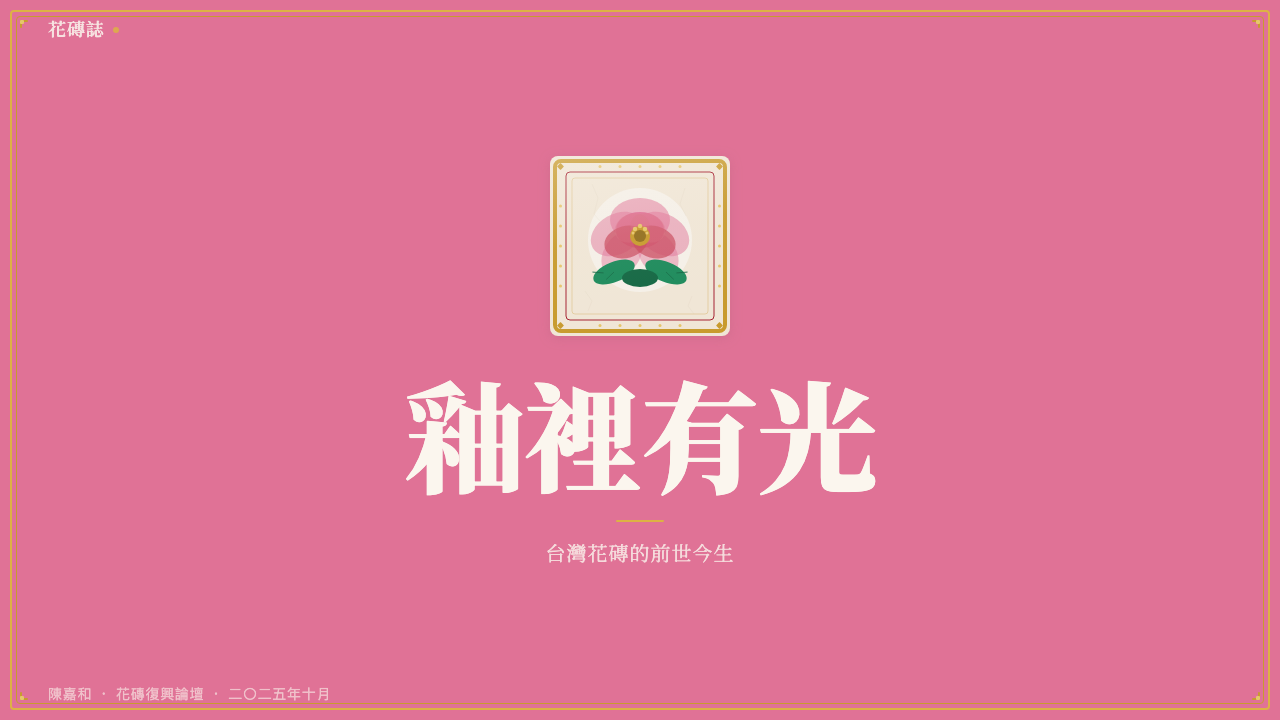
For presentation slides, the tile vernacular works best as an immersive frame rather than a neutral container. Cover slides benefit from a rich background treatment: a full-bleed tile pattern or a centered panel-style composition with a bold figurative motif at center, bordered and framed, with the title text set in a clean contrasting weight that reads clearly against the decorated ground. Content slides work differently — they should lighten the approach significantly, using tile-derived color accents and border elements on white grounds to maintain the design language without overwhelming the information. Data slides can use the saturated palette strategically: the rich greens and pinks work well for categorical differentiation in charts, provided the palette is applied consistently.
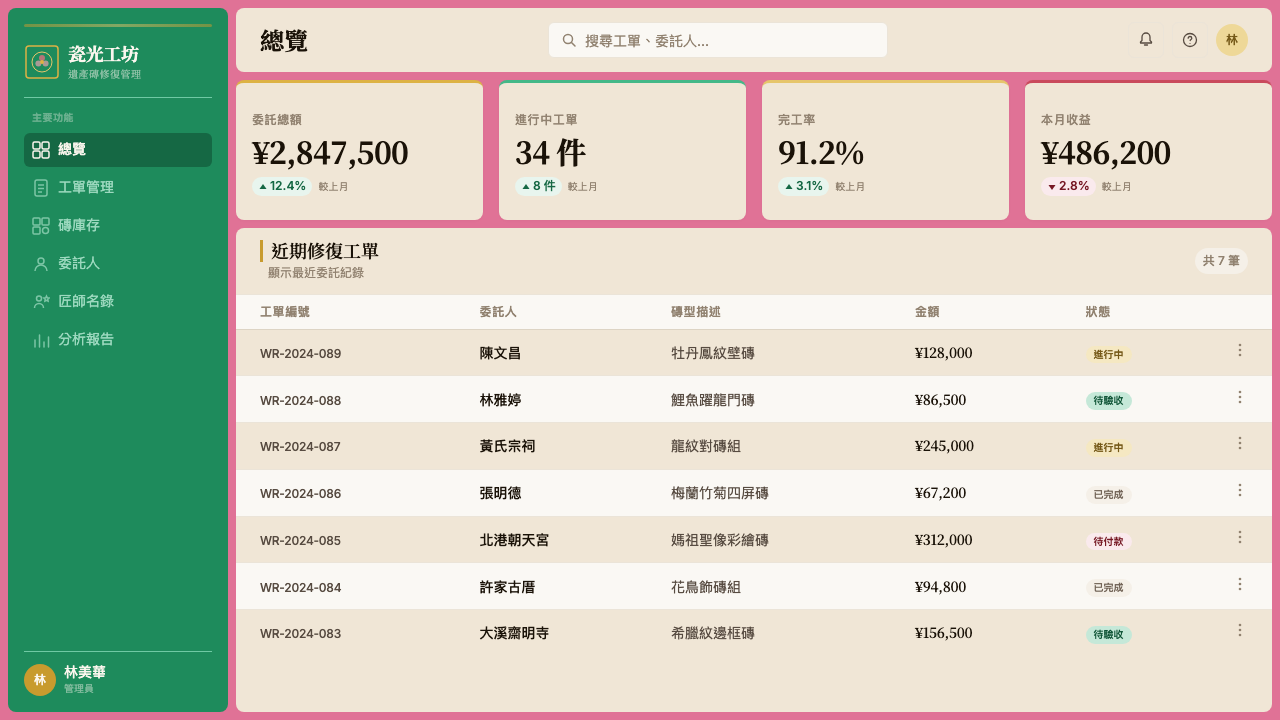
For web interfaces, the style is at its strongest on landing pages, cultural institution sites, and brand identity contexts where the audience expects richness. A tile-vernacular home page works with a mosaic or grid-of-panels structure, each panel carrying a self-contained visual composition — saturated color field, centered motif, bordered frame. Navigation and utility elements should be relatively restrained (dark text on neutral ground) to create contrast with the richly decorated content areas. E-commerce and gallery interfaces can use tile-pattern borders and panel frames as product card backgrounds, though individual card layouts should be clean enough that product imagery reads clearly.
For editorial and marketing work, the most successful applications draw on the tile's poster-like boldness: full-width banner sections with centered, symmetrical compositions in the tile color palette; section dividers using geometric border strip motifs; pull-quote treatments that borrow the tile's framing logic (a short, complete, ornamentally bordered text block). The style is exceptionally strong for cultural, food, travel, and heritage brands, and for event materials, packaging, and social media graphics where high visual impact is the priority.
A common mistake when applying this style is using the palette but ignoring the compositional logic. The tile vernacular is not simply a color palette — it is a system of frames, borders, symmetry, and pictorial completeness. A design that uses rose pink and emerald green but arranges them in loose, unframed, asymmetric layouts will miss what makes this style distinctive. Similarly, mixing the saturated tile colors with large areas of flat white negative space will neutralize the style's character; the vocabulary is generous, not sparse, and it reads most authentically when the surface is populated rather than empty.
Taiwanese Painted Tile Vernacular — FAQ
Is the Taiwanese Painted Tile Vernacular the same as the broader majolica tile tradition?
Majolica tile refers to the production method — tin-glazed earthenware with painted decoration — used by British, Italian, Japanese, and other manufacturers from the nineteenth century onward. The Taiwanese painted tile is a regional tradition within that broader family: tiles produced primarily by English and Japanese factories specifically for export to Southeast Asia and the China coast, selected and arranged by Taiwanese building owners according to Hokkien-Taiwanese folk iconographic programs. The shapes, glazing technique, and industrial production method are shared with the broader majolica tradition; the iconographic content, the compositional programs, and the cultural meanings are distinctly Taiwanese.
How does the style handle dark or night-mode interfaces?
The tile tradition is fundamentally a light-condition aesthetic: the original tiles were designed to catch Taiwan's subtropical sunlight and the saturated colors were calibrated for bright outdoor surfaces. A dark-mode interpretation is possible but requires recalibration. On a very dark ground, the saturated emerald and rose will retain their character, but the gold ochre can read as muddy unless lightened. More importantly, the white mortar lines and plaster ground between tiles — which provide structural breathing room in the original — need a substitute in dark mode, typically a deep warm gray rather than pure black. The most successful dark-mode applications of this style tend to treat the dark ground as analogous to a lacquered panel rather than a neutral digital background, treating the tile motifs as inlaid decoration against a rich, non-neutral field.
Can this style work for technology or SaaS products, or is it too culturally specific?
The style's cultural specificity is both its strength and its limitation. For products that are intentionally rooted in Taiwanese, East Asian, or Southeast Asian cultural identity, the specificity is a feature — it signals genuine provenance rather than generic global design. For international or culturally neutral technology products, full deployment of the style risks reading as costume rather than design language. The practical middle ground is to use the style's structural vocabulary — modular grid, panel framing, border system, saturated color palette — while keeping the specific figurative iconography (the peonies, phoenixes, deity panels) as optional accent rather than primary visual content. This abstracted approach retains the style's warmth and organizational character without requiring the audience to be familiar with the iconographic tradition.
What is the relationship between this style and other Taiwanese or Chinese folk design traditions?
The painted tile vernacular draws from the same iconographic pool as several related traditions: Hokkien paper-cutting and embroidery share the same motif vocabulary (peonies, phoenixes, bats, auspicious geometry); traditional Taiwanese temple architecture uses similar figure programs in painted beams and ceramic ridge ornaments; and the broader Chinese folk decorative tradition encompasses the same symbolic coding of color, flora, and fauna. What distinguishes the tile is its material origin (industrially produced, imported) and its architectural function (facade cladding rather than portable craft or sacred decoration). The tile's particular visual character — bright, slightly raised, glaze-rich surfaces in a modular grid — distinguishes it from hand-embroidered or wood-carved folk traditions even when the iconographic content overlaps.
How should this style be adapted for accessibility, given its density and high saturation?
The tile vernacular's density and saturation create real accessibility challenges, particularly for text legibility and color differentiation. The most important adaptation is to separate the decorative layer from the informational layer clearly: tile-pattern backgrounds and decorative borders should never compete with text for attention, and any text placed over a patterned ground needs either a legible panel or a generous semi-transparent overlay. The color palette's richness is an asset for categorical data (where the distinct hues make categories memorable) but a liability if used to convey critical status information without an additional non-color signal (shape, icon, or label). The pattern density is best contained to section backgrounds, border elements, and accent panels, with content areas using the palette's cleaner, less complex end to maintain legibility.
Related design styles
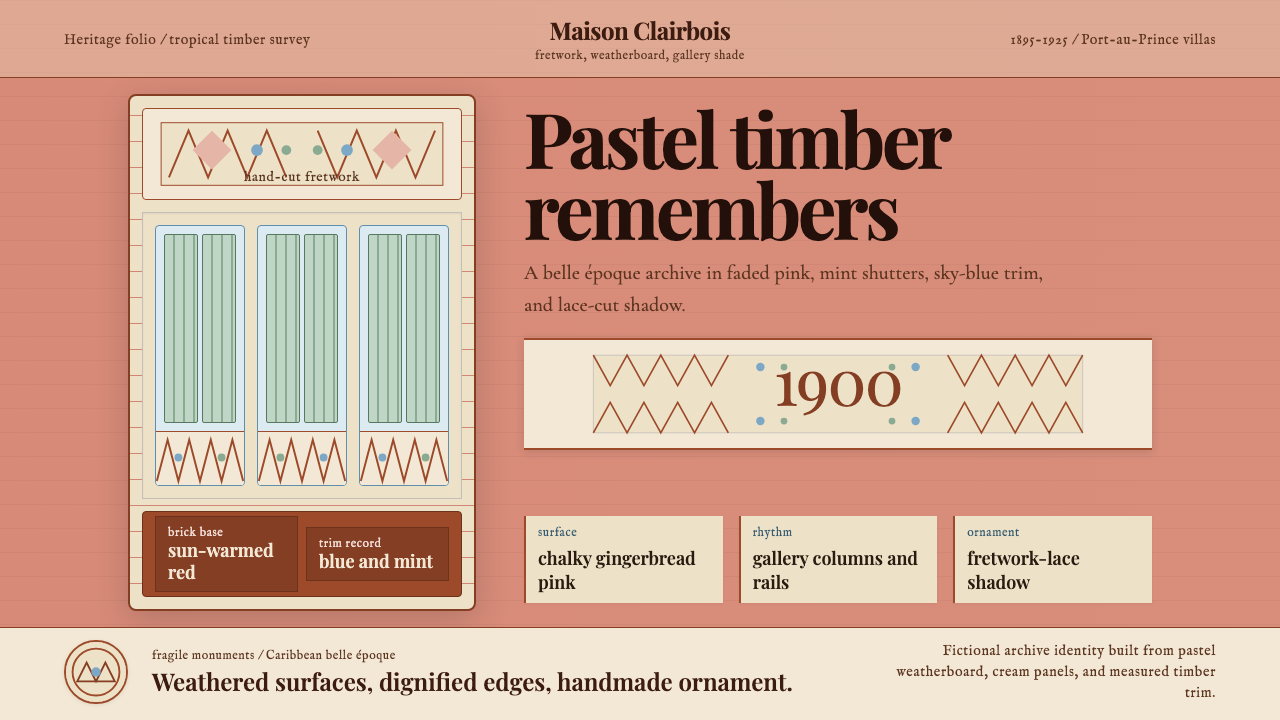 Haitian Gingerbread House (1900)Fragile elegance endures. Faded pink walls carry mint shutters and fretwork-l…
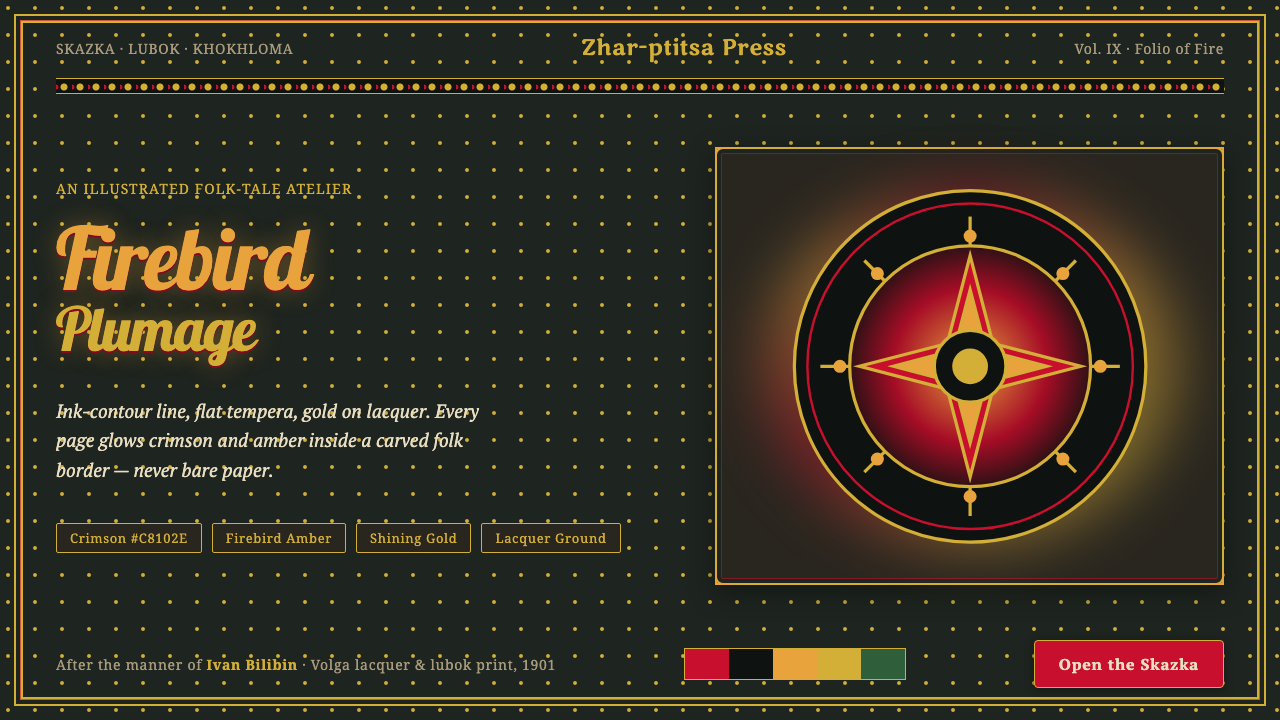 Slavic Firebird FolkloreNever bare paper. Crimson-gold firebird plumage glows in gilt folk borders on…
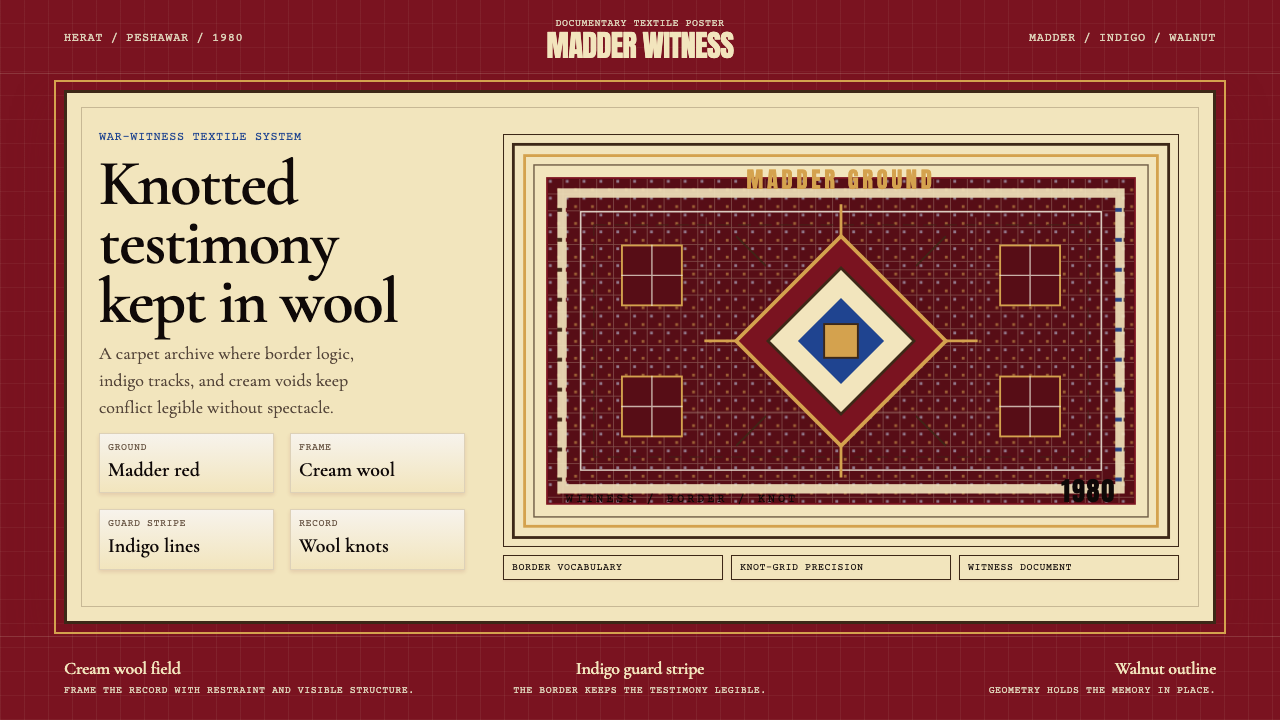 Afghan War Rug (1980)Witness in wool. Madder red, indigo, and cream borders knot testimony into a…
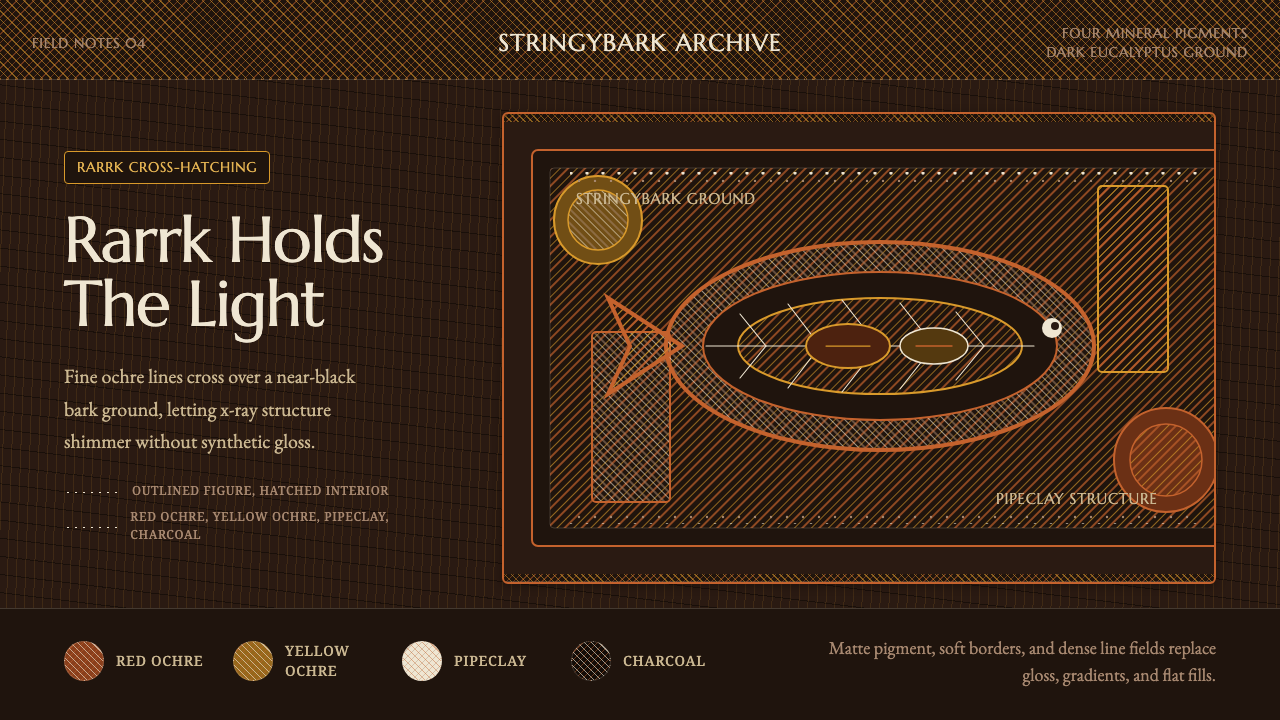 Arnhem X-Ray Bark PaintingShimmers without gloss. Ochre rarrk lines vibrate on dark stringybark.
 Ayacucho Retablo BoxSacred density. Deep teal shelves pack turquoise, cochineal, folk pink, and g…
 Burmese Yun LacquerwareLacquer glows in cut lines. Cinnabar, orpiment and viridian band a mirror-bla…