What is Afghan War Rug (1980)?
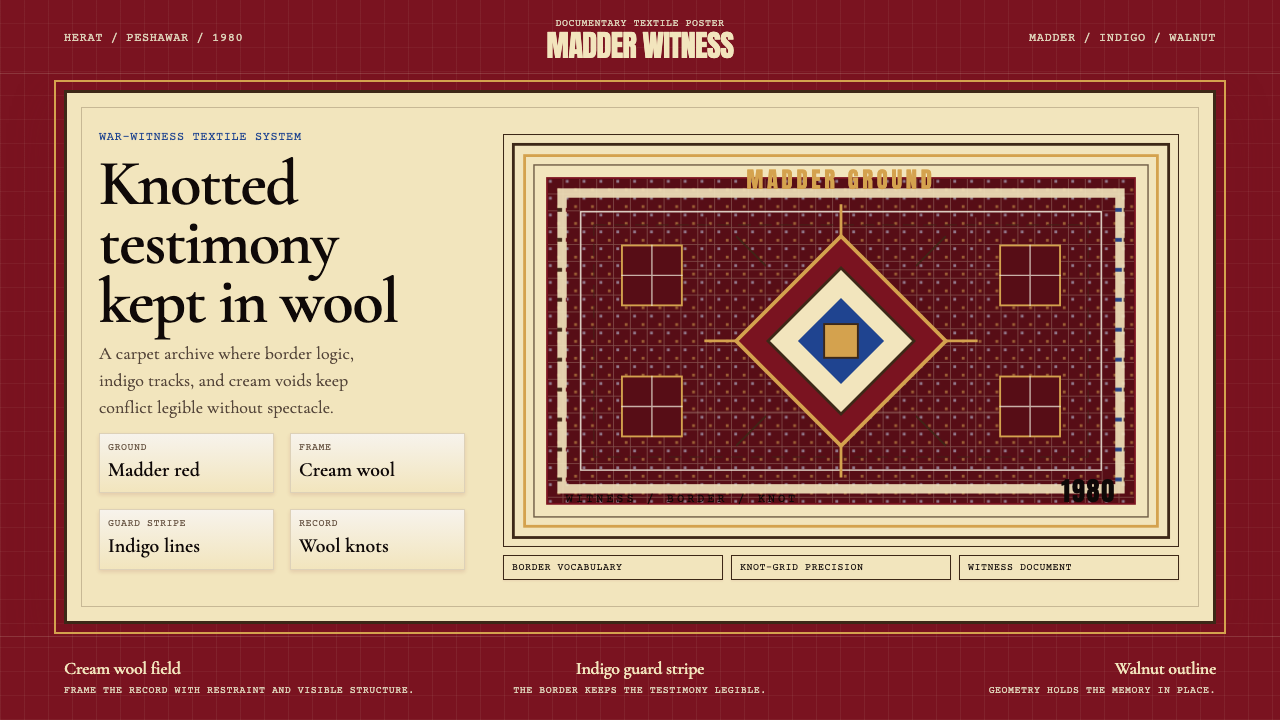
Woven during the Soviet occupation of Afghanistan, war rugs knotted Kalashnikovs, tanks, and helicopters into ancient carpet borders — turning a textile tradition into a pixel-art archive of conflict.
Afghan War Rug (1980) in brief
The Afghan war rug is a textile genre that emerged in the early 1980s, when Turkmen and Baluch weavers in Afghanistan and the refugee camps of Pakistan began incorporating military imagery — rifles, grenades, helicopters, tanks, landmines, and Soviet star insignia — into the vocabulary of traditional Central Asian carpet-making. These were not protest objects in any conventional sense; they were made primarily by women and children, who continued weaving in the only medium available to them, substituting war machines for the floral and geometric motifs their grandmothers had used.
What makes war rugs remarkable as a visual system is their formal tension. The military imagery — angular, mechanized, and modern — is knot-for-knot translated into the same rectilinear grid that structures any hand-woven carpet. A Kalashnikov rendered at carpet scale becomes a geometric abstraction, its silhouette broken into stepped diagonals dictated by the warp-and-weft constraint. The result is a visual language where extreme violence and ancient craft discipline occupy the same object simultaneously, each reading through the other.
As a design aesthetic, Afghan war rugs offer a distinctive palette derived from natural dyes — deep madder red, indigo blue, and warm cream — anchored within dense ornamental borders and organized on a strict rectilinear grid. The materiality of the wool knot is the foundational unit: everything resolves to a square cell, the way pixels resolve a digital image. This grid logic, when translated into digital design, produces a sensibility that is simultaneously decorative and diagrammatic, culturally resonant and formally disciplined.

Where does Afghan War Rug (1980) come from?
The history of Central Asian carpet-weaving reaches back more than two thousand years. The Turkmen and Baluch peoples of the Afghan plateau developed a particularly refined tradition: tribal rugs with strict geometric patterning, organized into repeated guls (medallion motifs) within layered ornamental borders, using madder, indigo, and walnut-husk dyes to produce the characteristic deep red, blue, and brown palette. These rugs were not luxury exports — they were functional objects, used as floor coverings, tent walls, and trade goods, and their patterns carried tribal identity. A weaver's family could be identified by the structure of the gul she used.
The Soviet invasion of December 1979 shattered this tradition without extinguishing it. By 1980, an estimated three to five million Afghans had fled to Pakistan and Iran; the majority of weavers were now working in refugee camps around Peshawar and Quetta. The material conditions of weaving changed — commercial synthetic dyes supplemented natural ones, and the carpet trade shifted from tribal use to export markets serviced by bazaar merchants. But the loom kept running. And around 1980, isolated weavers began introducing a new vocabulary: the silhouette of a Mil Mi-24 helicopter, the profile of a T-62 tank, the AK-47 at a scale that made it almost unrecognizable as anything other than a geometric element.
Scholars disagree about the exact origin point and motivation. Some, notably anthropologist Brian Spooner, have argued that the military motifs were introduced partly at the prompting of merchants who understood their appeal to Western buyers — a kind of market-driven vernacular that responded to the geopolitical curiosity of European and American collectors. Others, including textile historian Enrico Mascelloni, insist that the earliest war rugs predate the commercial market and represent a genuine expressive impulse: weavers documenting what they saw because the loom was their only available medium. The truth is likely both at once — the tradition was expressive, and the market reinforced it.
The peak years of war rug production ran roughly from 1980 to 1992, corresponding to the period of Soviet occupation. After the Soviet withdrawal, production continued through the subsequent civil war and then through the Taliban period and the post-2001 American occupation, each phase adding new motifs: Stinger missiles in the late 1980s, RPGs and pickup trucks in the 1990s, B-52 bombers and unmanned drones in the 2000s. The rugs thus became a running visual archive of forty years of conflict, each generation of weapons absorbed into the same traditional border vocabulary. Collector Kevin Sudeith, who assembled one of the largest documented archives of war rugs, has tracked more than two hundred distinct weapon and vehicle types rendered across thousands of individual pieces.
What defines the Afghan War Rug (1980) look?
Palette
The foundational colors are derived from natural dyes historically available in the Afghan plateau: deep madder red, which serves as the dominant ground color; cool indigo blue, used for secondary fields and border elements; and warm natural cream, which acts as the primary content-bearing surface within the border system. A dark brown drawn from walnut husks provides the darkest structural line. The palette reads as simultaneously ancient and urgent — the madder red is not decorative warmth but something denser, recalling dyed wool dried in high-altitude sun.
The Knot Grid
Every visual element — whether a traditional floral gul, a helicopter silhouette, or a block of lettering — is constrained to a square cell grid determined by the warp-and-weft structure of the carpet. No diagonal is truly diagonal; it is a staircase of cells. This pixel-art constraint gives the style its characteristic stepped contours and imposes a visual unity across wildly different subject matters. In digital applications, honoring this grid means treating all elements as aligned to a tight modular cell rather than to a continuous coordinate space.
Ornamental Border System
Traditional Central Asian carpet borders are not incidental frames — they are layered systems of pattern, typically three to five concentric bands each carrying its own repeating geometric or floral motif, organized to create a visual containment that is as formally complex as the central field. In war rugs, these borders sometimes incorporate military imagery within the repeating motif itself — a row of alternating grenades and flowers — but more often maintain traditional geometry while the central field is transformed. The border serves as cultural continuity; the field is where testimony appears.
Military Motif Vocabulary
The war rug's distinguishing feature is its inventory of military objects rendered in the carpet medium: Kalashnikov rifles, Mil Mi-24 attack helicopters, tanks, armored personnel carriers, landmines, Stinger missiles, grenades, and fighter aircraft. Each object is translated into the stepped-diagonal grammar of the knot grid, producing silhouettes that are simultaneously recognizable and abstracted. The visual effect is related to early pixel-art game sprites — complex forms simplified to their most essential outline — and carries a similar quality of compressed visual information.
Handmade Irregularity
Unlike mechanically produced textiles, hand-knotted rugs carry the evidence of their making: slight variations in knot tension, minor drift in the grid alignment, color variations across a field as dye lots change. This irregularity is not flaw but materiality. In digital design inspired by this aesthetic, introducing controlled variation — slightly uneven border weights, subtle texture applied to flat ground colors, the suggestion of a woven surface — distinguishes an engaged interpretation from a superficial pastiche that treats the style as a pattern-set rather than a material practice.
Witness and Archive
The war rug is not merely decorative — it is documentary. Each rug produced during a specific conflict period contains a visual record of the weapons, vehicles, and geopolitical symbols of that moment. Maps of Afghanistan sometimes appear in the field; Soviet and American flags are incorporated as border elements; text in Dari or Pashto may identify specific battles or dates. This archival impulse gives the style a weight and intentionality that purely decorative carpet traditions lack. When designers draw on this aesthetic, they inherit its documentary seriousness — a quality that suits data-heavy and information-dense applications.
Rectilinear Geometry over Naturalism
Every element in the war rug vocabulary — whether a traditional gul medallion or a Mi-24 helicopter — resolves to horizontal and vertical lines plus staircase diagonals. Nothing curves smoothly; nothing gradients. The visual language is inherently diagrammatic: forms are typological rather than individualized, abstract rather than naturalistic. This is a consequence of the medium, but it produces a distinctive sensibility — closer to a legend or a schematic than to a painting — that translates directly into digital design contexts that value categorical clarity over illustrative richness.

Who shaped Afghan War Rug (1980)?
The most prominent Western collector and cataloguer of Afghan war rugs, Sudeith began assembling his archive in the 1990s and eventually documented more than two thousand individual pieces. His work established the war rug as a serious field of textile study rather than a curiosity, and his online archive remains the most comprehensive public resource for the genre. Sudeith has identified and classified more than two hundred distinct weapon and vehicle types rendered across war rugs from different conflict periods, treating each rug as a primary document of the military technology visible at a given moment in the occupation.
An Italian textile historian and curator, Mascelloni brought war rugs into European museum and gallery contexts through exhibitions and critical writing. His scholarship focused on distinguishing the documentary and expressive dimensions of the genre from its commercial dimensions, arguing that the earliest war rugs were produced as genuine witness objects before the Western collector market existed. His catalogues are among the most rigorous art-historical treatments of the genre and have established the textual foundation for subsequent scholarly work on war rugs as material culture.
A French art critic and theorist associated with Arte Povera scholarship, Sauzeau was among the first Western art-world figures to treat war rugs as objects deserving serious critical attention rather than ethnographic curiosity. Her writing situated the war rug within broader conversations about vernacular art, witness testimony, and the relationship between traditional craft and contemporary political conditions. Her early advocacy helped establish the legitimacy of the genre in contexts where it might otherwise have been dismissed as tourist commodity.
An anthropologist at the University of Pennsylvania specializing in Iranian and Afghan societies, Spooner contributed foundational scholarship on the social and economic contexts of Afghan carpet production. His work analyzed how the refugee camp economy, the shift from tribal to commercial production, and the influence of Western collector markets shaped the development of war rug imagery. Spooner's analysis of the market-mediated character of war rug production offers the most rigorous account of why the genre took the specific form it did — neither pure folk expression nor pure commercial manufacture, but something produced in the tension between the two.
The actual makers of war rugs were overwhelmingly women and girls from Turkmen and Baluch tribal communities — weavers working within a tradition their families had maintained for generations, suddenly faced with a material reality their inherited vocabulary had no existing terms for. Their collective contribution is the genre's foundation: the decision to continue weaving, to incorporate what they saw, and to apply the formal discipline of the carpet border to the imagery of modern warfare. They are rarely named in collector or scholarly literature, yet every formal quality that makes the war rug distinctive originated in their hands.
How do you use Afghan War Rug (1980) today?
The Afghan war rug aesthetic functions best in design contexts where cultural weight, information density, and a deliberate tension between structure and subject matter are assets. Its formal strengths — the tight modular grid, the layered border system, the naturalistic palette drawn from earth and plant dyes — make it particularly effective when the design must communicate both authority and handmade specificity. The style should not be deployed lightly; it carries documentary seriousness that reads incongruous in contexts built around lightness, play, or polished corporate neutrality.
For presentation slides, the war rug system offers a powerful cover treatment: a deep madder red ground with cream lettering contained within ornamental border geometry creates an immediate visual gravity that commands attention before a word is read. Content slides work best when they adopt the border-as-frame principle — a consistent ornamental rule around the slide edge that remains stable while the interior content changes, producing visual continuity across a long deck. Data slides benefit from the grid logic: charts and diagrams rendered with hard-edged, cell-aligned geometry and colored using the natural dye palette (deep red for primary data, indigo for comparative, cream for neutral labels) acquire an archival quality that suits historical, analytical, or research-heavy presentations.
For web user interfaces, the style is well suited to dashboards, archival platforms, data-journalism layouts, and editorial products where the subject matter is serious and the user is expected to read carefully rather than scan quickly. The border system translates naturally into sidebar structures and persistent navigation frames that use ornamental geometric patterning to define screen regions without relying on drop shadows or blur effects. Cards and panels use cream or off-white fields framed by madder red or deep indigo borders, with body text in near-black on the cream ground. Pricing or tier pages can adopt the layered border system to differentiate plan levels — each tier receives its own border weight and ornamental density, with the premium tier rendered in the deepest ground color.
For editorial and marketing work, the war rug aesthetic supports long-form layouts with strong visual hierarchy. Section breaks use horizontal ornamental rules derived from the carpet border system rather than plain lines or decorative flourishes. Pull quotes sit in cream panels framed by narrow border geometry. Feature imagery, if used, works best when treated with high contrast and positioned as a contained element within the border structure rather than bleeding to the edges. Marketing pages for products with heritage, craft, or cultural-complexity positioning benefit from this style's combination of visual richness and formal discipline — it signals that someone has thought carefully about the form.
The most common mistake when applying this aesthetic is treating the ornamental borders as decoration to be applied optionally, then stripped away for cleaner or simpler variants. The border system is structural: it is what organizes the relationship between ground, content, and edge. Removing it does not simplify the design — it breaks it. An equally common error is using the madder red at full saturation across large areas simultaneously with the indigo, producing a visual conflict rather than the complementary layering the palette is designed for. The palette works through depth and proportion: deep red as ground, indigo as accent and structural element, cream as the readable surface. Inverting these proportions or treating all three colors as equals produces visual noise rather than the authoritative calm the style is capable of.

Afghan War Rug (1980) — FAQ
Is it appropriate to use this aesthetic for any subject matter, or are there ethical considerations?
This is the most important question to ask before using the war rug aesthetic. The style was created under conditions of extreme duress — by displaced people documenting violence they had witnessed and survived. Deploying it for trivial, commercial, or purely decorative purposes without acknowledging that weight is at minimum a form of cultural tone-deafness. The aesthetic works best in contexts where its documentary seriousness is an asset: journalism, research, cultural heritage institutions, humanitarian organizations, or products with a genuine connection to craft and material culture. Using it for fast-fashion, entertainment products, or brand contexts that trade on superficial edginess is something designers should think carefully about.
How do war rugs relate to other Central Asian textile traditions, and does that matter for design use?
War rugs are an outgrowth of a continuous Central Asian carpet-weaving tradition that includes Turkmen tribal rugs, Persian city carpets, and Baluch nomadic textiles. Each of these traditions has its own formal vocabulary — specific gul structures, border conventions, color hierarchies, and spatial arrangements. War rugs are distinguished by the introduction of military imagery into an otherwise conventional formal vocabulary; the border systems, color palette, and grid logic are continuous with the broader tradition. For design use, this means the aesthetic has historical depth and is not reducible to military imagery alone. A design system that uses the palette, grid, and border logic without the military motifs is drawing on the broader Central Asian textile tradition, which is a legitimate and well-established aesthetic source.
The palette is very warm and earthy. Can it work in contexts that call for a cooler or more technical feeling?
The indigo component of the palette is naturally the coolest element, and it can be foregrounded to shift the overall register without abandoning the system. A design that leads with a deep indigo ground instead of madder red, uses cream as the content surface, and reserves the madder as accent reads as significantly cooler and more structured while remaining within the aesthetic's formal logic. The military motifs themselves also read as technical when isolated against a cool-ground field — there is a reason early pixel-art game aesthetics share formal qualities with the war rug's stepped silhouettes. The system is more flexible than the dominant red-ground examples suggest.
How does this style handle typography, and what approach works best?
Historical war rugs incorporate Dari and Pashto script in a way that is architecturally integrated with the carpet geometry — letterforms follow the same grid constraints as the figural elements, producing a calligraphic quality that is angular and cell-aligned. In digital applications, this suggests typography that has structural weight and sits within the composition rather than floating above it. Slab-serif typefaces — those with heavy, unbracketed serifs — echo the blocky, grid-aligned character of knotted letterforms more closely than either delicate serifs or pure sans-serifs. Type should be treated as a structural element: set at high contrast against the cream ground, used at limited sizes to maintain hierarchy, and placed within or adjacent to the border geometry rather than ignoring it.
What distinguishes an authentic use of this aesthetic from a superficial or appropriative one?
Authentic engagement with the war rug aesthetic requires understanding and honoring three things: the formal system (the grid, the border hierarchy, the palette proportions), the documentary seriousness (the weight that comes from the style's origins in witness and testimony), and the material logic (the pixel-grid constraint, the stepped diagonals, the absence of smooth curves). A superficial use borrows the visual surface — the madder red and ornamental borders — without engaging the structural logic, producing work that looks vaguely ethnic without being formally coherent. An appropriative use deploys the style for purposes that are trivializing relative to its origins. The test is whether the design's purpose would have made sense to the weavers who created the vocabulary: does it carry information? Does it have stakes? Is the form in service of something that matters?
Related design styles
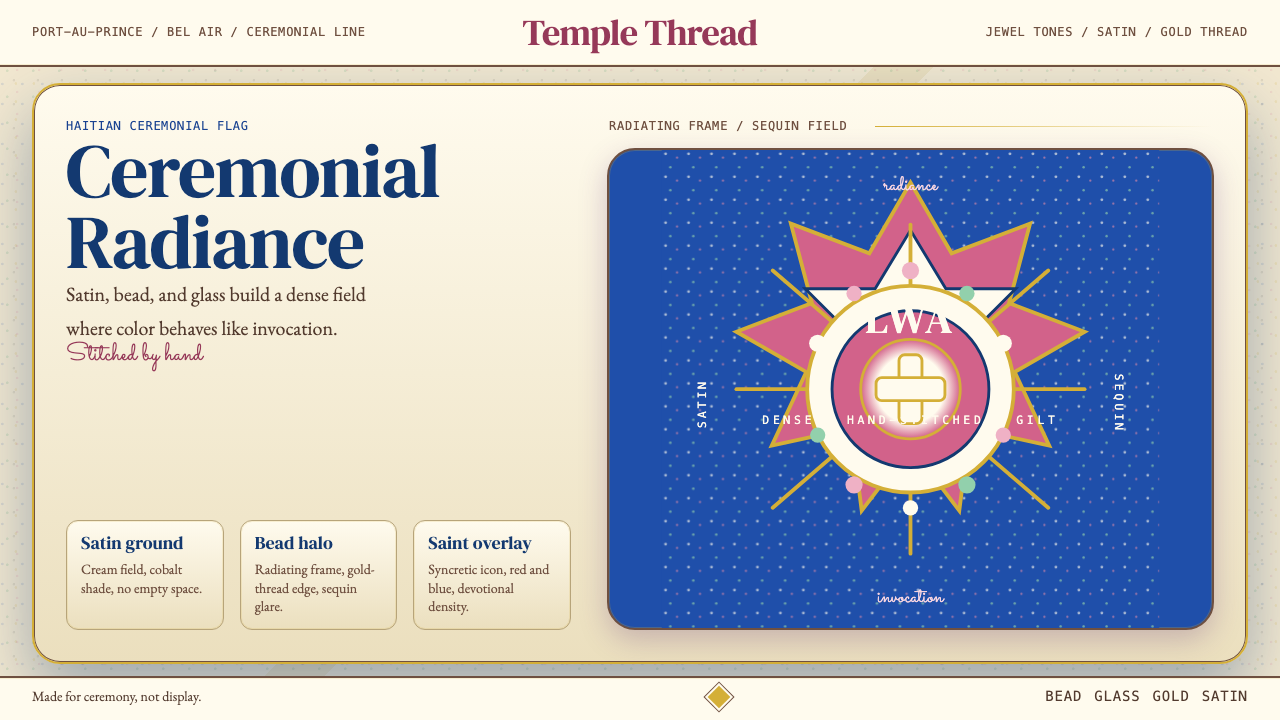 Haitian Vodou Flag (Drapo Vodou)Sacred and saturated. Jewel-tone satin, gold-thread frames, sequin halos.
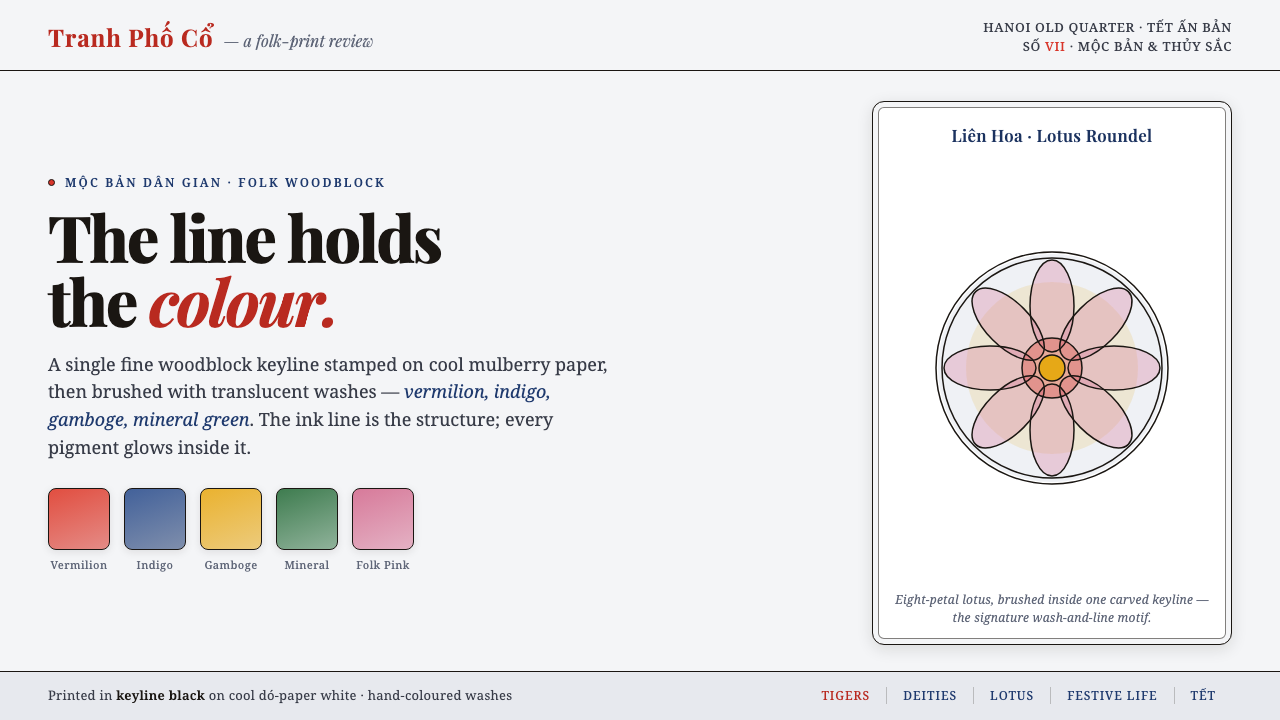 Hàng Trống Folk PrintBright folk colour, never loud. Translucent vermilion-indigo washes held insi…
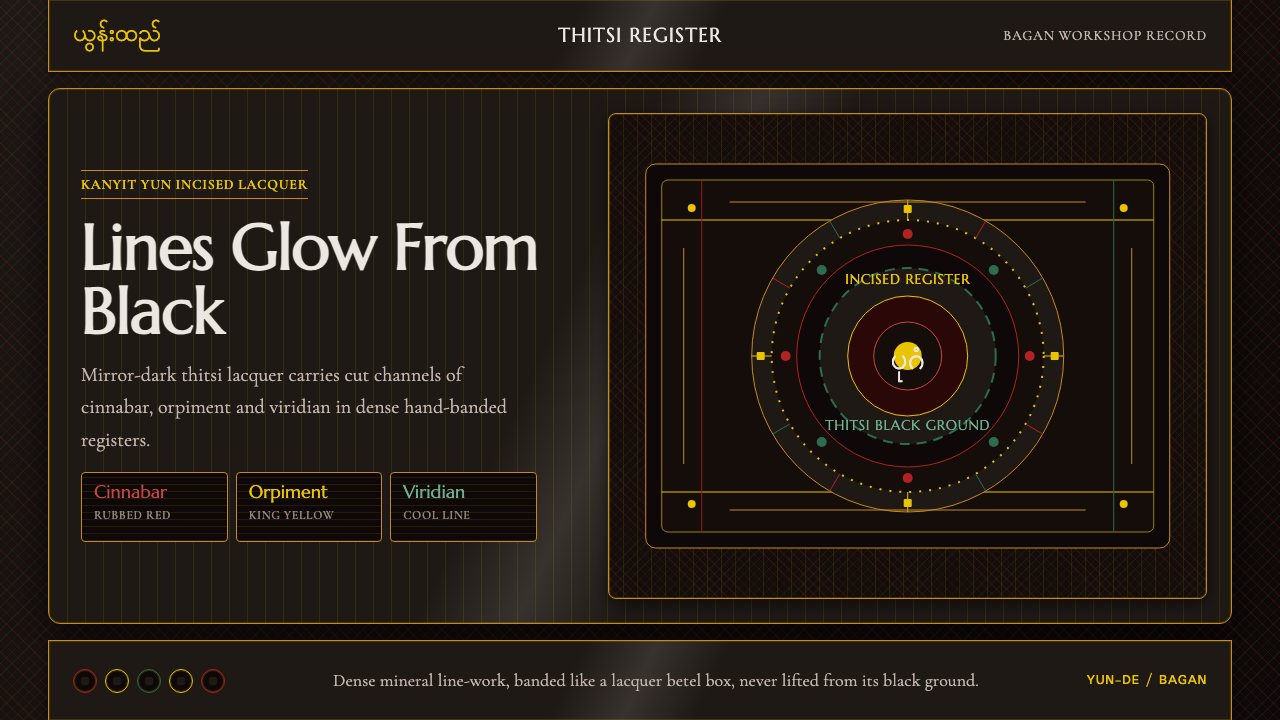 Burmese Yun LacquerwareLacquer glows in cut lines. Cinnabar, orpiment and viridian band a mirror-bla…
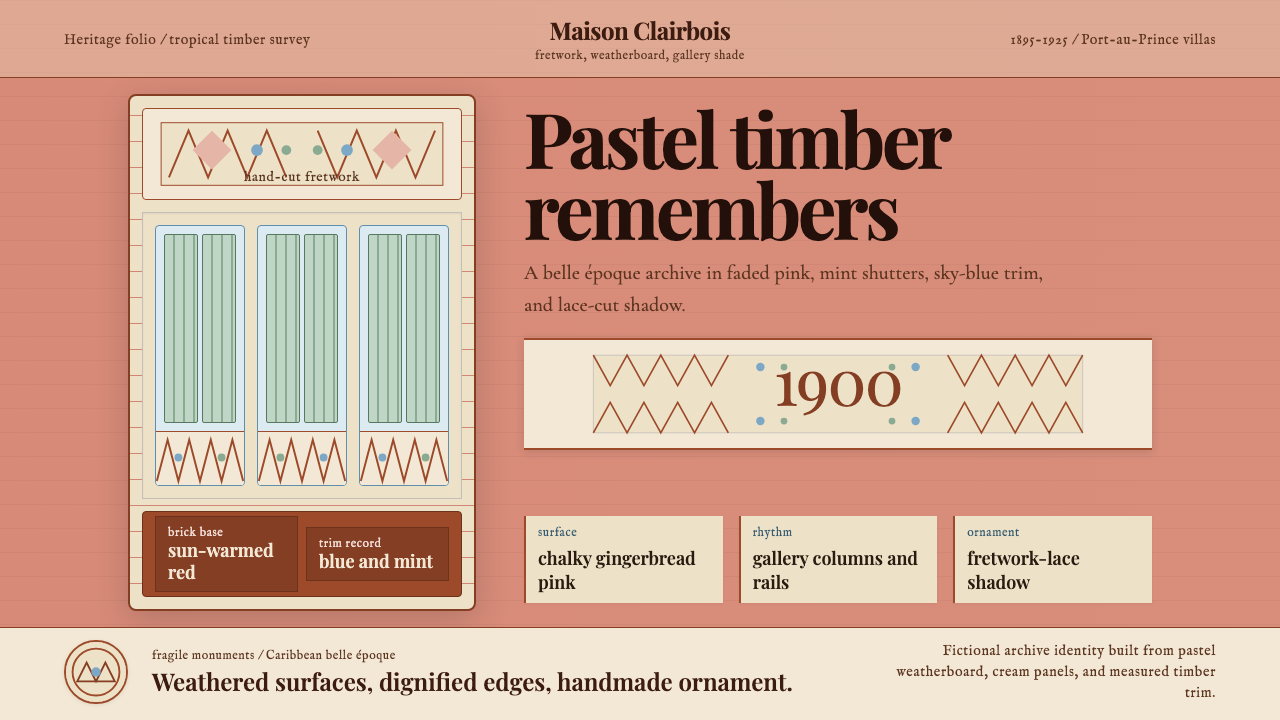 Haitian Gingerbread House (1900)Fragile elegance endures. Faded pink walls carry mint shutters and fretwork-l…
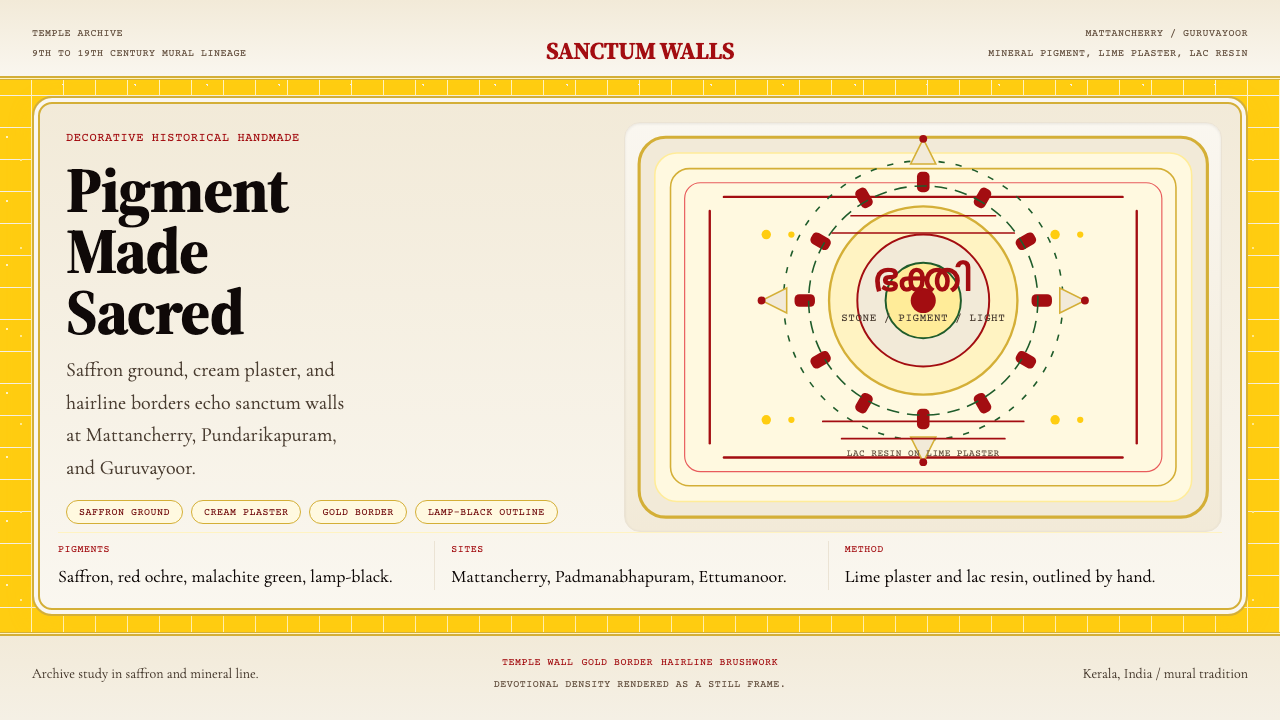 Kerala Mural TempleDevotional density over space. Saffron ground and cream panels, edged in gold.
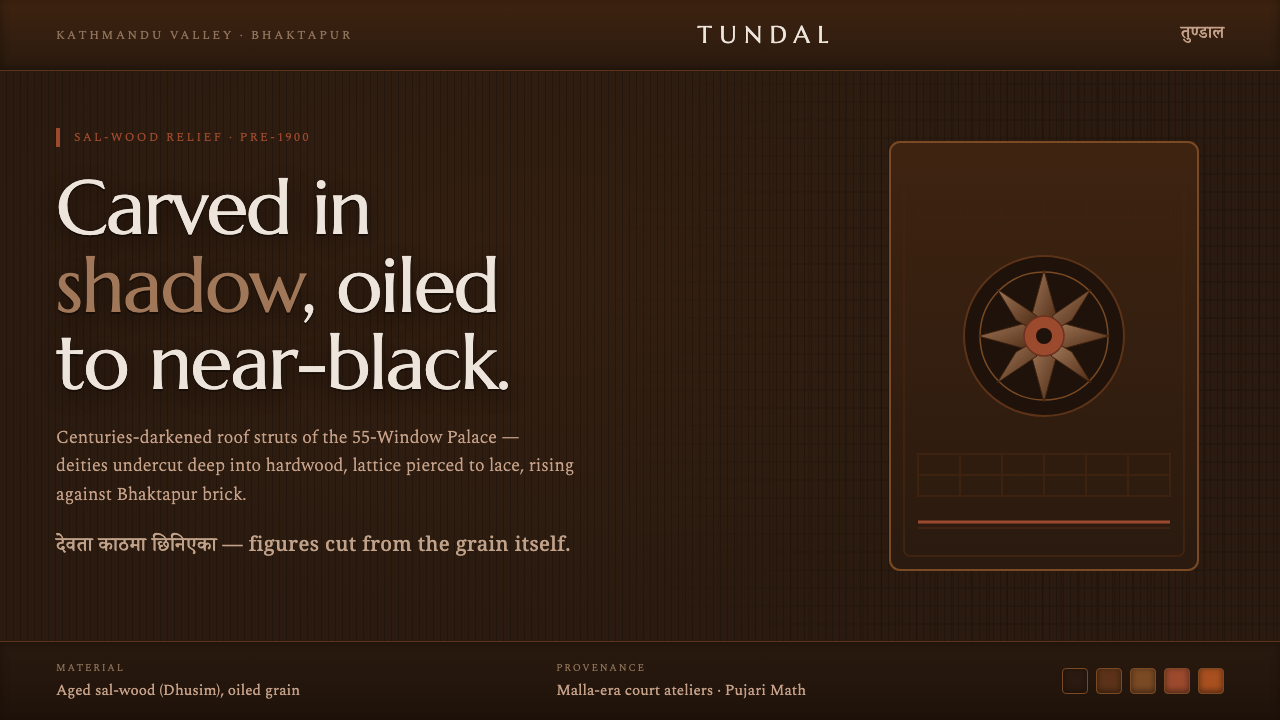 Newar Tundal Strut CarvingCenturies-darkened sal-wood. Carved deities and pierced lattice in mid-brown…