What is PNG Huli Wigman?
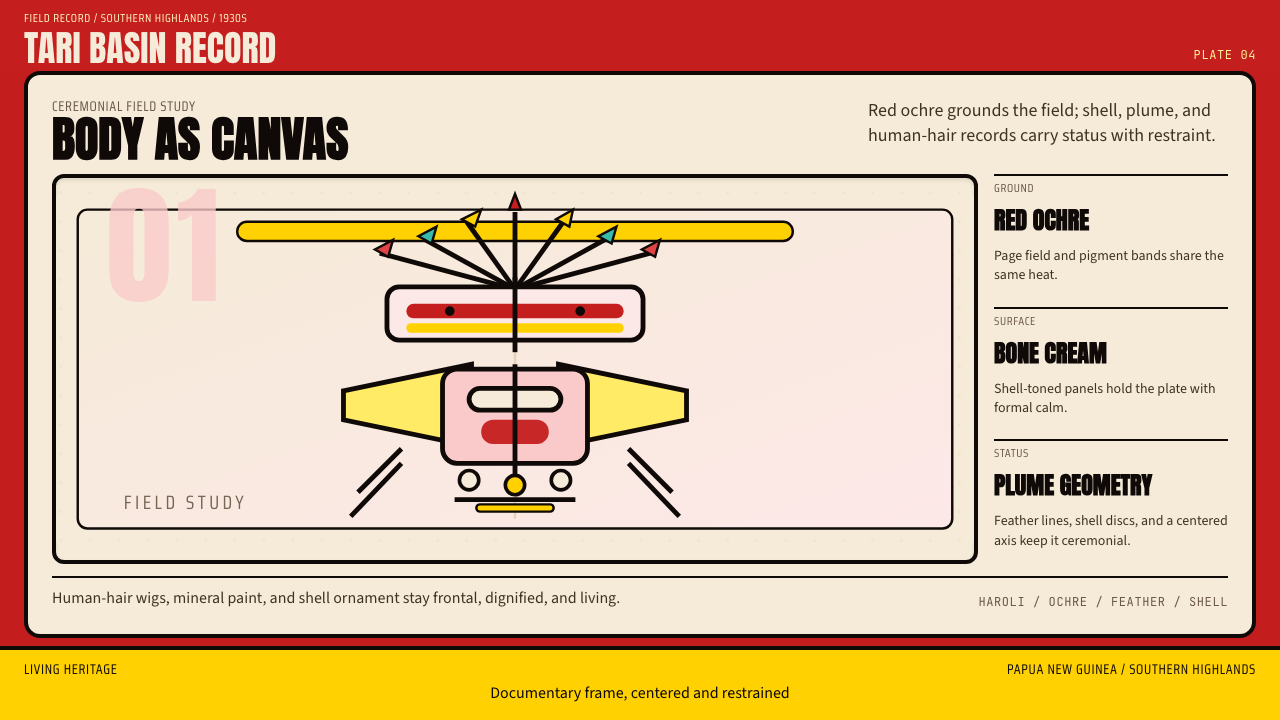
The Huli wigman transforms the male body into a ceremonial canvas — mineral pigments, bird-of-paradise plumes, and years of devoted cultivation producing one of the world's most visually arresting ritual traditions.
PNG Huli Wigman in brief
PNG Huli Wigman is a design system rooted in the ceremonial dress tradition of the Huli people of Papua New Guinea's Southern Highlands. The visual language draws directly from the documentary-anthropological photography of Huli wigmen — warriors and performers who spend years growing elaborate human-hair wigs in communal wig schools, then crown those wigs with the iridescent plumes of birds of paradise, the rigid quills of cassowaries, and the vivid feathers of parrots. Their faces are painted in red ochre and mineral yellow; their posture is frontal, still, and utterly composed. Every design token in this system is an attempt to translate that living ceremony into digital form.
The aesthetic operates on a principle of natural authority. It does not borrow the surface sheen of indigenous decoration as pastiche — it channels the structural logic of ceremonial presentation: a warm ochre ground that reads as earth and skin, bone-cream surfaces that suggest prepared material, and iridescent blue-green accents that belong to the paradise bird alone. Typography is bold and ethnographic in character — dignified, austere, never playful. The overall effect is documentary and reverential rather than exoticizing.
What separates PNG Huli Wigman from other ethnographically inspired visual systems is its commitment to the frontal portrait as compositional anchor. Huli ceremonial performance is designed to be seen head-on; there is no casual angle, no candid moment. This aesthetic principle translates into digital design as a preference for centered, confrontational hierarchy — elements that meet the viewer directly rather than leading the eye on a meandering path.

Where does PNG Huli Wigman come from?
The Huli people have inhabited the Tari Basin of Papua New Guinea's Southern Highlands Province for centuries, and their ceremonial traditions are among the most elaborately documented in Melanesia. The practice of wig cultivation — in which young Huli men enter gender-segregated wig schools called wig men's houses, live apart from women and children for roughly eighteen months to three years, and carefully tend the growth of their own hair into a mushroom-shaped wig — is understood as both a rite of passage and a form of spiritual investment. The wig is not a costume in the Western sense; it is grown from the wearer's own body and carries that person's accumulated ritual energy.
European documentation of Huli ceremonial life began in earnest in the 1930s with the first colonial expeditions into the Southern Highlands. The region had remained largely uncontacted by outside populations until that period. Early ethnographers and patrol officers recorded a society organized around elaborate systems of ceremonial exchange, ritual purity, and inter-clan negotiation — with the wigman's dress functioning as both personal status display and diplomatic communication. The term 'wigman' entered English-language anthropological literature during this contact period and became the standard designation for male Huli ceremonial performers.
The visual record expanded dramatically in the contemporary era, primarily through the work of photographers drawn to Papua New Guinea's ceremonial gatherings — the sing-sing festivals at which dozens of cultural groups perform simultaneously. Photographers including Stephen Dupont, Jimmy Nelson, Brent Stirton, and Maria Edla Mannarini produced documentary bodies of work that brought Huli wigmen to international attention from the 1990s onward. Their images share a common formal quality: the frontal, full-frame portrait of a wigman in full ceremonial dress, the face paint creating a stark geometric mask against the warm ground of ochre-rubbed skin, the wig crown erupting with feathers into the upper frame.
The movements that inform this design system — Melanesian ceremonial-dress tradition, ethnographic photography, and indigenous-heritage documentation — share a core orientation: the preservation and dignified presentation of cultural practices that are under sustained pressure from modernization, missionary activity, and economic change. Contemporary Huli wigmen navigate a complex relationship with their tradition, performing for tourist audiences and documentary crews while maintaining the ceremony's spiritual dimensions for their own communities. The design system inherits this complexity and is intended to be used with corresponding awareness.
What defines the PNG Huli Wigman look?
Color Ground
The palette begins with warm red ochre — a mineral pigment derived from iron-rich earth that Huli face painters apply with their fingers and palms in broad, deliberate strokes. This ochre tone grounds the entire system: it reads simultaneously as skin, earth, and ceremony. Against it, bone-cream panels create content surfaces that feel prepared and deliberate, like cured material held up for examination. The combination is warm but not domestic; earthy but not rustic.
Iridescent Accent
The blue-green iridescence of bird-of-paradise plumage — feathers that shift from deep teal to electric turquoise depending on the angle of light — provides the system's accent color. Used sparingly and with intention, this hue carries the weight of the feathers themselves: rare, earned, and conspicuous only when the moment demands it. It should appear on interactive elements, status indicators, and key calls to action, never as background or ambient fill.
Typography
Type in this system is bold and ethnographic in character — recalling the titling conventions of documentary monographs and museum caption plates rather than contemporary digital interfaces. Headlines carry the weight of a proper noun, something named and known. Body text is set with deliberate measure and generous leading, treating the reading experience as something to be approached with patience. Decorative or script letterforms have no place here; the text is a record, not a performance.
Frontal Composition
Huli ceremonial display is designed to be witnessed from directly in front. There is no profile view, no three-quarter turn; the performance meets its audience face-on. This translates into a design preference for centered or near-centered primary elements, content blocks that address the viewer directly, and hierarchy that reads immediately from top to bottom without requiring lateral scanning. The compositional logic is monumental rather than dynamic — objects present themselves rather than being discovered.
Geometric Mask
The Huli face painting tradition reduces complex spiritual identity to a set of hard-edged geometric zones: bands, arcs, and solid planes of mineral color that transform the face into a structured diagram. This principle carries forward into the design system as a preference for clear, bounded regions with decisive edges — cards and panels defined by flat color rather than gradient, containers that know their own limits. Ambiguity at the boundary is a compositional failure.
Feather as Hierarchy Signal
In Huli ceremony, the height and density of feather ornamentation communicate status and occasion: the more elaborate and elevated the crown, the higher the ceremonial register. This logic translates to vertical hierarchy in the design system — the most important element occupies the greatest vertical presence, whether through scale, weight, or spatial prominence. Supporting elements recede in measured steps, each level clearly differentiated from the last rather than blending into an undifferentiated field.
Documentary Restraint
The ethnographic photography that forms the visual canon of this tradition is characterized by restraint — long lenses, neutral backgrounds, controlled light — that places the subject rather than the photographer's interpretation at the center. This restraint carries into the design system as a discipline against visual noise: no ambient textures, no decorative overlays, no motion for its own sake. Every element should feel as though it has been carefully placed for documentation, not embellishment.

Who shaped PNG Huli Wigman?
An Australian documentary photographer who spent extended periods in Papua New Guinea producing intimate, high-contrast portraits of Huli wigmen and other Highland groups. His work is distinguished by its proximity — he shoots close, at eye level, creating images that feel like encounters rather than observations. Dupont's approach has been widely exhibited and published, making his portraits among the most recognizable visual representations of Huli ceremonial culture in Western photographic contexts.
A Dutch photographer whose long-term project documenting vanishing indigenous cultures produced some of the most widely circulated images of Huli wigmen in contemporary media. Nelson's work is formally grand in scale and ambition — sweeping landscapes, elaborate group compositions — and was published in the book 'Before They Pass Away' (2013), which reached audiences far beyond the ethnographic photography community. His images have been central to public awareness of Huli visual culture internationally.
A South African photojournalist whose work in Papua New Guinea was produced under editorial assignments for publications including National Geographic. Stirton's approach combines the rigor of long-form documentary journalism with formal sensitivity to light and ceremonial staging, producing images that serve both immediate news audiences and longer archival purposes. His photographs of Papua New Guinea's cultural festivals are considered among the definitive documents of Highland ceremony in the contemporary era.
An Italian anthropologist and photographer whose sustained fieldwork in the Southern Highlands produced documentation oriented toward the scholarly record as much as the visual archive. Mannarini's images are notable for their attention to process — the application of face paint, the careful assembly of feathered headpieces, the social dynamics of the wig school — providing context that purely aesthetic photographic work often lacks. Her contribution establishes the importance of documentation that is culturally embedded rather than purely observational.
How do you use PNG Huli Wigman today?
PNG Huli Wigman is a design system built for contexts that benefit from natural authority, documentary gravitas, and a warm mineral palette — as opposed to synthetic brightness or generic modernism. Applying it correctly requires internalizing the frontal, confrontational posture of the ceremonial tradition: elements present themselves to the viewer rather than inviting exploration. This is not a system for products whose experience depends on playfulness, approachability, or sensory warmth in the domestic sense. It is for work that wants to be taken seriously.
For presentation slides, the system excels on both cover pages and section dividers. A cover built in this idiom should lead with a large, warm ochre or bone-cream field occupying the majority of the frame, with a title set in heavy, confident type positioned in the lower third — the same compositional logic as a properly constructed ethnographic portrait. Section covers benefit from the bold frontal structure: a single prominent element centered and addressed directly to the audience. Content slides should be clean and generous with space; the documentary restraint of the source material argues against cluttered information density. Data slides take on a diagrammatic quality when palette and typography are applied consistently — charts become geometric objects rather than decorative embellishments.
For web interfaces, this system is well-suited to editorial platforms, cultural institutions, documentary projects, and any web product positioning itself as authoritative and considered rather than fast and frictionless. Dashboard layouts benefit from the system's clear hierarchy logic — the most important metric occupies the largest vertical presence, supporting data recedes in measured steps. Pricing pages and feature comparison tables gain legibility from the system's preference for clear, bounded regions and decisive edges. Navigation should be typographic and minimal; icon decoration should be limited to geometric forms that carry clear semantic weight.
For editorial and marketing contexts, the system's documentary character makes it well-suited to long-form article layouts, cultural publication design, and institutional communication. A feature article built in this system would use a generous outer margin for pull quotes or photographer credits, a deliberate body text measure that asks for patient reading, and section breaks defined by ruled lines or palette shifts rather than decorative ornament. Marketing applications require more care — the system's authority and restraint can read as inaccessible if the product itself is intended for broad consumer audiences. It works best for campaigns positioning the brand as expert, responsible, or culturally serious.
A common mistake when applying PNG Huli Wigman is treating the ochre and iridescent accent as equivalent weights — scattering the blue-green throughout a layout as freely as the warm ground. The iridescent accent is the exception, not the rule; it should appear where the most important single element in the composition lives, and nowhere else. A second common error is importing soft-shadow card components from other design systems without adapting them to the flat, bounded aesthetic this system requires. Soft shadows and ambient glow undermine the documentary hard-edge quality that gives the system its authority.

PNG Huli Wigman — FAQ
Is it appropriate to use a design system inspired by indigenous ceremonial culture?
The question of cultural appropriation is real and worth taking seriously. PNG Huli Wigman is designed as documentary homage rather than aesthetic extraction — it channels the visual logic of ceremonial presentation as observed through ethnographic photography, not the sacred meanings of specific objects or symbols. The appropriate use of this system involves awareness of its origins, transparent attribution in contexts where the reference is made explicit, and avoidance of applications that trivialize or commodify the source culture. Using it for serious, considered work — cultural institutions, documentary projects, editorial design — aligns with the spirit of the tradition. Using it for casual, trend-driven commercial purposes does not.
How does this system handle photography and illustration?
Photography is the native medium of this design system — the entire visual language is derived from the documentary portrait tradition. When photography is used, it should be treated with documentary seriousness: high contrast, deliberate framing, frontal or near-frontal subject positioning. Cropping should be decisive and full-frame where possible; loosely composed lifestyle photography undermines the system's authority. Illustration, if used, should follow the geometric-mask logic of Huli face painting — flat planes of color with hard edges, not graduated or painterly forms. Representational illustration that mimics naturalistic rendering is foreign to this aesthetic.
Can the system work in a light or dark variant, and which is primary?
The primary variant is warm-light: ochre and bone-cream grounds with dark type, mirroring the way Huli skin and wig function as a warm substrate against which the darker feather structures and face paint geometry read. A dark variant is possible — reversing to a deep, near-black ground with ochre or bone-cream type — but it shifts the mood significantly from documentary warmth to something more archival and severe. The iridescent blue-green accent works well on both variants. The warm-light version should be the default for most applications; the dark variant suits contexts where authority and solemnity are the primary register, such as formal institutional communications or memorial projects.
What kinds of products or brands are a poor fit for this system?
Any product whose value proposition depends on lightness, speed, spontaneity, or sensory delight will struggle against this system's documentary gravity. Consumer food and beverage brands, children's education products, fast-fashion retail, social entertainment applications, and wellness or lifestyle brands are all poor candidates — not because the palette is wrong, but because the posture of the system is monumental and the audience relationship is formal. Similarly, products that rely on high information density, rapid interaction, or frequent visual novelty will find the system's restraint limiting. The question to ask is whether the product wants to be witnessed, like a ceremony, or explored, like a playground. This system serves the former.
How does PNG Huli Wigman differ from other ethnographically inspired design systems?
Many ethnographically inspired design systems treat indigenous visual culture as a surface pattern source — borrowing geometric motifs, textile structures, or color combinations without engaging with the underlying logic of the tradition. PNG Huli Wigman attempts a different approach: the design tokens are derived from the specific material reality of Huli ceremonial practice — mineral pigments, keratin-based materials, feather iridescence — rather than from abstracted pattern. The frontal composition principle comes from the structure of the ceremony itself, not from a stylistic choice made after the fact. This specificity is both the system's strength and its constraint: it rewards careful application and resists casual borrowing.
Related design styles
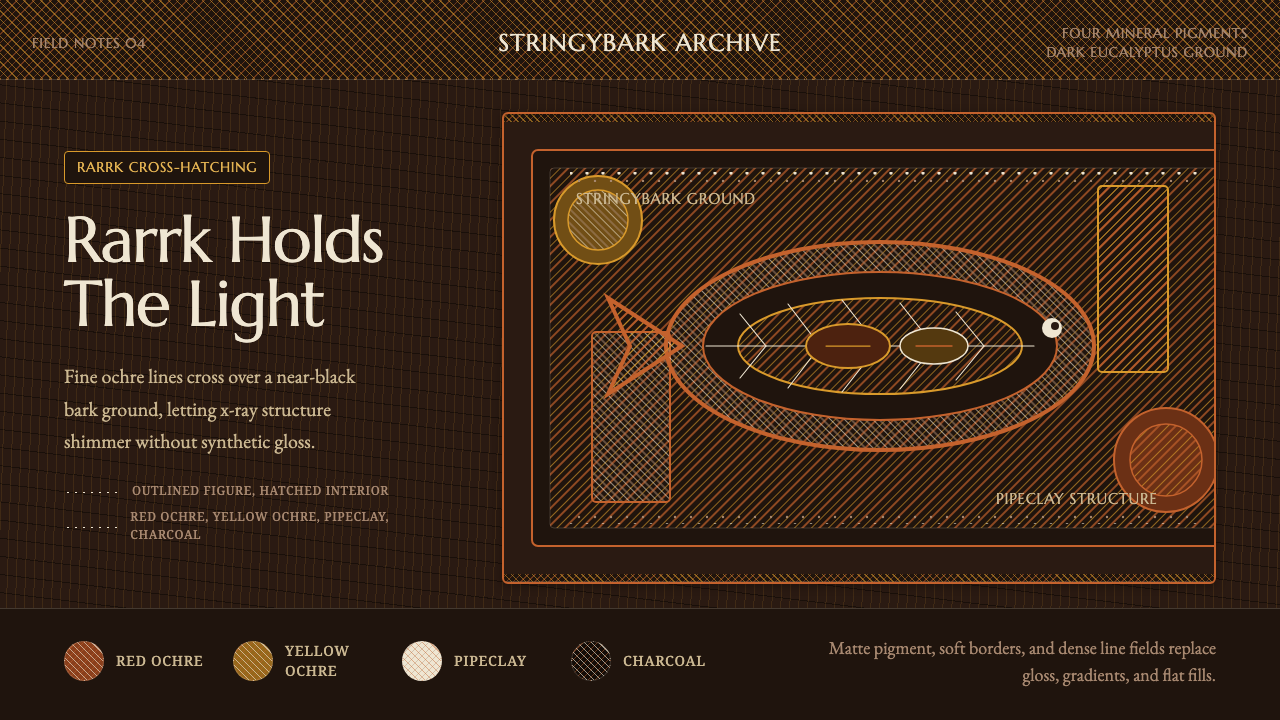 Arnhem X-Ray Bark PaintingShimmers without gloss. Ochre rarrk lines vibrate on dark stringybark.
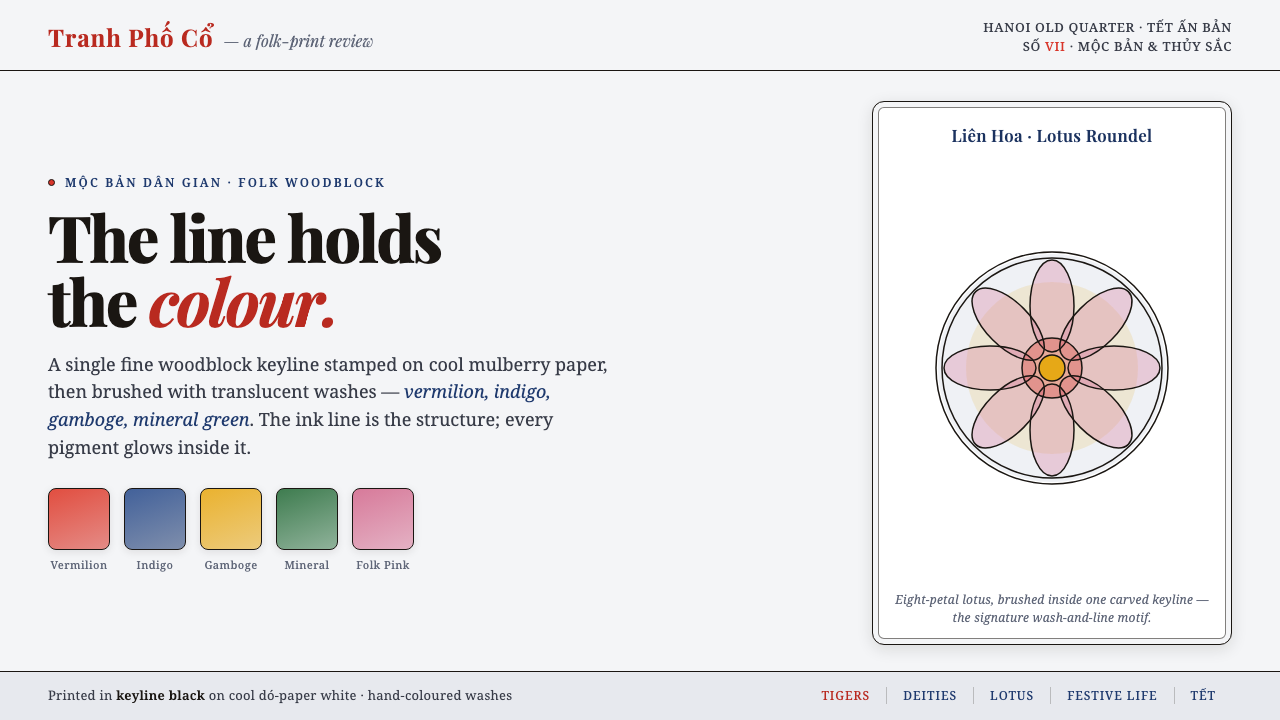 Hàng Trống Folk PrintBright folk colour, never loud. Translucent vermilion-indigo washes held insi…
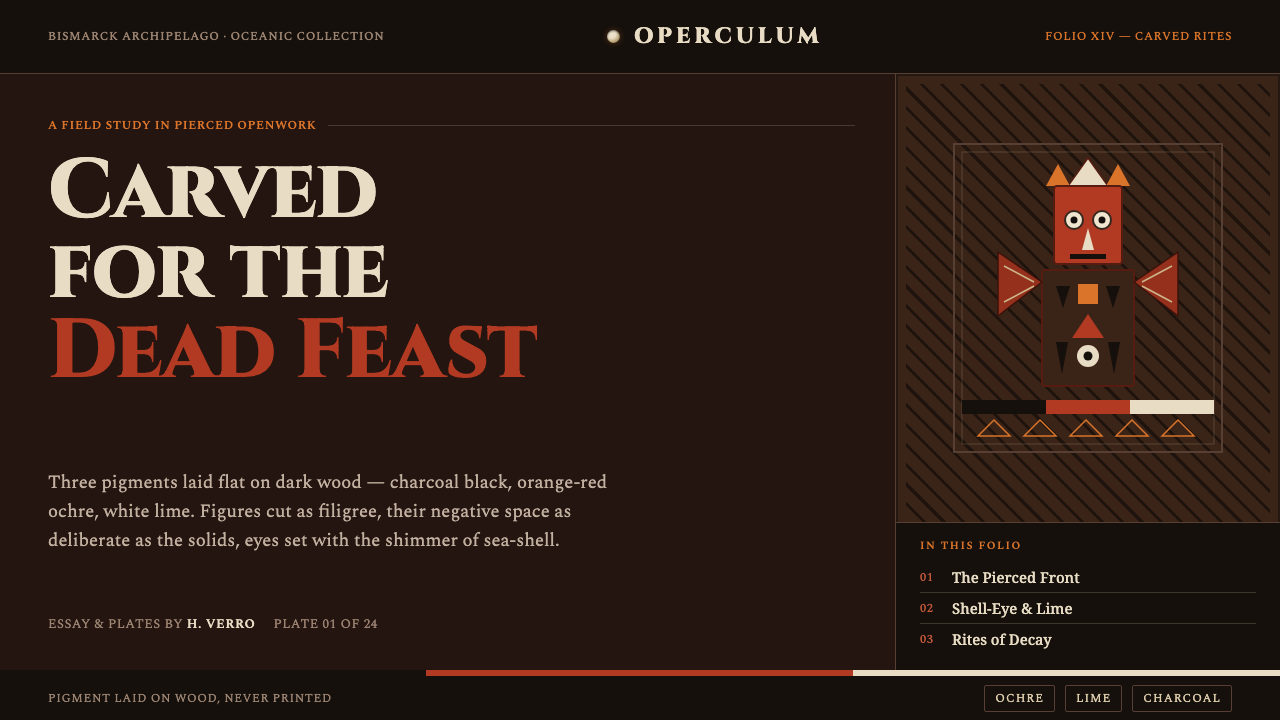 Malagan CarvingCarved for the dead feast. Ochre, lime and charcoal pierced into dark wood, e…
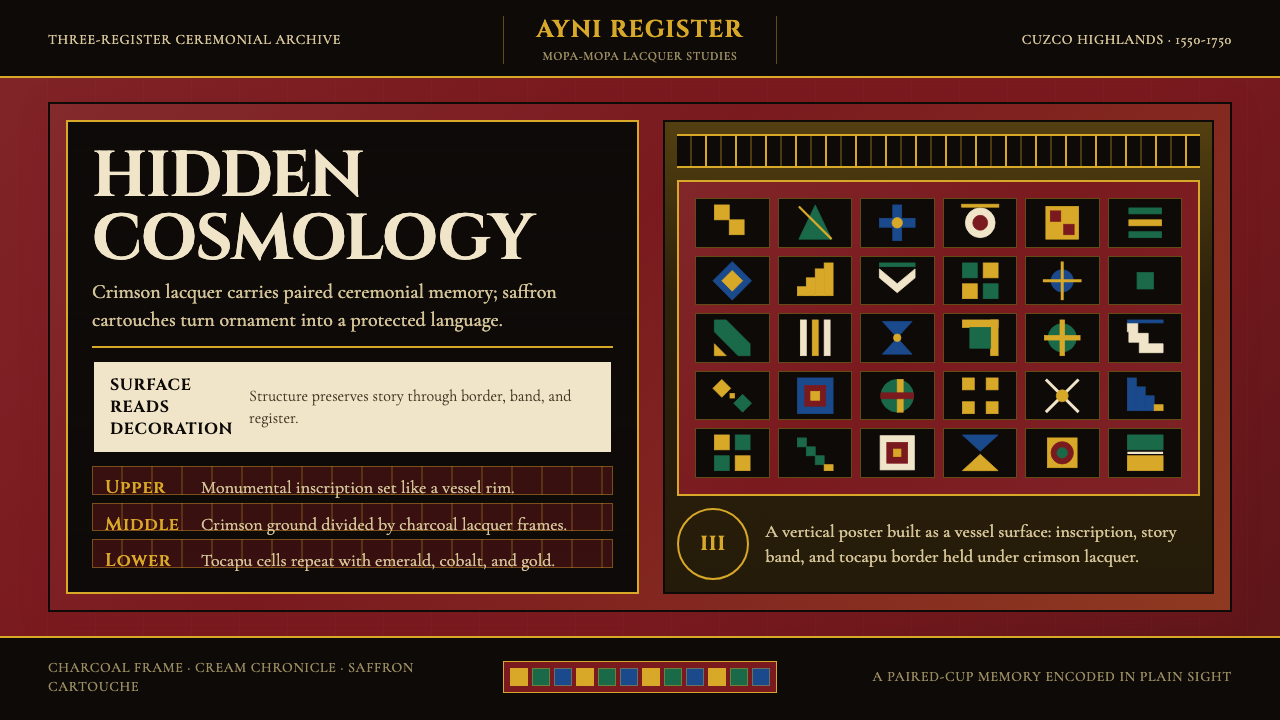 Peruvian Quechua Keros (Andean Cup)Hidden cosmology glows. Crimson lacquer and saffron tocapu grids frame the st…
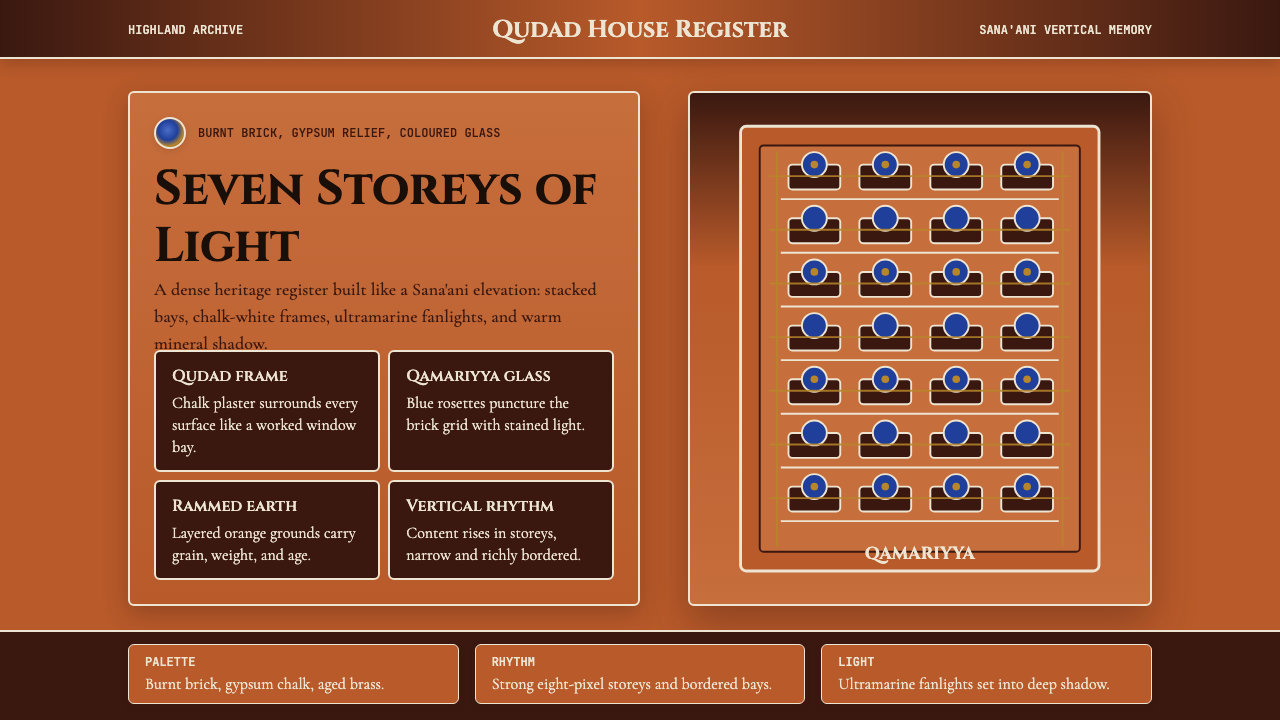 Yemeni Sana'a Old City Tower-HouseVertical memory, densely framed. Brick orange, gypsum white, and blue rosette…
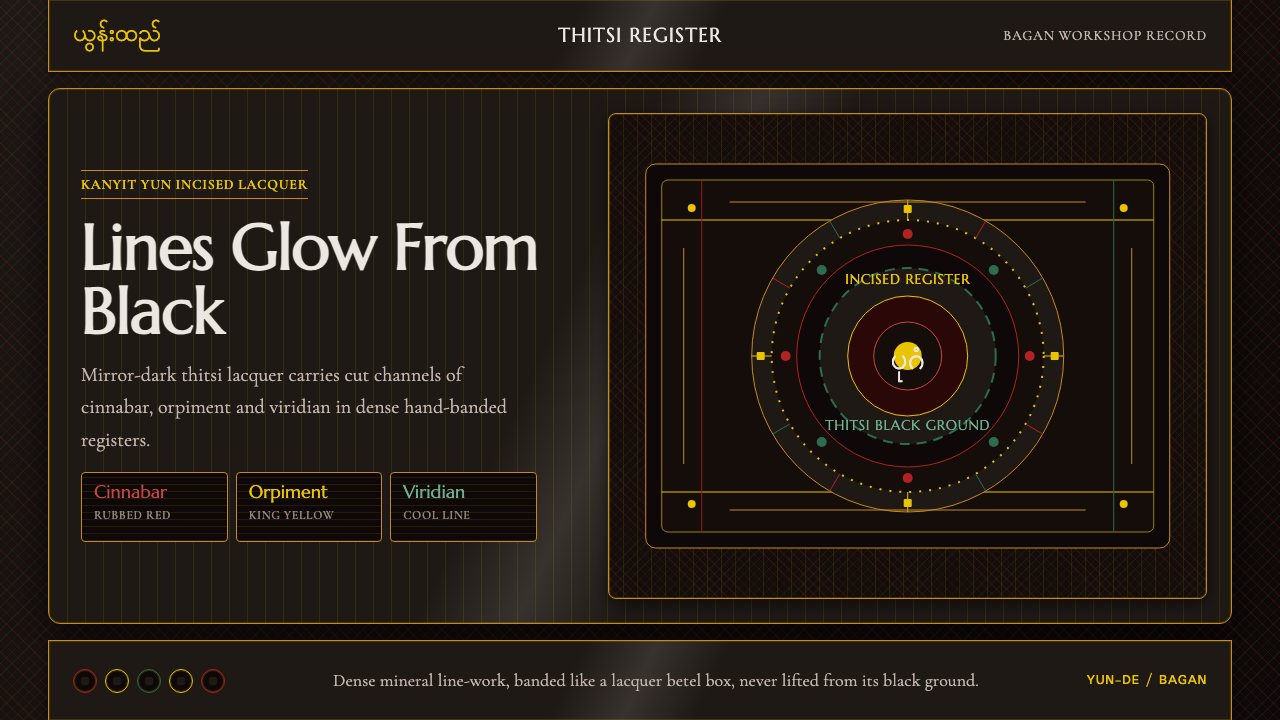 Burmese Yun LacquerwareLacquer glows in cut lines. Cinnabar, orpiment and viridian band a mirror-bla…