What is Peruvian Quechua Keros (Andean Cup)?
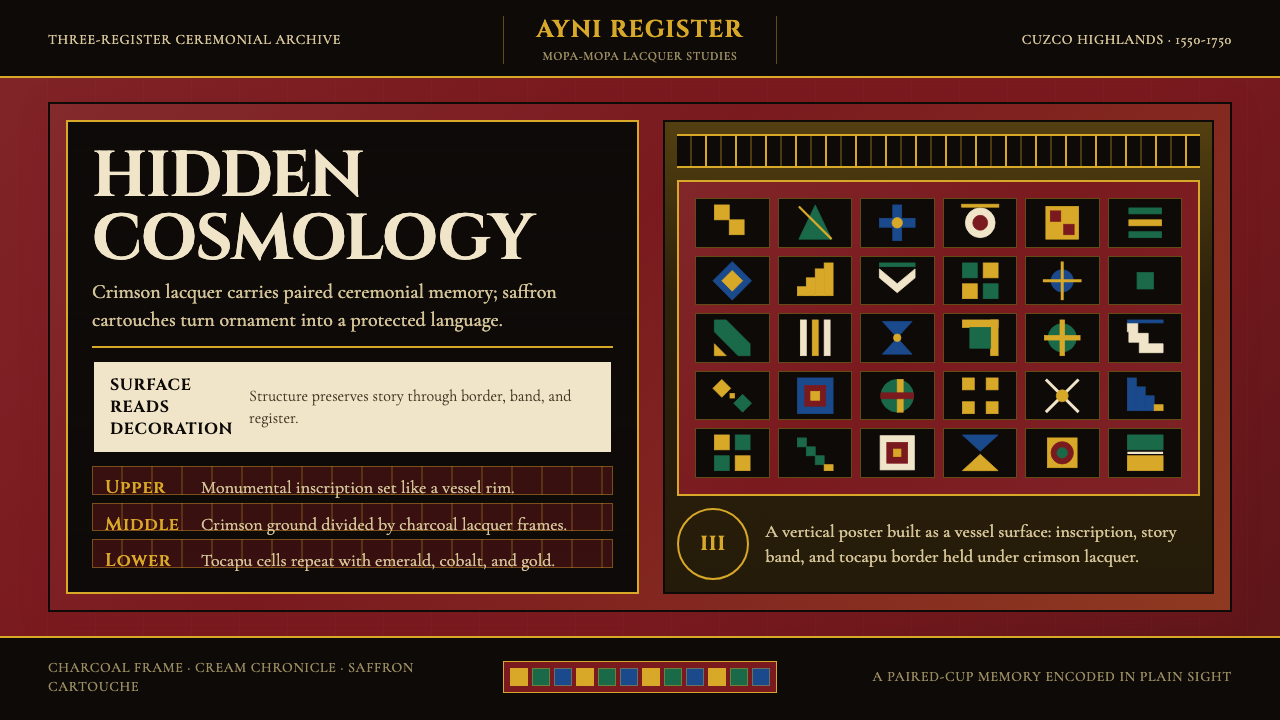
Quechua kero cups carried a hidden universe — crimson lacquer, saffron geometric bands, and sacred processions that colonial rulers mistook for mere decoration.
Peruvian Quechua Keros (Andean Cup) in brief
Peruvian Quechua Keros (Andean Cup) is a design system rooted in the painted wooden ceremonial vessels of the Quechua-speaking Andes. Known as keros, these cups were used to share chicha — a fermented maize beer central to Inca ritual life — during ceremonies that reinforced social bonds, honored ancestors, and communicated cosmological order. Their painted surfaces are among the most visually sophisticated objects to survive the colonial encounter in the Americas.
The visual language of the kero is built on three compositional registers stacked vertically around the cup body. The uppermost band carries interlocking geometric cartouches called tocapu — small, precisely bounded fields containing abstract symbols that functioned as a kind of visual vocabulary in Inca society. The middle register opens into narrative figuration: pumas, condors, solar discs, and processions of Inca nobles rendered in saturated mineral and resin pigments. The lowest band returns to geometric rhythm, anchoring the composition in structured repetition. Together these layers create a visual system that moves between code and image, ornament and meaning.
What distinguishes the kero aesthetic from other pre-Columbian visual traditions is the technique introduced during the colonial period: mopa-mopa resin painting. Artisans pressed thin layers of pigmented resin — vivid crimson, deep emerald, warm saffron gold — directly onto the wooden vessel surface, building up color fields of extraordinary vividness and durability. This lacquer-like finish gives kero palettes their characteristic intensity: not the earthy ochres of ceramic traditions, but jewel-saturated hues that read as deliberately chosen and symbolically weighted.
Where does Peruvian Quechua Keros (Andean Cup) come from?
The kero tradition stretches back into the pre-Inca Andean past, with wooden and ceramic vessels used in ceremonial drinking across multiple highland cultures for centuries before the Inca expansion. Under the Inca empire (roughly 1438–1532), keros became instruments of statecraft: the Inca ruler would share chicha from paired keros with nobles, military commanders, and regional lords, sealing alliances and obligations through the act of reciprocal drinking. The vessels were produced in the highland cities of the Cuzco region — the imperial capital — and distributed as gifts that carried the prestige of the state.
The Spanish conquest of 1532 did not immediately end kero production. Instead, it transformed it. Between approximately 1550 and 1750, Quechua artisans adapted the kero form to new conditions, introducing the mopa-mopa resin-paint technique that enabled far greater chromatic intensity and figurative detail than earlier methods. Colonial-era keros typically added Spanish elements — horses, Christian imagery, European textiles — alongside traditional Andean iconography, creating a syncretic visual language that was legible to colonial authorities as harmless decoration while simultaneously preserving Inca cosmological references for Quechua viewers who knew how to read them. This double-coding made the kero one of the most sophisticated acts of cultural resistance in the colonial Americas.
The primary geographic centers of kero production were the highland departments of Cuzco, Apurímac, and Puno in present-day Peru, and the Lake Titicaca basin extending into what is now Bolivia. These high-altitude regions — above three thousand meters — shared a visual culture shaped by the vast, luminous landscape of the altiplano: the deep blue of high-altitude sky, the ochre and crimson of volcanic earth and textile dyes, the gold of morning light across puna grasslands. The kero palette absorbed and concentrated these environmental colors into a deliberately saturated register.
By the nineteenth century, as museum collecting intensified, keros entered European and North American collections, where they were studied primarily as ethnographic objects. Scholars such as Joanne Pillsbury, Tom Cummins, Lisa Trever, and Verena Liebscher later reframed keros as sophisticated communicative artifacts — design objects encoding political, cosmological, and social meaning through a deliberate visual system. This scholarship transformed how the objects are understood: not as craft curiosities but as evidence of a fully developed visual intelligence operating under conditions of cultural suppression.
What defines the Peruvian Quechua Keros (Andean Cup) look?
Palette
The kero palette centers on three dominant hues: a deep lacquered crimson that saturates the ground, a warm saffron-gold that outlines and fills the tocapu geometric cartouches, and a cool emerald that fills figural elements. Charcoal and near-black anchor the darkest tones, functioning as both outline and shadow. The palette is high in saturation and low in lightness — jewel-toned rather than pastel, ceremonial rather than decorative. These are colors chosen to be read at a distance and to survive centuries of use.
Three-Register Composition
Every kero surface is organized into three horizontal zones: a geometric header band of tocapu cartouches, a narrative middle field of figures and scenes, and a geometric footer band that mirrors or complements the header. This tripartite structure is non-negotiable — it is the compositional grammar of the form. In design terms, it provides a hierarchy of reading: the eye enters through the geometric framework, moves to the figural narrative, and exits through grounding geometry. The structure also encodes cosmological meaning, with the vertical axis of a cup corresponding to levels of the Andean world.
Tocapu Geometry
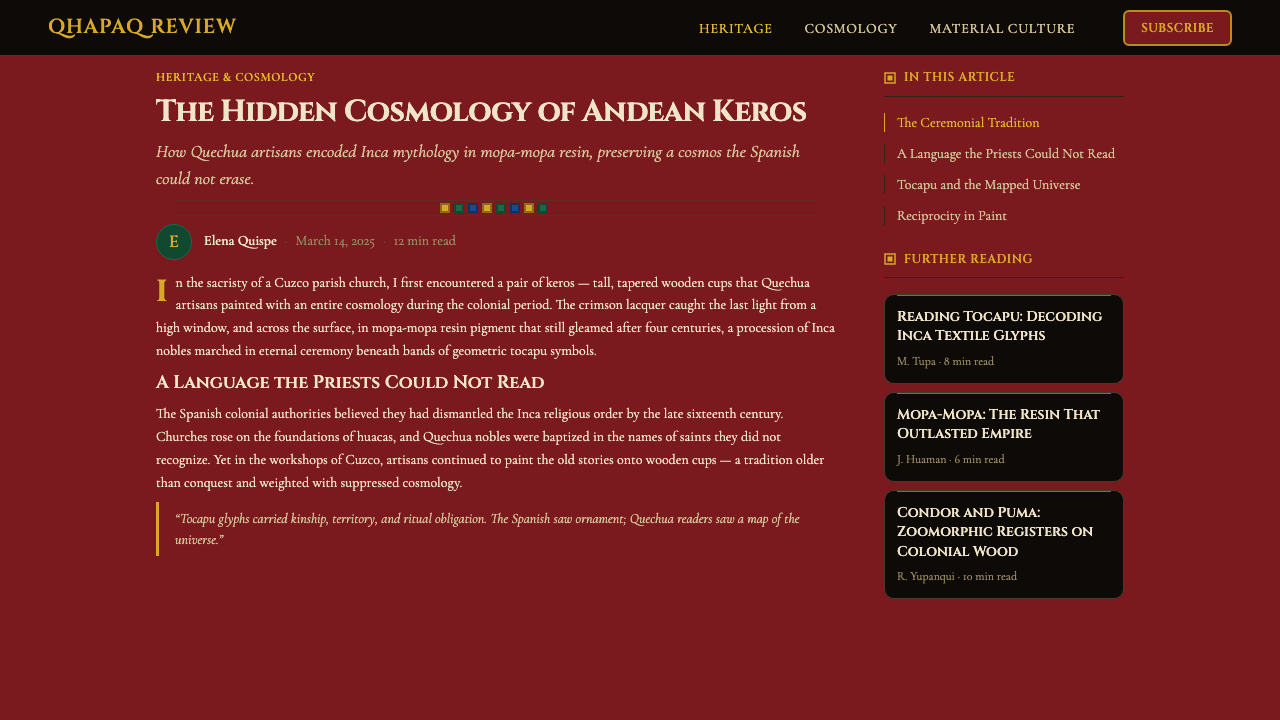
Tocapu are the small, precisely bounded geometric fields that appear in the border bands and occasionally within the figural register. Each tocapu unit is a self-contained rectangle or square containing a pattern — stepped frets, hourglass forms, interlocking diamonds, zigzag chevrons — rendered with sharp-edged precision. The tocapu bands repeat these units in rhythmic sequence, creating a visual cadence similar to a typographic border or a musical motif. Scholars believe individual tocapu functioned as meaningful units within a broader visual code, analogous to heraldic badges or calendar signs.
Figural Narrative
The middle register of a kero presents figures in profile or three-quarter view against the crimson ground: Inca nobles carrying offerings, pumas and condors as sacred animals, solar discs flanked by rays, and — in colonial-era keros — Spanish horsemen integrated into processional scenes. Figures are rendered with confident, flat outlines filled with solid color fields. There is no modeling or shading; depth is suggested by vertical stacking of figures rather than perspective recession. The result is a visual register that reads simultaneously as illustration and as heraldic symbol.
Lacquer Intensity
The mopa-mopa resin technique produces a surface quality unlike any other pre-modern painting tradition. Color fields are perfectly flat, with razor-sharp edges between hues and no visible brushwork or texture. The resin layers build depth without translucency — colors appear to glow from within rather than reflect light from the surface. This intensity is not about decoration; it is about legibility and durability. Kero pigments were designed to remain vivid after centuries of handling and outdoor ceremonial use. In digital design terms, the equivalent would be colors at maximum achievable vividness on the display medium.
Bilateral Symmetry within the Register
While the three-register structure provides vertical hierarchy, the composition within each register typically follows a bilateral symmetry organized around a central axis — a solar disc, a central figure, or a heraldic animal. This central axis is not a mirror: the flanking elements may be slightly varied, as in heraldic compositions where paired animals face each other with minor differences. The symmetry creates ceremonial weight and visual stillness even within a highly saturated, active palette. It is symmetry used as ritual form, not as mechanical balance.
Dark Ground Logic
The deep crimson ground is not a neutral background — it is an active field that gives warm luminosity to the saffron gold and makes the cool emerald vibrate by contrast. Figures are read against this charged ground rather than on top of a neutral white. Dark-ground composition is relatively rare in Western design traditions but is natural to the kero, where the lacquered vessel body itself functions as the ground. Working with a dark ground requires thinking about which colors advance (warm saffron, bright gold) and which recede (deep emerald) rather than relying on light-ground contrast norms.
Who shaped Peruvian Quechua Keros (Andean Cup)?
Pillsbury is a leading art historian of the pre-Columbian Andes whose research fundamentally reshaped scholarly understanding of keros as political and communicative objects rather than ethnographic curiosities. Her work on Inca material culture, conducted across major museum collections in the Americas and Europe, established the frameworks through which kero iconography is now systematically interpreted — including the relationship between tocapu patterning, state identity, and ceremonial drinking as a form of political theater.
Cummins brought the tools of art history and visual semiotics to the analysis of Andean objects, arguing in landmark scholarship that keros should be understood as part of a broader Andean visual language that operated independently of alphabetic writing. His work on colonial-era keros demonstrated the sophistication of the double-coding strategy — how Quechua artisans embedded Inca iconographic meaning within surface elements that colonial administrators read as purely decorative. His research transformed keros from historical artifacts into design documents.
Trever's scholarship bridges pre-Columbian and colonial Andean art, with particular attention to the materiality of image-making and the ways Andean artists negotiated between indigenous visual traditions and the demands of colonial representation. Her work on the relationship between surface, pigment, and meaning in Andean objects — including keros — provides critical tools for understanding why the mopa-mopa resin technique was adopted and what it enabled beyond purely technical capability.
Liebscher contributed systematic iconographic analysis of colonial-era kero imagery, cataloguing the recurring motifs — the Inca procession scenes, the puma and condor symbols, the tocapu systems — and tracing their transformations under colonial pressure. Her work is particularly valuable for design practitioners because it documents the compositional logic of the kero surface as a system: how elements are sequenced, how registers interact, and how the overall visual program encodes layered meaning.
How do you use Peruvian Quechua Keros (Andean Cup) today?
The kero visual system translates into contemporary design through three core moves: leading with a deep saturated ground rather than a neutral background, organizing content into clearly delineated horizontal registers, and using a small high-saturation palette — warm gold, cool emerald, deep crimson — with deliberate symbolic intent. The style rewards contexts where richness, cultural depth, and ceremonial weight are desired rather than minimalist clarity.
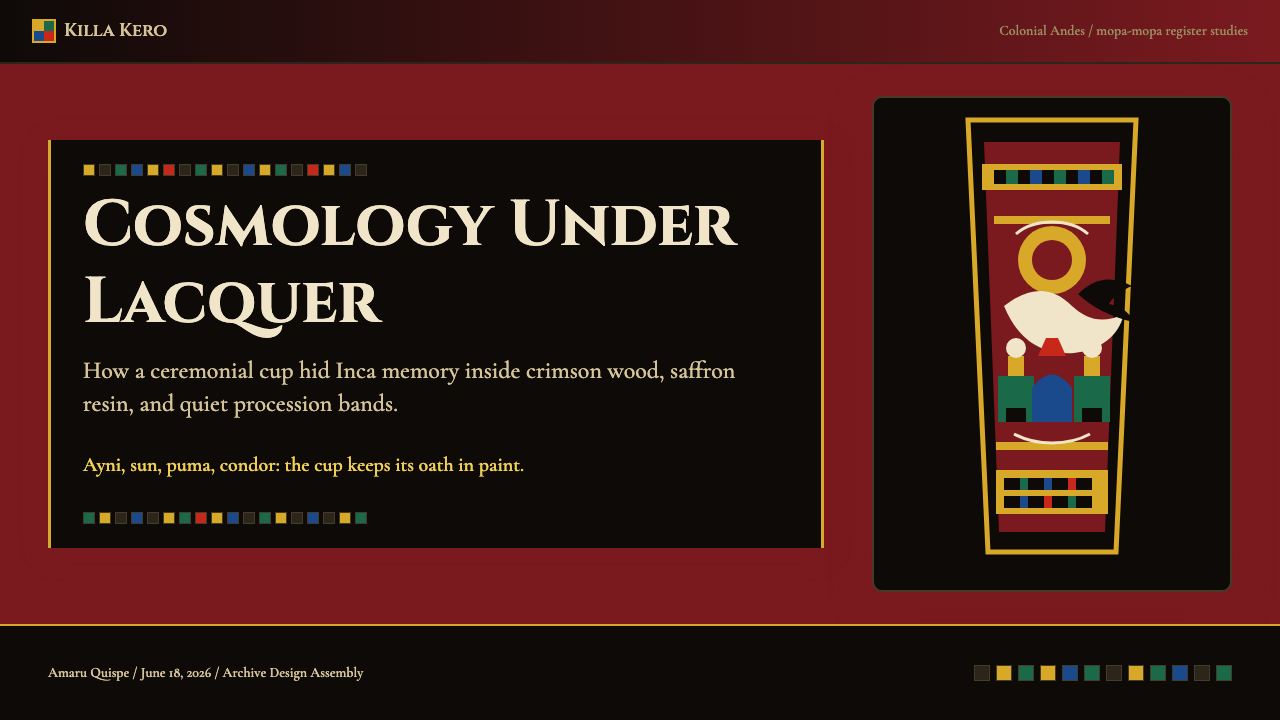
For presentation slides, the kero approach is most effective when used at the register level. A cover slide works as a kero surface in miniature: a deep crimson or near-black ground carries a central emblem or title in warm gold, with a horizontal tocapu-like geometric band at top and bottom to frame the composition. Content slides benefit from the three-register model applied at scale — a narrow header strip in a geometric pattern, the main content in the central field, and a footer strip with category or pagination. Data slides take on ritual weight when chart elements are colored in the kero palette: gold bars on a dark ground, emerald comparison lines, crimson highlights for key values.
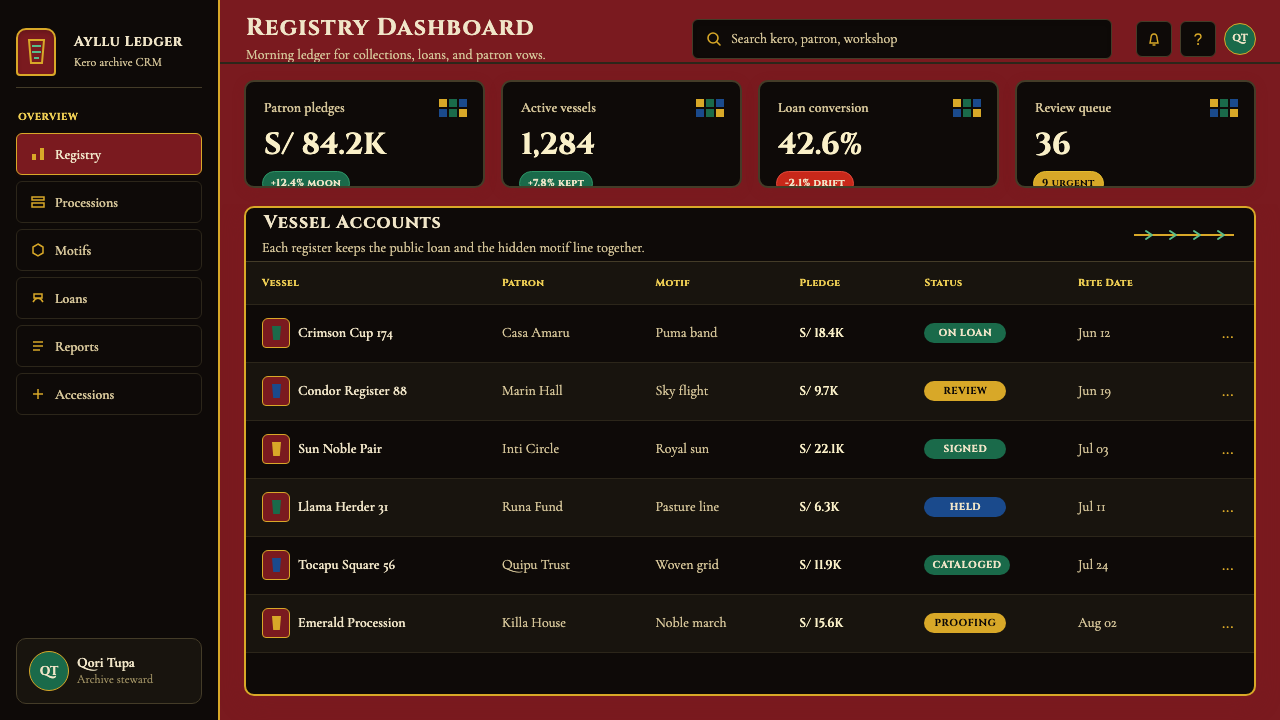
For web interfaces and dashboards, kero logic suggests dark-ground compositions where the ground itself carries visual charge. Sidebar navigation works well as a tocapu band — a sequence of vertically stacked, geometrically bordered items in warm gold against deep crimson or charcoal. Card components should emphasize contained color fields rather than soft shadows; sharp-edged and flat, with each card acting as a bounded register. Pricing pages benefit from tier differentiation using the palette's natural hierarchy: a warm gold card for the featured tier, a deep crimson accent for urgency, emerald for confirmation states.
For editorial and marketing work, the kero style lends itself to cover imagery and section breaks that feel both ancient and contemporary. A full-bleed dark ground with a central geometric emblem in gold immediately references kero compositional grammar without literal quotation. Section headers can use a narrow horizontal band of tocapu-like geometric pattern to divide content registers — a device that creates visual continuity without repeating a single motif. Marketing copy should be set in high contrast against the dark ground, using scale and weight to establish hierarchy rather than color variation within the text.
A common mistake is treating the kero palette as a warm, earthy, or folkloric aesthetic — adding organic textures, brushstroke effects, or terracotta tones that flatten the palette's jewel-like intensity into something closer to artisanal craft. The authentic register is the opposite: lapidary precision, flat color fields, razor-sharp geometric edges. Another frequent error is overloading the figural zone with too many narrative elements, which destroys the register logic that gives kero composition its ceremonial stillness. The discipline of the three-register structure — geometry, narrative, geometry — is what separates kero-informed design from generic Andean pastiche.
Peruvian Quechua Keros (Andean Cup) — FAQ
Is this style only appropriate for projects with a Latin American or indigenous cultural focus?
Not necessarily. The kero visual system is distinctive enough that it carries cultural associations, and designers should be thoughtful about context. But the core principles — dark saturated grounds, horizontal register composition, high-intensity geometric banding, a small jewel-toned palette — are structural devices that can be applied abstractly without literal cultural quotation. The risk of inappropriate borrowing is higher when figurative kero iconography (pumas, condors, specific tocapu motifs) is used decoratively without understanding. The geometric and compositional logic transfers more freely.
How does the kero palette differ from other Andean or Latin American design traditions?
The kero palette is distinguished by its lacquer-like intensity and its dark ground. Many Andean textile traditions use similarly saturated hues — the warp-faced weaving of Cusco or the island communities of Lake Titicaca employs vivid reds, greens, and golds — but typically on lighter grounds. The mopa-mopa resin technique gives the kero palette its particular depth: colors that appear to glow from within rather than reflect ambient light. Mexican pre-Columbian traditions like Mixtec codex painting also use saturated, dark-ground compositions, but the figurative style and geometric vocabulary are entirely distinct. The kero stands apart as a lacquer tradition with a ceremonial register quite different from textile or ceramic color systems.
Can the kero style work in a light-ground, white-background digital context?
With significant adjustment, yes — but the inversion changes the style's fundamental character. On a light ground, the palette reads as warm and richly decorative rather than as luminously saturated and ceremonially weighty. If working light-ground, the three-register compositional structure remains the most useful element to preserve: geometric banding at top and bottom, narrative content in the center. The saffron gold becomes the primary accent against white, and the crimson serves as a secondary emphasis. Emerald works as a third accent. The result is warmer and more approachable but loses the jewel-box intensity that makes the dark-ground version so distinctive.
What is the difference between tocapu geometry and generic geometric pattern?
Tocapu units are self-contained, bounded fields — each geometric motif occupies its own clearly delimited rectangle or square, separated from its neighbors by a visible frame or edge. They are not flowing tessellations or continuous repeat patterns in the sense of Moorish tile or Art Nouveau surface design. The containment is the distinguishing feature: each unit is discrete, complete, and potentially meaningful in isolation. In practical design terms, this means tocapu-inspired geometric bands function more like a sequence of distinct emblems or badges than like a repeating wallpaper pattern. The visual rhythm comes from repetition of units rather than from the continuity of a single flowing motif.
How should the double-register geometric banding be handled at small sizes or on mobile screens?
At small sizes, the tocapu geometric band should be simplified — the level of detail that reads clearly at desktop scale becomes visual noise at mobile dimensions. The most effective approach is to use a single color stripe of consistent height as a stand-in for the detailed geometric band, preserving the compositional rhythm of header-content-footer without requiring the internal patterning to be legible. Alternatively, a single repeating motif at a larger scale — one geometric unit spanning the full band height — can substitute for the densely packed tocapu sequence. The register structure itself is the semantically important element; the internal detail of the geometric bands is secondary and can scale down gracefully.
Related design styles
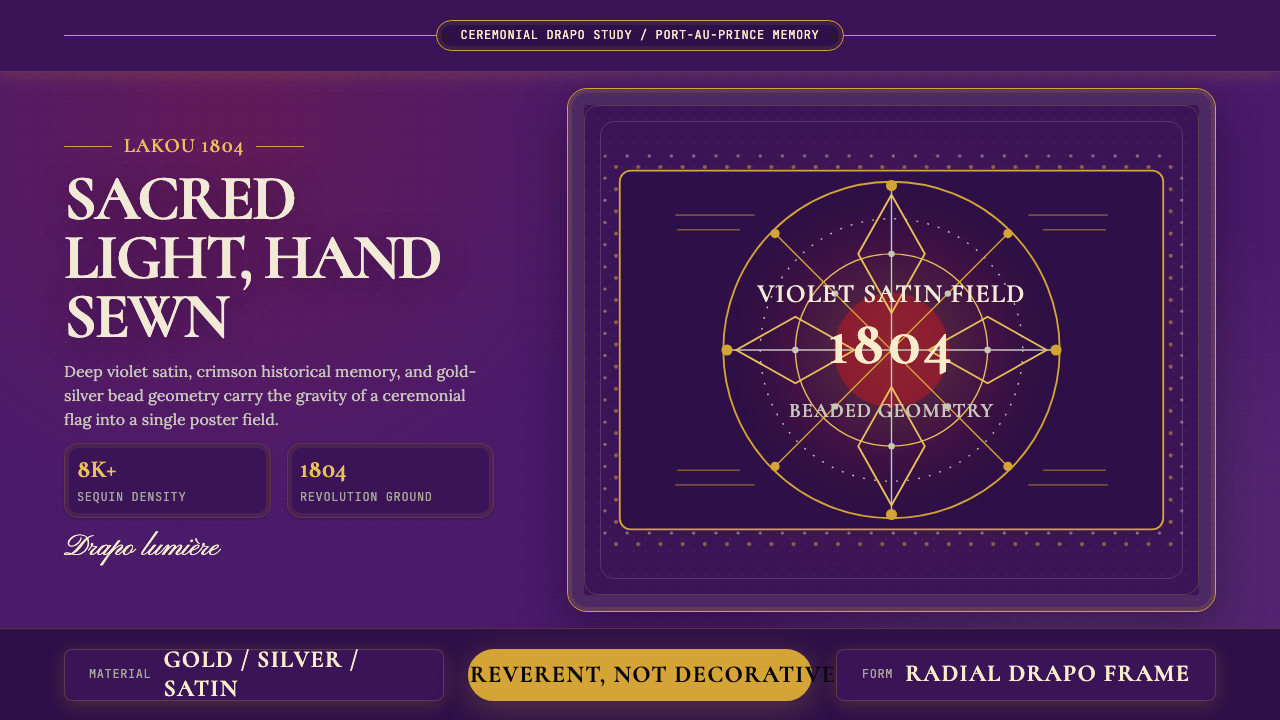 Haitian Vèvè Sequin Drapo 1804Sacred density. Violet satin, gold sequins, and radial geometry hold 1804 gra…
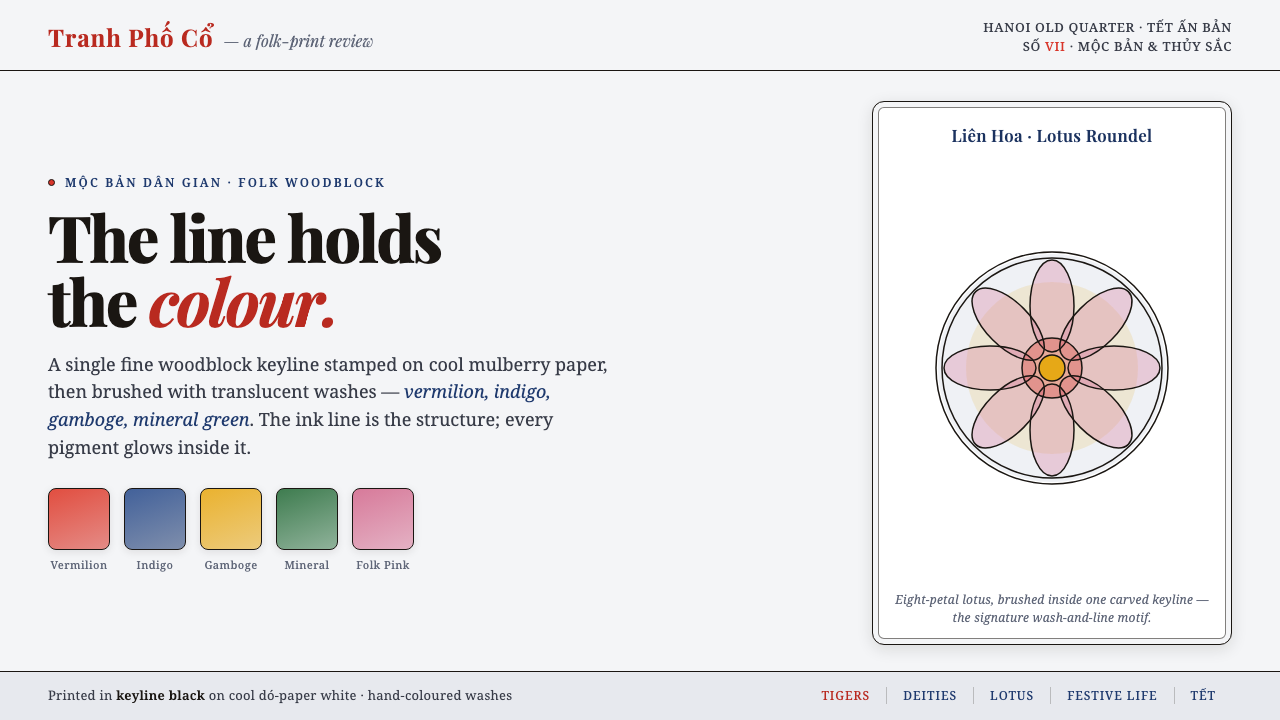 Hàng Trống Folk PrintBright folk colour, never loud. Translucent vermilion-indigo washes held insi…
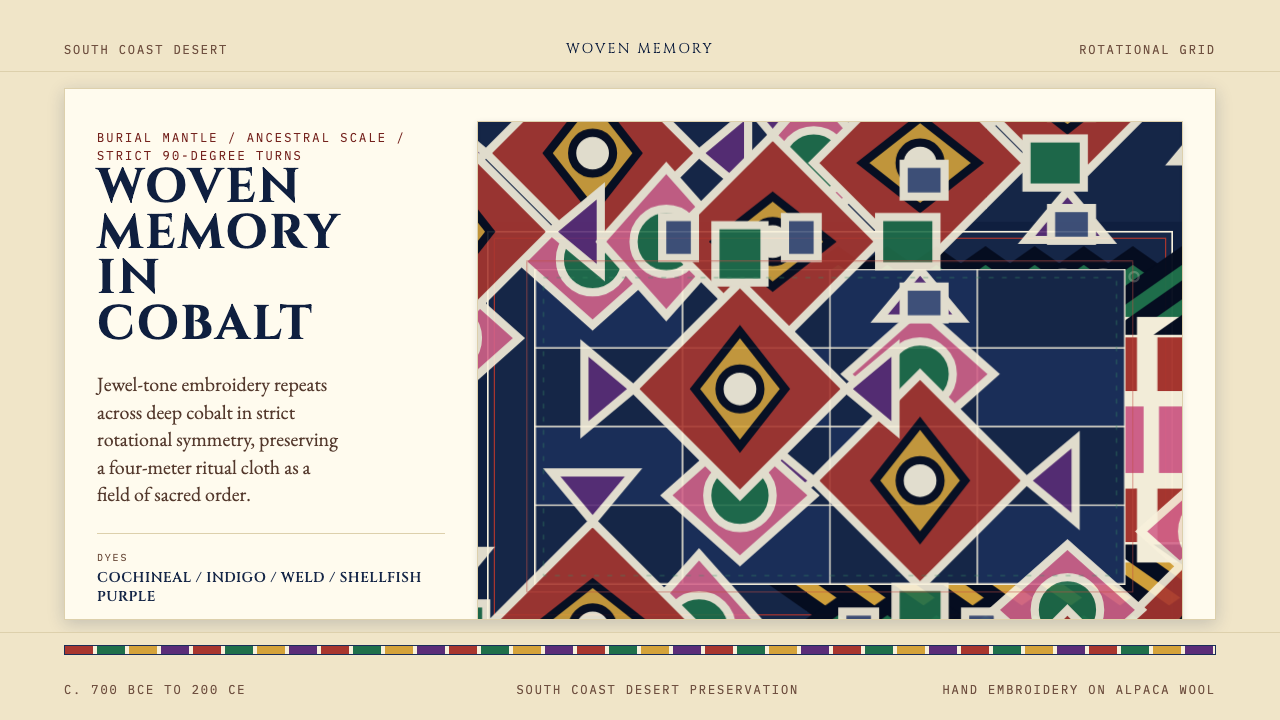 Paracas Andean TextileAncestral and exact. Jewel tones repeat on deep cobalt in strict 90° turns.
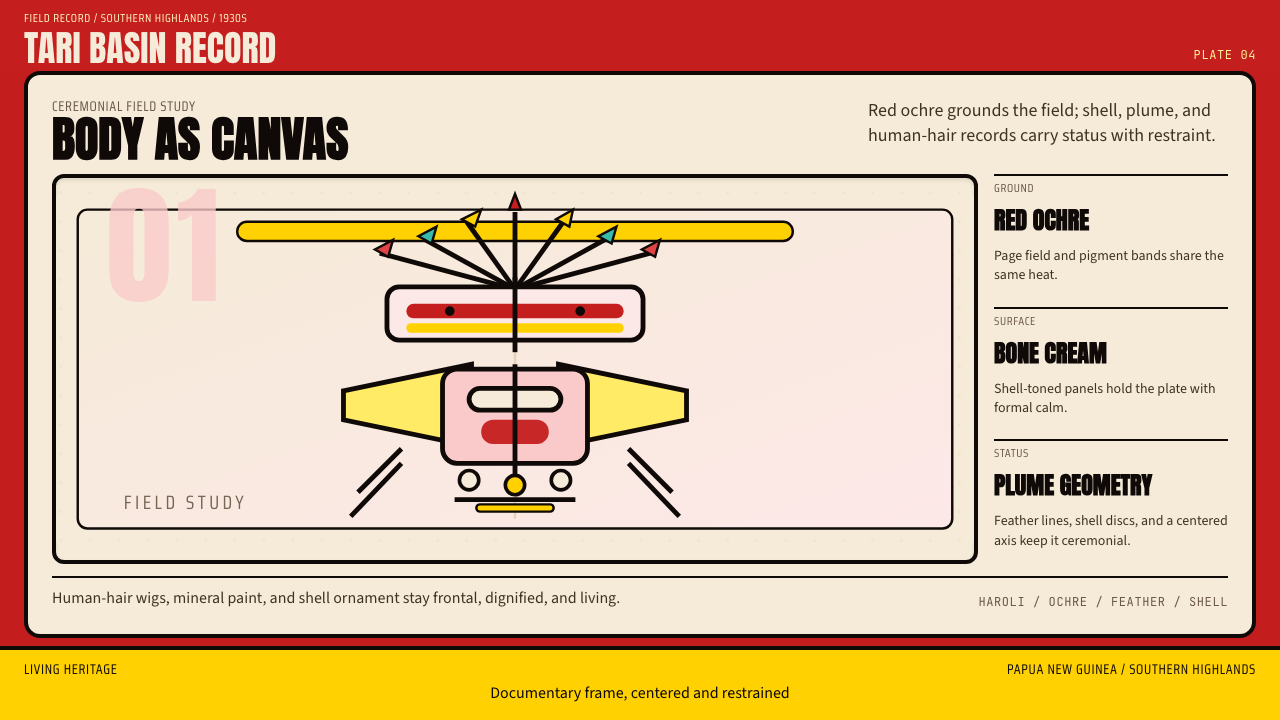 PNG Huli WigmanBody as ceremony. Red ochre, cream bone, and feathered geometry hold a fronta…
 Suriname Maroon TembeDense memory, carved in rhythm. Kaolin lines cross hardwood brown in bilatera…
 Yemeni Sana'a Old City Tower-HouseVertical memory, densely framed. Brick orange, gypsum white, and blue rosette…