What is Talavera Poblana Ceramic?
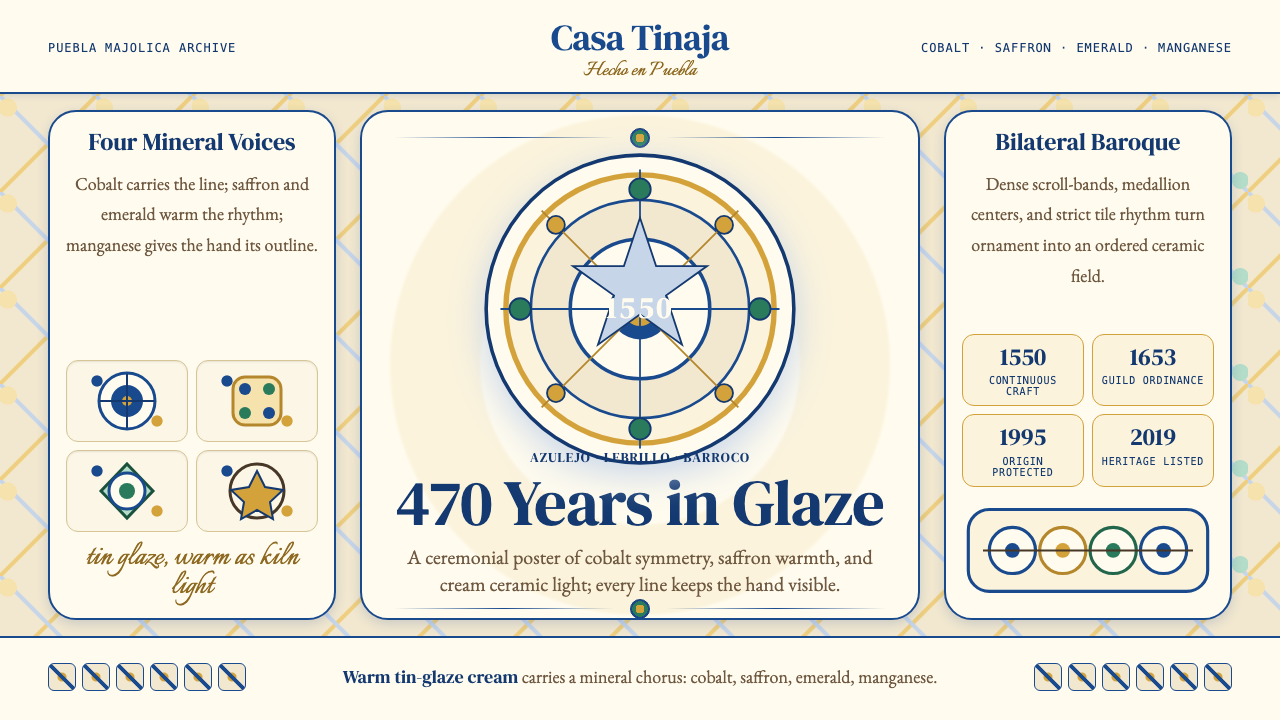
Talavera Poblana is five centuries of Spanish, Moorish, and Mexican Baroque craft fused into warm tin-glaze cream painted with saturated cobalt, saffron, emerald, and manganese — a living tradition still governed by guild law and UNESCO recognition.
Talavera Poblana Ceramic in brief
Talavera Poblana is the tin-glazed majolica ceramic tradition produced continuously in Puebla, Mexico, since around 1550. Its visual signature is immediately recognizable: a warm cream ground that reads as neither stark white nor beige, overlaid with hand-painted motifs in a disciplined palette of cobalt blue, saffron yellow, emerald green, and manganese black, sometimes accompanied by an iron-orange accent. The imagery draws on Baroque floral scrollwork, figural scenes, birds, and geometric interlace — all executed with slight brush irregularity that marks every piece as human-made.
The aesthetic system operates under strict self-imposed constraints. Certified Talavera Poblana pieces use no more than five colors on any given surface, achieve a hard tin-glaze finish that produces a particular depth and sheen distinct from ordinary earthenware, and exhibit bilateral or radial symmetry as the dominant organizational grammar. The symmetry is never mechanical — the hand of the painter is always legible — which is precisely the quality that distinguishes authentic Talavera from industrial imitation. Motifs repeat and mirror, but they breathe.
Because Talavera Poblana holds a Mexican Denominación de Origen (DO) since 1995 and was inscribed on the UNESCO Representative List of the Intangible Cultural Heritage of Humanity in 2019, the name itself carries legal weight. Only pieces produced by certified workshops in the states of Puebla and Tlaxcala, following documented traditional methods including natural mineral pigments and double-firing, may legally carry the Talavera designation. This heritage context shapes how the aesthetic should be handled in digital work: the visual language deserves the same respect as a protected geographical indication.

Where does Talavera Poblana Ceramic come from?
The roots of Talavera Poblana are a palimpsest of three continents. The tin-glaze technique itself — applying an opaque white glaze containing tin oxide to earthenware before painting — originated in the Islamic ceramic world, traveled through Persia and North Africa into Moorish Spain, and settled in Andalusia. From there it crossed the Mediterranean into Renaissance Italy, producing the celebrated Faenza majolica (from which the word 'faience' derives) and the parallel tradition of Talavera de la Reina in the Toledo region of Castile. When Spain began colonizing the Americas in the sixteenth century, Castilian potters carried both the technique and the visual vocabulary with them.
Puebla de los Ángeles — founded by the Spanish Crown in 1531 as a planned colonial city — became the center of New World majolica production for reasons of both geography and policy. The surrounding Tlaxcalan highlands offered deposits of high-quality clay and lead, and the city's position on the trade route between Veracruz and Mexico City made it a natural manufacturing hub. By the second half of the sixteenth century, Dominican friars had established tile workshops there to supply the region's many churches and convents. Spanish immigrant potters, bringing techniques from Talavera de la Reina and Seville, settled in Puebla and began training local mestizo and indigenous apprentices.
The colonial guilds formalized practice early. A 1653 guild ordinance — the first of its kind in the Americas — established quality standards, regulated the number of masters and apprentices, and specified which pigments were permissible. This guild structure was the seedbed of the formal protected-status system that exists today. During the Baroque peak of roughly 1650 to 1750, Puebla workshops produced the large decorative tiles (azulejos) that still cover the facades and kitchen interiors of the city's colonial buildings, as well as the iconic Talavera vessels — platters, pitchers, holy-water fonts, and apothecary jars — exported throughout New Spain. The imagery in this period blended Castilian botanical and heraldic motifs with Chinese blue-and-white (imported via the Manila Galleon trade), indigenous florals, and scenes from Catholic hagiography.
After Mexican independence in 1821, the workshops entered a long period of contraction as European industrially produced ceramics undercut local prices. The Uriarte family workshop, established in Puebla in 1824, became one of the crucial continuity nodes, maintaining hand production and traditional firing methods through the nineteenth and twentieth centuries. The late twentieth century brought deliberate revival: craft museums, academic documentation of historical techniques, and eventually the Denominación de Origen decree of 1995, which created a formal Regulatory Council (Consejo Regulador de la Talavera) to certify workshops and authenticate pieces. The 2019 UNESCO inscription, shared jointly with Spain's Talavera de la Reina tradition, confirmed the tradition's status as living world heritage rather than historical artifact.
What defines the Talavera Poblana Ceramic look?
Palette Discipline
Certified Talavera Poblana limits itself to five colors derived from natural mineral pigments: cobalt blue, saffron yellow, emerald green, manganese black, and an iron-derived orange-red. The warm cream of the tin-glaze ground functions as an implicit sixth tone — never stark white, always with a fired warmth — and serves as the breathing space between painted motifs. This restricted palette creates immediate visual coherence across wildly varied subject matter; whether the piece depicts birds, flowers, or saints, the same five colors bind everything into a unified world.
Bilateral and Radial Symmetry
Symmetry is the structural backbone of Talavera Poblana composition. Circular pieces — plates, bowls, tiles — typically organize their decoration in radial panels that mirror and repeat around a central focal motif. Elongated forms such as pitchers and vases use bilateral symmetry, with mirrored floral or figural arrangements flanking a central axis. This symmetry is never mechanically perfect: the human hand introduces slight asymmetries in brushstroke weight and curve, and it is precisely this imperfection that distinguishes hand-painted Talavera from printed facsimiles.
Baroque Figural and Floral Vocabulary
The motif library of Talavera Poblana is dense and syncretic. Castilian Baroque contributed spiraling acanthus scrollwork, heraldic eagles, and pomegranate borders. The Manila Galleon trade introduced Chinese-derived peony blossoms, cloud bands, and fish. Indigenous Mexican artisans layered in local flora — particularly passionflowers and marigolds — as well as deer, rabbits, and pre-Columbian geometric interlace. Catholic iconography provided saints, angels, and sacred monograms. These elements co-exist on the same surface without hierarchy, producing a visual richness that is encyclopedic rather than chaotic, bound together by the consistent palette and symmetrical grammar.
Hand-Painted Brush Presence
Unlike transfer-printed or industrially decorated ceramics, authentic Talavera Poblana makes the painter's hand visible. Brushstrokes have variable pressure — the entry and exit of a stroke differ from its middle passage. Lines that appear straight are slightly alive. Floated washes of cobalt show subtle pooling at edges. This visible human agency is not a flaw to be minimized but the central authenticating quality of the tradition. In digital interpretation of the aesthetic, textures that evoke this quality — slight surface variation, hand-drawn linework over geometric structure — carry more fidelity to the original than perfect computer-generated symmetry.
Tin-Glaze Ground Warmth
The foundation of the entire visual system is the tin-glaze ground itself — a fired ceramic surface that is opaque, slightly granular in texture, and warm in tone. It is not the bright white of modern porcelain or printer paper but an off-white with an almost imperceptible amber undertone that comes from the firing process. Against this ground, even the coolest cobalt reads as warm. Reproducing this quality in digital contexts means choosing background tones that are cream rather than white — backgrounds with warmth baked in, not cold neutral grounds with a warm overlay.
Hard-Fired Finish and Color Depth
Talavera Poblana undergoes two firings: a bisque firing that hardens the clay body, and a second glaze firing at a higher temperature that fuses the tin-glaze and the painted mineral pigments into a glassy, durable surface. This double-firing gives the colors a particular luminous depth — the pigments sit within the glaze rather than on top of it, so they appear to glow from inside the surface. The cobalt in particular achieves an intensity that shifts from near-black in dense areas to a luminous blue in thinly applied passages. This quality of depth and inner light distinguishes Talavera color from surface-printed color.
Guild Craft and Regulated Authenticity
Since 1995, the visual and material standards of Talavera Poblana are legally defined by the Denominación de Origen regulations and enforced by the Consejo Regulador de la Talavera. Each certified piece is individually inspected and receives a seal of authenticity. This regulatory framework means that the aesthetic system is not merely a historical style but an ongoing living practice with enforceable standards. For designers working with the Talavera visual language, this context implies a responsibility of informed interpretation — using the forms and color logic thoughtfully, in ways that acknowledge their cultural origin rather than flattening them into generic decorative pattern.

Who shaped Talavera Poblana Ceramic?
The Uriarte workshop is the oldest continuously operating certified Talavera workshop in Puebla and the most important institutional anchor of the tradition through the difficult nineteenth and early twentieth centuries, when European industrial ceramics threatened to displace hand production entirely. Founded in 1824, the workshop maintained traditional double-firing techniques, natural mineral pigments, and apprenticeship training across multiple generations. Today it functions as both a working production facility and a museum, and its historical archive of designs and techniques was instrumental in establishing the documentary basis for the 1995 Denominación de Origen.
The unnamed Spanish immigrant potters from Talavera de la Reina who settled in Puebla in the latter half of the sixteenth century are the direct technical progenitors of the Pueblan tradition. They brought the tin-glaze formula, the pigment preparation methods, the kiln-building knowledge, and the visual conventions of Spanish Baroque majolica. Working alongside Dominican friars who needed tiles for their churches and local indigenous craftspeople who supplied their own formal instincts, these potters created the hybrid workshop culture from which all subsequent Talavera Poblana descended. The 2019 UNESCO inscription recognized their role by designating both the Puebla tradition and the surviving Talavera de la Reina tradition in Spain as a single, shared heritage element.
Ventosa is among the key figures in the late-twentieth-century scholarly and institutional effort to document, standardize, and protect the Talavera Poblana tradition. His work contributed to the technical and historical groundwork that informed the 1995 Denominación de Origen regulations. The regulatory framework he helped build — specifying permitted pigments, required techniques, geographic boundaries, and quality inspection protocols — transformed what had been a surviving folk craft into a formally protected and internationally recognized heritage category.
The Talavera de la Reyna workshop in Puebla is one of the few contemporary certified workshops that has made a deliberate effort to engage international audiences with the living practice of Talavera, offering public demonstrations of hand-painting, pigment preparation, and kiln firing. Its work illustrates how the tradition adapts within its strict constraints: new figurative subjects and contemporary design commissions are accommodated while the Denominación de Origen requirements for palette, technique, and materials remain non-negotiable. The workshop represents the tradition's ability to remain culturally alive rather than becoming a museum artifact.
The Dominican religious order was the institutional catalyst for industrial-scale Talavera production in colonial Puebla. The order's ambitious building program — convents, churches, hospital chapels — created sustained demand for the large format decorative tiles and utilitarian vessels that gave the workshops their economic basis. Friars also served as intermediaries between Spanish immigrant potters and indigenous craft communities, creating the institutional conditions under which the syncretic visual language of Talavera Poblana could develop. The kitchens of the convent of Santa Rosa de Lima, entirely covered in Talavera tile, remain the most visited single expression of the tradition's early colonial golden age.
How do you use Talavera Poblana Ceramic today?
Talavera Poblana translates into digital design work through a set of specific, historically grounded choices: a warm cream ground rather than neutral white, a palette of no more than four or five saturated mineral-derived tones, bilateral or radial symmetry as the structural grammar, and decorative motifs that are dense without being chaotic because they are organized by symmetry and bounded by the restricted color set. The style suits any project where warmth, craft heritage, cultural depth, and visual richness are desirable — not as decoration layered on top of function, but as function expressed through ornament.
For presentation slides, Talavera's visual logic works best when the cover slide is treated like a decorated ceremonial plate: a centrally organized composition with the title occupying the visual center, flanked by symmetrical decorative borders drawn from the floral and scrollwork vocabulary. Section divider slides can echo the tile panel format — a warm cream field subdivided into a radial or grid arrangement of smaller decorative units, with the section title placed as the central medallion. Content slides should step back from dense decoration: use the warm cream ground, the restricted palette for accent colors in data visualization and callouts, and reserve the full decorative vocabulary for moments that signal transition or emphasis.
For web interfaces — particularly dashboards, pricing pages, and cultural-sector sites such as museum platforms or artisan marketplace pages — Talavera offers a distinctive alternative to cold neutral design systems. A Talavera-informed dashboard places data within a visual context that feels handcrafted and warm: card components with cream backgrounds and cobalt or saffron accent borders, navigation bars that use the cream-and-cobalt pairing, and chart visualizations that draw from the five-color palette. The symmetry principle informs grid structure — a centered or balanced layout rather than a hard left-anchored one. This aesthetic is particularly effective for products that want to communicate cultural authenticity, artisanal quality, or heritage value.
For editorial and marketing work, Talavera's richness makes it suitable for feature articles, cultural brand campaigns, and packaging design in the premium artisan food, spirits, and craft goods categories. A Talavera-derived editorial layout uses a warm cream page ground, section headers set against cobalt or saffron bands, and ornamental rule lines drawn from the tradition's geometric interlace patterns as structural dividers. Marketing materials — posters, social cards, packaging — work well with the tradition's poster-like combination of symmetrical composition and high-saturation color: the warm cream ground prevents the saturated tones from reading as garish, and the symmetry provides immediate visual calm amid the richness.
A common mistake when applying the Talavera aesthetic is treating it as a license for maximum color and pattern — piling on all five colors simultaneously at full saturation across the entire surface, or adding decorative motifs without the underlying symmetrical structure that gives the tradition its coherence. Authentic Talavera work always has negative space: the cream ground breathes between painted motifs, and the symmetry organizes density into legibility. In digital applications, the equivalent discipline means not every component needs decoration, not every color needs to appear on every screen, and the warm ground itself — spacious and undecorated — is an active part of the design. Restraint within richness is what separates a thoughtful Talavera-inspired design from a superficial pastiche.

Talavera Poblana Ceramic — FAQ
What makes Talavera Poblana different from other blue-and-white ceramic traditions like Delftware or Chinese porcelain?
All three traditions descend, at some remove, from the same Islamic blue-and-white ceramic lineage, but they diverged significantly in technique, palette, and cultural content. Chinese porcelain uses a translucent, hard-fired kaolin body that produces a bright white, ringing ground — quite different from Talavera's earthenware body with its warm, slightly absorbent tin-glaze. Delftware developed in the Netherlands from the late sixteenth century largely in response to the Chinese import trade and tends toward cooler blues on a brighter white ground with a more pictorial, landscape-scene tradition. Talavera Poblana is distinctive for its multi-color palette (Delftware is predominantly blue-and-white; Talavera uses four to five colors), its explicitly Baroque figural and floral vocabulary fused with indigenous Mexican motifs, and its continuous living tradition under protected-designation status. The warm ground tone is also diagnostic: Talavera cream is unmistakably warmer than Delft or Chinese white.
Can the Talavera aesthetic work for dark-background digital designs?
The canonical Talavera ground is warm cream — not dark — and inverting the system to a dark background fundamentally changes the aesthetic logic. On a dark ground, the warm intimacy and glowing depth that characterize the tradition are difficult to preserve; the colors that read as rich and saturated against cream can become garish or over-bright against black. A dark-mode adaptation is possible, but it works better as a reinterpretation than a direct inversion: treat a deep warm charcoal or near-black with warm undertones as the ground, use the cobalt and saffron sparingly as accent elements rather than primary motif colors, and reduce the decorative density significantly. The result will feel more like a nocturnal reference to the tradition than an authentic expression of it.
How do I reference the Talavera aesthetic without it reading as cultural appropriation?
The distinction between informed interpretation and appropriation lies in attribution, depth of understanding, and context. Using the Talavera color logic and symmetrical grammar in a digital product that openly references and credits the tradition — perhaps noting the Denominación de Origen, the Pueblan origin, or the UNESCO heritage status — is very different from stripping the visual surface and using it as generic 'Mexican-looking' decoration without acknowledgment. Understanding why the palette is restricted, why symmetry governs the composition, and what the motifs historically mean is also part of responsible use. For commercial products that use the tradition's full visual vocabulary extensively, engaging directly with Puebla-based certified workshops for actual creative collaboration is the most straightforward way to ensure the relationship is one of partnership rather than extraction.
Is there a meaningful difference between Talavera Poblana and other Mexican ceramic traditions like Talavera-style pottery from Guanajuato?
Yes, and the distinction is legally defined. The Denominación de Origen restricts the use of the name 'Talavera' — without a qualifying modifier — to pieces produced by certified workshops in Puebla and Tlaxcala following the regulated traditional process. Pottery from Guanajuato and other Mexican states that uses similar visual conventions may be described as 'Talavera-style' or 'majolica' but cannot legally be labeled Talavera. The difference extends beyond naming: certified Talavera Poblana uses double firing and natural mineral pigments, while unregulated Talavera-style ware often uses synthetic pigments, single firing, and transfer-printed decoration. The visual result can be superficially similar but lacks the depth of color and slight surface texture that the regulated process produces. For designers, this means that sourcing actual photographic references from certified workshops, rather than from generic internet searches for 'Talavera pattern,' will produce more accurate and respectful source material.
Does Talavera Poblana work for minimalist or modern product aesthetics, or is it only suited to maximalist contexts?
The tradition itself is not minimalist, but its underlying principles — a restricted palette, structured symmetry, and a warm cream ground — are entirely compatible with restrained modern applications. The key is selective deployment: take the palette and ground, but use only one or two motif elements rather than the full decorative vocabulary; use the symmetry principle as a composition guide without filling every zone with pattern; let the warm cream ground do more work and the painted elements do less. A pricing page that uses cobalt card borders and a cream background is Talavera-informed without being Baroque in density. The tradition's constraints are actually assets in a modern context: because the palette is already limited and the compositional logic is already clear, you can borrow the parts that serve your context without having to reproduce the full ornamental density of a decorated plate.
Related design styles
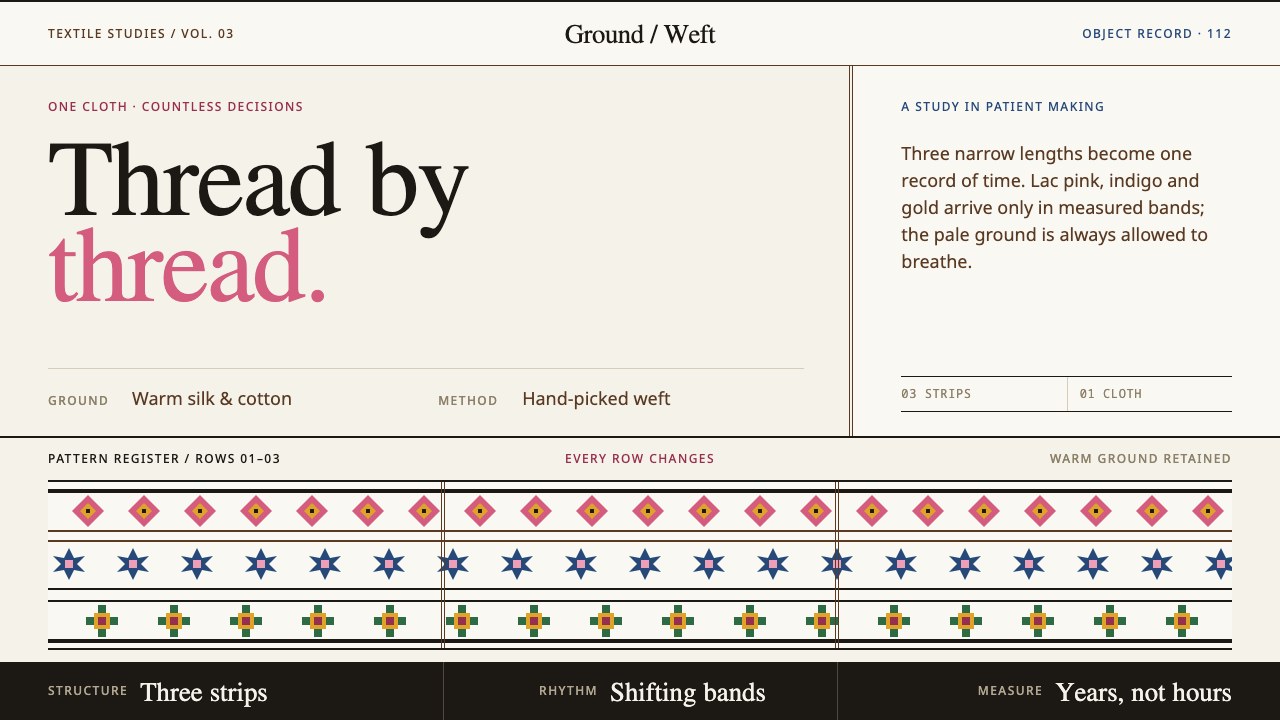 Bhutanese KushutharaPatience made visible. Lac pink and indigo bands shift across a warm silk gro…
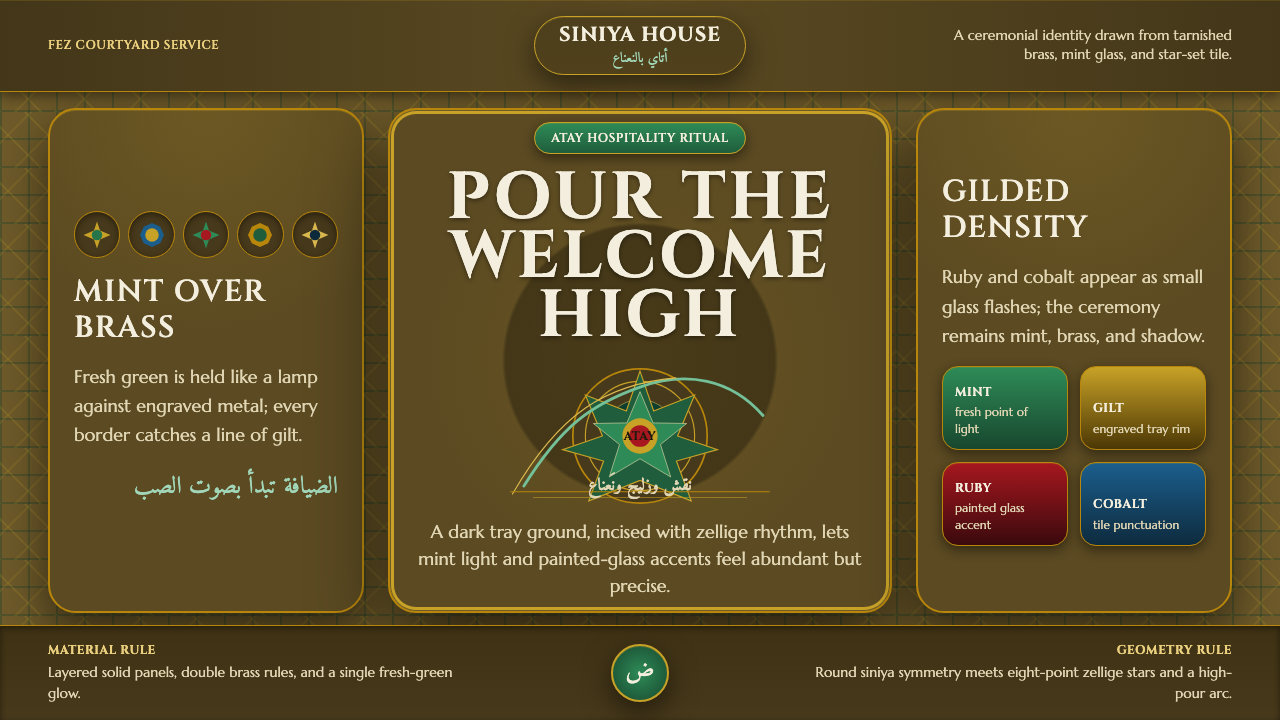 Moroccan Mint TeaCeremony glows in brass. Mint green, Cinzel type, and zellige geometry frame…
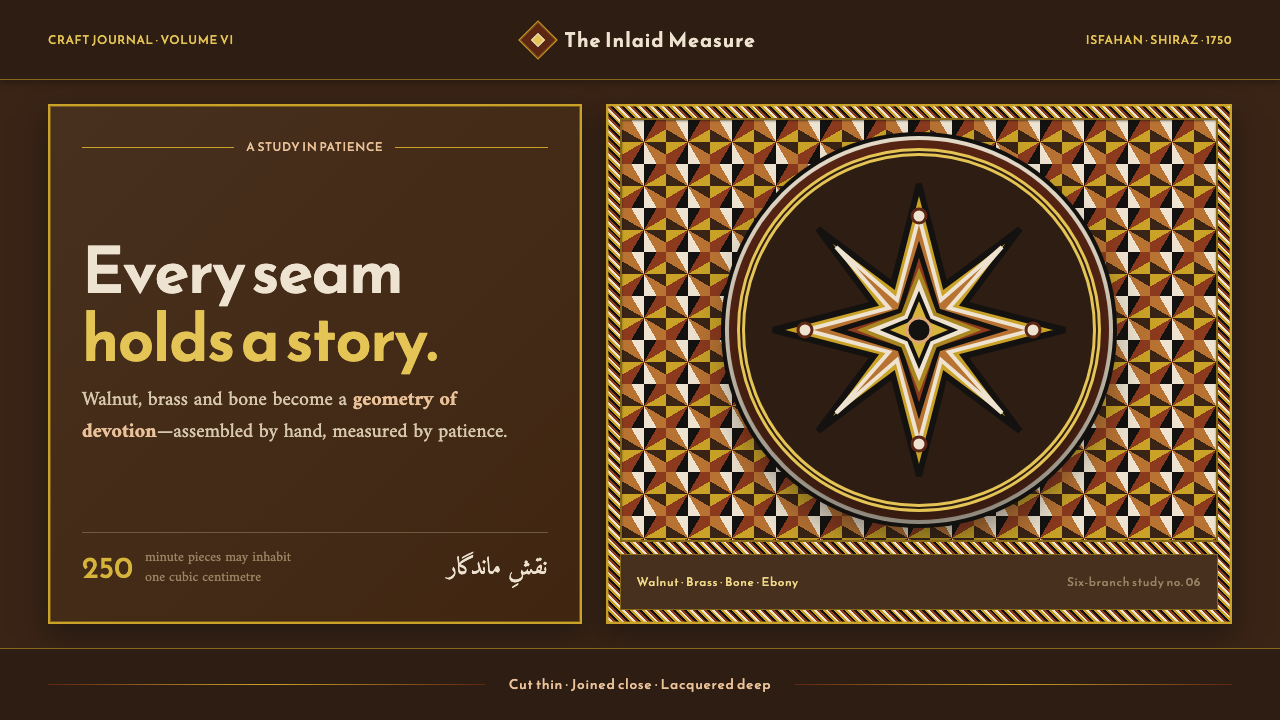 Persian Khatam MarquetryPatience becomes pattern. Brass-and-bone stars tessellate across lacquered wa…
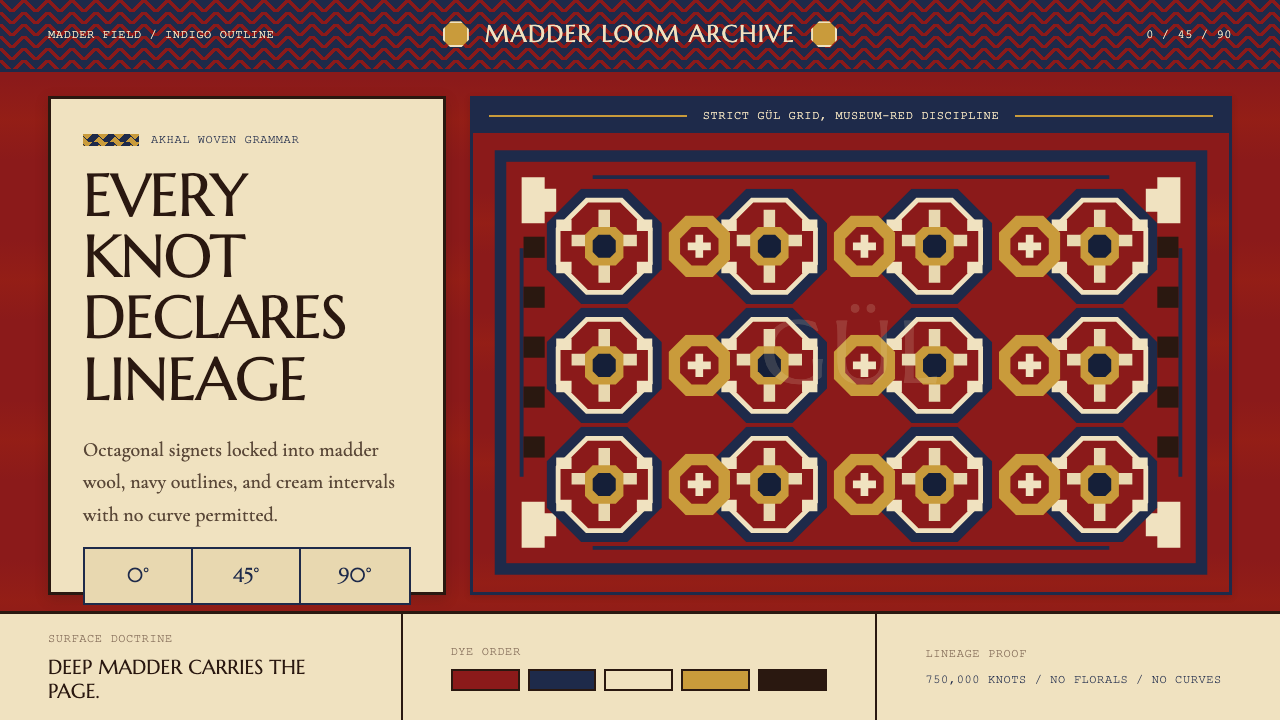 Turkmen Tekke Carpet (Gül Medallion)Disciplined red geometry. Madder field, indigo outlines, cream gül grid.
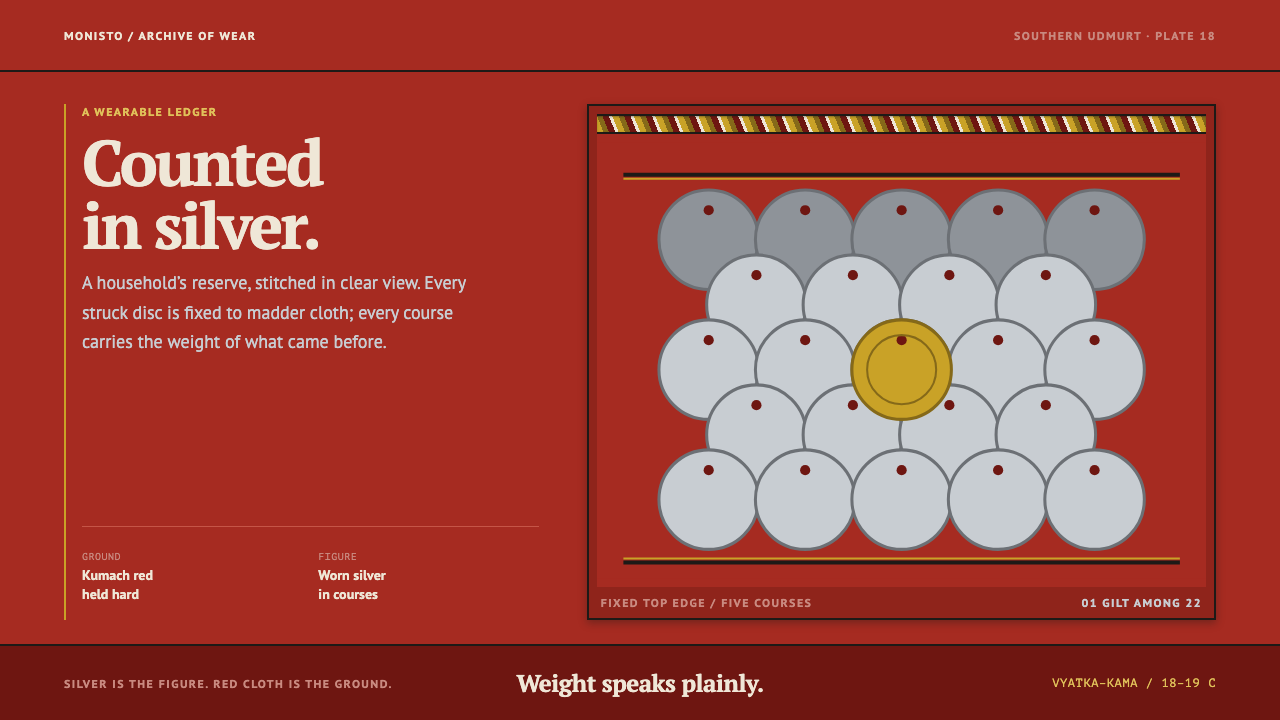 Udmurt MonistoValue made visible. Overlapping silver courses weigh against madder-red cloth.
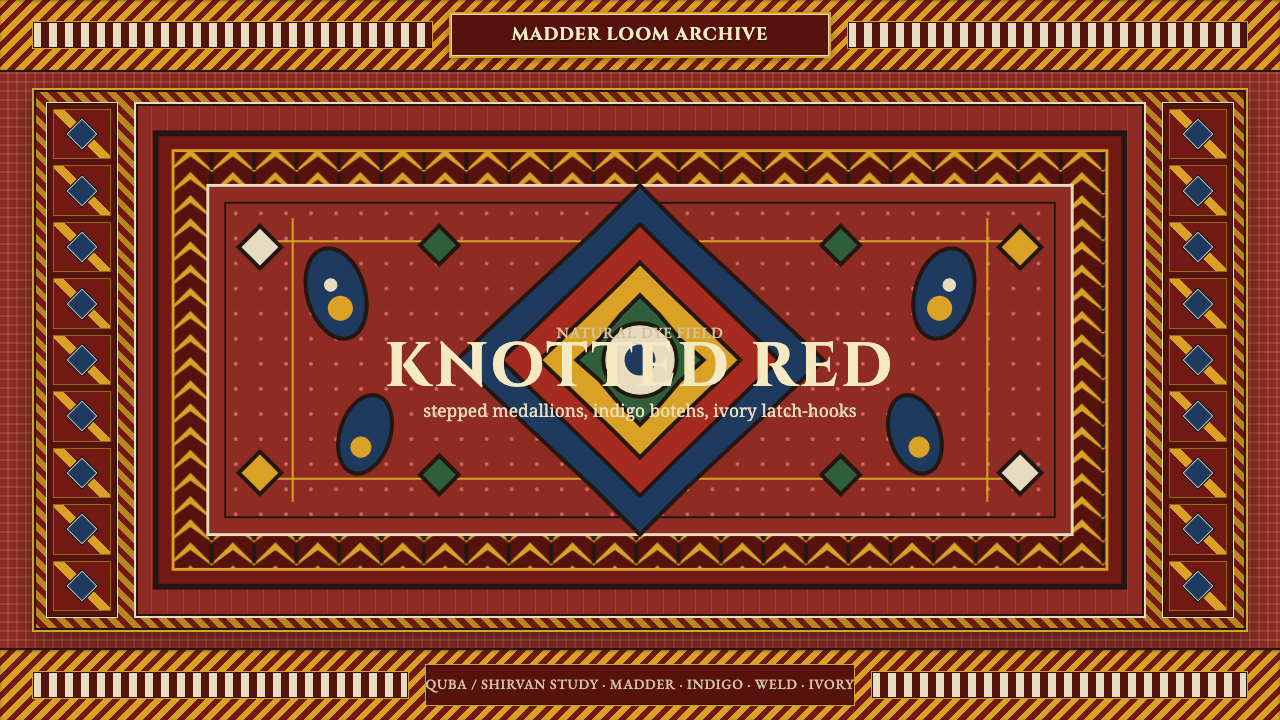 Azerbaijani Quba CarpetRed is the field. Indigo botehs and ivory latch-hooks orbit a stepped medalli…