What is Turkmen Tekke Carpet (Gül Medallion)?
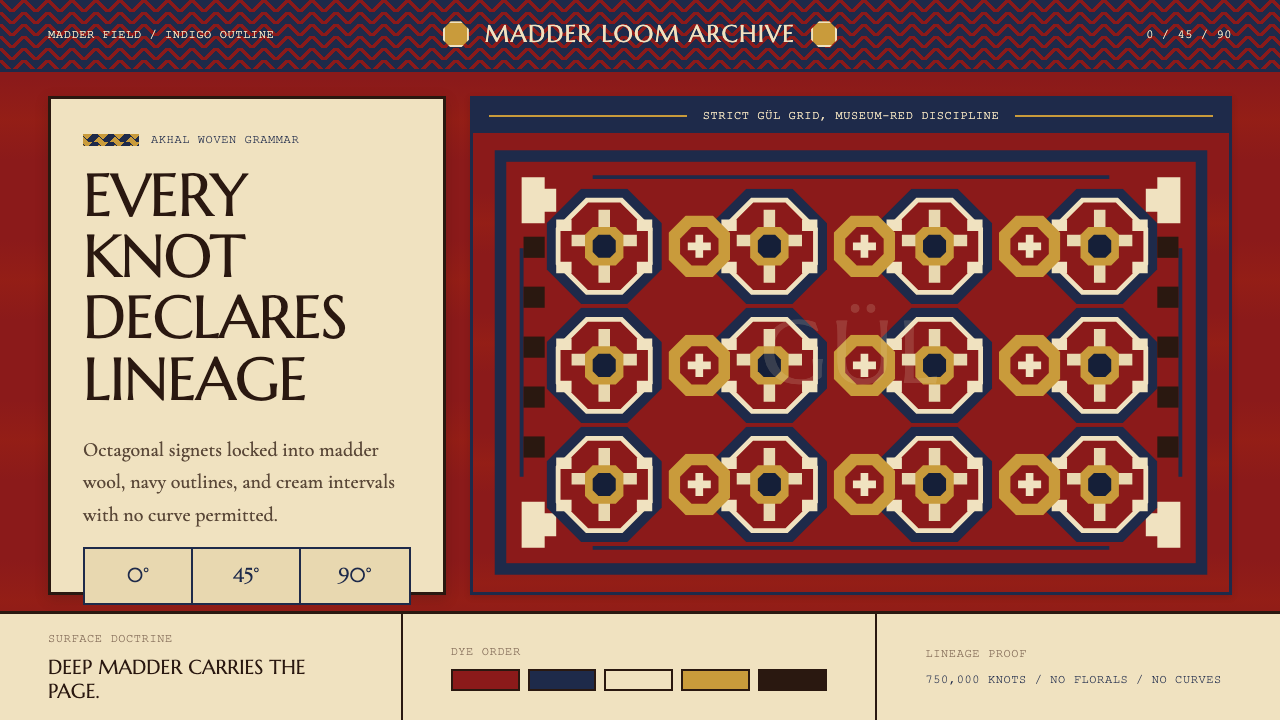
The Tekke carpet's octagonal gül medallion is one of design history's most disciplined geometric systems — a tribal signet woven in madder red and indigo that turns repetition itself into a monument.
Turkmen Tekke Carpet (Gül Medallion) in brief
The Turkmen Tekke carpet is the signature textile tradition of the Tekke tribe, the largest and most prestigious of the Turkmen confederations. Its visual identity rests on a single, endlessly iterated motif: the gül, an octagonal or hexagonal medallion built from interlocking geometric subforms, arranged in a strict grid across a field of saturated madder red. The carpet is not a picture of anything — it is a statement of identity, ownership, and tribal authority rendered entirely through geometric discipline.
What distinguishes the Tekke tradition from other Central Asian weaving schools is the absolute precision of its geometry and the severity of its color logic. The madder-dyed field is not decorative background; it is the dominant voice. Indigo outlines give each gül its crisp internal structure, while small accents of undyed cream wool provide the only visual relief in an otherwise unbroken field of red. The palette is restricted to three tones — deep crimson, navy, and natural cream — applied with a consistency that approaches the rigidity of a typographic system.
The gül itself is a tribal marker that functioned somewhat like a heraldic device: different Turkmen tribes used recognizable gül variants, and the Tekke gül — with its characteristic quartered internal structure and secondary minor güls filling the interstices — is among the most formally sophisticated. Every element inside the medallion is geometric: stepped diamonds, reciprocating hooks, and small cross-like forms, all constructed on a strict diagonal grid that permits only forty-five-degree angles outside of the vertical and horizontal axes.
Where does Turkmen Tekke Carpet (Gül Medallion) come from?
The Tekke tribe's homeland lies across the Akhal oasis near present-day Ashgabat and the Merv oasis in southern Turkmenistan, regions where settled irrigated agriculture met the open steppe grazing routes used by nomadic pastoralists. The carpet tradition likely crystallized in its recognizable form during the eighteenth century, though the weaving practices that produced it — using wool from the fat-tailed Karakul sheep, natural dyes sourced from madder root, indigo, and pomegranate rind, and the asymmetric Persian knot tied around warps of handspun wool — are substantially older.
The nineteenth century, and especially the period between roughly 1850 and 1900, is regarded as the golden age of Tekke weaving. Before the Russian conquest of Merv in 1884, which ended effective Tekke political independence, the tribe maintained a sophisticated internal economy in which fine carpet weaving was the primary medium of stored wealth. A single large carpet could represent months of labor by multiple weavers, and the density of knotting in the finest pieces — sometimes exceeding one hundred thousand knots per square foot — functioned as a demonstration of collective skill and tribal resources.
Russian and then Soviet administration brought radical change. The conquest opened Central Asian textiles to European commercial markets, creating demand for larger formats and, eventually, pressure to alter the traditional palette toward colors more fashionable in European interiors. Aniline dyes, which produced brilliant but unstable colors, entered the regional market in the late nineteenth century, and their adoption by some weavers marks a visible degradation in the collector's record. The finest pre-conquest pieces, with their deep mineral madder reds and stable indigo navies, are distinguished from later work precisely by the quality of color that time has only deepened.
Scholarly documentation of the Tekke tradition was a largely Western enterprise. Aleksandr Felkerzam, a Baltic German scholar working in the Russian Imperial court's collection, produced early systematic descriptions of Turkmen tribal types. Werner Loges and later Jon Thompson brought rigorous structural analysis to the field, establishing the vocabulary of gül identification — main gül, minor gül, elem border, outer guard stripe — that remains in use today. Thompson's work in particular helped reframe Turkmen carpets not as decorative curiosities but as complex semiotic systems whose geometry encoded social and political information legible to a tribal audience.
What defines the Turkmen Tekke Carpet (Gül Medallion) look?
Color Field
The dominant tone is a deep, saturated crimson produced from madder root — a warm, slightly orange-leaning red that has none of the coolness of modern synthetic reds. It reads as mineral and ancient rather than vibrant or decorative. This red is not background; it is the primary material of the composition, with the geometric ornament understood as a layer applied over it. A digital interpretation should use a single deep red as the commanding ground tone, with all other elements understood as figures against that field.
Gül Medallion Grid
The gül medallions are arranged in a strict offset grid — each row aligned horizontally and vertically, with the spacing between medallions precisely regulated so that secondary minor güls fill the interstices with equal visual weight. The repetition is not monotony; it is the formal argument of the piece. Each individual medallion is internally complex, built from quartered symmetry and layered geometric subforms, yet the grid enforces a larger order that transforms the individual unit into a tessellating whole.
Diagonal Geometry Only
Every internal line within the gül resolves to a vertical, horizontal, or forty-five-degree diagonal. Curves do not exist in this system. This constraint is partly technical — the square-knotted grid of warps and wefts makes true curves impossible — but it also defines the style's visual character completely. The result is a design vocabulary of stepped forms: staircase diagonals that resolve into hook shapes, reciprocating V-patterns, and interlocked saw-teeth. Softness enters only through the optical blending of closely spaced tones, never through curved line.
Indigo Outline Structure
Indigo navy serves as the outlining and structural color throughout the composition. It defines the boundaries of each gül against the red field, delineates the internal subforms within each medallion, and anchors the multiple border bands that frame the carpet's perimeter. The navy reads as the system's logic made visible — wherever the geometry needs to resolve, indigo is the agent of resolution. It never appears as a field or a background, only as line, edge, and structure.
Cream Accent
Undyed natural cream wool appears as a minor but critical accent — used for specific subforms within the gül, for highlight lines within the border bands, and occasionally for the ground of the minor güls. Against the deep red field and navy outlines, the cream registers with surprising prominence despite its sparse use. It provides the composition's only warm neutral relief and prevents the red-and-navy combination from becoming oppressive. In digital translation, a warm off-white — not a cold white — is the correct equivalent.
Border System
Every Tekke carpet is framed by a hierarchical series of border bands: a wide main border containing its own geometric ornament — often a stylized vine rendered in pure angular steps — flanked by narrow guard stripes of reciprocating diagonal hooks. The border is not a decorative frame; it is a structural container that defines the field as a closed, bounded system. The transition from field to border is managed by a narrow transitional stripe, preserving the visual separation between the field's repeating grid and the border's continuous running pattern.
Density and Texture
The finest Tekke pieces are knotted at extraordinary density, producing a surface so tightly packed that individual knots are invisible; the pile reads as a continuous, slightly velvety mineral surface. This material quality translates aesthetically into a sense of weight and permanence — the carpet does not feel improvised or casual, but accumulated, deliberate, and formally complete. A design system derived from this tradition should share that quality of apparent density: patterns that feel thoroughly considered rather than quickly applied.
Who shaped Turkmen Tekke Carpet (Gül Medallion)?
A Baltic German scholar working within the Russian Imperial collection in the early twentieth century, Felkerzam produced some of the first systematic attempts to classify Turkmen carpet types by tribal origin and structural characteristics. His work, though limited by the standards of later scholarship, established foundational categories that subsequent researchers would refine. His access to the Imperial holdings — which included significant Tekke pieces acquired during the Russian Central Asian campaigns — gave him a breadth of comparative material unavailable to contemporaries working from the European art market alone.
Loges brought structural rigor to the study of Turkmen weaving in the mid-to-late twentieth century, developing methods for documenting the internal construction of güls — the precise sequence of subforms, the treatment of outline widths, the handling of transition zones — that allowed for reliable differentiation between tribal types and between production periods. His analytical framework helped transform Turkmen carpet study from an appreciation-based discipline into a structurally grounded field capable of supporting authentication and provenance research.
Thompson is among the most influential scholars in the field of Central Asian textile studies, known for insisting that Turkmen carpets be understood as semiotic systems rather than decorative objects. His analytical writing — particularly his work on the structure and social meaning of gül variants — reframed the entire field, arguing that the precision of Tekke geometry was not aesthetic accident but deliberate communicative encoding. Thompson's scholarship helped bring Turkmen textiles into serious art historical discussion, and his influence on the vocabulary and methodology of the field remains foundational.
The authentic makers of the Tekke tradition were women weavers working within the tribal structure, whose names were almost never recorded by outside observers. The transmission of pattern knowledge — the exact proportions of each gül subform, the specific handling of border transitions, the permissible color relationships — was entirely oral and demonstrative, passed from experienced weavers to younger family members within the tent household. The consistency of Tekke design across generations and across geographically dispersed groups is a testament to the effectiveness of this transmission system, which maintained formal precision without any written documentation.
How do you use Turkmen Tekke Carpet (Gül Medallion) today?
The Tekke carpet aesthetic is a powerful digital design resource for contexts that require authority, cultural weight, and geometric rigor without resorting to either modernist abstraction or digital-native minimalism. Applying it correctly means committing to the core logic: deep red as the dominant field, indigo as the structural articulator, cream as the only neutral, and diagonal stepping as the only means of drawing anything that is not strictly horizontal or vertical.
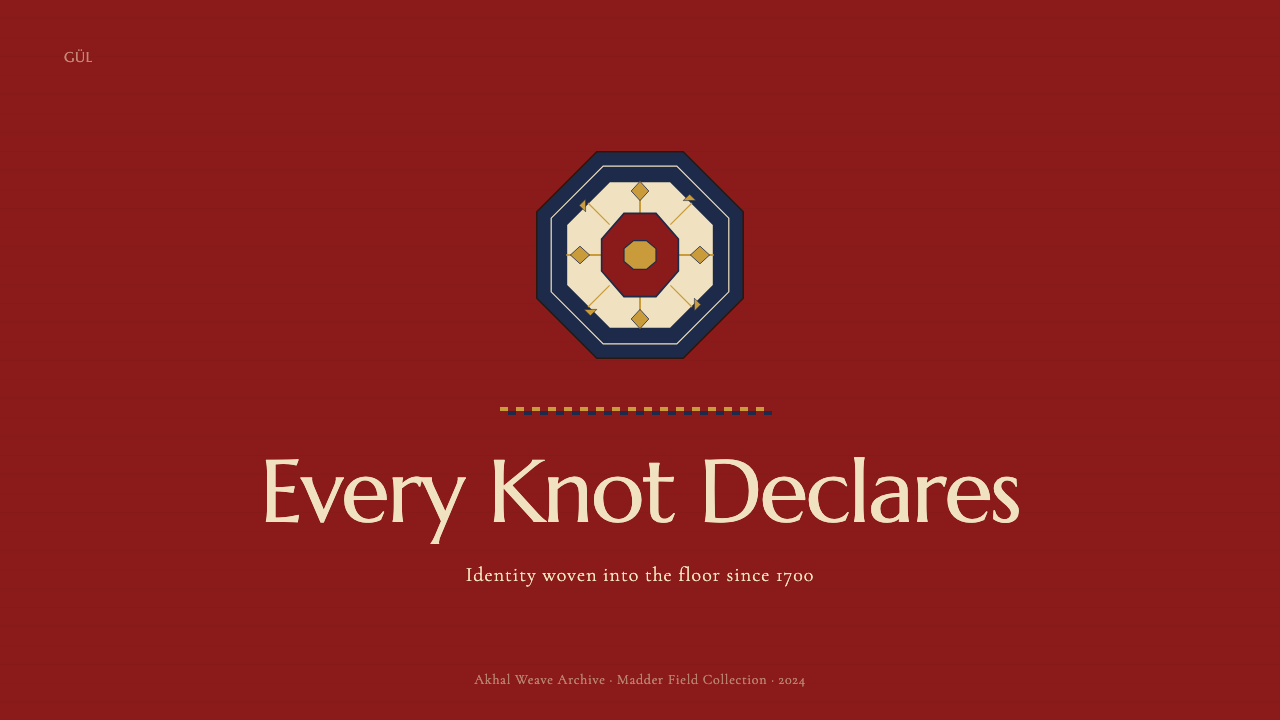
For presentation slides, the Tekke system delivers immediate visual impact on both cover and content pages. A cover page works well with the full field treatment — the entire slide ground in deep madder red, with a central gül-derived geometric device rendered in indigo and cream, and the title in a large, clean sans-serif in cream or near-white. This treatment is especially effective for decks that need to signal cultural depth, craft values, or institutional gravitas. Content slides benefit from a more restrained application: a deep red header band at the top, indigo rules marking section divisions, and body text in near-black on a cream ground — the gül reduced to a small corner ornament or section marker rather than a full-field treatment. Data slides can apply the color logic to chart elements, using deep red bars against a cream ground with indigo axis lines, turning bar charts and area graphs into objects that feel woven rather than plotted.
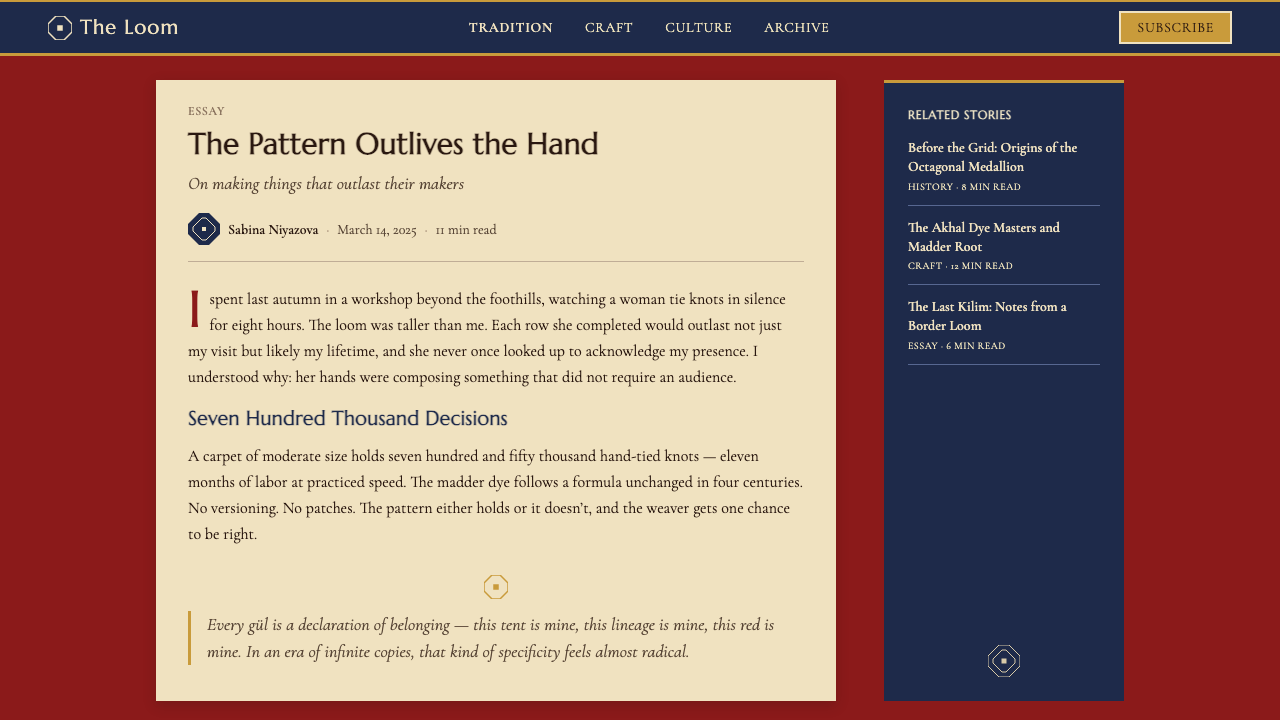
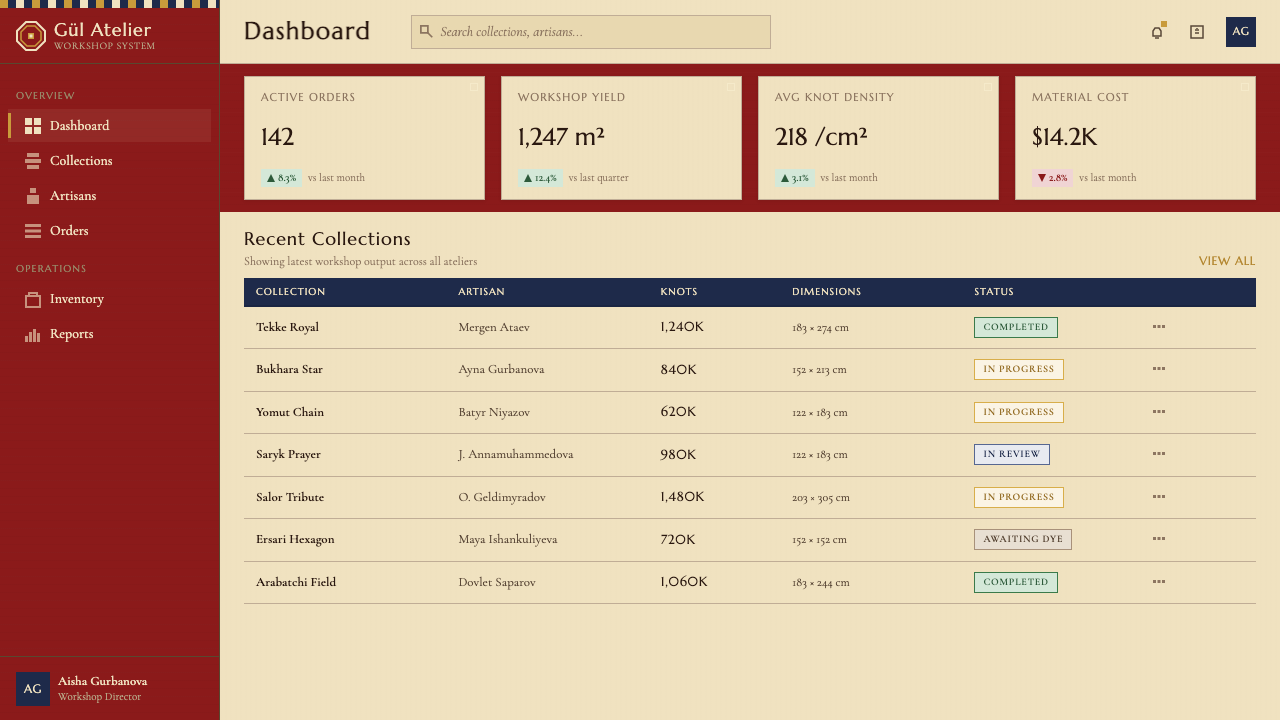
For web interfaces, the style works best in contexts where deliberate visual authority is appropriate: editorial platforms, cultural institutions, heritage brands, luxury e-commerce, and dashboard applications where the visual weight of the interface needs to signal trustworthiness and depth. The approach for dashboards and pricing pages: use the deep madder red sparingly as an accent or primary call-to-action color against a near-white ground, with indigo used for structural elements like navigation, borders, and data labels. Reserve the full red-field treatment for hero sections or feature callouts where maximum impact is required. Geometric ornament derived from gül subforms — stepped diamonds, hook chevrons, saw-tooth borders — can serve as dividers, icons, or decorative rules at small scale without overwhelming the interface.
For editorial and marketing work, the Tekke vocabulary supports strong, memorable visual identities. A publication using this system might establish a consistent color code: deep red for primary sections, indigo for secondary taxonomy, cream for body fields. Borders derived from the guard stripe motif — narrow bands of reciprocating diagonal hooks — can articulate article boundaries or pull-quote boxes with a richness that flat rules cannot achieve. Marketing materials benefit from the style's inherent tension between surface density and compositional clarity: dense geometric pattern in a contained zone reads as craftsmanship, while generous white or cream margins preserve legibility and prevent the composition from becoming exhausting.
A common mistake when drawing on Tekke geometry is treating the gül as isolated decoration — dropping a single medallion motif onto an otherwise neutral layout as a logo-like accent. This misunderstands what the gül means: its power comes from repetition, density, and the field relationship. A single gül floating on white looks like a clip art stamp. The correct application is systemic: the gül exists in a grid, the grid respects the border, the border respects the field. Another frequent error is substituting warmer or brighter reds — coral, tomato, or vermilion — for the deep mineral crimson of authentic madder dye. These lighter reds lose the gravity that makes the tradition work, tipping into decorative cheerfulness when the style calls for mineral weight.
Turkmen Tekke Carpet (Gül Medallion) — FAQ
What makes the Tekke gül different from other Turkmen tribal güls?
The Tekke main gül is typically quartered — divided into four symmetrical quadrants, each of which contains its own sub-pattern of stepped hooks, small cross-like forms, and diamond clusters. The quartered internal structure gives the Tekke gül a sense of formal complexity that is still legible at a distance because the four-part symmetry provides a clear organizing axis. By contrast, some Yomut güls use a diagonal bi-partite structure, and Ersari güls tend toward more open internal arrangements. The Tekke gül is also distinguished by the minor güls — smaller secondary medallions that fill the spaces between the main güls — which in high-quality pieces are as carefully articulated as the main medallions rather than being simplified filler forms.
Why is the madder red so specifically important — can any deep red serve the same purpose?
The quality of madder red is specific. Natural madder produces a warm, slightly brownish-red that is technically described as being in the crimson range but with an earthen undertone — not the pure, saturated cool red of modern synthetic dyes, and not orange-red either. Over decades, madder red ages into deeper, richer tones rather than fading, which is why antique Tekke pieces often appear more resonant than newly produced work. In digital translation, the closest equivalent is a deep, slightly muted crimson with an earth undertone — not a coral, not a fire-engine red, and not a burgundy. The temperature of the red determines whether the palette reads as mineral and ancient or simply as bold and modern.
Is this style appropriate for a contemporary brand, or does it read as historical pastiche?
Whether a Tekke-derived aesthetic reads as thoughtful appropriation or pastiche depends almost entirely on how the geometric vocabulary is abstracted and applied. Direct reproduction of gül medallions as branded motifs tends toward pastiche — it looks like a rug pattern transplanted wholesale rather than a design language understood and reinterpreted. The more effective approach is to absorb the underlying logic: the commitment to strict diagonal geometry, the deep red field relationship, the structural role of navy outlining, the restrained three-color system. A brand or product that applies these principles without literally reproducing traditional motifs can access the authority and cultural weight of the tradition while making something that feels contemporary and purposeful rather than costume-like.
How does this style handle typography, given its strong pattern orientation?
The Tekke weaving tradition has no typographic component — it predates print and exists in a culture where Arabic-script calligraphy was the prestige written form — so any typographic choices in a Tekke-derived digital design system are interpretive rather than historically grounded. The most coherent approach is to look for visual analogies: the system's emphasis on geometric precision and clear hierarchical structure suggests type that is equally geometric, structurally clear, and free of decorative flourish. The tricolor palette dictates that type must work in deep red, indigo, and cream against each other's opposite. Condensed forms handle well in border and label contexts where horizontal space is constrained by the geometric ornament.
Does the style work in a light or white-ground version, or is the deep red field essential?
The deep red field is not merely decorative — it is structurally constitutive of the system. In a Tekke carpet, the gül exists because of the tension between the ornament and the field it sits on. Without the field, the gül becomes isolated pattern; with the field, it becomes figure-ground relationship. A light-ground interpretation is possible but requires significant reorientation: the red shifts from field to figure, deployed as the outlining or pattern color against a cream ground, with indigo as a secondary structural color. This is a legitimate and more commercially accessible variation, but it operates by inversion and will read as derived rather than primary. The full authority of the style comes from committing to the red ground.
Related design styles
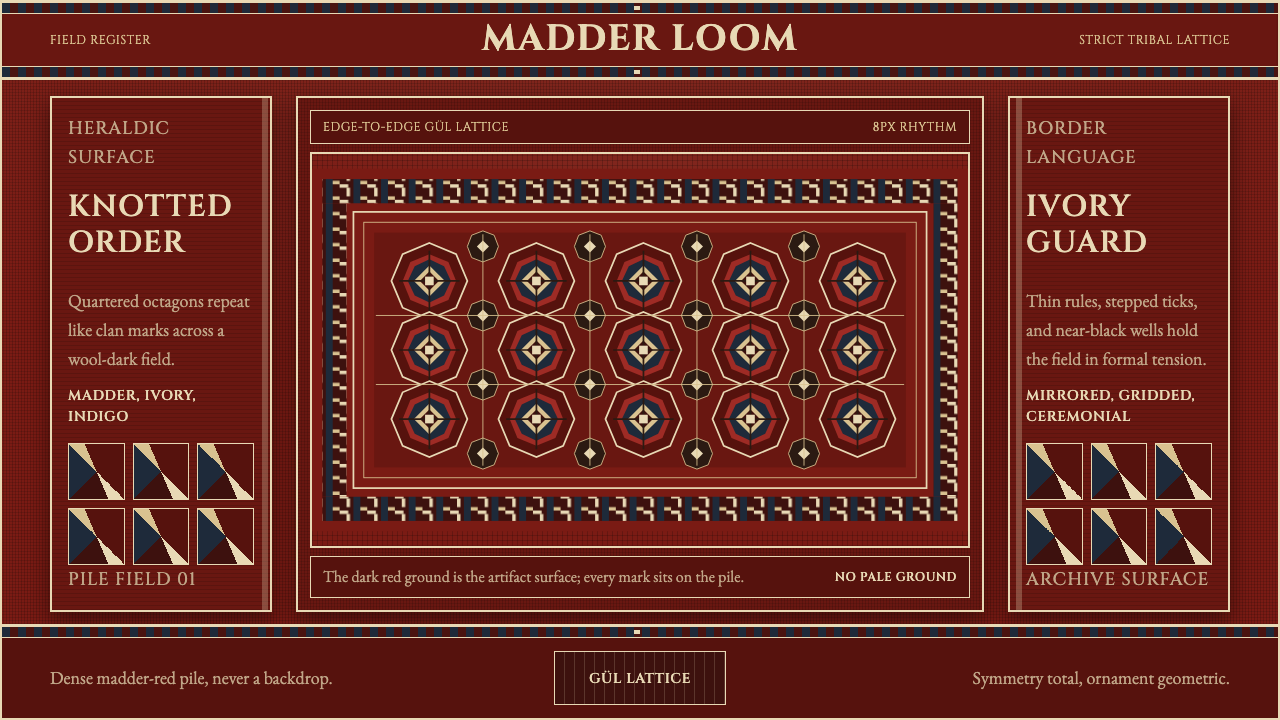 Turkmen Bukhara RugHeraldic and earthbound. Madder red, ivory hairlines, and octagonal güls lock…
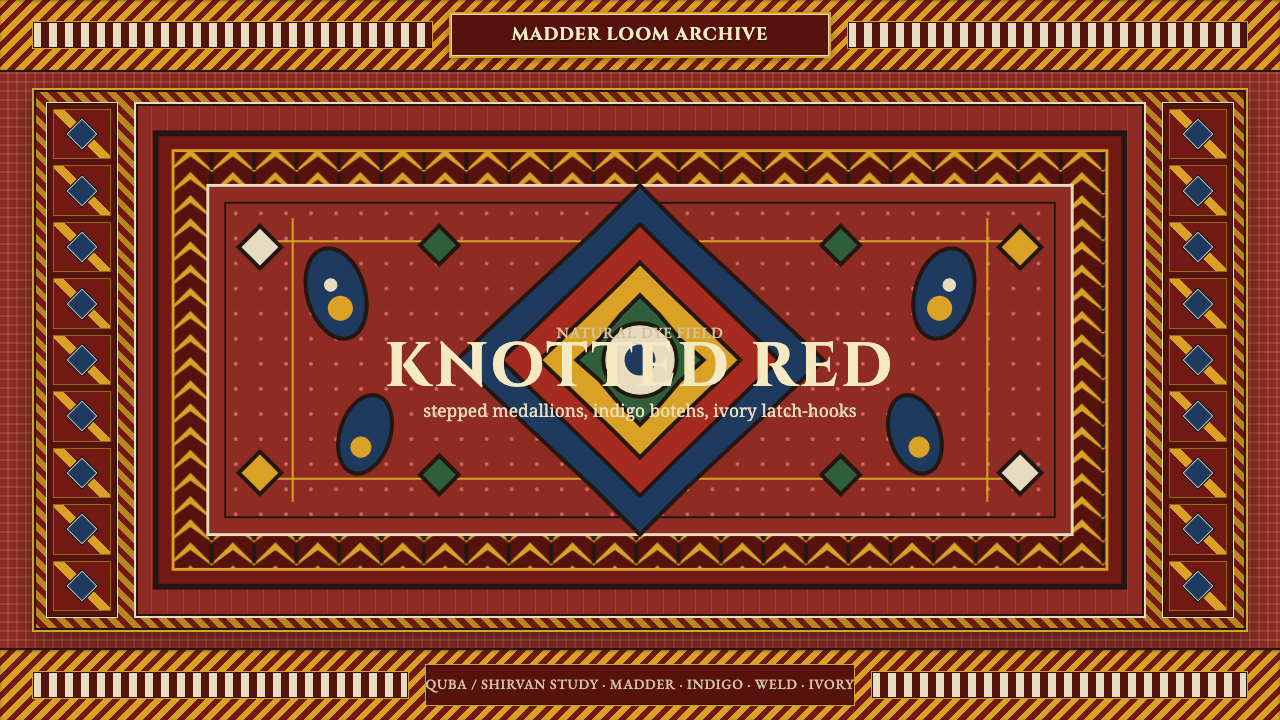 Azerbaijani Quba CarpetRed is the field. Indigo botehs and ivory latch-hooks orbit a stepped medalli…
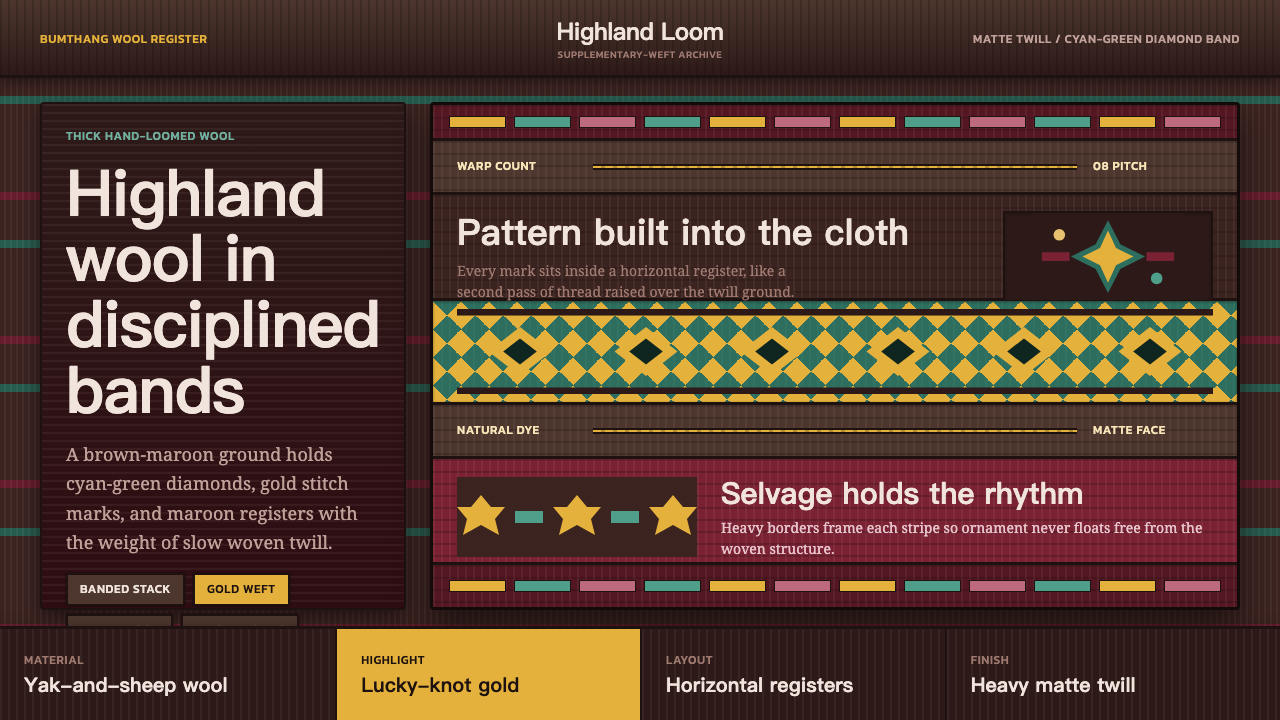 Bhutanese Yathra Wool WeaveHighland wool made digital. Brown-maroon bands carry cyan diamonds and spare…
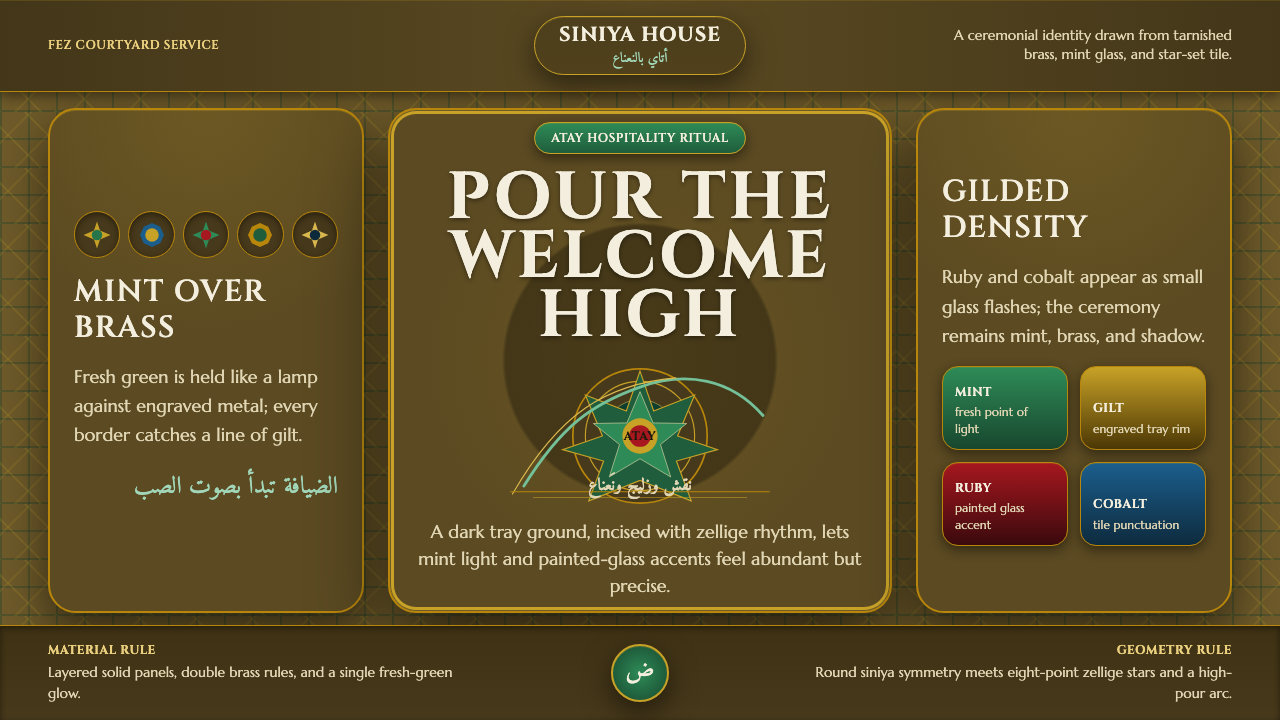 Moroccan Mint TeaCeremony glows in brass. Mint green, Cinzel type, and zellige geometry frame…
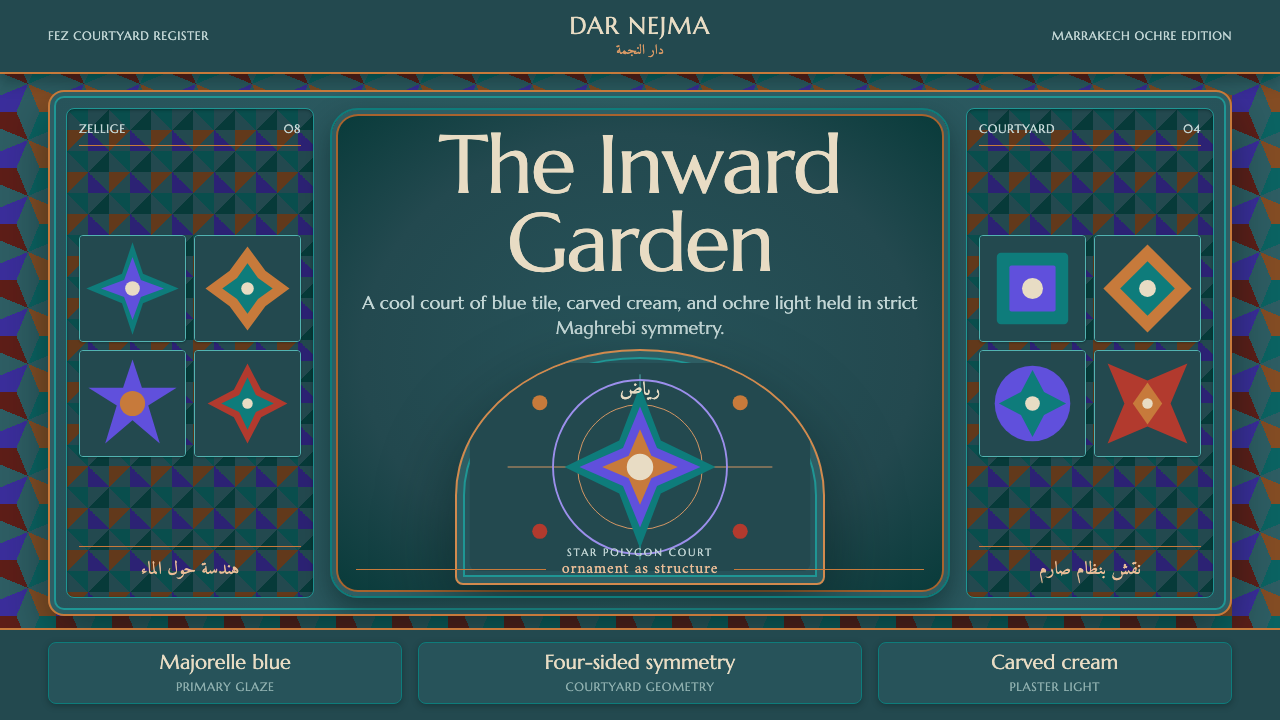 Moroccan RiadOrnament is structure. Majorelle blue and teal zellige frame a symmetrical ar…
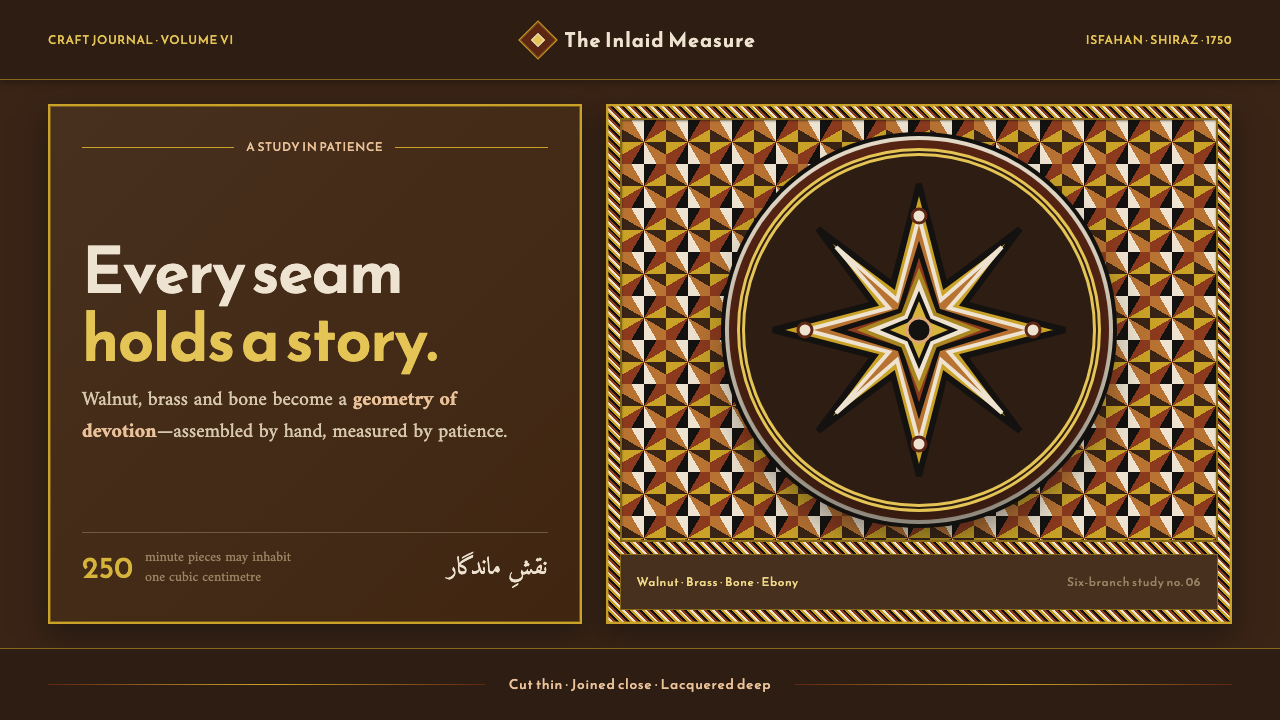 Persian Khatam MarquetryPatience becomes pattern. Brass-and-bone stars tessellate across lacquered wa…