What is Uyghur Xinjiang Suzani Embroidery?
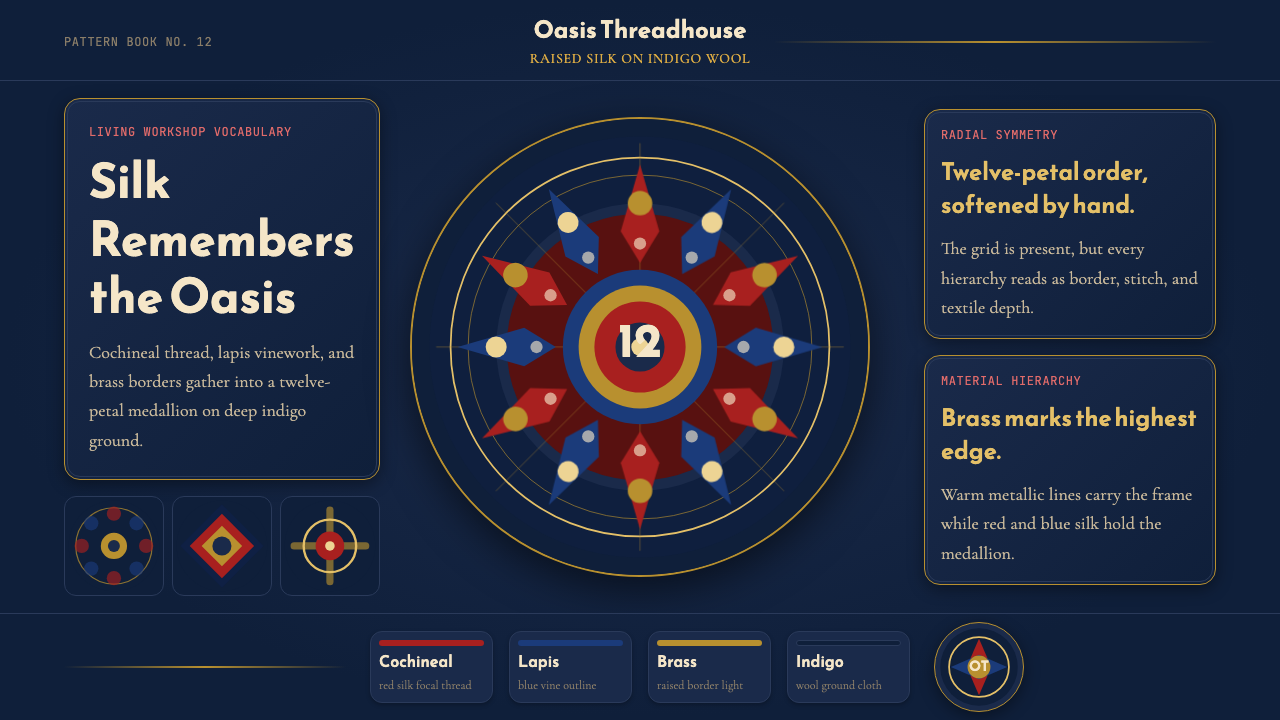
In the oasis workshops of Kashgar and Hotan, Uyghur needlewomen stitched cosmic medallions onto indigo wool with silk threads dyed in cochineal red and lapis blue — a tradition that turns fabric into a map of the universe.
Uyghur Xinjiang Suzani Embroidery in brief
Uyghur suzani embroidery is a textile tradition native to the oasis cities of southern Xinjiang — Kashgar, Hotan, Yarkand, and Atush — in which large-format wool or silk ground fabrics are densely covered with radial medallion compositions executed in polychrome silk thread. The word 'suzani' derives from the Persian for needle, reflecting the craft's deep roots in the broader Central Asian textile corridor that once linked Persia, the Sogdian cities, and the Tarim Basin through overland trade.
What distinguishes Uyghur suzani from the Uzbek and Tajik relatives it is often grouped with is the particular vocabulary of its medallion forms: twelve-petalled rosettes derived from the wooden lattice windows of Kashgar mosques, vine-scroll borders that move through corners in continuous unbroken circuits, and the use of a deep indigo wool ground that makes the silk thread colours appear to glow from within rather than sit on the surface. Brass and gold metallic threads are used selectively to mark the outermost ring of a medallion or the highest-status border elements, creating a quiet hierarchy of shimmer that rewards close looking.
As a design system, Uyghur suzani embroidery offers a radically different logic from Western modernism. Where modernism strips surfaces bare, suzani fills every inch — but the filling is organised, not chaotic. The medallion is the unit of order: each one is internally symmetrical, radiating from a centre point along eight or twelve axes, and the overall composition is built from the interlocking of these units across a field. The result is dense but navigable, ornate but disciplined — a pattern language that is recognisable in digital interfaces as belonging to the deep historical visual grammar of the Silk Road.
Where does Uyghur Xinjiang Suzani Embroidery come from?
The roots of Uyghur suzani embroidery extend to the Karakhanid dynasty (840–1212 CE), which ruled the Tarim Basin and adopted Islam in the tenth century, accelerating the absorption of Persian arabesque vocabulary into the decorative arts of the region. The vine-scroll motif that frames every suzani composition — its leaves unfurling in rhythmic alternation, its stems following a strict S-curve geometry — is a direct inheritance from this period, when Kashgar served as one of the premier intellectual and artistic centres of the Islamic world.
The eighteenth century brought a period of concentrated court patronage under the Yarkand Khanate, which supported specialist silk-thread workshops attached to the courts of local aristocrats known as begs. These workshops produced the most technically elaborate examples of the tradition: ground fabrics of finely beaten wool dyed with imported indigo from Bengal, thread dyed with cochineal imported along the same trade routes, and compositions that could take a team of needlewomen several years to complete. The medallion vocabulary became more codified during this period, with the twelve-petalled rosette emerging as the dominant focal element — its number of petals referencing the twelve-toned modal system of Uyghur classical music, the muqam.
The twentieth century brought radical disruption. The establishment of the People's Republic in 1949 and the subsequent collectivisation of craft production moved embroidery out of family workshops and into state-run cooperatives, particularly in Hotan. This transition preserved the technical skills of the tradition while standardising certain compositional templates, resulting in a large body of cooperative-period work that is technically accomplished but compositionally more uniform than the court-period pieces. The cooperative model also expanded the tradition's reach, training a broader base of practitioners than the guild system had historically supported.
The late twentieth and early twenty-first centuries have seen a complex revival, with scholars including ethnomusicologist Rahile Dawut documenting the tradition's connections to the broader Uyghur cultural heritage, and photographer Lisa Ross producing extensive photographic records of embroidery practitioners and their work in the southern oasis communities. Contemporary Hotan cooperatives continue to produce suzani work for both domestic and international markets, maintaining the indigo-ground palette and radial medallion structure while also adapting scale and composition to contemporary interior and fashion applications.
What defines the Uyghur Xinjiang Suzani Embroidery look?
Ground Colour and Atmosphere
The defining ground is a deep, saturated indigo — the colour of the night sky above the Taklamakan — that gives the entire composition its sense of depth and makes every thread colour appear to radiate from within. This is not a neutral background but an active field: the indigo absorbs visual noise and forces the eye toward the medallion centres. Secondary grounds in burgundy or black appear in certain regional variants, but the indigo ground is the tradition's most characteristic signature.
Radial Medallion Structure
The medallion is the primary compositional unit: a circle or multi-lobed form that radiates outward from a central point along eight or twelve axes of symmetry. The most characteristic form is the twelve-petalled rosette, whose geometry mirrors the wooden mashrabiyya lattice windows of Kashgar's historic mosques. Medallions are never isolated — they interlock, overlap, or are surrounded by subsidiary rosettes that echo the primary form at reduced scale, creating a hierarchical radial field across the full fabric.
Colour Vocabulary
The thread palette is organised around two chromatic poles: warm cochineal reds ranging from deep crimson through rose, and cool lapis blues that shade from cerulean to near-violet. These are played against the indigo ground in a relationship of complementary tension. Brass and gold metallic thread appears in limited, hierarchically significant positions — the outer ring of a medallion, the highest-status border — while ivory and pale yellow serve as lightening agents within the rosette interiors. The palette never drifts toward the pastel; saturation is consistently high.
Border and Transitional Grammar
Every suzani composition is framed by a vine-scroll border in which paired leaves unfurl from a continuous running stem. The corner resolution of this border is a point of particular skill: the stems must turn the corner without breaking their visual rhythm, a problem solved through a mirrored S-curve that reads as both a continuation and a pivot. Within the main field, narrower bands of geometric interlace — diamond grids, chain-link repeats, running key patterns — serve as transitional registers between the large medallions, providing visual rest between moments of maximum complexity.
Texture and Thread Hierarchy
The surface of an authentic suzani is not flat. Satin-stitch passages — in which thread is laid parallel and close together in long strokes — create areas that catch light differently from the chain-stitch outlines that define the medallion edges. Metallic thread, couched onto the surface rather than pulled through it, sits proud of the fabric and creates a faint three-dimensional ridge. In digital translation, this layered quality is evoked through subtle surface treatment: a slight luminance variation across a flat colour field, or a thin highlight along the edge of a medallion ring, suggests the raised-thread quality without literal imitation.
Symmetry and Its Deliberate Breaks
Uyghur suzani is radially symmetrical at the level of the individual medallion but not at the level of the full composition. Large pieces typically organise their medallions in a roughly balanced field without achieving strict mirror symmetry — a deliberate quality that experienced practitioners describe as intentional imperfection, echoing Islamic craft traditions that reserve perfect symmetry for the divine alone. This asymmetric balance at the macro scale is what prevents the overall composition from feeling mechanical despite the repetitive precision of each individual unit.
Compositional Density
Unlike many other Central Asian textile traditions that use ground fabric as a visible, breathing element in the composition, Uyghur suzani aims for near-total coverage. The goal is for the indigo ground to be glimpsed only in narrow passages between the border vines and between medallion perimeters — a quality described by Hotan cooperative embroiderers as filling the breath of the cloth. This density is what gives the tradition its characteristic visual weight and makes even small fragments instantly identifiable as suzani work.

Who shaped Uyghur Xinjiang Suzani Embroidery?
A Uyghur ethnomusicologist and folklorist based in Xinjiang, Rahile Dawut spent decades documenting the intangible cultural heritage of the Uyghur people, including the ritual and ceremonial contexts in which embroidered textiles played a central role — bridal trousseau preparation, shrine decoration, and seasonal festival practice. Her work established the scholarly framework for understanding suzani embroidery not as a decorative art in isolation but as a carrier of social memory and spiritual practice embedded in the daily and ceremonial life of southern Xinjiang's oasis communities.
An American photographer who spent many years working in the Uyghur regions of Xinjiang, Lisa Ross produced a sustained body of photographic work documenting embroidery practitioners, their workshops, and the shrines for which much ceremonial suzani work was originally made. Her photographs — which record both the material objects and the human networks through which the tradition is sustained — constitute one of the most substantial visual archives of the tradition produced by an outside observer, and have been exhibited internationally as part of broader documentation of Central Asian sacred landscape.
A master embroiderer based in the Hotan cooperative system, Aysulu represents the living practitioner tradition of Uyghur suzani work. Master embroiderers of her standing are responsible not only for the most technically demanding sections of a composition — the medallion interiors, the corner resolutions of the vine border — but also for training apprentices and transmitting the compositional templates and colour-mixing knowledge that constitute the tradition's tacit knowledge base. Her work bridges the cooperative-period standardisation of the craft and the older, more improvisational court-period approach.
A Uyghur musician and cultural figure closely associated with the muqam classical music tradition, Abdusalam Heyit represents the deep entanglement of Uyghur embroidery with the musical and poetic traditions of the region. The twelve-tone modal system of the muqam — twelve maqams, each with its own emotional register, melodic vocabulary, and ceremonial application — is mirrored in the twelve-petalled rosette that anchors suzani composition, a correspondence that practising embroiderers explicitly acknowledge. Understanding the muqam tradition helps illuminate why suzani embroidery carries such concentrated cultural weight beyond its visual qualities alone.
Not a single individual but a collective tradition of workshop practice associated with the Karakhanid dynasty (840–1212 CE), whose courts in Kashgar and Balasagun were among the first in Central Asia to systematically patronise Islamic decorative arts. The arabesque vine-scroll grammar that underlies all suzani composition was codified in these ateliers as a specifically Islamic visual language suitable for domestic textiles, architectural ornament, and manuscript illumination. The Karakhanid contribution is less a named individual than a shared formal inheritance that connects Uyghur embroidery to the wider world of Islamic art.
How do you use Uyghur Xinjiang Suzani Embroidery today?
Uyghur suzani embroidery translates into digital design surfaces with an unusual directness because its visual logic is already compositional rather than mimetic — it does not depict objects but organises space through a system of radial units, hierarchical borders, and calibrated colour relationships. The challenge in application is not to reproduce the craft literally but to understand which elements carry its essential character and how those elements behave at digital scale and resolution.
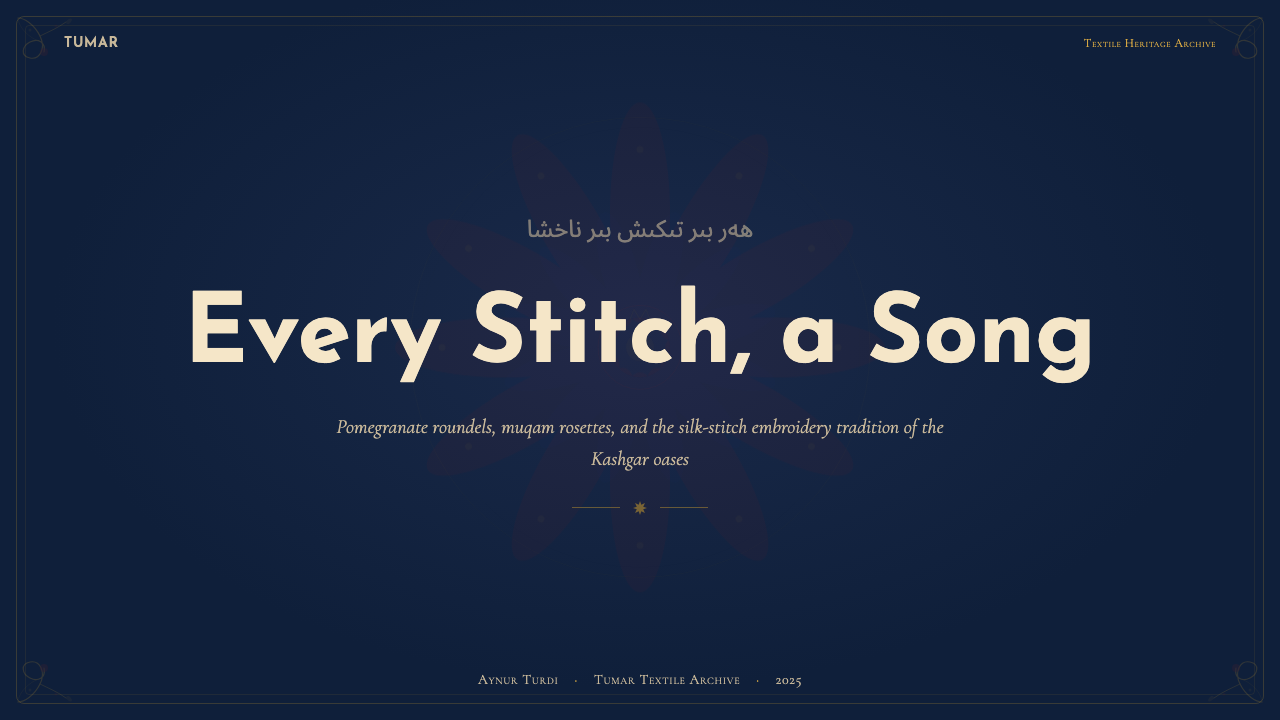
For presentation slides, the style works most powerfully at the cover and section-break level. A cover built on suzani logic places a central medallion form — a twelve-lobed radial shape in the primary thread colours — against a deep indigo field, with the title set in a light, high-contrast weight that holds its own against the visual density of the background. Section-break slides can use single-medallion compositions at large scale, nearly filling the frame, with text anchored in one of the quieter interstice zones. Content slides should pull back from the density: a thin vine-border rule across the top or bottom is enough to signal the system without competing with the slide's information load. Data visualisations in this system work best when chart elements — bars, segments, connecting lines — are coloured from the thread palette, reserving the metallic accent for the single most important data point.
For web and digital interfaces, suzani's radial grammar translates naturally into icon systems, loader animations, and decorative accent elements rather than full-surface pattern. A navigation system can use a simplified four-petalled or eight-petalled rosette as a logo or wayfinding mark; authentication screens or paywall gates can use a large centred medallion as a focal illustration behind a card component. Dashboard interfaces benefit from the style's sense of structured abundance: the indigo ground used as a sidebar or header background, with warm thread colours assigned to the status categories that need to draw the eye. The metallic accent should appear only at the single point of highest hierarchy — a primary call-to-action button, an active state indicator — and nowhere else.
For editorial and marketing contexts, suzani's most valuable quality is its suggestion of accumulated cultural depth without the weight of a specific brand or commercial reference. A brand that wants to signal craft, heritage, and the richness of non-Western cultural tradition can use suzani-derived pattern elements — vine-scroll borders, radial medallion backgrounds, the deep indigo ground — as environmental texture in printed materials, packaging, or large-format digital banners. The key is restraint in how much of the surface the pattern is allowed to cover: used at full density, it overwhelms; used as a framing element at the edges of a composition, or as a partial-field reveal, it reads as considered and purposeful.
A common mistake when applying suzani-derived aesthetics is to treat the palette as simply jewel tones on dark ground and deploy it with the soft gradients and blurred shadows common in contemporary dark-mode interfaces. Authentic suzani colour relationships are hard-edged and fully saturated — the cochineal red sits against the indigo without blending, the brass thread sits proud of the wool without a glow or halo. Introducing soft-edged glows, gradient overlays, or blurred bokeh effects into a suzani-derived design immediately breaks the visual logic of the tradition, producing a result that reads as neither contemporary nor historical but simply confused. The tradition's richness comes from intensity and precision of placement, not from atmospheric softening.
Uyghur Xinjiang Suzani Embroidery — FAQ
How is Uyghur suzani different from Uzbek suzani?
The two traditions share a name and a common ancestry in the Persian textile culture of Central Asia, but they diverged significantly over the past three to four centuries. Uzbek suzani, produced in cities like Bukhara, Samarkand, and Nurata, typically uses a cream or white cotton ground rather than the deep indigo wool ground of Uyghur work, and its medallion vocabulary is more overtly floral — pomegranate forms, tulip buds, and oversized bloom compositions are common. Uyghur suzani is characterised by the geometric severity of the twelve-petalled rosette, the mosque-window lattice references, and the specific cochineal-red-and-lapis-blue palette against the indigo ground. The two traditions are broadly identifiable at a glance: Uzbek suzani reads as exuberant and garden-like; Uyghur suzani reads as architectural and cosmological.
What does the twelve-petalled rosette symbolise?
The twelve-petalled rosette carries multiple layers of symbolic resonance in Uyghur visual culture. Most immediately, it mirrors the wooden mashrabiyya lattice windows of the historic mosques of Kashgar — the rosette form was literally derived from the geometry of those windows, giving it an architectural and sacred quality. At a second level, twelve is the structuring number of the Uyghur muqam classical music tradition, which organises its modal system around twelve maqams. Practising embroiderers in the Hotan cooperative tradition explicitly connect the rosette's twelve petals to the twelve maqams, describing the composition of a piece as analogous to the composition of a musical sequence. At a cosmological level, twelve also carries the universal associations of the twelve months and the zodiacal cycle common across many Central Asian cultural traditions.
Can this design system work in a light-background digital context?
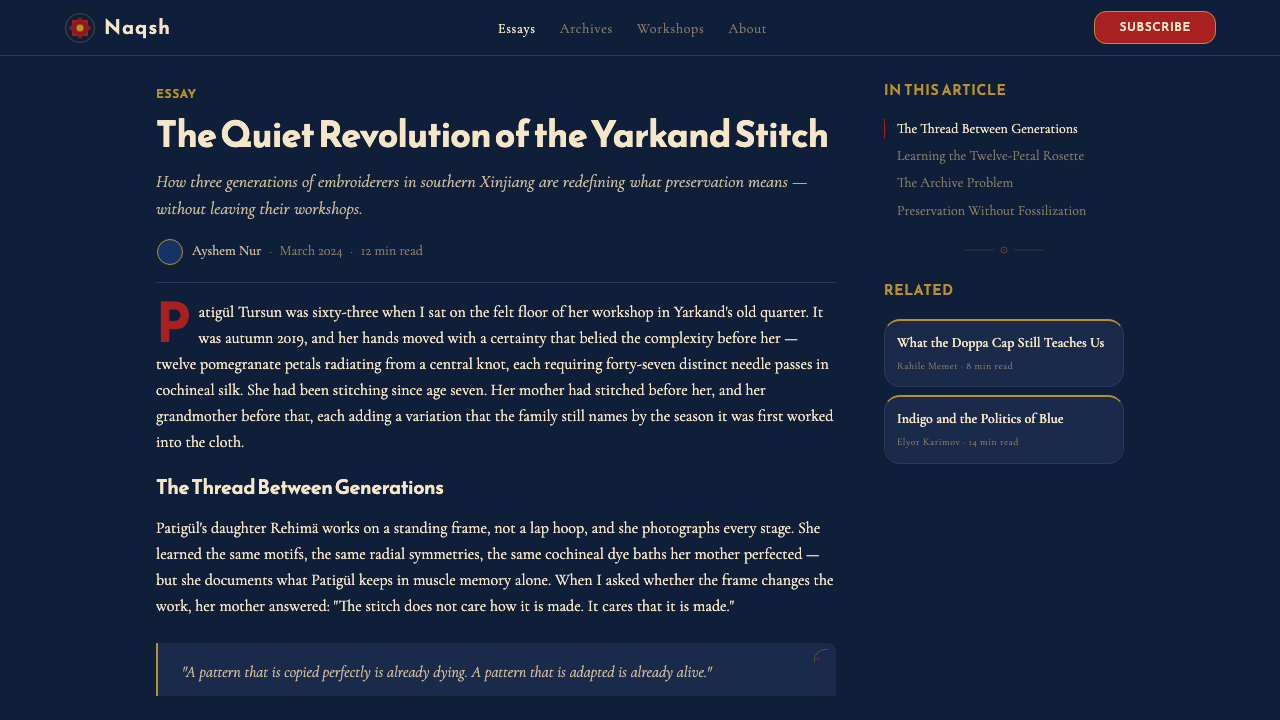
It can, but it requires careful recalibration. The tradition's visual power depends significantly on the deep indigo ground, which gives the thread colours their luminous quality. On a light background, the same thread colours — the cochineal reds and lapis blues — will read very differently: brighter, more intense, less jewel-like. A light-ground suzani adaptation works best when it uses the medallion vocabulary and the vine-scroll border system as line-work elements rather than filled-ground compositions — think of it as moving from the textile to the drawing that preceded the textile, sketching the structural geometry in deep indigo or dark brass on a light field rather than filling it with thread colour. This approach is historically grounded: workshop pattern books known as naqqash were drawn as line compositions before being transferred to fabric.
Is Uyghur suzani embroidery still being made today?
Yes, though the conditions of production have changed substantially from the historical guild and court-patronage model. The Hotan cooperative system remains the primary site of production, with master embroiderers training apprentices in the traditional compositional and stitch vocabularies. Production serves both a domestic market — large suzani pieces remain important gifts in Uyghur wedding and ceremonial contexts — and an international collector and design market that values the tradition's visual distinctiveness and cultural depth. Contemporary pieces range from small decorative panels produced in a few weeks to monumental large-format works that require a team of embroiderers working over several years, closely approximating the scale and ambition of court-period pieces.
How should the metallic accent be used in a digital adaptation?
In the original textile, brass and gold metallic thread appears at the single point of highest hierarchy within each compositional unit — typically the outermost ring of the medallion or the primary border element — and nowhere else in that unit. The same principle applies in digital adaptation: the metallic accent should mark the single most hierarchically significant element on any given screen or composition, and it should appear once. On a pricing page, the metallic accent belongs on the recommended plan; on a dashboard, on the single most important metric; on a slide, on the key number or the title of the most significant section. Using metallic accents on multiple elements simultaneously, or as a general premium surface treatment applied to backgrounds and cards, violates the tradition's logic and eliminates the element's ability to direct attention.
Related design styles
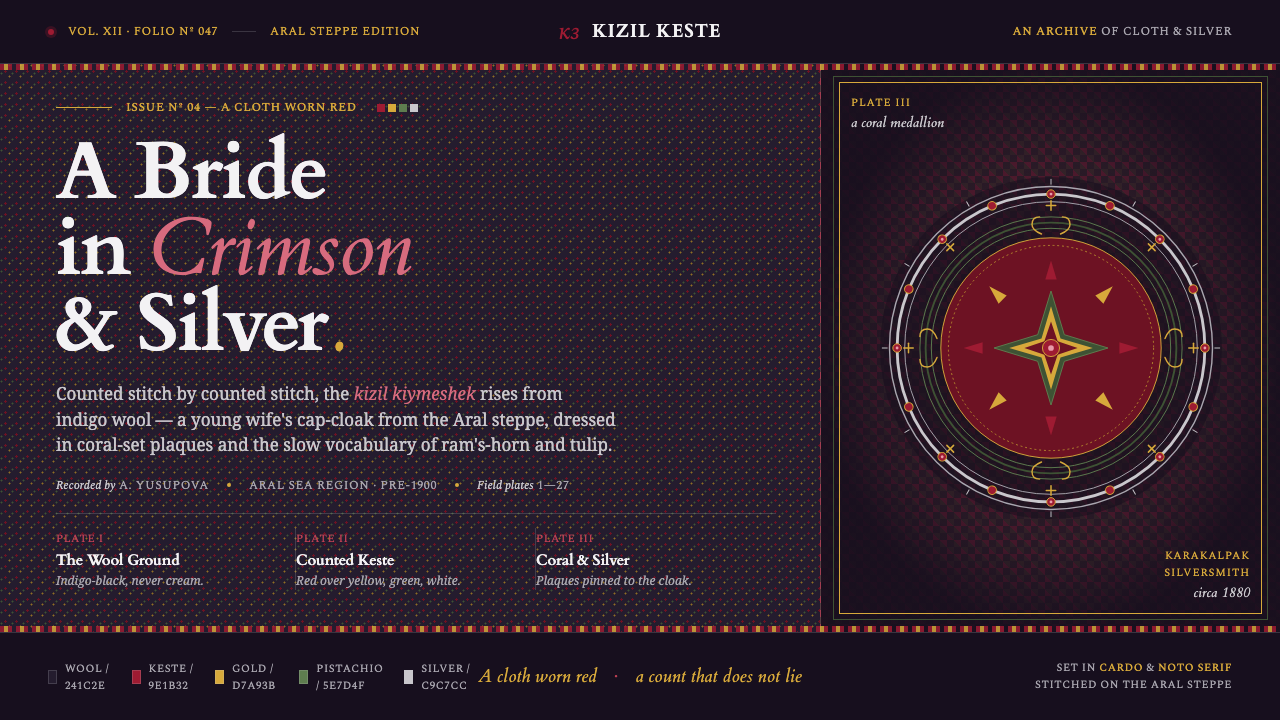 Karakalpak Kimeshek DressA cloth worn red. Crimson keste cross-stitch on indigo wool, set with silver-…
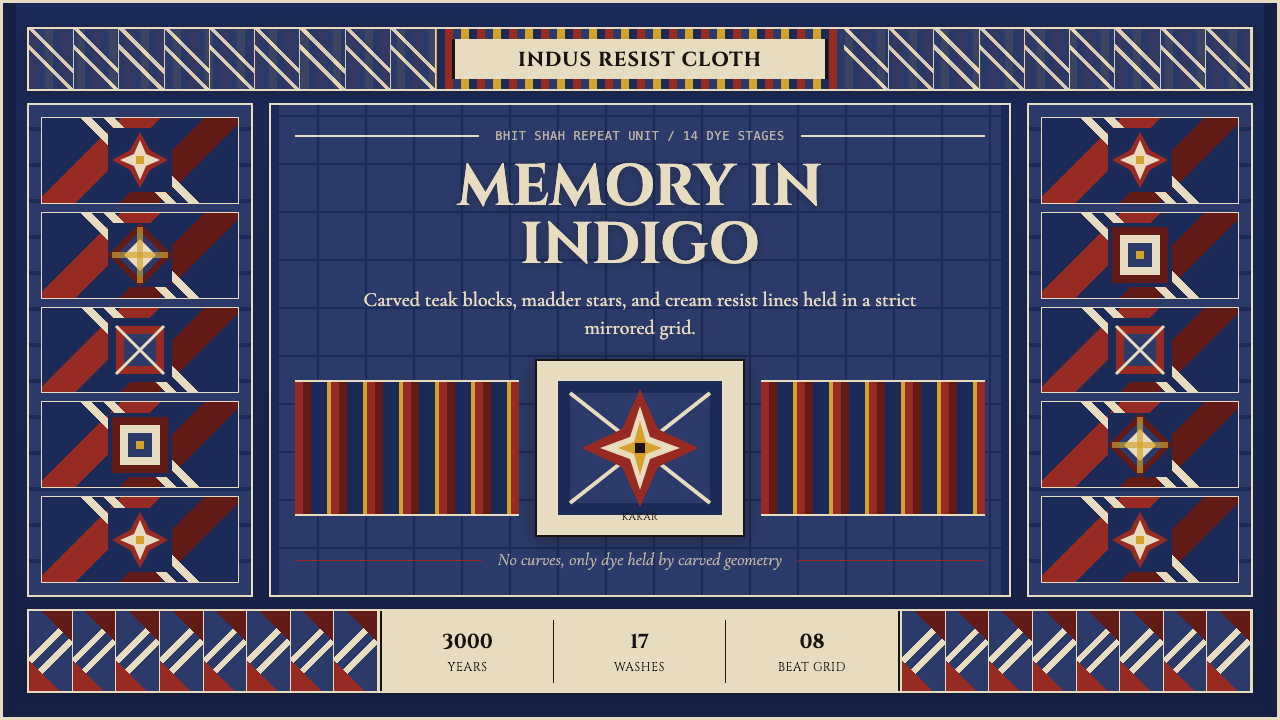 Sindh Ajrak Block PrintAncient cloth feels exact. Indigo fields, madder stars, and cream grids repea…
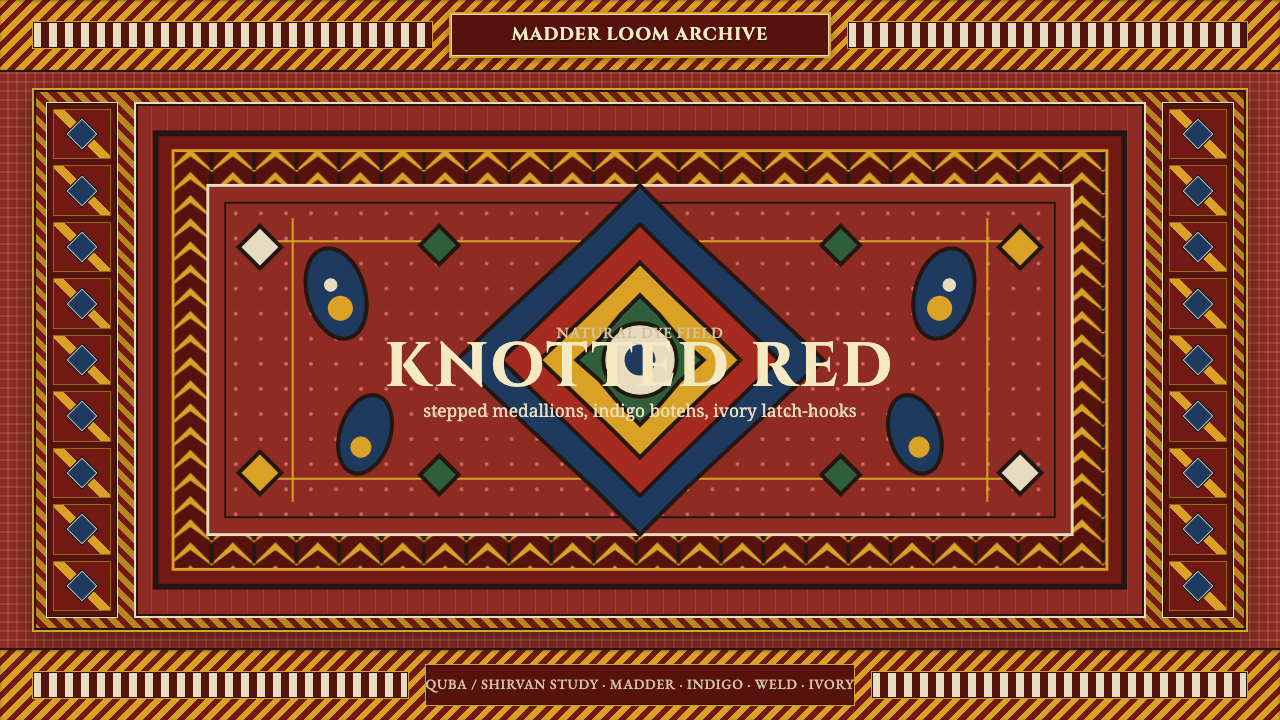 Azerbaijani Quba CarpetRed is the field. Indigo botehs and ivory latch-hooks orbit a stepped medalli…
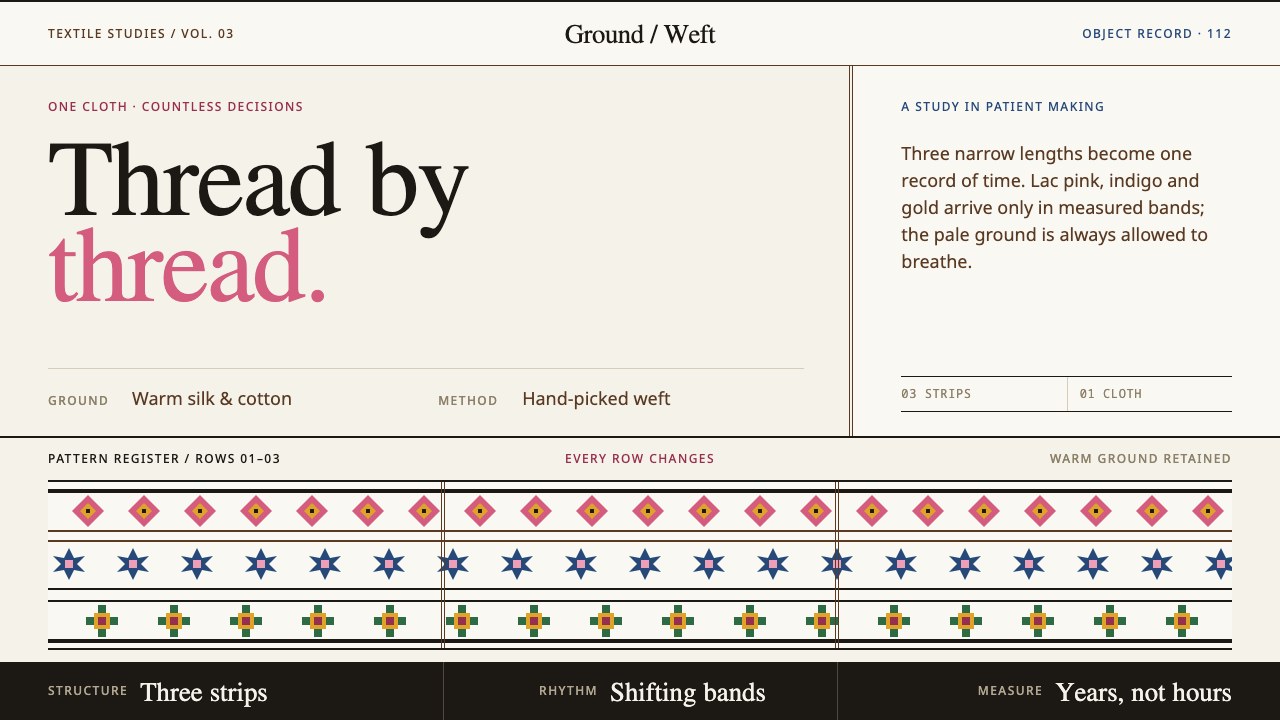 Bhutanese KushutharaPatience made visible. Lac pink and indigo bands shift across a warm silk gro…
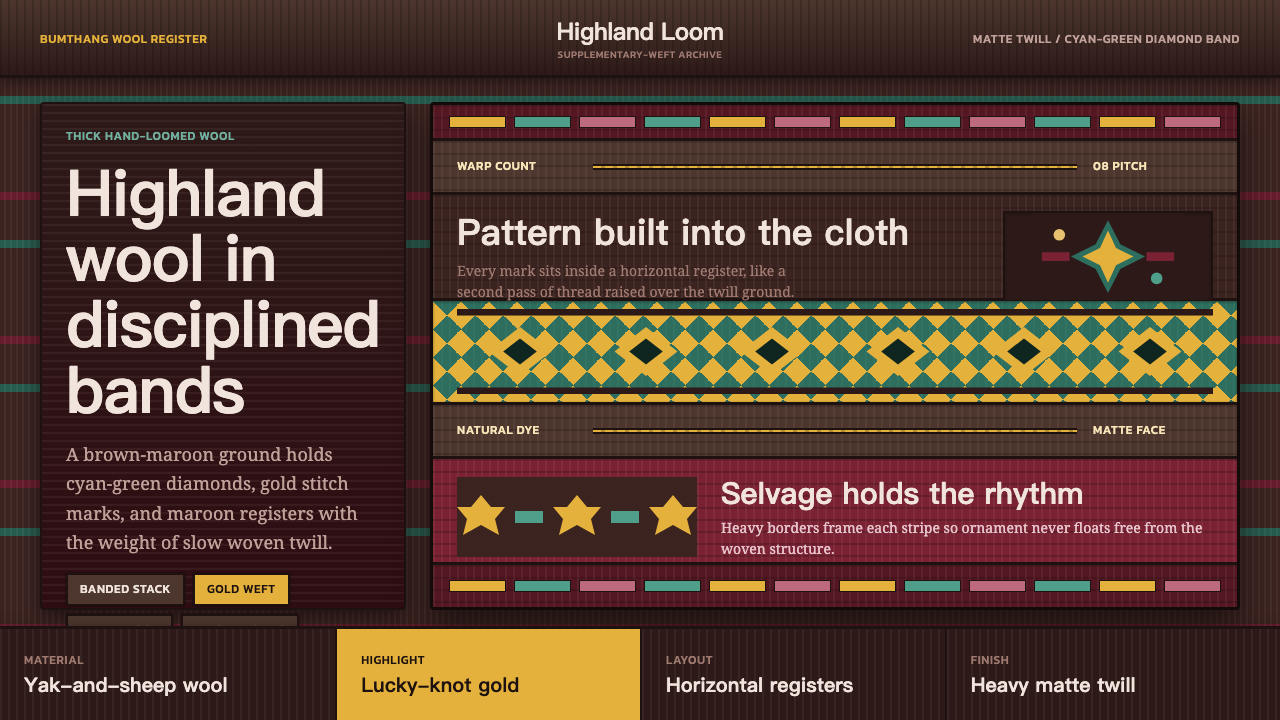 Bhutanese Yathra Wool WeaveHighland wool made digital. Brown-maroon bands carry cyan diamonds and spare…
 Nuristani Carved CedarDepth replaces pigment. Smoke cedar, chevrons, and rosettes carve light from…