What is Sindh Ajrak Block Print?
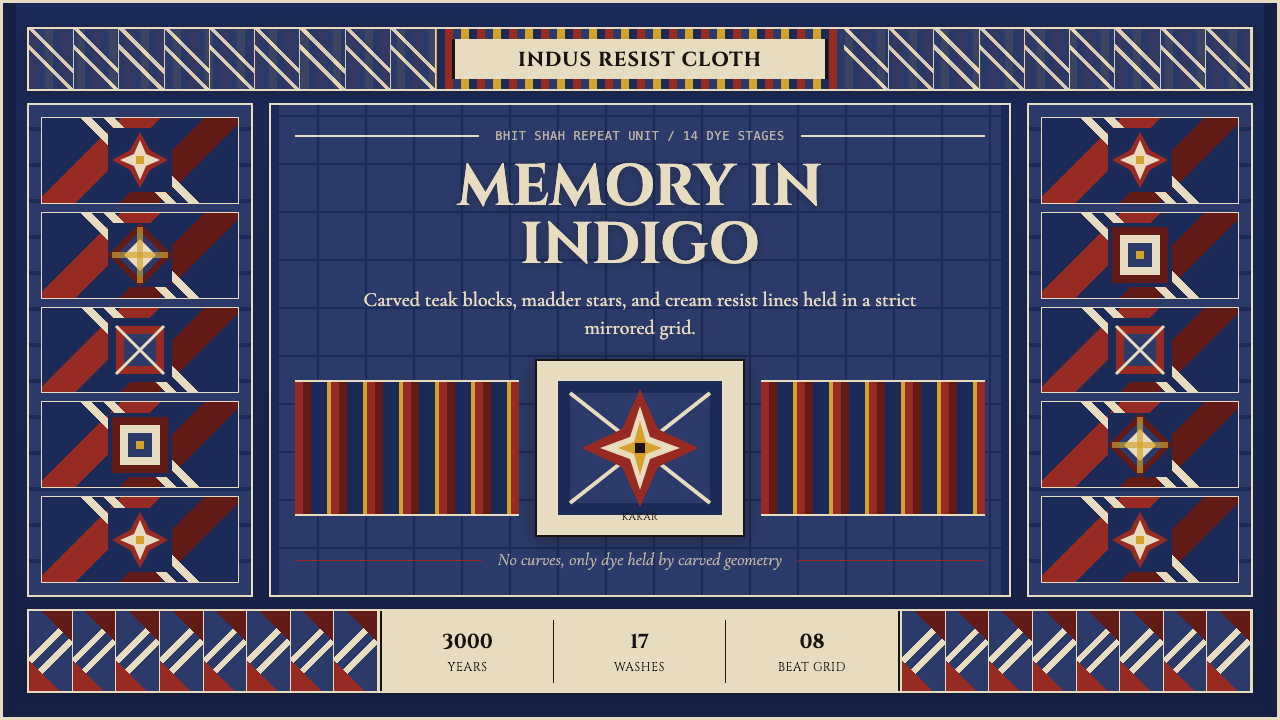
Ajrak is a five-thousand-year-old printed cloth from the Indus Valley — indigo deep as a night river, madder red as dried pomegranate, and geometric borders carved block by block from teak.
Sindh Ajrak Block Print in brief
Ajrak is the oldest continuously practiced block-printed textile tradition in South Asia. Produced by the Khatri printer families of Sindh, Pakistan, and Kutch, India, each cloth is built up through fourteen to seventeen distinct production stages — carved teak blocks pressed into natural-dyed paste, alternating indigo and madder baths, river washing, and stone beating — until the pattern is literally worked into the fiber rather than sitting on its surface.
The visual identity of ajrak is instantly legible: a deep indigo field anchors the composition, madder-red star medallions called kakar punctuate the repeat, and a cream or white resist-lattice holds the geometry in tension. The borders — always present, always geometric — are composed of stepped and interlocked forms that echo the crystalline logic of Islamic tilework and Indus Valley seal impressions alike. There are no curves. Every element is orthogonal, every intersection deliberate.
As a design language, ajrak translates this workshop discipline into a visual system of rare precision. The palette is restricted and high-contrast. The geometry is repetitive but never mechanical — the slight irregularities of hand-carved wood give each block a warmth that distinguishes the tradition from computer-generated pattern. The result is simultaneously ancient and structurally modern: a system of order whose rules are strict enough to be meaningful.
Where does Sindh Ajrak Block Print come from?
The ajrak tradition traces to Mohenjo-Daro, the great Indus Valley city that flourished between roughly 2600 and 1900 BCE on the banks of the Indus River in present-day Sindh, Pakistan. Archaeological excavations at Mohenjo-Daro uncovered a seated figure — the so-called Priest-King — draped in a cloth bearing a trefoil pattern rendered in red against a dark ground, a motif recognizable as ancestral to the kakar star found in contemporary ajrak. The dye residues and cotton fibers found at the site confirm that the Indus Valley civilization was already producing sophisticated printed textiles more than four thousand years ago.
The Khatri community, whose members remain the primary producers of ajrak today, consolidated their guild tradition in Sindh during the medieval period, with the town of Bhit Shah — site of the shrine of the Sufi poet Shah Abdul Latif Bhittai — becoming a center of the craft. The Sufi culture of Sindh gave ajrak a ritual significance beyond its function as cloth: the fabric was used in ceremonies marking births, marriages, and deaths, draped over the shrines of saints, and given as tokens of respect and hospitality. The cloth became inseparable from Sindhi identity, worn by farmers, fishermen, landowners, and religious figures alike.
The craft was nearly destroyed twice in the twentieth century. The Partition of 1947 forced many Khatri families to migrate from Sindh to Kutch in India, fragmenting the community and disrupting apprenticeship networks that had transmitted technical knowledge across generations. Then, in 1983, catastrophic floods inundated Dhamadka — the principal ajrak-producing village in Kutch — destroying workshops, dye pits, and stored materials. Ismail Mohammad Khatri, the master printer who led the Dhamadka community, rebuilt the village on higher ground and reestablished the craft, a reconstruction effort that drew international attention and support.
Recognition of ajrak's cultural weight accelerated in the late twentieth century, partly through the advocacy work of textile scholars and designers. Noorjehan Bilgrami, the Pakistani textile expert, worked to document and systematize ajrak production standards and played a central role in connecting Sindhi craftspeople to international design markets. UNESCO recognized ajrak block printing as an element of Intangible Cultural Heritage. Today, production centers operate in Bhit Shah, Matiari, and Hala in Sindh, and in Dhamadka and the purpose-built village of Ajrakhpur in Kutch — the latter founded by Abdul Jabbar Khatri specifically to house relocated families and preserve the tradition after the 1983 floods.
What defines the Sindh Ajrak Block Print look?
Color Field
Ajrak compositions are built on three foundational tones: a deep, saturated indigo that serves as the dominant ground, a warm madder red used for primary motifs and accent fields, and a natural cream or resist-white that reads as negative space and provides structural breathing room. These three tones are not mixed — they sit in pure, flat fields, each asserting its role without blending. Black occasionally appears as an outline or secondary resist, sharpening the geometry. The palette is ancient but high-contrast, and behaves in digital contexts like a set of primary colors with centuries of proven legibility.
Block-Carved Geometry
Every motif in ajrak originates in a carved teak block. The constraints of block printing — a flat surface, orthogonal pressure, repeating registration — produce a geometry that is strictly rectilinear. Stars are assembled from interlocking stepped diamonds. Borders are composed of recursive angular meanders, each turn exact. The kakar star medallion, the central motif of most ajrak compositions, radiates from a center point through a series of stepped arms that never curve, only angle. This orthogonal discipline gives the visual system its characteristic tension: richness achieved without any departure from the straight line.
Resist-Lattice Detailing
Between the bold indigo fields and the madder medallions, ajrak compositions carry a fine cream lattice — the visible record of the resist-print process, in which a mud-and-gum paste is applied to block out areas from the dye bath. This lattice is not a border or a divider; it is a structural membrane that holds the composition together. In digital translation, it functions as a middle-tone texture layer: present enough to enrich the surface, restrained enough not to compete with the primary color fields.
Bilateral Symmetry and Rotation
Traditional ajrak is printed on both faces of the cloth, with blocks aligned so that the pattern reads symmetrically from front and back — a discipline known as double-sided or bilateral printing. Within the composition itself, motifs are organized around central axes of symmetry, with rotational quarters that produce a pattern field whose weight is identical in every direction. There is no dominant reading orientation. This rotational logic distinguishes ajrak from most Western textile patterns, which typically have a clear up and down.
Layered Depth Through Process
The richness of ajrak color does not come from a single dye application but from the accumulation of multiple baths: an indigo base is established, then overprinted, then stripped in areas to reveal the madder underneath, then washed, then beaten. This process produces a visual depth — the slight halo where resist edges, the variation in saturation across a single field — that cannot be replicated by a flat digital color fill. When translating ajrak into digital work, designers should introduce tonal variation within color fields rather than using a single flat tone, to honor this layered quality.
Border Logic
Every ajrak cloth is framed by a succession of geometric borders arranged in decreasing width from the outer edge inward — a hierarchy of containment that defines where the central field begins and the transition zones end. The outermost border is typically the boldest, composed of stepped triangles or angular key-fret meanders. Inner borders grow progressively finer. In digital applications, this border logic translates directly into a principle of framing: the outermost container of any ajrak-derived layout should be the most visually assertive structural element.
Dark Ground Confidence
Ajrak is a dark-ground tradition. The indigo field is not a background — it is the dominant visual mass, against which lighter madder and cream elements read as figures. This inversion of the conventional light-ground layout (which dominates most Western design traditions) requires a different compositional logic: elements that would read as small accents on a white ground become focal points on a dark ground, and negative space must be managed more deliberately to prevent the composition from becoming heavy.
Who shaped Sindh Ajrak Block Print?
The master printer of Dhamadka, Kutch, Ismail Mohammad Khatri is the figure most directly associated with the survival of ajrak through the late twentieth century. When the 1983 floods destroyed Dhamadka, he led the community's relocation to higher ground and rebuilt the production infrastructure from scratch, a process documented by scholars and textile organizations around the world. His dedication to maintaining the full multi-stage natural-dye process — refusing to substitute chemical shortcuts even when natural dye sources became scarce — established a standard for what authentic ajrak production means.
A Pakistani textile authority and curator, Noorjehan Bilgrami spent decades documenting and advocating for the craft traditions of Sindh, with ajrak among her most sustained concerns. Her work — which included establishing quality standards, creating market linkages between Sindhi craftspeople and international buyers, and writing and curating exhibitions that contextualized ajrak within the broader history of South Asian textile culture — was instrumental in securing international recognition for the tradition. Her book on Sindhi textiles remains a foundational reference for anyone approaching the craft historically.
An American textile scholar who settled in India and founded the Shrujan trust in Kutch, Judy Frater worked extensively with the craft communities of the region — including the Khatri printers — to document living textile traditions and develop sustainable market access for artisans. Her approach emphasized preserving technical knowledge while enabling craftspeople to engage with contemporary design contexts on their own terms, a model that influenced how development organizations subsequently approached endangered craft traditions across South Asia.
The founder of Ajrakhpur — the purpose-built village in Kutch established after the 1983 floods to house displaced Khatri families and reconstitute the ajrak production community — Abdul Jabbar Khatri represents the generational transmission of the craft into the contemporary period. His workshop at Ajrakhpur has become a reference site for researchers, designers, and institutions seeking to understand ajrak production, and his family's work has been central to the tradition's international visibility since the village's founding.
The eighteenth-century Sufi poet whose shrine at Bhit Shah became a center of Sindhi cultural identity, Shah Abdul Latif Bhittai is not a designer or craftsperson, but his significance to ajrak is inseparable from its meaning. The cloth was draped over his shrine, given to pilgrims, and used in the ceremonies of Sindhi spiritual life. The association between ajrak and Sufi devotional culture gave the textile a ritual authority that extends well beyond its function as printed cloth, and continues to inform the reverence with which the tradition is held in Sindh.
How do you use Sindh Ajrak Block Print today?
Ajrak translates into digital work with unusual fidelity because its visual language is already system-like: a restricted palette, a geometric repeat, a strict hierarchy of fields and borders. Applying it correctly means understanding how each of those elements functions structurally — not decoratively — and assigning them roles that match their weight in the original.
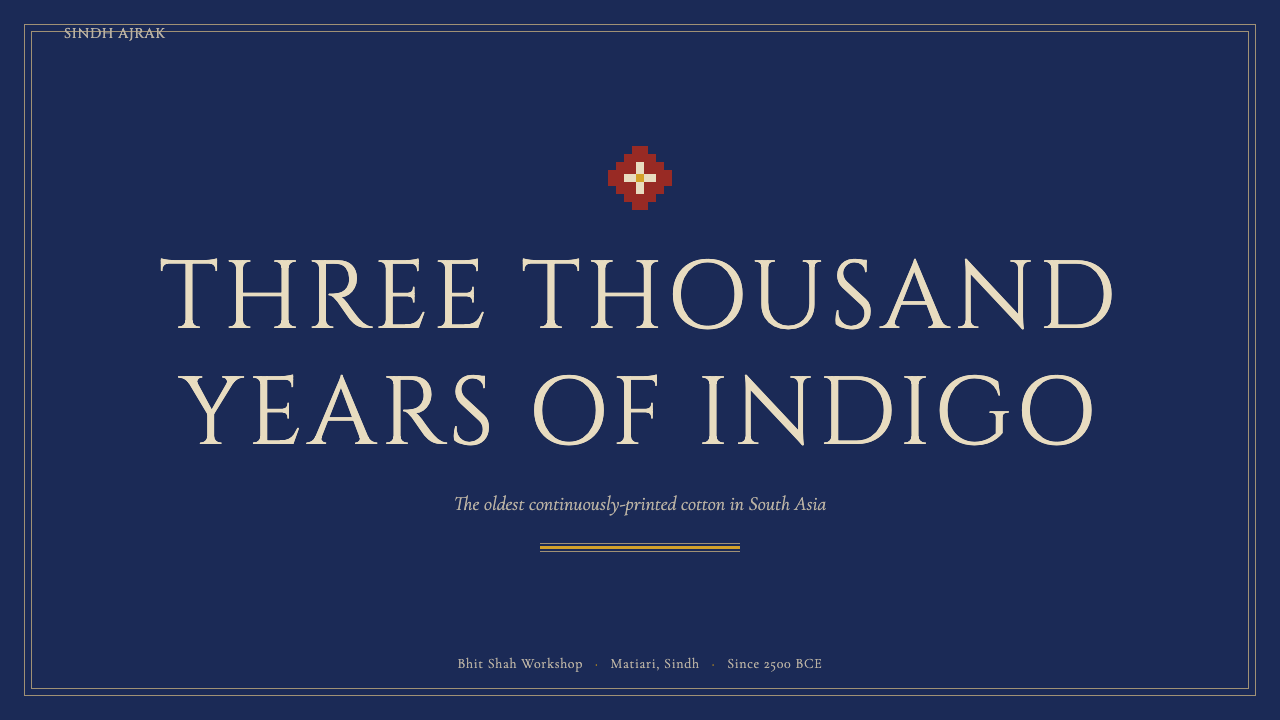
For presentation slides, ajrak works best when its dark-ground logic is embraced rather than adapted away. A cover slide built on a deep indigo field, with the title set in cream or warm white and a single madder-red geometric accent, carries the authority of the tradition without requiring any direct quotation of textile motifs. Content slides should use the same palette at reduced intensity: cream backgrounds with indigo type and madder-red used only for key data points or section markers. Data visualizations benefit from the palette's natural contrast — indigo and madder read as clearly differentiated on any screen calibration, and the cream resist-tone works well as a neutral gridline or axis color.
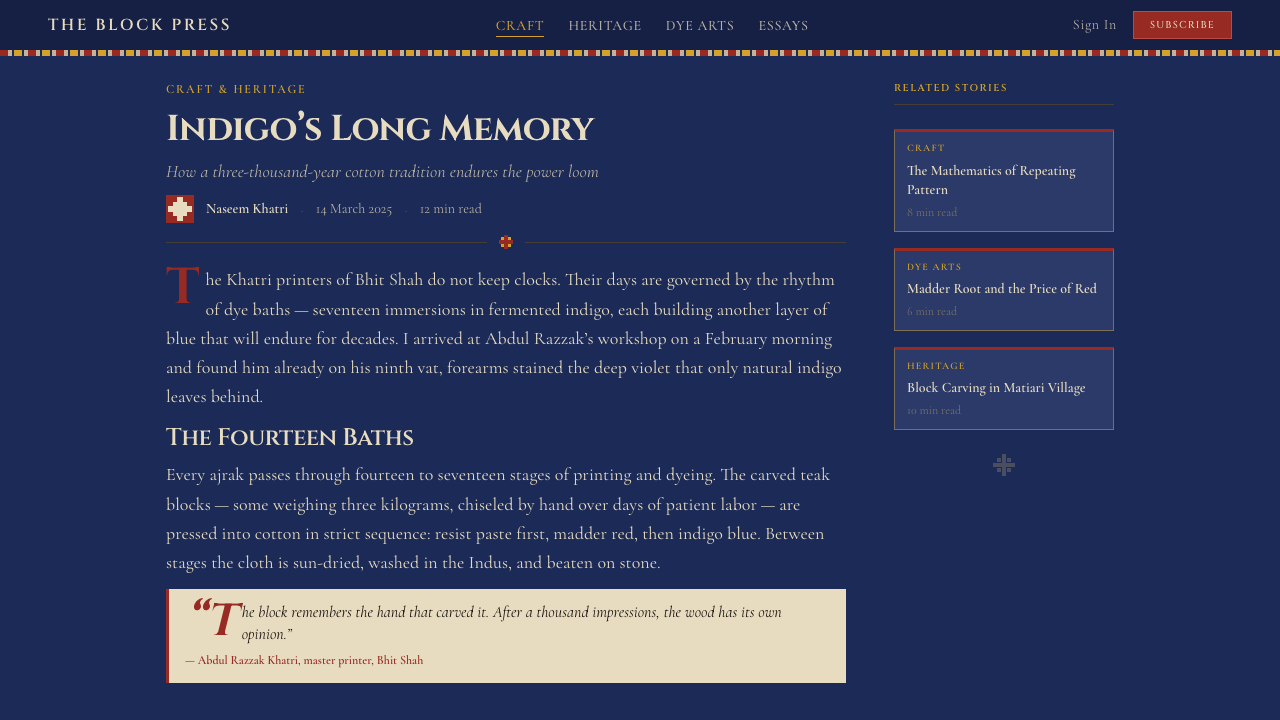
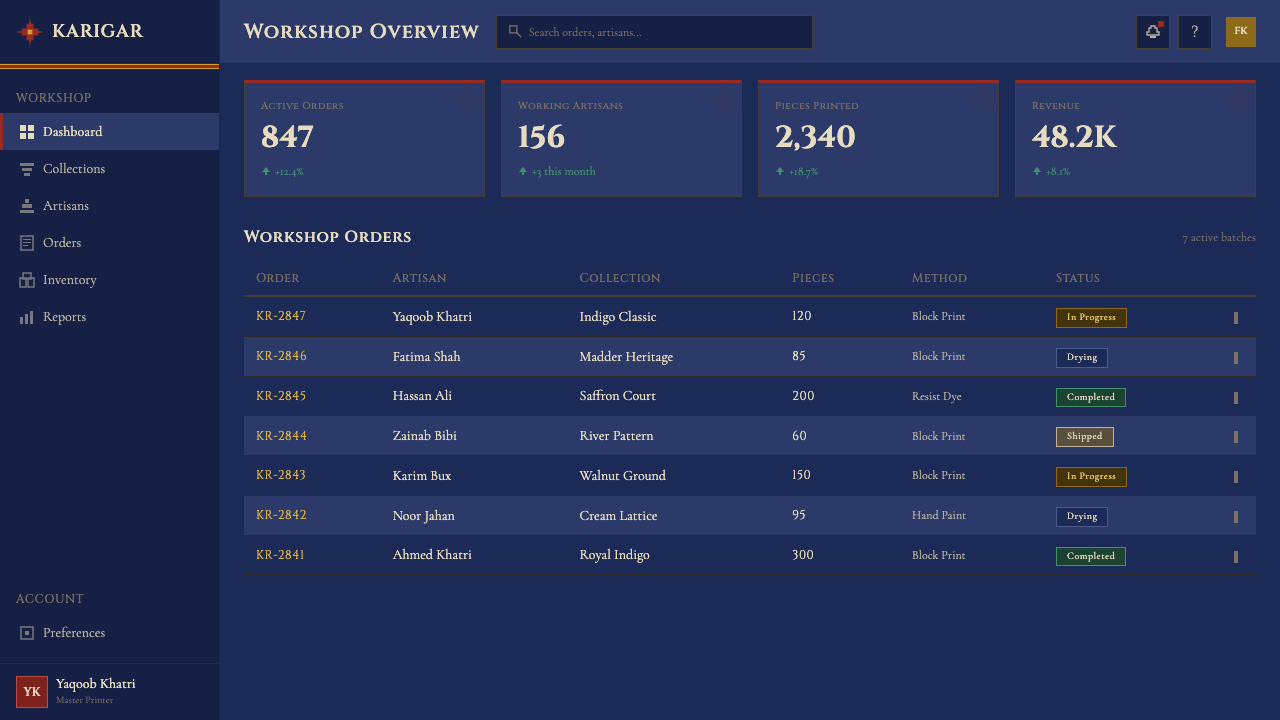
For web interfaces, ajrak is well-suited to contexts where gravitas and cultural specificity are assets: heritage brands, artisan marketplaces, travel and hospitality platforms, and editorial publications with a regional identity. The approach should follow the border logic of the textile: define strong outer frame elements that establish the composition before the user encounters the content field. Navigation bars and footers should be treated as borders — not decorative bands but structural containment. The dark indigo ground works particularly well for dashboards where data needs to feel authoritative; reserve the madder red for interactive states and primary calls to action only.
For editorial and marketing work, the style permits a bolder compositional vocabulary than most contemporary design systems. Full-width section breaks using the ajrak border repeat — a horizontal band of stepped geometric forms — serve as section dividers that are structural rather than ornamental. Pull-quote blocks set in cream on an indigo ground create strong visual anchoring. Marketing pages that need to communicate craft, heritage, or quality benefit from restraining the ajrak vocabulary to two colors per section, allowing the geometry to do the work rather than the palette.
A common mistake when applying ajrak in digital contexts is treating it as a surface texture rather than a structural system. Applying the kakar star or border motif as a decorative overlay on an otherwise conventional layout produces pastiche rather than design. Ajrak's power comes from committing to the palette and geometric logic across the entire composition: indigo is the ground, not an accent; borders contain, they do not decorate; and the resist-lattice appears as structural negative space, not as a pattern element added for visual interest.
Sindh Ajrak Block Print — FAQ
What makes ajrak different from other South Asian block-print traditions?
The combination of three features makes ajrak distinctive: the bilateral (double-sided) printing process, the natural indigo-and-madder dyeing sequence requiring fourteen to seventeen stages, and the specific stepped geometric vocabulary derived from the Indus Valley seal tradition. Most other South Asian block-print traditions use a single-sided process, simpler dye stages, and more curvilinear motifs. The strictly orthogonal geometry of ajrak — no curves, only angles — is the most immediately recognizable distinguishing feature in visual terms.
Can ajrak work on a light background, or does it always need the dark indigo ground?
Traditional ajrak is always dark-ground, but light-ground inversions are used in some contemporary craft and digital applications. The inversion changes the visual logic significantly: on a cream or white ground, the madder motifs become dominant and the composition reads as warm and approachable rather than authoritative and deep. For digital work, a light-ground ajrak variant works well for contexts that need to communicate accessibility or warmth while retaining the geometric vocabulary — but the designer should choose deliberately between the two modes, as mixing dark-ground and light-ground elements in the same composition produces visual incoherence.
How should the geometric motifs be used in digital work — directly quoted or abstracted?
Both approaches are valid, but they serve different purposes and require different execution discipline. Direct quotation — using recognizable kakar stars or border meanders as graphic elements — works well for branding and editorial work where the cultural reference is intentional and the context supports it. Abstraction — extracting the underlying principles of stepped geometry, bilateral symmetry, and dark-ground contrast without using specific motifs — works better for interface design, where overly literal pattern quotation can compromise usability. The risk in direct quotation is superficiality; the risk in abstraction is losing the visual specificity that makes the tradition recognizable.
Is ajrak appropriate for dark mode interfaces?
Ajrak is one of the few traditional design systems that translates naturally into dark mode, because its canonical form is already dark-ground. A deep indigo background with cream and madder-red elements maps almost directly onto a dark-mode color assignment: the indigo reads as the interface surface, cream reads as primary content, and madder-red reads as interactive or accent state. The main adjustment required is managing the saturation of the madder — at full intensity, a warm red on deep blue can vibrate uncomfortably on screen. Desaturating the madder slightly, or warming it toward a terracotta tone, stabilizes the composition without losing the character of the palette.
How does the handmade quality of ajrak translate to a digital design context?
The handmade quality in ajrak manifests as slight registration variation between block impressions, tonal depth within a single dye field, and the halo effect at resist edges. In digital work, these qualities can be approximated — but should not be simulated through artificial grunge or texture overlays, which tend to read as nostalgic pastiche rather than genuine material engagement. The better approach is to honor the underlying principle: embrace tonal variation within color fields rather than using flat fills, allow geometric elements to have slight visual weight rather than being mathematically perfect, and let the geometry itself carry the aesthetic rather than relying on surface treatment.
Related design styles
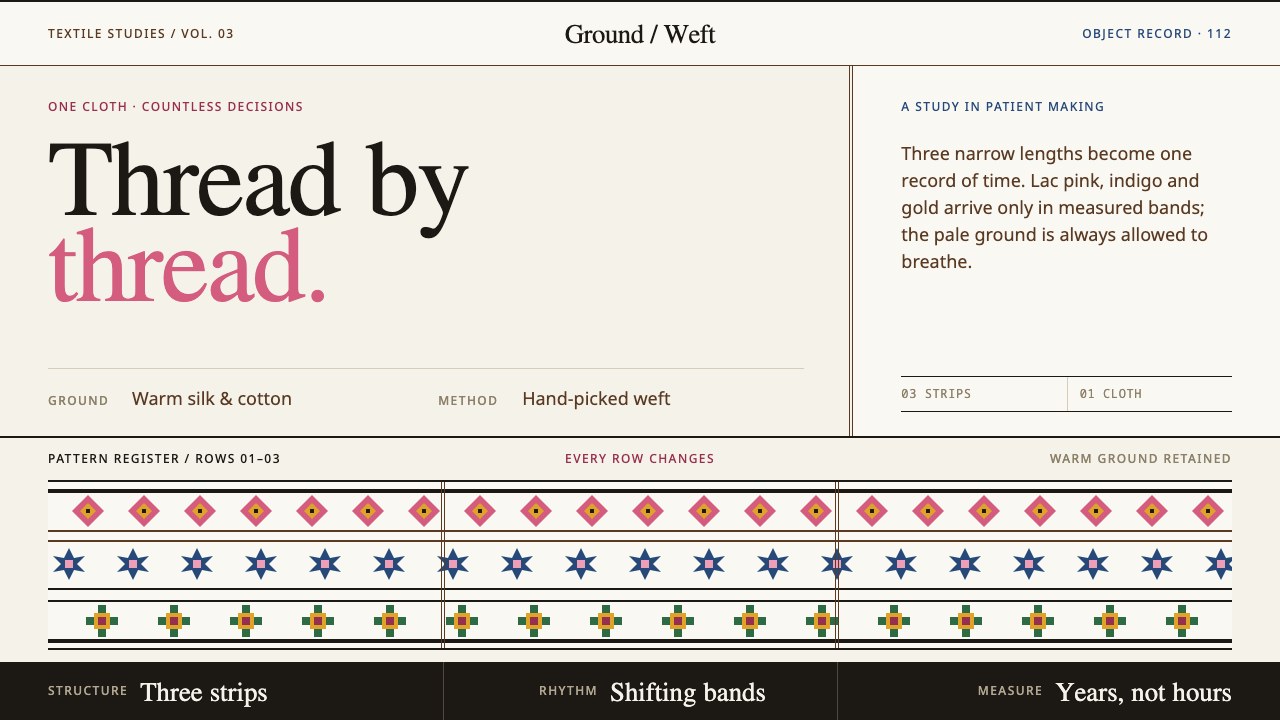 Bhutanese KushutharaPatience made visible. Lac pink and indigo bands shift across a warm silk gro…
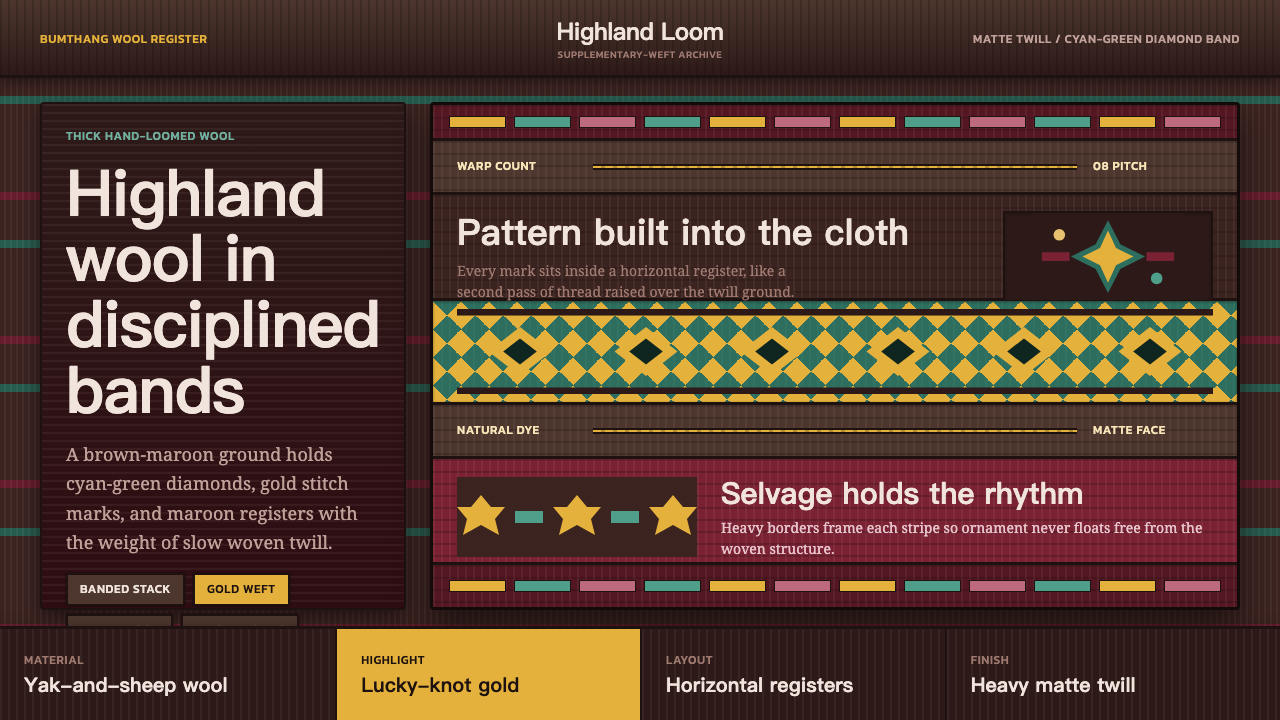 Bhutanese Yathra Wool WeaveHighland wool made digital. Brown-maroon bands carry cyan diamonds and spare…
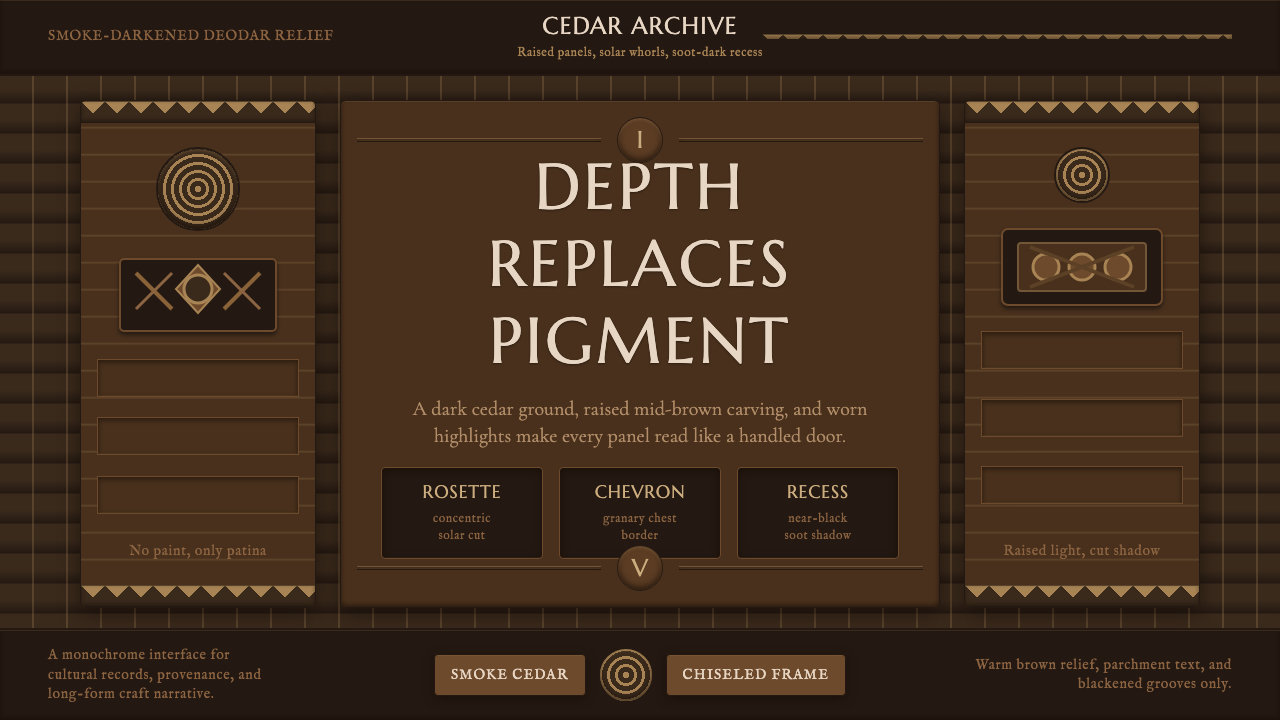 Nuristani Carved CedarDepth replaces pigment. Smoke cedar, chevrons, and rosettes carve light from…
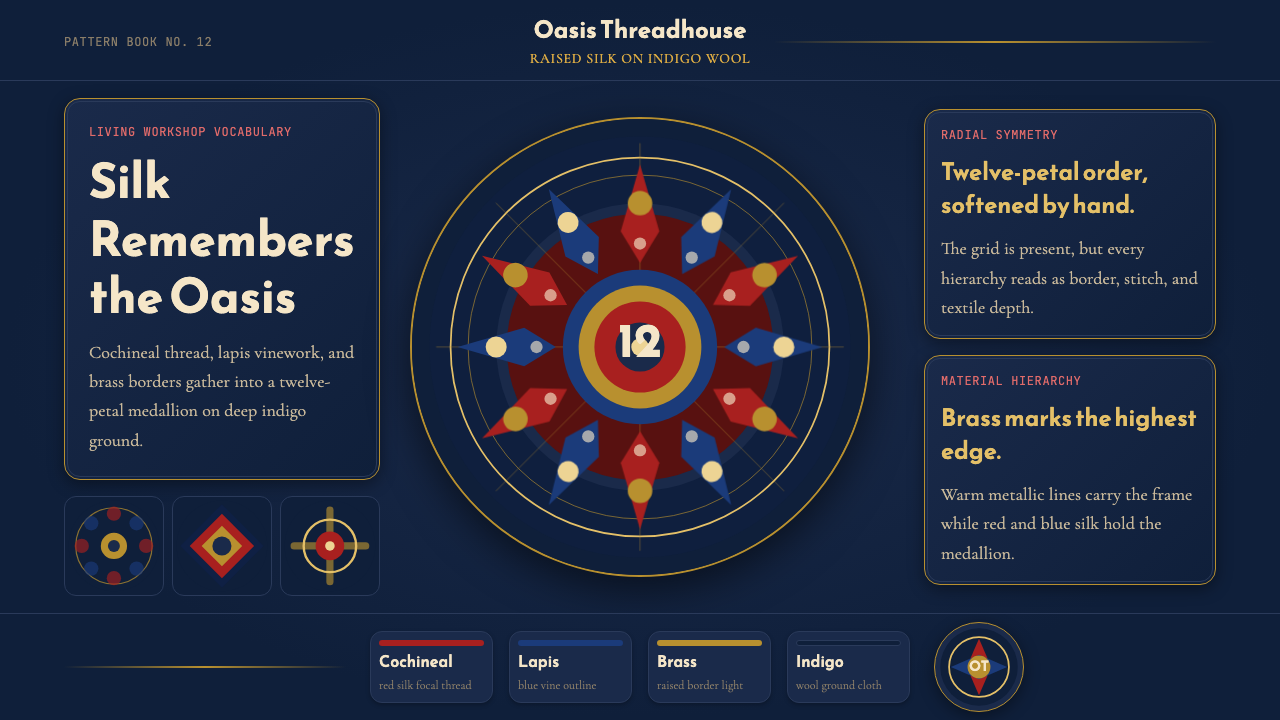 Uyghur Xinjiang Suzani EmbroiderySilk glows like memory. Cochineal and lapis medallions orbit brass on indigo…
 Yomut Gül CarpetHand-knotted authority on screen. Hooked dyrnak diamonds lattice a madder-red…
 Azerbaijani Quba CarpetRed is the field. Indigo botehs and ivory latch-hooks orbit a stepped medalli…