What is Iraqi Baghdad Shanasheel House?
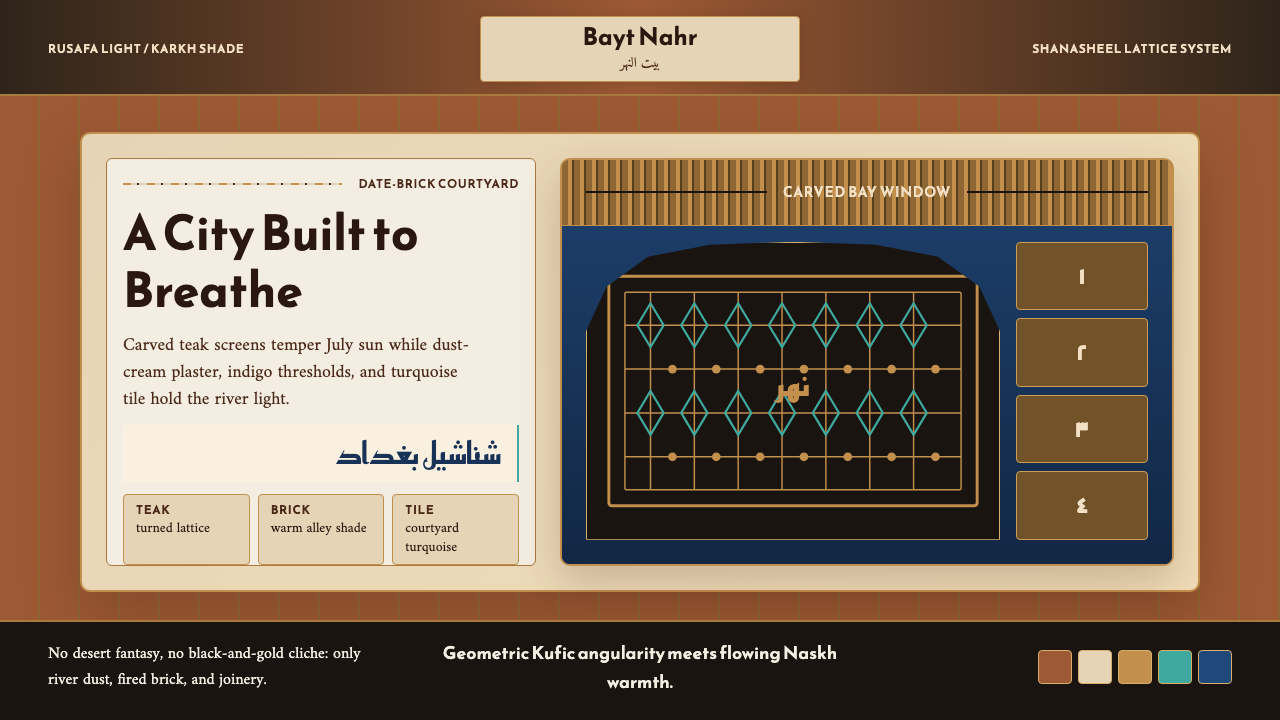
The Baghdad shanasheel house transformed Islamic geometric ornament into a living architecture of filtered light, carved teak, and courtyard cool — a design tradition that learned to breathe.
Iraqi Baghdad Shanasheel House in brief
Iraqi Arabesque Baghdad House is a design style rooted in the domestic architecture of Ottoman-era Baghdad, specifically the merchant townhouses that lined the narrow lanes of the Rusafa and Karkh quarters along the Tigris. Its defining visual element is the shanasheel — the elaborately carved teak lattice bay window that projects outward from upper floors, filtering harsh Mesopotamian sunlight while funneling river breezes into the interior. The style draws its full identity from this architecture: the warmth of sun-fired date brick, the deep blue-green of courtyard tile, the dense geometric weave of turned wood, and a threshold palette of indigo and amber that marks the transition from street to sanctuary.
The visual system is fundamentally one of layered ornament working in service of a rational environmental purpose. Every carved screen, every geometric tile border, every interlocking star pattern exists because it solves a physical problem — it shades, ventilates, or orients — while simultaneously asserting a cultural identity rooted in centuries of Islamic geometric tradition. This is not decoration applied to structure; ornament and structure are one and the same. The Arabesque logic of infinite interlocking pattern reflects a worldview in which beauty is found in repetition, variation, and the inexhaustibility of geometric possibility.
In contemporary design practice, this style offers a distinctive alternative to both flat minimalism and Western historicism. It brings warmth through earthy, sun-soaked tonality; depth through geometric layering; and cultural specificity through Arabic calligraphic typography. It is particularly resonant for brands and projects seeking to evoke the richness of the Arab and Islamic world without resorting to cliché, and for any context where a sense of crafted, material warmth is preferable to sterile precision.
Where does Iraqi Baghdad Shanasheel House come from?
The Baghdad shanasheel tradition took its mature form during the eighteenth and nineteenth centuries, when the city emerged from decades of Ottoman-Safavid conflict to become a thriving trading hub on the Tigris. Merchants who grew wealthy on the river trade — dates, textiles, spices — invested their fortunes in elaborate courtyard houses whose exterior plainness concealed lavish interiors. The shanasheel bay window was the primary vehicle for this inward-facing luxury: families could observe the street while remaining screened from view, and the carved lattice modulated light and air with a precision no solid wall could achieve.
The carpentry tradition that produced the shanasheel drew on a craft lineage stretching back through Mesopotamian and Islamic woodworking, but its peak expression in Baghdad was specifically Ottoman-Iraqi — shaped by the availability of imported Burmese and Indian teak, by local guilds whose masters passed joinery techniques across generations, and by a climate that demanded functional performance from every decorative choice. The geometric vocabulary — interlocking stars, hexagonal rosettes, arabesque vine scrolls — was itself a living tradition, with each craftsman both inheriting and improvising within inherited constraints.
The intellectual and architectural history of this period is inseparable from a handful of key figures who either practiced within the tradition or later documented and theorized it. Rifat Chadirji, Iraq's most significant modern architect, spent decades photographing and cataloguing Baghdad's vernacular architecture before much of it was demolished, preserving visual records that now serve as the primary source for any serious engagement with the shanasheel vocabulary. Mohamed Makiya, who bridged traditional craft knowledge and modernist training, argued that Iraqi architecture needed to find its own synthesis rather than import Western models wholesale — a position that made the domestic tradition a site of active intellectual inquiry rather than mere nostalgia.
By the early twentieth century, the shanasheel house was already under pressure from colonial modernization, and the mid-century demolitions that accompanied Baghdad's rapid urban expansion erased enormous swaths of the historic fabric. What survived did so partly through Chadirji's documentary work and partly through the materials themselves — tiles, carved panels, and door frames that were salvaged and reinstalled in museums or private collections. The style now exists as a recoverable heritage, available for contemporary reinterpretation through the visual and typographic systems that distill its essential logic.
What defines the Iraqi Baghdad Shanasheel House look?
Color Palette
The palette is anchored in three material realities: the warm ochre and amber of sun-dried date brick, the deep blue-green of glazed courtyard tile, and the rich reddish-brown of aged teak. Against these warm grounds, accents of indigo — drawn from the threshold tilework that marked the entry sequence — provide depth and punctuation. The overall tonality is earthy and saturated but never garish; these are colors worn by materials that have aged in intense sunlight and dry heat, and they carry that weight.
Geometric Ornament
The geometric vocabulary is drawn directly from the Islamic ornamental tradition — interlocking stars of six, eight, and twelve points, hexagonal rosette clusters, and the continuous arabesque vine scroll that fills secondary registers. Crucially, this ornament is not surface decoration applied to a neutral ground; it is structural, generated by the logic of the material — wood that must be joined at specific angles, tile that must be laid in repeating modules. The pattern reads as infinitely extensible, implying a whole beyond the visible frame.
Typography
Typography inhabits two registers that correspond to the two poles of Arabic letterform tradition. Display text calls for geometric Kufic forms — angular, architecturally structured, carrying the weight of inscription and monument. Running text and secondary labels shift to Naskh, the flowing cursive script that carries warmth, human scale, and the feel of the manuscript tradition. Used together, they create a typographic hierarchy that mirrors the architecture: the structural and the intimate held in balance.
Light and Screen
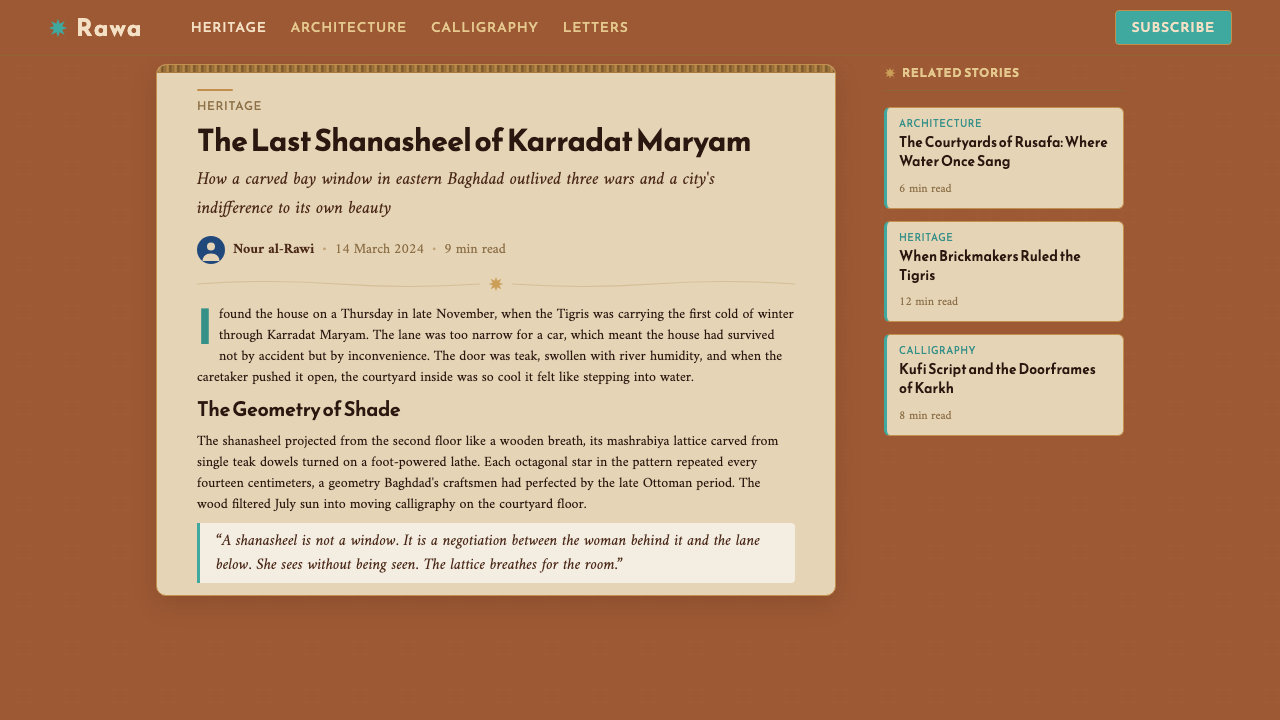
The shanasheel lattice teaches a specific lesson about light: it is most beautiful when filtered. In digital applications, this principle translates into an approach that avoids pure white fields and uniform illumination. Instead, surfaces carry subtle warm tonality, geometric motifs cast their own internal shadows, and contrast is achieved through layering rather than through stark opposition. The interplay of pattern and void — of the carved screen and the light passing through it — is the signature mood of the style.
Material Depth
The style carries a strong sense of material weight: brick that has been fired, wood that has been carved, tile that has been glazed and fixed. This is not the smooth, weightless flatness of digital minimalism; it is the depth of things made by hand from heavy materials. In two-dimensional applications, this sensibility manifests as subtle surface texture in backgrounds, graduated tonal warmth rather than flat fill, and a preference for ornamental borders and frames that suggest thickness and edge.
Courtyard Rhythm
The Baghdad house is organized around a central courtyard — an inward-facing void that provides air, light, and social space. This spatial rhythm, of enclosure broken by an open center, has a compositional analog in the style's layouts: dense ornamental registers surrounding a central, relatively open field. Content areas breathe within framed borders; whitespace is not emptiness but a held center, equivalent to the courtyard itself.
Border and Frame
Every significant element in the Baghdad house interior is bounded: doorways have carved frames, niches have geometric tile borders, windows have carved surrounds. This habit of framing is one of the style's most usable design principles. In contemporary applications, geometric borders — narrow bands of interlocking pattern, tile-inspired rules, or framed medallion treatments — signal both cultural identity and compositional intention. A framed element is a deliberate element; the border is an argument for its importance.
Who shaped Iraqi Baghdad Shanasheel House?
Iraq's most significant modern architect, Chadirji dedicated decades to photographing and systematically cataloguing the traditional domestic architecture of Baghdad before extensive demolition erased much of the historic city. His documentation of the shanasheel houses — their carved woodwork, tiled courtyards, and spatial organization — created the visual archive that now underpins any serious scholarly or design engagement with the tradition. He also practiced as an architect, producing buildings that negotiated between modernist form and the spatial logic of Iraqi vernacular architecture.
An architect and intellectual who studied in Britain before returning to Iraq, Makiya became one of the most influential voices arguing that modern Iraqi architecture should synthesize its own heritage rather than import Western models. He practiced at the intersection of traditional craft knowledge and modernist building technique, and his theoretical writing positioned the domestic architecture of Baghdad — including the shanasheel tradition — as a legitimate and sophisticated source for contemporary design thinking rather than a relic to be preserved in amber.
An architect who worked within the Chadirji circle and contributed to the broader project of documenting and theorizing Baghdad's urban heritage. Munir's engagement with the shanasheel typology helped establish the analytical framework through which later designers and scholars could engage with the tradition — understanding not just what these houses looked like but how their spatial and environmental logic worked, and what it might mean to draw on that logic in contemporary practice.
Associated with the documentation and continued scholarly attention to Iraqi vernacular architecture, Rashid represents the continuing intellectual tradition of taking the Baghdad house seriously as a designed artifact worthy of rigorous study. His work, alongside that of Chadirji and Makiya, forms part of the intellectual infrastructure that makes it possible to speak of a coherent Baghdad shanasheel design tradition rather than an undifferentiated collection of old buildings.
How do you use Iraqi Baghdad Shanasheel House today?
Applying the Baghdad house style in contemporary work requires understanding which of its qualities are transferable and which are specific to physical materials and spatial experience. What translates well: the warm, layered color palette; the geometric border and frame vocabulary; the typographic pairing of angular and flowing Arabic letterforms; and the compositional principle of dense ornamental registers surrounding an open center. What does not transfer directly: the specific depth and tactility of carved wood and fired tile, which in digital contexts must be suggested rather than reproduced.
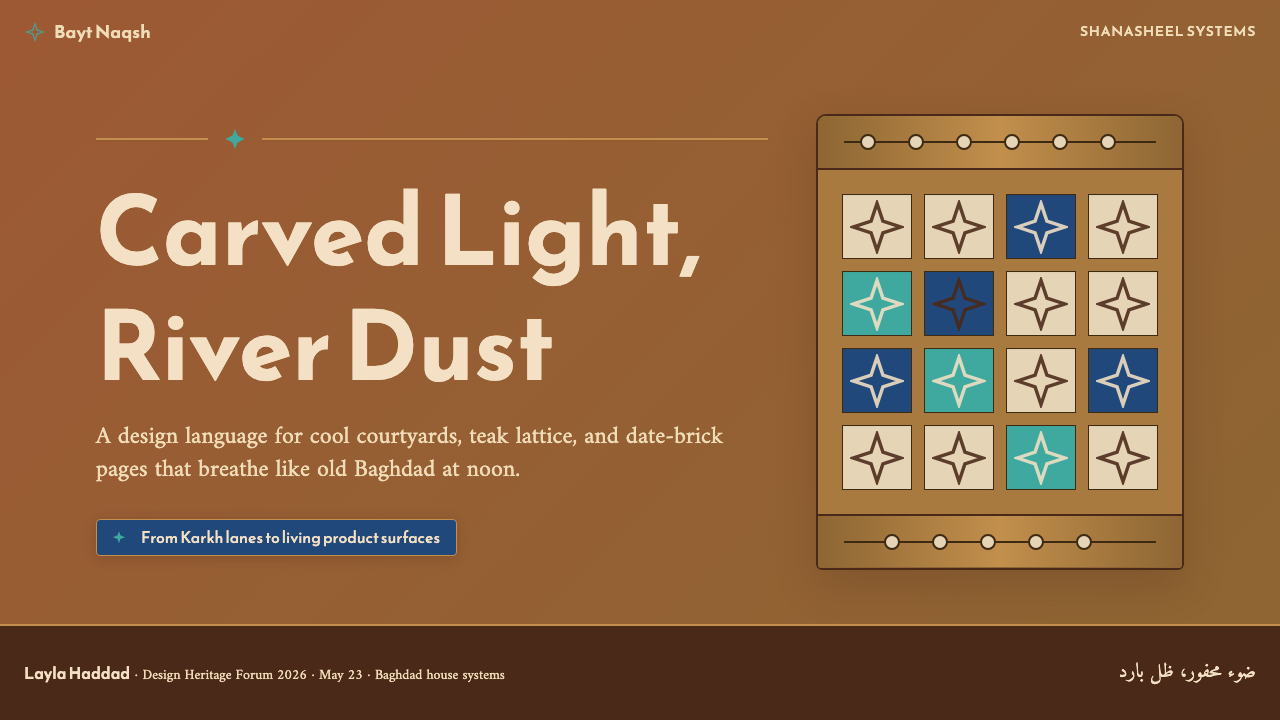
For presentation slides, the style works particularly well for cover and section-break pages. A cover using this approach might feature a large geometric border frame in teak-brown or indigo surrounding a central title set in geometric Kufic display type, against a warm brick-ochre ground. Section dividers work as full-bleed ornamental bands — narrow geometric interlocking patterns used as horizontal rules to mark transitions. Content slides should be kept relatively clean: use the warm ground color, a single ornamental border accent, and limit body text to a flowing Naskh-style typeface for legibility. Data visualizations can incorporate the palette — bar and flow charts in the deep teal and amber tones — without applying the full ornamental treatment.
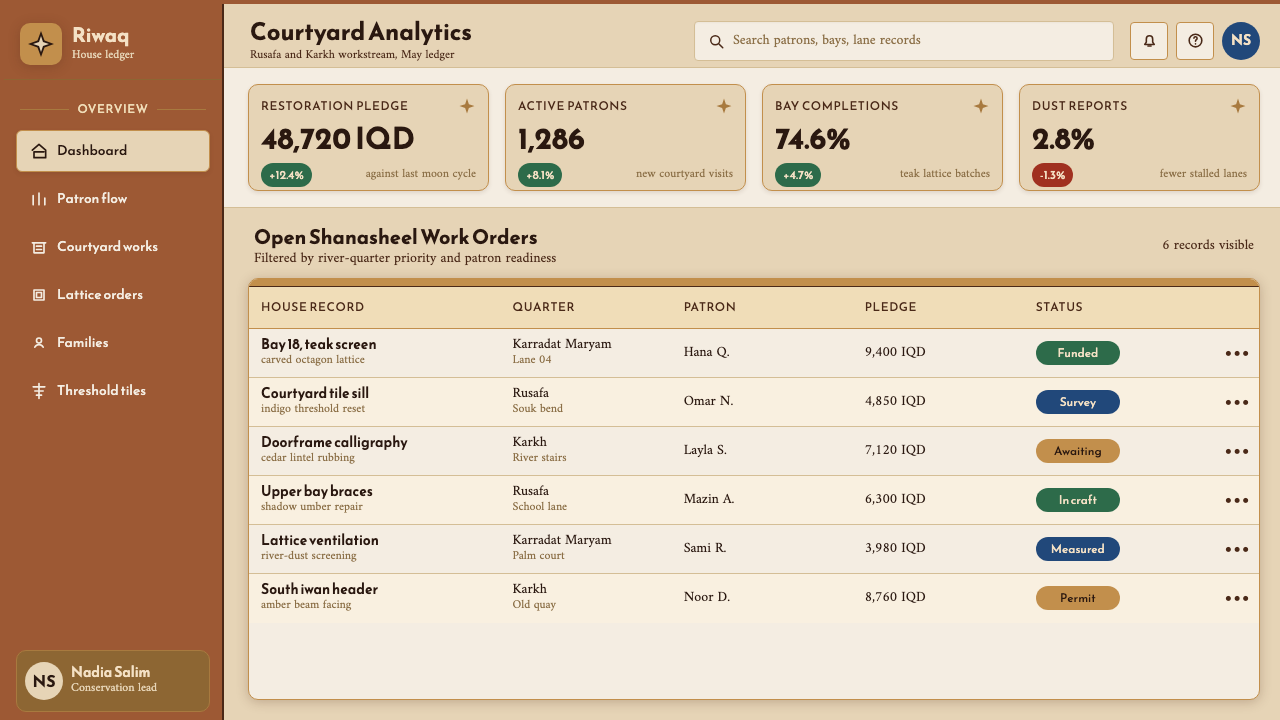
For web interfaces and dashboards, the style suits contexts where warmth and cultural identity matter more than clinical efficiency. A dashboard or pricing page might use the warm ochre as its page background, teal for primary interactive states and key data highlights, and indigo for alerts or tier indicators. Navigation can incorporate narrow geometric band motifs as separators. Card components work best with a slightly raised, warm-toned surface and a geometric border accent rather than a simple drop shadow — the sense of a framed, deliberate element is characteristic of the style. Avoid making interfaces feel busy: use the ornamental vocabulary sparingly, as punctuation rather than wallpaper.
For editorial and marketing applications, the style's strongest asset is its combination of warmth, geometric precision, and unmistakable cultural identity. Feature spreads or hero sections can use full geometric border treatments as structural frames around headline content. Pull quotes work well with a cartouche-style frame — a geometric surround that gives the quote monumental weight. Marketing pages that need to signal cultural authenticity, craftsmanship, or a connection to the Arab world will find the style immediately communicative. The color palette alone — the date-brick warmth, the Tigris teal, the threshold indigo — does significant cultural work without requiring the full ornamental apparatus.
The most common mistake when applying this style is using the ornamental vocabulary so densely that the overall effect becomes claustrophobic rather than rich. The Baghdad house itself breathes through the courtyard void; a design that applies geometric pattern to every surface without relief loses the spatial intelligence that makes the tradition compelling. A second common error is treating the geometric motifs as purely decorative surface elements, when their power comes from their structural role — they should frame, divide, and organize content, not merely texture it. A third pitfall is mixing this style with Western historicist ornament (Art Nouveau flourishes, Victorian decorative borders) — the geometric logic of the Arabesque tradition is internally coherent, and hybrid ornamental registers tend to cancel each other out rather than enrich.
Iraqi Baghdad Shanasheel House — FAQ
How is the Baghdad shanasheel style different from generic Islamic geometric pattern?
Islamic geometric ornament is a broad tradition spanning over a thousand years and dozens of distinct regional and cultural expressions. The Baghdad shanasheel style is a specific local application of that tradition, shaped by the particular materials of the Tigris region — date brick, teak, glazed tile — and by the environmental demands of the Mesopotamian climate. It also carries a specific architectural context: the projecting bay window of the merchant house rather than the dome of a mosque or the portal of a madrassa. Working with this style means engaging with that specificity — the warm palette, the domestic scale, the interplay of lattice and courtyard — rather than applying a generic arabesque fill.
Can this style work for interfaces aimed at non-Arab audiences?
Yes, with thoughtful application. The visual elements of the Baghdad house style — the warm palette, geometric layering, and border vocabulary — are legible and appealing to audiences without any prior knowledge of Iraqi architectural history. What requires care is avoiding a superficial exoticism: the style should be applied because its specific visual qualities serve the product's needs, not simply to signal otherness or deploy a cultural aesthetic as decoration. For audiences unfamiliar with the tradition, the ornamental geometry reads as richness, warmth, and craft — qualities that translate broadly. The typographic dimension is more culturally specific, and a decision to use Arabic letterforms in an otherwise Latin-script interface should be made deliberately and respectfully.
How should the ornamental elements be scaled — should they always be elaborate?
No — in fact, the most effective applications often use restraint. The Baghdad house tradition itself shows that the same geometric vocabulary can be deployed at many scales, from the dense overall surface treatment of a major door surround to the simple interlocking band of a shelf edge. In digital work, the most usable register is typically the narrow geometric border or rule — a single band of interlocking pattern used as a divider or frame accent — rather than an all-over ornamental fill. Scaling down to this level preserves the cultural and aesthetic identity of the style while keeping interfaces functional and uncluttered. Reserve the full ornamental treatment for moments of emphasis: hero sections, cover pages, key callout elements.
Is this a dark or light style?
The historical Baghdad house interior was a light style in the architectural sense: courtyards and latticed windows maximized the entry of natural light, and wall surfaces were often plastered white or pale to reflect that light inward. The palette, however, is warm rather than cool, with dominant earth tones and saturated accent colors rather than the blue-white neutrality of some light styles. In contemporary digital application, the style works best on warm off-white or ochre grounds — not pure white, which strips the warmth — with deep teal and indigo as accent colors. A dark variant is possible using deep brick-red or near-black grounds with the geometric vocabulary highlighted in gold-ochre and teal, but the historical reference point is unambiguously warm and light.
What kinds of projects is this style least suited for?
The Baghdad house style struggles where the product's values are sterility, speed, or technological futurism. A medical interface, a high-frequency trading platform, or a tool positioning itself as algorithmically precise would be undermined by the style's warmth and historical depth — these are contexts where the visual system should signal efficiency and trust through reduction, not richness. The style also requires typographic commitment: the Arabic letterform pairing is integral to the identity, and a version that strips it out in favor of a purely Latin system loses a central element. Projects that need typographic neutrality — global enterprise software, for instance — should consider whether this style's cultural specificity is an asset or a liability for their specific audience.
Related design styles
 Paraguayan Itauguá Ñandutí Spider LaceReverent craft glows. Snow lace medallions radiate over rose velvet with Guar…
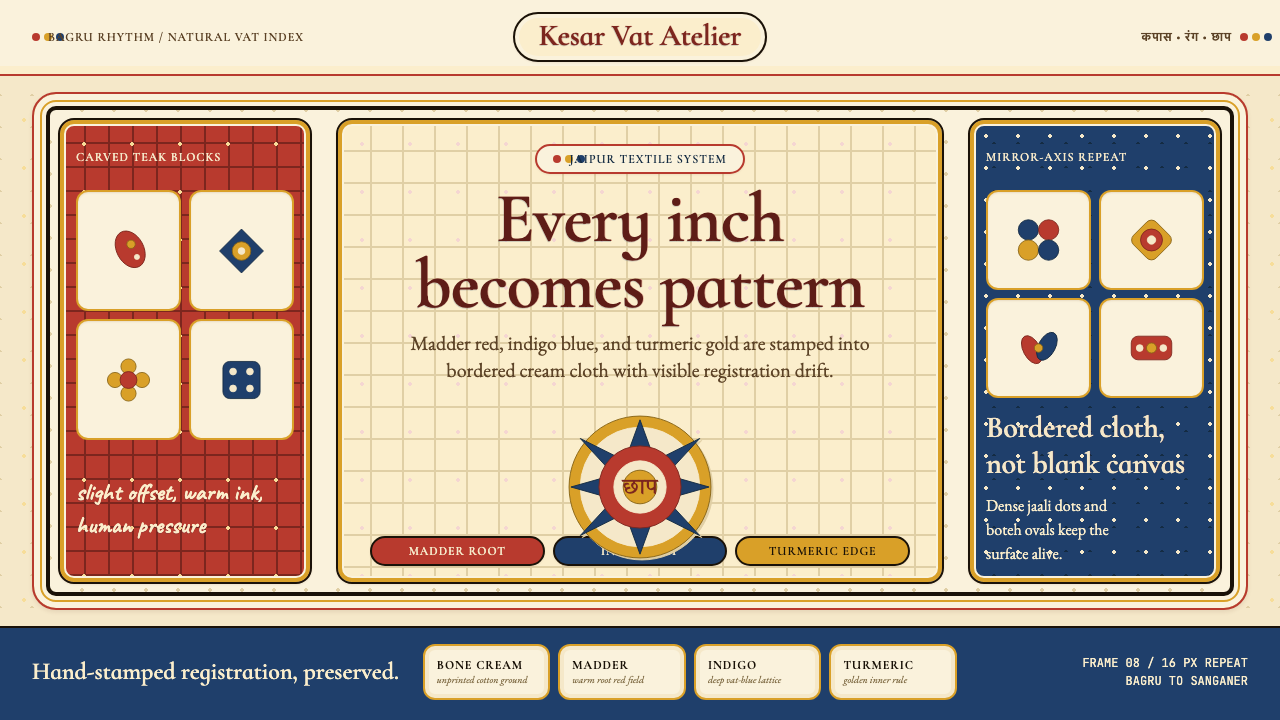 Indian Block PrintPattern claims every inch. Madder, indigo and turmeric stamp dense bordered c…
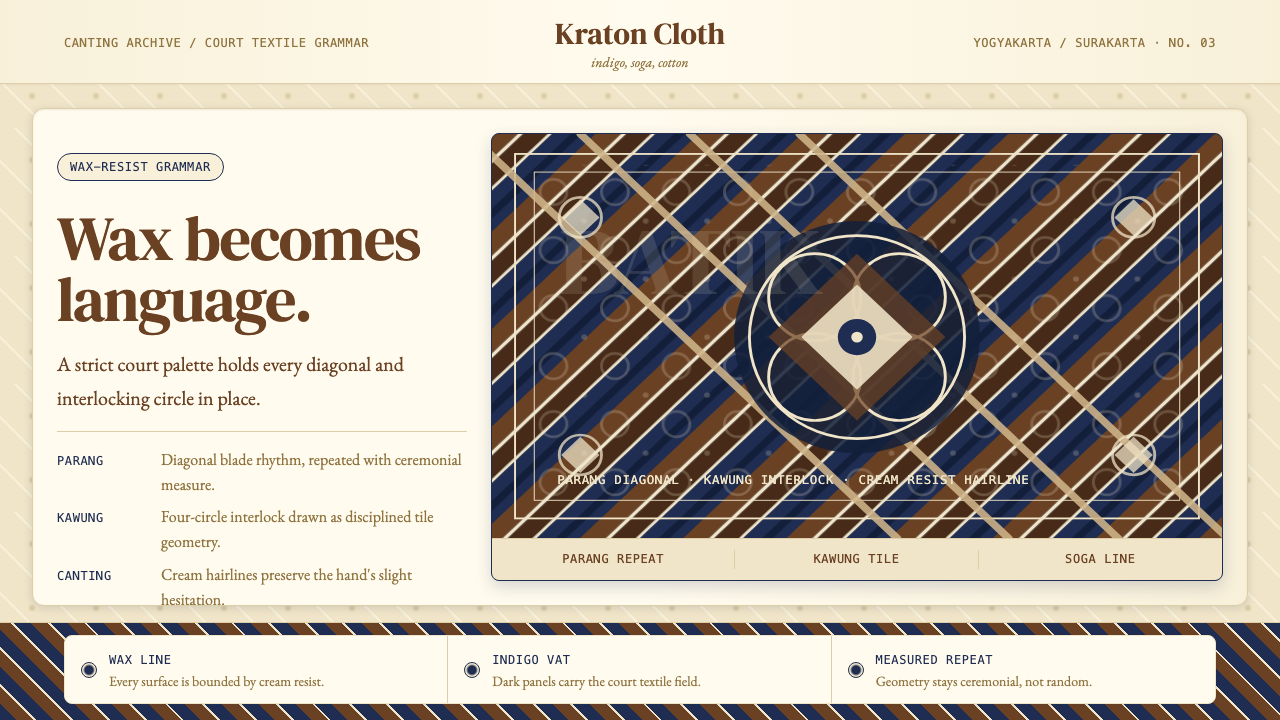 Javanese BatikCeremonial repetition. Indigo, soga, and cream frame a tiled canting motif.
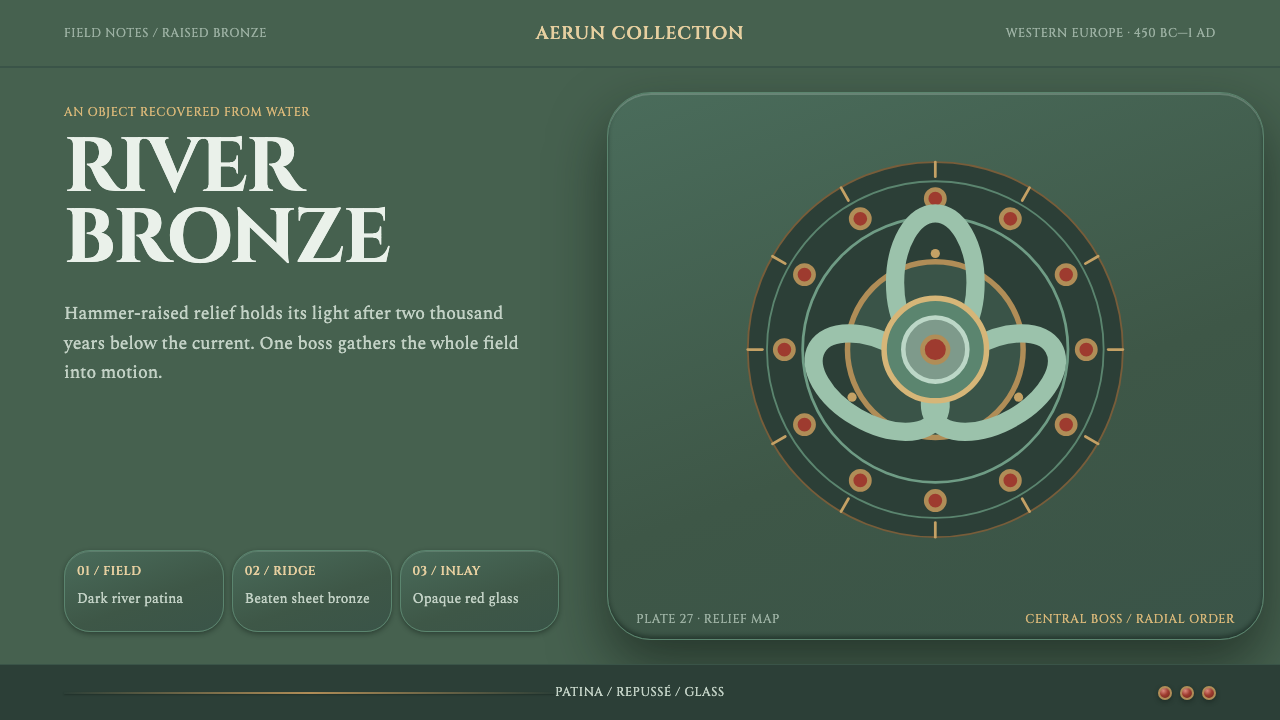 La Tène Celtic MetalworkMetalwork that still moves. Patina-green relief radiates from a bronze boss,…
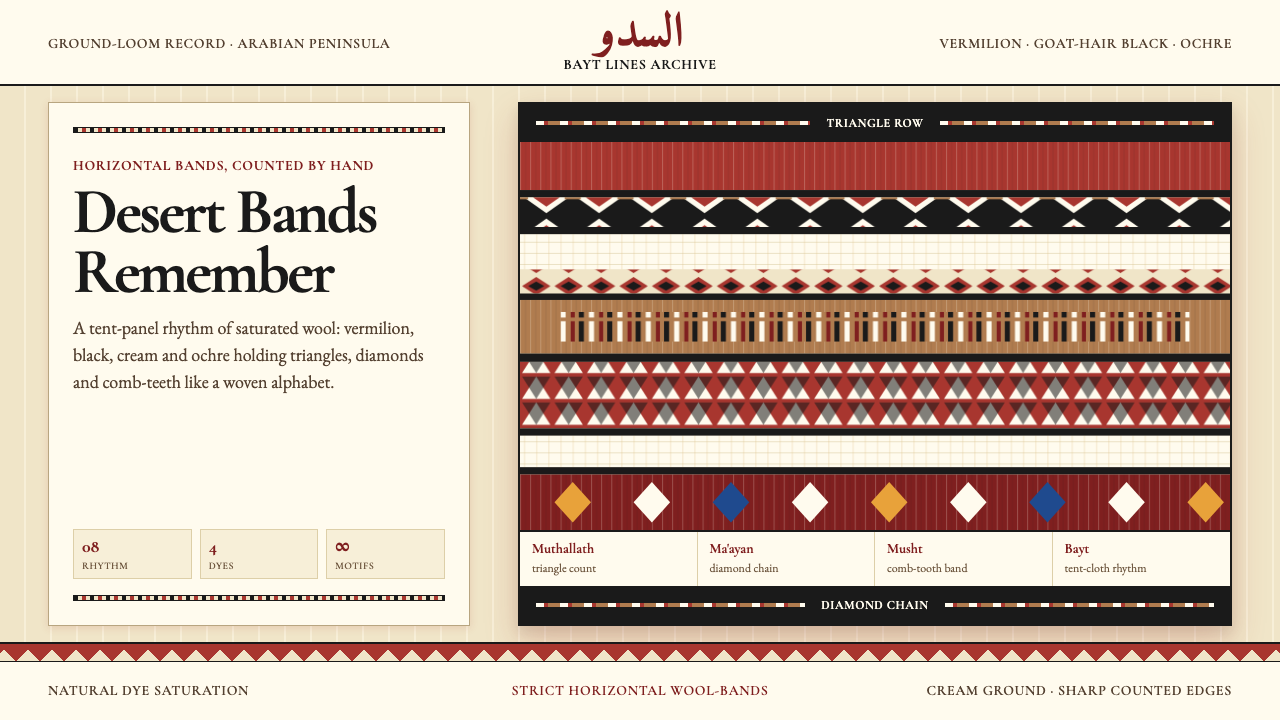 Bedouin Desert Textile (Sadu)Woven memory, not ornament. Vermilion-black bands count triangles and diamond…
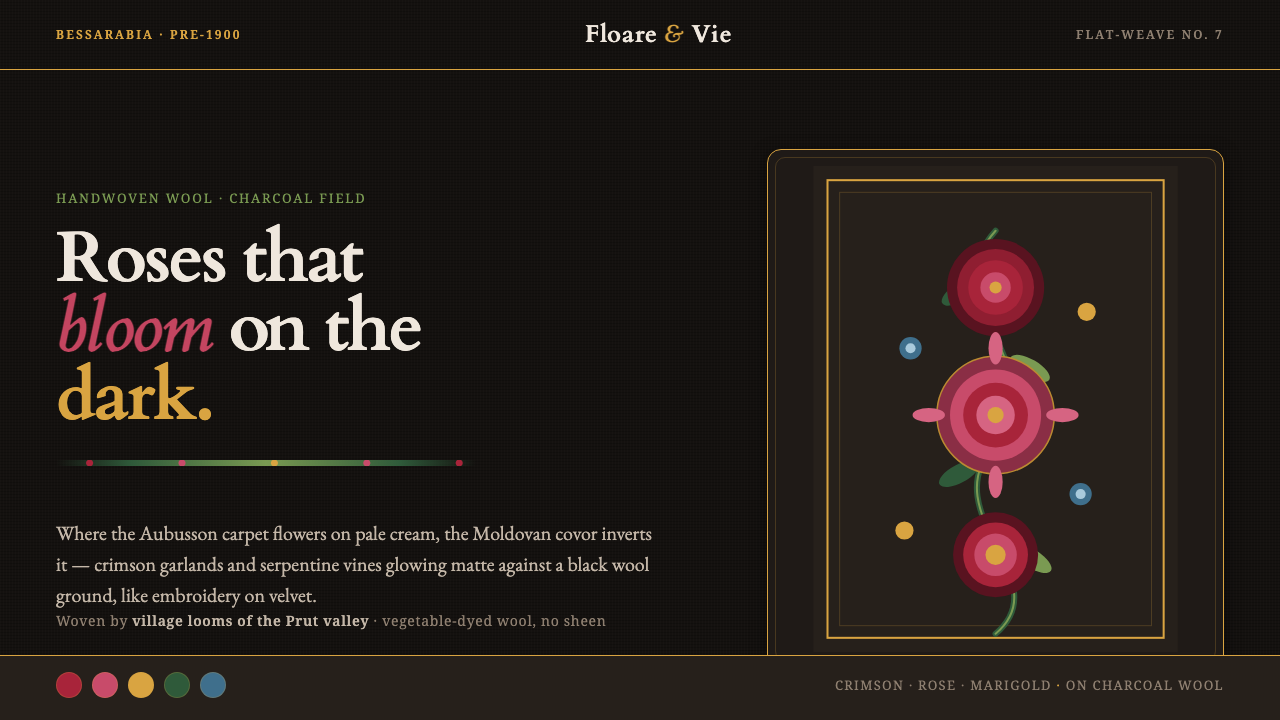 Moldovan Covor KilimRoses that bloom on the dark. Crimson garlands glow matte on a charcoal wool…