What is Nuristani Carved Cedar?
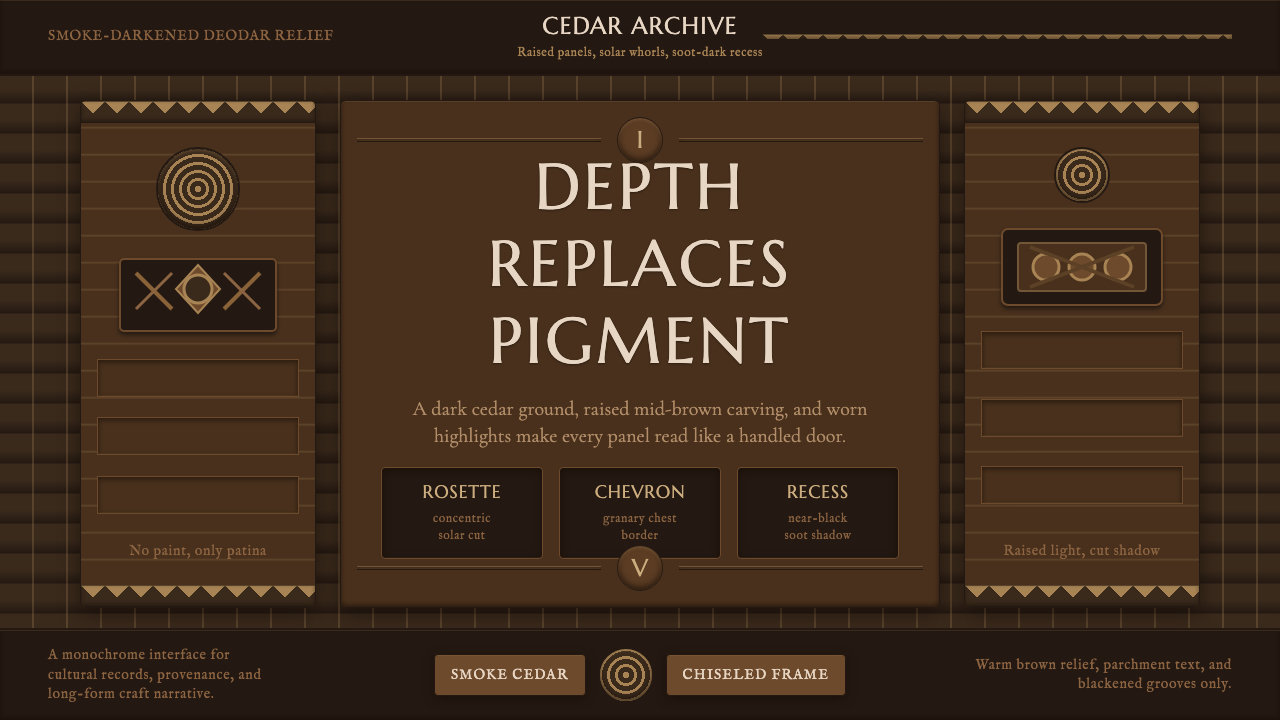
Nuristani Carved Cedar trades pigment for depth — a smoke-darkened wooden surface where light and shadow, not color, carve out every ornament.
Nuristani Carved Cedar in brief
Nuristani Carved Cedar is a design language built entirely from a monochrome woodcraft tradition: the deep-relief carving found on doors, columns, and granary chests in the high valleys of what is now Nuristan, in northeastern Afghanistan. Unlike almost every other design tradition that relies on color contrast to create visual interest, this style relies on depth — the interplay of raised carved surface and recessed shadow within a single warm-brown wood tone.
The wood itself, deodar cedar aged and darkened by decades of smoke from indoor fires, is never painted. Its only variation is tonal: worn highlights where hands and light have touched raised carving over generations, and near-black pooling shadow in the deep-cut recesses of rosettes, chevrons, and geometric motifs. The entire visual drama comes from this light-and-shadow relief rather than from hue.
Motifs are drawn directly from historical Kafiri carving practice — solar discs, rosettes, chevron bands, and ibex-head finials — deep-cut into door panels and storage-chest lids by anonymous master carvers working in a craft tradition that predates the region's conversion to Islam in 1896. This design system translates that tactile, sculptural woodwork into an interface language built on texture and shadow rather than flat color fields.

Where does Nuristani Carved Cedar come from?
Before 1896, the region now called Nuristan was known as Kafiristan — 'land of the infidels' — named by neighboring Muslim populations for the animist and polytheistic beliefs practiced by its isolated mountain communities. Cut off by the extreme terrain of the Hindu Kush, these communities developed a distinctive material culture over centuries, most visibly expressed in elaborately carved wooden architecture: house columns, door frames, and communal structures covered in deep-relief ornament.
Carving in this tradition served both decorative and votive functions. Ancestor effigies, carved wooden chairs reserved for men of high social standing, and ornately worked granary chests all carried the same visual language of deep-cut geometric and solar motifs — chevrons, rosettes resembling flowers or suns, and stylized ibex heads referencing an animal central to the region's subsistence and ritual life. The wood was left in its natural, smoke-aged state; unlike neighboring textile and metalwork traditions rich in color, Kafiri woodcarving communicated entirely through relief depth and surface patina.
In 1895–1896, the Emir of Afghanistan Abdur Rahman Khan led a military campaign that forcibly converted the region's population to Islam, after which Kafiristan was renamed Nuristan — 'land of light.' The conversion disrupted many aspects of the pre-Islamic material culture, including the ancestor-figure carving tradition tied to animist religious practice, though vernacular architectural carving on doors and domestic structures persisted in modified form.
In recent decades, organizations such as the Turquoise Mountain Foundation have worked to document and revive traditional Afghan craft practices, including woodcarving, while ethnographic collectors and museums hold surviving examples of pre-1896 Kafiristan carving — the primary surviving record of a craft tradition otherwise transmitted almost entirely through oral apprenticeship rather than written record.
What defines the Nuristani Carved Cedar look?
Monochrome Wood Tone
The entire palette is built from a single family of warm brown wood tones — no blue, red, or green ever enters the system. All visual variation comes from value shifts within that brown family: lighter worn highlights and darker recessed shadow.
Deep Relief and Shadow
The defining technique is simulated deep relief: raised motifs catch a lighter, worn highlight while the surrounding recessed carving pools into near-black shadow, exactly as light falls across genuine deep-cut woodwork.
Geometric Rosettes
Circular rosette motifs resembling stylized flowers or solar discs recur throughout the system as focal ornaments, drawn directly from the carved medallions found on historical Kafiri doors and chests.
Chevron and Zigzag Bands
Repeating chevron and zigzag bands frame panels and borders, providing rhythmic linear structure that contrasts with the rounder rosette forms while remaining within the same carved-relief technique.
Panel and Frame Construction
Layouts are organized as if built from carved door panels or chest lids — heavy raised-panel borders frame content areas, echoing the structural logic of the wooden objects the style is drawn from rather than a flat digital grid.
Ibex and Animal Motifs
Stylized ibex-head finials and other animal-derived motifs appear sparingly as corner or terminal ornaments, referencing figures central to the region's traditional subsistence and ritual life without becoming a dominant illustrative element.
Typography as Carving
Where type appears, it is treated as if carved into the same wood surface — set with a subtle raised or recessed relief effect rather than flat ink, keeping typography consistent with the tactile, sculptural logic of the rest of the system.

Who shaped Nuristani Carved Cedar?
The unnamed craftsmen who developed and passed down this deep-relief carving tradition across generations, working entirely through oral apprenticeship rather than written pattern books, are the true originators of every motif this design style draws upon.
Contemporary organizations documenting and reviving traditional Afghan craft practices, including Nuristani woodcarving, have helped preserve knowledge of this tradition for study and reference in the absence of extensive historical written records.
Museum and private collections holding surviving pre-1896 Kafiristan carved objects preserve the primary visual record of this tradition, since much of the original architectural and ritual carving was disrupted by the region's forced conversion.
How do you use Nuristani Carved Cedar today?
Nuristani Carved Cedar suits contexts wanting to feel handcrafted, ancient, and tactile rather than digital or slick. Applying it well requires committing to the monochrome-wood constraint fully — introducing color anywhere in the system undermines the entire premise of depth-as-decoration.
For presentation slides, this style works powerfully for cultural, craft-heritage, or travel storytelling: a cover slide built as a full carved-panel border framing the title, with rosette or chevron motifs anchoring corners. Content slides should keep the carved-relief treatment reserved for section headers and dividers, letting body text sit on a plainer wood-grain ground so density of ornament doesn't overwhelm readability.
For web interfaces, the style suits cultural institutions, artisan marketplaces, heritage travel platforms, or any product wanting to evoke craft authenticity and history. Card components and panels benefit from a raised-border treatment mimicking carved frames, while navigation and interactive elements should use simplified relief cues rather than full ornamental density to remain usable.
For editorial and marketing work — craft documentaries, cultural features, artisan product storytelling — the style provides an immediately tactile mood: full-bleed wood-grain sections, carved-relief pull quotes or section dividers, and photography treated with warm, low-contrast tones consistent with the wood palette.
A common mistake is introducing color accents to 'liven up' the palette, which breaks the style's core premise that depth and grain — not hue — carry all visual interest. A second common error is over-ornamenting every surface with carved motifs; authentic Kafiri woodwork reserves its densest carving for focal objects like doors and chests, leaving surrounding surfaces comparatively plain.

Nuristani Carved Cedar — FAQ
Why does this style avoid color entirely?
The historical Kafiri woodcarving this style is drawn from was never painted — its makers communicated visual richness entirely through carved depth and the natural patina of smoke-aged cedar. Introducing color would misrepresent the source material and collapse the light-and-shadow logic the entire system depends on.
How is depth simulated without literal 3D carving?
The effect relies on consistent, directional light-and-shadow cues applied to flat motifs: a lighter tone or subtle highlight along one edge of a shape, and a darker, near-black tone pooling along the opposite edge, mimicking how light would fall across genuine deep-cut relief.
Is this style specific to doors, or can it apply more broadly?
While doors and chests are the most documented carrier objects, the underlying visual grammar — monochrome wood, relief carving, geometric and solar motifs — transfers to any surface or component wanting to evoke handcrafted, ancient woodwork, from packaging to interface panels.
What typography pairs well with this style?
Sturdy, slightly rustic serif or slab-serif forms that can plausibly be rendered with a relief effect work best. Highly decorative script faces or thin geometric sans-serifs undercut the handcrafted, carved character the style depends on.
Does this style work for a modern, tech-forward product?
It is a difficult fit. The style's entire identity rests on ancient craft, tactile depth, and historical specificity — qualities that read as slow and traditional rather than fast and technological. It works far better for cultural, heritage, artisan, or travel contexts than for a product wanting to signal cutting-edge innovation.
Related design styles
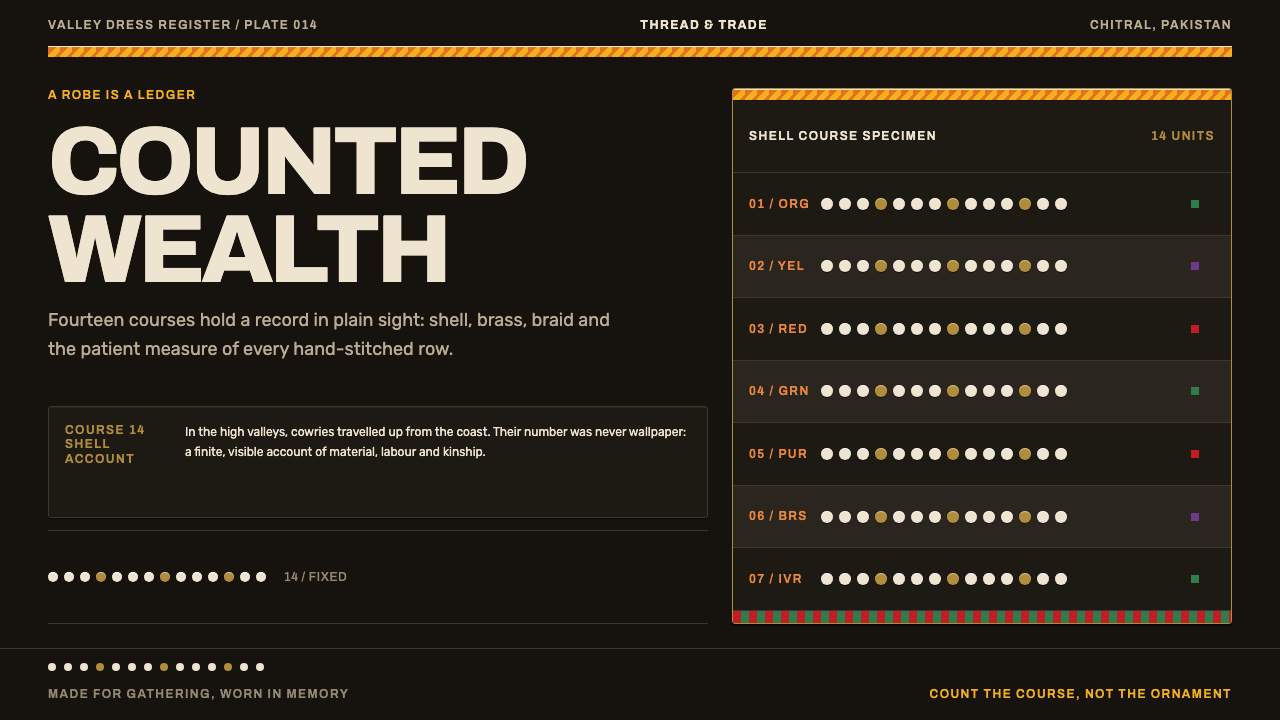 Kalash KupasDensity carries value. Ivory shell courses and orange braid are counted on wa…
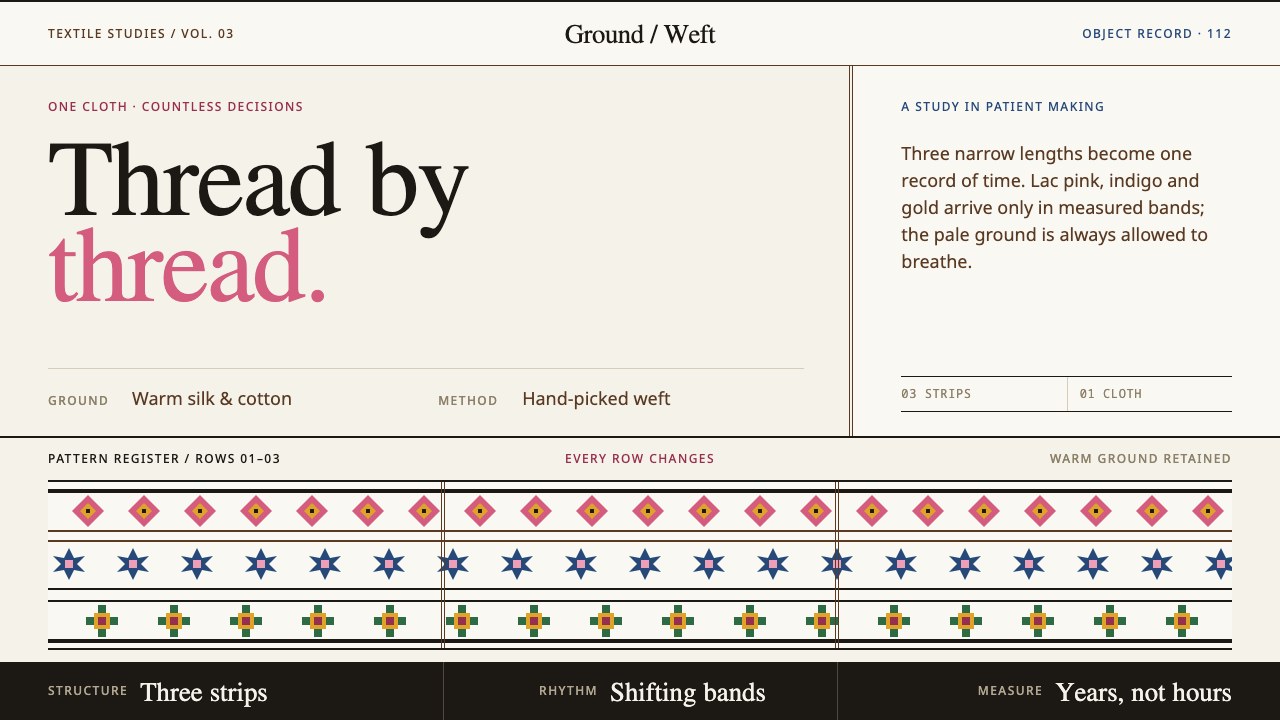 Bhutanese KushutharaPatience made visible. Lac pink and indigo bands shift across a warm silk gro…
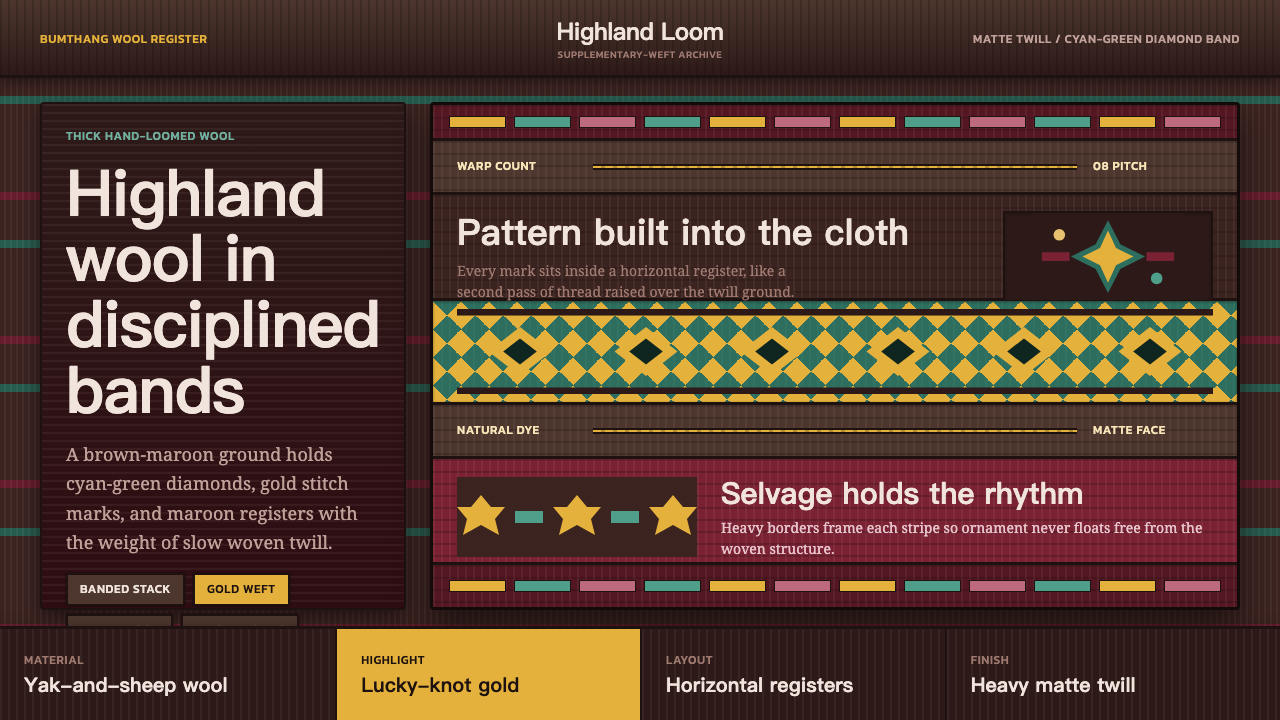 Bhutanese Yathra Wool WeaveHighland wool made digital. Brown-maroon bands carry cyan diamonds and spare…
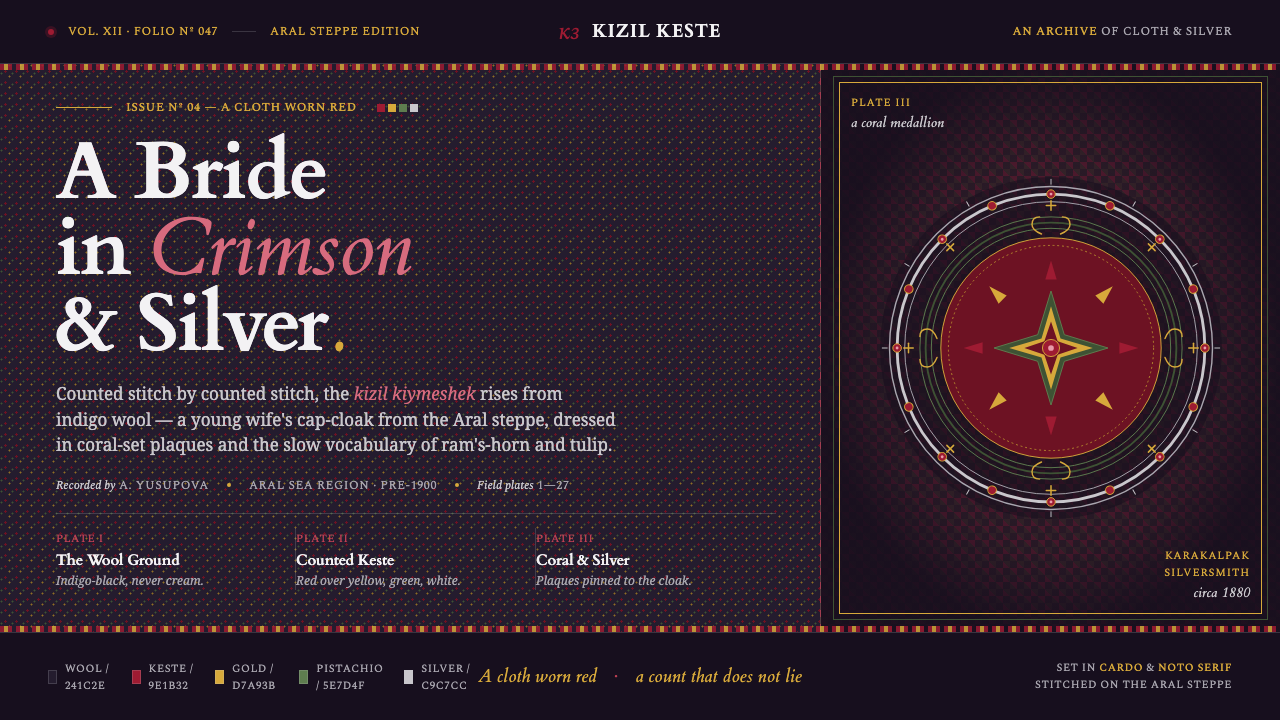 Karakalpak Kimeshek DressA cloth worn red. Crimson keste cross-stitch on indigo wool, set with silver-…
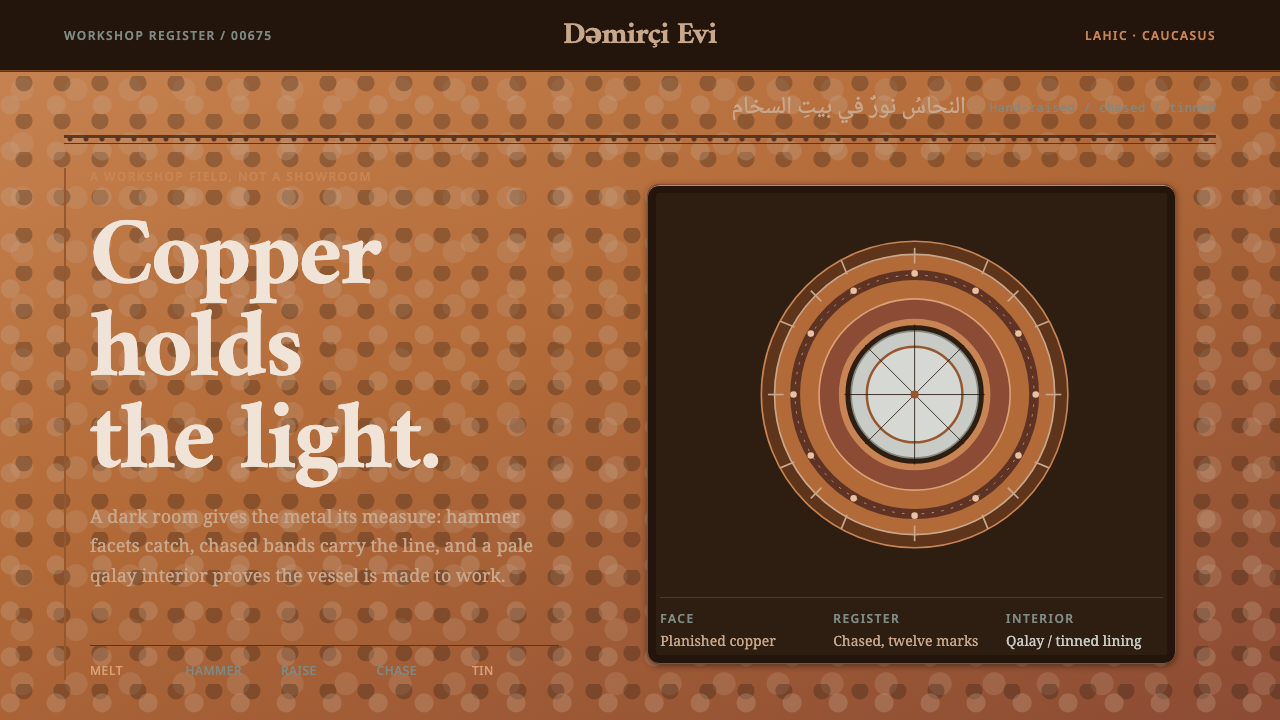 Lahic CoppersmithCopper becomes light. Soot-black bands, Amiri type, hammer facets and tin rev…
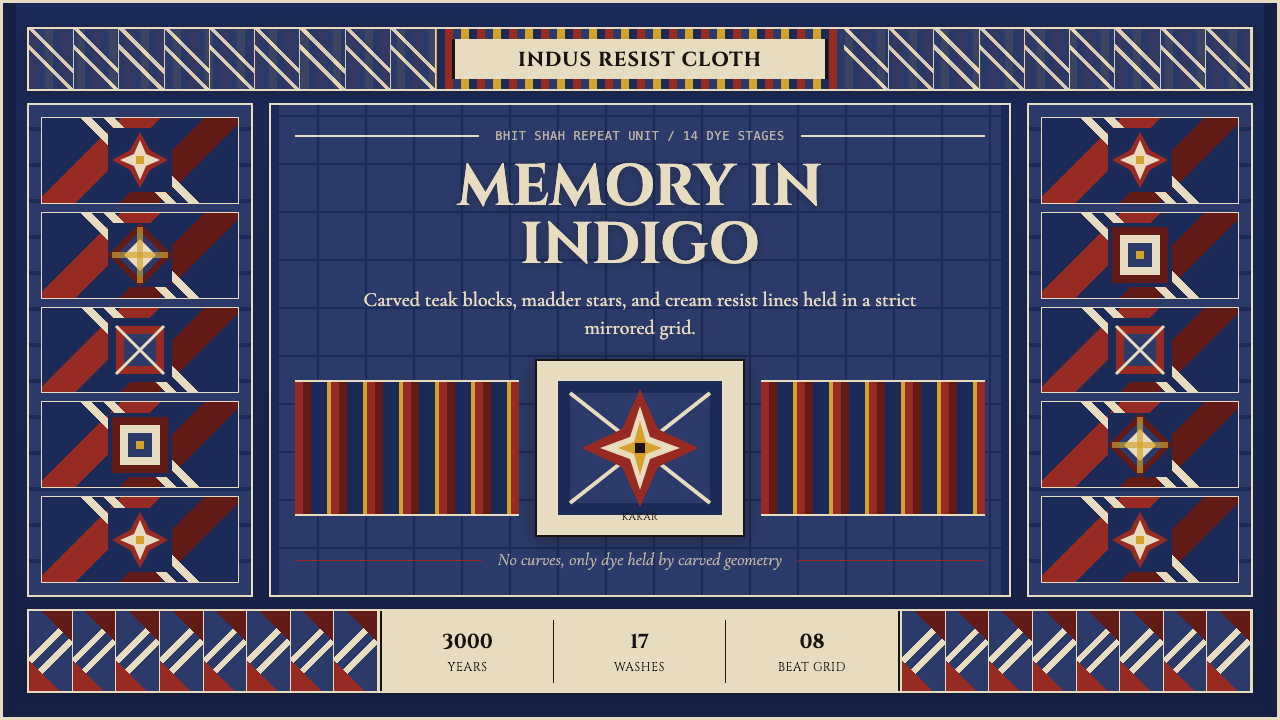 Sindh Ajrak Block PrintAncient cloth feels exact. Indigo fields, madder stars, and cream grids repea…