What is Kalash Kupas?
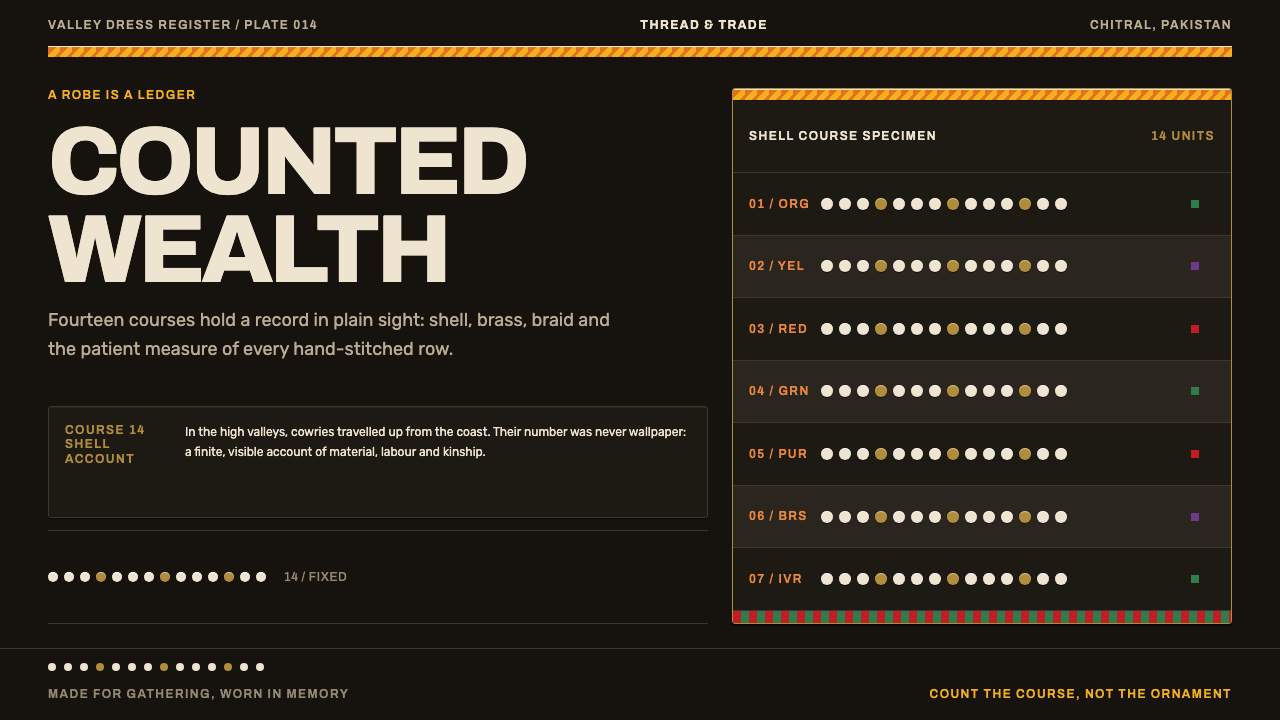
Density carries value in this style: on a warm village black, rows of ivory shell discs and bands of orange braid are counted rather than scattered, as on the festival headdress of a Kalasha woman.
Kalash Kupas in brief
Kalash Kupas takes its visual logic from the kupas, the festival headdress of Kalasha women in the Chitral valleys of northern Pakistan. A long band of black woollen cloth hangs down the wearer's back, and its whole surface is encrusted with rows of cowry shells, buttons, brass medallions and small round bells. At the top sit a feather and a wool pompom. A girl receives her first headdress at about the age of five, and a smaller everyday version, called a shushut, is worn from day to day.
The style treats the garment as a page. The ground is a warm village black rather than pure ink, the black of homespun cloth, and everything on it is counted instead of repeated at random. Braid in orange and yellow runs in strips of constant height. Ivory discs, modelled on the shells, serve as bullets and markers. Bands are stacked on top of one another like the rows of cowries on the headdress. The robe beneath the headdress is the same black, in coarse cotton for summer and hand-spun wool for winter, with collar and cuffs worked in bands of orange and yellow thread in zigzags and checks. The style keeps that stitched-band rhythm as its basic unit.
Its central proposition runs against the usual advice of modern design. Whitespace is not a virtue here. The finest kupas carries fourteen rows of cowries, and that density is an account of wealth, because every shell was traded up from the coast. A page in this style should therefore feel full: crowded in an orderly way, every unit countable, every band doing a job. The dark ground gives that fullness a place to rest and keeps the dense ornament from overwhelming the reader's eye.
Where does Kalash Kupas come from?
The kupas belongs to the Kalasha, a small community living in three side valleys of Chitral District in Khyber Pakhtunkhwa, northern Pakistan: Bumburet, Rumbur and Birir. These are high, steep valleys in the Hindu Kush, and the community's dress remains distinctive within the wider region. The source material describes the kupas as a living tradition older than 1900, first documented by Western collectors from the late nineteenth century onwards and still worn today. The style therefore draws on an object that is neither a relic nor a reconstruction but a garment in current use.
In this tradition the garment is a ledger as much as an ornament. Cowrie shells come from the sea, and they reached these mountain valleys only by being carried a very long way, passing through many hands. A headdress with many rows of shells therefore records how much trading wealth a family could command. The best examples carry fourteen rows. The brass medallions, buttons and bells that share the band are likewise worked or imported metal, and the wool pompom and feather at the crown complete a silhouette that is unmistakable. Dense ornament, in this setting, is not excess; it is the visible form of status and effort.
The black robe beneath the headdress is made in two weights, coarse cotton for summer and hand-spun wool dyed black for winter, and its collar and cuffs are worked in bands of orange and yellow thread in zigzag and check patterns. This is counted-thread work: the stitcher advances by counting threads, and the pattern emerges from arithmetic rather than from drawing. The source places it in a wider tradition of Hindu Kush counted-thread embroidery, alongside the cowry-shell trade ornament of the northwest frontier. That is why the style forbids curves. Curves are drawn; stripes and checks are counted, and the whole visual identity of the garment is built on the second kind of mark.
The people at the centre of this tradition are the Kalasha women who make and wear the headdresses, whom the source material lists first among its key figures. The wider record comes partly from museums: the Pitt Rivers Museum in Oxford and the Spurlock Museum in Illinois are named as institutions associated with the documented examples, which entered Western collections from the late nineteenth century. Those catalogues are valuable but secondary. The garment's meaning, including what the shells count and when a girl receives her first one, belongs to the community that lives with it, and any design that borrows from it should remember that.
What defines the Kalash Kupas look?
Warm Village Black
The ground is a black with warmth in it, the black of dyed homespun rather than the cold void of a screen switched off. It is soft enough to make ivory and orange glow, and dark enough that dense ornament can sit on it without turning to noise. Pure black would flatten the system; this black has a slight brown undertone that keeps it human.
Counted, Not Repeated
Every graphic follows the logic of counted stitches. Units are discrete, the same size, and in a number you could say aloud. A strip is five zigzags, not a pattern that fades off the edge. This makes the style legible as a system, because a reader can tell where a mark begins and ends, and it gives even decorative elements a quiet arithmetic honesty.
Braid Colours Kept Whole
Orange is the leading hue, taken from the thick embroidery braid, with yellow beside it and red, green and purple retained as they are on the garment. These colours are used at full strength in narrow bands against the dark ground; they are not mixed, tinted or softened. Saturation here is a material fact, not a mood.
Ivory Shell Discs
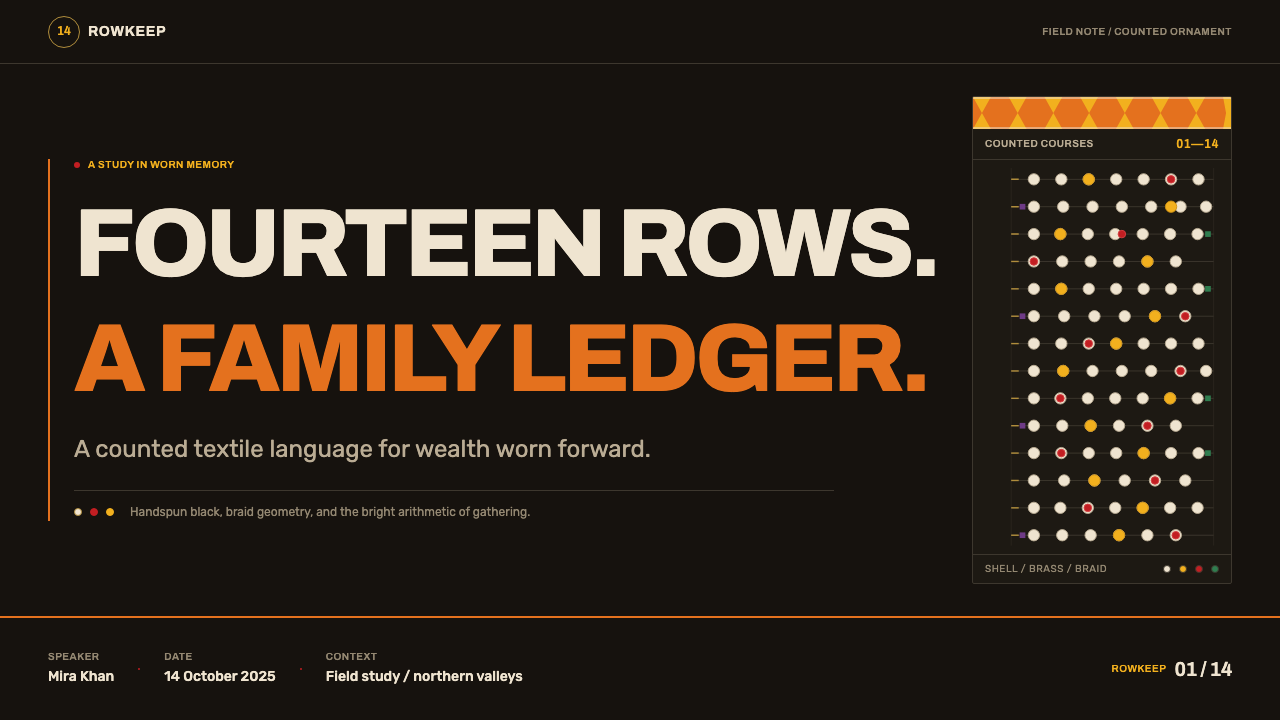
Small ivory discs, modelled on cowry shells, act as bullets, markers, rating dots and list counters. They are the style's smallest unit and its most recognisable one. Placed in neat rows they make an immediate visual rhythm, and they let a page show quantity without charts.
Horizontal Bands, Never Curves
Structure is built from horizontal strips of fixed height, stacked like the rows of cowries on the headdress. Zigzags and checks do the decorative work. Circles appear only as the ivory discs. Curved lines, soft blobs and wave motifs are out, because the underlying craft is counted thread, and thread counted on a grid does not curve.
Density as Value
Empty space is treated as an unfinished surface. Regions of a layout are filled, and the fill is orderly. This is the style's most radical rule and the one most often resisted, but it follows directly from the object: a headdress with sparse shells is a poor headdress. Density is how the system expresses abundance, effort and worth.
Stitched Borders
Borders and dividers are made as narrow zigzag and check bands, in the manner of the embroidered collar and cuff of the robe. A section does not end with a hairline; it ends with a row of stitches. This is a small decision with a large effect, because it makes every edge on the page feel handmade and counted.
Who shaped Kalash Kupas?
The source lists the women who make and wear the headdresses first among its key figures, and rightly: the kupas is their work and their dress. A girl receives her first at about five, a smaller shushut serves for daily wear, and the full headdress appears at festivals. For a designer, they are the reminder that the density on the page originates in real labour and real family wealth.
Named in the source material as one of the institutions associated with the documented record of the kupas. Museum collections like this one are the way the headdress became known to outside audiences from the late nineteenth century onward, preserving the objects and their descriptions even as the living tradition continued in the valleys.
A second institution named in the source as part of the documented record. Along with Oxford, it marks the Western-collecting history of the garment: how a headdress made for a festival in a Hindu Kush valley came to be catalogued, photographed and studied in distant cities, and why the style can describe its structure in such detail.
How do you use Kalash Kupas today?
Kalash Kupas is a dark, dense and highly ornamental style, and it rewards confidence. It suits subjects where richness, craft, heritage or abundance are the message: festivals and events, textiles and jewellery, culture and travel, archives and museum content, music, and premium products that want to feel handmade and significant rather than minimal. It is a poor match for anything that depends on calm and emptiness.
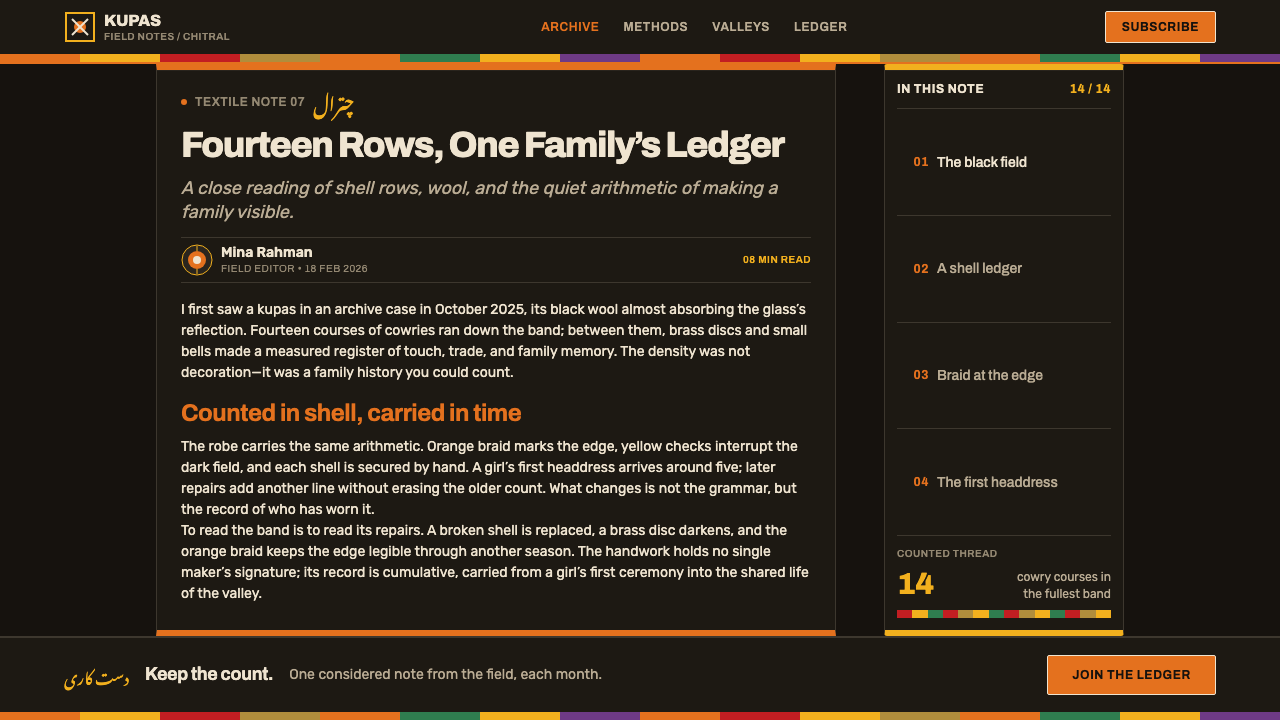
On slides, a cover can be a field of warm black with a stack of horizontal braid bands across the lower third and the title set in ivory above them. Content slides can use a narrow braid strip at the top and bottom, ivory disc bullets, and compact blocks of text arranged in rows. For data slides, resist the smooth line chart. The style favours countable marks: unit charts in which every dot or disc represents a fixed quantity, stacked bars cut into visible segments, and tables with banded rows. The audience should be able to count what they see.
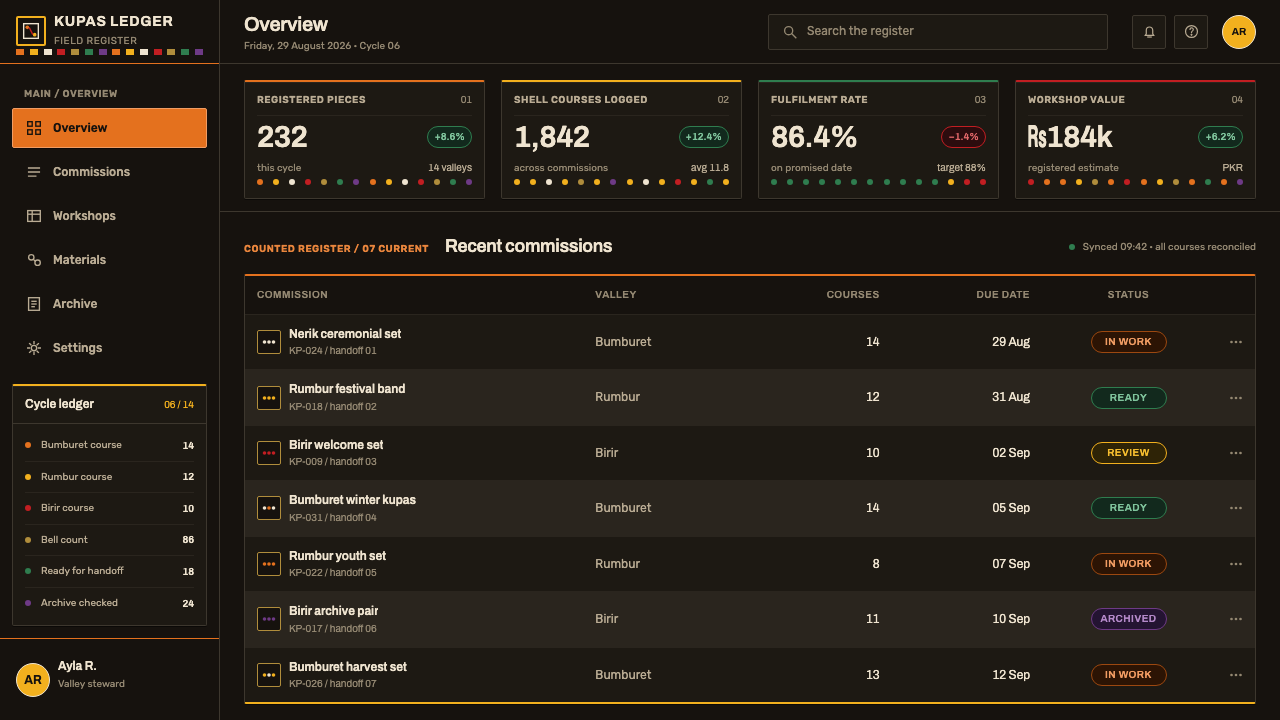
In web interfaces, the style suits marketplaces, galleries, catalogues and dashboards that carry a great deal of information. Tables become banded rows, tags become small discs, section headings are underlined with a stitched strip, and cards are packed tightly on the dark ground. Pricing pages can present each plan as a stacked band with its features counted off by ivory discs. Keep the information architecture strict even when the surface is rich: the more ornament there is, the more important it is that hierarchy stays obvious.
For editorial and marketing work, the style makes strong feature pages, event posters, collection pages and long-form pieces about craft. Use braid bands as section dividers, ivory discs as list markers, and keep photography warm and close-up: textile, metal, hands, shells. Because the ground is dark, text needs generous contrast, and long passages should be set in a plain, readable voice, leaving the ornament for the frame.
The most common mistake is to soften it. Adding generous whitespace, rounding every corner, or introducing gradient glows and curved ornament undermines the one rule the style cannot do without: marks are counted, not drawn. A second mistake is to use pure black, which turns the warm village ground cold and flat, or to flood the page with orange so that the ivory and yellow lose their counting function. And because the kupas is a garment in living use, avoid reducing it to a generic tribal decoration: borrow its logic, name its source, and treat it as a living tradition rather than a pattern pack.
Kalash Kupas — FAQ
What is a kupas?
A kupas is the festival headdress of Kalasha women in the Chitral valleys of Pakistan. It is a long black woollen band that hangs down the back, covered in rows of cowry shells, buttons, brass medallions and small bells, and topped with a feather and a wool pompom. Girls receive their first at about five, and a smaller version called a shushut is worn every day.
What do the rows of cowrie shells mean?
Cowries come from the coast and were carried up into the mountains by traders, so each row represents wealth in a form that could be counted and displayed. The source notes that the finest headdresses carry fourteen rows. The style translates that into layout: density is not clutter but a ledger, and every row must be countable.
Why does the style avoid whitespace and curves?
Both rules come from the garment. Counted-thread embroidery works on a grid, so its forms are stripes, zigzags and checks rather than curves. And because value on the headdress is expressed through the number of shells, a sparse surface would read as poverty rather than elegance. The style follows the object's logic even where that contradicts contemporary taste.
How is it different from generic tribal or ethnic pattern styles?
Generic pattern styles apply motifs as surface decoration. Kalash Kupas is built on one specific object and its construction rules: counted units, fixed-height bands, a warm black ground, a limited braid palette and shell-disc markers. Remove the shells and braids and the rules still produce a coherent layout, which is what makes it a system rather than a costume.
Can I use it for a modern product interface?
Yes, especially for data-rich or content-rich products such as marketplaces, archives, catalogues and analytics dashboards, where its banded rows and countable markers do real work. It is less suitable for minimal, task-focused tools, where the density would get in the way. Use the dark ground and the band logic, and keep the ornament in service of hierarchy.
Related design styles
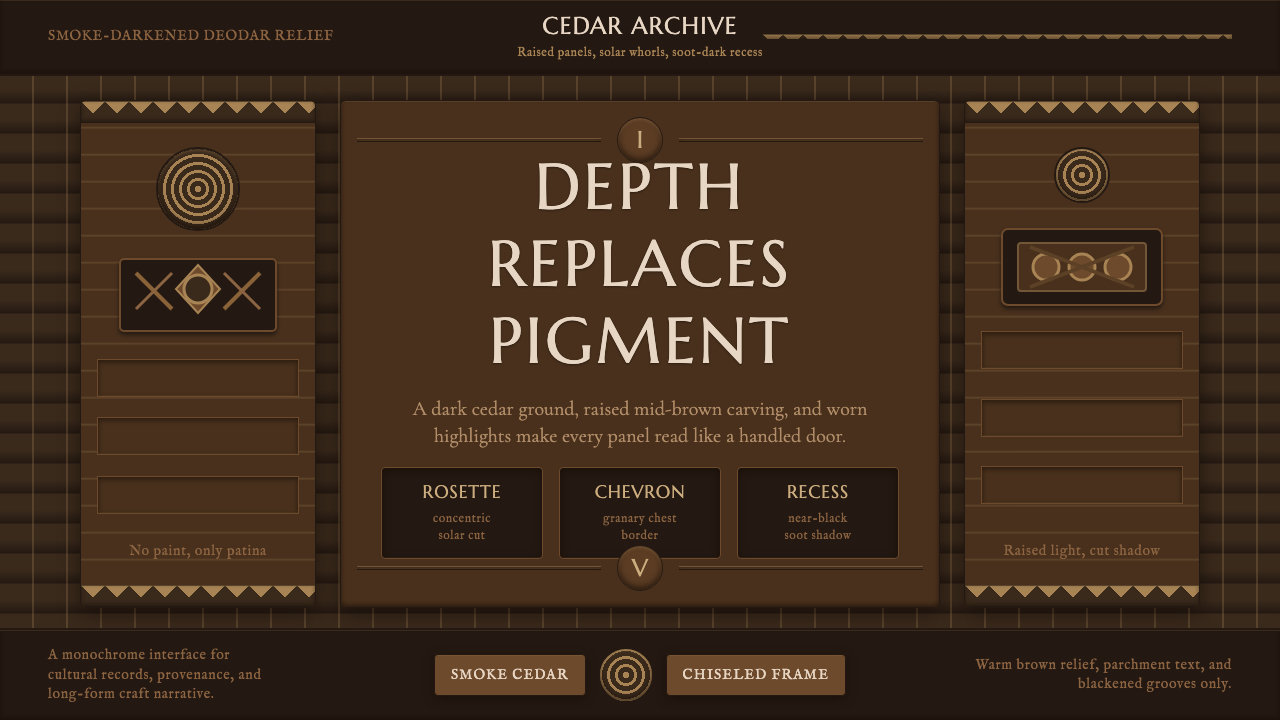 Nuristani Carved CedarDepth replaces pigment. Smoke cedar, chevrons, and rosettes carve light from…
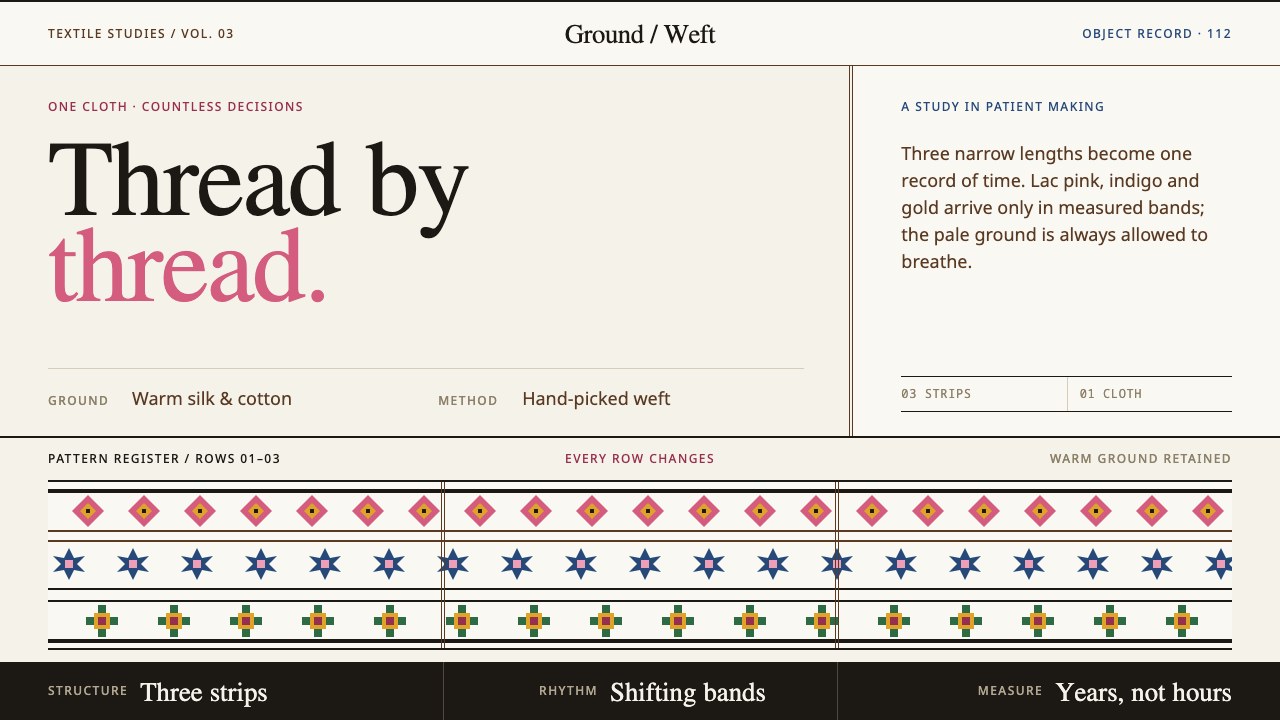 Bhutanese KushutharaPatience made visible. Lac pink and indigo bands shift across a warm silk gro…
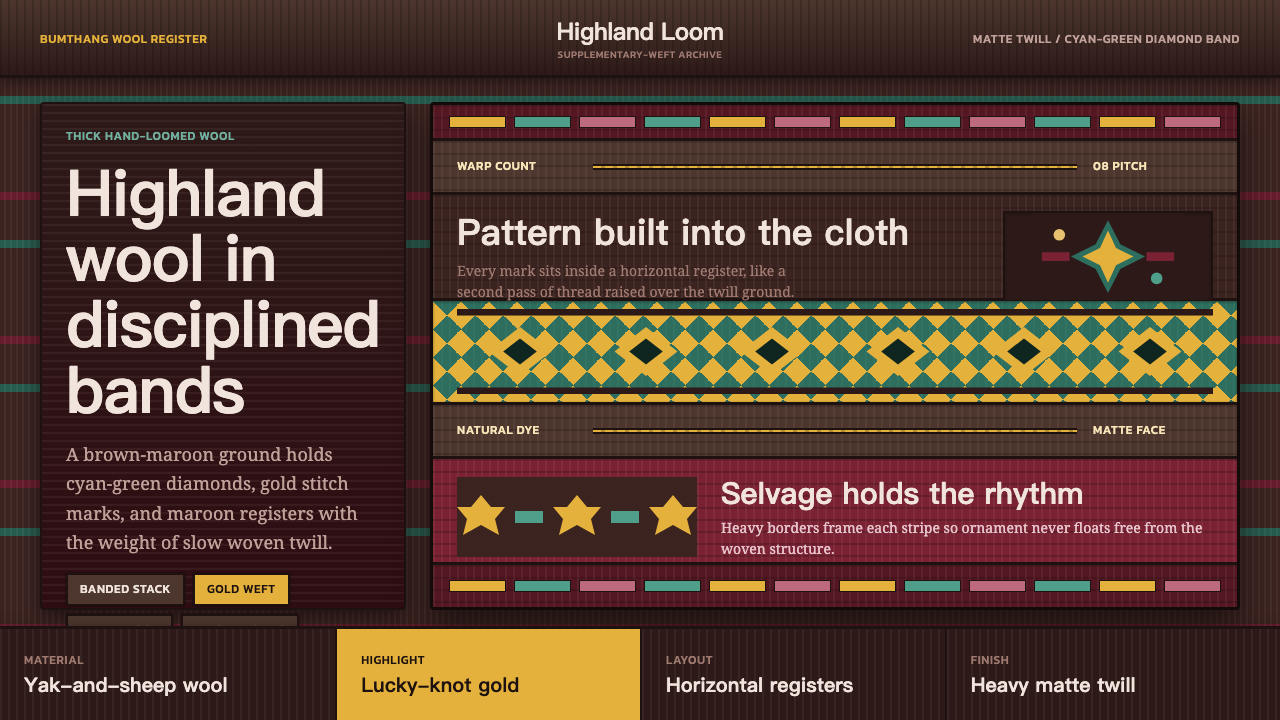 Bhutanese Yathra Wool WeaveHighland wool made digital. Brown-maroon bands carry cyan diamonds and spare…
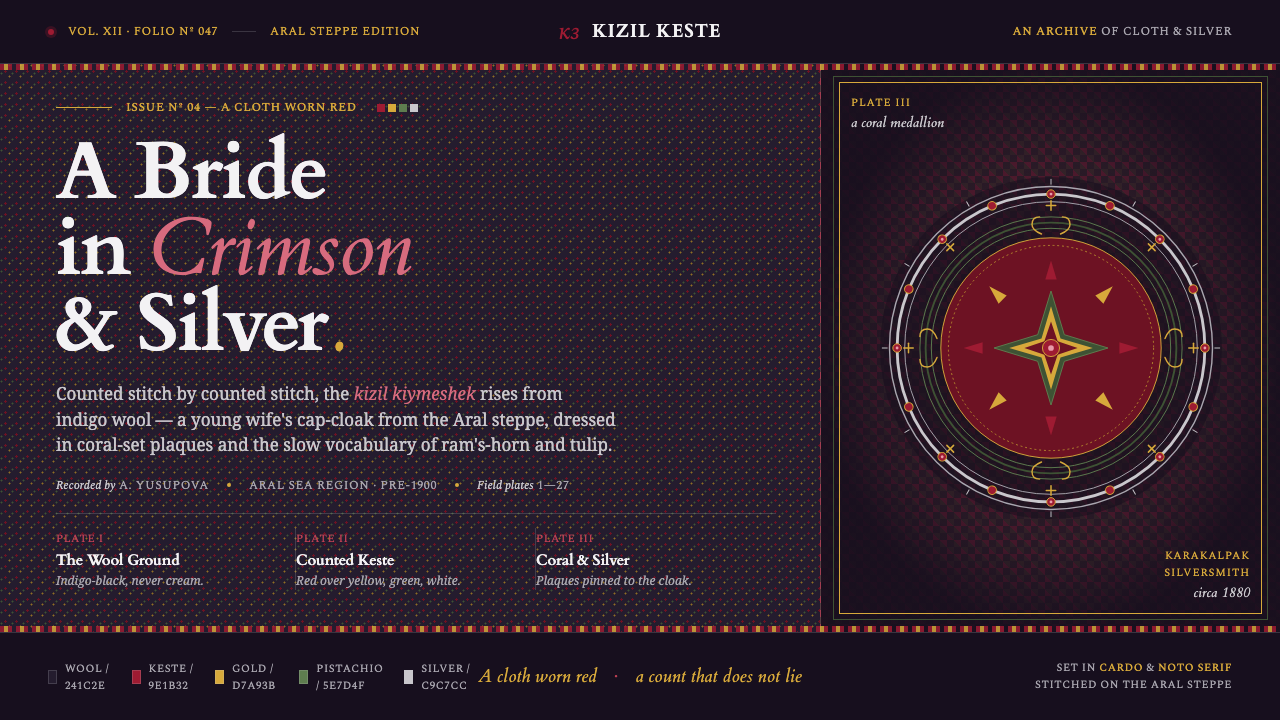 Karakalpak Kimeshek DressA cloth worn red. Crimson keste cross-stitch on indigo wool, set with silver-…
 Lahic CoppersmithCopper becomes light. Soot-black bands, Amiri type, hammer facets and tin rev…
 Sindh Ajrak Block PrintAncient cloth feels exact. Indigo fields, madder stars, and cream grids repea…