What is Bhutanese Kushuthara?
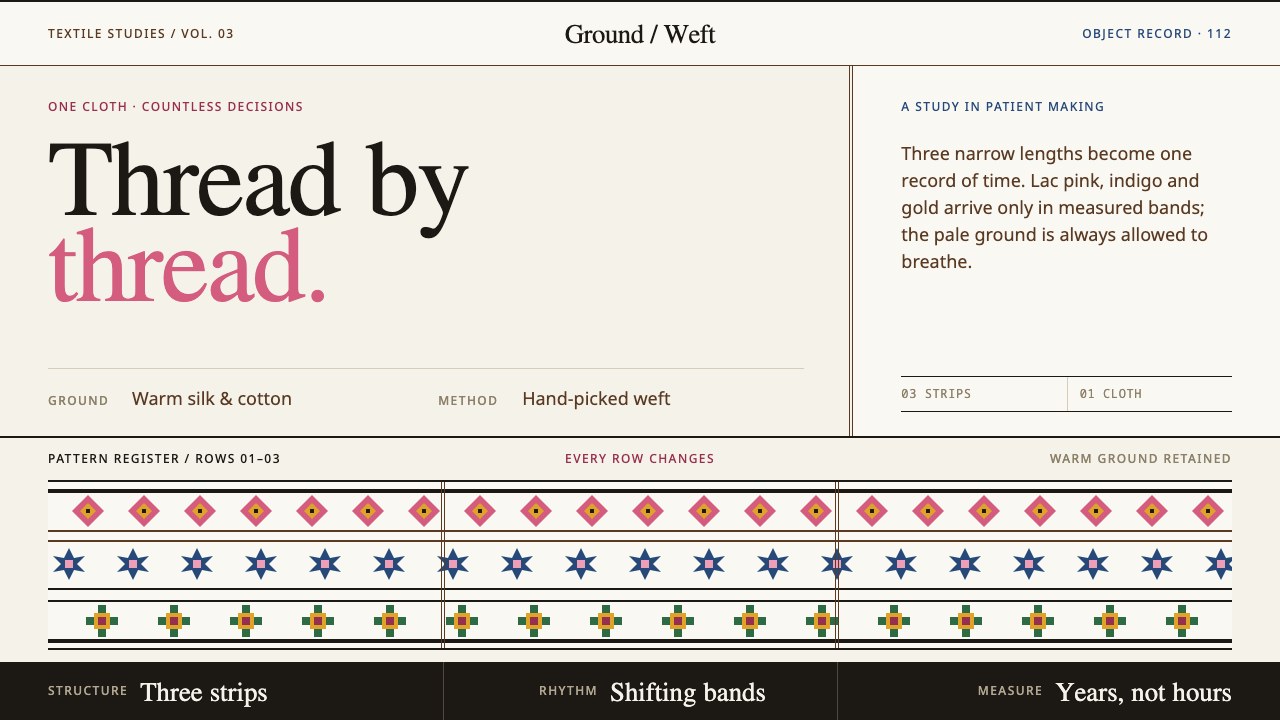
Kushuthara is cloth made so slowly that the pattern becomes a record of attention: pale silk left bare, colour laid in bands, every row picked out by hand.
Bhutanese Kushuthara in brief
Kushuthara is a way of weaving the kira, the floor-length wrapped dress worn by Bhutanese women, and it is the most demanding way of all. It comes from Khoma, in the Kurtoe region of north-eastern Bhutan, where weavers work on a backstrap loom (a loom held taut by the weaver's own body) and make the cloth as three narrow strips that are woven separately and then stitched into one wide panel. The patterns are not printed, embroidered or dyed onto finished cloth. They are picked out by hand, thread by thread, in discontinuous supplementary weft, a technique in which each coloured thread travels only across the small motif it belongs to. A single kira can take years.
As a visual style, kushuthara turns that labour into three recognisable habits. A pale silk ground stays visible across the whole piece and is never covered over. Colour arrives in horizontal bands, with lac pink and indigo as the pairing the system is built around, and each band is framed by dark stripe borders. And the pattern rows do not repeat mechanically: motif bands change as they climb, so the eye is rewarded for moving upward instead of recognising a tile.
What sets kushuthara apart from most ornamental traditions is that its surface is honest about being made. Because every motif is built row by row on a loom, structure shows up as seams, selvedges and stripe borders rather than as cast shadow or gradient, and the ground is neither perfectly filled nor perfectly even. Those irregularities are not flaws to be corrected; in hand-woven cloth they are the evidence of the hand. A design system that borrows from kushuthara therefore asks an interface to behave like cloth: calm, structured, patient and visibly constructed.
Where does Bhutanese Kushuthara come from?
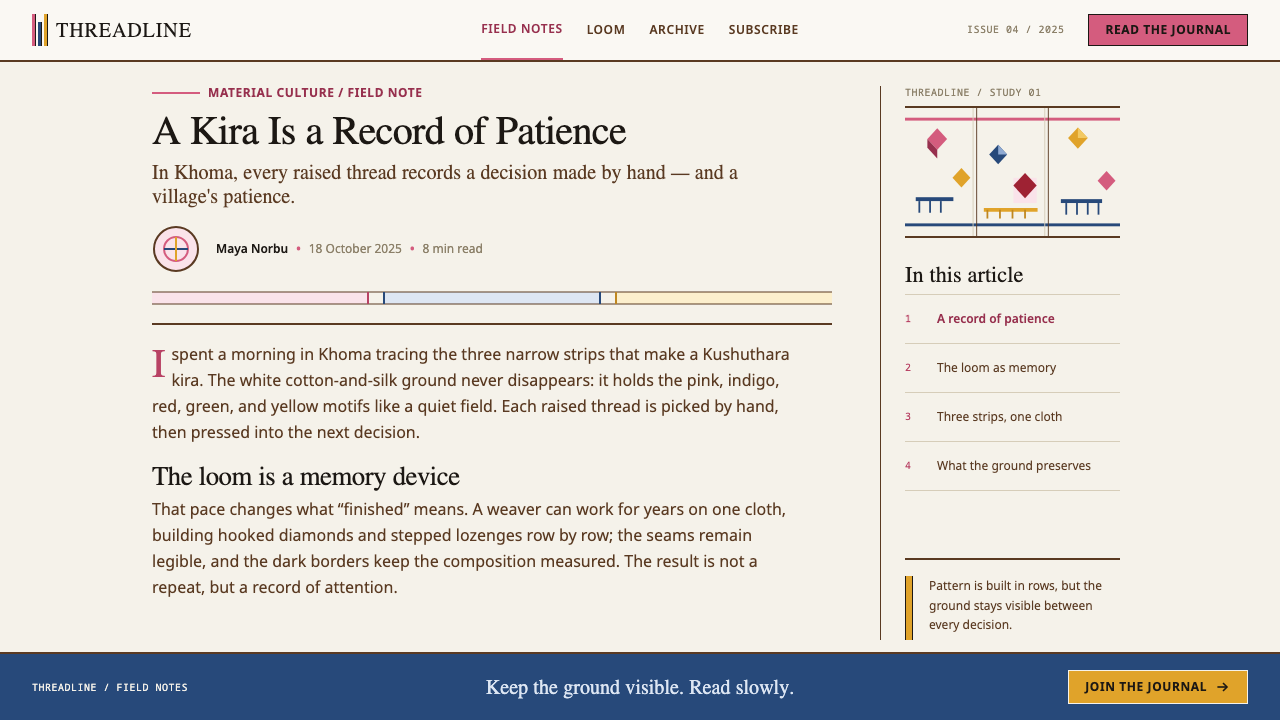
Kushuthara belongs to Khoma, a village in the Lhuentse district of north-eastern Bhutan, in the region known as Kurtoe. It is a living tradition rather than a revival: the women of Khoma are still the people who weave it, which is why the style has no neat founding date and points instead to a documented reference piece, a kira from Kurtoe in Lhuentse dated to the late 1970s and recorded as Powerhouse 11218. Anchoring the design system to one specific cloth keeps it honest. It borrows from something that exists, was made by identifiable methods in an identifiable place, and can be looked at closely.
The Bhutanese word for weaving is thagzo, and weaving sits within Zorig Chusum, the traditional framework of Bhutan's arts and crafts. Within that framework the kira is a particular object: a woman's wrapped, floor-length dress. Other ways of weaving a kira ask less of the maker; kushuthara asks for nearly everything. The cloth is made in three narrow strips on a backstrap loom, each strip woven separately and stitched to its neighbours, with the figured motifs added by hand as the weaving proceeds.
Technically the cloth belongs to the wider family listed in the style's references as Himalayan supplementary-weft brocade. A plain base weave supplies the ground, and extra coloured weft threads are inserted by hand to form the pattern. In the discontinuous version used here, each coloured thread is carried only across the motif it belongs to rather than running from one selvedge to the other. That is why the pattern can change so freely from row to row, since nothing running behind the cloth dictates a repeat, and it is also why the work is so slow. Every shift in a motif is a new decision with a new set of threads.
Institutions now help frame the tradition's visibility. The Royal Textile Academy of Bhutan appears in the style's reference list, as does Sangay Choden Wangchuck; together with the weavers of Khoma they stand for a culture that treats textiles as heritage to be documented, taught and worn, not merely produced. For a designer the lesson is that kushuthara is not a pattern pack. It is a way of making in which a ground, a band system and a pace of production together produce a look, and the design system keeps the cause along with the effect.
What defines the Bhutanese Kushuthara look?
The Bare Ground
The pale silk ground is the page. It is never flooded with colour, never covered by a full-bleed panel, and it shows between and around every motif. In weaving terms, the ground is the base cloth on which the supplementary weft sits; in design terms, it is the warm, undyed surface that makes each band read as something added rather than a change of background. Leaving it exposed is what keeps the style quiet, however much colour sits on top.
Colour in Bands
Colour arrives as horizontal bands, not as scattered accents or filled blocks. Lac pink and indigo carry the palette against the pale ground, and each band is closed off by dark stripe borders on either side. The dark stripes work like the lines of a ruled page: they contain the colour and stop neighbouring bands from bleeding into each other, so a page can hold a great deal of pattern without ever looking messy.
Structure by Seam
The cloth is woven in three narrow strips and stitched together, so division in this style comes from seams and selvedges, not from shadow. A divider is a stripe or a stitched line; an edge is a selvedge. Nothing floats above the surface casting a shadow, and nothing is lit from an imagined direction. Depth is as literal as cloth is literal: there is one layer, and the thread either crosses a given spot or it does not.
Rows That Climb
Motif rows change as they move up the cloth. Where most pattern traditions tile one unit across a field, kushuthara treats each band as its own small composition, so a long page reads like a ladder of decisions instead of wallpaper. The rows share a palette and a rhythm, which holds the whole together, but no two neighbouring bands announce themselves in quite the same way.
Picked, Not Printed
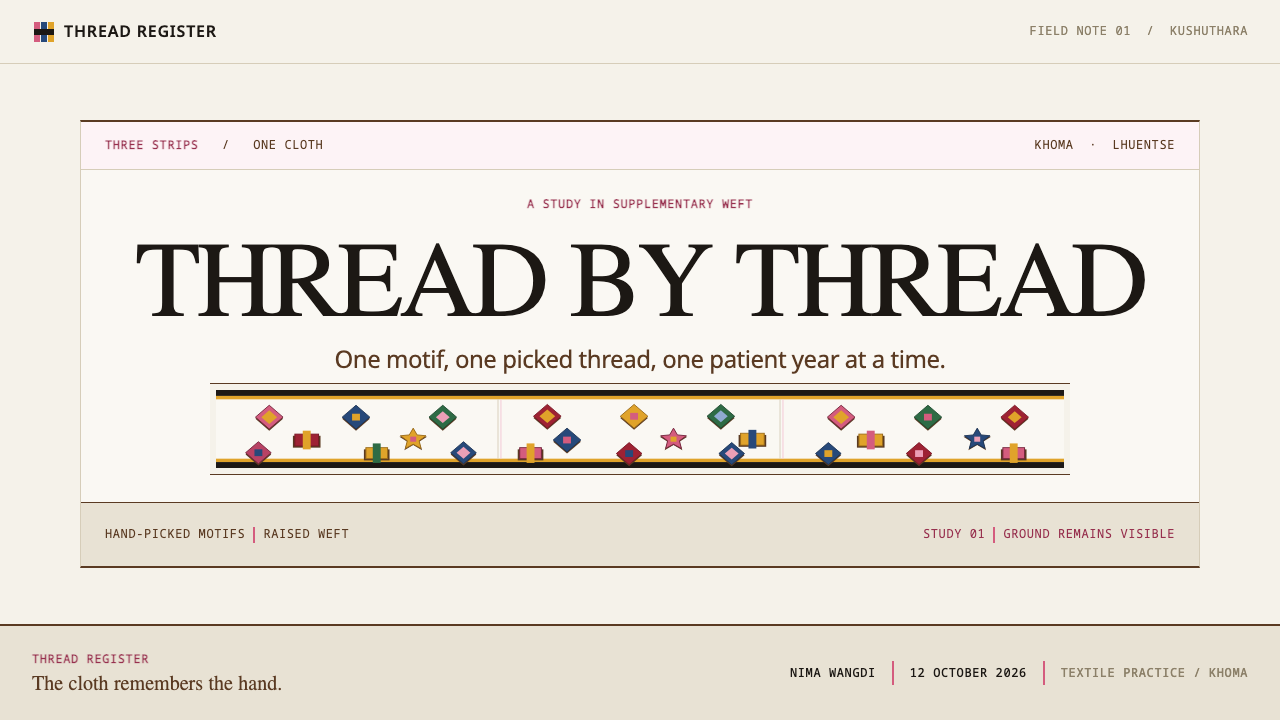
Discontinuous supplementary weft means each motif is built from short passes of colour that stop where the motif stops. The edges therefore look constructed rather than drawn, as though assembled from a grid of threads. The visual vocabulary is one of small, stepped, diagram-like units, and anything that tries to look airbrushed, feathered or smoothly rendered would contradict how the cloth was actually made.
Evidence of the Hand
The ground is not entirely filled and the white space is not perfectly even. That unevenness is the source of the style's warmth: it tells the viewer a person made this, slowly, row by row. A layout that is mathematically too regular loses the very quality that makes kushuthara trustworthy. Slight variations in spacing and rhythm read as handwork, where in other styles they would read as errors.
Who shaped Bhutanese Kushuthara?
The weavers of Khoma are the tradition itself. They work on backstrap looms, weave the three strips separately, pick every motif by hand and carry the technique forward as living practice rather than revival. The style's exposed ground, banded colour and changing rows are not design decisions so much as consequences of how they work, and when the style is applied, the credit belongs with them.
Named in the style's reference list as an institution of Bhutan's textile heritage, an organisation whose very name places cloth at the centre of national culture. Its presence signals that kushuthara is treated as heritage worth documenting and teaching as well as wearing, which is the attitude a design system borrowing from it should share.
Listed among the key figures of the tradition's reference material. The detail that matters for design is what such a name stands for: the attention of cultural institutions and patrons that keeps a slow, labour-heavy craft visible in a world of fast production. The style is built on the same premise that slowness is a value worth showing.
The documented reference kira for the system, a piece from Kurtoe in Lhuentse dated to the late 1970s and recorded as Powerhouse 11218. It matters as an anchor: the style is drawn from a real, catalogued cloth made by named methods in a named place, rather than from a generic idea of Himalayan pattern.
How do you use Bhutanese Kushuthara today?
Kushuthara suits work that wants to feel made rather than manufactured. It rewards a designer who understands what the cloth is doing (letting the ground breathe, setting colour in disciplined bands, showing structure through seams) more than one who simply scatters a pink and indigo palette across a layout.
On a presentation cover, let the pale ground fill most of the frame and run a single band of colour, framed by dark stripes, across the upper or lower part of the page; the title sits on the bare ground, never on the colour. Content slides work as stacked bands: each section or step takes one horizontal band with its own small change of pattern, and the stripes between them replace rules and boxes. For data slides, treat the chart itself as a band. Bars and segments take the lac pink and indigo, labels stay on the pale ground, and the frame is a stripe border, not a drop shadow.
In interfaces, kushuthara fits calm, content-forward products: portfolios, documentation, craft and heritage commerce, journaling and reading tools. Keep the page background pale and undyed in feeling, use horizontal colour bands for section headers, banners and pricing tiers, and mark boundaries with stripes and thin stitched-looking lines rather than elevation. Cards need no shadows; a card is simply a region of ground with a dark stripe along its edges. Let list rows and feature rows vary slightly as the page scrolls so that the layout never turns into a repeated template.
For editorial and marketing pages, the style gives a long page a natural vertical rhythm. Section breaks can be a coloured band with a dark stripe frame; pull quotes sit on bare ground with generous margin; photography works best when it feels like another woven strip, cropped narrow and set against the pale field. Copy about making, time, labour and provenance suits the style well, because the visual language is itself an argument for patience.
The most common mistake is to treat pink and indigo as a gradient pair or to fill the whole background with colour, which erases the exposed ground the style depends on. The second is to tile one motif row down the page like wallpaper; the point of the style is that rows change as they climb. A third is to add soft shadows to cards for the sake of depth. In cloth there is no light source, only seams.
Bhutanese Kushuthara — FAQ
What is a kira, and what makes kushuthara different from other kinds?
A kira is the floor-length wrapped dress worn by Bhutanese women. Kushuthara is the most demanding way of weaving one: three narrow strips are woven separately on a backstrap loom and stitched into one cloth, and every motif is picked by hand in discontinuous supplementary weft. That hand-picking is what allows the pattern to change freely from row to row, and what makes a single piece take years.
Why does the style leave so much of the background plain?
Because in the cloth the pale ground is the base weave, and the coloured motifs sit on top of it without covering it. If the ground is flooded with colour, every band stops reading as an addition and the whole logic of the style collapses. Keeping the ground visible is what gives the page its calm and lets the bands of lac pink and indigo carry real weight.
Can kushuthara work on a dark background?
It is built on a pale, undyed ground, and the dark stripe borders that frame each band only work as frames when they sit against that light surface. Inverting the whole page to dark removes the contrast that makes the stripes read as borders and turns the colour bands into glowing blocks, which is closer to a different tradition altogether. If a dark surface is unavoidable, keep a pale panel as the working ground and use the dark only for stripes and chrome.
How is this different from a generic ethnic or tribal pattern look?
A generic pattern look is usually a tile: one motif repeated across a field, in a loud palette, with no particular origin. Kushuthara is tied to one cloth in one place and keeps the logic of its making: bare ground, colour in framed bands, structure shown by seams, and rows that change as they climb. Remove those rules and what remains is just a pink and indigo wallpaper.
Does the style use shadows, gradients or glossy effects?
No. Cloth has no light source, and the style takes that literally. Separation comes from seams, selvedges and stripe borders; colour changes at the edge of a band rather than blending; and surfaces stay matte and single-layered. A soft shadow or a gradient fill would introduce a lit, three-dimensional logic that nothing in a woven strip can justify.
Related design styles
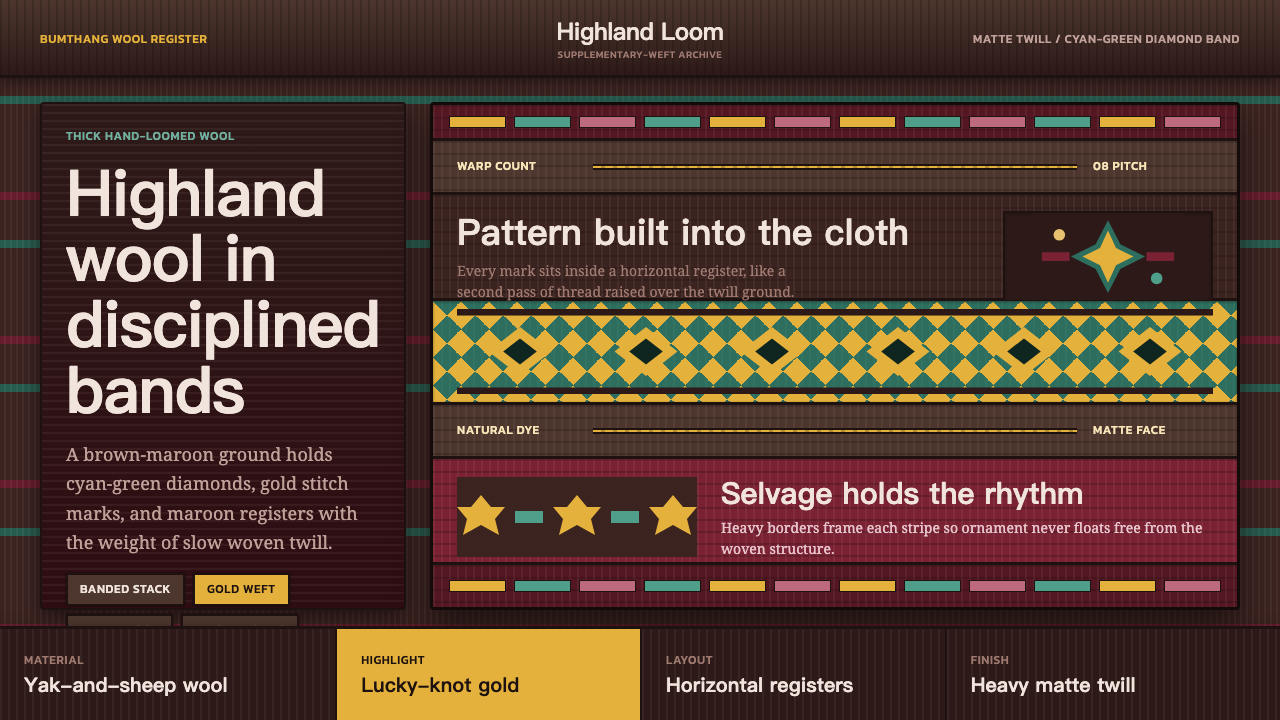 Bhutanese Yathra Wool WeaveHighland wool made digital. Brown-maroon bands carry cyan diamonds and spare…
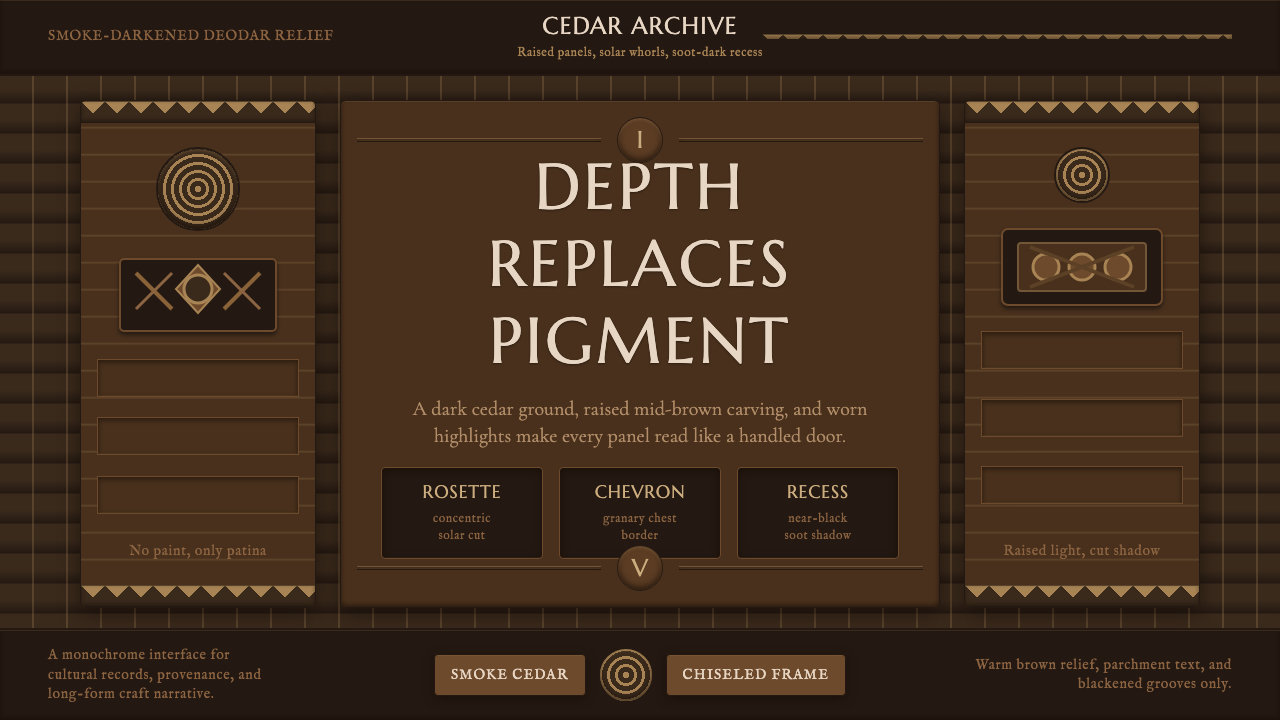 Nuristani Carved CedarDepth replaces pigment. Smoke cedar, chevrons, and rosettes carve light from…
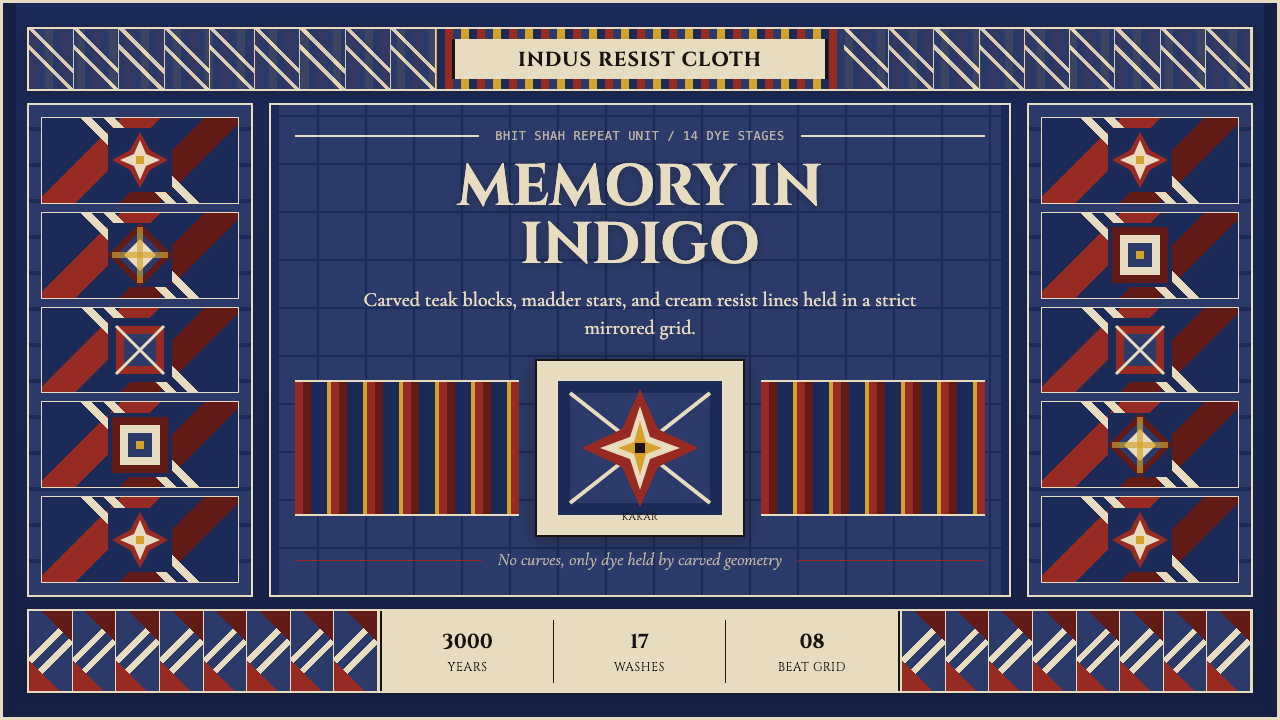 Sindh Ajrak Block PrintAncient cloth feels exact. Indigo fields, madder stars, and cream grids repea…
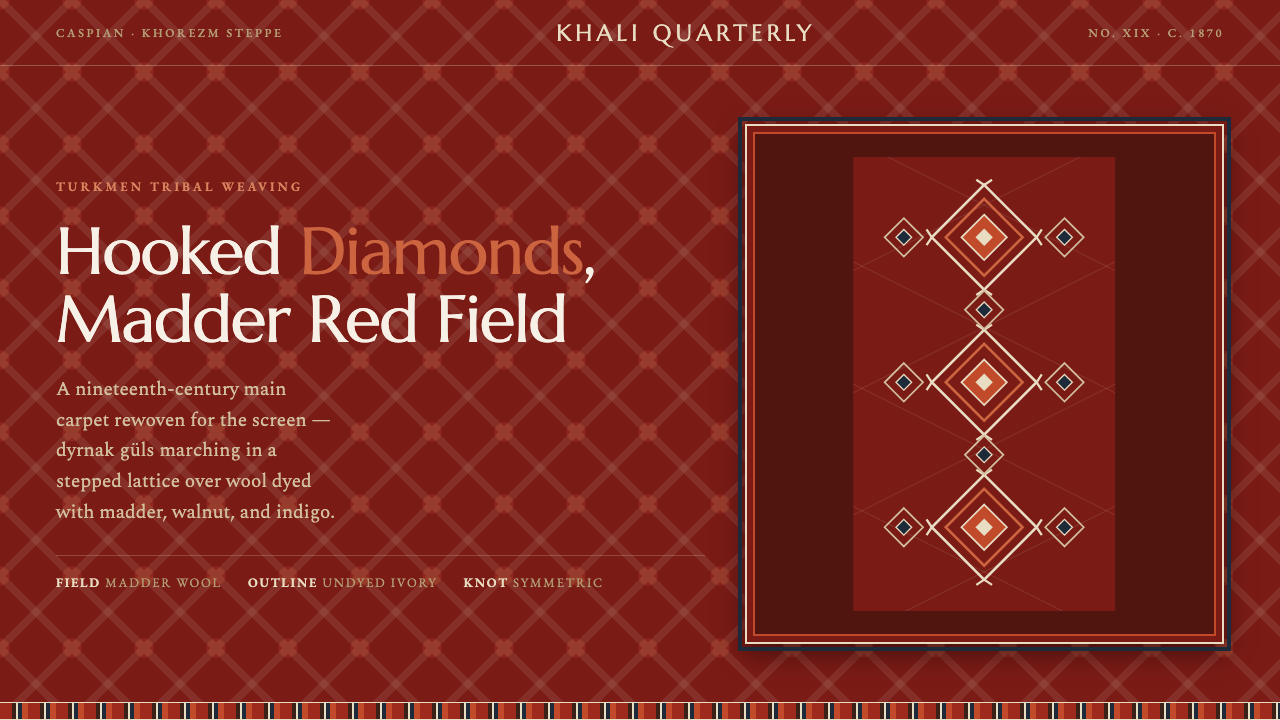 Yomut Gül CarpetHand-knotted authority on screen. Hooked dyrnak diamonds lattice a madder-red…
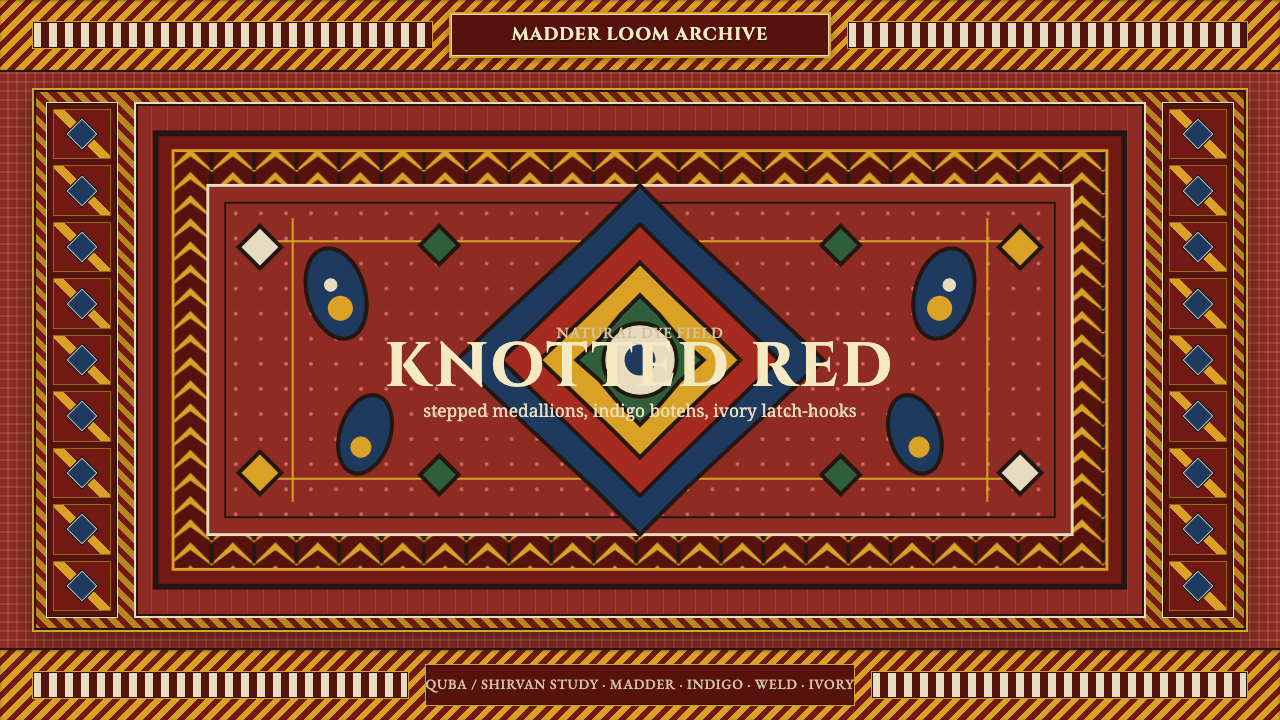 Azerbaijani Quba CarpetRed is the field. Indigo botehs and ivory latch-hooks orbit a stepped medalli…
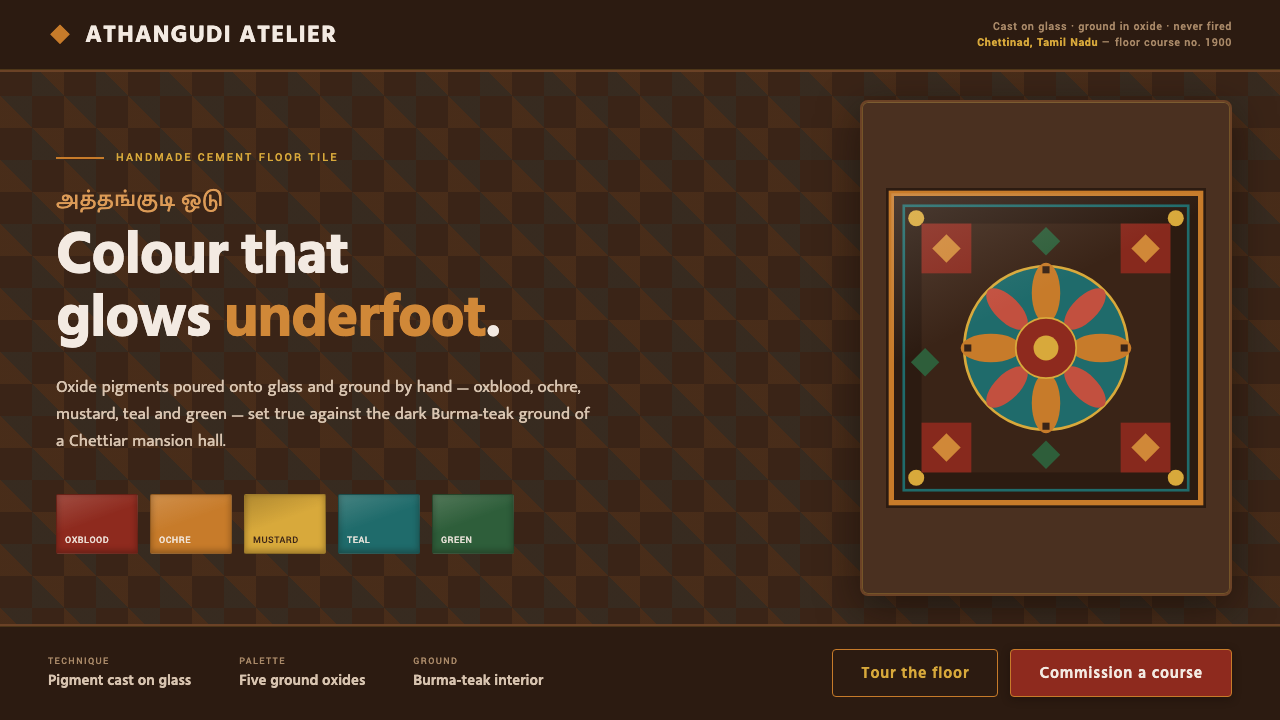 Chettinad Athangudi TilesColour that glows underfoot. Five ground-oxide tones on dark teak in bordered…