What is Sambalpuri Bandha?
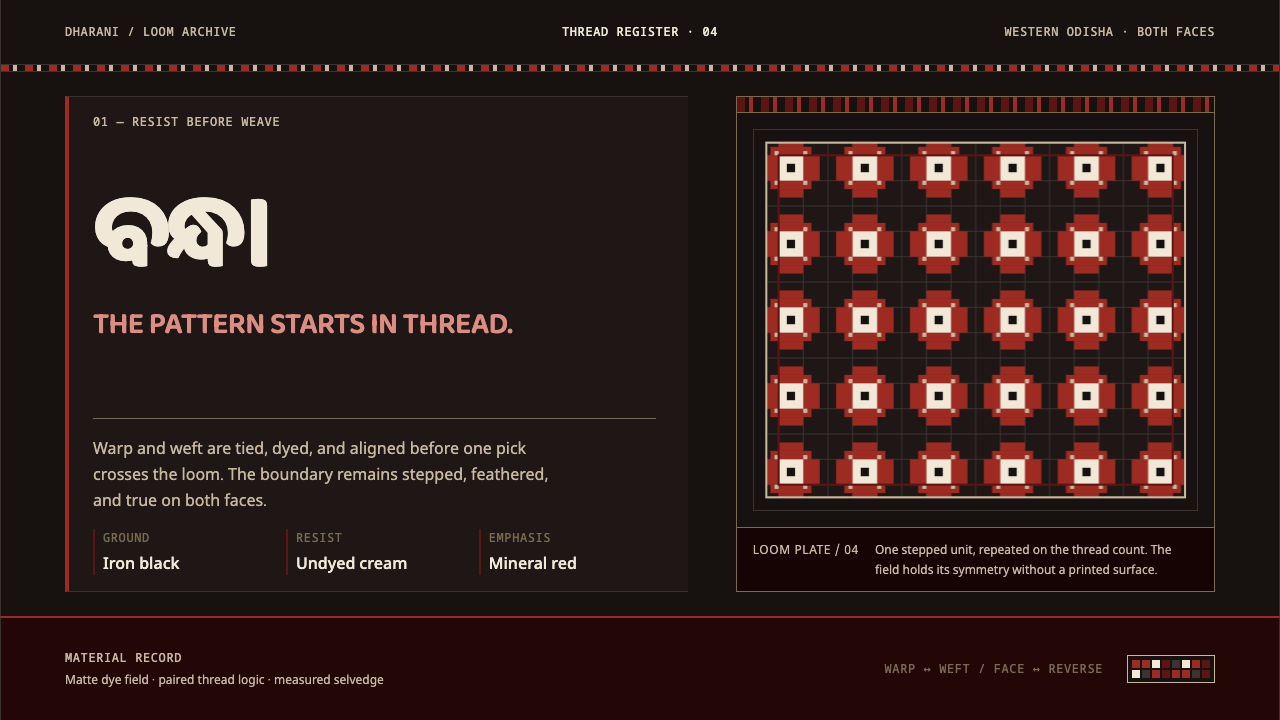
Sambalpuri bandha ties its pattern into the thread before the cloth exists, so every motif arrives from the loom feathered at the edges and identical on both faces.
Sambalpuri Bandha in brief
Sambalpuri bandha is a double-ikat textile from western Odisha, in eastern India. In double ikat the pattern is made by tying and dyeing sections of both the warp and the weft threads before weaving begins. The weaver then has to line the dyed segments up on the loom so that the motif emerges as the cloth grows. Nothing is printed onto the finished surface, and because the colour lives in the thread itself, the design reads the same on both faces of the cloth.
The palette is not a matter of taste but of tradition. Red, black and white are the face-colours of Lord Kaalia, the form of Jagannatha worshipped at Puri, and a black or deep-maroon body carrying white conch, wheel and flower motifs against a contrasting border is everyday production rather than a stylistic experiment. The cloth belongs to Jagannatha iconography as much as it belongs to the world of the Indian handloom.
Visually the style is matte and built on a grid. Colour sits in the yarn as a dyed ground, not as a coating. Motifs are assembled from stepped units that follow the loom, and layouts mirror themselves across an axis. Because dye creeps a little beyond where it was tied, every outline is soft at the edge and stepped in profile, never a clean vector curve. Curio's Sambalpuri Bandha system keeps that discipline: a dyed ground, a loom-grid skeleton, mirrored layouts and stair-stepped, feathered shapes.

Where does Sambalpuri Bandha come from?
The craft belongs to western Odisha, on India's eastern coast, in the area around Sambalpur, Bargarh, Balangir, Boudh and Sonepur. The tradition predates 1900 and has stayed in continuous production into the present day rather than being revived after a gap. Its standing as a regional product was formalised in 2007, when it received a Geographical Indication tag, the legal designation that ties the name of a craft to its place of origin.
Many weaving families are involved, but the Bhulia weaver communities of western Odisha are the people most closely linked with bandha. Production has been household-based and handloom-based, and the word bandha points to the heart of the technique: it refers to tying. Bundles of yarn are bound at precise points so that dye cannot reach those parts, and the pattern is recorded in the resist before a single thread is woven. This is why the craft is also spoken of as bandha kala, the art of the tie.
Iconography connects the cloth to the Jagannatha temple tradition at Puri. The palette is described as doctrinal because red, black and white are the face-colours of Lord Kaalia, and the standard motifs of shankha (the conch), chakra (the wheel) and phula (the flower) come from the same devotional world. This is a textile whose colours and symbols carried meaning long before any designer considered them, and it deserves to be approached with that in mind.
Three weavers with the Meher name appear among the figures associated with the tradition: Radhashyam Meher, Kunja Bihari Meher and Chaturbhuj Meher. Their names attach to the modern reputation of the craft. Alongside them stands the broader frame of Indian handloom traditions protected through Geographical Indication status, which treats a technique as a living inheritance with a specific home and specific makers, not as a free pattern pack.
What defines the Sambalpuri Bandha look?
Double-Ikat Logic
Both warp and weft carry the pattern. Because each set of threads is tied and dyed separately and must be registered on the loom, the motif can never be perfect; it shows tiny shifts where threads meet. Those small irregularities are the proof of how the cloth was made, and a design that tried to look machine-clean would deny the technique.
Feathered Edges
When dyed thread is woven, the boundary between two colours is a blur of fibres rather than a line. The edges of motifs show a soft step, as if a fringe of dye had crept past the tie. This is the most recognisable visual signature of the style, and it should survive into digital work as stepped or slightly broken outlines.
Red, Black and White
The palette is doctrinal: the three face-colours of Lord Kaalia. A black or deep-maroon body is the usual ground, white carries the motifs, and a contrasting border frames the whole. Red works as a body colour, a border colour or a detail colour, but the trio is the rule. Stray hues dilute the iconographic logic that gives the colours their meaning.
Symbolic Motifs
Shankha, chakra and phula, the conch, the wheel and the flower, are the staple motifs. Each is built from small stepped units that follow the loom's grid, so even a flower becomes a faceted, geometric figure. They are arranged with intent, repeating in rows or gathering at the border, rather than scattered at random.
Mirrored Layouts
Layouts reflect across an axis, with the body of the cloth echoing itself from one half to the other and the border wrapping the symmetry. The effect is calm, ceremonial and orderly, which suits designs that need a sense of formality and ritual.
A Matte Dyed Ground
The cloth carries no gloss. Colour sits in the yarn, so the surface is flat and absorbent and light rests on it rather than gleaming off it. In digital terms that means solid colour grounds, with no sheens, no glassy highlights and no soft glows.
Loom-Grid Structure
The skeleton of the pattern is the weave itself, rows and columns of thread. Any curve has to be approximated by steps, so shapes are built from small units. That gives the style a pixel-like quality that predates screens, and it sits comfortably in interfaces that already celebrate the grid.

Who shaped Sambalpuri Bandha?
The collective makers of bandha. Their knowledge of tying, dyeing and registering threads is the real substance of the craft, held in practice rather than in a text. Treating them as the authors of the style, instead of treating the style as a free-floating aesthetic, is the starting point for any respectful use of it.
Three weavers of the Meher name who appear among the key figures of the tradition. Their names are attached to the modern reputation of Sambalpuri bandha, a reminder that behind a regional craft stand named masters as well as anonymous communities.
Not a maker but the iconographic source of the palette. Red, black and white are the face-colours of Lord Kaalia, and the conch, wheel and flower motifs belong to the same devotional world. The deity is the reason the colours are doctrinal rather than decorative.
How do you use Sambalpuri Bandha today?
Sambalpuri Bandha is a dark, matte, symmetrical style, so it excels where ceremony, craft and trust are the values being communicated. It asks for a dyed ground, a restricted palette, mirrored composition and motifs built from steps rather than curves.
For presentation slides, a cover can mirror itself around a central title, with a black or deep-maroon ground, a border in a contrasting band, and one white motif such as a wheel or flower built from stepped units, repeated symmetrically. Content slides work best with the same ground and a thin bordered frame, with text in white and a single red accent reserved for headings or key figures. Data slides suit bar charts with blocky, stepped ends and symmetrical arrangements, where each bar is a flat colour with no gloss.
Interfaces benefit from a calm, high-contrast dark theme. Cards sit flat on the dyed ground with square or lightly stepped corners, navigation is typographic, and borders appear as contrasting bands that frame hero sections and pricing tiers. Buttons are matte fills in red or white, with no gradients and no glowing shadows. A pricing page can mirror its tiers around a central featured plan.
In editorial and marketing work, the style suits heritage, craft, culture, travel and gift commerce. Use the border band as a recurring frame for images and pull quotes, place motifs at the head and foot of sections in mirrored pairs, and let photography of cloth, thread or hands carry the warmth. Copy that names its sources and makers fits the spirit of the style better than generic luxury language.
The most frequent mistake is rendering the look with perfect vector curves and smooth gradients, which erases the dyed-thread character. A second is borrowing the red, black and white palette without the structure: random placement of motifs, lopsided layouts and glossy effects turn it into costume. The third is treating the temple-linked symbols as pure decoration. Shankha, chakra and phula have devotional meaning, so use them in a deliberate context, or build motifs of your own from the same stepped logic.

Sambalpuri Bandha — FAQ
What does double ikat mean?
Ikat is a technique in which threads are tied and dyed in sections before weaving, so the pattern is carried by the yarn rather than added to the finished cloth. In double ikat both the warp and the weft are treated this way, and the weaver must align them on the loom so that the two halves of the motif meet. The payoff is a design that is woven in and reads the same on both faces.
Is bandha the same as batik or tie-dye?
No. Batik uses wax to resist dye on finished cloth, and ordinary tie-dye is applied to cloth that already exists. Bandha ties and dyes the threads before weaving, so the pattern is part of the structure of the fabric. It is not printed and it is not a wax resist. That is why its outlines feather and step in a particular way.
Why are red, black and white so central?
Because they are the face-colours of Lord Kaalia at Puri, the form of Jagannatha. A black or deep-maroon body carrying white motifs against a contrasting border is a standard production pattern, not a stylistic choice. The colours carry devotional meaning, which is why the system treats them as a discipline to keep rather than a palette to tweak.
Can I use smooth curves, gradients and gloss?
They work against the style. The cloth is matte because colour sits in the yarn, and its shapes are stepped because they follow the loom grid. Smooth curves, glossy highlights and gradient fills belong to a different visual world, and adding them turns a bandha-inspired design into a generic dark theme with a few motifs on it.
Where does the craft come from, and is it protected?
It comes from western Odisha, in the area around Sambalpur, Bargarh, Balangir, Boudh and Sonepur, and has been in continuous production from before 1900 to the present. It received a Geographical Indication tag in 2007, which ties the craft's name to its region. For designers, the practical point is to credit the tradition and its makers when drawing on it.
Related design styles
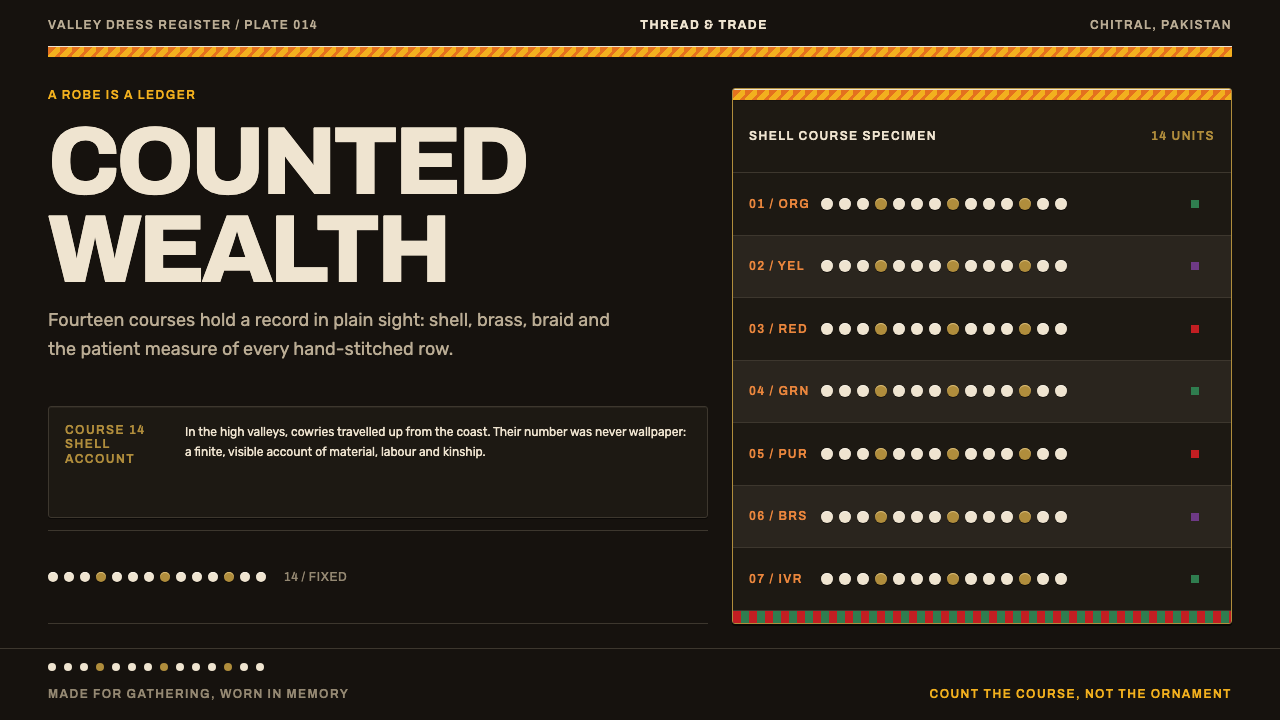 Kalash KupasDensity carries value. Ivory shell courses and orange braid are counted on wa…
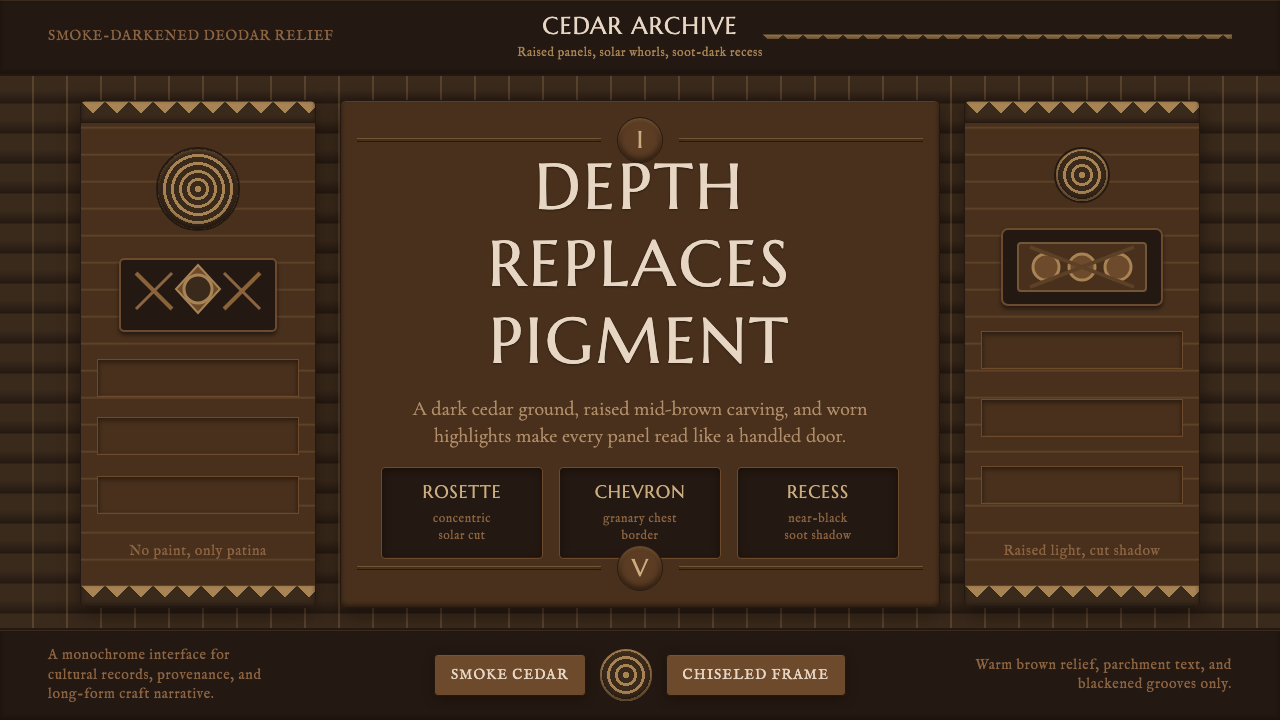 Nuristani Carved CedarDepth replaces pigment. Smoke cedar, chevrons, and rosettes carve light from…
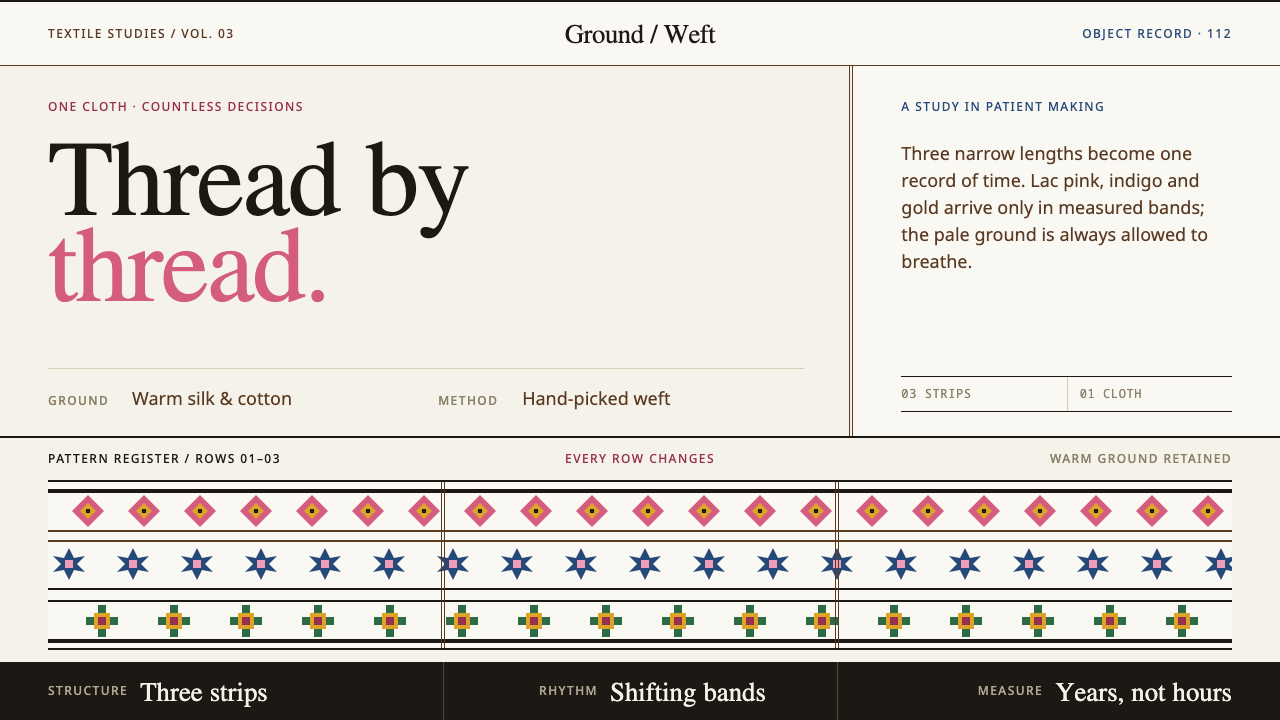 Bhutanese KushutharaPatience made visible. Lac pink and indigo bands shift across a warm silk gro…
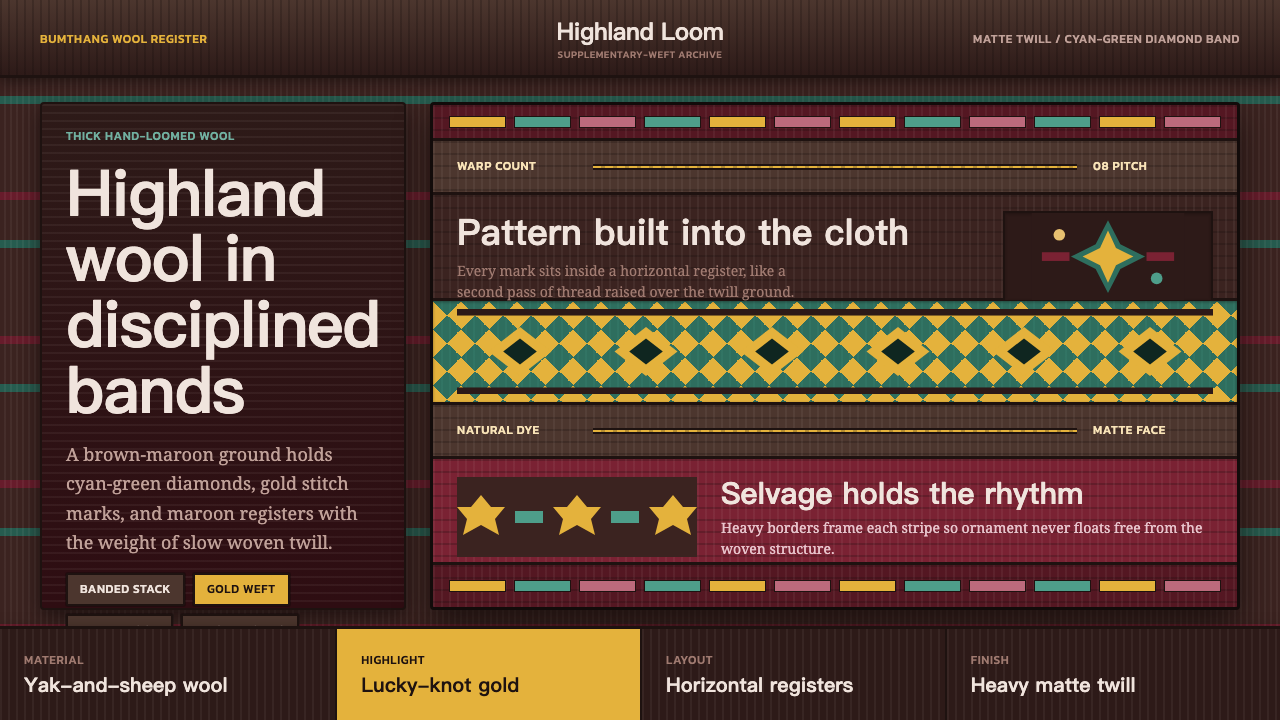 Bhutanese Yathra Wool WeaveHighland wool made digital. Brown-maroon bands carry cyan diamonds and spare…
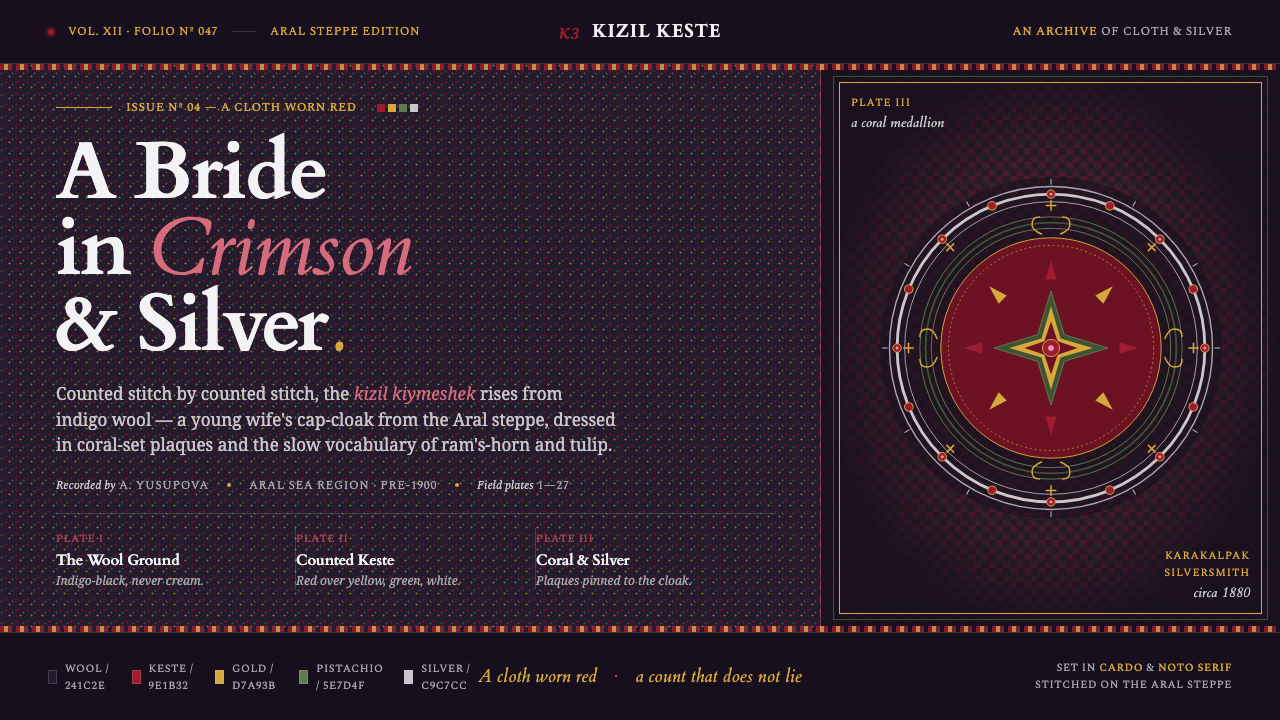 Karakalpak Kimeshek DressA cloth worn red. Crimson keste cross-stitch on indigo wool, set with silver-…
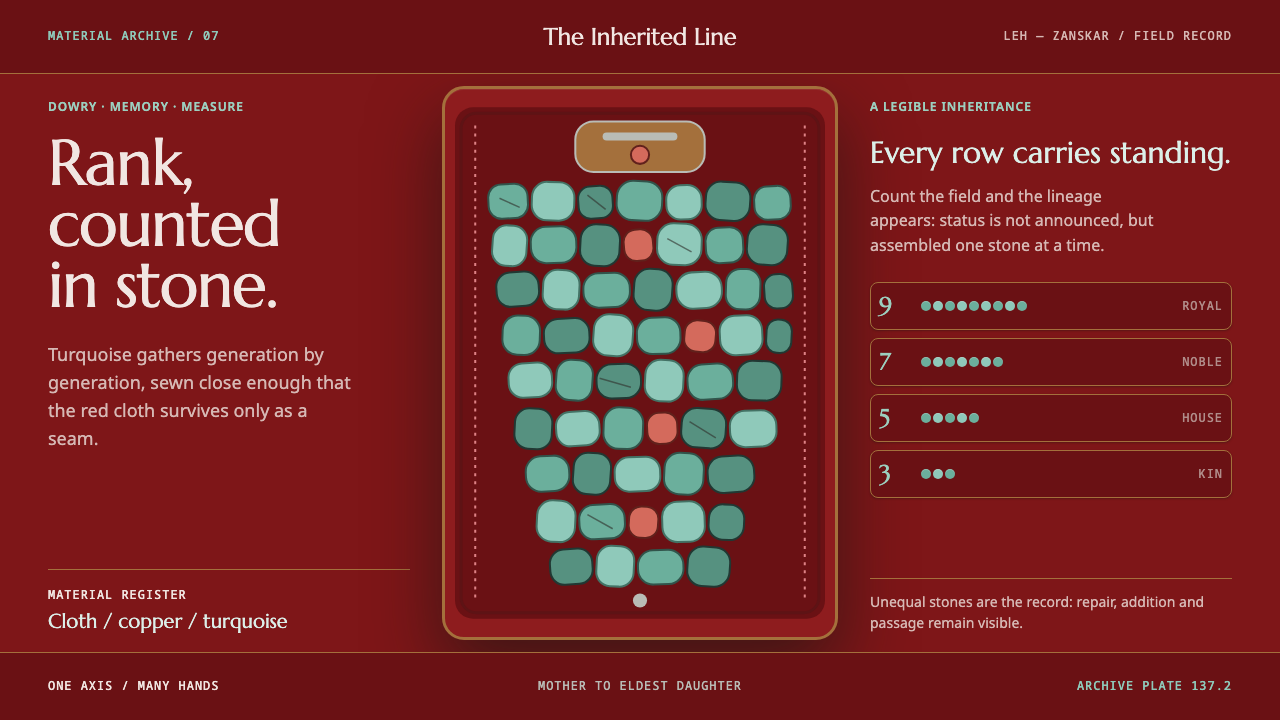 Ladakhi PerakInheritance made legible. Uneven turquoise crowds a single spine of antique r…