What is Ladakhi Perak?
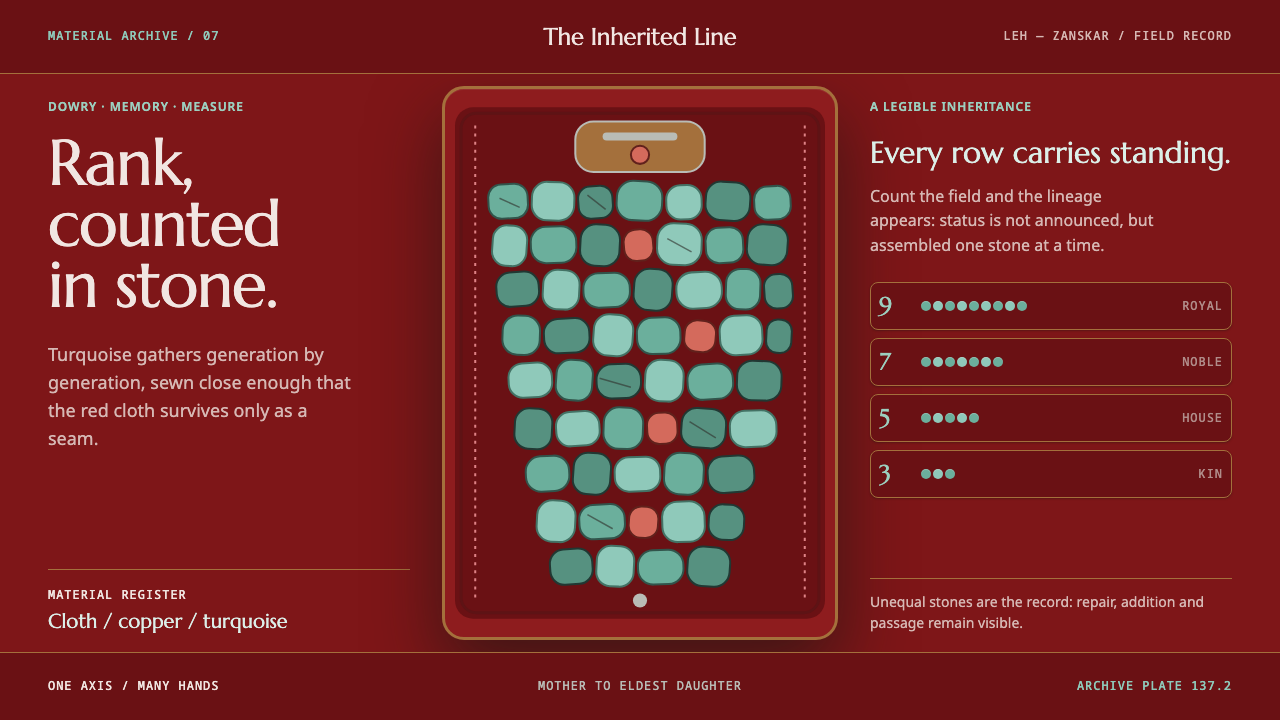
The Ladakhi perak is a wearable ledger: one spine of antique red cloth carrying row after row of turquoise, where the number of rows tells you who the wearer is.
Ladakhi Perak in brief
The perak is the cobra-shaped headdress of Ladakhi women, worn in Leh and Zanskar in the high Himalaya of northern India. It is a padded strap of red cloth stretched over leather that starts at the forehead, passes over the head and runs down the back; in the longest examples it reaches toward the knees. Along its whole length, turquoise stones are sewn flat into the cloth in rows, set so tightly that the red base shows only in the seams between them.
Around that spine the object assembles its own supporting cast. Black lambskin flaps cover the ears. A silver or copper gau, an amulet box, sits at the crown. Coral, carnelian and shell fill the gaps between the stones, so that no part of the band is left plain. The result is a single vertical composition with a clear top (the box), a clear axis (the stone-covered strap) and a dark, soft framing on either side of the face.
As a design style, Ladakhi Perak takes this object literally. Its blurb, inheritance made legible, names the central move: a page organized around one dominant vertical band, packed with stones of unequal size crowded edge to edge, with the red ground visible only in the seams. The stone surface is matte and veined with black rather than glossy, and every stone sits a little out of true, because each was once sewn on by hand. It is a dark, dense, heirloom-weight style, closer to a record of lineage than to a decorative pattern.

Where does Ladakhi Perak come from?
The perak is first of all a piece of family finance. It is dowry and bank account at once: stones are a store of value that can be worn, displayed and, if need be, sold. It passes from mother to eldest daughter, so a single headdress can carry the accumulated wealth of several generations. Heirloom examples are documented from before 1900, and the perak is still worn continuously at festivals and weddings, which makes it a living object rather than a museum survivor.
What makes it legible, and what the design system borrows most directly, is the rule of rows. The number of rows of turquoise tells an observer where the wearer stands: nine rows for the queen of Leh, seven for the aristocracy, and five and three for those below. Status is not announced by a label but by counting, and the count can be read from across a courtyard. Hierarchy is carried by quantity and density rather than by anything added on top as decoration.
The materials place the perak in two overlapping worlds. One is the Tibetan Buddhist culture of ornament and amulets, to which the gau at the crown belongs: a small box worn close to the body to hold protective or sacred things. The other is the Himalayan trade in turquoise and coral. Turquoise is prized across the plateau, and coral, a material of the sea, could only reach the mountains along long trade routes. Every stone in a heavily stoned perak is therefore also a trace of those routes, which is part of why such a headdress is worth so much.
A third layer of history is the way the object has been collected and recorded. Ladakhi dress has long interested museums and private collectors, and named, photographed examples are what let outsiders study the perak closely. The Bowers Museum records one under accession number 2019.7.1, and the names Michael Backman and the Wovensouls collection are attached to documented pieces as well. The close, documentary clarity of the visual system, almost like a museum label beside an object, comes from this third layer as much as from the first two.
What defines the Ladakhi Perak look?
Color
Two colors do the structural work: an antique red, faded and cloth-soft rather than bright, and the greens and blue-greens of turquoise. Everything else is supporting cast: black from the lambskin, the pale grey-white of shell, the orange-reds of coral and carnelian, and the dull glint of silver or copper. Because the red is meant to show only in the seams, it behaves like grout, not like a background field. On a dark ground the turquoise reads as the lit element, but never as neon.
Composition
One dominant vertical band governs the page, like the strap that runs from forehead to back. Everything else is subordinate and flanks it, the way the lambskin flaps flank the face. This is not decorative symmetry. The band is a spine: an organizing line that every other element answers to, and that the eye can follow from top to bottom without interruption.
Density
Stones crowd edge to edge. Empty space in the usual sense is almost absent; what separates things is the thin red seam. The density is the point, because the value of the object is counted in how many stones it carries. An airy layout would read as poverty, not as restraint.
Surface
Stone faces are matte and carry black, spiderweb-like veining. They are not polished gems with bright highlights and smooth gradients, and the style avoids glossy reflection almost entirely. The surface language is mineral and opaque: weight and grain, not sparkle. The metal accents, silver or copper, are similarly worn and quiet.
Hand-sewn Irregularity
Stones come in unequal sizes, and each sits slightly high, low or tilted, because each was sewn on by hand, one stitch after another. The imperfection is kept on purpose. Perfectly aligned tiles would read as machine-made, whereas the whole claim of the style is that this is inherited, hand-built labor.
Hierarchy by Count
Rank is encoded as quantity: rows, not labels. Translated to an interface, priority is shown by how much of the band an item occupies and how densely it is filled, rather than by badges, arrows or color changes. An item with more rows is simply more important, and it can be seen without reading it.
Quiet Type and the Single Precious Accent
The object carries no lettering, so type has to behave like the caption beside it in a museum case: small, plain and subordinate to the thing it describes. Metal accents appear the way the gau does, as one small, precious, boxlike element placed at the top rather than scattered across the field.

Who shaped Ladakhi Perak?
The royal house sits at the top of the rank system the perak encodes: the queen of Leh is the wearer entitled to nine rows. The court is the reason the headdress works as a legible ladder rather than a simple ornament, since every lower count is measured against that top rung.
The Bowers Museum records a perak under accession number 2019.7.1. A museum entry is the form in which most outsiders meet the object: photographed square-on, measured and described, with every stone visible. The close, documentary look of the design system owes a good deal to that way of seeing.
Michael Backman is one of the collecting names attached to documented perak examples that have circulated outside Ladakh. Named, photographed pieces of this kind are what allow the headdress's rows, stone sizes and construction to be studied away from the wearer.
The Wovensouls collection is another named source of documented Ladakhi dress and ornament. Together with museum holdings, collections like it form the record on which a faithful visual reading of the perak depends, down to the uneven sizing of the stones.
How do you use Ladakhi Perak today?
Ladakhi Perak is a dark, dense, high-information style, and it works best when the subject is itself about lineage, accumulation or rank. Applying it well means keeping the three structural ideas intact: a single dominant vertical axis, stones crowded edge to edge, and a ground that shows only in the seams. Simply putting a turquoise accent on a dark page does not make it a perak.
For presentation slides, the cover is the natural place to commit. Let one tall band of stones run down one side or through the middle, with the title set quietly beside it as a caption would be. Content slides can reuse the band as a spine: a column of numbered items hung along one axis, each filled to a different density. Data slides suit ranking and comparison, where the length and density of the band carry the message, and the chart needs no further decoration.
For web interfaces, the style fits leaderboards, inventories, collections and anything where order is the point. A product dashboard can show priority by how full a band is. A pricing page can express tiers by density, so that each higher plan visibly carries more stones, which is the same logic as nine rows for a queen and three for the rest. Keep the dark ground, keep controls plain and flat, and let the stones be the only ornament on screen.
In editorial and marketing work, the style suits heritage and craft subjects: genealogy and family-record products, auction and collection catalogues, jewelry and textile makers, museum exhibitions, and stories about things that are handed down. A long vertical scroll with the band as its spine is a natural layout, and photography of real objects with every detail visible does more than any illustration could.
The most common mistake is to treat the style as generic gemstone ornament: polished stones with gradients and highlights, perfectly aligned tiles, bright red as a full background, or gold added because it feels precious. The object has none of these. Another is to scatter stones as confetti instead of packing them on one axis. A third is to forget that this is a living tradition, and to use its status code for something arbitrary; where the style is used for a commercial subject, it is better to name the source plainly.

Ladakhi Perak — FAQ
What exactly is a perak?
A perak is the traditional headdress of Ladakhi women in Leh and Zanskar. It is a padded strap of red cloth over leather that starts at the forehead and runs down the back, sewn along its whole length with rows of turquoise. Black lambskin flaps cover the ears, a silver or copper gau amulet box sits at the crown, and coral, carnelian and shell fill the gaps between the stones. Because of its shape it is often called cobra-shaped.
Why does the number of rows matter so much?
Because rank is read from it. Nine rows of turquoise belong to the queen of Leh, seven to the aristocracy, and five and three to those below. The count turns the headdress into a visible hierarchy that can be read without a label. The design system carries this over by expressing importance as quantity and density instead of as badges or decoration.
Does Ladakhi Perak work on a light background?
It is built as a dark style: the black lambskin, the deep seams and the matte, veined stones all assume a dark frame, and the turquoise reads as the lit element against it. A light version is possible in principle, but it tends to lose the sense of weight and to turn the red seams into a pattern rather than a ground. If a light page is required, keep the single vertical band and the crowded stones, and let a dark band carry the object while the surrounding page stays quiet.
How is this different from generic boho or turquoise jewelry styling?
Generic turquoise styling is about a mood: scattered stones, silver, earthy warmth. The perak is about structure. It has one axis, a fixed logic of rows, a red base that shows only in seams, and matte stones with black veining. Take those away and what is left is jewelry in the abstract. The style is useful precisely because it is specific.
Is it appropriate to use this style commercially?
The perak is a living object with real social meaning, passed from mother to eldest daughter and worn at weddings and festivals today. Using its visual logic, dense stones on one axis with rank shown by count, is a matter of learning from a design idea. It is better done respectfully: avoid presenting it as a costume or novelty, avoid trivial uses that empty out the status code, and name Ladakh as the source when the subject allows.
Related design styles
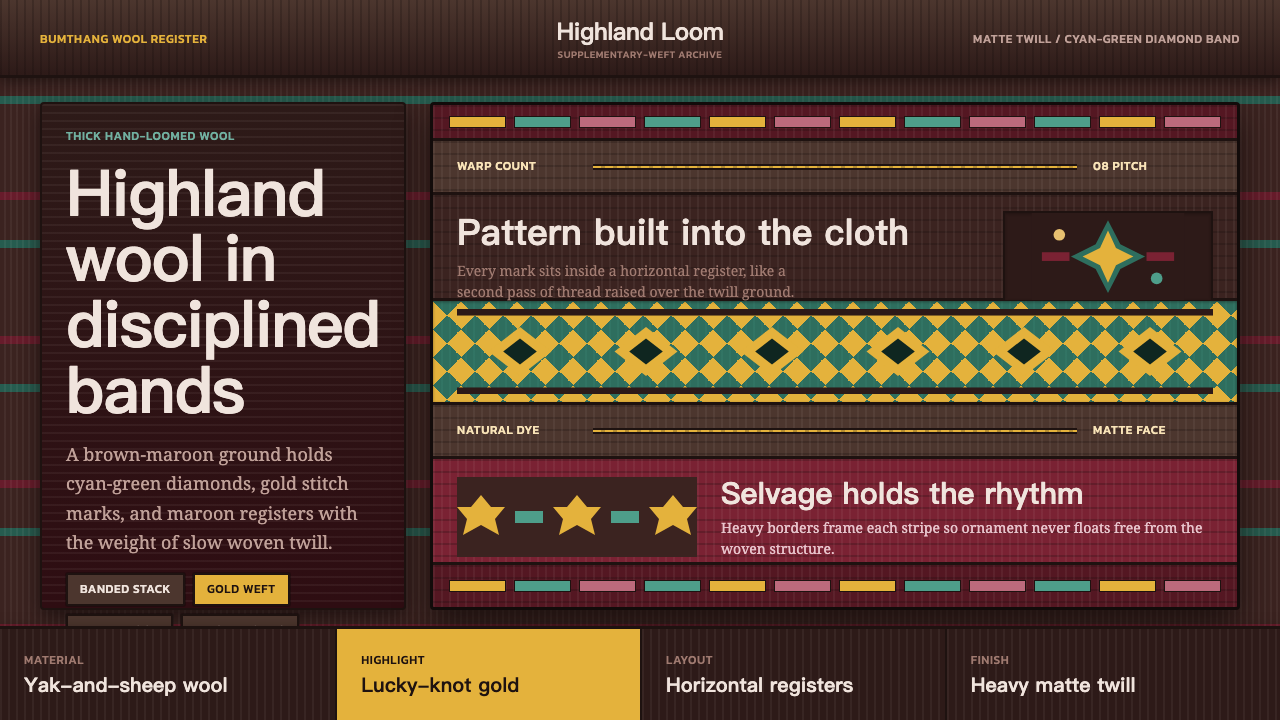 Bhutanese Yathra Wool WeaveHighland wool made digital. Brown-maroon bands carry cyan diamonds and spare…
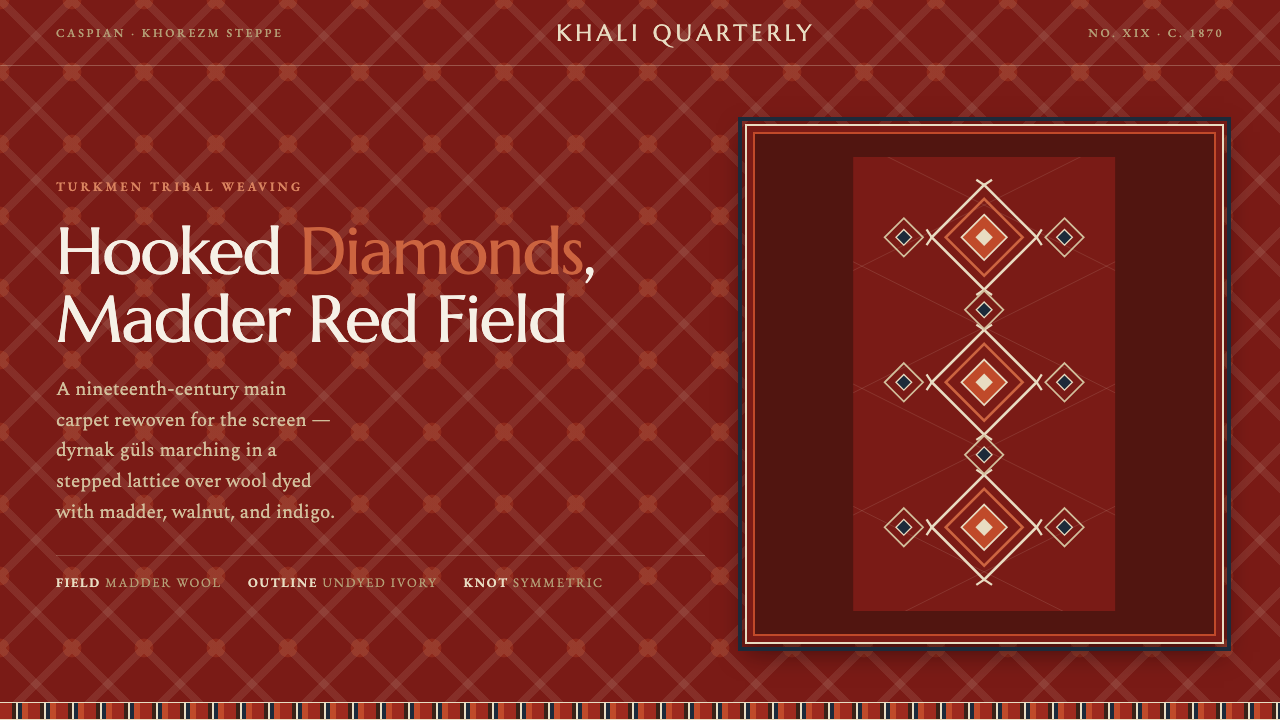 Yomut Gül CarpetHand-knotted authority on screen. Hooked dyrnak diamonds lattice a madder-red…
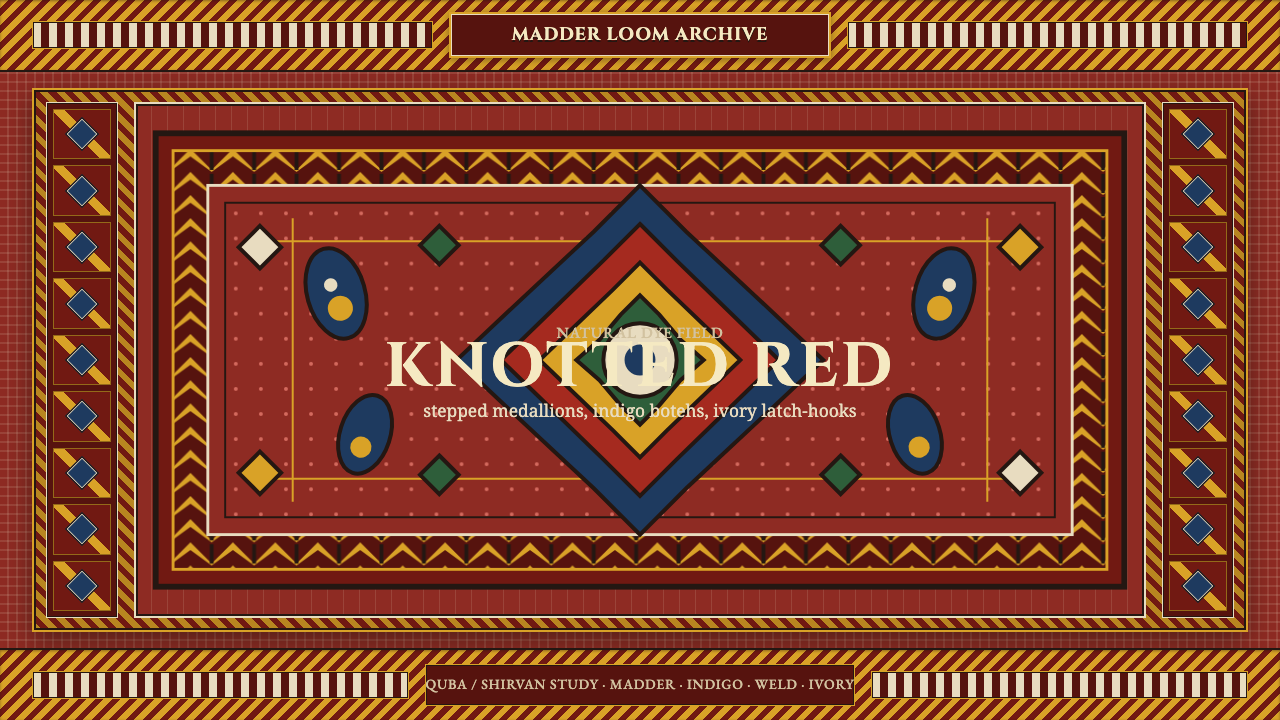 Azerbaijani Quba CarpetRed is the field. Indigo botehs and ivory latch-hooks orbit a stepped medalli…
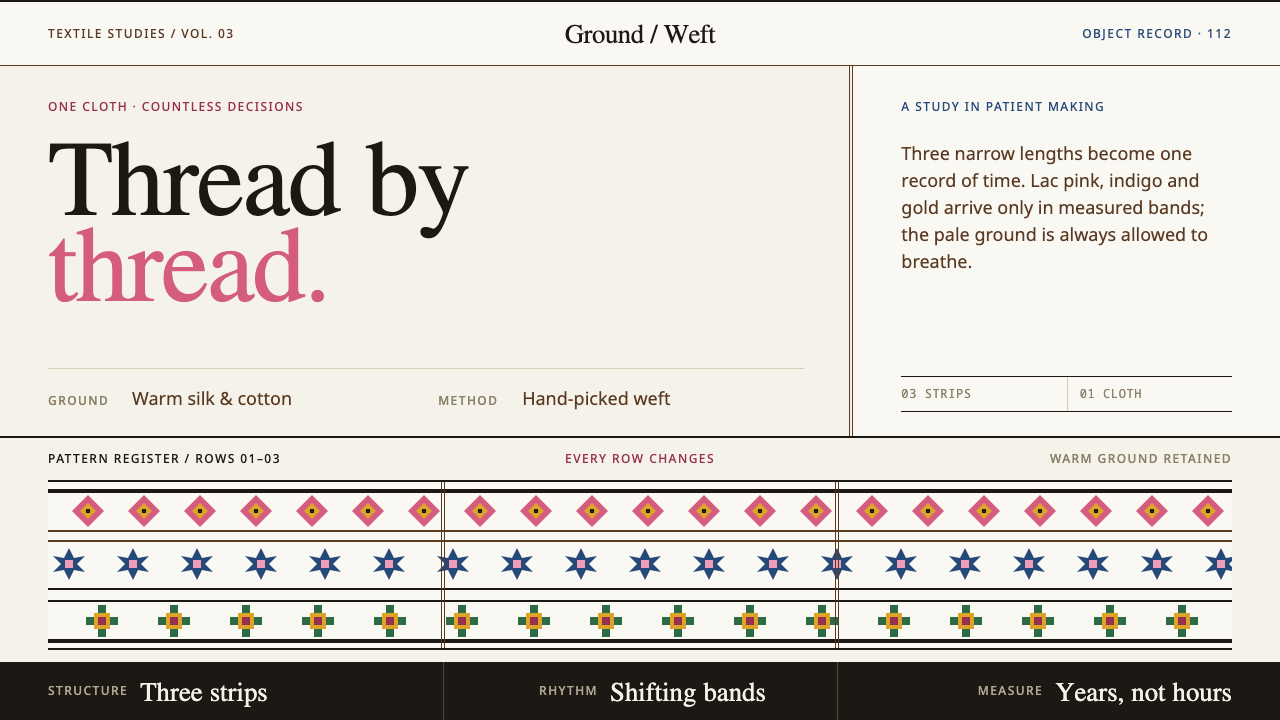 Bhutanese KushutharaPatience made visible. Lac pink and indigo bands shift across a warm silk gro…
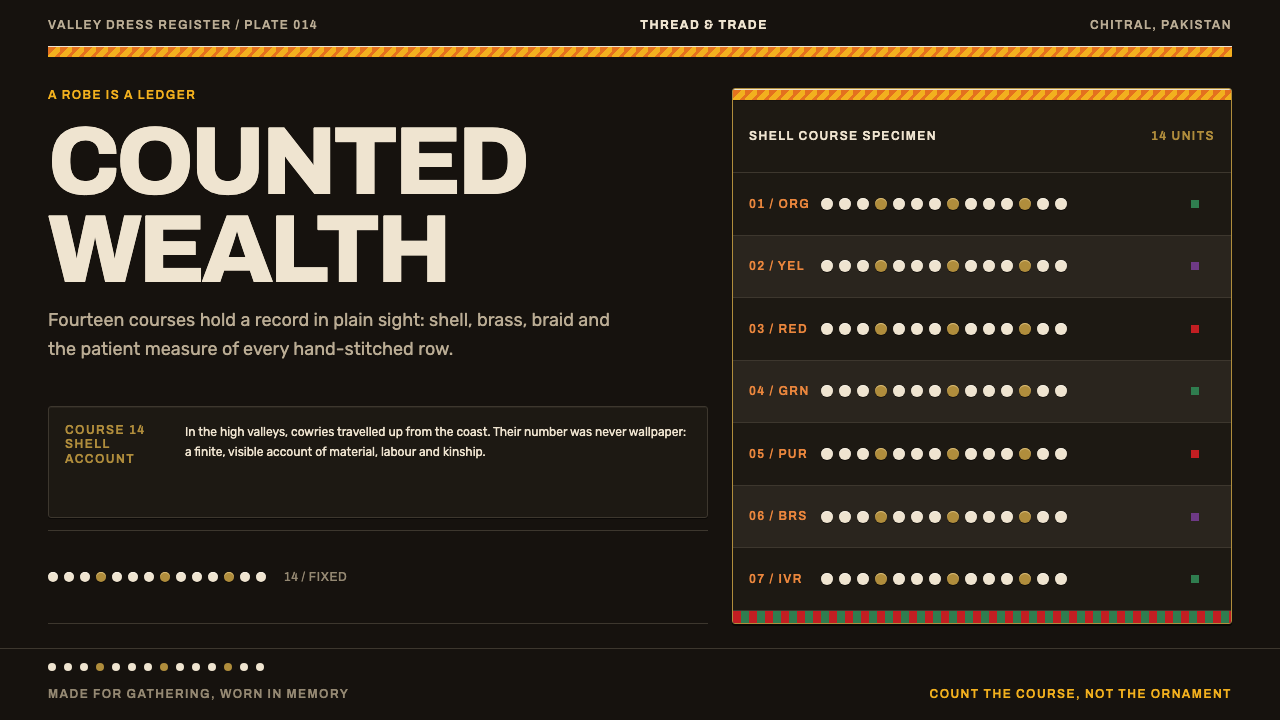 Kalash KupasDensity carries value. Ivory shell courses and orange braid are counted on wa…
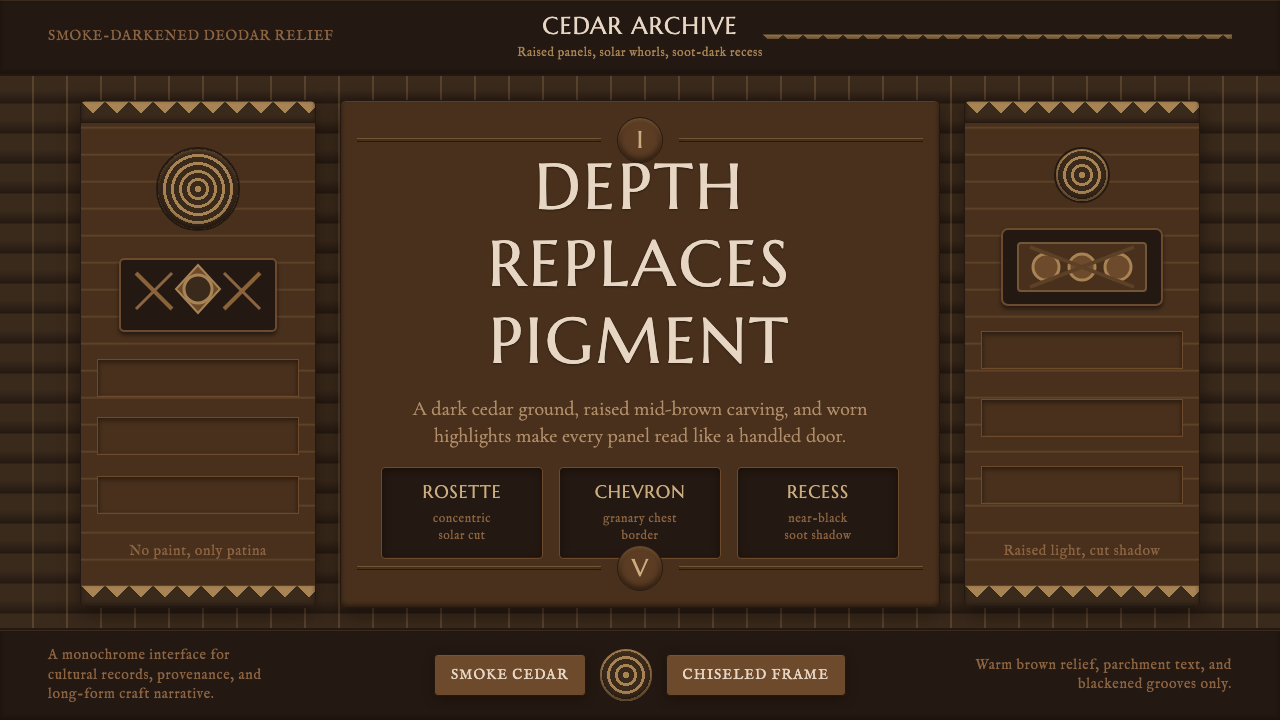 Nuristani Carved CedarDepth replaces pigment. Smoke cedar, chevrons, and rosettes carve light from…