What is Lahic Coppersmith?
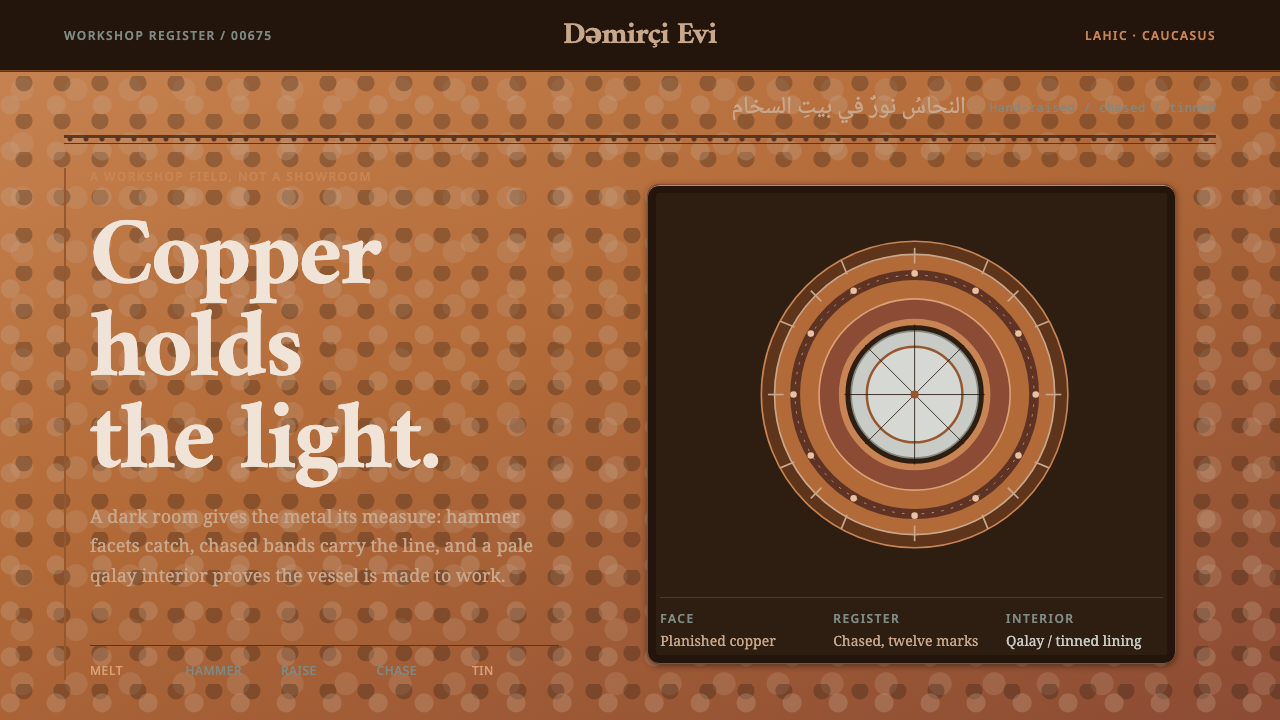
Lahij copperwork is a workshop turned inside out: smoke-black walls, copper as the only light, ornament wrapped in bands around the vessel, and a pale tinned lining that appears wherever the vessel opens.
Lahic Coppersmith in brief
Lahic Coppersmith is a design style drawn from Lahij, a mountain village in Azerbaijan where roughly 120 copper workshops fill a single quarter. Its visual language starts from the workshop itself: a deep, soot-darkened ground, copper as the one source of light, ornament arranged in horizontal registers that wrap a body rather than sitting in a grid, and surfaces that keep the facets of the hammer. It is a dark style, and the darkness is functional. It is the room the metal is made in.
The craft runs as one unbroken chain: melt the copper, hammer it into sheet, raise the vessel, engrave the ornament, and finally tin the inside with qalay so that it is safe to cook in. The design system translates that sequence into its rules. The ground is what the forge leaves behind, the copper is what the hammer brings out, the bands of ornament are what the engraver adds, and the pale lining is what the tinsmith finishes, last and structural.
The mood is warm, dense and made by hand. Colour is scarce and physical, with one metallic hue glowing out of a dark field, and the tones around it are all consequences of fire, smoke and tin. Nothing is glossy for its own sake. The style asks for proof of labour on every large surface, and it rewards compositions that look as though they were beaten into shape rather than rendered.
Where does Lahic Coppersmith come from?
Lahij lies in the Ismayilli district of Azerbaijan, in the foothills of the Greater Caucasus. The source record describes a village where about 120 copper workshops fill a single quarter, each working in a windowless stone room whose walls and plaster have been blackened by forge smoke. The tradition predates 1900, and the record notes that the workshop quarter and its guild structure are documented in the eighteenth and nineteenth centuries. In 2015 the craft was inscribed on UNESCO's list of intangible cultural heritage, which recognises it as a living practice rather than a museum survival.
The craft is organised as a master-and-apprentice system. The named key figures in the source are the Lahij coppersmith master-apprentice families, alongside the Lahij Museum of Local History, and the movements it belongs to are Caucasian copper craftsmanship and guild-organised village metalwork. That organisation matters visually, because a guild trains its members to produce consistent results: consistent registers of ornament, consistent hammer texture, consistent tinning. The style inherits that discipline, which is why it looks ordered even though every surface is hand-worked.
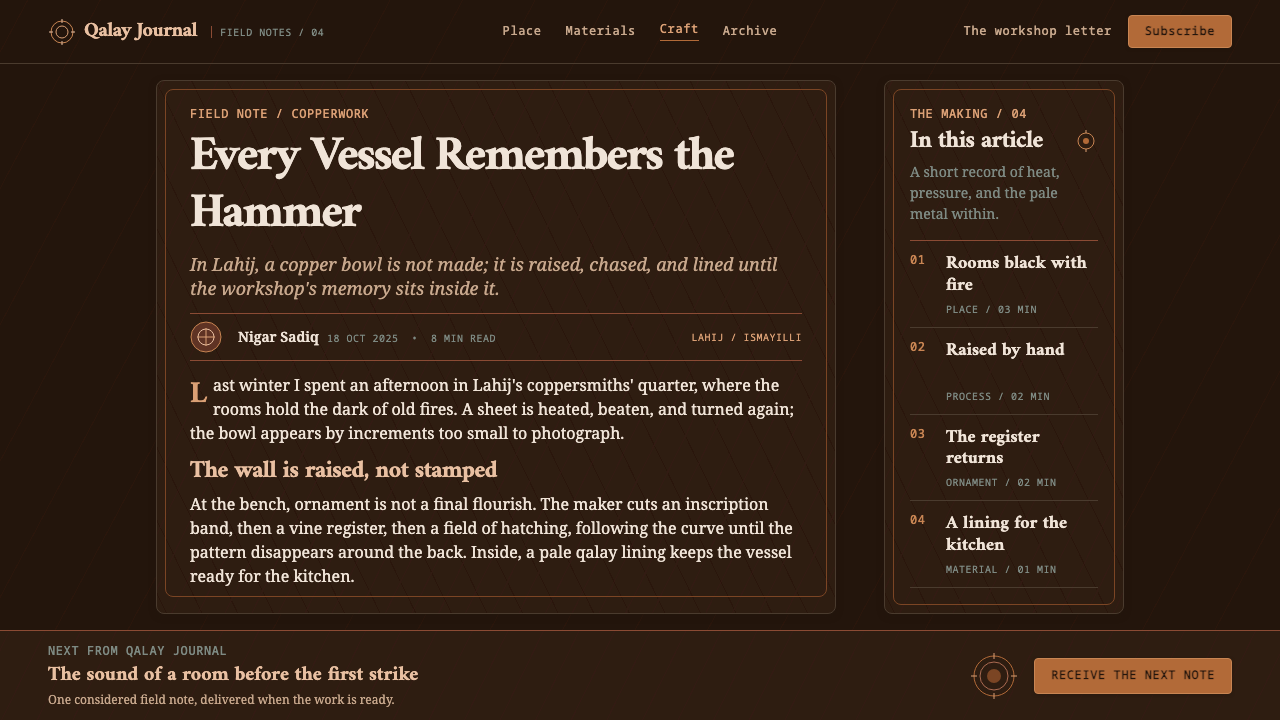
The making process is a sequence of operations that each leave a mark. Copper is melted, then hammered into sheet, which gives the surface its faceted, light-catching character. The vessel is raised, meaning shaped up from the sheet by repeated hammering. The ornament is engraved into the body, and it is arranged in horizontal registers, such as an inscription band, a scroll band and a band of dense dots, which circle the vessel instead of filling a flat rectangle. Finally the inside is tinned with qalay, a thin pale layer that makes the vessel safe for cooking.
The design system does not treat these steps as theme and ornament. It treats them as structure. The soot-dark ground is the workshop. Copper is the one light in it. Naskh inscriptions are set as properly readable type, not bent into decorative curves. Hammer facets carry every large surface, and the pale tin lining is always allowed to show where a vessel opens, because it is part of the construction and not a neutral colour chosen for convenience. Each choice is a way of saying that the object was made, in order, by people who could be named.
What defines the Lahic Coppersmith look?
Soot-Dark Ground
The field is a deep, warm brown-black, the colour that walls and plaster take on after generations of forge smoke in a windowless room. It is not a pure black and not a cold slate grey; it has the faint warmth of burnt material. Large areas rest in this tone, which gives the style its enclosed, concentrated atmosphere. The darkness is the setting, and everything luminous in the composition has to earn its place against it.
Copper as the Only Light
Copper is the single luminous hue in the system, glowing out of the dark ground. It is warm, reddish and metallic, used for the ornament, the edges of forms and the points of emphasis. No second bright colour competes with it, which is what gives the palette its focus. Because it is the only light, it must be used with care: overuse turns the glow into a flat orange, and the effect of a vessel catching a flame is lost.
Horizontal Registers
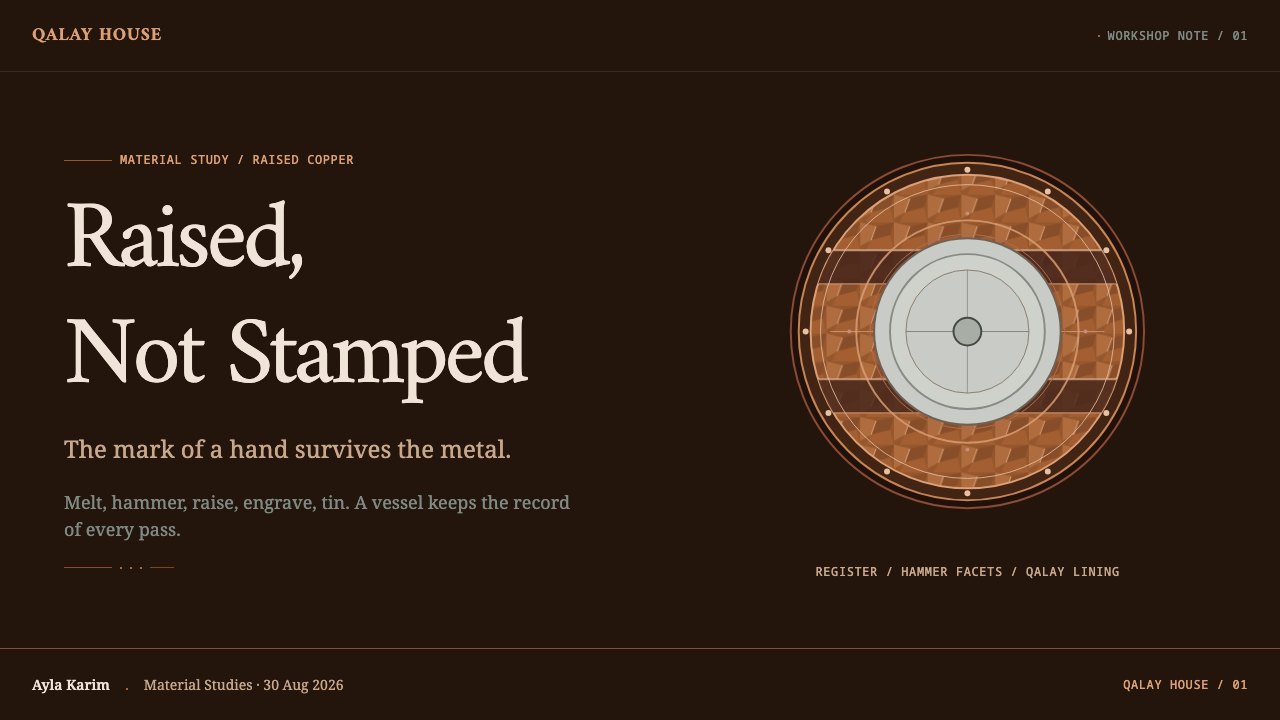
Ornament is arranged in bands that circle the body: an inscription band, a scroll band, a band of dense dots. Each band has its own rhythm and its own width, and they are stacked like the rings of a vessel. This is the opposite of a grid. The pattern wraps around a volume instead of tiling a plane, so layouts in this style read as sequences of horizontal strata that the eye travels along and around.
Naskh Inscriptions as Real Type
Arabic-script inscriptions are set in a Naskh style as readable type, with proper letterforms, spacing and direction. They are not stretched, bent or repeated as pattern. The decision gives the inscription band its meaning: when a line of writing circles a vessel, it is writing first and ornament second. In a layout, text in this style should be something a reader could actually read, with genuine content rather than filler.
Hammer Facets
Every large surface carries the facets left by the hammer: many small planes that each catch light a little differently. Nothing large is perfectly flat, and no area is smoothed to a gradient. The result is a surface with visible labour in it, where highlight and shadow come from the object's own geometry rather than from an applied effect. Facets are a texture of evidence, and they are what stops the dark ground from looking empty.
The Tinned Lining
Wherever a vessel opens, a pale grey-white tinned lining shows. It is part of the structure, because the lining is what makes the vessel safe to cook in, and the style refuses to treat it as a neutral background colour. In an interface this means that an opened thing reveals its inside: a menu, a drawer, a dialog or an input shows a pale interior, so that dark outside and pale inside tell the user where the opening is.

Who shaped Lahic Coppersmith?
The named human centre of the tradition in the source record. These families pass the craft down by training: melting, hammering, raising, engraving and tinning are learned in sequence, in the same stone rooms, by people who watch the work done correctly before they do it themselves. Their continuity is why the style insists on consistency of hand, and why it reads as an inherited system of rules rather than an individual artist's invention.
The record documents the workshop quarter and its guild structure in the eighteenth and nineteenth centuries, with roughly 120 copper workshops filling a single quarter. This concentration of makers is what produces the shared look: a whole neighbourhood working in the same material, the same dark rooms and the same set of ornament bands. The style takes the quarter as its model of density, a place where the same craft is repeated until it becomes an atmosphere.
The one institution named in the source record. A local-history museum sits at the point where a working craft is described, collected and explained to visitors, and its presence marks the transition from workshop practice to documented heritage. For the design system it is a reminder that the style is rooted in a specific village and its record, not in a generic idea of Caucasian metalwork or Islamic ornament.
In 2015 Lahij copper craftsmanship was inscribed on UNESCO's list of intangible cultural heritage. The inscription treats the craft as a practice, with its knowledge, sequence and social organisation, and not as a set of objects. That is the same stance the style takes: the processes of melting, hammering, raising, engraving and tinning are the subject, and the finished vessel is evidence of them.
How do you use Lahic Coppersmith today?
Lahic Coppersmith is a dark, warm and densely worked style, and it suits projects that want craft and heat rather than clean neutrality. It transfers well wherever darkness and a single luminous accent are a natural fit, and where the story of how something is made belongs in the foreground. Applying it correctly means thinking in bands and in layers: dark ground, copper light, horizontal ornament, and a pale inside that appears where things open.
For presentation slides, a cover can be a smoke-dark field with a thin copper line of type and a horizontal ornament band running across the lower third, the way a band circles a pot. Content slides divide into registers: a narrow header band, a wide body band and a footer band, each with its own rhythm. Data slides work with bars or segments as copper bands on the dark ground, and any slide that opens a detail, such as a callout or an expanded table, shows it in the pale lining tone.
For web interfaces, the style gives dark-mode products a handmade warmth that most dark themes lack. Cards and panels carry subtle facet-like variation in their surfaces rather than flat fills. Copper marks the primary action, the focus ring and key numbers, and nothing else competes for that role. Menus, drawers, modals and input fields reveal pale interiors when they open, which makes the open and closed states unmistakable. On a pricing page, plan tiers can be stacked as horizontal registers instead of equal columns.
For editorial and marketing work, the style fits stories about craft, cookware, tea, food, hospitality, heritage tourism and anything made slowly by hand. A long article can be structured in horizontal bands, with section breaks drawn as ornament rows, and with pull quotes set in a readable inscription style across a copper line. Photography works best when it is warm, low-key and close to the material, showing hammer marks, tinned interiors and the glow of the metal.
The most common mistake is to treat the pale tinned lining as a generic neutral and use it for backgrounds throughout, which would flip the style into a light theme and lose the logic of the workshop. A second mistake is to cover everything in glossy metallic gradients, which erases the hammer facets that make copper look worked. A third is to turn the inscription into a decorative curve with no readable content, or to arrange ornament in a rigid grid. Each of these keeps the surface of the style while removing the reasoning underneath it.
Lahic Coppersmith — FAQ
What is Lahij copperwork, and what is the design style based on?
Lahij is a mountain village in Azerbaijan where roughly 120 copper workshops fill a single quarter. The craft runs from melting and hammering the sheet to raising the vessel, engraving ornament and tinning the inside with qalay. The design style takes the smoke-dark workshop as its ground, copper as its only light, ornament in horizontal bands and a pale tinned lining wherever a vessel opens.
Why is the style dark, and can it be used on a light background?
The darkness comes from the workshop: windowless stone rooms whose walls and plaster are blackened by forge smoke, with copper as the only light. A light version would lose that logic. If a light surface is needed, use the pale tinned tone only for interiors and openings, the way the lining appears inside a vessel, and keep the main field soot-dark.
What is the pale tinned lining, and why does it matter in a layout?
Tinning is the final step in the craft: the inside of the copper vessel is coated with qalay, a thin pale layer that makes it safe to cook in. The style treats that lining as structure, not as a neutral colour. In a layout it appears wherever something opens, such as a menu, drawer, dialog or input, so that dark exterior and pale interior mark the opening.
How should Arabic-script inscriptions be handled?
As real, readable type. The style sets Naskh inscriptions with proper letterforms, spacing and direction, and does not stretch or bend them into decorative curves. If your project does not need an inscription, do not fake one; use a clean band or dot row in its place. A band of writing only works when it is genuinely writing.
Where does the style fit, and where does it struggle?
It fits craft, cookware, tea, food and hospitality brands, heritage and cultural projects, and dark-mode products that want warmth and a single strong accent. It struggles with clinical or minimal contexts, with products that need a bright, airy feel, and with dense data tables where hammered texture and ornament bands would get in the way. Use it where the making matters.
Related design styles
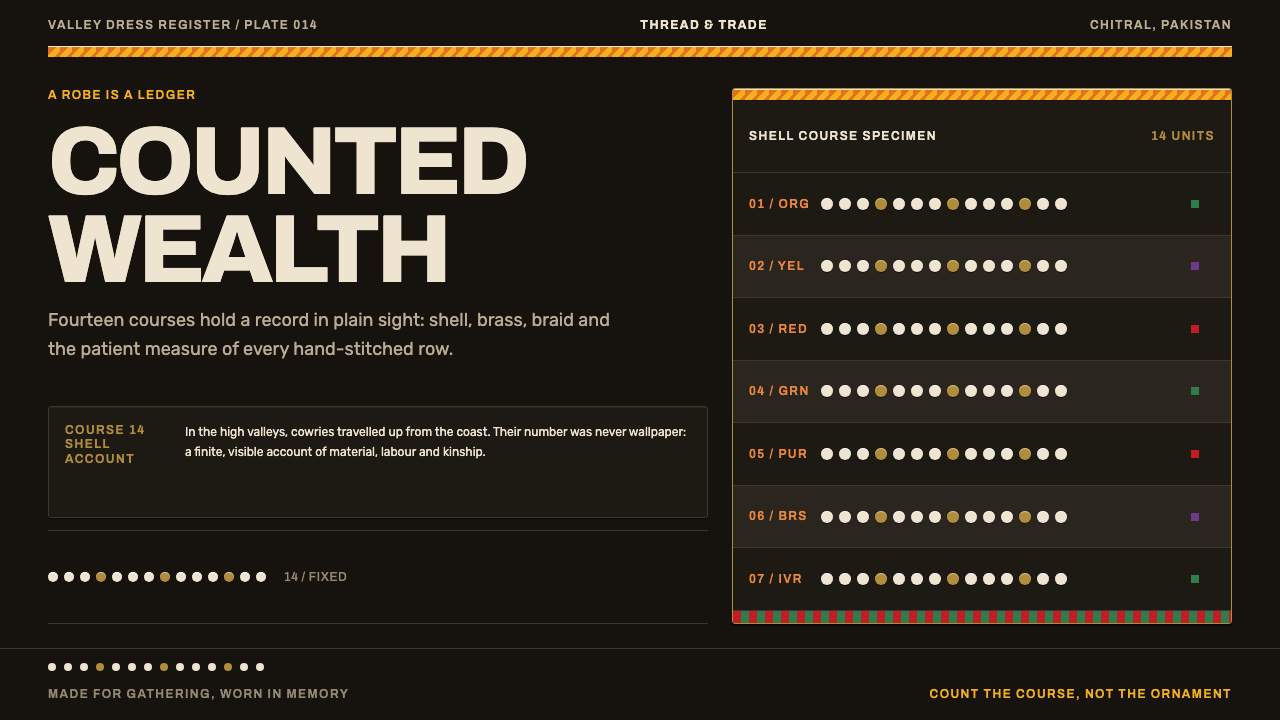 Kalash KupasDensity carries value. Ivory shell courses and orange braid are counted on wa…
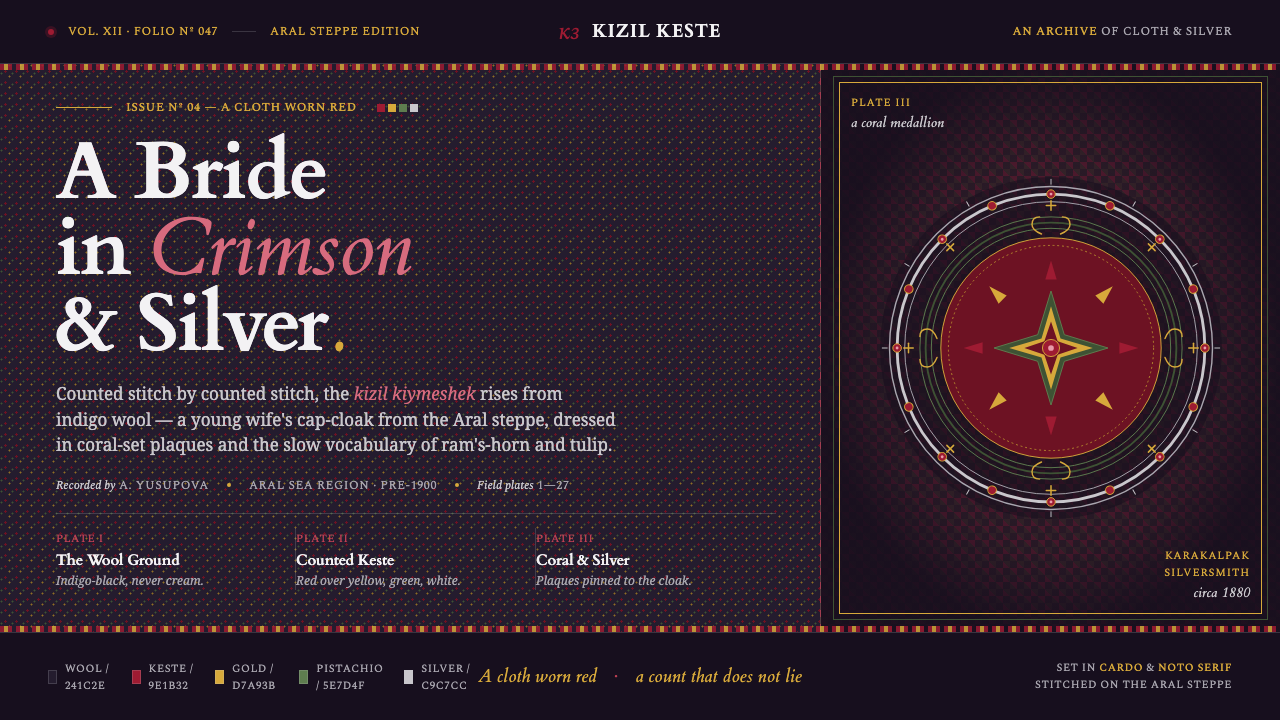 Karakalpak Kimeshek DressA cloth worn red. Crimson keste cross-stitch on indigo wool, set with silver-…
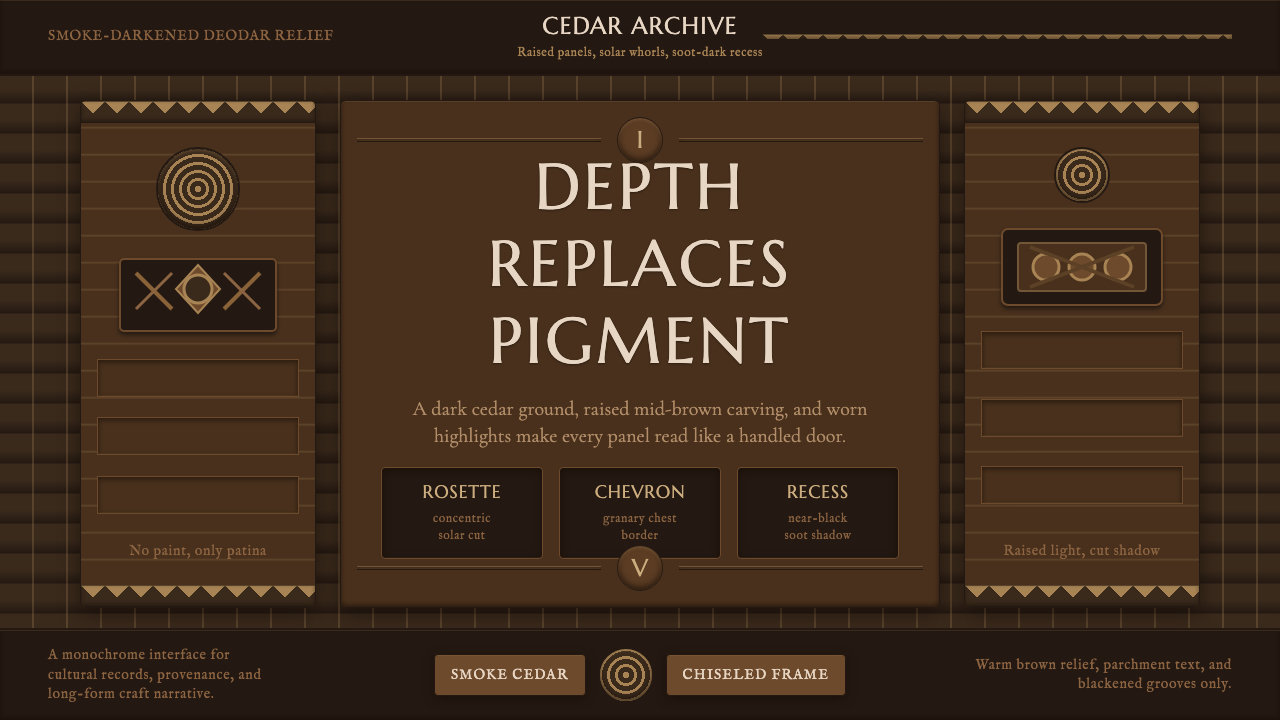 Nuristani Carved CedarDepth replaces pigment. Smoke cedar, chevrons, and rosettes carve light from…
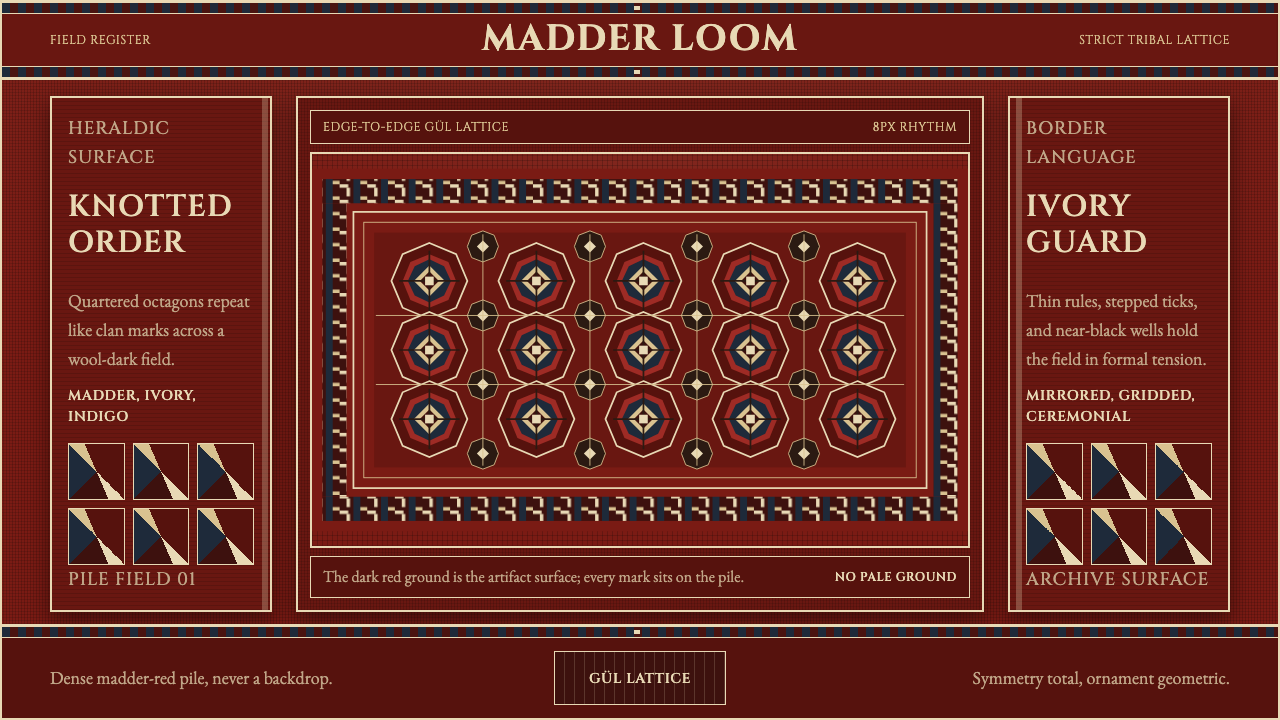 Turkmen Bukhara RugHeraldic and earthbound. Madder red, ivory hairlines, and octagonal güls lock…
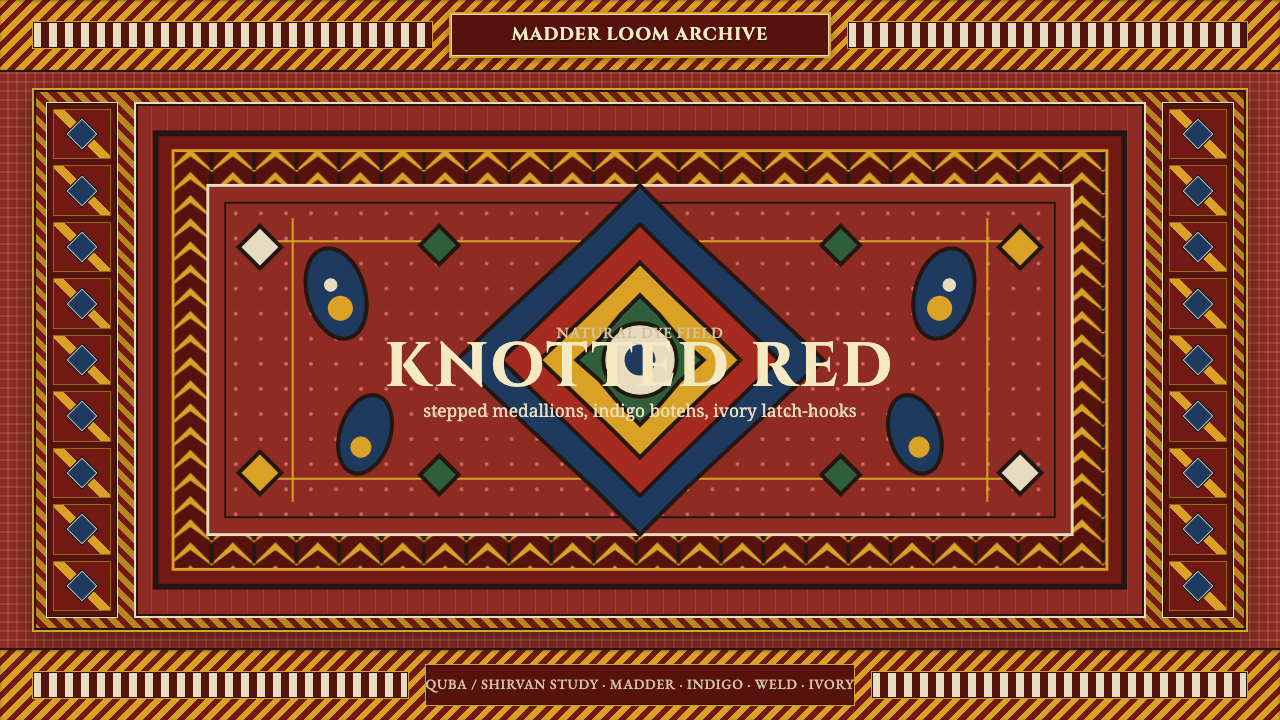 Azerbaijani Quba CarpetRed is the field. Indigo botehs and ivory latch-hooks orbit a stepped medalli…
 Bhutanese KushutharaPatience made visible. Lac pink and indigo bands shift across a warm silk gro…