What is Cook Islands Tivaivai?
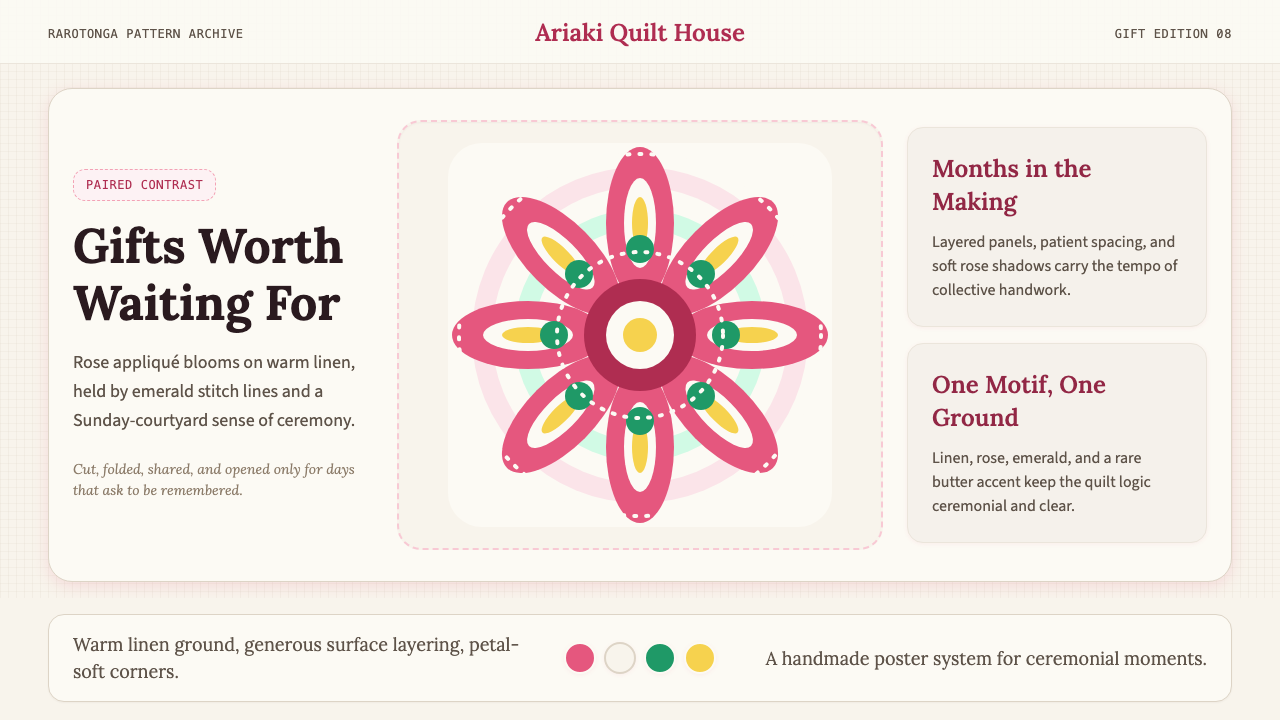
Tivaivai — the quilted appliqué tradition of the Cook Islands — is an art of patient collective beauty, where women's groups stitch months of labor into layered fabric compositions that are given away only at the most significant moments of community life.
Cook Islands Tivaivai in brief
Tivaivai is the premier visual art tradition of the Cook Islands, a living practice carried forward by vainetini — women's sewing groups — across the islands of Rarotonga, Aitutaki, Mangaia, and beyond. Each quilt is an act of sustained collective labor: women gather regularly to plan, cut, sew, and embroider, sometimes working on a single piece for well over a year. The results are not sold or displayed commercially. Tivaivai are gifts, presented at weddings, funerals, church openings, and significant family celebrations — occasions when the deep weight of communal effort needs a visible form.
The visual language of tivaivai is built on radial symmetry and bold two-color contrast. The most celebrated form, taorei, creates intricate interlocking patterns by folding cloth into quarters or eighths and cutting through all layers simultaneously — a technique related to the paper-cutting traditions found across the Pacific and in many folk cultures worldwide, but developed here into something distinctly Polynesian in its scale, density, and ceremonial gravity. The other major form, manu, uses shaped appliqué patches — cut into flowers, leaves, birds, and geometric outlines — stitched onto a contrasting ground.
At its core, tivaivai is a design system of contrast and abundance. Where many minimalist traditions seek to subtract, tivaivai accumulates: curves multiply into rosettes, leaf forms echo and interlock across the entire surface, and the stitching itself — rows of running stitch or blanket stitch tracing every seam — adds a secondary layer of visual texture to an already dense composition. The effect is opulent but ordered, festive but rigorous.
Where does Cook Islands Tivaivai come from?
The Cook Islands lie at the heart of Polynesia, roughly midway between Hawaii and New Zealand. The islands' quilting tradition did not emerge from a single historical moment but grew from a layered encounter: when Christian missionaries arrived in the 1820s — primarily from the London Missionary Society — they introduced Western fabric, thread, and sewing techniques. Cook Islands women absorbed these materials into existing textile knowledge and a pre-existing aesthetic culture shaped by tapa-cloth making, plaiting, and pattern-cutting in natural materials. The quilt form arrived, but what was made with it became something entirely local.
The most significant period of tivaivai's development as a recognized art form came in the early twentieth century, particularly from the 1920s onward. The practice became deeply embedded in the Cook Islands Christian Church (CICC), where women's groups formed an integral part of congregational life. Church openings — a major social event in island communities — became the primary occasion for the display and gifting of tivaivai, cementing the connection between the textile tradition and communal spiritual identity. The scale and ambition of quilts grew as women's groups developed longer working traditions and more complex cutting patterns.
The New Zealand diaspora played a crucial role in the tradition's visibility beyond the Pacific. As Cook Islanders emigrated to Auckland and other New Zealand cities from the mid-twentieth century onward, they brought tivaivai practice with them, and the art entered the broader Pacific community in New Zealand. By the 1970s and 1980s, gallery exhibitions and Pacific arts festivals had begun to introduce tivaivai to audiences outside the Cook Islands, though the objects themselves remained embedded in a gift economy rather than an art market.
Scholars and documentarians brought the tradition into wider academic and public consciousness in the late twentieth century. Lynnsay Rongokea's sustained research and documentation — most fully expressed in her foundational book on tivaivai — provided the first rigorous account of regional variations, technical categories, and the social organization of vainetini groups. This documentation mattered not only for outside audiences but for communities on the islands themselves, where younger generations could engage with the full breadth of their inherited tradition. The Pacific Pioneers and related exhibition initiatives brought tivaivai into institutional art spaces while preserving their integrity as objects of cultural relationship rather than aesthetic commodity.
What defines the Cook Islands Tivaivai look?
Color Logic
Tivaivai operates on a two-color contrast system: one vivid foreground hue against a light, usually white or cream, ground. The foreground color is typically drawn from the warm side of the spectrum — rose, coral, deep red, or vibrant magenta — though cool greens and blues appear in certain island and era variants. The critical relationship is the ratio of figure to ground: the cut motifs are bold enough to read across a large room, but the ground always breathes, giving the composition air despite its density. Accent stitching in a third color — often a deep green or a contrasting warm tone — traces seams and edges, adding a fine linear layer that knits the composition together without interrupting its fundamental two-tone clarity.
Radial Symmetry
The defining structural principle of tivaivai is four-fold or eight-fold radial symmetry, achieved through the fold-and-cut technique. A single folded cut produces four or eight identical mirror-image forms simultaneously. When unfolded and laid flat, the result is a mandala-like pattern radiating from a central point or axis — no two arms are independently drawn, because all emerge from the same physical cutting action. This symmetry is not imposed decoratively but grows organically from the making process itself, giving tivaivai its characteristic sense of inevitability: the pattern could not have looked any other way.
Motif Vocabulary
The natural world of the Pacific provides the primary source material for tivaivai motifs. Frangipani, hibiscus, tiare (gardenia), bougainvillea, and breadfruit leaves appear repeatedly — not as realistic botanical illustrations but as clean, simplified silhouettes in which the essential character of each plant is distilled into a form that can be folded and cut. Birds, fish, and shells also appear. In more abstract taorei work, the original botanical source may be so transformed by the geometry of folding and interlocking that the final pattern reads as purely formal, related to Celtic knotwork or Islamic geometric ornament in its rhythmic density.
Surface Density and Rhythm
Unlike design traditions that value open space and deliberate emptiness, tivaivai fills its surface with intention. Motifs are arranged so that the positive shapes (the appliquéd cloth) and the negative shapes (the exposed ground) are in roughly equal visual dialogue. The edge of each cut form is precise and confident — there is no ambiguity about where the motif ends and the ground begins. At the same time, the repetition of similar forms across the entire surface creates a strong rhythm: the eye moves across the quilt in a measured, almost musical way, finding familiar forms in new positions.
Stitching as Drawing
Every appliquéd edge in a tivaivai is secured and defined by stitching, and that stitching is itself an expressive element. Blanket stitch along a cut edge creates a visible line that slightly extends and frames the shape. Running stitch quilted across the background surface — typically in parallel rows or following the contour of nearby motifs — adds a secondary texture that catches light differently from the appliquéd top layer. In some pieces, this quilting background stitching is elaborate enough to constitute a second level of patterning, visible only when the light falls at a particular angle.
Communal Authorship
A tivaivai is never the product of one person's imagination alone. The vainetini group negotiates the design, the color, the occasion, and the intended recipient collectively. Individual women contribute particular skills — some are acknowledged as exceptional cutters, others as precise stitchers — but ownership of the finished piece belongs to the group, and the recipient is the community occasion rather than an individual buyer. This collective authorship shapes the aesthetic: decisions that serve the group's shared vision take precedence over individual expression, producing a visual culture of agreement rather than signature.
Ceremonial Weight
Tivaivai are not made to be used as bedding or displayed as decoration in ordinary domestic contexts. Their purpose is ceremonial exchange — they are made to be given at the height of community life. A quilt presented at a funeral wraps the deceased or is placed in the coffin; one presented at a wedding surrounds the couple with visible evidence of communal investment in their union. This function shapes the object's visual register: tivaivai are designed to be seen and recognized from a distance, to signal abundance and care, and to carry the weight of collective presence made tangible.
Who shaped Cook Islands Tivaivai?
Rongokea is the most significant researcher and documentarian of tivaivai practice. Her book-length study — the foundational text in the field — combined ethnographic fieldwork with close visual analysis to map the regional variations between islands, document the technical categories of taorei and manu, and record the names, biographies, and methods of leading vainetini practitioners. Her work gave the tradition intellectual credibility and provided the Cook Islands communities themselves with a written record of practices that had previously been transmitted primarily through living apprenticeship and collective memory.
Mama Mii Tongia is among the most celebrated tivaivai makers of the twentieth century, recognized within Cook Islands communities for the exceptional density and precision of her taorei work. Her quilts achieved a level of interlocking complexity that required not only technical mastery but an intuitive spatial intelligence developed over decades of practice. She represents the ideal of the senior vainetini practitioner: someone whose skill is inseparable from her role as keeper and transmitter of communal knowledge.
Mary Tongia's contributions to tivaivai are recognized both through her own extraordinary quilts and through her role in teaching and sustaining vainetini practice across generations. Senior practitioners like Mary Tongia hold the community's pattern knowledge — not in written form but in the muscle memory of folding and cutting, in the ability to predict what a cut shape will look like when unfolded, and in the judgment of what color combinations will honor an occasion. Her work demonstrates how individual mastery and collective tradition are mutually constitutive in this art form.
Smallman is associated with the contemporary documentation and promotion of Cook Islands textile arts, helping to bridge the community contexts in which tivaivai have their primary meaning and the broader public and institutional spaces where the art form has gained wider recognition. The work of practitioners like Smallman has been instrumental in situating tivaivai within conversations about Pacific art history, Indigenous creative traditions, and the politics of cultural visibility — without reducing the objects to mere symbols, or separating them from the social relationships that give them their deepest significance.
How do you use Cook Islands Tivaivai today?
Tivaivai is among the richest and most specific regional design traditions available for contemporary digital and print work. Applying it well requires understanding what the tradition actually does visually — two-color contrast, radial symmetry, motif repetition, stitching as a secondary linear layer — rather than simply borrowing flower shapes and warm pink tones. The most common misapplication treats it as generic Pacific decoration; the more sophisticated approach recognizes it as a precision system built from cut-paper logic and gift-economy values.
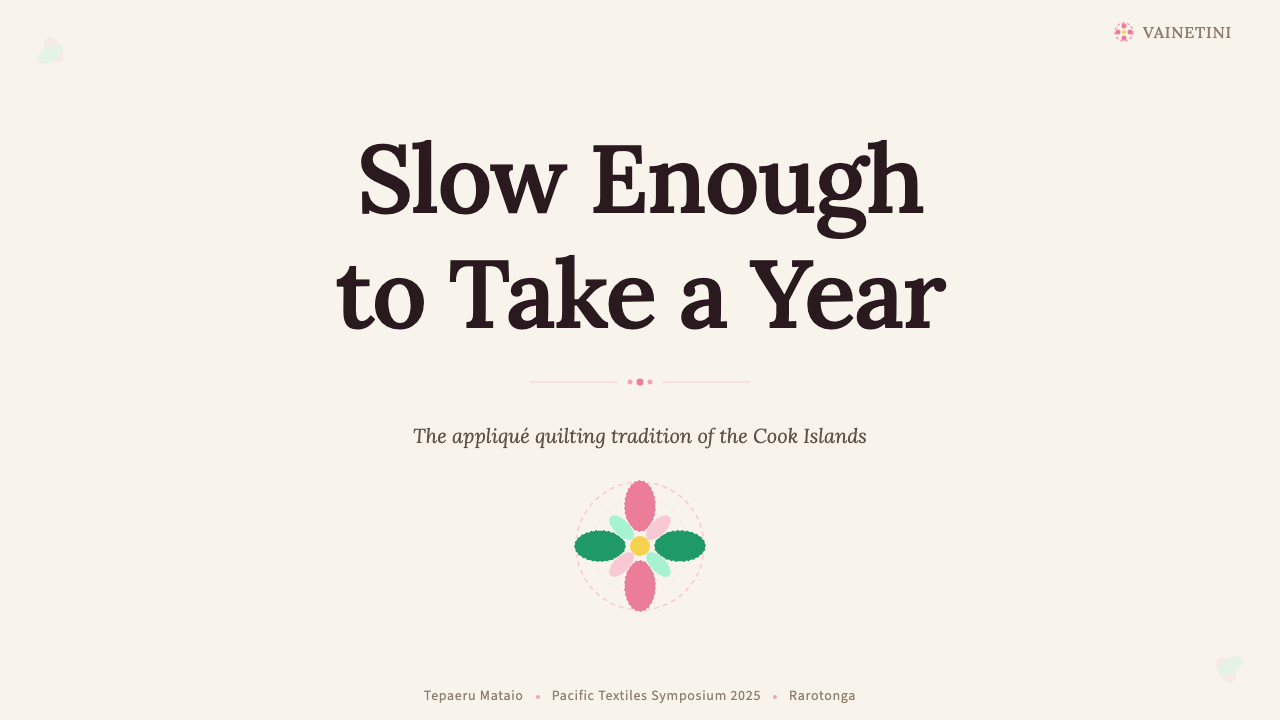
For presentation slides, tivaivai works beautifully on covers and section dividers. A cover built on tivaivai logic places a large, radially symmetric floral medallion as the central or off-center anchor, using the two-color system to create immediate visual authority — warm foreground on light ground, or the reverse. The medallion should fill at least a third of the slide area to achieve the tradition's characteristic sense of abundance. Content slides should be treated more sparingly: use the motif vocabulary as decorative corner accents or section markers, keep the palette to the core two-color pairing, and let the typographic hierarchy do the organizational work without competing with pattern.
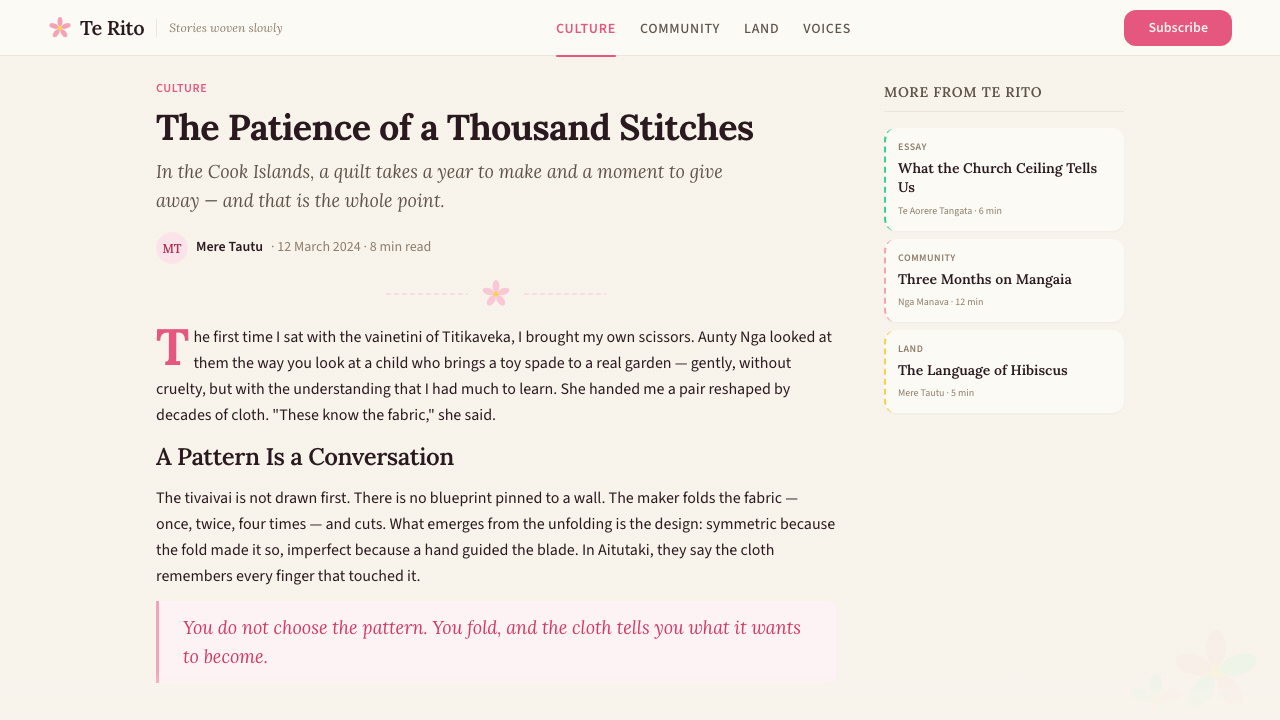
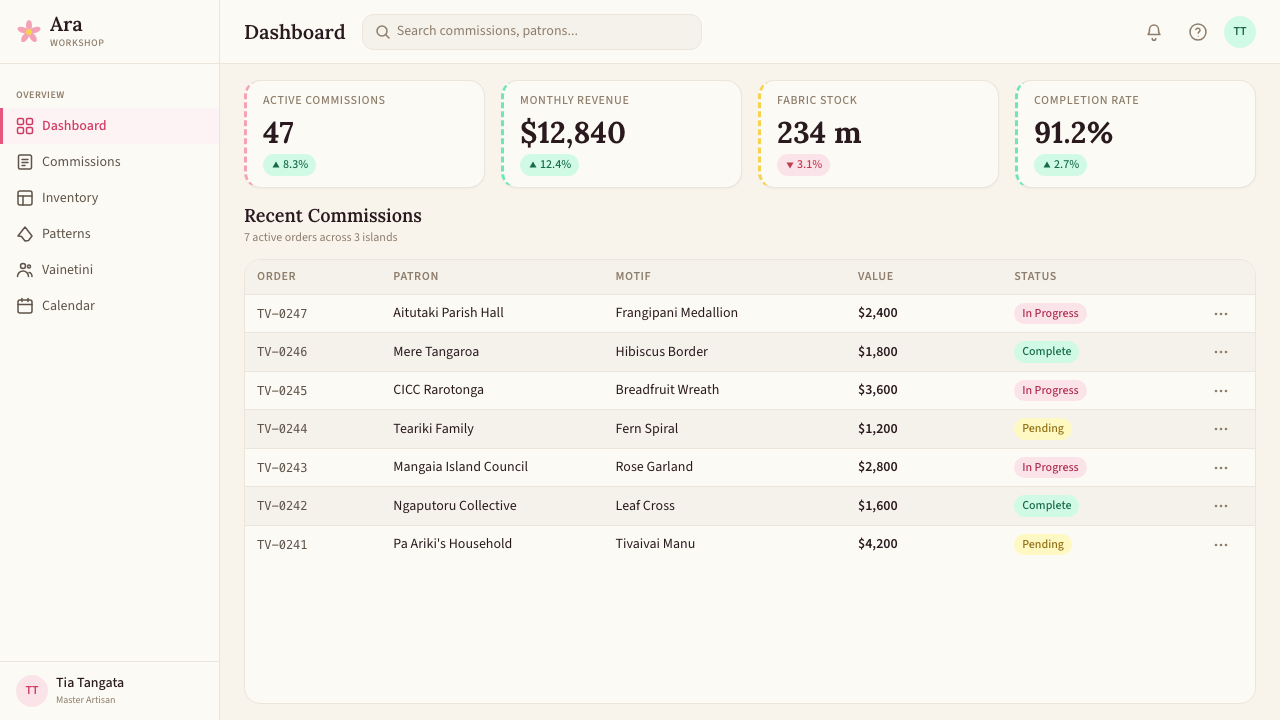
For web interfaces, the tradition is best suited to landing pages, cultural platforms, event sites, and editorial contexts where visual richness and a sense of artisanal care are desired values. The key is restraint in application: one large tivaivai-derived pattern element per viewport — perhaps as a hero background, a section divider, or an illustration panel — anchors the aesthetic without overwhelming the interface. Interactive elements and navigation should remain typographically clean; the pattern does the atmospheric work. A tivaivai-derived dashboard or data-heavy interface is rarely a good fit — the tradition's density and warmth work against the scannability that functional tools require.
For editorial and marketing work, tivaivai is exceptionally well-suited to cultural journalism, heritage brand campaigns, food and hospitality contexts with Pacific resonances, and any communication where warmth, community, and handmade quality are the core message. Full-bleed pattern backgrounds can work powerfully for feature article openers or campaign headers, provided the overlay typography is large, bold, and in a third color (usually dark) rather than fighting for legibility within the pattern itself. Marketing pieces that wish to evoke the tradition's gift-economy values — generosity, communal effort, the object as a relationship made visible — should let the pattern breathe: present it fully rather than fragmenting it into isolated ornamental flourishes.
A common mistake when applying tivaivai-inspired aesthetics is introducing too many colors. The tradition's power comes from the tension between exactly two saturated values — reduce or increase that number and the logic dissolves. Similarly, replacing the clean-edged cut-paper silhouettes with brushy, textured, or softly rendered botanical forms misses the tradition's fundamental precision: tivaivai motifs are geometric as well as natural, because they are literally produced by cutting through folded layers. When the edge loses its confidence, the design loses its authority.
Cook Islands Tivaivai — FAQ
What is the difference between taorei and manu?
Taorei and manu are the two primary technical categories of tivaivai. Taorei is made by the fold-and-cut method: cloth is folded into quarters or eighths and cut through simultaneously, producing the radially symmetric, interlocking patterns that most viewers associate with tivaivai. When unfolded, the result is a single continuous piece of cut cloth whose negative spaces are part of the design. Manu, by contrast, uses separate shaped appliqué patches — cut individually into flower, leaf, bird, or geometric forms — that are then stitched onto a contrasting ground cloth. Manu compositions tend to be more pictorial and less strictly symmetric, with individual motifs arranged in repeating grids or organic scatters across the surface. Both forms are traditionally hand-stitched, and both rely on the two-color contrast logic that defines the tradition as a whole.
Is tivaivai only found in the Cook Islands?
Tivaivai is most strongly identified with the Cook Islands, but related appliqué quilt traditions exist across Polynesia — in French Polynesia (where the practice is called tifaifai), Hawai'i, and other island groups where missionary contact in the nineteenth century introduced Western sewing techniques that were then transformed into local art forms. The Cook Islands tradition is distinguished by its particularly sophisticated taorei fold-and-cut technique, the strength of its vainetini organizational structure, and its deep integration with the Cook Islands Christian Church's gift culture. In New Zealand, the large Cook Islands diaspora has sustained tivaivai practice in an urban context, where community events and church life continue to occasion the making and gifting of quilts.
Can tivaivai patterns be used commercially, or is there a cultural sensitivity to consider?
This question deserves careful consideration. Tivaivai patterns are not simply decorative motifs — they are the outputs of a living tradition embedded in a specific gift economy, community structure, and spiritual context. Using them commercially without acknowledgment, attribution, or community engagement raises legitimate concerns about cultural appropriation, particularly given the history of Pacific artisanal traditions being commodified without benefit to originating communities. The most respectful approach for designers drawing on tivaivai as inspiration is to work with generative principles — radial symmetry, two-color contrast, fold-and-cut logic — rather than reproducing specific documented patterns, and to be transparent about the tradition that has inspired the work. Where commercial collaboration with Cook Islands artists or communities is possible, that path is strongly preferable.
How does tivaivai handle dark backgrounds?
Traditional tivaivai are almost universally made on light — white or cream — grounds, with the colored motif as the active foreground. The light ground is not merely a neutral support: it represents the space between forms, the breathing room that allows the cut silhouettes to register with full clarity. Inverting to a dark ground is possible in contemporary applications but changes the visual logic substantially. On a dark ground, the light or bright foreground motifs appear to radiate outward — they gain a luminous quality that the traditional configuration does not emphasize. This inverted reading can be beautiful, but it shifts the emotional register from the warmth of Sunday morning light on white cloth toward something more nocturnal and formal. Whether that shift serves the communication is a judgment call that depends on context.
What makes tivaivai different from other folk quilt traditions, such as American patchwork?
The structural difference is fundamental. American patchwork — the best-known folk quilt tradition in the English-speaking world — is built from the accumulation of small pieces, often in many colors and from many fabric scraps, sewn edge-to-edge to create larger geometric patterns. The logic is additive and mosaic-like: complexity arises from the assembly of many units. Tivaivai, by contrast, is subtractive and monolithic: complexity arises from what is removed — the cuts made through a single folded piece of cloth — rather than from what is assembled. Where American patchwork celebrates variety and the history embedded in different fabric scraps, tivaivai celebrates the single bold gesture of the cut, the unity of a form that radiates from a single point, and the social act of sustained collective attention to one shared object.
Related design styles
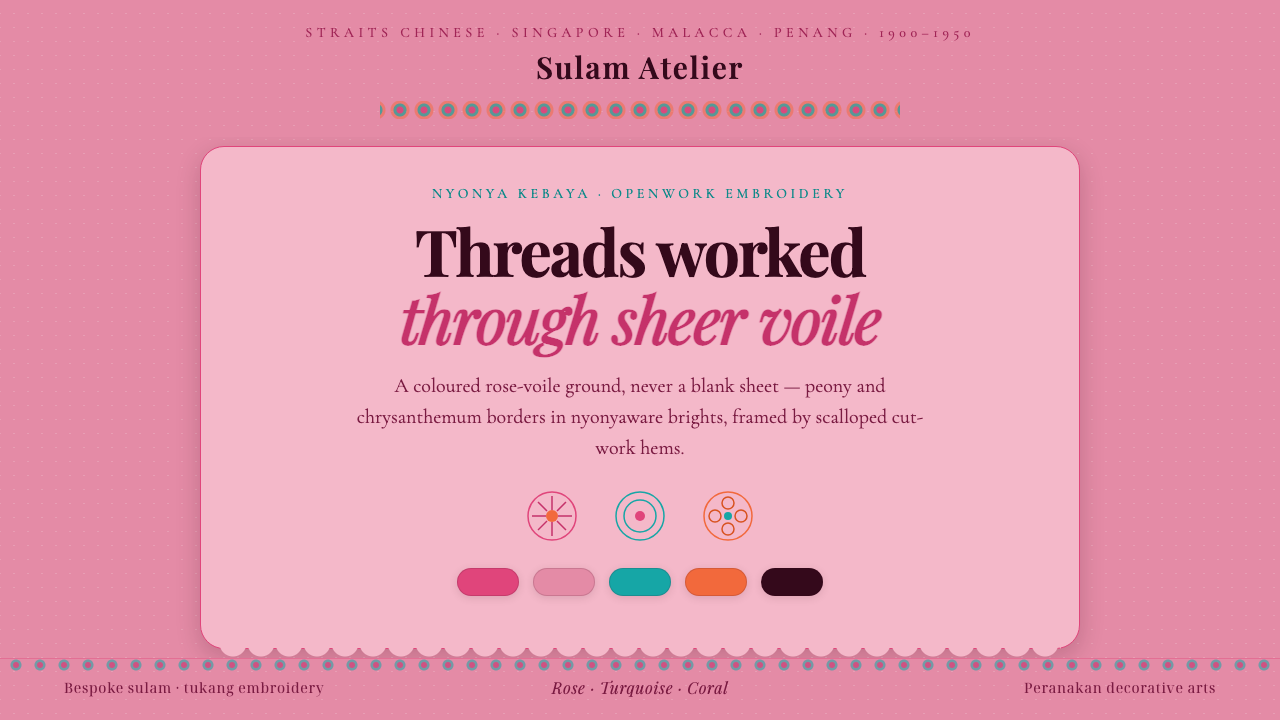 Nyonya Kebaya EmbroideryCraft, never a blank sheet. Rose-voile ground in turquoise sulam openwork, hi…
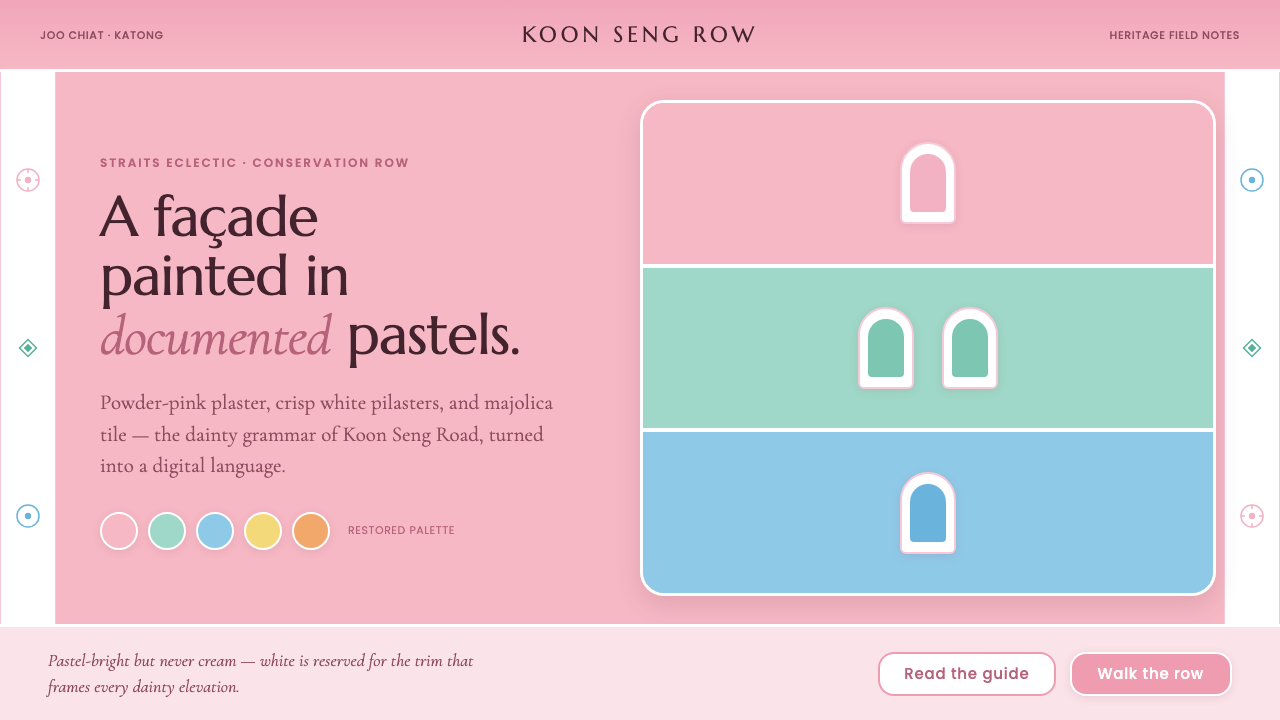 Peranakan Shophouse PastelPastel, never cream. Powder-pink plaster facades framed by crisp white pilast…
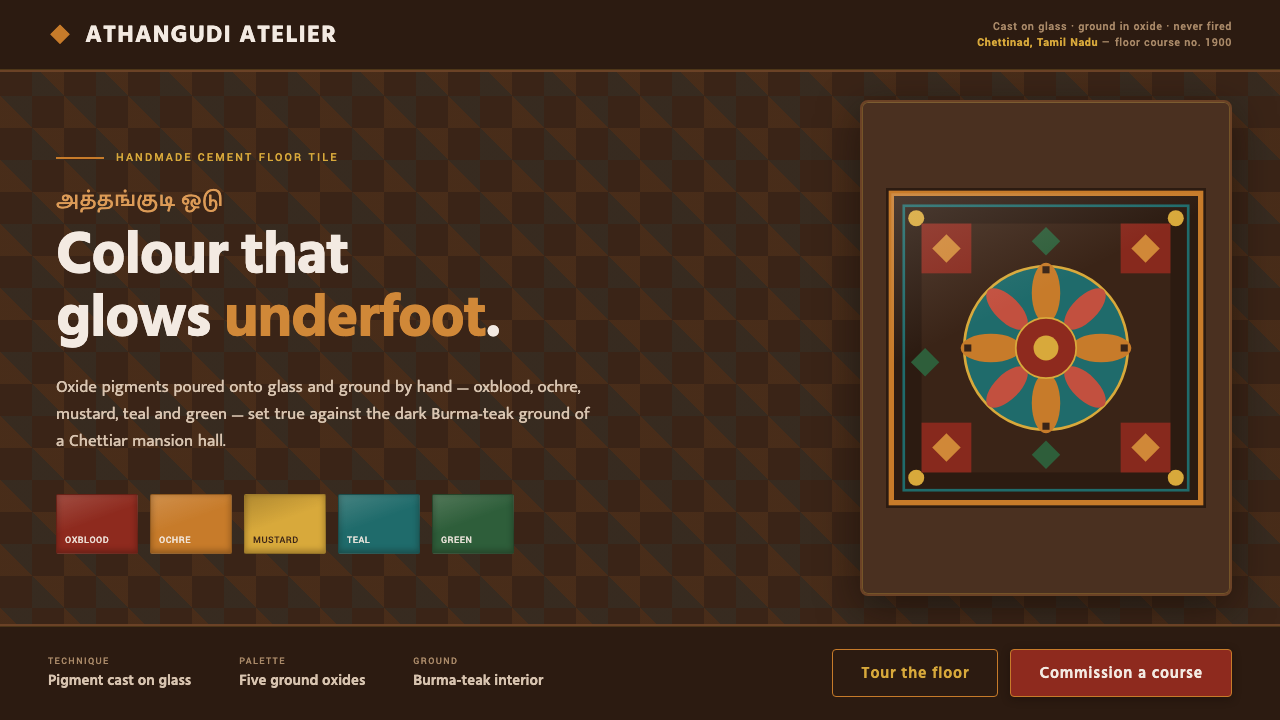 Chettinad Athangudi TilesColour that glows underfoot. Five ground-oxide tones on dark teak in bordered…
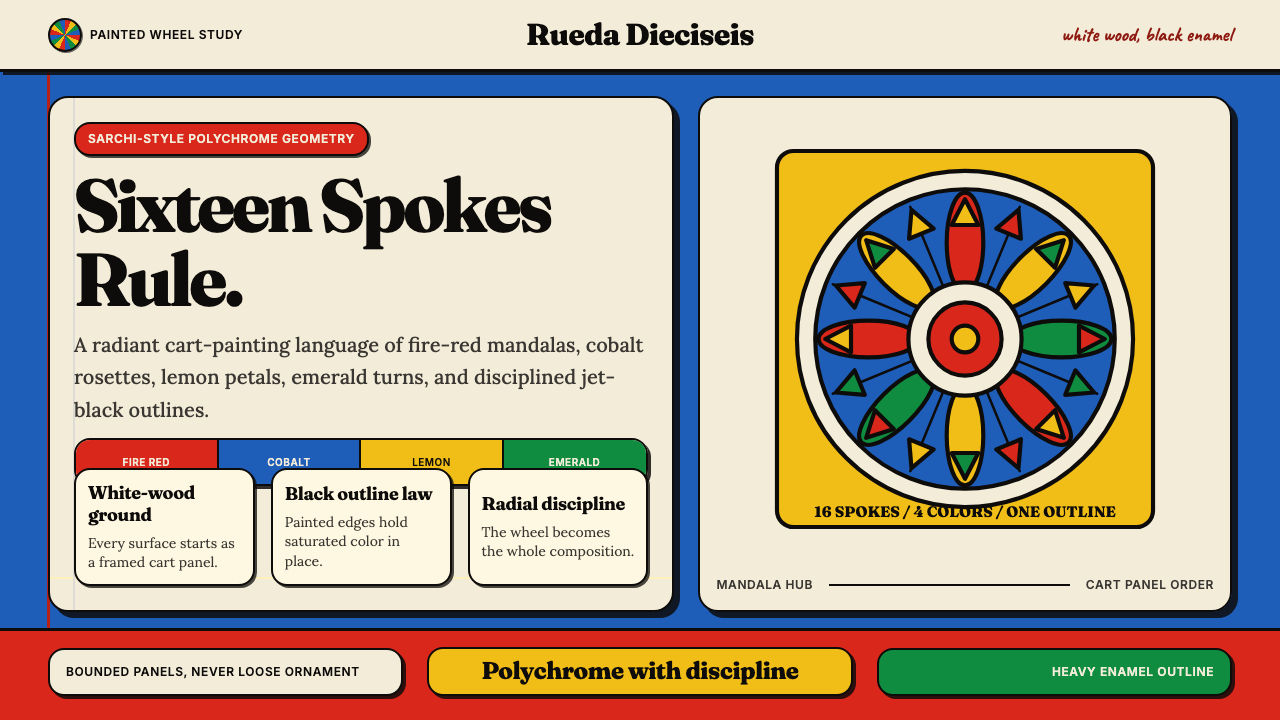 Costa Rican Oxcart Sarchí 1900Geometry sings. Fire red, cobalt, lemon and black outlines turn the wheel int…
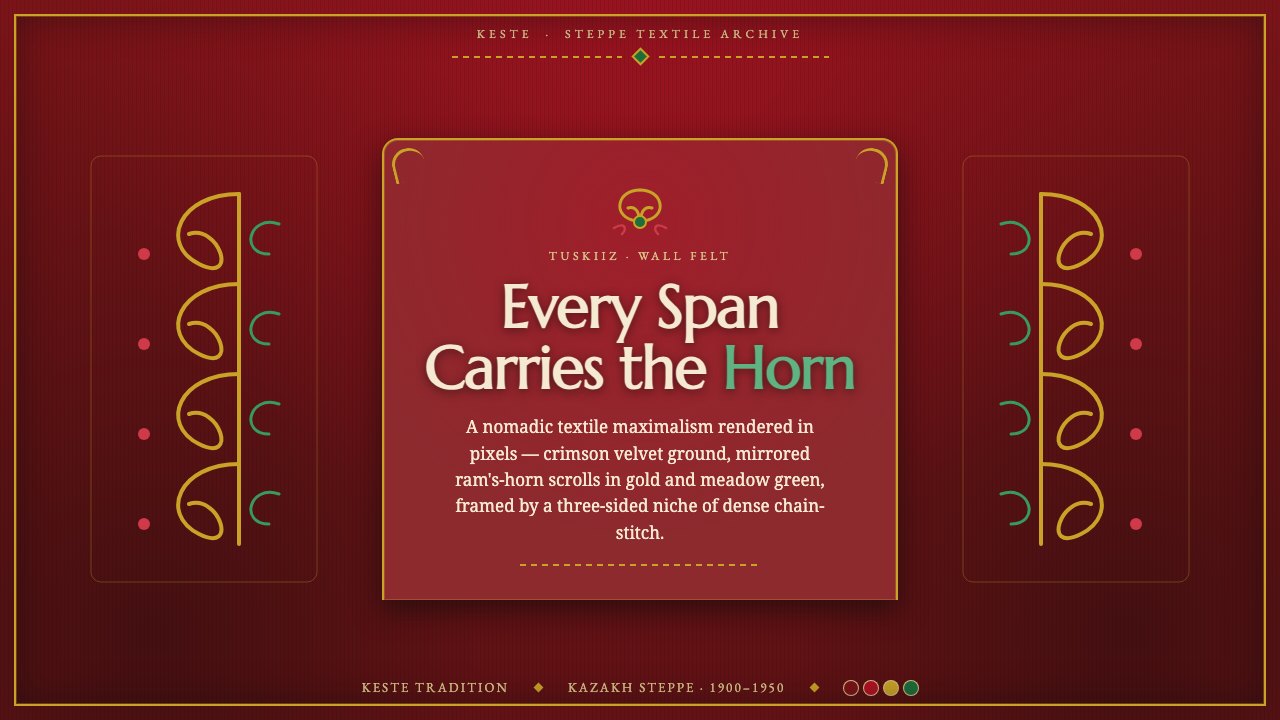 Kazakh Tuskiiz Wall HangingNothing flat, nothing empty. Crimson velvet, gold-green ram's-horn scrolls, a…
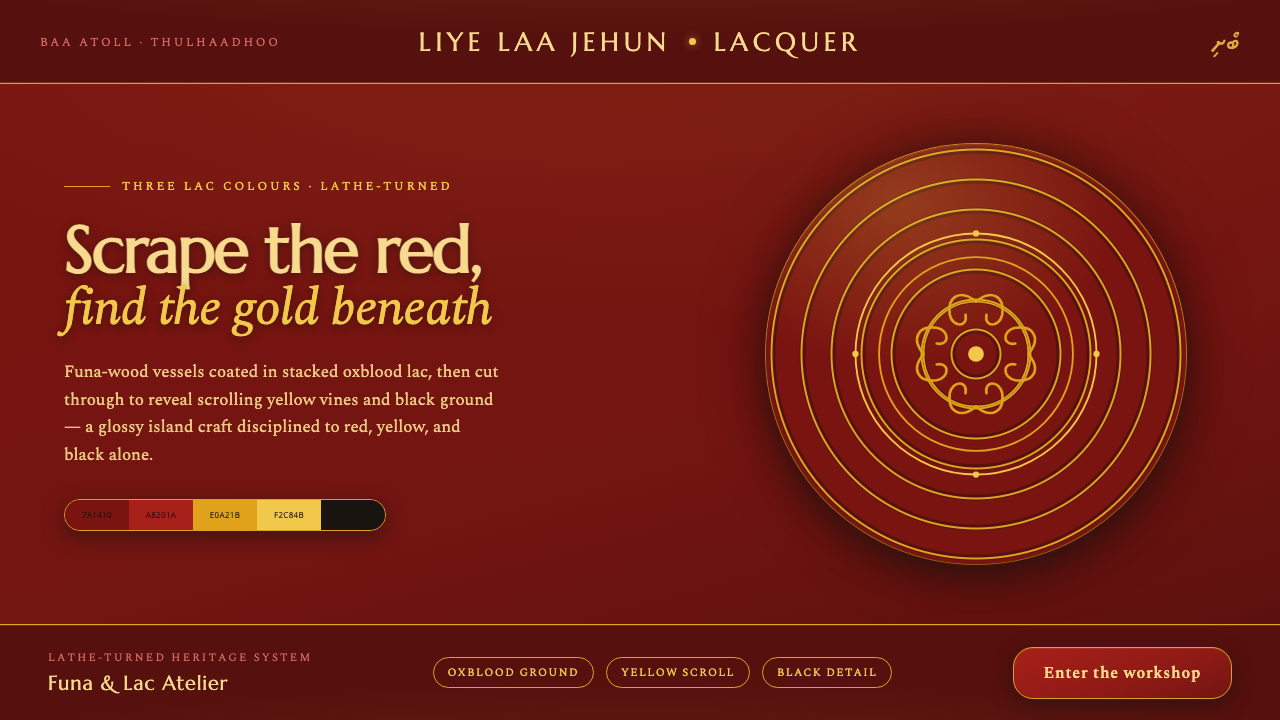 Maldivian Liye Laa Jehun LacquerThree lac colours, nothing else. Glossy oxblood scraped through to yellow scr…