What is Italian Gelato Shop?
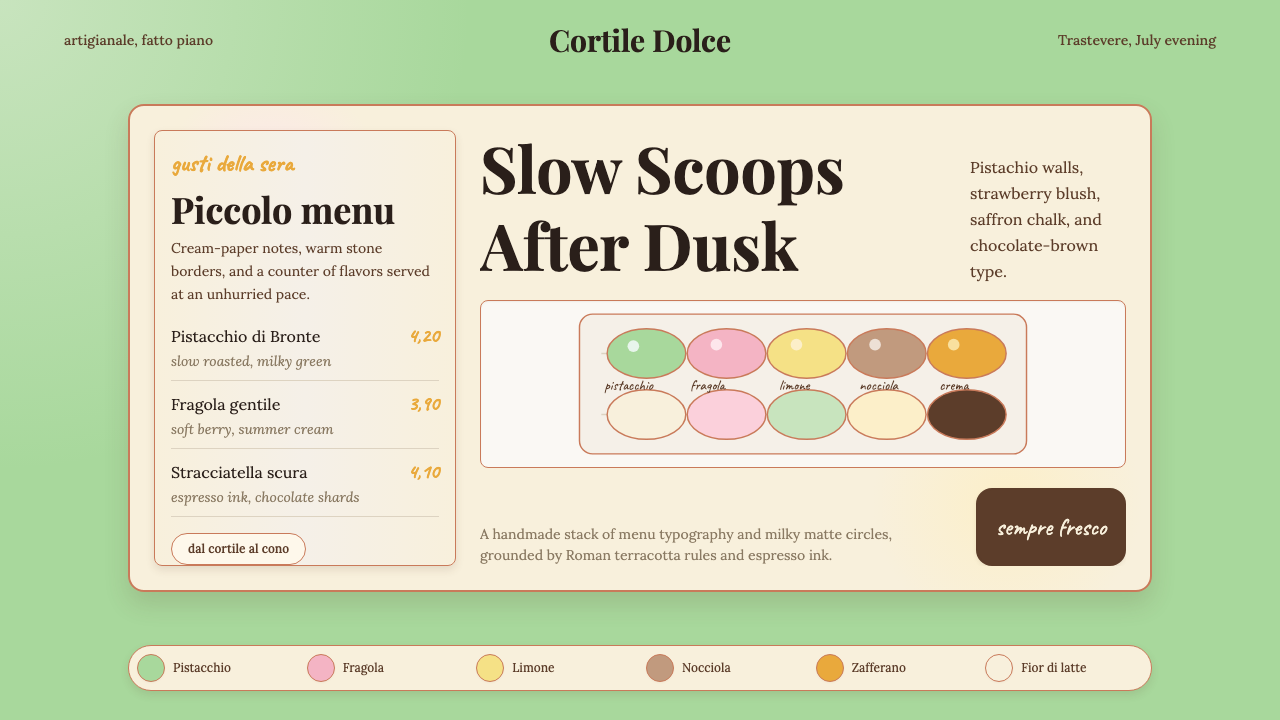
Italy's gelateria counter is a design system in disguise — pastel tubs glowing under warm light, chalk script, and the quiet authority of centuries of craft.
Italian Gelato Shop in brief
The Italian Gelato Shop aesthetic is a visual language drawn from the artisanal gelateria — the neighbourhood ice-cream parlour that has anchored Italian street life since the early modern period. Its palette is built from the colours inside the metal trays: pistachio green, strawberry pink, lemon yellow, hazelnut brown, and the off-white of fresh fior di latte, all held together by a warm terracotta or chocolate ground. Nothing is garish; every hue has been softened by dairy and light until it reaches exactly the temperature of an afternoon in summer.
The system's typographic character comes from the chalkboard. Hand-lettered Italian names — Pistacchio, Fragola, Limone, Stracciatella — appear in a loose, confident script that treats the board surface as a kind of controlled imperfection. When print or digital media adopt this character, they turn to warm serif display faces and hand-drawn lettering that preserve a sense of the maker's hand without becoming decorative pastiche. Body text, where it appears, is set small and quietly, deferring to the flavour names and visual colour blocks.
Texture is the quality that separates this aesthetic from other pastel traditions. The surfaces are not smooth digital gradients but carry the grain of marble countertops, the slight roughness of recycled paper wrapping, the tactile irregularity of hand-trowelled plaster walls. Applied to slides, web interfaces, or print, this means favouring textured backgrounds, slightly irregular hand-lettered elements, and a deliberate avoidance of the sterile smoothness associated with factory production.

Where does Italian Gelato Shop come from?
Gelato's origins in Italy trace back to the sixteenth century, when Florentine court culture gave rise to spectacular dessert performances. Bernardo Buontalenti — architect, engineer, and theatrical designer to the Medici — is credited with refining the iced confections served at Florentine banquets around the 1560s and 1570s. His preparations combined eggs, sugar, milk, and fruit in ratios that produced a denser, creamier freeze than the simple sorbetti already known across the Mediterranean. The aesthetic of those early preparations was already theatrical: displayed in elaborate silver vessels, flavoured with rare spices, and presented as part of a total sensory spectacle.
The tradition spread across Europe through Sicilian emigrant Procopio Cutò, who opened the Café de Procope in Paris in 1686 — the oldest continuously operating café in France and arguably in the world. Procopio's establishment introduced iced desserts to a sophisticated Parisian clientele and established the template for the gelateria as a place of refined leisure: marble surfaces, a carefully arranged display of colours, and a ritual of selection that was itself part of the pleasure. By the eighteenth century, Italian gelato makers — gelatieri — were working across European courts, and their visual vocabulary of pastel-coloured confections in elegant vessels had begun its long career as a signifier of cultivated pleasure.
The modern gelateria as a neighbourhood institution emerged in the nineteenth and early twentieth centuries, as Italian families opened small shops in cities from Rome and Bologna to Turin and Naples. Bologna's La Romana, founded in 1947, represents one of the earliest examples of what would later be called the boutique gelateria: a small, family-run shop committed to traditional recipes, quality ingredients, and a distinctive local identity. The visual language of these shops — marble counters, brass fittings, hand-lettered boards, trays of vibrantly coloured tubs — became the design template the rest of the world would copy.
The contemporary revival of the artisanal gelateria aesthetic dates from the early 2000s, when Federico Grom and Guido Martinetti opened the first Grom location in Turin in 2003, with an explicit commitment to single-origin ingredients and a brand identity that drew on the warm, handmade quality of mid-century Italian shop design. Grom's success — eventually expanding to dozens of locations across Europe, Japan, and the United States — demonstrated that the aesthetic vocabulary of the traditional gelateria could function as a powerful contemporary brand language. The revival coincided with the broader slow-food and artigianale food movements, which positioned artisan production methods and their associated visual codes as a meaningful counterpoint to industrial food culture.
What defines the Italian Gelato Shop look?
Pastel Palette with Warm Ground
The defining colour move is pastel hues — pistachio green, strawberry pink, lemon cream, lavender — set against a warm ground rather than a cool white. The ground reads as terracotta, aged parchment, warm sand, or milky chocolate depending on context, and it is this warmth in the base layer that prevents the pastels from feeling cold or clinical. The pastels themselves are never fully saturated; they carry the optical memory of dairy, of something blended with cream until its intensity softened.
Hand-Lettered Script Typography
The typographic character of the gelateria aesthetic is inseparable from the chalkboard script. Flavour names appear in a loose, flowing hand that is clearly skilled — not rough or amateur — but that preserves the slight irregularity of a person who writes the same board every morning, slightly differently each time. In designed applications, this spirit is captured through warm, humanist typefaces with calligraphic origins for headlines, contrasted against tight, classical roman type for supporting information. The two typographic registers create a dialogue between the handmade and the traditional institutional.
Marble and Counter Texture
The material world of the gelateria is dominated by cool marble countertops, brass trim, and the particular quality of Italian tile — surfaces that have been touched, cleaned, and used for decades and that show it. This material vocabulary translates into design as textured backgrounds that carry visible grain, paper stocks with tooth, and a general preference for surfaces that reveal their physical nature rather than aspiring to seamless digital perfection. Even when rendered digitally, the aesthetic favours slight noise and warmth over pristine flatness.
Generous Warmth Over Minimalism
Unlike cold-palette minimal aesthetics, the gelato shop visual system is deliberately full. A counter display with a dozen flavours visible simultaneously is not cluttered; it is abundant. This abundance is a design value: it communicates choice, generosity, and the confidence of a producer who has many excellent things to offer. In designed layouts, this translates to rich use of colour blocks, full flavour-name labelling, and a composition that allows multiple colours to coexist without any single one dominating aggressively.
Artisanal Imperfection as Signal
The slight drip down the side of a tub, the uneven hand-press of a logo stamp on wax paper, the diagonal chalk line that is almost but not perfectly straight — these are not errors in the gelateria aesthetic; they are its proof of authenticity. A too-perfect, too-regularized version of this style reads as imitation, as a factory product packaging itself in artisanal clothes. Deliberate imperfection — applied with skill so that it reads as confidence rather than sloppiness — is the central authenticity signal.
Warm Serif and Script Contrast
The typographic system layers at least two contrasting registers: a flowing, calligraphic script for names and highlights, and a structured, upright serif for institutional or informational content. This contrast maps directly onto the gelateria experience, where the chalkboard (handmade, personal, changeable) coexists with the more permanent signage and packaging of the brand (official, traditional, authoritative). Neither register is neutral; both carry emotional weight that the combination amplifies.
Layered Colour Blocks and Tray Logic
The visual organisation of the gelateria display — flavours arranged in rows, each in its own tray with its own colour — offers a layout logic applicable far beyond ice cream. Colour blocks are self-contained units, clearly bounded, each occupying its own territory without bleeding into its neighbour. This tray logic produces layouts that feel organised without feeling rigid: the boundaries are clear but the overall effect is warm and browsable, not clinical and taxonomic.

Who shaped Italian Gelato Shop?
Medici court designer and polymath, Buontalenti is credited with creating the refined iced dessert preparations served at Florentine banquets in the 1560s and 1570s, laying the technical and visual foundations of Italian gelato. His involvement meant that gelato began its life as a luxury spectacle — displayed in elaborate vessels, styled for a sophisticated audience — and this origin as a designed, presented experience has shaped the aesthetic of the gelateria ever since.
Sicilian-born Procopio opened the Café de Procope in Paris in 1686, bringing Italian iced desserts to France and establishing a template for the café-gelateria as a site of refined public leisure. His establishment's visual language — marble surfaces, elegant display, a social atmosphere that was simultaneously democratic and aspirational — became the archetype that European and eventually global café culture would imitate for the next three centuries.
Grom co-founded the gelato company that bears his name in Turin in 2003, with a brand concept explicitly rooted in single-origin ingredients and the warm, handmade visual identity of mid-century Italian shop design. Grom's international expansion demonstrated that the artisanal gelateria aesthetic could function as a powerful premium brand language in global markets, and his company's visual and editorial choices — warm palettes, hand-lettered elements, emphasis on provenance — became widely imitated by food brands across categories.
Neapolitan artisan Stefano Ferrara is the foremost contemporary designer of gelato display cases — the refrigerated counters that define the spatial and visual experience of the gelateria. Ferrara's cases, produced in his Naples workshop, are characterized by curved glass, polished metal trim, and a proportional elegance that frames the coloured trays like paintings in a gallery. His work demonstrates that the aesthetic of the gelateria is inseparable from its purpose-built equipment, and that great craft objects can define an entire spatial and visual language.
La Romana represents the tradition of the family gelateria carried across generations — a Bologna institution that has maintained its recipes, its visual identity, and its neighbourhood character since 1947. Its longevity illustrates the durability of the gelateria aesthetic: a combination of consistent colour palette, handmade quality signals, and a spatial atmosphere that reads as both timeless and specific to place. La Romana's brand continuity from the postwar period to the present is itself a lesson in how visual systems based on warmth and craft can outlast trends.
How do you use Italian Gelato Shop today?
The Italian Gelato Shop aesthetic is one of the warmer and more human historical palettes available to contemporary designers, and it transfers well to contexts where warmth, craft, and sensory richness are meaningful brand signals. Applying it correctly requires understanding that this is not a cold-pastel minimal system — it is an abundant, textured, deliberately imperfect one. The palette invites colour, the typography invites handmade variation, and the layout logic invites a browsable richness rather than austere hierarchy.
For presentation slides, the style works particularly well on covers that need to feel inviting rather than authoritative. A cover page built on a warm terracotta or aged-parchment ground, with a large script headline in a warm pastel and a secondary serif line for the subtitle, immediately establishes a tone of quality and care. Content slides benefit from the tray logic: treat each major content block as a self-contained colour unit — a soft pistachio card for one theme, a cream card for another — separated by warm-toned gutters rather than hard lines. Data slides can lean into the coloured-tub palette: bar charts in gelato pastels on a warm ground read as distinctive and memorable without sacrificing clarity.
For web interfaces, the aesthetic suits editorial landing pages, food and hospitality brands, and any product experience where the user should feel welcomed rather than processed. The approach is to build the colour system from the pastel palette — reserving the warmer, deeper anchor colours for navigation and structural elements, and using the lighter pastels as background cards or section colour-coding. Typographic hierarchy should run from a display script or warm serif at headline scale down to a clean, legible roman for body text. Interactive states — hover, selected, active — work well with soft shadow lifts and gentle colour temperature shifts rather than the hard-edge treatments appropriate to more structural styles.
For editorial and marketing content, the style is well-suited to food publications, travel writing, artisanal product marketing, and lifestyle brands that want to position quality and heritage without appearing stiff. A marketing layout in this system typically pairs a full-bleed warm-ground photograph or textured illustration with a large, confident headline in script, then transitions into a structured information layer using upright serif and clear visual hierarchy. Pull quotes can be set in script against a pastel colour block; product or pricing information should be typeset in a more restrained serif to signal reliability alongside warmth.
A common mistake when applying this style is allowing the pastel palette to drift into the cold register — using blue-white grounds instead of warm cream, or choosing pastels with a grey base rather than a warm one. Cold pastels produce a clinical or Nordic-minimal effect entirely at odds with the gelateria character. A related error is over-regularising the handmade elements: a hand-lettered headline that is too perfectly spaced or too mechanically consistent loses exactly the confidence and warmth it was supposed to convey. The goal is controlled imperfection, not chaos, but also not factory uniformity.

Italian Gelato Shop — FAQ
How is this different from other pastel design styles like Scandinavian minimalism or Y2K?
The key differentiator is warmth and texture. Scandinavian minimalism uses pastels on cool, near-white grounds with abundant negative space and a deliberate removal of texture; the effect is serene and clean. Y2K pastels are typically cold-based — bubblegum pinks, sky blues, electric lavenders — deployed with a sleek, synthetic surface quality and often with a digital-chrome sensibility. The Italian Gelato Shop palette is warm-based — creamy, dairy-tinged, honey-influenced — and always accompanied by a preference for organic texture and material authenticity. If Scandinavian minimalism is a calm morning, the gelato aesthetic is a warm evening.
Can this style work for non-food brands without looking like a food company?
Yes, with careful calibration. The gelato aesthetic reads as food-specific only when the full set of its signals is present simultaneously — the chalkboard script, the tub-like colour blocks, the counter-top texture, the Italian-inflected naming. Remove two or three of these signals and what remains is a warm-palette, artisanal-quality visual system that reads as premium craft without being gelateria-specific. Wellness brands, children's educational products, artisanal retail, boutique hospitality, and premium stationery have all successfully borrowed from this palette family. The key is anchoring the warmth in brand-appropriate texture and typography rather than in food-specific visual codes.
Does the style work in dark mode?
The classic gelateria aesthetic is a light-mode system — its warmth comes specifically from the relationship between soft pastels and a warm off-white or parchment ground. A dark inversion is possible, but the result is a significantly different aesthetic: placing the pastel colours on a very dark espresso-brown or near-black ground produces something closer to a vintage trattoria atmosphere than a bright gelateria counter. This dark variant works well for evening-atmosphere applications, cocktail or spirits branding that wants to borrow the Italian food heritage, or premium packaging. However, the core warmth and abundance of the original are harder to preserve; the pastels become accents rather than the dominant register, and the system risks losing its characteristically generous, browsable quality.
How much handmade texture is too much?
The calibration question. The correct amount of handmade texture is the amount that reads as confidence and skill rather than either sterility or chaos. A single hand-lettered headline in an otherwise typeset layout carries the entire warmth of the system; a layout where every element — headline, body text, labels, borders, dividers — is hand-lettered becomes unreadable and precious. The gelateria itself offers the calibration guide: the chalkboard is handmade, but the counter, the signage, and the tubs are not. Structural elements should be clean and consistent; expressive elements — headlines, pull quotes, flavour-name equivalents — can carry the handmade character.
Which contexts is this style poorly suited for?
The Italian Gelato Shop aesthetic struggles in contexts that require communicating rigour, authority, or technical precision above all else. Financial services, legal platforms, medical interfaces, and enterprise software dashboards call for visual languages that signal systematic rationality — the warmth and deliberate imperfection of the gelateria system work against these values. The style also underperforms in contexts where the brand needs to feel cutting-edge or technologically forward: the artisanal sensibility has a heritage quality that positions it as craft and tradition rather than innovation. Finally, in highly data-dense interfaces where maximum information density and legibility are paramount, the textural and typographic richness of this palette can compete with content rather than serving it.
Related design styles
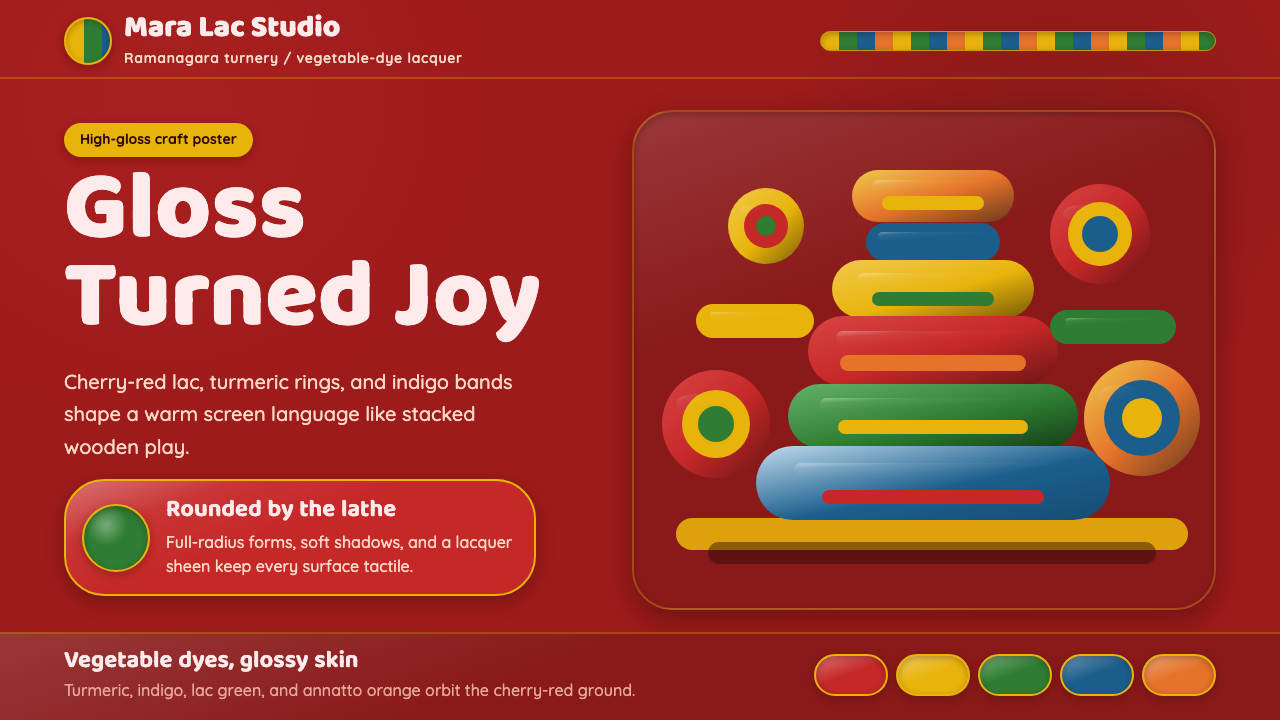 Channapatna Lacquered ToysGloss feels handmade. Lac-red ground and turmeric-indigo bands turn pixels in…
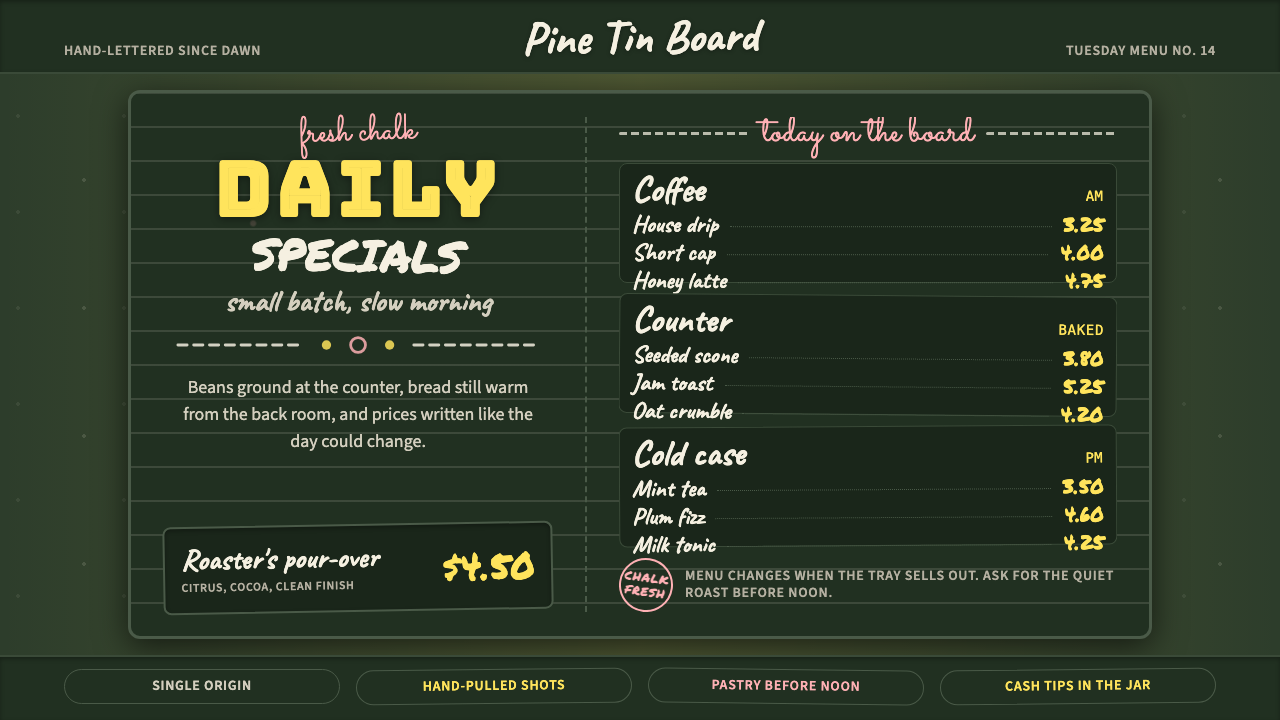 Chalkboard Cafe Menu (2010)Warm craft, handwritten. Chalk-white stacks on green slate with yellow prices…
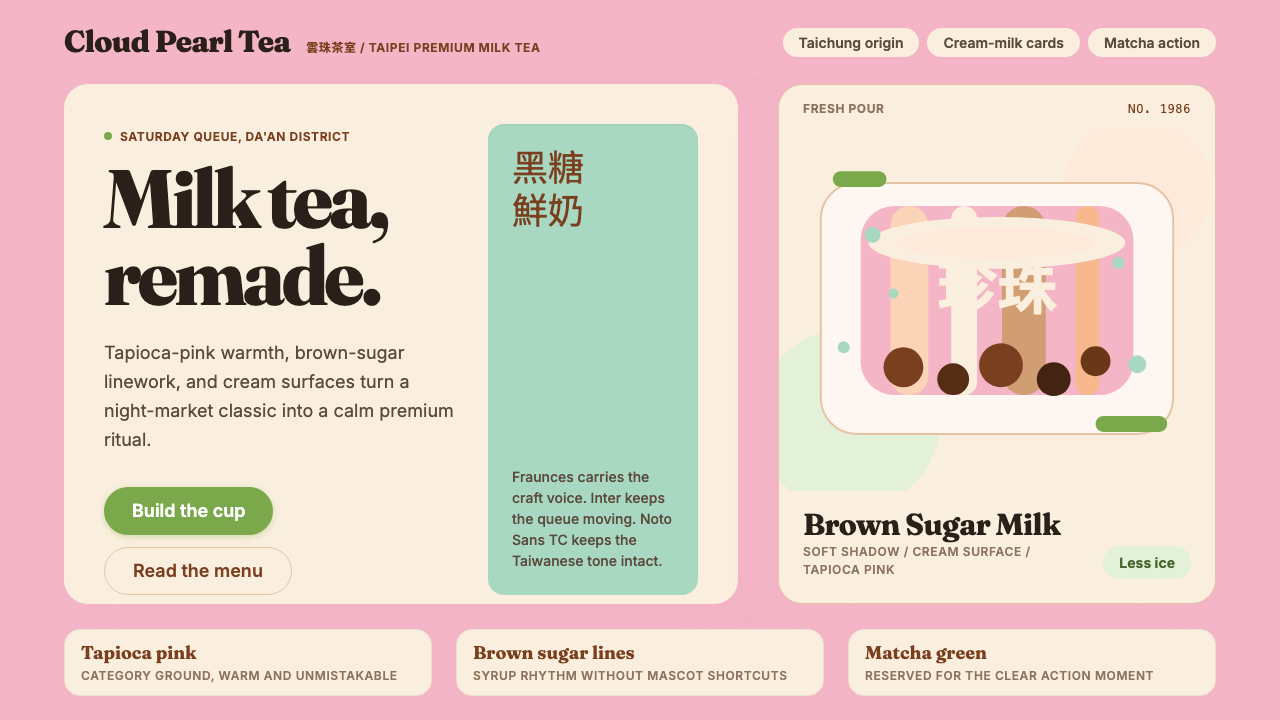 Taiwan Bubble Tea PremiumWarm craft, not kawaii. Tapioca pink, Fraunces serif, cream cards, matcha act…
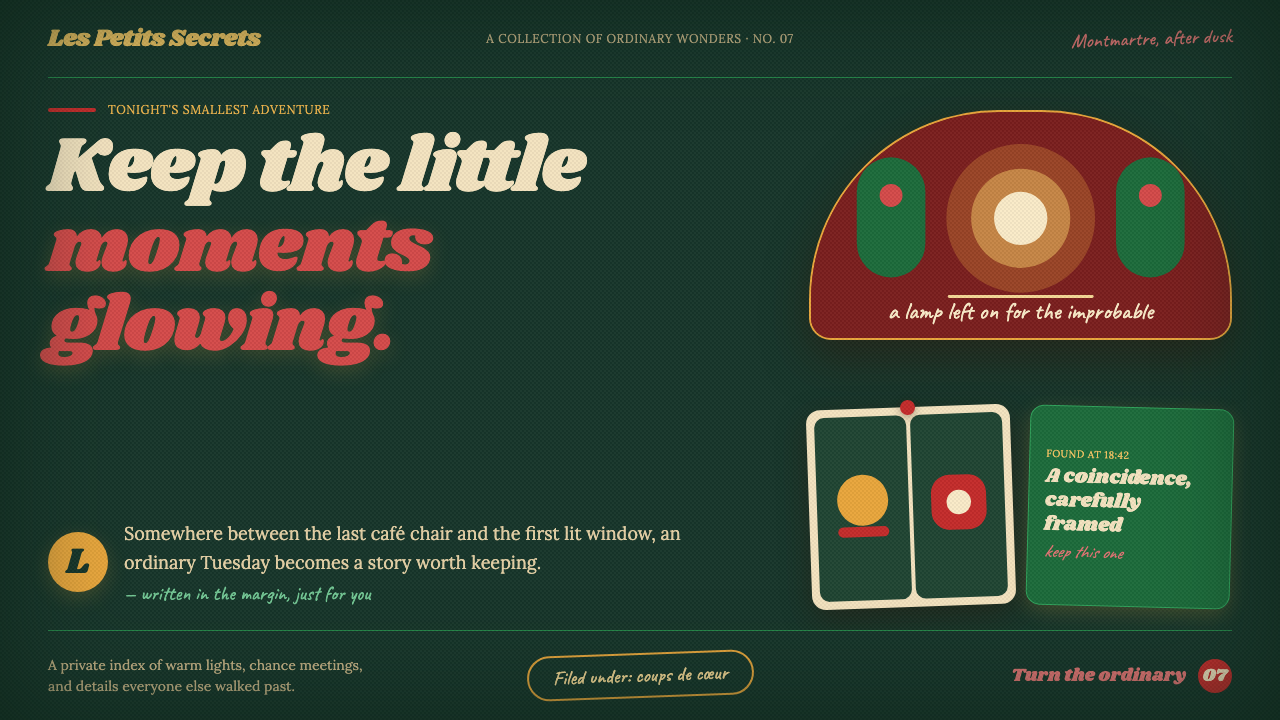 Amélie (Montmartre 2001)Ordinary moments glow like secrets. Storybook green, carmine accents, and cre…
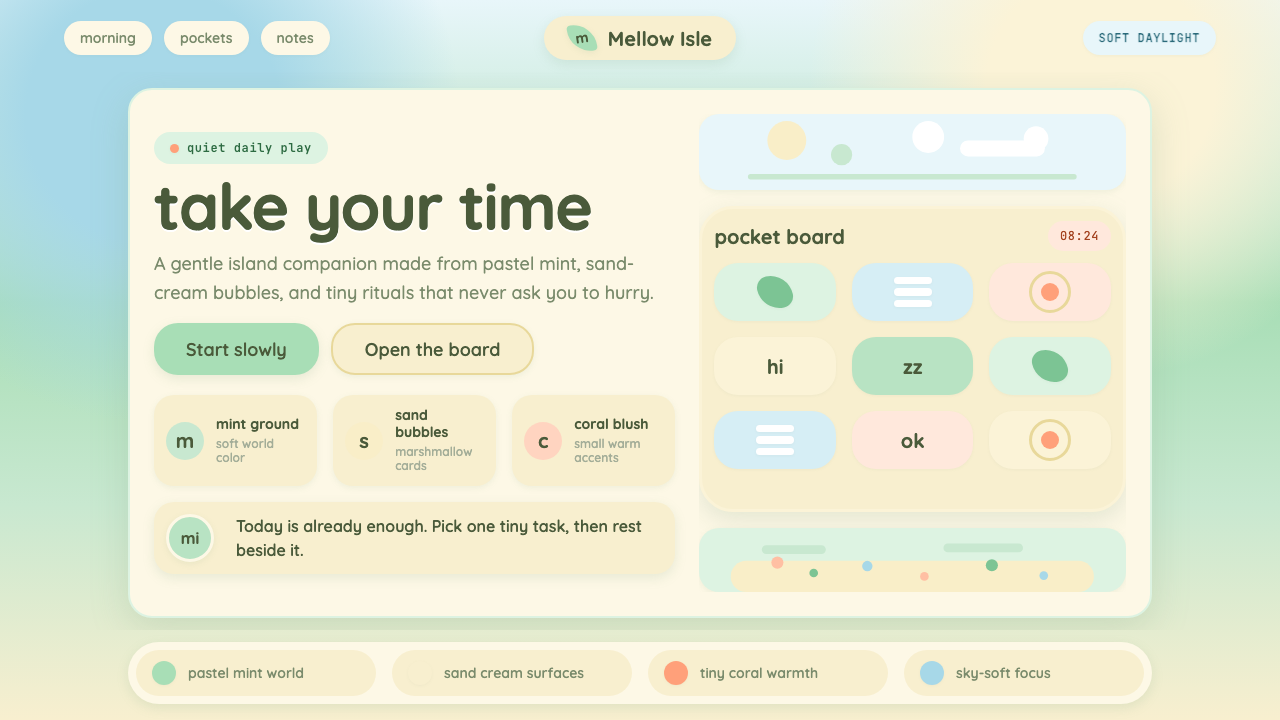 Animal Crossing — New HorizonsNo pressure, only daylight. Mint fields and sand bubbles soften every edge.
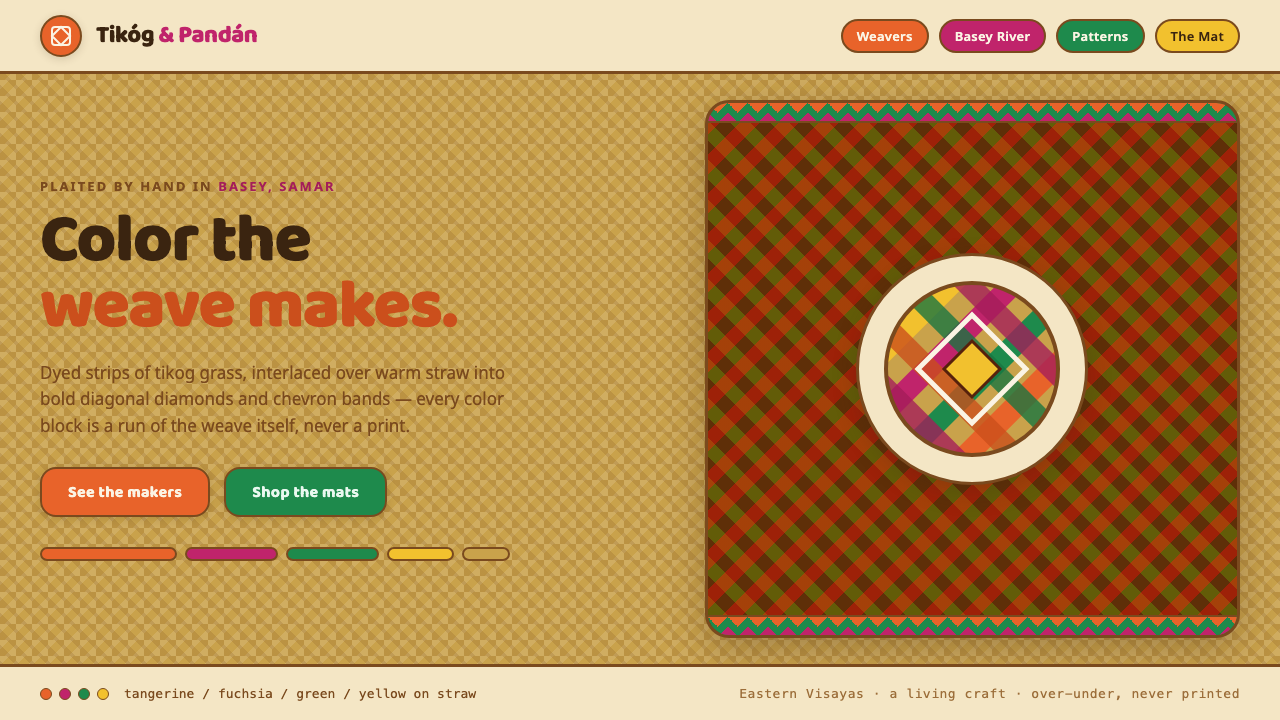 Banig Pandan MatHandwoven Filipino joy. Tangerine, fuchsia and green strips plaited into diag…