What is Coquette Aesthetic Pink Bow (2023)?
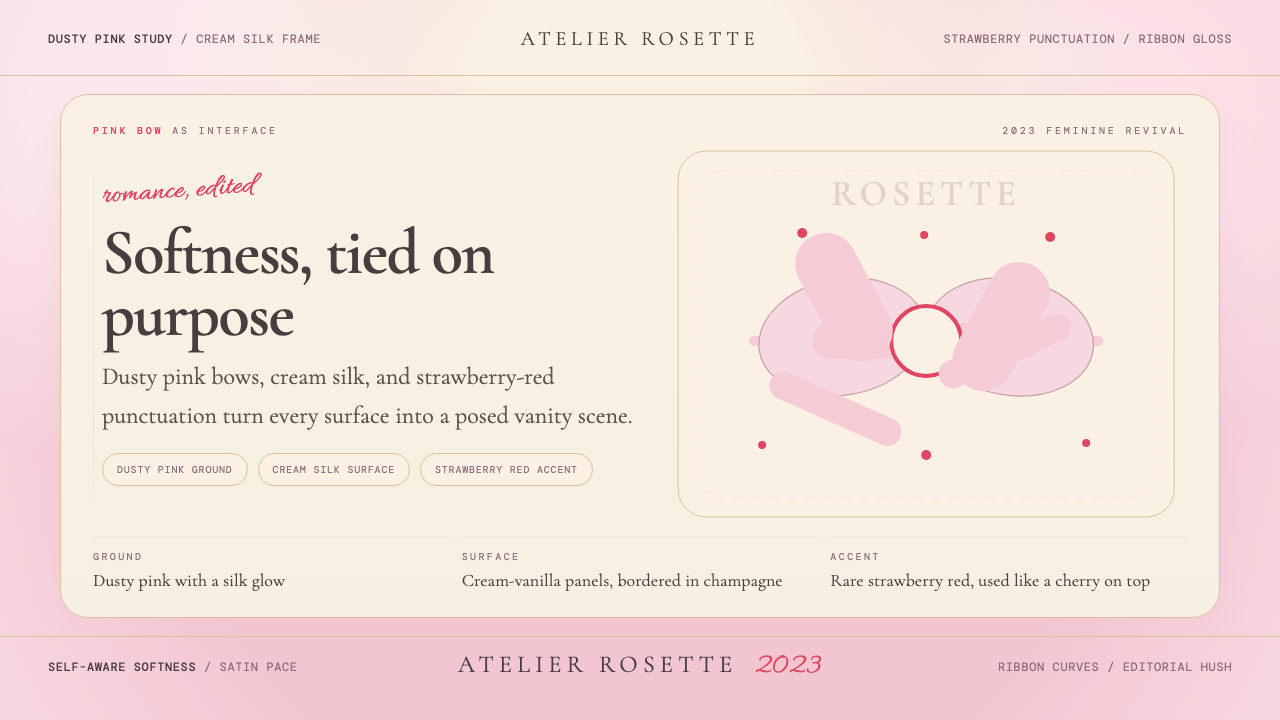
Dusty pink, cream silk, and strawberry-red bows turned self-aware femininity into a full design language — and TikTok made it go global overnight.
Coquette Aesthetic Pink Bow (2023) in brief
The coquette aesthetic is a visual system built from a small, precisely tuned palette — dusty blush pink, warm cream-vanilla, and punctuation accents of strawberry red — arranged on surfaces that evoke the texture of silk or satin laid over antique vanity furniture. Every element curves. Corners soften into ribbons. Hard edges give way to tied bows and gathered fabric. The overall impression is deliberate softness: nothing accidental, nothing casual, nothing without intention.
What distinguishes coquette from generic pastel romance is its ironic self-awareness. This is femininity rendered as a considered interface rather than an inherited default. The aesthetic knows it is performing softness; that performative quality is the point. Objects and compositions feel like they are wearing an outfit, not simply existing. A slide deck in this style does not merely use pink — it argues for pink, presents pink as a position.
Visually, the system is defined by the bow as its central motif — a ribbon tied at center, symmetrical yet organic, simultaneously decorative and structural. Where Bauhaus used the circle, square, and triangle as its visual alphabet, coquette uses the bow and the ribbon curve as its primary formal vocabulary. Layered tulle-like transparencies, frilled or ruffled edge treatments, and delicate serif or script letterforms complete the register.

Where does Coquette Aesthetic Pink Bow (2023) come from?
The coquette aesthetic did not emerge from a design school or a single manifesto. It crystallized on TikTok between 2021 and 2022 from a convergence of fashion, music, and nostalgia, peaking as a cultural dominant in 2023 and continuing into 2024 and beyond. The word 'coquette' — from French, describing a woman who flirts with artful self-presentation — became a hashtag category and then a worldview, adopted predominantly by Gen Z creators in the United States, the United Kingdom, and Brazil, while drawing its cultural references from French and Italian visual traditions.
The deepest historical root is Sofia Coppola's 2006 film Marie Antoinette, whose production design transformed the Palace of Versailles into a pastel fever dream of macarons, ribbon-tied hatboxes, and silk gowns in blush, cream, and lavender. Coppola's deliberate use of anachronism — pairing eighteenth-century court dress with a New Wave soundtrack — established the template for the coquette sensibility: historical femininity refracted through contemporary irony. That film's visual language was not widely codified as an aesthetic movement until TikTok provided the infrastructure for micro-taste communities to name and amplify it.
Fashion was the second accelerant. New York designer Sandy Liang had been building a bow-centric design vocabulary since the late 2010s, with her collections featuring cascading bow embellishments on fleece, tailoring, and knitwear that felt simultaneously childlike and sophisticated. When Liang's work reached broader cultural visibility around 2022 and 2023, it gave the TikTok coquette aesthetic a high-fashion anchor. Simultaneously, Phoebe Philo's austere-romantic approach to womenswear — restraint with unexpected softness — provided a secondary reference point for creators who wanted to position the aesthetic as intelligent rather than merely cute.
Lana Del Rey's musical world supplied the emotional grammar. Her albums from Ultraviolence (2014) through Did You Know That There's a Tunnel Under Ocean Blvd (2023) built an extended meditation on romantic melancholia, Americana nostalgia, and a kind of doomed femininity that is fully conscious of its own performance. Del Rey's aesthetic — floral headbands, vintage silk slips, the visual language of old Hollywood — translated readily into coquette imagery, and her fanbase formed a significant portion of the movement's early community. By 2023, the convergence of Coppola's film legacy, Sandy Liang's runway vocabulary, Phoebe Philo's intellectual framing, and Del Rey's emotional landscape had produced a coherent aesthetic system with global reach and genuine expressive depth.
What defines the Coquette Aesthetic Pink Bow (2023) look?
Color Palette
The palette is built from three anchors in careful relation to each other: dusty blush pink as the dominant ground, warm cream-vanilla as the secondary surface tone, and strawberry red as the accent punctuation. None of these colors is saturated at full intensity — each carries a muted, slightly faded quality, as if the hues have been softened by years of sunlight filtering through lace curtains. The overall temperature is warm and slightly powdery. Deep black and cool neutrals are used sparingly, if at all; when contrast is needed, it comes from the strawberry red rather than from darkness.
The Bow Motif
The bow is the defining formal signature of the coquette aesthetic — the equivalent of the geometric circle in Bauhaus or the floral arabesque in Art Nouveau. It appears at multiple scales: as a structural centerpiece on a hero image, as a small recurring decorative detail at section breaks, as a pattern element tiled across a background. The bow's shape implies tying and being tied, revealing and concealing simultaneously — qualities that map onto the aesthetic's broader sensibility of deliberate self-presentation. A bow is never merely ornamental within this system; it is the system's argument rendered as a form.
Soft Texture and Surface
Where Bauhaus insists on flat, material-honest surfaces, coquette actively simulates texture — the sheen of silk, the translucency of tulle, the slight crumple of satin ribbon. Backgrounds may carry a subtle fabric-like grain or a very gentle gradient that suggests the drape of cloth rather than a digital ramp. Layering is essential: elements sit on top of each other in a way that implies physical depth without abandoning the decorative register. The goal is not photorealistic simulation but an idealized memory of how certain fabrics feel to the eye.
Typography
Type in the coquette aesthetic gravitates toward high-contrast display serifs and flowing script faces — letterforms that feel hand-crafted or historically resonant rather than mechanically produced. Body text, when present, is typically set in a refined old-style serif that feels like it belongs on the pages of a nineteenth-century French novel. Tracking is generous; line spacing is airy. Type is never heavy or muscular; even at large display sizes, it retains a delicate, ribbon-like quality. All-capitals usage is rare — the lowercase feels more suited to the register of intimate, personal address.
Ornament as Structure
The coquette aesthetic inverts one of Bauhaus's most fundamental principles. Here, ornament is not waste — it is the primary communicative device. Decorative borders, scalloped edges, repeated ribbon motifs, and delicate line-work flourishes are not applied after the composition is resolved; they are the composition. This does not mean that anything goes: the ornamental vocabulary is tightly controlled, and the difference between an authentic coquette composition and an undisciplined one is whether the decorative elements are selected from the same controlled family and arranged with internal consistency.
Romantic Melancholy
The emotional register of coquette is not cheerful or exuberant — it is wistful, slightly dreamy, and tinged with the kind of melancholy that looks beautiful rather than painful. Images may reference wilting flowers, diary pages, antique mirrors, handwritten letters. Color combinations feel like faded photographs rather than fresh pigments. This melancholic undercurrent differentiates coquette from simpler kawaii or bubblegum pink aesthetics: it implies interiority, narrative, and time — the sense that the person behind this visual world has a rich and slightly sad inner life.
Ironic Self-Awareness
Perhaps the most sophisticated quality of the coquette aesthetic is that it is never naive about itself. The softness is theatrical; the bows are chosen, not given. This self-awareness shows up visually through slight exaggeration — bows that are a size too large, compositions that are a degree too precious, color that is a note too sweet. The excess is calibrated. When designing in this style, the most successful work sits in the narrow register where the visual language is legible as a deliberate choice rather than an accidental one.

Who shaped Coquette Aesthetic Pink Bow (2023)?
Coppola's 2006 film Marie Antoinette is the primary visual source for the coquette aesthetic. Her art direction — pastel macaron palettes, silk-draped chambers, ribbon-tied accessories — translated the excess of the French court into a deliberately modern, anachronistic fantasy. The film treated historical femininity not as museum artifact but as a living, desirable mode of self-expression. Its visual language provided the aesthetic with a cinematic authority that TikTok creators could reference and remix, giving the movement depth beyond pure trend.
Liang is the designer most directly responsible for translating coquette sensibility into wearable high fashion. Her New York-based label built an extended vocabulary around the bow — appearing on fleece pullovers, suiting, ballet flats, and eveningwear — that combined childhood nostalgia with adult sophistication. When her collections gained broader cultural visibility after 2021, they provided concrete design evidence that the coquette aesthetic could be deployed with seriousness and craft. Her bow-centric visual language is the most direct precursor to the motif's appearance in graphic design and digital interfaces.
Del Rey's musical and visual world provided the emotional grammar that distinguishes coquette from simpler pink aesthetics. Her body of work from the early 2010s through the mid-2020s developed an extended meditation on romantic melancholy, performance of femininity, and the aesthetics of nostalgia — florals, vintage slip dresses, old Hollywood imagery — that became the emotional backbone of the coquette sensibility. Her fanbase was among the earliest communities to formalize and name the aesthetic, and her visual references remain foundational touchstones for practitioners of the style.
Philo's influence on coquette is more indirect but genuinely present. Her work at Céline (2008–2018) and later under her own name established a template for femininity that was simultaneously restrained and emotionally rich — never girlish, but never cold. Her vocabulary of unexpected softness within otherwise severe tailoring gave the coquette aesthetic a counterweight against pure sweetness, suggesting that the sensibility could carry intellectual seriousness. Designers and creators who wanted to position coquette as more than trend frequently cited her work as evidence that extreme femininity and sharp thinking were not opposites.
The historical queen functions in the coquette aesthetic not as a political figure but as a visual archetype — the ultimate embodiment of femininity as spectacle, excess, and deliberate self-fashioning. The Versailles court's visual language: blush brocades, towering powdered wigs, ribbon-trimmed gowns, porcelain skin — was already a highly constructed aesthetic performance in its own time. Coppola's film reactivated this material, and TikTok creators further distilled it into the coquette visual vocabulary. Marie Antoinette stands as the movement's primary historical icon: not emulated but sampled.
How do you use Coquette Aesthetic Pink Bow (2023) today?
Applying coquette correctly to designed artifacts requires understanding that the style's emotional register is its primary value proposition — warmth, intimacy, deliberate femininity — and that every compositional decision should serve that register. Unlike Bauhaus, where the principles are structural and transferable across cold contexts, coquette works only where softness is appropriate and desired. The most common misapplication is using the color palette without the motif system, or using the motif system without the emotional tone — producing something that looks vaguely pink but communicates nothing coherent.
For presentation slides, the coquette aesthetic is well-suited to brand story decks, investor presentations for consumer and lifestyle brands, editorial pitch documents, and any context where the presenter wants to signal taste, care, and personal investment. A cover slide works best with a single large bow motif centered or offset on a cream ground, the presentation title set in a display serif, and a strawberry-red detail as punctuation. Content slides should use generous white space — cream or blush ground with light text at an airy line height — with section titles in script or high-contrast serif and body text in a refined smaller face. Data slides can carry the aesthetic through color assignment: pink for the primary metric, cream for supporting data, strawberry red for a highlight value or call-out annotation.
For web interfaces, the coquette aesthetic is most natural in contexts aligned with its cultural origins: beauty and skincare brands, fashion e-commerce, wedding planning tools, lifestyle editorial platforms, personal portfolio sites, and any subscription or membership product targeting an audience that values self-expression and aesthetic intentionality. Dashboard and pricing page design can work in this style when the product itself is aspirational: use cream as the page ground, blush card surfaces with very soft shadow or subtle border, strawberry red for primary call-to-action buttons and alert states, and a display serif for hero headings. Navigation should be spacious and typographic — script or refined serif wordmarks, generous padding, no aggressive icon systems.
For editorial and marketing work, coquette supports strong visual storytelling with high emotional immediacy. Feature editorial layouts work well with full-bleed blush or cream image backgrounds, display serif headline typography layered over the image, and bow or ribbon graphic elements used as pull-quote ornaments or section dividers. Marketing campaign assets — social cards, email headers, landing page heroes — benefit from the style's poster-like quality: one strong central image (a bow, a ribbon-tied product, a soft-focus floral), title text in large display serif, and a minimal copy block in a smaller refined face. The key is restraint in the number of decorative elements: three or four carefully chosen ornamental details create a richer effect than a surface covered in competing motifs.
A common mistake when applying the coquette aesthetic is confusing softness with lack of structure. The most effective coquette compositions are precisely organized beneath their decorative surface — type is aligned to a grid, hierarchy is clear, reading order is unambiguous. Another frequent error is over-saturating the pink: dusty and muted is correct; hot pink or bubble-gum pink breaks the tonal register immediately. Similarly, mixing typefaces from incompatible periods — pairing a Victorian swash font with a modern geometric sans, for instance — undermines the historical coherence that gives the aesthetic its authority. Choose typefaces that feel like they belong to the same imaginary wardrobe, and ensure every decorative element could have appeared on the same antique vanity table.

Coquette Aesthetic Pink Bow (2023) — FAQ
Is the coquette aesthetic the same as kawaii or Y2K pink?
They share color adjacency but are emotionally and historically distinct. Kawaii originates in Japanese youth culture and is characterized by rounded, cheerful, maximally approachable forms with a palette that skews toward bright, saturated pinks and pastels. Y2K pink draws on the futurism of early-2000s consumer electronics — metallics, iridescence, a slightly ironic techno-optimism. Coquette is older in its references — eighteenth-century French court, early-twentieth-century boudoir, 1950s romantic femininity — and carries a specific emotional tone of wistful melancholy that kawaii and Y2K do not. The colors are also categorically different: coquette's palette is intentionally dusty and muted, while kawaii and Y2K pink are typically at higher saturation.
Can the coquette aesthetic work for non-fashion or non-beauty brands?
Yes, with careful mapping of values. The aesthetic works whenever a brand's desired emotional register overlaps with what coquette communicates: intimacy, care, deliberate self-expression, warmth, and a slightly romantic view of the world. A literary publisher producing poetry collections, a boutique hotel with a nostalgic interior design approach, a wellness brand positioning itself around self-care rituals, or an artisanal food producer with a French-inflected brand story can all use coquette elements with genuine coherence. The style struggles for brands that need to convey authority, technical precision, scale, or institutional trustworthiness — a financial services platform or a B2B SaaS product is unlikely to benefit from bow motifs and dusty pink grounds.
How do you prevent coquette from reading as childish or unprofessional?
The key is the ironic self-awareness that is intrinsic to the aesthetic. Coquette at its most sophisticated is never naive — it is always performing softness rather than simply being soft. In practical terms: maintain precise typographic hierarchy so reading order is unambiguous; keep the ornamental vocabulary tightly edited to three or four recurring elements rather than saturating every surface; ensure that blush and cream tones are genuinely muted rather than bright or candy-sweet; and treat layout structure with the same rigor you would bring to any other style. The professional register is preserved not by reducing the aesthetic's intensity but by making visible the intentionality behind every choice.
What is the difference between coquette and dark academia or old money aesthetic?
All three aesthetics share an interest in historical reference, literary or cultural depth, and a rejection of corporate-contemporary blandness. But they occupy very different emotional and chromatic registers. Dark academia is cool, shadowed, and intellectually austere — its palette of charcoal, deep brown, and muted olive references autumnal libraries and candlelit study. Old money aesthetic values restraint and inconspicuous quality — navy, ivory, and heritage tweed — and its emotional register is measured confidence rather than romantic longing. Coquette is the warmest and most emotionally expressive of the three, the only one where decoration is embraced rather than avoided, and the only one where melancholy is aestheticized rather than suppressed. They can be in conversation with each other — a brand might use coquette's warmth with old money's restraint — but mixing them carelessly produces incoherence.
Is the coquette aesthetic tied to a specific gender audience?
The aesthetic emerged from and is primarily practiced within feminine-identified communities, and its historical references — eighteenth-century court femininity, Sandy Liang womenswear, Lana Del Rey's self-presentation — are explicitly gendered. However, as a design system applied to products and communications rather than to personal identity, its utility is determined by emotional register rather than by the gender of the end user. A brand targeting any audience that values warmth, intimacy, and aesthetic care can use elements of the coquette vocabulary without those choices being gendered in the final user's experience. The more relevant question for designers is whether the style's emotional values align with the product's promise — and that alignment is context-dependent, not gender-determined.
Related design styles
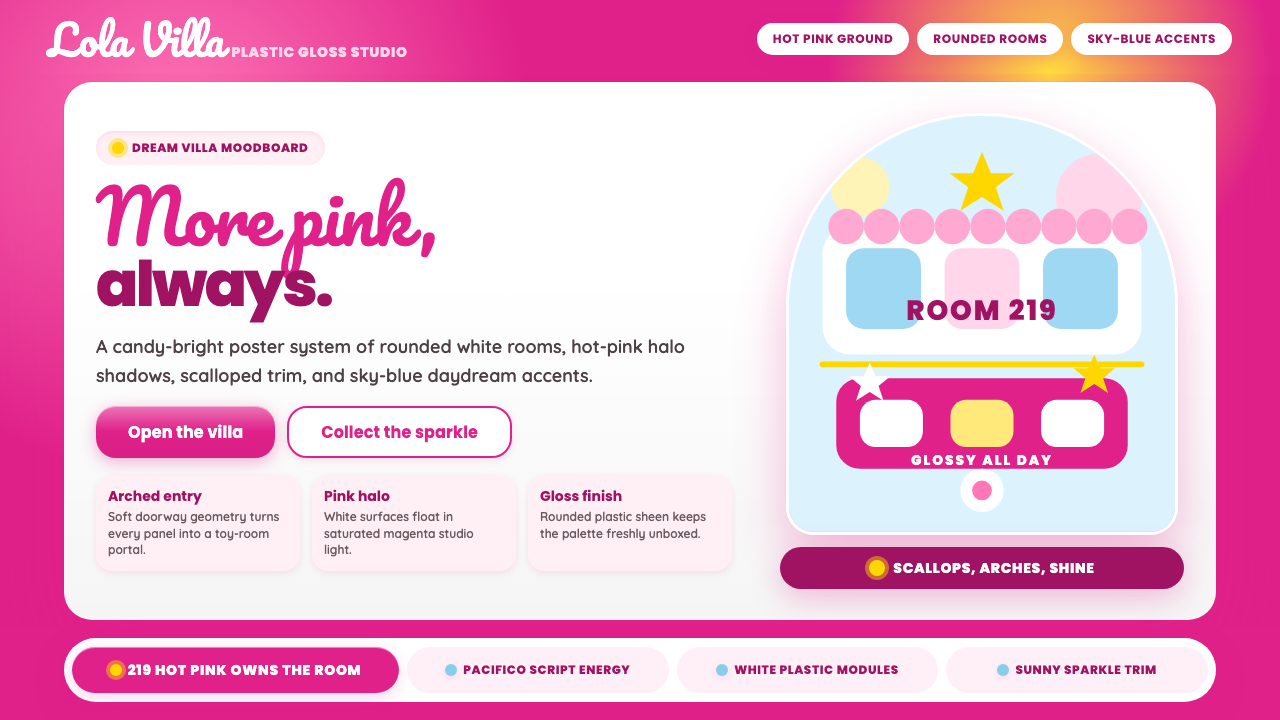 Barbie DreamhousePink is the whole world. Hot magenta ground, Pacifico script, scallops and gl…
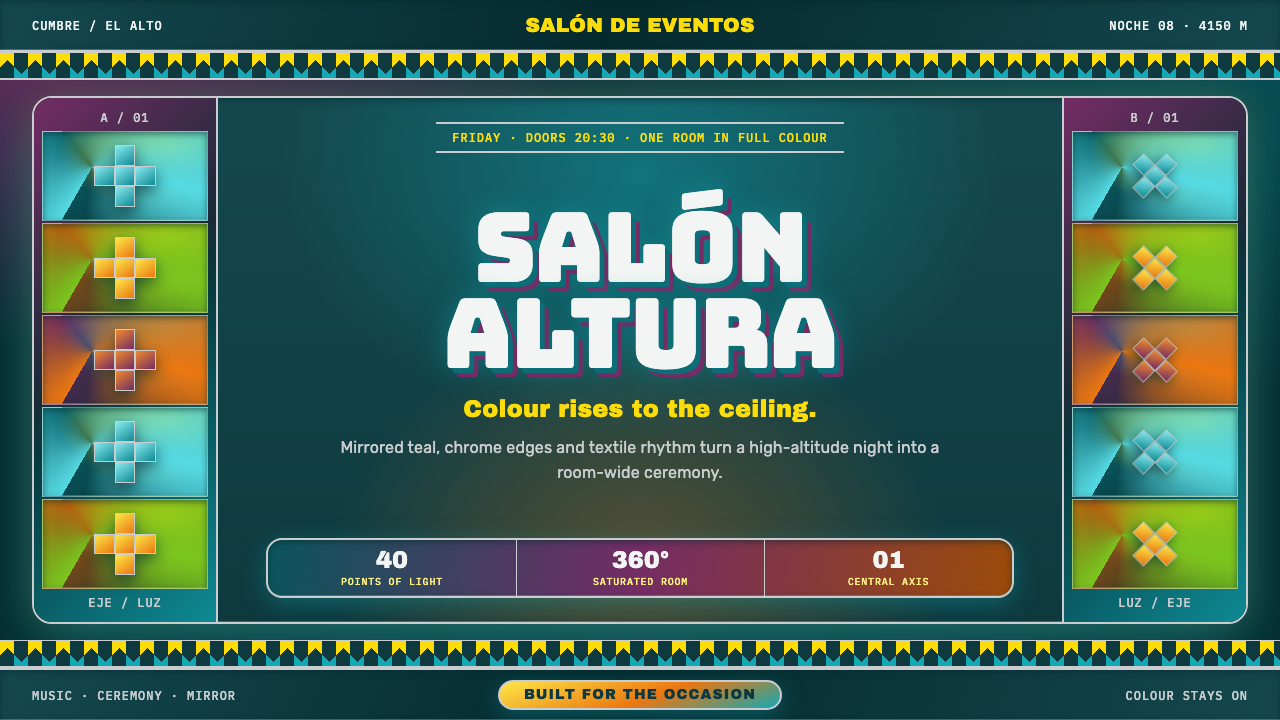 Cholet — Freddy MamaniSaturation is the architecture. Mirrored teal, chrome trim and textile geomet…
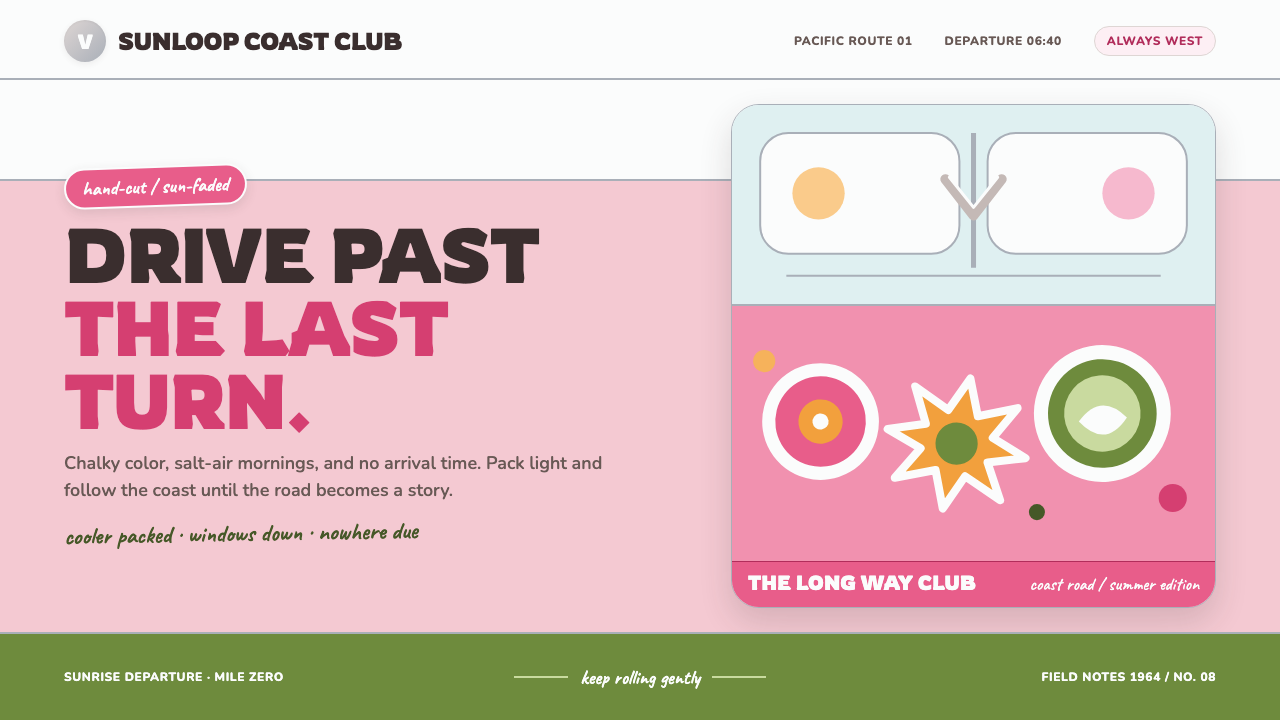 VW Bus Flower-Power (1964)Road-trip optimism in chalky pastels. Rounded type rides pink, white, and chr…
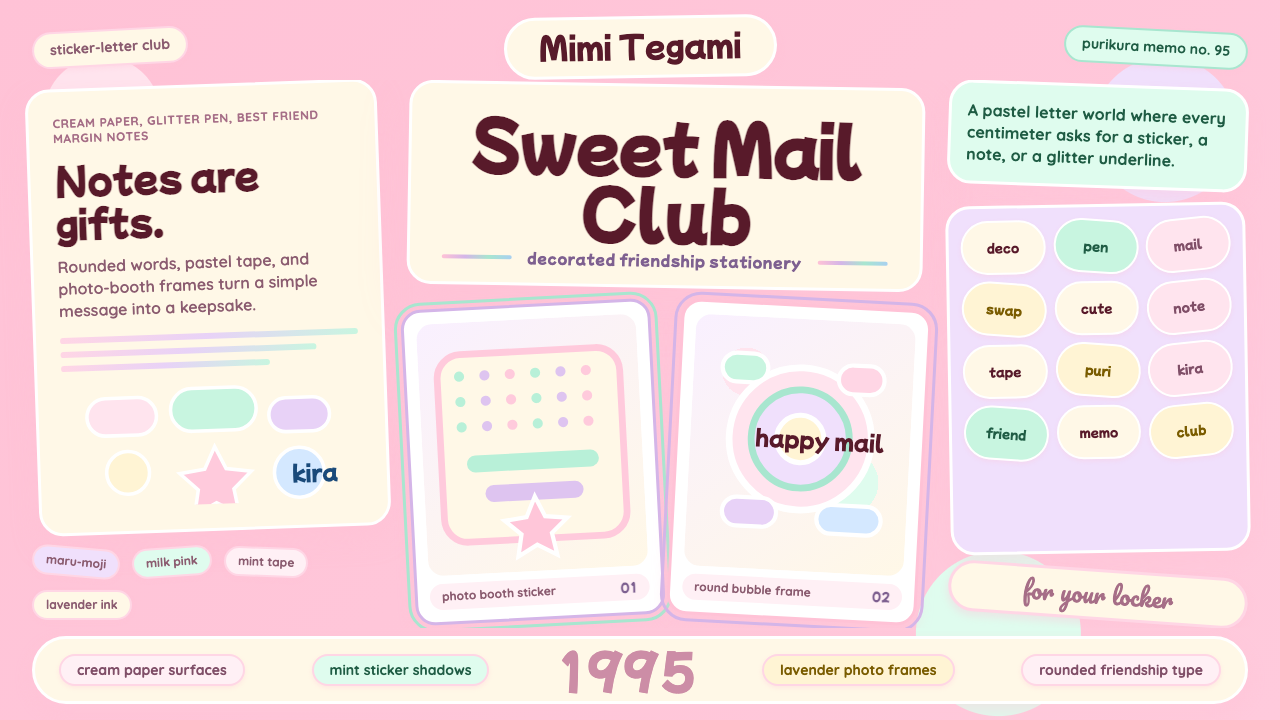 Kawaii Japanese Letter PurikuraCuteness fills every inch. Pink cream paper, mint stickers, lavender frames.
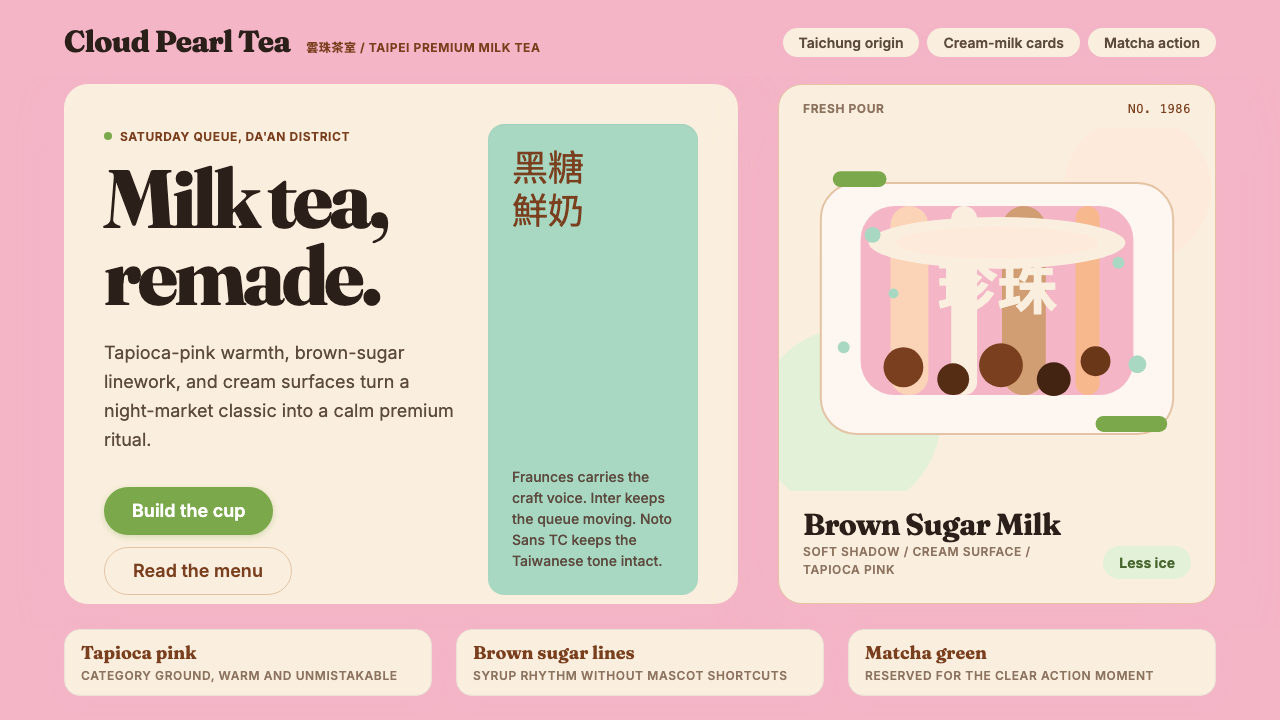 Taiwan Bubble Tea PremiumWarm craft, not kawaii. Tapioca pink, Fraunces serif, cream cards, matcha act…
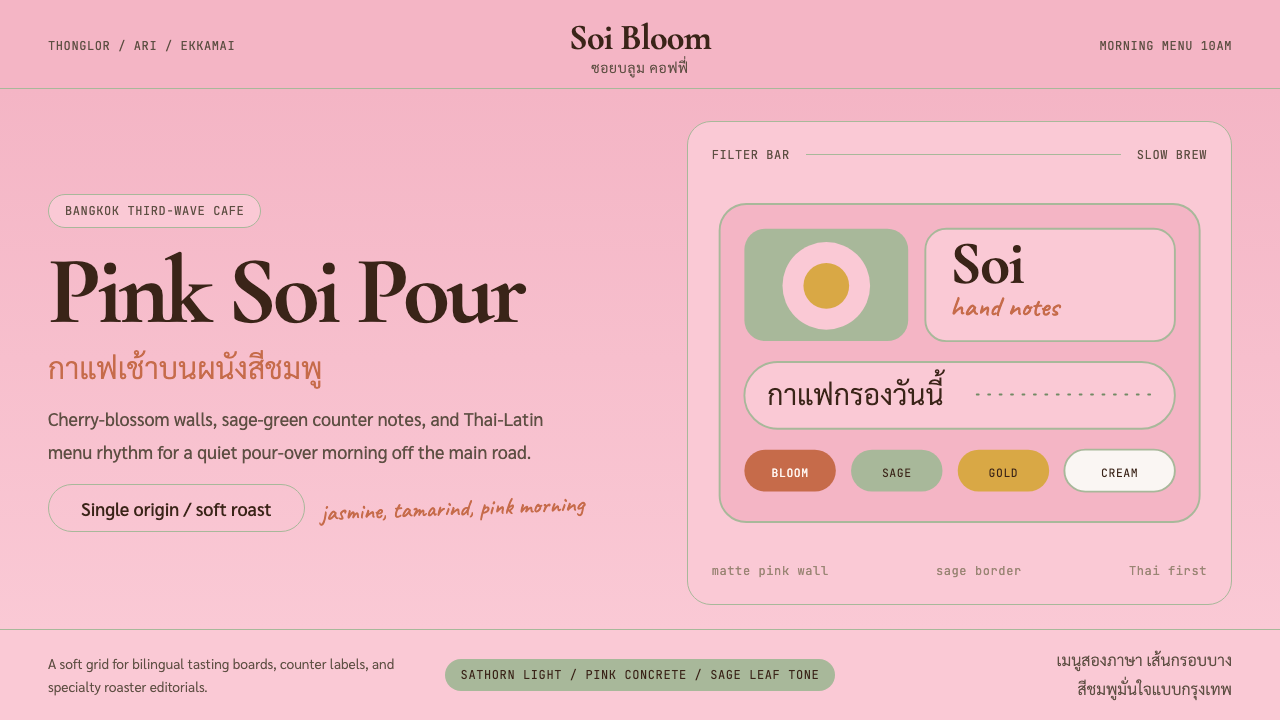 Bangkok Third-Wave CafeBangkok feels soft but sure. Cherry pink, sage borders, and Thai-Latin menu r…