What is Bolivian Cholita (Bowler-Hat Fiesta)?
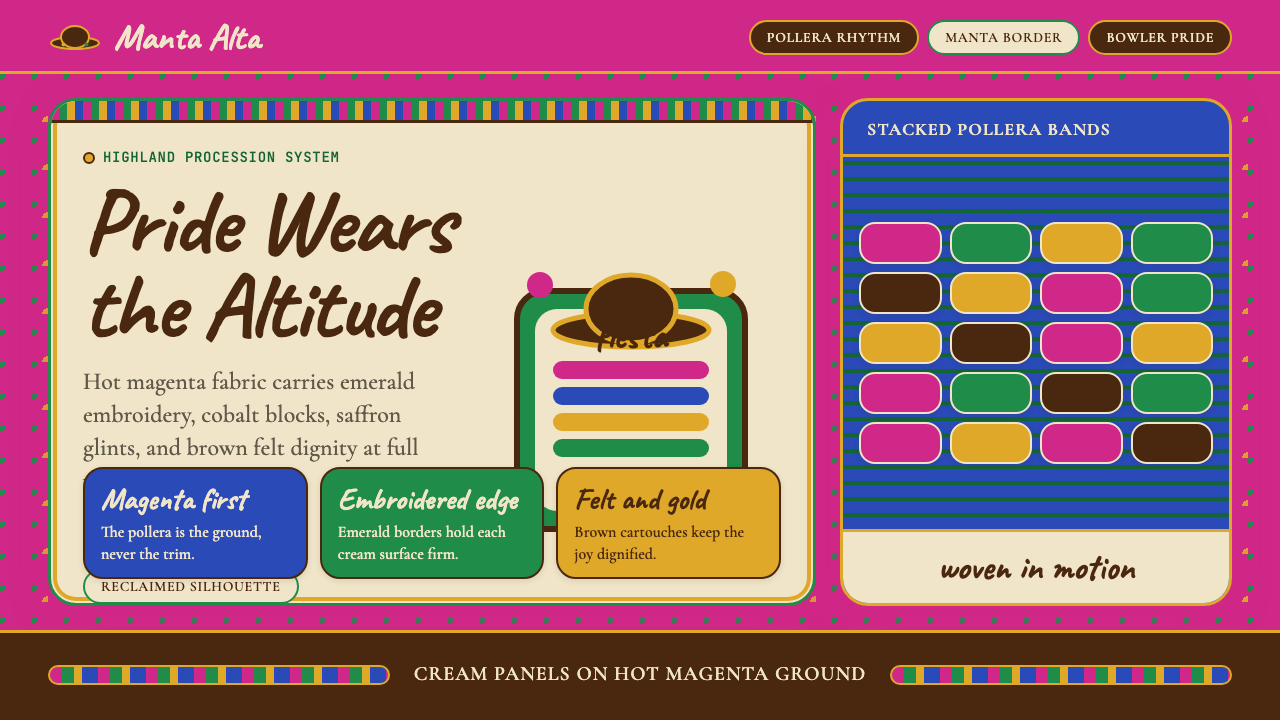
The cholita aesthetic transforms colonial imposition into radiant Indigenous pride — hot magenta pollera skirts, cobalt embroidery, and the bowler hat that became a crown.
Bolivian Cholita (Bowler-Hat Fiesta) in brief
The Bolivian Cholita design system is rooted in the everyday dress of Aymara and Quechua women in the high-altitude cities of La Paz and El Alto. What began as a dress code imposed during the colonial era evolved, over generations, into one of the most visually commanding and culturally charged aesthetics in the Americas. The cholita silhouette — layered pleated skirt, richly embroidered shawl, and iconic bowler hat — is now inseparable from Bolivian national identity and global recognition of Indigenous feminine power.
Visually, the style is defined by maximum chromatic intensity. The palette draws on the deep, saturated hues of Andean textiles: hot magenta and rose dominate the pollera fabric, while emerald green and cobalt blue animate embroidered borders and manta shawl edges. Saffron yellow appears as a luminous accent, and warm brown felt anchors the palette with the earthy texture of the bowler hat. These are not pastels or muted tones — they are colors worn to be seen across a mountain plaza.
The visual system organizes itself around layering, contrast, and movement. Horizontal bands of contrasting color run along skirt hems and shawl borders, creating a rhythmic structure that reads boldly at distance. Embroidery adds dense floral and geometric motifs within these bands, layering handcraft over woven ground fabric. The silhouette as a whole suggests abundant volume and kinetic energy — a moving, swirling presence rather than a static composition.
Where does Bolivian Cholita (Bowler-Hat Fiesta) come from?
The history of the cholita aesthetic cannot be separated from the history of colonial subjugation and Indigenous resilience in the Andean highlands. Following the defeat of the Tupac Katari uprising in 1781, Aymara women in the colonial urban centers of Upper Peru were subjected to dress codes designed to mark social hierarchy. The pleated skirt — known as the pollera — and the layered shawl were originally worn under conditions of enforced visibility as markers of subordinate status. Colonial authorities used clothing as an instrument of social control.
The bowler hat's arrival tells a particularly resonant story. Around the 1920s, a shipment of British-made bowler hats — originally destined for European railway workers — arrived in Bolivia either oversized or misdelivered for their intended recipients. According to the most widely circulated version of the story, a merchant promoted them to Aymara women as the fashionable hat of European high society. Whether by commercial ingenuity or historical accident, Aymara women adopted the bowler, adapted it to their own aesthetic logic — tilted to the side, set atop elaborate braided hair — and transformed it into an unmistakable symbol of feminine dignity and cultural identity.
The post-1952 Bolivian Revolution nominally abolished racial caste distinctions, but social discrimination against cholas persisted in practice for decades. The explosive growth of El Alto — a high-plateau city adjacent to La Paz that became one of the largest Aymara urban centers in the world — created the social and economic conditions for a cholita cultural renaissance. By the 1990s and accelerating sharply after Evo Morales came to power in 2005, wearing the pollera and bowler in professional, civic, and public spaces became an explicit assertion of Indigenous rights rather than a mark of marginalization.
The contemporary cholita empowerment movement has spawned remarkable cultural phenomena: the Cholitas Escaladoras de Bolivia, a group of Aymara women who climb Andean peaks in full traditional dress; cholita lucha libre wrestlers who perform in packed arenas in La Paz; and a growing cholita fashion industry centered on the ateliers of El Alto, where designers produce increasingly elaborate pollera ensembles for quinceañeras, weddings, and civic festivals. The fiesta aesthetic — the full-volume, maximally ornamented version of the cholita dress — represents this tradition at its most celebratory and its most defiant.
What defines the Bolivian Cholita (Bowler-Hat Fiesta) look?
Color
The palette is built on maximum chromatic saturation, drawing directly from the tradition of Andean woven textiles. Hot magenta and deep rose anchor the palette as the dominant warm tones of the pollera skirt. Emerald green and cobalt blue provide the cool contrasting forces, appearing most prominently in embroidered bands and shawl borders. Saffron yellow punctuates as a high-energy accent. The combination is deliberately loud — these are celebration colors intended to project joy and presence across a crowded fiesta plaza, not to harmonize into a subtle system.
Layering and Textile Structure
The defining visual logic is additive layering. Multiple petticoats support the full volume of the pollera, while the outer skirt displays a structured horizontal band near the hem — embroidered, trimmed, or contrasting in color. Over the blouse sits the manta shawl, pinned at the chest with an ornate fibula brooch and falling in an asymmetric drape. Each layer adds color, texture, and embroidered detail independently. The visual result is one of accumulation: richness built through stacking rather than through a single dominant element.
Embroidery and Ornament
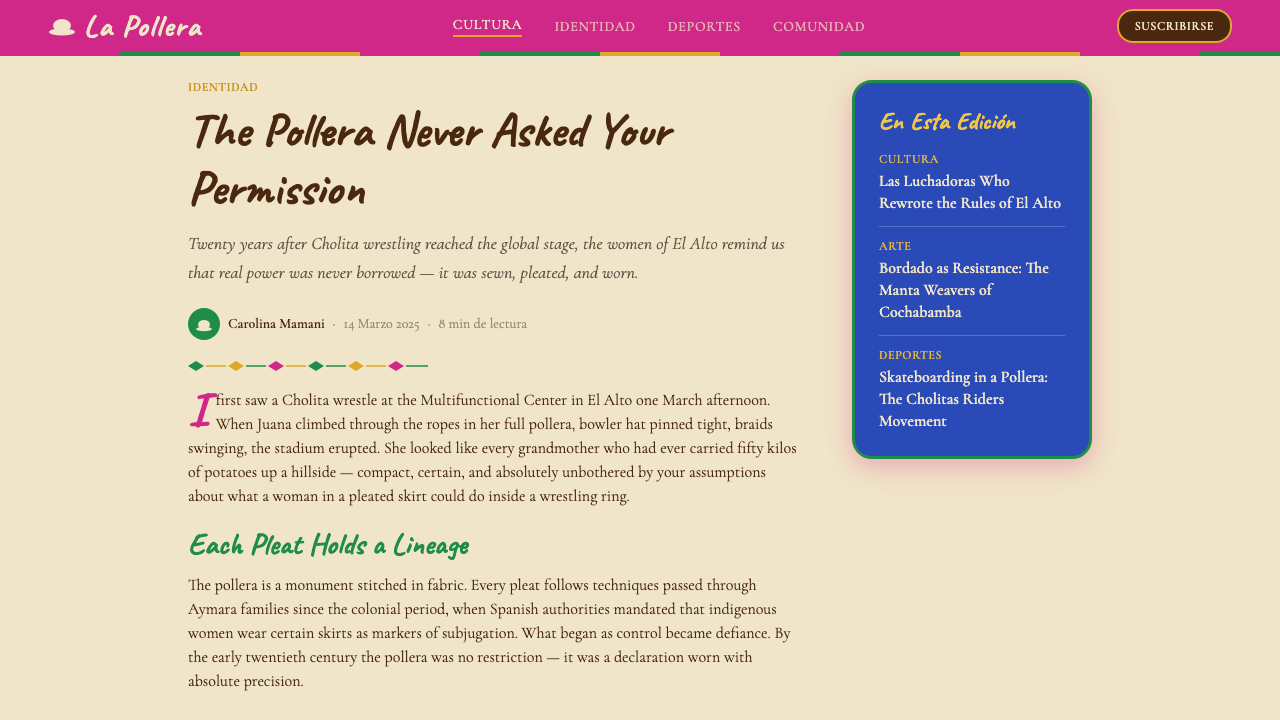
Embroidery is not accent in this system — it is structural. Dense floral motifs, geometric diamonds, and stylized bird and leaf forms cover hem bands, shawl borders, and sleeve cuffs in concentrated bands of thread. The embroidery is typically executed in contrasting color against the base fabric: cobalt blue flowers on magenta ground, gold-tone tendrils on deep green. The density of handwork signals status and occasion — a fiesta or wedding pollera carries far more embroidery than everyday dress, and the quality and quantity of that work is a form of cultural communication.
The Bowler Hat
The bowler hat is the most iconic single element of the cholita aesthetic and carries its own visual and symbolic grammar. It is worn tilted slightly to one side — never centered symmetrically — and perched atop elaborate braided hair rather than placed flush on the head. The hat itself is typically a warm brown felt, sometimes black, often decorated with a contrasting band. Its compact round form provides a visual full stop atop the abundant layered silhouette below. The tilt is deliberate: it signals individual personality and confident self-presentation rather than conformity to a uniform.
Volume and Silhouette
The silhouette is deliberately maximalist in volume. The pollera is constructed with many pleats and worn over multiple petticoats, creating a silhouette that flares dramatically from the waist. During fiesta processions and cholita wrestling performances, the skirt becomes kinetic — spinning, swirling, and catching light — turning movement itself into a visual element. The visual language explicitly rejects the silhouettes of Western fashion that dominated colonial dress codes. Width, fullness, and flare are virtues; the narrower the silhouette, the more it departs from cholita aesthetic values.
Occasion Hierarchy
The cholita aesthetic scales with occasion in a deliberate way. Everyday dress is simpler — fewer petticoats, plainer embroidery, a more subdued palette. Festive and ceremonial dress — for quinceañeras, patron saint festivals, Carnaval de Oruro, or cholita wrestling — pushes every element to maximum: deeper colors, denser embroidery, more petticoats, more elaborate hair and jewelry. This scaling is understood and legible within Bolivian Aymara communities. When working with the fiesta variant of the style, all parameters should be calibrated toward the festive extreme, not the everyday norm.
Textile Pattern and Geometry
Beneath the embroidery, the woven grounds and trim fabrics carry their own geometric patterning. Andean textile traditions — inherited from pre-Columbian weaving practices including those of the Tiwanaku and Inca cultures — employ stepped frets, interlocking diamonds, and zigzag bands as foundational geometric motifs. These appear in manta shawls, in trim applied to pollera hems, and in the woven sashes worn at the waist. The geometry is rectilinear and precise, contrasting with the curvilinear quality of the applied embroidery — a productive tension between woven structure and embroidered ornament.

Who shaped Bolivian Cholita (Bowler-Hat Fiesta)?
The Cholitas Escaladoras — a collective of Aymara women who climb major Bolivian Andean peaks in full traditional dress, including pollera skirts, manta shawls, and bowler hats — became internationally recognized symbols of cholita empowerment in the 2010s. Their climbs on peaks including Aconcagua and Huayna Potosí demonstrated that the traditional dress was not a limitation but a statement of identity capable of accompanying its wearers to the most extreme physical environments. Their visual presence on high-altitude summits, colorful skirts against snow and rock, is one of the most iconic images associated with the cholita aesthetic.
A prominent Bolivian designer working within the El Alto cholita fashion industry, Eliana Paco represents the generation of artisans and entrepreneurs who elevated the pollera from everyday dress to high-fashion object. Working out of the ateliers of El Alto, designers like Paco transformed the production of cholita dress into a luxury craft sector, with elaborate fiesta polleras commissioned for weddings and quinceañeras carrying significant economic and cultural value. Their work demonstrates that the aesthetic's visual language — layering, embroidery, contrasting bands — is alive and evolving, not frozen in historical documentation.
A figure associated with the cholita wrestling phenomenon and broader cholita cultural visibility in Bolivia and internationally. The cholita wrestlers of El Alto — who perform in elaborate traditional dress in packed arenas — brought the fiesta aesthetic into an entirely new performance context, demonstrating the visual dynamism of the pollera in motion and making the cholita aesthetic legible to global audiences unfamiliar with Andean cultural traditions. Vargas and her contemporaries turned the wrestling ring into a stage for the most kinetic expression of the cholita visual system.
An anthropologist and scholar whose research on Bolivian Indigenous identity, including the cholita as a cultural and political phenomenon, has helped document and analyze the aesthetic and social dimensions of the pollera and bowler hat tradition. Academic engagement with the cholita phenomenon — understanding how dress functions as political assertion, cultural reclamation, and economic statement simultaneously — provides the analytical framework for interpreting the visual system's depth beyond surface aesthetics. Canessa's work situates the cholita within the broader history of Andean identity politics and the post-2005 political transformation of Bolivia.
How do you use Bolivian Cholita (Bowler-Hat Fiesta) today?
The cholita fiesta aesthetic is one of the most immediately recognizable and culturally specific visual systems available to designers working with Andean, Latin American, or Indigenous empowerment themes. Because the style carries deep historical and political resonance, it works best when the subject matter genuinely connects to celebration, cultural pride, community identity, or feminine power — particularly in Bolivian and Andean contexts. Applied with understanding, it produces presentations, covers, and materials that communicate festivity and dignity simultaneously.
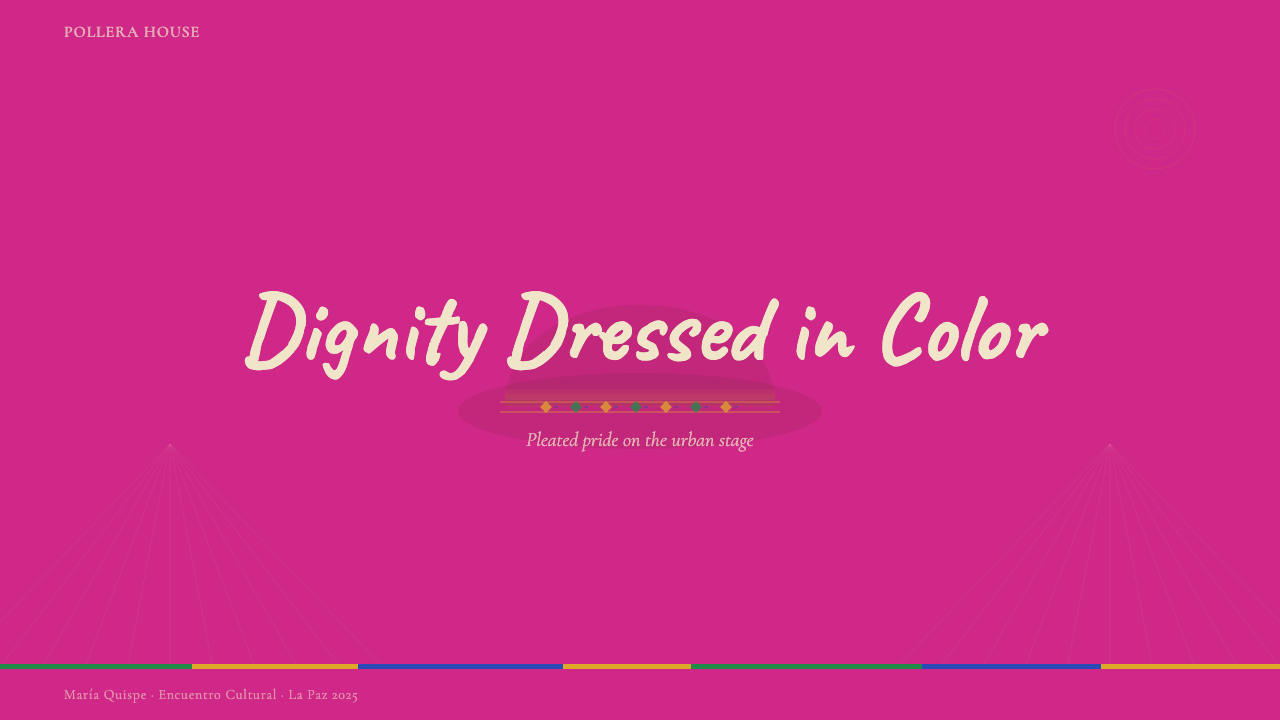
For presentation slides, the fiesta variant of the style is ideally suited to cover pages and section dividers that need to announce energy and occasion. A cover built around this system places a dominant warm magenta or deep rose as the primary field, layered with a contrasting horizontal band in emerald or cobalt near the bottom edge — echoing the pollera hem structure. Dense decorative embroidery motifs, adapted as repeating geometric or floral border elements, define the transitional zone between color fields. Titles should sit in high contrast — creamy white or warm gold against the saturated ground. Content slides work best with a cream or near-white background, with the saturated accent palette used sparingly for highlights, dividers, and data points.
For web interfaces, this aesthetic suits landing pages, cultural organization sites, festival event pages, and contexts where rich cultural heritage is the primary message. A homepage built around the style layers horizontal bands of contrasting color across the viewport, with the richest ornament concentrated at section transitions. Navigation and call-to-action elements can adopt the bowler-hat device — a compact, bold, slightly tilted graphic motif — as a recurring signature element. The palette's intensity demands generous use of neutral breathing space; small areas of saturated color read boldly against cream or warm white, while large areas of unrelieved magenta can become visually exhausting.
For editorial and marketing work, the style supports poster-scale boldness and is particularly effective for event announcements, cultural festival materials, and brand identities that want to signal pride in Indigenous or Latin American heritage. A poster in this system uses full-bleed saturated color, bold layered horizontal bands, and large-scale embroidery-derived ornament as structural framing — not decorative afterthought. Text is set in high contrast, often in cream or gold against the warm ground, and the bowler hat motif can serve as a brand signature or section marker.
A common mistake when applying this aesthetic is flattening its layered richness into a simple two-color palette. The visual logic of the cholita tradition specifically depends on layering — warm tones over cool tones over neutral grounds, embroidery over woven structure, ornament over ornament. A design that uses only magenta and cream, for instance, captures the warmth but loses the complex tension of the full system. Similarly, using the palette without any reference to the horizontal banding structure — which organizes the layered elements into readable zones — produces color that feels arbitrary rather than culturally grounded. The banding is not decoration; it is the architecture.
Bolivian Cholita (Bowler-Hat Fiesta) — FAQ
Is the cholita aesthetic appropriate to use outside of Bolivian or Andean cultural contexts?
The style can be used thoughtfully in contexts that are genuinely connected to Bolivian culture, Andean heritage, Latin American celebration, or Indigenous empowerment themes — festival branding, cultural organization identities, travel and tourism materials for the region, and projects that explicitly celebrate Aymara or Quechua cultural traditions. What it cannot do well is serve as generic 'Latin' decoration or as a stand-in for vague 'colorful culture' — the aesthetic is specific and carries real political and historical weight. The more specific and respectful the connection to the actual tradition, the more effectively the visual system works. Using isolated surface elements (magenta and bowler hat motif) without engaging the underlying cultural meaning tends to produce results that feel appropriative rather than referential.
How does this style differ from other Andean or Latin American textile traditions?
The cholita aesthetic is specifically urban — it developed in the cities of La Paz and El Alto among Aymara women navigating the intersection of Indigenous and colonial cultures. It is distinct from purely rural Andean weaving traditions in that it incorporates European garment forms (the bowler hat, the blouse) while transforming them through Indigenous aesthetic logic. It also differs from, say, Guatemalan Maya textile traditions or Peruvian carnival dress in its specific palette, garment forms, and historical development. The bowler hat is particular to the Bolivian cholita tradition; it does not appear in equivalent form in any other Andean textile culture. When representing Andean identity in general rather than specifically Bolivian Aymara identity, other traditions — Quechua weavings from Cusco, for instance — have their own distinct visual vocabularies.
Can this aesthetic work for dark or night-mode interfaces?
Yes, though the inversion requires specific handling. The historical palette is warm-ground — cream and warm neutral backgrounds are canonical. A dark inversion works when it treats deep indigo, near-black brown, or very deep emerald as the ground, and allows the hot magenta and saffron yellow to function as radiant foreground elements — much as festival lanterns glow against a night sky. On dark grounds, the embroidery-derived border ornament should use the lighter palette elements (cream, gold, saffron) rather than the saturated cool tones, which may disappear into a dark background. The key is to preserve the contrast between warm and cool, saturated and neutral — if both ground and foreground are saturated, the layering logic collapses.
How should the bowler hat motif be used in graphic design?
The bowler hat works best as a compact silhouette element — a graphic punctuation mark rather than a detailed illustration. In the cholita tradition, the hat's power comes from its bold round form and its characteristic tilt, not from surface detail. In graphic applications, a simplified bowler silhouette, slightly tilted, can serve as a brand icon, section marker, bullet point alternative, or repeating motif in border patterns. It reads well at small sizes precisely because it is geometrically simple. What to avoid: over-literal rendering with realistic shadow and texture, which loses the flat graphic confidence that makes the element culturally legible. The hat should look like itself — compact, round, slightly defiant in its tilt — rather than like a photographic reference.
Is this style suitable for brand identities beyond cultural or festival contexts?
The style translates well to any brand that genuinely values boldness, craft heritage, feminine empowerment, or joyful celebration as core identity attributes. It has natural resonance for artisanal food and beverage brands, textile and fashion businesses with heritage roots, organizations working in Indigenous rights or cultural preservation, and event and hospitality brands targeting Latin American markets. It is less suited to contexts where austerity, technical precision, or restrained professionalism are the primary signals — corporate finance, medical technology, or enterprise software, for instance. The style's visual logic is inherently celebratory and abundant; it signals generosity and pride, not restraint and efficiency.
Related design styles
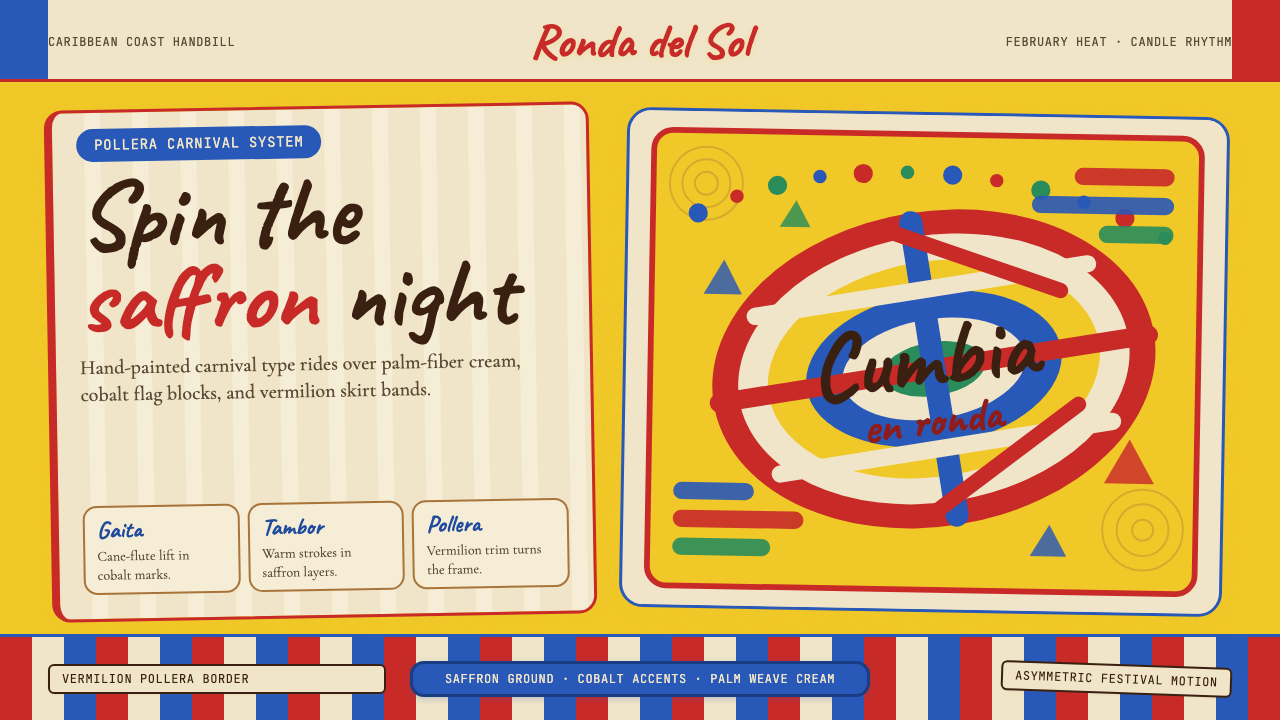 Colombian Cumbia (Pollera Carnival)Carnival heat spins. Saffron ground, Caveat script, vermilion stripes, cobalt…
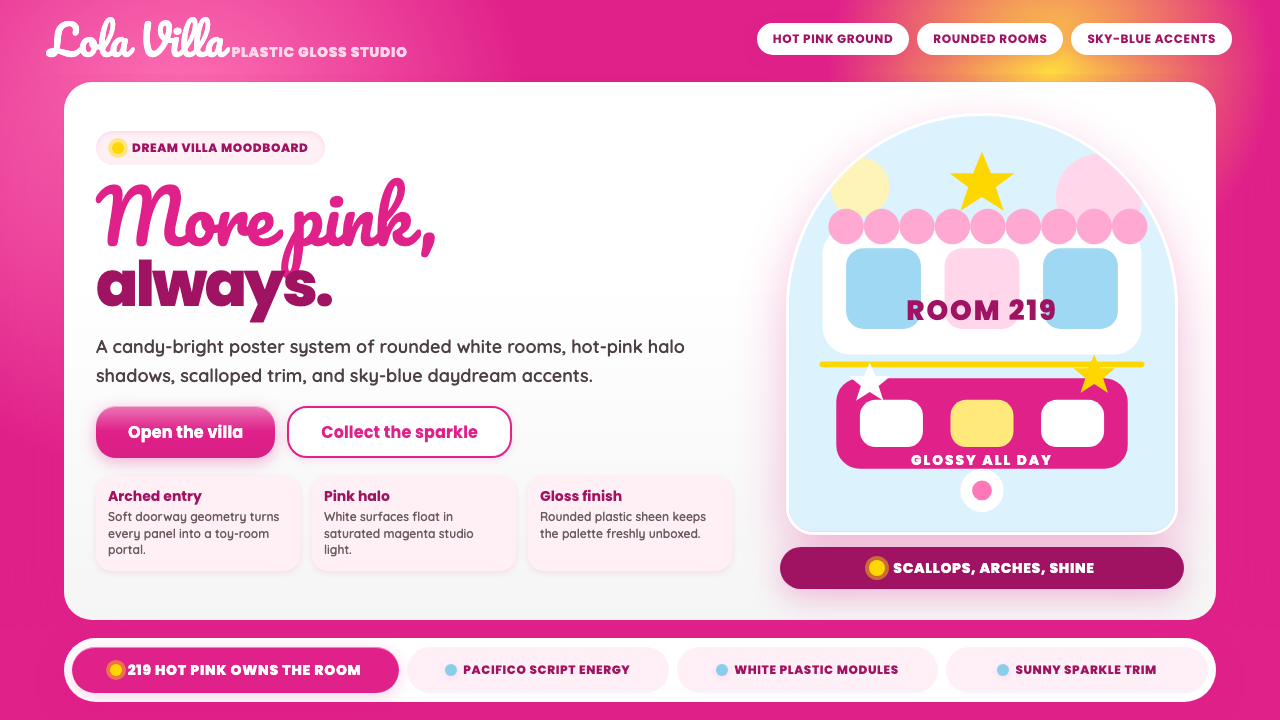 Barbie DreamhousePink is the whole world. Hot magenta ground, Pacifico script, scallops and gl…
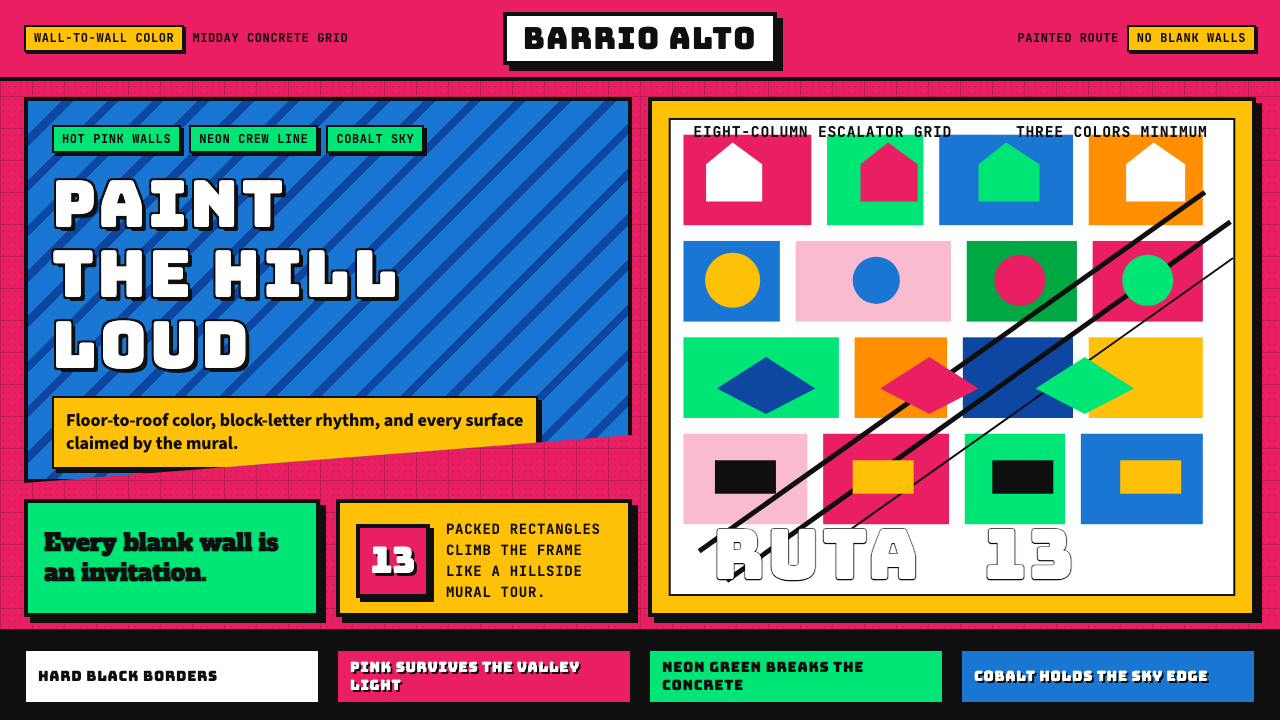 Medellín Comuna 13 MuralsRefuses blank walls. Hot pink, neon green, and cobalt blocks pack the grid li…
 Memphis (Sottsass 1981)Joy weaponizes bad taste. Hot pink, turquoise, yellow and terrazzo specks bre…
 Watermelon Bubblegum Pink80s candy maximalism. Neon pink on rose-magenta, sugar-shine highlights, infl…
 Candy Crush (2012)Sugar rush without restraint. Glossy candy tiles pulse across a striped bubbl…