What is Gujarati Bandhani Tie-Dye?
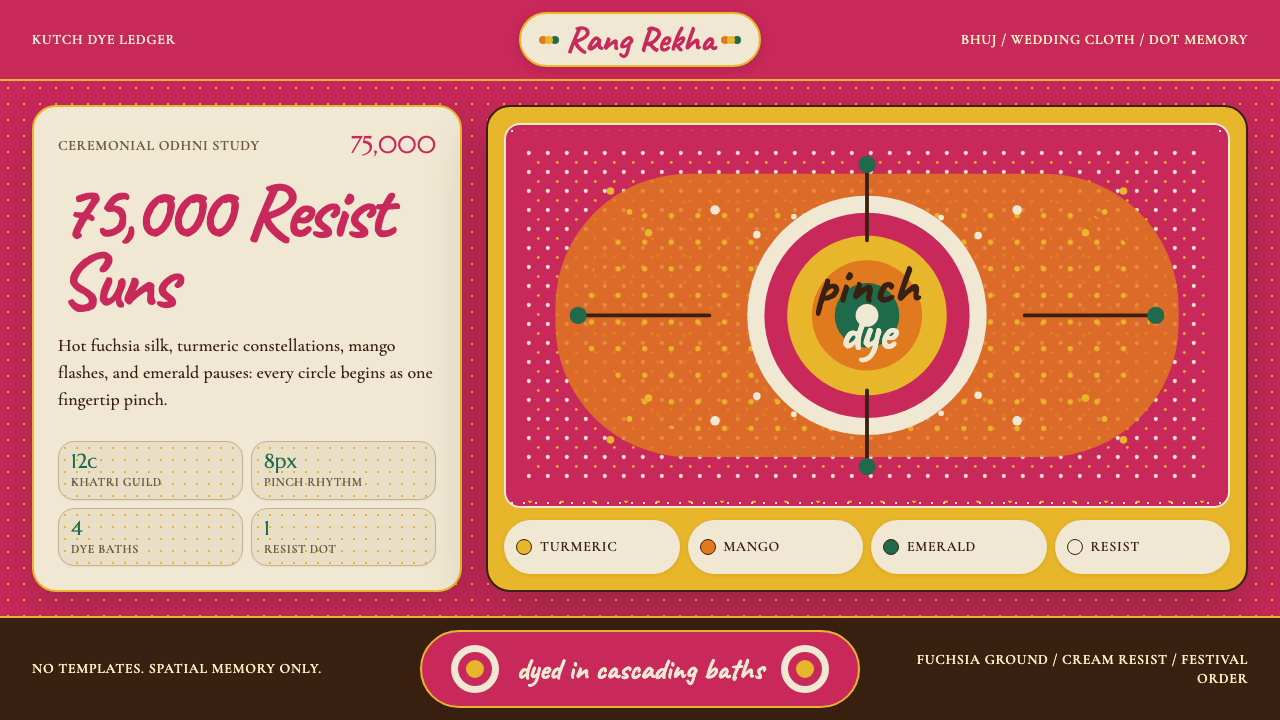
Gujarati bandhani is the world's most precise tie-dye tradition — tens of thousands of hand-pinched dots on silk, dyed in cascading baths of festival color, producing a visual language as intricate as any printed textile.
Gujarati Bandhani Tie-Dye in brief
Gujarati bandhani (बंधनी) is a resist-dyeing technique in which fabric is pinched into tiny points, each bound tightly with thread before immersion in a dye bath. When the binding is removed after dyeing, each pinch-point reveals a small circle of undyed or earlier-dyed color — a resist dot. The cumulative effect of thousands of such dots forms geometrically precise constellations: grid arrays, diagonal waves, concentric rings, and the pea-sized circles of the classic chandrakala moon pattern. A single ceremonial odhni — a wedding veil — can carry more than seventy-five thousand individually hand-pinched points.
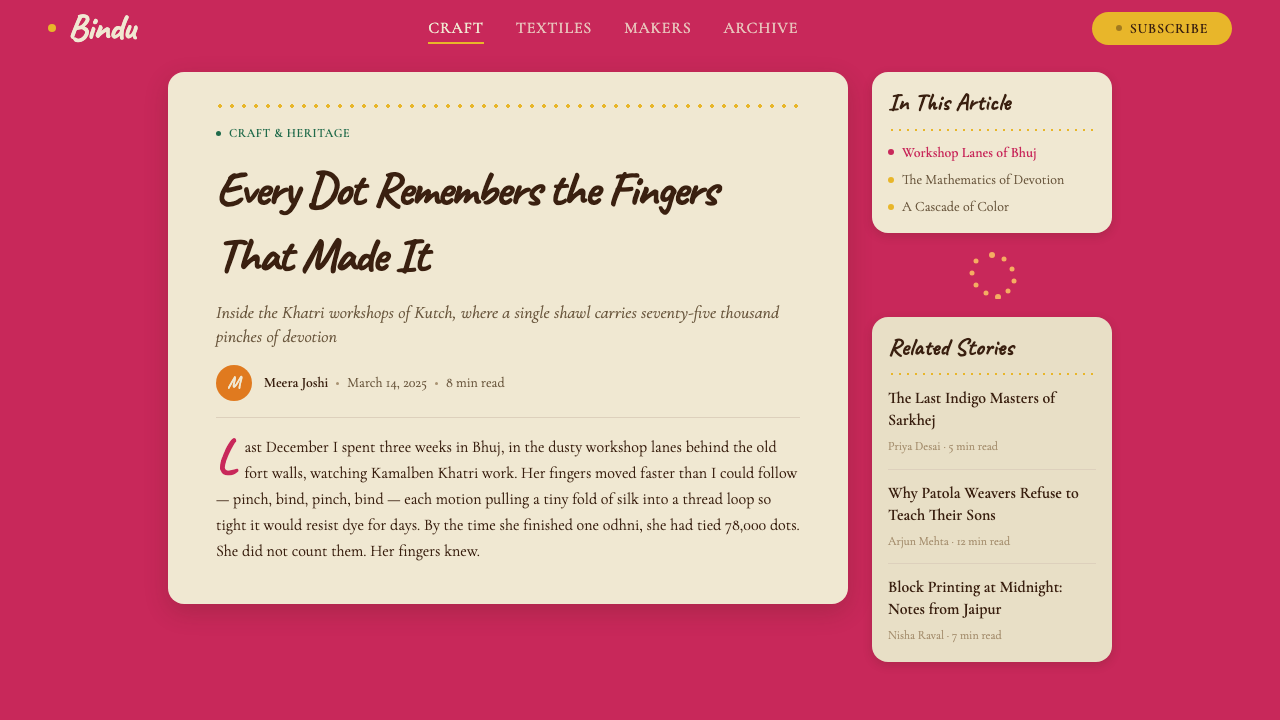
The visual language of bandhani is built entirely from this fundamental unit: the dot. Everything else — stripes, borders, floral arrangements, animal motifs — is constructed from clusters and gradients of dots at varying densities. The palette is festival-saturated: fuchsia and magenta grounds dyed over turmeric yellow base layers, deep crimson reds, peacock greens, and cream reserves. Color depth is achieved not through pigment mixing but through sequential immersion, so adjacent areas can shift from one hue to another through the logic of subtraction — each dye bath adds color only where the resist thread has not been tied.
As a design aesthetic, bandhani translates this dot-field logic into a bold, pattern-forward system. The characteristic warm fuchsia ground paired with turmeric yellow dot constellations functions as a kind of visual grammar: saturated ground, luminous resist marks, and accent hues drawn from the same ceremonial palette. Mango orange, emerald green, and ivory cream punctuate the composition, echoing the classic bandhani motifs — the peacock (mor), the mango paisley (keri), and the crescent moon (chand) — without requiring literal illustration.
Where does Gujarati Bandhani Tie-Dye come from?
Bandhani's origins reach back at least to the fourth century. Ajanta cave paintings from that era depict dotted fabric in ceremonial contexts, suggesting that pinch-resist dyeing was already an established craft vocabulary in the subcontinent's textile culture long before any guild formalized it. The technique's name derives from the Sanskrit root bandha, meaning to bind or tie — a word that also underlies the term bandhana, evoking connection and bond.
The Khatri community of artisans, primarily concentrated in the Kutch region of Gujarat and in cities such as Jamnagar, Bhuj, and Mandvi, became the guild most closely associated with bandhani from around the twelfth century onward. Khatri dyers developed the technique into a caste specialty, transmitting dyeing sequences, dot density charts, and color-bath orderings through family lineage. The traditional division of labor within Khatri households was precise: women performed the pinching and tying — a task demanding extraordinary manual dexterity — while men managed the dye vats and fixed the mordants that made colors fast on silk and cotton. A skilled artisan could tie several hundred dots per hour without any template, relying entirely on trained finger memory.
Bandhani achieved its commercial and cultural peak during the eighteenth and nineteenth centuries, when the Saurashtra region's prosperous textile economy supplied wedding cloth across the subcontinent and into trade networks reaching the Gulf and East Africa. Specific cloth types became markers of social occasion: the gharchola, a red-and-gold grid pattern given to brides, was understood by sight as a wedding textile anywhere in Gujarat. Different regional centers developed distinct dot sizes, color combinations, and ground weaves: Jamnagar favored finer silk with smaller dots and cooler color ranges; Bhuj specialized in heavier, more saturated pieces intended for rural ceremonial use.
Eiluned Edwards, the textile scholar whose research helped document Kutchi material culture for international audiences, traced the survival of bandhani through the economic disruptions of the twentieth century — partition, synthetic dye competition, and the mechanization of Indian textiles. Yashodhara Agrawal's curatorial work at Indian craft institutions helped position bandhani alongside other Geographical Indication-protected textiles, eventually leading to the Kutch Bandhani receiving GI tag recognition, which now governs its provenance claims in trade contexts. Master craftsman Abdul Aziz Khatri became one of the most recognized living practitioners in the post-independence era, demonstrating the technique's continued vitality as both livelihood and cultural inheritance.
What defines the Gujarati Bandhani Tie-Dye look?
Dot as the Fundamental Unit
Every element in bandhani — pattern, border, motif, field — originates from the single resist dot. In design terms, this means the aesthetic is radically modular: everything is built from repetition and variation of one primitive form. Dot density reads as tone (tightly packed dots read as near-solid; widely spaced dots read as transparent field), and dot arrangement encodes all representational content — no outline drawing is needed.
Festival-Saturated Color
Bandhani's palette is unapologetically intense: hot fuchsia and deep magenta grounds, turmeric yellow dot fields, mango orange and peacock green accents, ivory and cream reserves. These are colors calibrated for visibility at distance in outdoor ceremony — the opposite of the subdued palette of contemporary digital minimalism. The saturation level is structural rather than decorative; it marks the cloth as festive and auspicious.
Layered Dye Logic
Bandhani color relationships are the product of sequential dye baths rather than simultaneous mixing. A ground color set in the first bath persists wherever subsequent binding is applied; the second bath adds a new color only in unbound areas; the third bath does the same. This creates depth through transparency and subtraction — areas that appear one color may in fact be the result of multiple overlapping dye decisions. Designs using this system should allow for color relationships that feel layered and luminous rather than flat.
Geometric Motif Vocabulary
Classic bandhani motifs are geometric: the chand (crescent moon), the bundi (small dot field), the shikari (hunting scene rendered entirely in dot arrays), and the mor (peacock silhouette built from clustered dot fans). Even the paisley mango keri motif — organically curved — is constructed from rows of dots following a curved path. The entire repertoire is resolvable into geometric operations on the dot: rotation, scaling, mirroring, density variation.
Textile Ground and Grain
Traditional bandhani is worked on silk or fine cotton, and the ground weave contributes its own visual texture to the finished piece — a very fine grained luminosity that no flat digital surface replicates exactly. In design applications, the equivalent is to treat the background as an active surface rather than an empty container: slight variation, grain, or warmth in the background field adds the visual softness that makes the dot constellations vibrate against the ground rather than sit inertly on it.
Symmetry and Repetition
Bandhani compositions are typically organized around bilateral or four-fold symmetry, with a central field of dot density enclosed by progressively structured border bands. This creates a visual hierarchy from center outward — the central mass is the richest, most complex area; the borders are more regimented and linear. This inside-out hierarchy differs from Western grid layouts where hierarchy typically flows top-to-bottom.
Auspicious Color Coding
In the traditional context, bandhani colors carry specific social meaning: red grounds signal bridal occasion; yellow is associated with turmeric ceremony and new beginnings; green marks religious festivity. This color coding is not arbitrary — it is a literacy shared across the communities that use and recognize the cloth. Design systems drawing on bandhani inherit this sense of color as communication rather than decoration: each hue is expected to carry weight.
Who shaped Gujarati Bandhani Tie-Dye?
One of the most celebrated living masters of Kutchi bandhani, Abdul Aziz Khatri has been recognized by the Indian government for his role in sustaining and transmitting the Khatri tie-dye tradition. His work demonstrates the highest register of the craft — pieces with exceptionally fine dot density, complex multi-bath color sequences, and the precise border grammar of Kutchi ceremonial cloth. He has been instrumental in training younger artisans and in engaging with documentation projects that have helped secure GI recognition for Kutch bandhani.
A British textile scholar specializing in the craft traditions of Kutch and Saurashtra, Eiluned Edwards conducted extensive fieldwork in Gujarat documenting the material culture, social organization, and aesthetic conventions of bandhani and related embroidery traditions. Her published research brought rigorous ethnographic attention to the Khatri guild's practices at a moment when those practices were under economic pressure, and her work has been foundational to subsequent curatorial and preservation efforts in both India and international textile institutions.
A curator and craft scholar whose institutional work helped position Kutchi bandhani within the broader framework of India's protected textile heritage. Agrawal's engagement with craft policy and exhibition practice raised the visibility of bandhani in contexts beyond regional markets, contributing to the Geographical Indication recognition process that now protects the designation 'Kutch Bandhani' in trade contexts and supports its authenticity claims against machine-made imitations.
The Khatri community's contribution to bandhani is not reducible to any single individual — it is a collective tradition spanning centuries and hundreds of family workshops across Kutch, Jamnagar, Bhuj, and Mandvi. The guild's anonymous collective achievement includes the development of the gharchola wedding cloth format, the standardization of dot-density conventions across different cloth grades, the chemical expertise needed to work natural dyes on both silk and cotton grounds, and the social grammar that made specific bandhani patterns readable as social markers across the subcontinent.
How do you use Gujarati Bandhani Tie-Dye today?
Bandhani is a high-energy, ceremonially saturated aesthetic, and applying it well requires committing to its central logic: the dot as the atomic unit, the festival palette as a structural commitment, and ornamental density as a feature rather than a flaw. Half-measures — borrowing the fuchsia ground while using generic geometric shapes, or adding dot patterns as wallpaper behind otherwise conventional UI — tend to look costume-like rather than considered. The style rewards designers willing to rethink layout primitives in terms of dot fields, circular motifs, and layered color.
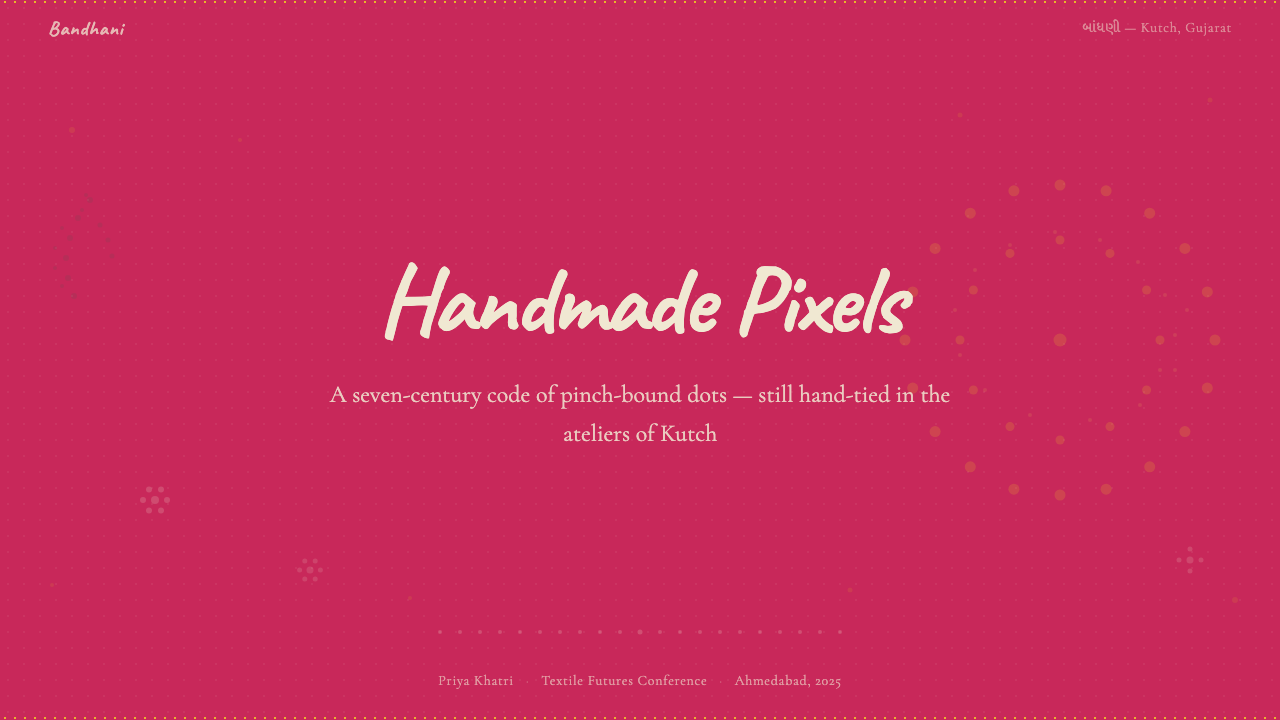
For presentation slides, bandhani's cover page potential is exceptional. A richly saturated fuchsia ground with a turmeric dot constellation in one quadrant — leaving the opposing quadrant for title text in cream or white — creates immediate visual authority without resorting to photography. Content slides should lean into the dot-module logic: use circular badge elements for data callouts, let geometric motifs frame section openers, and maintain the festival palette as a consistent signal system (warm reds and oranges for priority information, cooler greens for supporting context). Data slides work well as dot matrices or bubble fields — chart elements become dots at varying density rather than conventional bars.
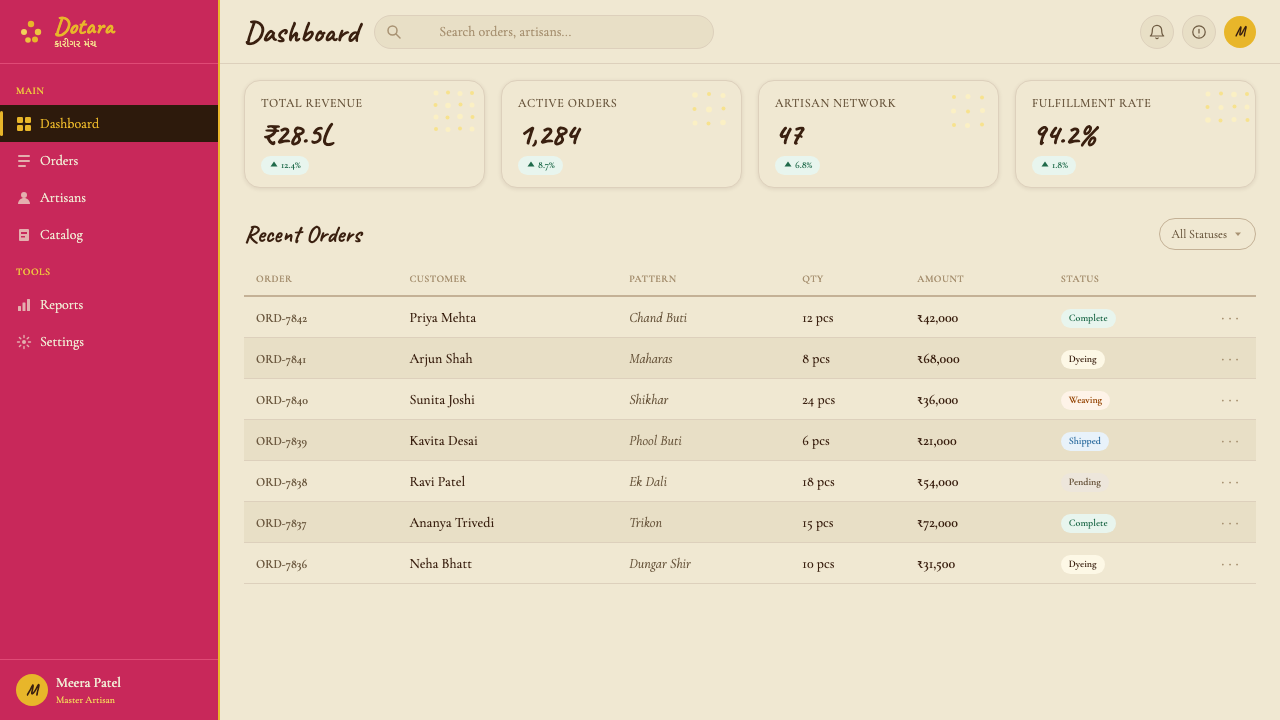
For web interfaces and dashboards, bandhani suits contexts where warmth, cultural richness, and visual confidence are values — hospitality platforms, cultural organizations, lifestyle brands, artisan marketplaces, and any product aiming at South Asian audiences or at markets where festive visual culture is aspirational rather than foreign. The dot field translates naturally into a pattern layer behind hero sections or card grids; the festival palette generates a clear active-state hierarchy when applied to interactive elements. Pricing pages benefit from the style's traditional color-coding logic: use the warmest, most saturated hue for the recommended tier, cooler accents for alternatives.
For editorial and marketing work, bandhani provides one of the strongest available tools for cultural specificity and visual warmth. A feature spread using a fuchsia-to-ivory gradient dot field as a background wash — with type set in clean, generous weight against it — reads as distinctive and culturally grounded. Marketing pages using the full festival palette for hero blocks, with the dot motif appearing as a textural element in section dividers and pull quotes, achieve the celebratory register the style is built for. The style is especially effective for announcement contexts — product launches, seasonal campaigns, and cultural events — where the ceremonial weight of the source tradition translates directly into visual impact.
A common mistake is treating bandhani as a color palette with dots added — importing the fuchsia and orange while leaving the compositional logic entirely generic. The result looks like a mood board rather than a coherent system. Equally, trying to desaturate or 'calm down' the palette to make it feel more 'professional' typically destroys the style's energy without replacing it with any alternative logic. If the context genuinely requires a muted palette, bandhani is probably not the right choice. The style also suffers when dot patterns are applied at too small a scale — the dots need visual weight to function as a structural element rather than noise.
Gujarati Bandhani Tie-Dye — FAQ
Is bandhani the same as tie-dye in the Western sense?
They share the same basic resist principle — binding fabric before dyeing to preserve color in the bound areas — but bandhani is far more technically precise and compositionally systematic than Western tie-dye. Western tie-dye, popularized in the 1960s counterculture, typically uses large random folds and rubber bands, producing unpredictable, fluid patterns. Bandhani uses individual finger-pinches at planned positions across a grid, producing exactly placed dot constellations that can be replicated across hundreds of pieces. The tools, scale of precision, pattern vocabulary, and cultural context are entirely different.
Can bandhani work in dark-mode or dark-background interfaces?
Yes, but the inversion requires rethinking the color hierarchy. Traditional bandhani is a light-resists-on-dark-ground system — the dot is lighter than the ground it appears on, because it resisted the darkening dye. A dark interface can maintain this logic by using a deep indigo, near-black, or saturated eggplant as the ground, with turmeric yellow or pale gold dot fields reading against it. The warm accent hues — mango orange, peacock green — tend to hold their vibrancy on dark grounds well. What does not survive is the hot fuchsia used as a ground on dark: it reads as garish rather than festive. Treat dark mode as the deep-dye-bath stage rather than a simple inversion.
How does bandhani differ from other Indian textile aesthetics, such as ikat or block print?
Ikat achieves its pattern by resist-dyeing the yarn before weaving, which produces characteristically feathered or blurred edges at pattern boundaries — the woven structure itself creates the visual softness. Block print applies pigment or dye through carved wooden stamps, giving it hard edges and the ability to render complex multi-color florals and geometric fill patterns. Bandhani's marks are always circles — the pinched dot — and its pattern edges are always crisp at the individual dot level even when the overall composition reads as a soft field. The fundamental mark of each technique is different: ikat is a line or area; block print is a stamped form; bandhani is always a circle.
What types of products or contexts are a poor fit for the bandhani aesthetic?
The style struggles in contexts where clinical neutrality, minimalist restraint, or high-information-density readability are primary requirements. Enterprise software, medical interfaces, financial analytics dashboards, and platforms positioning themselves as austere or precision-first will conflict with the aesthetic's fundamental warmth and visual density. The dot-field structure also competes with data visualizations — overlaying a dot pattern on a chart creates visual interference. Additionally, the style's festive register makes it a poor choice for somber or serious-toned communications: legal services, crisis communications, or any context where celebratory visual energy would read as tone-deaf.
Is it appropriate to use bandhani-inspired design without cultural connection to Gujarat or India?
This question doesn't have a single universal answer, but a few principles help frame it. Attribution and transparency matter: if a product is explicitly drawing on bandhani as a named tradition, naming it and providing context is more respectful than passing it off as generic pattern. Depth matters over surface: applying the festival palette as a color theft while ignoring the dot logic, the compositional grammar, and the cultural significance of specific motifs tends to produce work that reads as superficial appropriation. And purpose matters: using the aesthetic to serve a South Asian cultural context, celebrate the tradition itself, or create a design system genuinely rooted in the style's logic is different from using it as exotic decoration for an unrelated product.
Related design styles
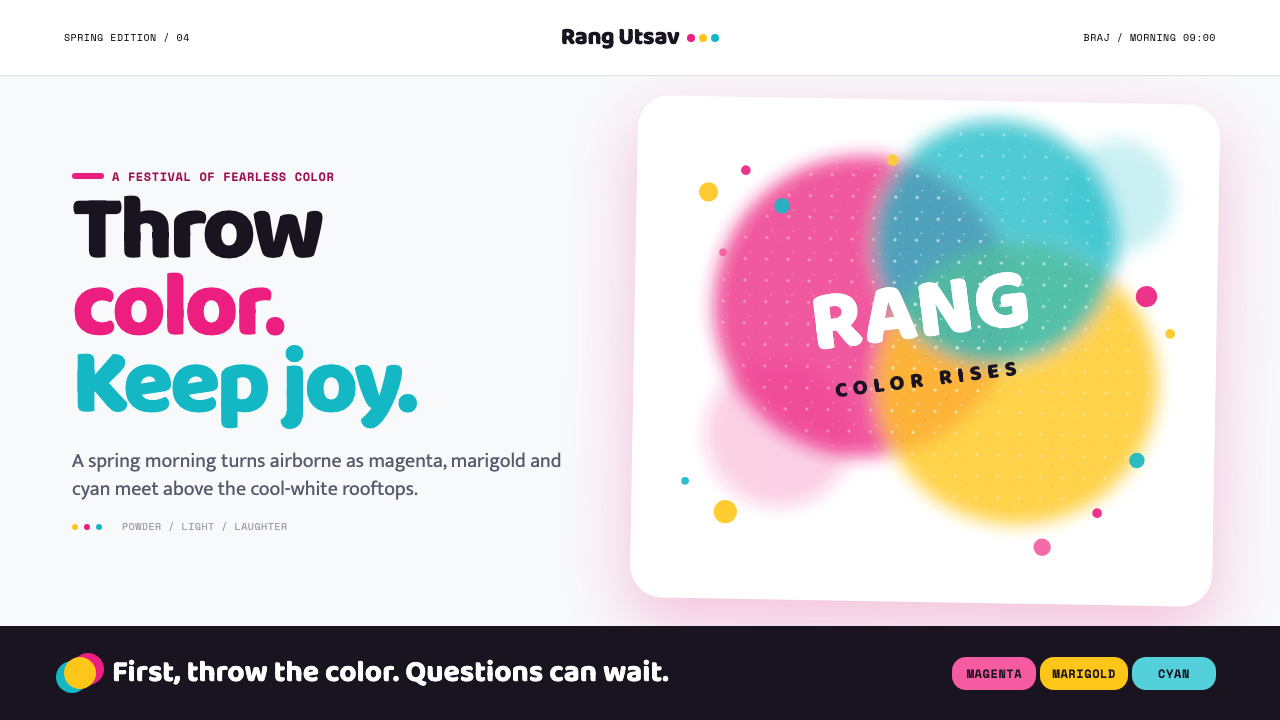 Holi Festival of ColorsColor refuses to sit still. Magenta, marigold and cyan powder bloom across co…
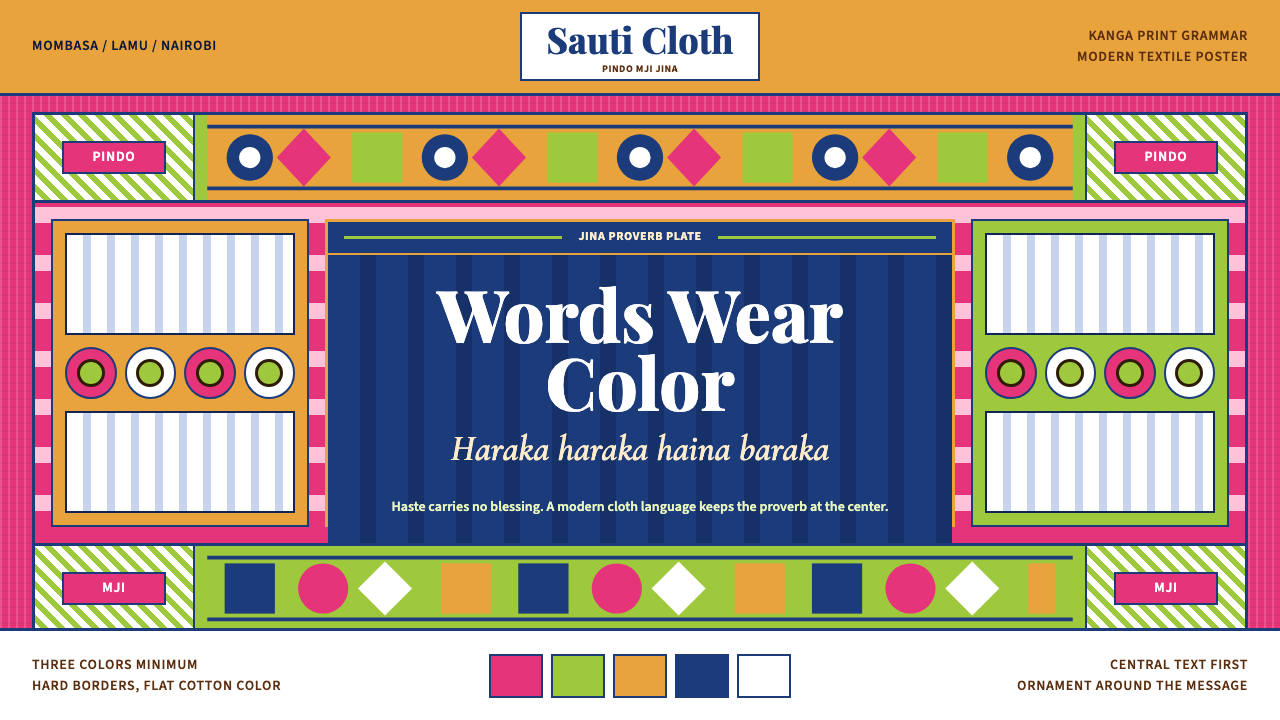 Kenyan Kanga PrintText speaks first. Hot pink ground, lime pindo border, indigo italic proverb…
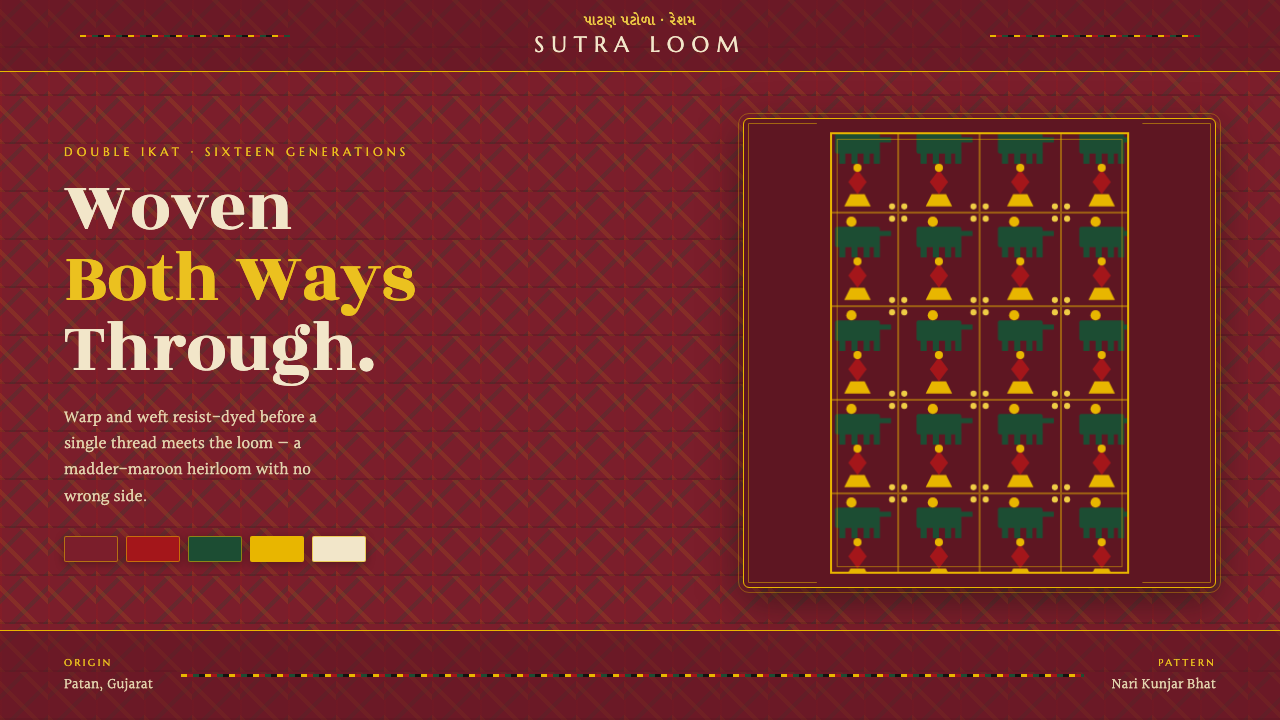 Patan Patola Double IkatReversible by design. Madder-maroon ground, a strict red-green-gold lattice,…
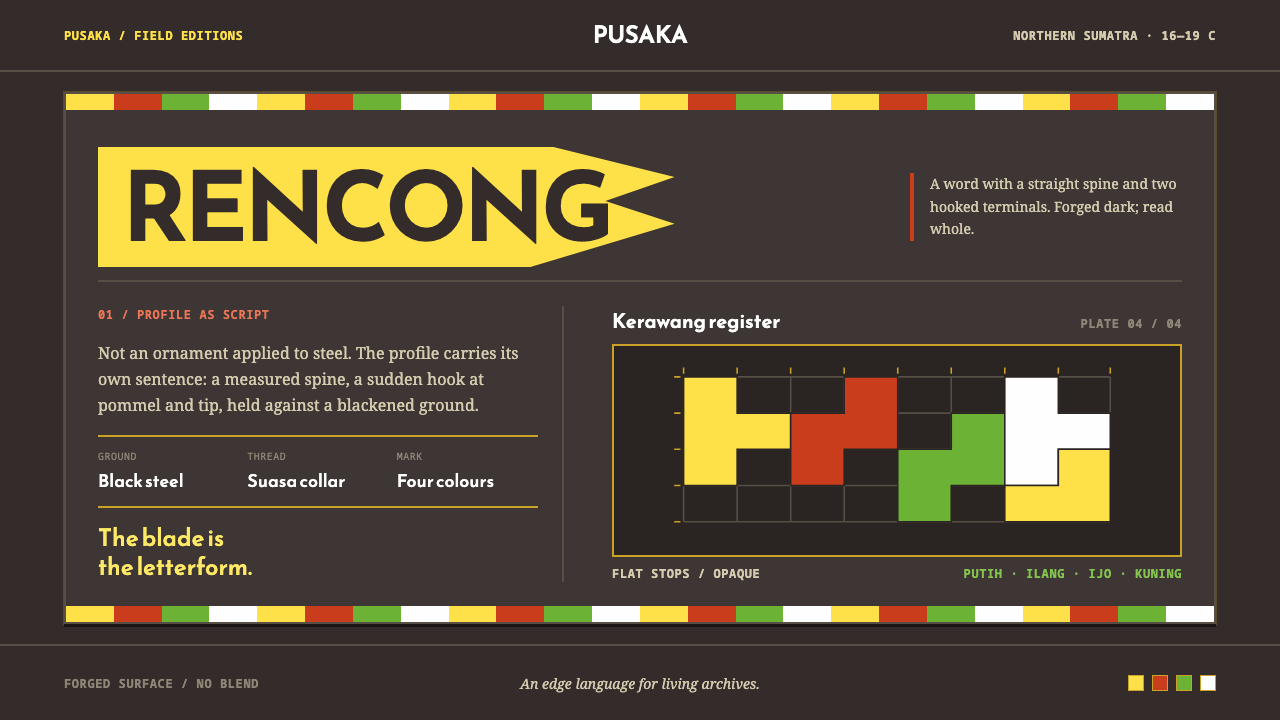 Acehnese Rencong MotifA blade that reads as a word. Flat kerawang red, white, green and yellow lock…
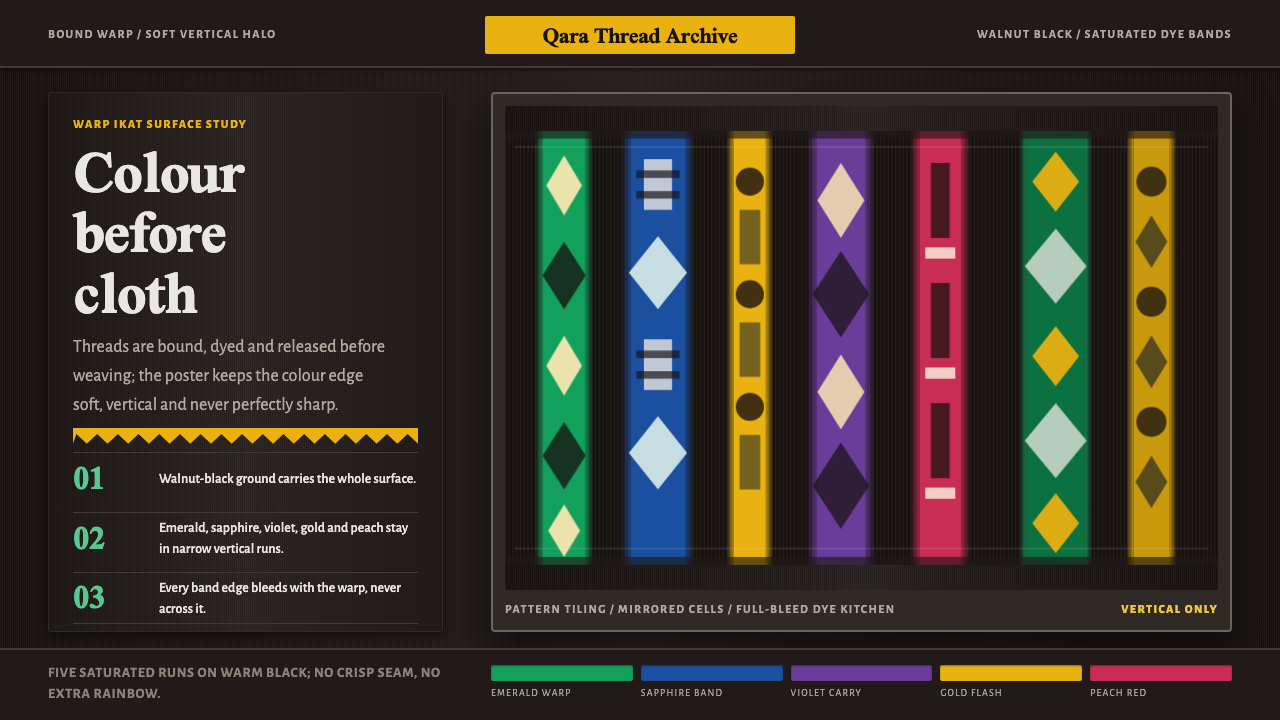 Atlas Silk (Etles)Soft before it is woven. Walnut-black silk holds vertical emerald and gold dy…
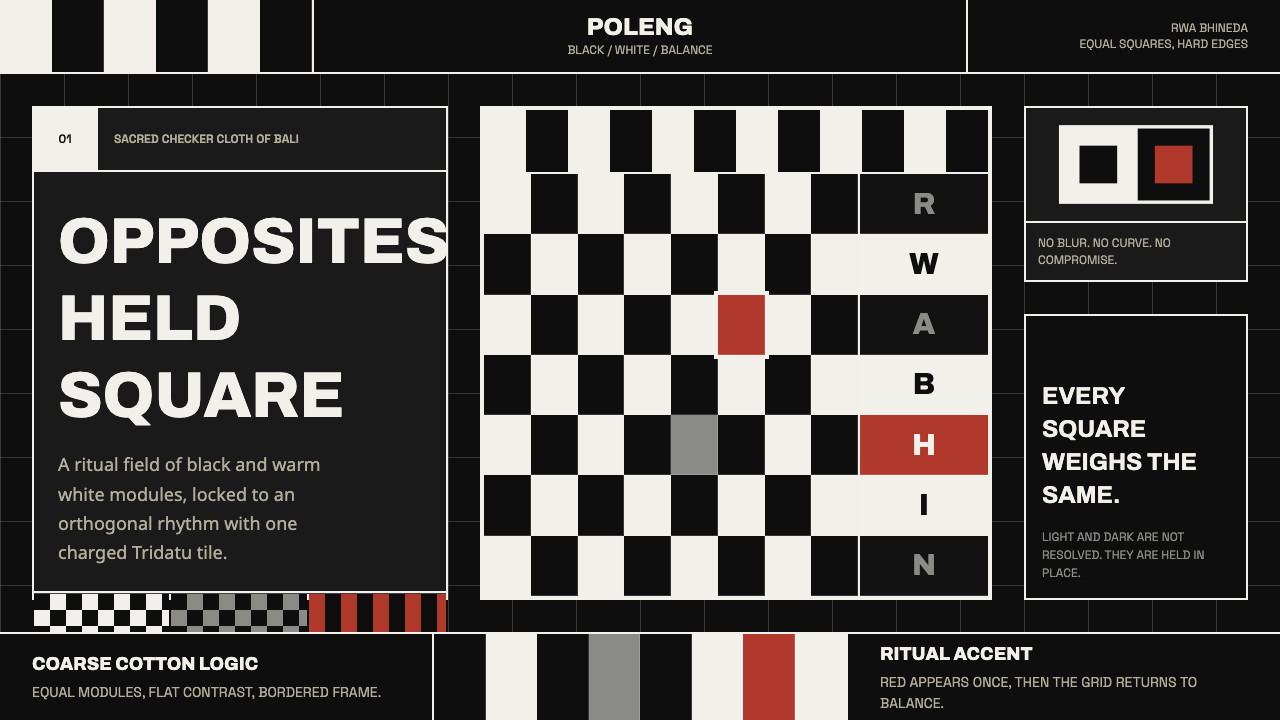 Balinese Poleng ClothSacred duality holds. Black-white squares lock the field; one red tile charge…