What is Timorese Tais (Backstrap Loom)?
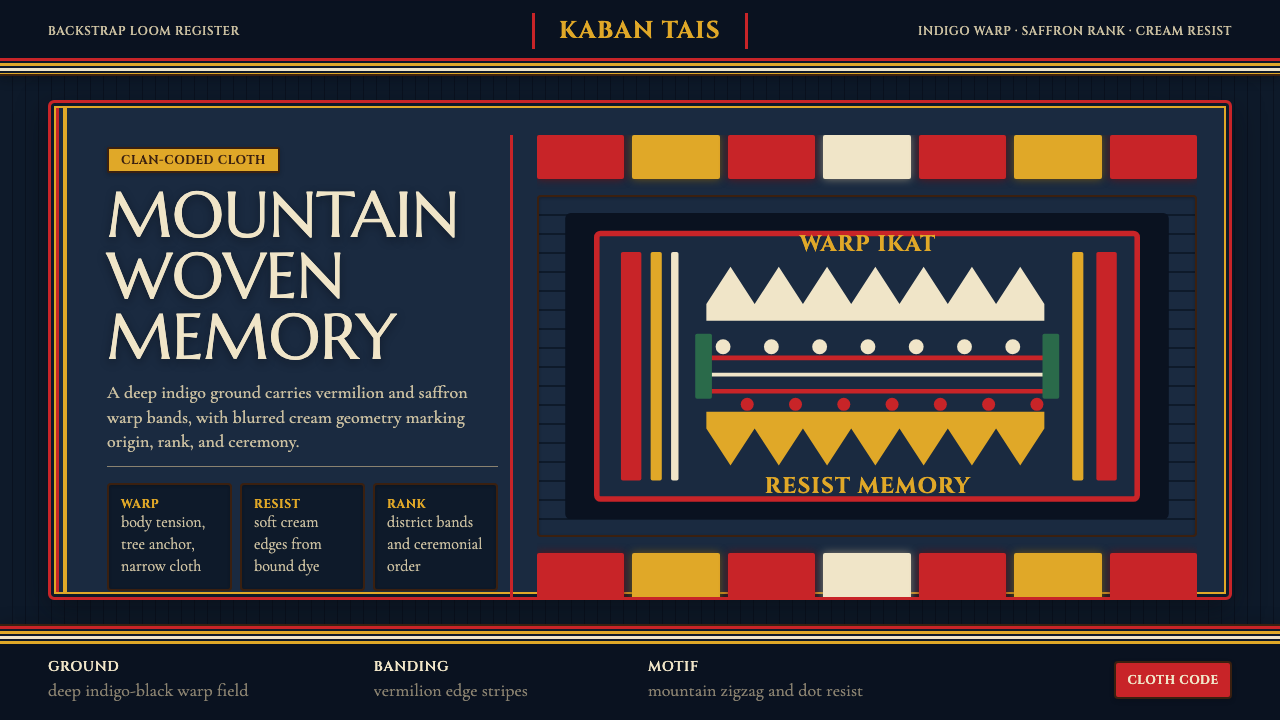
Woven on a body-tensioned loom and saturated with clan memory, Timorese tais translates the island's mountain geography, ancestral spirits, and social rank into bands of indigo, vermilion, and saffron that no two villages share.
Timorese Tais (Backstrap Loom) in brief
Timorese tais is the defining textile tradition of Timor-Leste and the surrounding Lesser Sunda Islands. Produced on a backstrap loom — where one end of the warp is tied to a tree or post and the other is anchored to a belt wrapped around the weaver's lower back — tais cloth takes the form of a narrow, dense tube whose width is literally determined by the span of the weaver's outstretched arms. No two pieces are identical, and no two communities share the same pattern vocabulary.
What distinguishes tais from other Southeast Asian ikat traditions is the density of social information it carries. The geometric motifs — zigzag mountain ranges, stylized crocodiles, geckos, and ancestral figures rendered in cream resist against a deep indigo-black ground — are not decorative choices. They encode the weaver's suku (clan grouping), the district she belongs to, and in ceremonial contexts her rank within a kinship hierarchy. A knowledgeable observer from Timor can read a piece of tais the way another person reads a family crest: it tells you which mountain a village sits on.
The aesthetic result of this identity-saturated system is a textile of remarkable visual force. The ground is almost universally a dense, darkness-embracing indigo or near-black, achieved through repeated immersion in natural dye baths. Against this ground, warp stripes of vermilion and saffron run in narrow vertical bands, punctuated by the blurred, soft-edged cream motifs that ikat resist-dyeing produces when wax or binding resists wax bleed slightly into the fiber. The characteristic blur at the edge of every ikat figure — neither crisp nor wholly dissolved — is considered a mark of quality rather than imprecision.
Where does Timorese Tais (Backstrap Loom) come from?
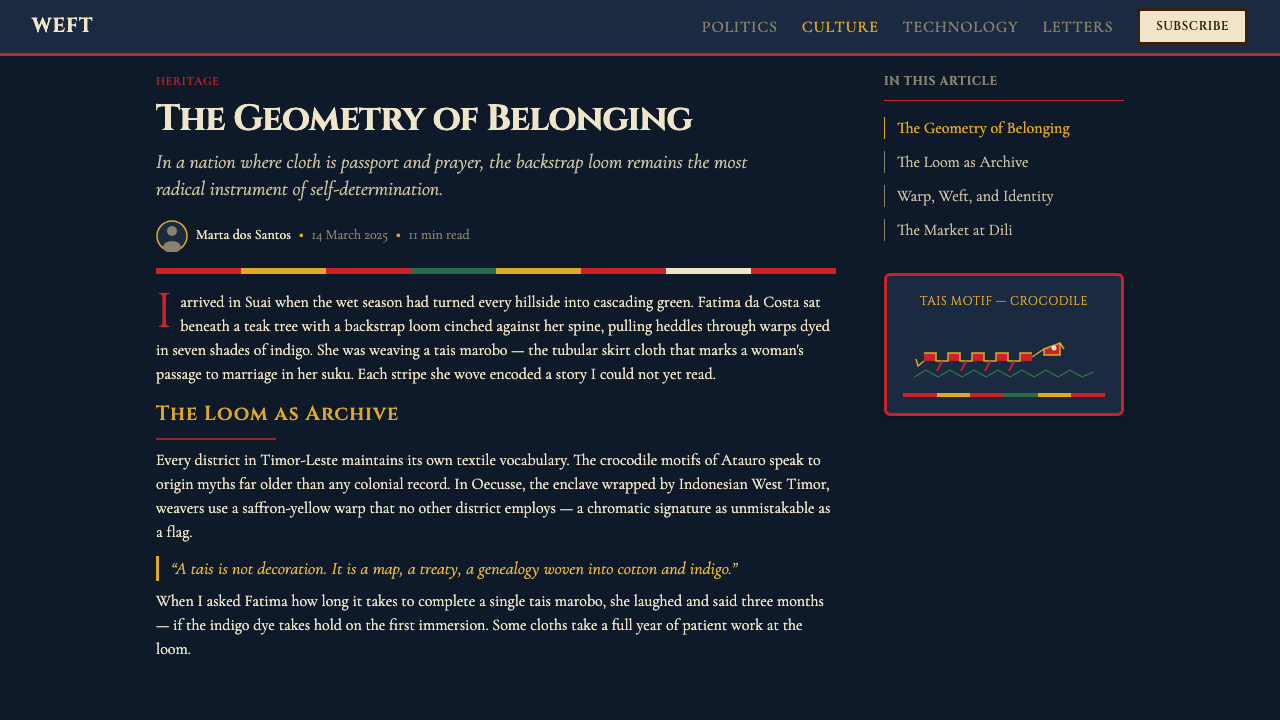
The backstrap loom technology underlying tais is part of the ancient Austronesian cultural continuum — a weaving tradition that spread with early maritime migrations from Taiwan southward through the Philippine archipelago and into the islands of eastern Indonesia and Timor over roughly four thousand years. Tais as a distinct Timorese form, with its characteristic ikat-resist patterning and clan-specific motif repertoire, was already established long before European contact in the sixteenth century. Portuguese colonial documentation of Timorese textiles dates from the 1600s, recording trade in cloth and noting the centrality of tais exchange to ceremonial alliances between clans.
The role of tais in Timorese society has always extended well beyond cloth production. Tais are central to every major life transition: births, marriages, funerals, and the installation of traditional leaders each require specific categories of tais as gifts, payments, or ceremonial dress. The exchange of tais between families at a wedding is not an incidental gesture but a formal act that establishes and records kinship obligations between groups. During the Portuguese colonial period, tais retained this ceremonial importance even as the broader material culture of Timor was reshaped by colonial administration.
The Indonesian occupation of Timor-Leste between 1975 and 1999 inflicted enormous destruction on Timorese cultural institutions, but tais weaving persisted. In the mountains, weaving continued as an act of cultural resistance as much as economic necessity. The motifs encoded in cloth carried communal memory through a period when open expression of Timorese identity was suppressed. Scholars including Joanna Barrkman and Roy W. Hamilton documented surviving traditions during and after this period, providing a scholarly record that supported the post-independence revival.
Following independence in 2002, the Timorese government explicitly elevated tais to the status of a national symbol. The pattern appears on official documents, government buildings display tais-derived motifs, and national events feature tais worn by officials and dignitaries. A significant revival of weaving cooperatives — particularly in Lospalos, Suai, Maliana, and Oecusse — has occurred, supported by fair-trade networks and development organizations. Researcher and practitioner Cristina Sosa has been among those working to document regional pattern variations and support weaver livelihoods. The revival has also created an international market for tais cloth, connecting Timorese weavers to craft and design collectors worldwide.
What defines the Timorese Tais (Backstrap Loom) look?
Ground Color
The foundation of any tais composition is a dense, dark ground — deep indigo, near-black blue, or darkness-saturated navy — achieved through multiple dye immersions in natural indigo baths. This deep ground is not a neutral backdrop; it is an active visual field that absorbs and intensifies every stripe and motif placed against it. The darkness gives the textile a gravity and solemnity appropriate to its ceremonial function.
Warp Stripes
Running vertically along the length of the cloth, warp stripes in vermilion and saffron are the primary structural rhythm of tais composition. These stripes vary in width and sequence from region to region — different districts of Timor-Leste use distinct stripe patterns as part of their identifying vocabulary. The interplay of deep indigo ground against warm red-orange and golden-yellow stripes produces a chromatic intensity that reads clearly even at a distance.
Ikat Resist Motifs
The figurative content of tais — crocodiles, geckos, mountain zigzags, diamond lozenges, and stylized human or ancestral figures — is produced through ikat resist-dyeing, in which portions of the warp threads are bound before dyeing so that the dye cannot penetrate. The bound areas emerge as cream or pale areas against the dark ground. The characteristic feature of ikat is the soft, slightly blurred edge of every motif, where the resist boundaries allowed minimal dye migration. This blur is not a flaw but a signature — it gives tais figures a quality of emergence, as if the motifs are surfacing from the depth of the cloth.
Symbolic Motif Content
The crocodile holds a privileged place in Timorese cosmology: oral tradition describes the island of Timor itself as having been formed from the body of a crocodile, making it simultaneously ancestor and homeland. Crocodile motifs in tais thus carry a mythological weight beyond decoration. The mountain zigzag encodes the literal landscape — specific ridgeline profiles that identify particular districts. Geckos and lizard forms appear as protective ancestral spirits. Taken together, the motif system functions as a territorial and genealogical map rendered in thread.
Narrow Tube Format
Tais is woven as a continuous tube rather than a flat panel — the weft travels around the entire circumference, with both selvages forming closed edges. When cut and unfolded, a tais produces a long, narrow rectangle whose proportions differ markedly from standard woven textiles. This format is not arbitrary: it reflects the physical constraints of the backstrap loom and the body that operates it, making the cloth a kind of bodily measurement — a record of the maker's physical span.
Regional Variation
There is no single tais aesthetic — the textile exists as a family of related but distinguishable regional traditions. Cloth from Lospalos in the east tends toward fine, dense patterns with intricate figurative content. Pieces from Oecusse (the West Timor exclave) show different stripe sequences and a distinct color balance. Atauro Island weavers produce a lighter, more open cloth with its own motif conventions. This regional specificity is not surface variation but the core function of the tradition: the differences are precisely the information the cloth encodes.
Ceremonial Weight
Tais are not everyday objects — they carry a ceremonial gravity that shapes how they are made, exchanged, and displayed. The finest pieces, produced for weddings, funerals, or the installation of leaders, may take months to complete and involve the most demanding ikat work a weaver can execute. This functional seriousness gives the visual system its characteristic quality: there is nothing casual about the color choices, nothing arbitrary about the motif placement. Every visual decision carries social consequence.
Who shaped Timorese Tais (Backstrap Loom)?
Barrkman is a textile scholar and curator whose fieldwork in Timor-Leste and eastern Indonesia has produced some of the most detailed documentation of regional tais traditions available in English. Her research distinguishes the motif vocabularies of different suku groupings and traces the relationship between tais exchange and kinship obligation in Timorese social structure. Her work has been instrumental in building the scholarly framework that supports the post-independence cultural revival and has helped connect Timorese weavers with museum collections and international craft institutions.
Hamilton, a curator and scholar affiliated with the Fowler Museum at UCLA, has produced extensive research on textiles across the Indonesian archipelago and Timor. His work situates tais within the wider Austronesian backstrap-loom continuum, tracing shared techniques and divergent aesthetic traditions across hundreds of island communities. Hamilton's documentation has been especially valuable for understanding how tais motifs function as social identifiers rather than purely decorative choices, and his publications have made Timorese textile traditions accessible to designers, anthropologists, and cultural historians beyond the region.
Sosa is a practitioner and researcher who has worked closely with weaving cooperatives across Timor-Leste in the post-independence period. Her focus has been on documenting regional pattern variations systematically before they are lost to generational change or market homogenization, and on supporting the economic viability of traditional weaving through fair-trade channels. Her work bridges the gap between academic documentation and on-the-ground support for living craftspeople, ensuring that tais knowledge survives not just in archives but in active practice.
The revival of organized weaving cooperatives following independence in 2002 is a collective rather than individual achievement, involving hundreds of women weavers across Lospalos, Suai, Maliana, Oecusse, and Atauro Island. These cooperatives have served as both economic institutions and cultural repositories, maintaining regional motif traditions while providing weavers with sustainable income. Their work has shaped the contemporary visual identity of tais — negotiating between ceremonial authenticity, market demand, and the creative agency of individual weavers navigating a post-occupation cultural landscape.
How do you use Timorese Tais (Backstrap Loom) today?
Tais presents a visual vocabulary of considerable power for contemporary design — but it is a vocabulary that carries real cultural weight, and applying it thoughtfully requires understanding what makes it compelling rather than simply extracting its surface appearance. The system's core strengths are its chromatic drama (deep dark ground, warm narrow stripes, soft-edged cream resist motifs), its sense of density and handmade material presence, and the way pattern and repetition create a unified rhythmic surface from individual geometric units.
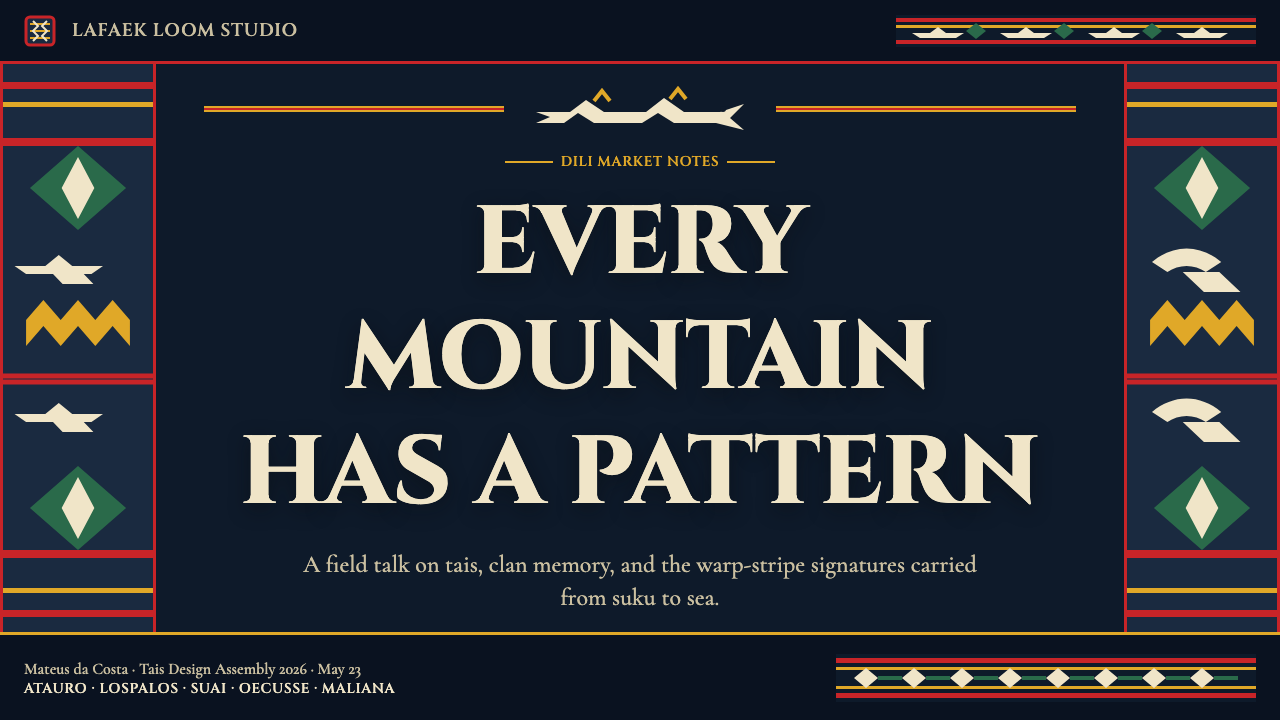
For presentation slides, the tais aesthetic works most naturally on cover and chapter-divider pages where visual impact takes precedence over information density. A deep indigo-black ground with a title set in a warm off-white or cream — positioned with generous margins on the left while a narrow vertical stripe in saffron or vermilion anchors the right edge — captures the textile's characteristic balance between darkness and warmth. Content slides should be stripped back: a cream or very pale background with black text, reserving the full chromatic system for structural markers only. Data visualization in this system favors simple, bold geometric forms — bars, segments, and indicators colored in the warm stripe palette against a dark or neutral field.
For web interfaces, tais translates well to contexts where cultural richness, craft identity, or editorial depth are valued — artisan platforms, cultural institutions, independent media, editorial portfolios, and products positioned around heritage or provenance. The approach: use the deep indigo-dark as a full-bleed hero or section background, restrict the warm stripe colors to accent and highlight functions, and keep functional UI elements (forms, navigation, body text blocks) on a near-white or very pale cream ground. Avoid applying the full chromatic intensity to small UI components — the system is designed for breadth, not density, and it performs best when the dark ground has room to breathe.
For editorial and marketing work, the style supports rich, atmospheric layouts that evoke texture and materiality without literal representation. A magazine-style spread might use the dark ground as a full-page wash on a left-hand page, with a portrait or product image treated in high-contrast warm tones against it, while the right-hand page switches to a light ground with generous body text. Marketing materials benefit from the poster-like quality of the vermilion-saffron-indigo triad: a single strong color field anchored by cream type creates memorable impact without visual complexity. The ikat blur effect — subtle edge softness on key graphic elements — is a useful technique for suggesting the textile's handmade quality without literal texture rendering.
A common mistake when drawing on tais is applying all three chromatic registers simultaneously at full intensity: deep indigo ground, saturated vermilion stripes, and saffron stripes all competing for attention alongside cream motifs. In the actual textile, hierarchy is maintained through proportion — the dark ground vastly dominates, stripes are narrow, and motifs are sparse against that expansive field. Digital applications that reverse these proportions — giving equal visual weight to each color element — lose the gravitational quality that makes tais so visually arresting. Another error is treating the ikat blur as a stylistic flourish applied universally rather than reserving it for specific figurative or symbolic elements: in authentic tais, the blur marks the resist-dyed areas and is structurally inseparable from the motif content, not a general texture effect.
Timorese Tais (Backstrap Loom) — FAQ
What does 'ikat' mean, and why does it produce that characteristic blurred edge?
Ikat is a Malay-Indonesian word for 'tie' or 'bind.' In ikat resist-dyeing, the threads — either warp, weft, or both — are bound tightly in specific areas before dyeing, so that the dye cannot penetrate the bound portions. After dyeing and unbinding, the bound areas appear as undyed (typically pale or cream) against the dyed ground. Because the binding can never be perfectly precise, and because dye wicks slightly into the fiber beneath the binding edge, the border between dyed and undyed areas is always slightly soft. This blur is structural, not stylistic — it is what ikat always looks like. In tais, as in other high-quality ikat traditions, a skilled weaver controls the degree of blur as a quality indicator: too much blur makes motifs illegible, too little suggests mechanical rather than handmade production.
Is it appropriate for contemporary designers to use tais motifs directly?
This is a question worth taking seriously. Tais motifs — the crocodile, the mountain zigzag, the gecko — are not generic geometric patterns. They encode clan identity and ceremonial rank within a specific living community, and their use in Timorese social life carries obligations and meanings that external applications cannot replicate. Many Timorese cultural authorities distinguish between appreciative engagement with the aesthetic system (color relationships, compositional logic, the ikat surface quality) and direct reproduction of clan-specific motifs for commercial purposes without community involvement. For design work that is not itself rooted in Timorese cultural context, focusing on the abstract visual principles — the dark ground, the warm stripe rhythm, the soft-edged resist effect — rather than directly reproducing the sacred or clan-identifying figurative content is both more respectful and, aesthetically, more sophisticated.
How does tais differ from other Southeast Asian ikat traditions like Indonesian batik or Philippine hablon?
The key distinctions are technique, format, and social function. Indonesian batik — while often grouped with ikat — is primarily a wax-resist technique applied to already-woven cloth, producing its pattern through painting or stamping rather than through pre-weaving thread binding. Philippine hablon uses similar backstrap-loom technology but typically employs supplementary-weft patterns rather than warp ikat. Tais is predominantly warp ikat on a backstrap loom, with pattern encoded in the warp threads before weaving begins. The tube-format and the extremely narrow width are also Timorese-specific. Most distinctively, tais remains tightly integrated into living ceremonial practice in a way that many other regional textile traditions have lost — it is still exchanged at weddings, worn at funerals, and used to install leaders, making it a still-functional social technology rather than a primarily touristic or heritage craft.
Why is the backstrap loom format significant — couldn't the same patterns be produced on a frame loom?
Technically, many ikat patterns could be approximated on a frame loom, but the backstrap format is integral to tais in ways that go beyond technical possibility. The backstrap loom makes the cloth a direct extension of the weaver's body: tension, width, and rhythm are controlled by posture, breathing, and the sustained physical engagement of a full working session. The narrow width that results — constrained by the weaver's arm span — gives tais its distinctive proportions and is inseparable from how the cloth is used ceremonially (wrapped, folded, draped across the body). Beyond the physical, the backstrap loom is the technology of the Austronesian ancestral tradition; using it is itself a cultural act, not just a production method. Transitioning to frame loom production would increase output and allow wider cloth, but it would also sever the connection between the maker's body and the textile — a connection that is, in Timorese understanding, part of what makes tais meaningful.
What role did tais play during the Indonesian occupation, and how did it survive?
During the Indonesian occupation (1975–1999), tais functioned as a form of cultural resistance as much as economic activity. While open expression of Timorese political identity was violently suppressed, the textile tradition continued in households and mountain communities because it was both economically productive (cloth is a portable, tradeable good) and visually coded: the meaning of a specific pattern was legible only to those who already knew it. Colonial administrations historically have found it difficult to suppress a tradition whose subversive content is woven into the cloth rather than spoken or printed. The weaving tradition also survived because it was practiced primarily by women in domestic settings, making it less visible to occupation authorities than more explicitly political cultural expressions. After 1999 and independence in 2002, weavers who had maintained the tradition became the custodians of regional pattern knowledge — a form of cultural memory that had been preserved in practice rather than in archive.
Related design styles
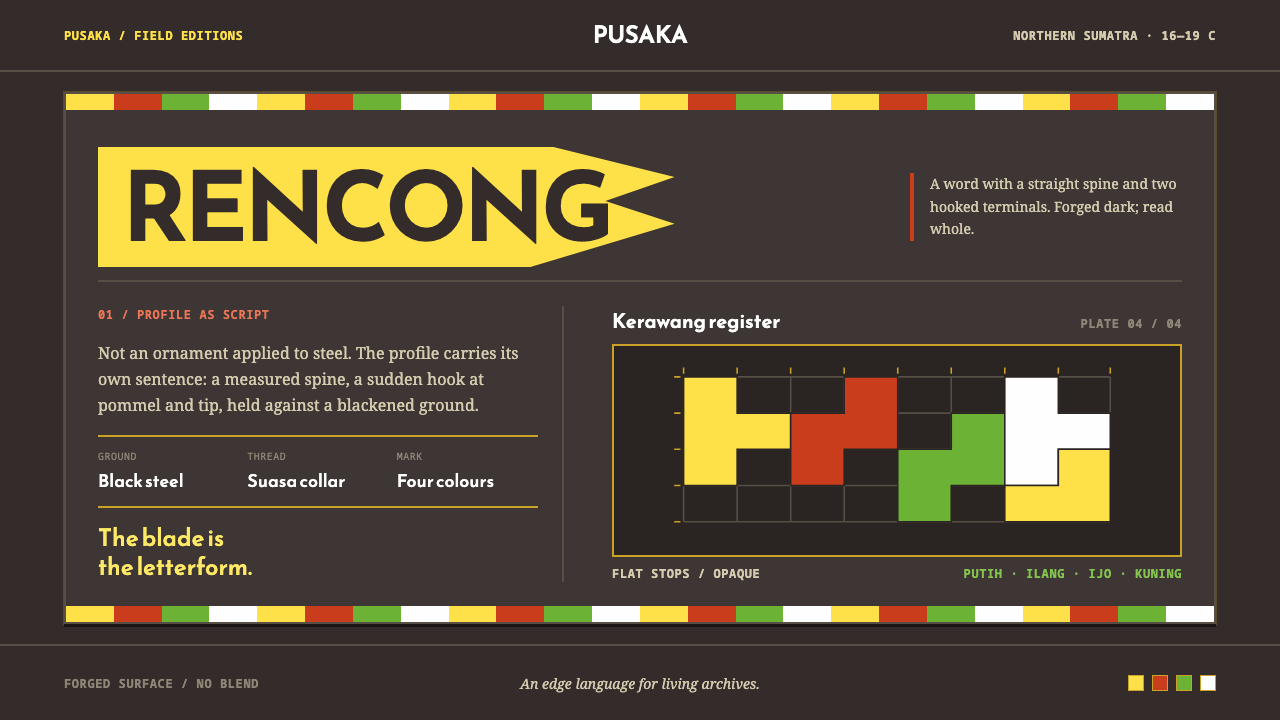 Acehnese Rencong MotifA blade that reads as a word. Flat kerawang red, white, green and yellow lock…
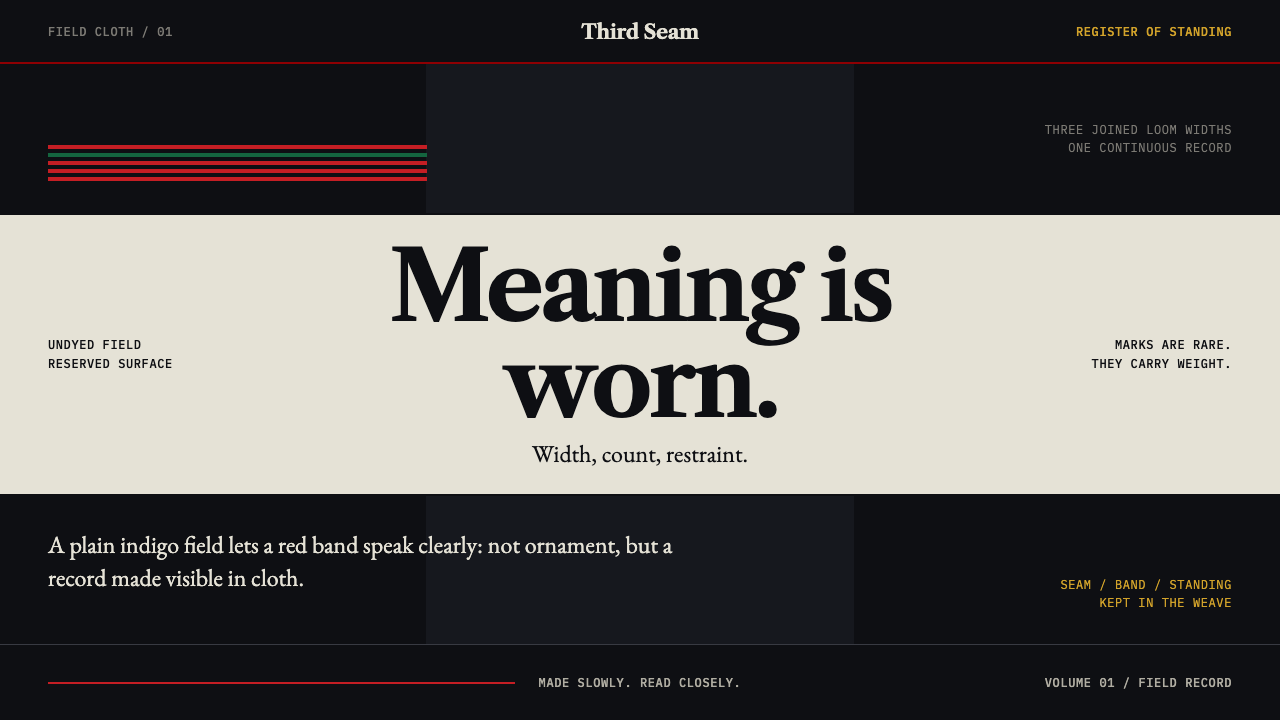 Naga Angami ShawlEvery stripe bears standing. Indigo seams frame rare red bands and one earned…
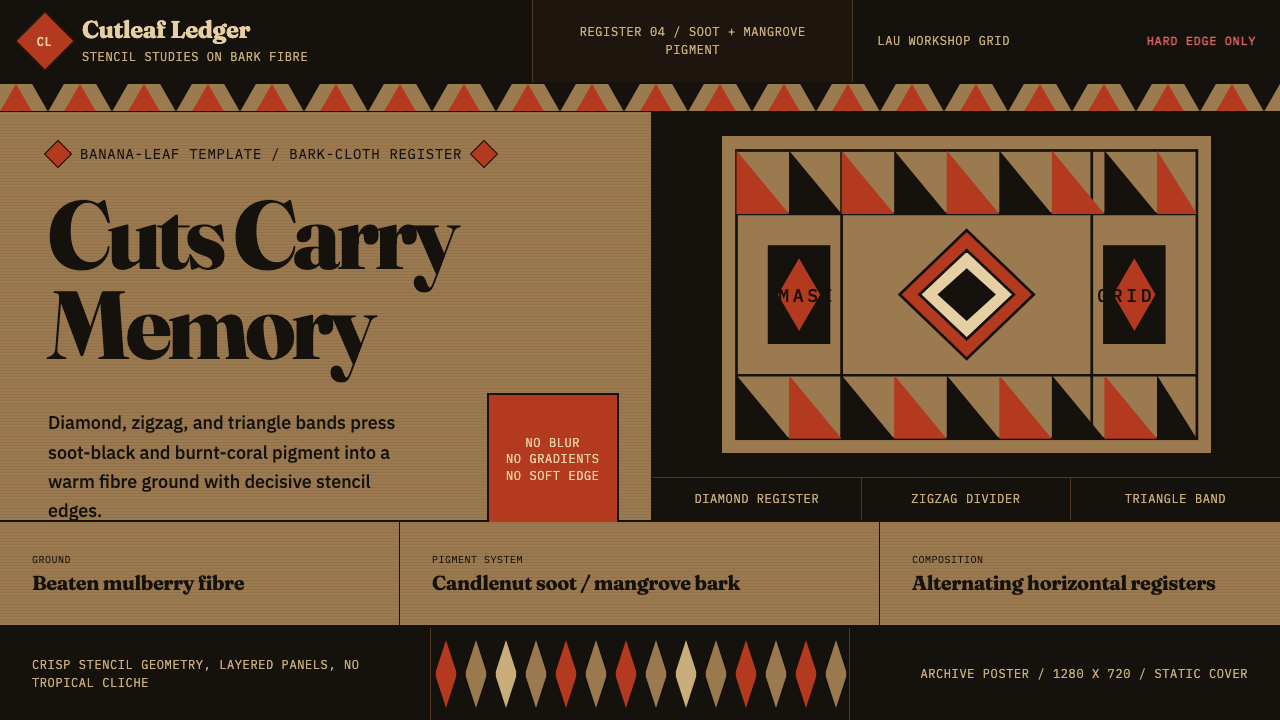 Fijian Masi (Bark Stencil)Stencil memory stays sharp. Soot black and burnt coral strike bark-fibre band…
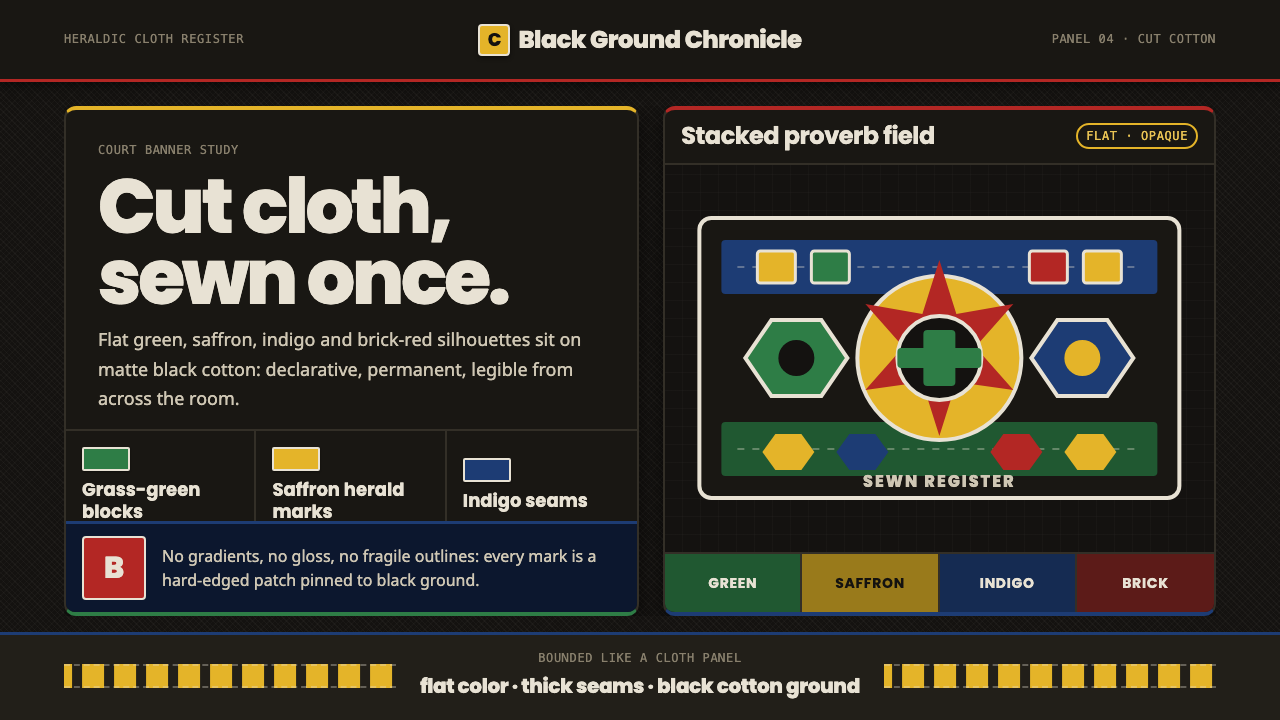 Fon Applique Banner AbomeyRoyal cloth speaks plainly. Flat saffron, green and indigo silhouettes on bla…
 Hmong Paj Ntaub (Flower Cloth)Memory is geometric. Fuchsia applique on indigo forms stepped maze panels.
 Hopi Katsina TihuEvery colour is a direction. Matte mineral fields meet in smoke-black keyline…