What is Samoan Tatau (Traditional Tattoo)?
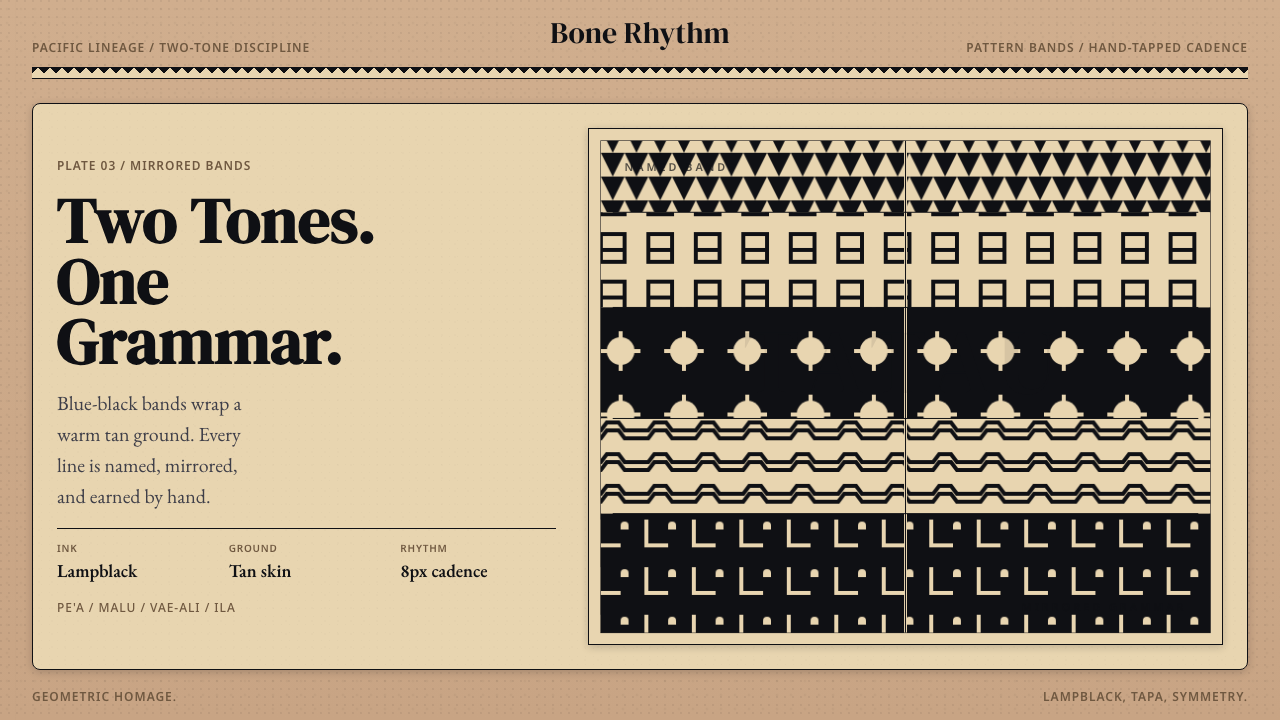
Samoan tatau is the oldest unbroken tattoo tradition on earth — three millennia of hand-tapped geometry encoding ancestry, status, and identity in deep blue-black ink on warm skin.
Samoan Tatau (Traditional Tattoo) in brief
Samoan tatau is a living ceremonial art form and a complete design system simultaneously. At its core it is a strict two-tone discipline: deep blue-black tatau ink laid against warm human skin, with cream-tapa cloth and dark polished wood appearing in the ritual setting. There are no pictorial images, no bright hues, no gradients — only named geometric pattern-bands arranged in precise horizontal registers that wrap the body with anatomical symmetry.
The two principal forms are the pe'a — the full-body male tattoo extending from the waist to the knees in dense interlocking panels — and the malu, the more open and delicate female thigh tattoo. Each carries dozens of individually named motifs: the comb-tooth band, the eel-spine track, the fishhook, the star-rosette, the sundial. These motifs are not decorative choices; they are a vocabulary with fixed meanings and fixed positions, encoding the wearer's clan lineage, social rank, and life achievements in a way legible to other tatau practitioners across the Polynesian Pacific.
As a visual system, tatau operates through repetition, rhythm, and structural contrast. Dense filled areas alternate with fine line zones, creating internal relief without using any color other than the ink itself. The bilateral symmetry of the composition is not mathematical precision but organic calibration to the individual body — every tatau is unique while conforming to tradition. This combination of strict rule and individual embodiment gives the tradition a visual coherence unlike any other historical decorative system.

Where does Samoan Tatau (Traditional Tattoo) come from?
The word tatau — from which the English word 'tattoo' ultimately derives — is found across Polynesian languages as a root denoting the practice, placing its origins deep in the common ancestor culture of the Pacific. Archaeological and linguistic evidence situates the origins of Samoan tatau at roughly three thousand years ago, making it by far the longest continuously documented tattoo tradition in the world. Whereas other ancient tattoo cultures — Egyptian, Scythian, Japanese — experienced interruptions, suppressions, or complete reinventions, the Samoan tradition passed without break from master tufuga ta tatau to apprentice across more than a hundred generations.
The instrument that defines the practice is the au — a comb of sharpened bone or shell teeth bound to a handle, struck rhythmically against a secondary stick to drive the ink into the skin. Different au have different tooth spacings and configurations, producing the distinct line weights, fill densities, and dot patterns of the various named motifs. The ink — historically made from the soot of burned candlenut kernels suspended in water — produces the characteristic deep blue-black that is the tradition's only chromatic material. The entire process for a pe'a takes weeks, spread over multiple sessions, and involves the tufuga, a group of assistants, the recipient's family, and a ceremonial context of food, mats, and gifts that frames the tatau as a communal rather than individual event.
European encounter with tatau is documented from the late eighteenth century, when Samoan men bearing pe'a were observed by explorers and missionaries. The missionary period brought sustained suppression efforts beginning in the 1830s, as Christian missions viewed tatau as a marker of pagan identity. Yet the practice survived — partially by being reinterpreted as compatible with Christian Samoan identity rather than opposed to it, and partially because the tufuga lineages maintained the tradition within families regardless of official pressure. The most significant surviving master lineage is the Sulu'ape family, whose successive masters — including Su'a Sulu'ape Paulo II and his sons — carried the tradition through the twentieth century and into the international tatau renaissance of recent decades.
The late twentieth century brought a global revival of interest in traditional Polynesian tatau, driven partly by Pacific diaspora communities seeking cultural reconnection and partly by the broader international tattoo renaissance. Su'a Sulu'ape Paulo II traveled internationally and worked with diaspora Samoans in New Zealand, Australia, and the United States, making the pe'a and malu accessible to community members born outside Samoa. His son Su'a Sulu'ape Petelo and nephew Su'a Sulu'ape Si'i Liufau continued this work. Curator and scholar Sean Mallon at the Museum of New Zealand Te Papa Tongarewa has been central to documenting and contextualizing the tradition for international audiences. In 2023, the United Nations Educational, Scientific and Cultural Organization inscribed the practice of tātau on the Representative List of the Intangible Cultural Heritage of Humanity, cementing its status as a living heritage of global significance.
What defines the Samoan Tatau (Traditional Tattoo) look?
Two-Tone Discipline
Tatau operates on an absolute two-tone palette: deep blue-black ink against the warm neutral of human skin. No additional colors exist within the system. The visual richness of the tradition is achieved entirely through the interplay of solid filled areas, fine line work, and open ground — the skin itself functioning as the active second tone. This chromatic restraint is not a limitation but a foundational rule that gives tatau its unmistakable visual identity across three millennia.
Named Geometric Motifs
Every pattern element in tatau has a traditional name and a fixed position in the overall composition. The comb-tooth band (nifo oti), eel-spine track, fishhook form, star-rosette, and sundial motif are among the most recognized. These are not free-form decorative choices; each motif belongs to a specific zone of the body and carries a specific semantic weight. The vocabulary is closed and inherited — a tufuga does not invent new motifs but deepens mastery of the existing canon across a lifetime of practice.
Horizontal Band Structure
The composition of tatau is organized into horizontal registers — distinct bands of pattern that encircle the body at specific anatomical zones. These bands alternate in visual density: a heavily filled solid band may sit above a fine-line geometric band, which in turn sits above a dotted or open-ground zone. The rhythm of dense and open creates a visual cadence similar to music — measure by measure, wrapping the form. This band-based architecture prevents visual chaos while enabling enormous variety within the system.
Bilateral Symmetry with Organic Calibration
Tatau compositions are bilaterally symmetrical — the left and right halves of the body mirror each other in pattern placement and motif selection. However, this symmetry is not mechanical reproduction; it is calibrated to the living body of the individual recipient. Variations in the tufuga's hand rhythm, the unique topography of each person's skin, and the organic shifts that occur across multiple sessions all contribute to a symmetry that breathes and lives rather than one that merely mirrors. This is the core paradox of tatau: absolute rule, individual expression.
Density and Relief without Color
Because tatau uses only two tones, it achieves visual depth and contrast purely through the proportion of filled to open areas within each zone. A densely filled triangular block adjacent to a fine-line comb pattern creates the same high-contrast relief effect that a Western designer might achieve by juxtaposing two different colors. The tradition demonstrates that tonal contrast — dark versus light, solid versus line — is a fully sufficient design vocabulary when applied with precision and intention.
The Hand-Tap Rhythm
Unlike modern rotary or coil tattoo machines, the au comb is driven entirely by the tufuga's hand rhythm — the tap of a secondary stick against the handle, repeated thousands of times per session. This manual percussion process means that every line is the direct record of a human gesture, and slight irregularities within a band encode the session's duration, the tufuga's focus, and the recipient's endurance. The machine aesthetic of perfect mechanical repetition is absent by definition; what remains is something closer to handwritten calligraphy than to digital type.
Zero Figural Imagery
Traditional tatau contains no representational imagery — no animals, no faces, no narrative scenes. Every element is abstract geometry: the fishhook motif is a geometric form named after a tool, not a picture of one. This absolute exclusion of figuration distinguishes tatau from most other decorative traditions worldwide and aligns it structurally with the most rigorous abstract design systems of any culture or era. The tradition demonstrates that a complete and expressive visual language can be built on pure geometric abstraction alone.

Who shaped Samoan Tatau (Traditional Tattoo)?
Su'a Sulu'ape Paulo II is the most internationally recognized tufuga of the twentieth century and the central figure in the global tatau renaissance. Based in Samoa and later working internationally, he brought the pe'a and malu to diaspora Samoan communities in New Zealand, Australia, and the United States at a time when many Pacific Islanders born abroad feared the tradition was inaccessible to them. His willingness to travel and his commitment to cultural education — explaining the meanings, protocols, and obligations of tatau to recipients outside the traditional village context — transformed tatau from an insular practice to a living tradition with global reach. His lineage continues through his sons and successors.
Su'a Sulu'ape Petelo is the son of Paulo II and one of the foremost active tufuga ta tatau working today. He continues his father's tradition of working both in Samoa and internationally, maintaining the ceremonial protocols and hand-tool methods that define authentic tatau while reaching recipients across the global diaspora. His work represents the direct transmission of a living lineage — not a reconstruction or revival of a lapsed practice, but an unbroken chain of mastery from teacher to student across generations.
Su'a Sulu'ape Si'i Liufau is a leading tufuga of the Sulu'ape lineage, prominent within the diaspora community and known for his work with Samoan communities in the United States. His practice embodies the tatau renaissance in a diaspora context — working with recipients who have deep cultural roots but were raised outside traditional Samoan society, navigating the protocols of a ceremonial practice in contemporary non-Samoan settings. His career illustrates how a tradition anchored in specific cultural geography can remain authentic and living while adapting its reach.
Sean Mallon is a curator and scholar at the Museum of New Zealand Te Papa Tongarewa and one of the most significant academic voices documenting and interpreting Pacific tatau for international audiences. His research and publications have been instrumental in establishing tatau within the discourse of art history, material culture, and intangible heritage rather than treating it solely as ethnographic curiosity. His work contextualizes tatau's visual system — the motif vocabulary, structural logic, and ceremonial framework — in ways that allow non-Polynesian designers and audiences to understand the tradition's depth without flattening it into surface aesthetic.
How do you use Samoan Tatau (Traditional Tattoo) today?
Tatau as a design reference is not a palette to sample or a set of motifs to borrow — it is a system of structural principles that can inform disciplined two-tone work, geometric pattern architecture, and the design of rhythm through density and spacing. Applying it well means understanding what it does rather than imitating how it looks: the discipline of zero figuration, the logic of named bands, the use of fill-to-open ratio as the primary source of contrast and visual hierarchy.
For presentation slides, the tatau visual language translates most directly through cover design and section dividers. A cover built on tatau principles would use a single deep tone against a warm neutral ground, with a geometric band motif — repeated comb-tooth or interlocking triangles — functioning as the organizing architectural element. The title sits within this structure, not above it. Content slides adopt the horizontal band logic: information is organized into distinct registers with clear visual weight differences between heading zones and body zones, separated by thin rules rather than color blocks. Data visualizations gain power when treated as geometric objects — bar charts and area charts built from solid fills with no gradients, their density itself communicating magnitude.
For web interfaces, the tatau system is most applicable to dashboards, documentation pages, and utility-forward products where hierarchy, scannability, and structural clarity are the primary design values. The approach: a warm off-white or cream background, a single deep near-black tone for all text and structural elements, and one carefully chosen accent tone for interactive states or key data callouts. Border treatments replace color fills for component differentiation. Pattern work in headers or section backgrounds should use repeating geometric motifs at low density rather than photographic or illustrative elements. Navigation and labeling should be purely typographic, with structure communicated through weight contrast and spacing rather than iconography.
For editorial layouts and marketing materials, tatau principles support strong, architecturally driven composition. An editorial page built on these principles uses wide outer margins as breathing zones, a narrow centered body column, and section-break devices that are purely linear — fine rules that echo the band structure of tatau itself. Marketing materials benefit from the tradition's boldness: full-bleed geometric pattern panels in a single deep tone, alternating with open-ground text zones, create a rhythm that is visually powerful without relying on color variety. Cover art for reports or event materials can use interlocking geometric fills at varying densities to create visual hierarchy without introducing additional hues.
The most common mistake when drawing on tatau as a design reference is treating it as a tribal aesthetic — applying generic repeating zigzags or Polynesian-adjacent patterns as surface decoration without understanding the structural logic underneath. This produces work that appropriates the visual surface while discarding the system. Equally problematic is adding color to a tatau-inspired composition under the assumption that the original palette is a constraint to modernize. The two-tone discipline is not a limitation of pre-industrial technology; it is the core design decision. Introducing even a third neutral tone immediately changes the system's logic and visual behavior.

Samoan Tatau (Traditional Tattoo) — FAQ
Is it appropriate to use tatau-inspired patterns in commercial design work?
This requires careful consideration. Tatau is a living ceremonial tradition with specific cultural protocols and social meanings; it is not a historical style available for free appropriation. Using the structural principles — two-tone discipline, geometric band architecture, fill-to-open contrast — as a design methodology is different from directly copying named motifs such as the pe'a or malu patterns, which carry specific identity and ancestry meanings within Samoan culture. Designers drawing on tatau as a reference should be transparent about the source, avoid reproducing specific named motifs outside their cultural context, and recognize that the tradition belongs to a living community with ongoing relationships to it.
How does tatau achieve visual complexity without using more than two tones?
Through three mechanisms operating simultaneously: density variation, scale contrast, and motif alternation. Density variation means that zones of closely packed fills appear darker and heavier than zones of fine line work even though both use the same ink. Scale contrast means that large bold geometric fills read differently than small repeating dot or line patterns even at the same fill percentage. Motif alternation means that adjacent bands using different named patterns — a solid triangle zone next to a comb-tooth band next to an open dotted zone — create rhythm and visual relief. These three mechanisms together produce compositions of extraordinary intricacy without ever departing from the fundamental two-tone constraint.
What distinguishes an authentic tatau from a contemporary tattoo that simply looks similar?
Several dimensions distinguish them. First, the instrument: authentic tatau is performed exclusively with the hand-struck au comb, never with a machine. The resulting line quality — slightly organic, carrying the record of the tufuga's rhythm — is distinguishable from machine work by a trained eye. Second, the motif vocabulary: authentic tatau uses the canon of named motifs in their correct positions on the body. Compositions that rearrange motifs freely or apply them to non-traditional body areas, however skillfully executed, depart from the tradition. Third, the ceremonial context: authentic tatau involves specific protocols of preparation, family participation, and reciprocal obligations. Fourth, the source of authorization: receiving tatau from a recognized tufuga lineage, such as the Sulu'ape family, is fundamentally different from receiving a visually similar tattoo from a practitioner outside that lineage.
Can tatau design principles be applied to digital interfaces, given that they were developed for the human body?
The structural principles transfer readily, though the application requires translation rather than direct transposition. The band-register architecture maps naturally to the horizontal sectioning logic of many interface layouts — hero zones, content bands, footer structures. The fill-to-open contrast logic maps to component density and whitespace management. The two-tone discipline maps to high-contrast accessible UI design where one foreground tone works against one background tone with no intermediate gradients. What does not transfer is the body-specific calibration: tatau's organic symmetry responds to the unique topography of a particular person's form, while digital interfaces respond to rectangular screen geometries. The designer's task is to take the underlying structural logic and re-express it in the medium's own terms.
How should the warm skin-tone ground be interpreted when applying tatau principles to non-skin media?
The warm neutral ground is as essential to the tatau system as the dark ink — the two tones define the system jointly. When transposing to paper, screen, or fabric, the skin-tone ground should be interpreted as a warm off-white or light tan: a tone that reads as neutral and natural rather than stark or cool. Pure white or cool grey backgrounds flatten the system and lose the warmth that gives tatau its distinctive visual register. The relationship between the deep tone and the warm ground creates a visual quality different from black-on-white — it is softer, more organic, and more resonant. This quality is worth preserving in any medium-transposition, because it is what distinguishes a tatau-inspired composition from generic high-contrast geometric design.
Related design styles
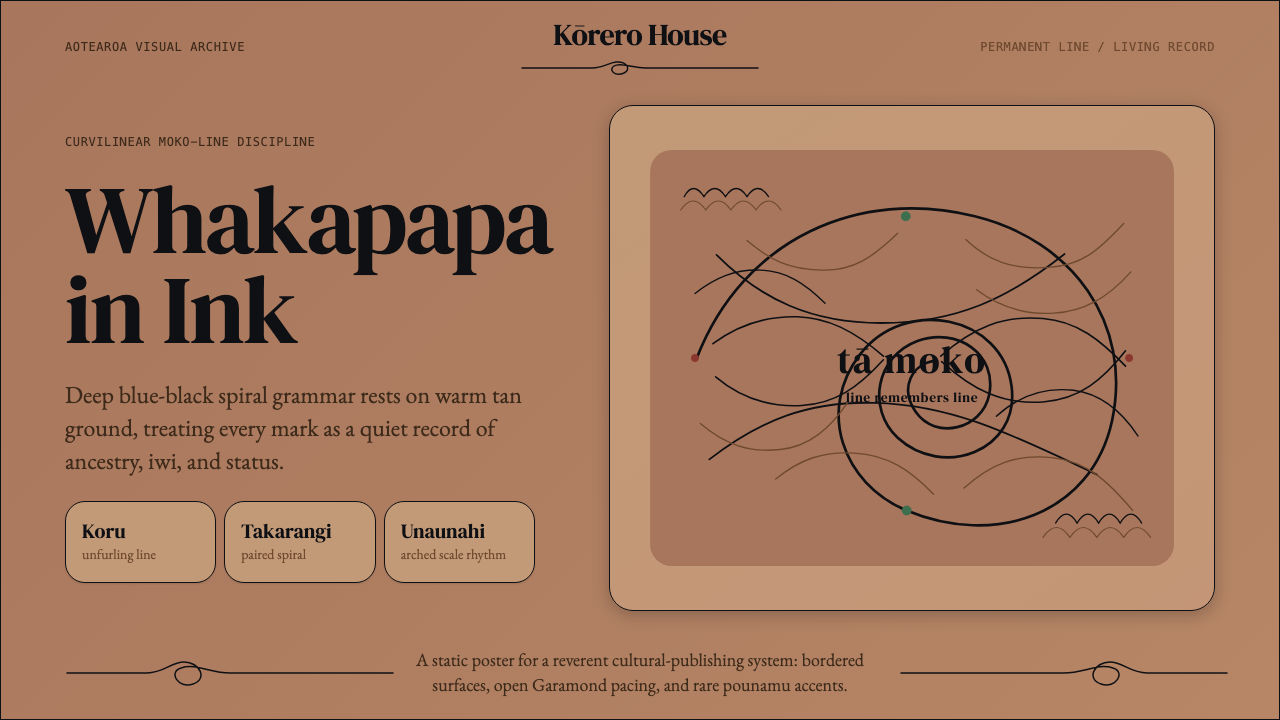 Māori Tā Moko (Facial Tattoo)Ancestry feels carved. Blue-black spirals on tan ground carry a restrained Ga…
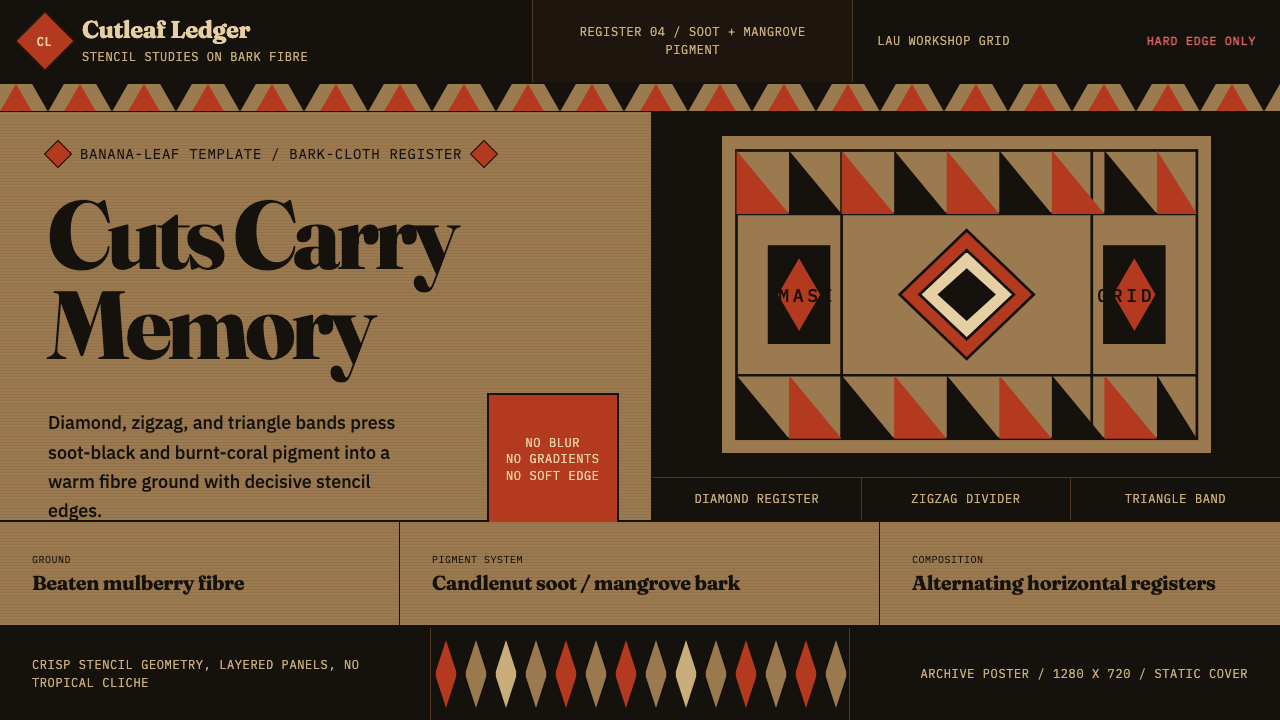 Fijian Masi (Bark Stencil)Stencil memory stays sharp. Soot black and burnt coral strike bark-fibre band…
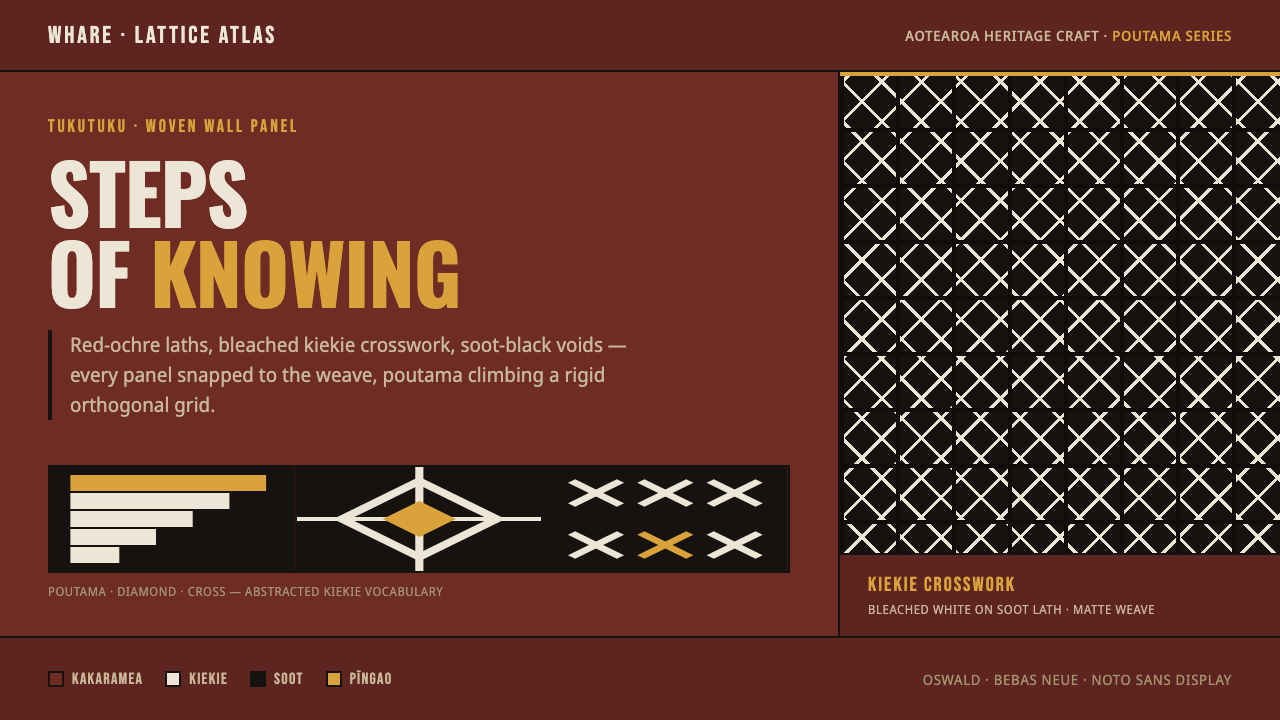 Māori Tukutuku PanelTukutuku weave, rendered strict. Bleached kiekie crosswork laces poutama step…
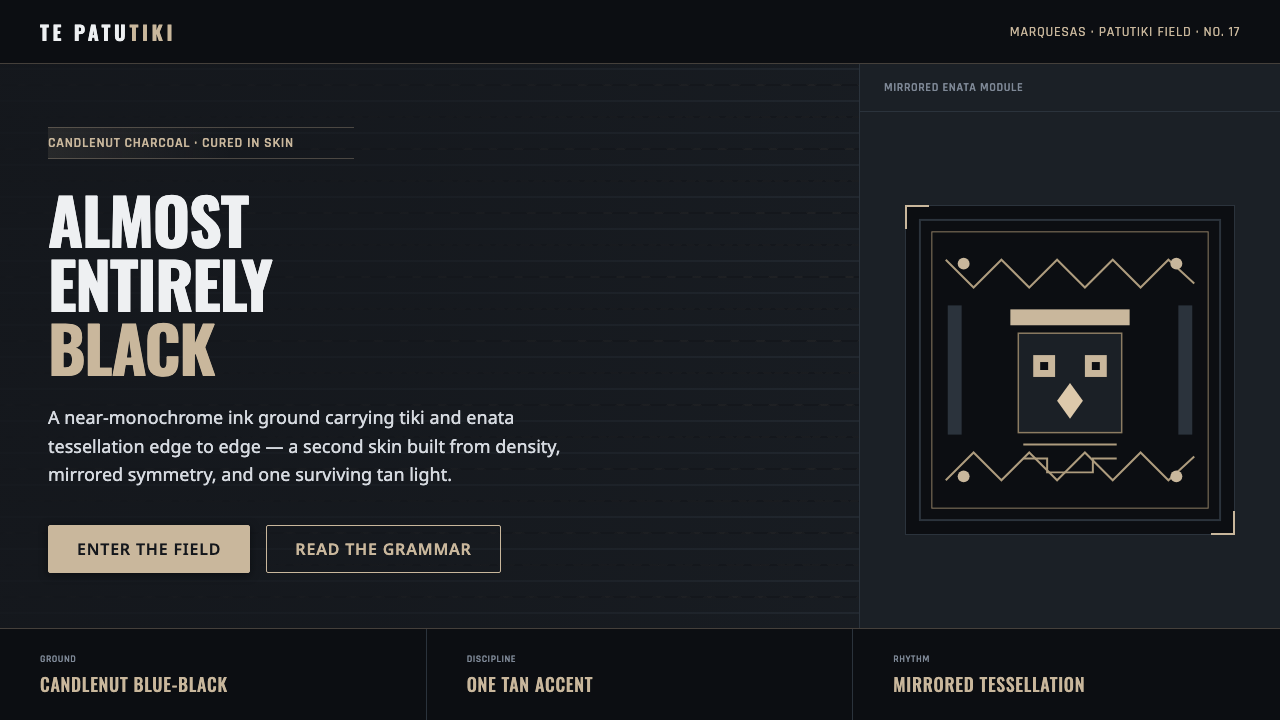 Marquesan Tatu PatternDensity as authority. Tiki and enata tessellation inked into blue-black, lit…
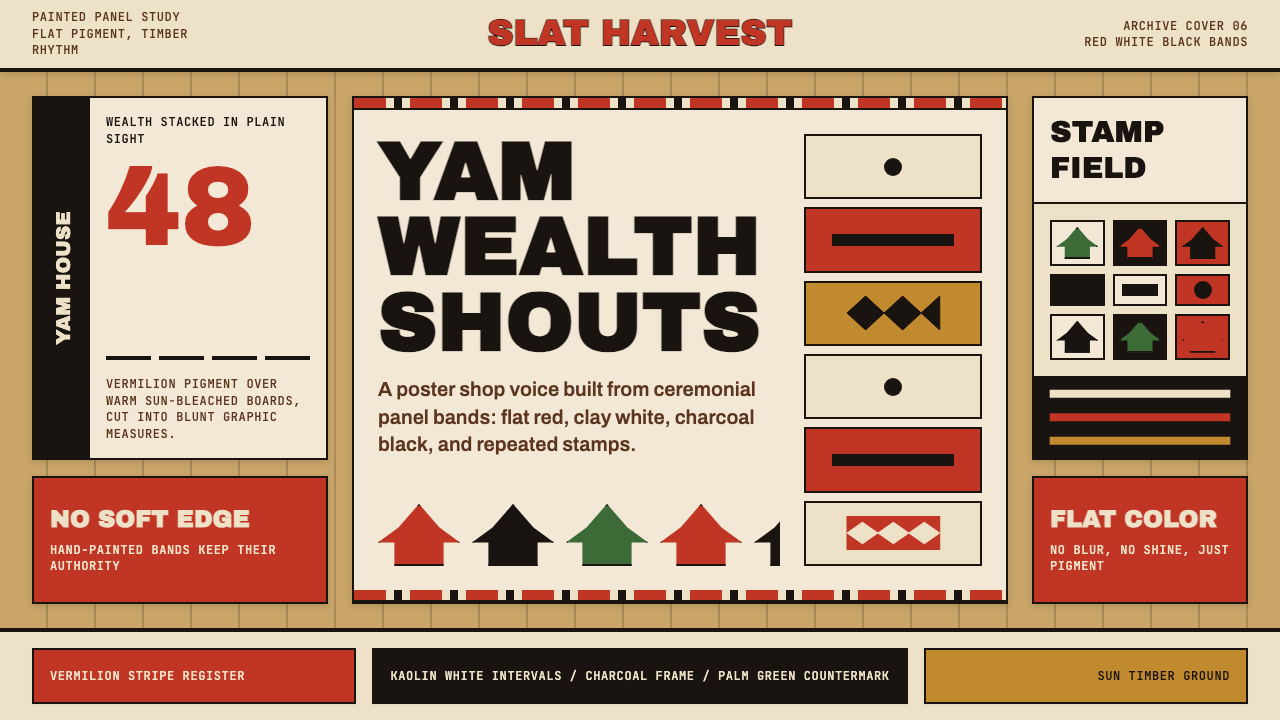 Trobriand Yam House PaintPainted wealth speaks loud. Vermilion bands and black stamp silhouettes hit t…
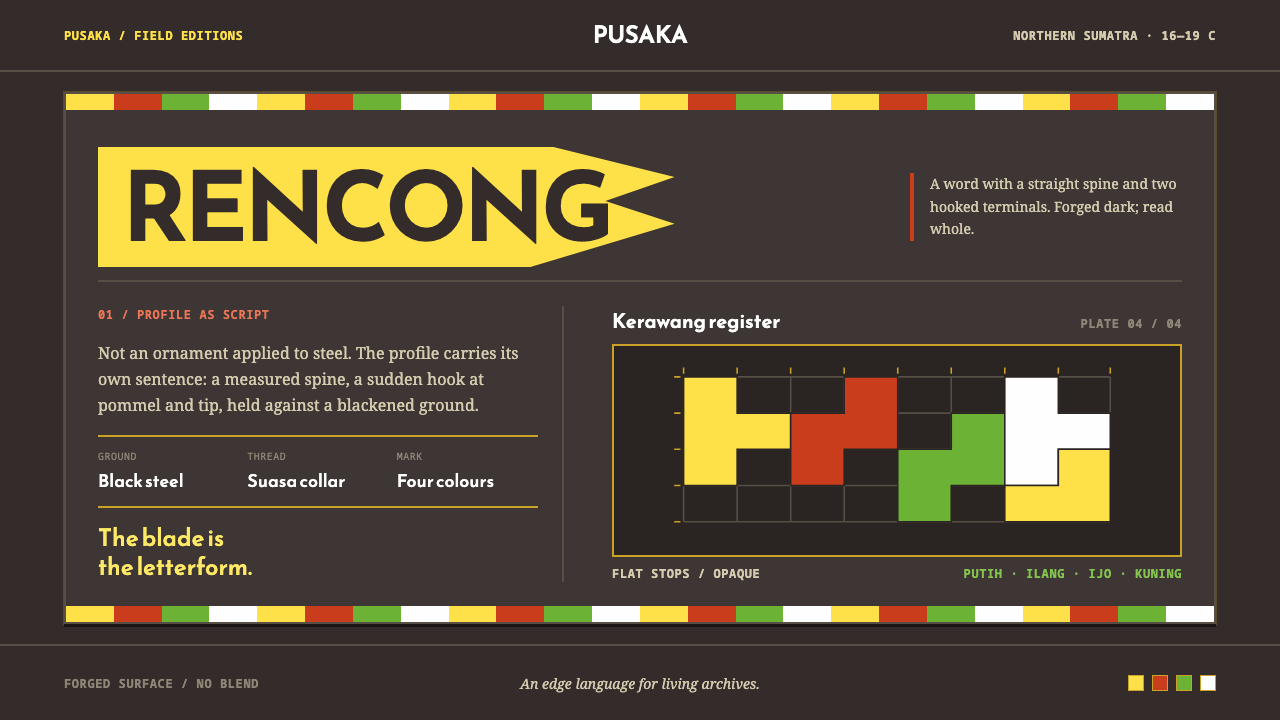 Acehnese Rencong MotifA blade that reads as a word. Flat kerawang red, white, green and yellow lock…