What is Trobriand Yam House Paint?
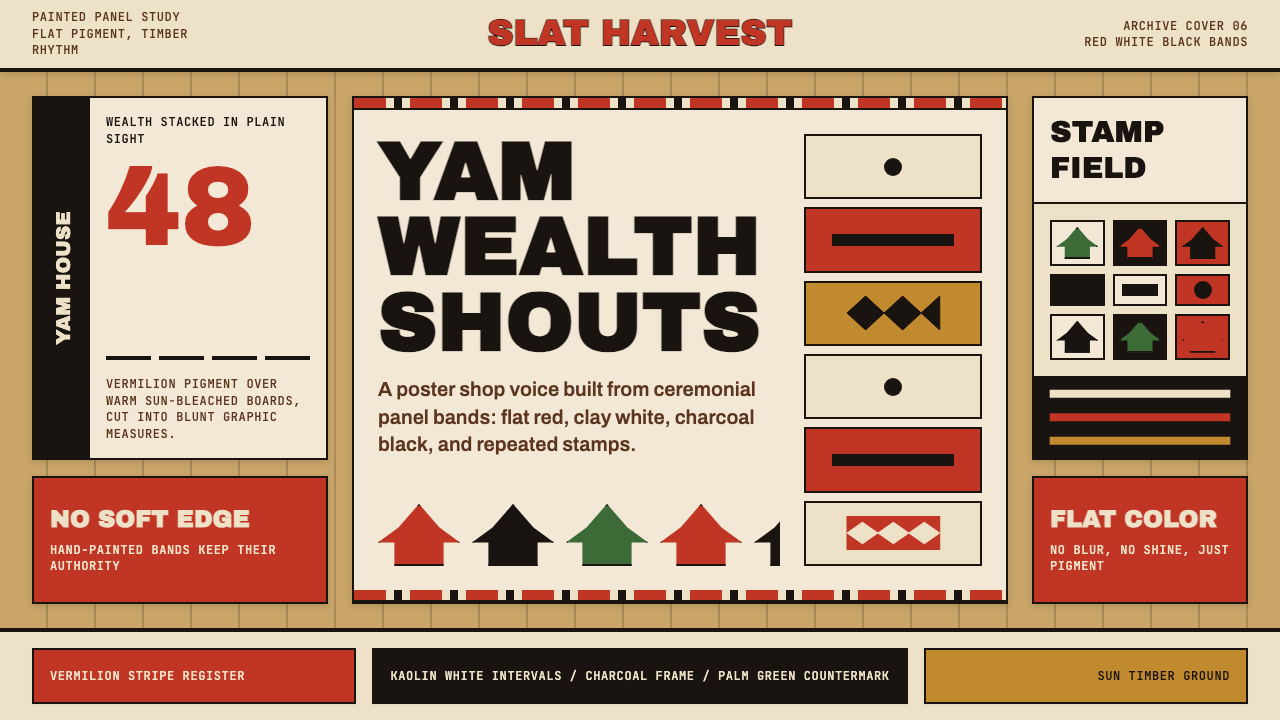
On the Trobriand Islands, a painted yam house is not decoration — it is a ledger of power, read by every passing canoe.
Trobriand Yam House Paint in brief
Trobriand Yam House Paint is a bold graphic tradition rooted in the ceremonial architecture of the Trobriand Islands, a coral archipelago in Milne Bay Province, Papua New Guinea. The central artifact is the bwema — a towering, slatted timber structure built to store and display the ceremonial yam harvest. Ownership of yams is political currency here, and the painted facade of the bwema announces the chief's wealth to the whole village.
The visual vocabulary is immediately striking: broad horizontal bands of vermilion red and kaolin white march across sun-bleached timber boards, interrupted by stamp-like silhouettes of birds, fish, and geometric forms rendered in deep black. The graphic quality is closer to a woodblock print than to decorative painting — flat, high-contrast, without shadow or gradation. Each motif repeats in a rhythmic sequence that reads from a distance, making the structure a kind of sign that broadcasts status across the open village plaza.
As a contemporary design system, Trobriand Yam House Paint translates these qualities into interface language. It brings the warmth of raw timber tan as a ground, the assertiveness of vermilion as its primary action color, the quiet authority of kaolin white as a secondary field, and deep matte black for structure and typography. The motif logic — stamp, repeat, band — becomes a modular pattern grammar applicable across digital surfaces.
Where does Trobriand Yam House Paint come from?
The Trobriand Islands have been inhabited for thousands of years, and their ceremonial culture was largely unknown to the outside world until the Polish-British anthropologist Bronisław Malinowski arrived for extended fieldwork between 1915 and 1918. Malinowski's writings — particularly Argonauts of the Western Pacific (1922) and Coral Gardens and Their Magic (1935) — documented a society of startling complexity, organized around two great systems of exchange: the kula ring, a vast inter-island circuit of shell valuables, and the urigubu, the formal presentation of yam tribute from a man's brothers-in-law to his household.
In Trobriand society, yams are not merely food. The size, quality, and public display of a chief's yam harvest directly express his mana — his social efficacy and spiritual potency. Bwema are built taller and more elaborately painted the more powerful the chief, and a chief's political standing can be read, with some accuracy, from the height of his yam house and the density of its painted decoration. The horizontal bands and silhouette panels on the facade are not arbitrary — they follow conventions established across generations, with specific motifs associated with particular clans and lineages.
Malinowski's fieldwork partner Annette Weiner, who conducted research in the Trobriands in the 1970s, documented additional layers of meaning in the visual system. Her work Women of Value, Men of Renown (1976) revealed that the economy of display extended beyond yams to include woven banana-leaf bundles and skirts, objects controlled by women and exchanged at mortuary ceremonies. The painted bwema sits within this broader economy of visibility, in which aesthetic intensity — the boldness of the color, the precision of the pattern — is itself a form of social argument.
The graphic tradition has survived into the present, with contemporary Trobriand communities continuing to build and paint bwema for festivals and harvest ceremonies. The encounter between this tradition and global visual culture has been gradual rather than disruptive: the motif vocabulary and palette have remained remarkably stable, grounded in locally available pigments and the practical constraints of large-scale timber painting. What makes the tradition relevant for contemporary design is precisely this stability — the forms that have persisted are the ones with the highest communicative efficiency.
What defines the Trobriand Yam House Paint look?
Palette
The palette is built on three protagonists and one ground: vermilion red, kaolin white, and deep matte black perform against a sun-bleached timber tan. The red is warm and aggressive — closer to brick and earth ochre than to cool primary red — giving the system organic heat rather than clinical energy. White is used for banding and negative-space relief rather than as a neutral field. Black is structural and silhouette-forming, never used as a background. The timber tan ground is the fourth actor, a natural surface that warms the whole composition and prevents it from reading as purely graphic.
Pattern Logic
The organizing principle is horizontal banding interrupted by stamped-motif panels. Broad bands of alternating color stack rhythmically across the surface, broken at intervals by panels containing silhouettes of birds, fish, canoes, or geometric forms. The motifs read as stamps — flattened, thick-contoured, without internal detail — repeated in rows or mirrored pairs. This band-and-panel grammar is the system's primary modularity: any surface can be structured by defining the band width, the panel placement, and the motif selection.
Silhouette Quality
Figural imagery is reduced entirely to silhouette. Birds are readable as birds — wing spread, beak angle, tail shape — but all internal feather detail is omitted. Fish have scale rhythm but no individual scales. This reductive approach gives the forms iconic clarity: they communicate their subject at a glance and scale without degradation from the height of a bwema facade to the scale of a button icon. The silhouette is always a single flat color — no gradients, no outlines separate from the fill, no dimensional modeling.
Hand-Painted Edge
What distinguishes authentic Trobriand painting from mechanical repetition is the quality of the edge. Lines are firm but not perfectly straight; band boundaries have micro-variation that speaks of a brush loaded with pigment and drawn against the grain of the timber. In digital application, this quality can be referenced through subtly imperfect geometry — edges that suggest handcraft without mimicking it literally. A line that is slightly uneven reads as authored; a line that wobbles randomly reads as broken. The distinction is intention.
Rhythmic Repetition
Motifs are never isolated — they repeat. The rhythm is regular enough to read as a system and varied enough to hold attention. A panel might contain three bird silhouettes at equal spacing, or a row of fish alternating direction, or a geometric diamond repeated seven times across the band. This repetition is not tedium: it is the grammar of the tradition, signaling that the painted surface is intentional, systematic, and authored by someone with enough resources to fill it completely.
Structural Horizontality
The architecture of the bwema — a tall, narrow facade of horizontal timber slats — dictates horizontal reading. The painted system reinforces this: bands run edge to edge, motif panels are wider than they are tall, and text-equivalent elements (if any) run in horizontal sequences. Vertical emphasis is structural and implicit (the height of the whole facade), never decorative. This horizontality translates directly to wide-aspect digital layouts: hero sections, data dashboards, editorial headers.
Social Legibility
The painted bwema is designed to be read from a distance — from across the village plaza, from a passing canoe. Every design decision privileges legibility at scale: high contrast between figure and ground, thick strokes on motifs, broad bands rather than fine lines. This broadcast quality carries into digital application as a preference for boldness over refinement. Elements should be readable at a glance, not studied. The system is for announcement, not contemplation.
Who shaped Trobriand Yam House Paint?
Malinowski's three-year fieldwork in the Trobriands (1915–1918) produced the first systematic documentation of bwema construction and decoration, embedding the visual tradition in the anthropological record. His account of the kula ring and the urigubu yam tribute system established the framework through which subsequent researchers understood how aesthetic intensity — the height of the painted facade, the density of its motifs — functions as social communication. Without his work, the design logic of Trobriand painted architecture would remain largely uninterpreted.
Weiner's fieldwork in the Trobriands in the 1970s extended and complicated Malinowski's account, revealing that the economy of display was not confined to yams and male prestige goods but encompassed women's wealth in woven textiles and banana-leaf bundles. Her analysis of Trobriand visual culture as a system of social argument — in which the completeness and boldness of a decorated surface signals the decorator's social efficacy — provides the theoretical grounding for understanding why the painted bwema looks the way it does. Her monograph Women of Value, Men of Renown (1976) remains a core reference.
The Trobriand painting tradition does not exist in isolation but is part of a broader Massim cultural area encompassing the islands of eastern Papua New Guinea's offshore archipelagos. Shared visual conventions — flat silhouette motifs, horizontal banding, the privileging of high-contrast graphic work — appear across Massim canoe prow carvings, dance shields, and body painting, suggesting a regional visual grammar with deep roots. Understanding Trobriand yam house painting as one expression of this broader Melanesian graphic sensibility helps calibrate what is uniquely Trobriand versus what is regionally shared.
Kiriwina, the largest of the Trobriand Islands, is the primary site where bwema construction and painting traditions have been best documented and continue most actively. Contemporary Kiriwina communities maintain the painted yam house as a living practice, not a museum artifact. The tradition's survival into the present — including in contexts where the underlying prestige economy has shifted substantially — speaks to the resilience of the visual system itself: forms that communicate clearly outlast the specific social conditions that generated them.
How do you use Trobriand Yam House Paint today?
Trobriand Yam House Paint suits presentations and digital surfaces where authority, warmth, and immediate visual impact need to coexist. The system is not precious or subtle — it is a broadcasting language, designed to be read at distance and understood without caption. This makes it well-suited to contexts where the audience has limited time and the message needs to land in seconds: pitch decks, conference slides, product launch pages, social media graphics.
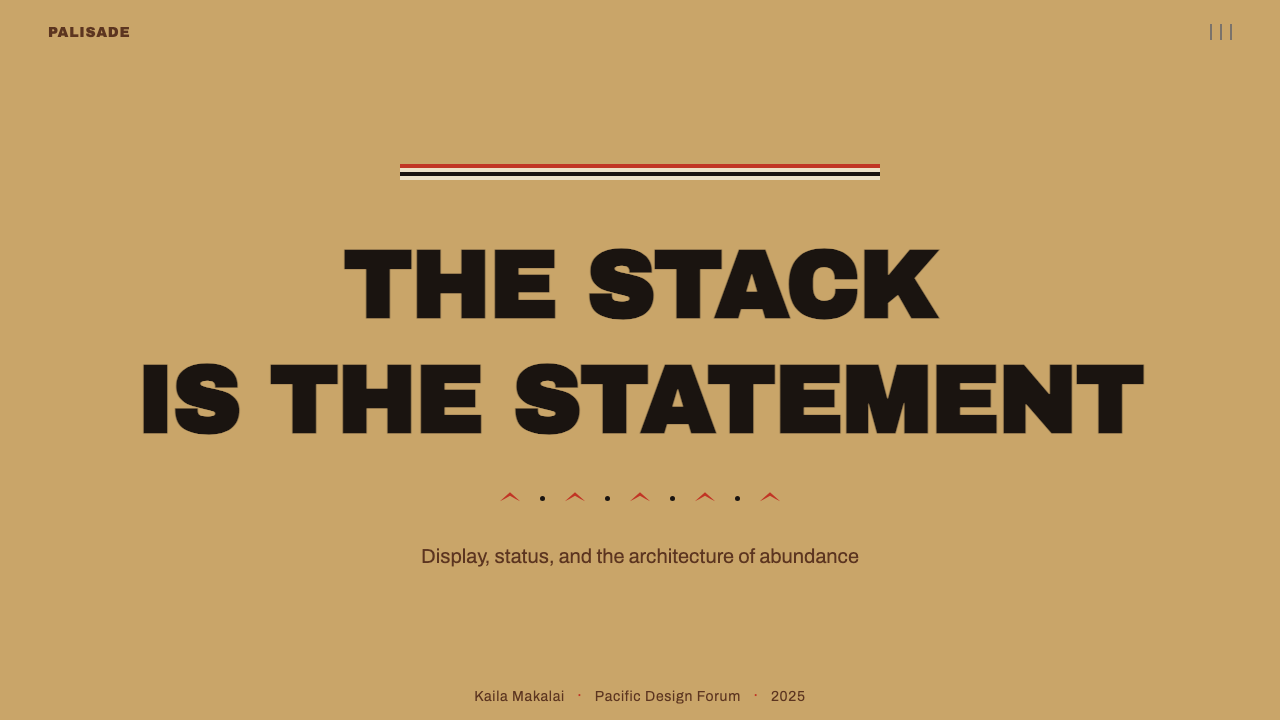
For presentation slides, the system excels on bold cover pages and section dividers. A cover built in this style uses the timber tan ground as the base, places a wide vermilion band across the upper third, and drops the title in heavy black type on the tan or white field below. A single bird or fish silhouette, large and placed asymmetrically, functions as the only graphic element — no photographs, no abstract textures. Content slides should carry the horizontality forward: use band-weight ruled lines to separate sections, keep body text left-aligned in a wide measure, and reserve vermilion for the single most important callout per slide. Data visualizations adopt the palette directly — bar charts in vermilion, comparison bars in kaolin white edged with black, annotations in black — giving charts the same authority as the decorative panels.
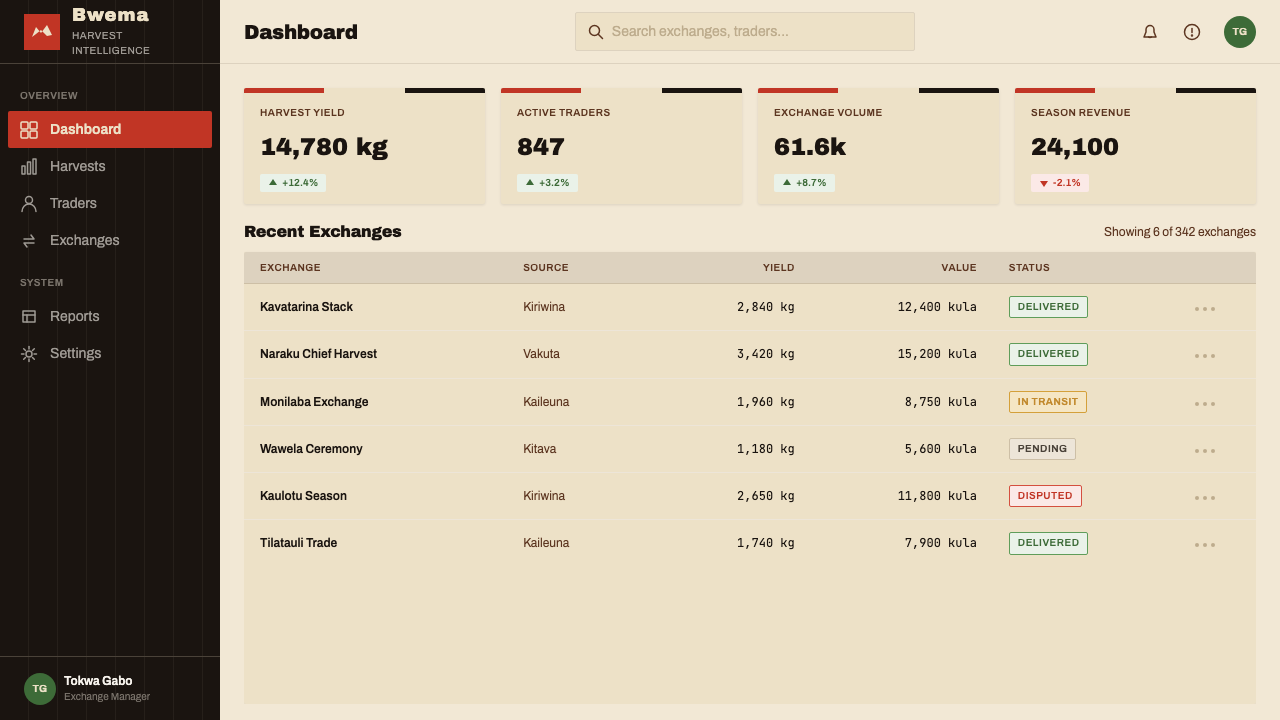
For web interfaces, the style is best deployed in marketing and editorial contexts rather than in dense transactional UI. A landing page built on this system uses alternating bands — timber tan, then vermilion, then kaolin — as the structural grid for section backgrounds. Navigation should be typographically heavy: wordmarks and labels in the same black as the silhouette motifs, with no icon decorations except the occasional geometric stamp used as a bullet or marker. Pricing or feature comparison pages benefit from the banding logic applied to table rows: alternating the tan and kaolin creates visual rhythm without relying on ruled lines. Dashboards are a stretch — the warmth of the palette and the graphic boldness work against the information density that dashboard users need.
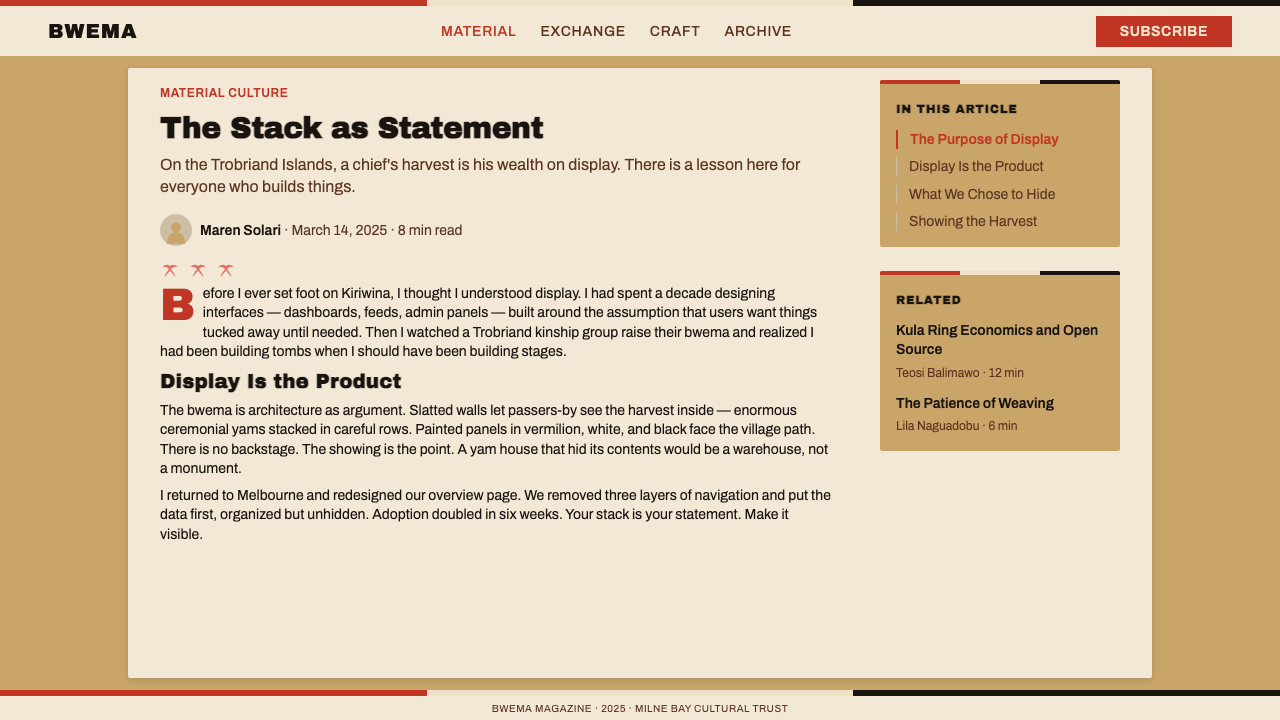
For editorial and marketing work, the style's poster-like energy is a natural fit. A feature article layout can open with a full-width header band in vermilion carrying the headline in kaolin white, then transition to a timber tan ground for the body. Pull quotes or callout boxes work well as horizontal bands spanning the content column, with the quote set in large black type on vermilion. Marketing materials — event graphics, social posts, printed materials — can use the motif vocabulary directly: a series of bird silhouettes across a banner, a fish-stamp pattern as a background texture in the margin, horizontal stripe banding as a framing device.
The most common mistake when applying this style is decorating it further. The bwema facade works because each element is necessary and the composition is full without being cluttered. Adding gradients, soft drop shadows, or layered textures breaks the broadcast logic — the surface starts to whisper when it should be announcing. Similarly, using the full palette simultaneously at equal visual weight produces visual noise rather than hierarchy. In a well-calibrated application of this system, vermilion leads, black structures, white relieves, and the timber tan grounds — each element has a role, and none competes for the same function.
Trobriand Yam House Paint — FAQ
Is this a well-documented tradition or are we reading too much into it?
Trobriand yam house painting is one of the more thoroughly documented examples of graphic art in Melanesia, precisely because Malinowski and subsequent anthropologists treated the visual system as inseparable from the social and economic system it expressed. The interpretation of the painted bwema as a form of social communication — rather than mere decoration — is grounded in the community's own explanations of what the paintings mean and who has the right to display which motifs. This is not projection from outside; it is the tradition's own self-description.
How does this compare to other Pacific Island visual traditions?
Trobriand yam house painting shares the Melanesian preference for high-contrast, flat-silhouette graphic work that appears across canoe prow carvings, tapa cloth, and dance shields throughout the western Pacific. What distinguishes the Trobriand tradition is the combination of strong horizontal banding with the stamp-like motif repetition, and the specific palette that gives primary importance to vermilion against timber. Other Melanesian traditions tend toward more intricate curvilinear pattern or toward a different palette structure. The overall graphic sensibility — bold, broadcast-legible, socially indexed — is broadly shared.
Can this style work for consumer products, or is it too bold?
The boldness is the point, not an obstacle. The question is whether the product benefits from the associations the style carries: authority, display, warmth, and a sense that the maker is announcing something with confidence. Food brands and artisan goods are a natural fit — the timber tan ground and handpainted-edge quality read as authentic and craft-adjacent. Fashion and lifestyle products can leverage the graphic intensity as a signal of cultural confidence. Where the style struggles is in products that need to project delicacy, luxury quietness, or precision engineering — the broadcast logic of the bwema works against understatement.
What does it mean to use this style ethically?
Using Trobriand visual conventions in contemporary design means working with a living tradition from a community that is still active. Ethical use starts with acknowledgment — identifying the origin clearly rather than presenting the aesthetic as generically Pacific or exotic. It means not lifting specific sacred or clan-affiliated motifs for commercial use without understanding their status. The broad principles — horizontal banding, high-contrast silhouette, bold palette — belong to a visual grammar that can be engaged with respect. The specific motifs — if they carry clan or ceremonial significance — warrant more care. The distinction matters.
How do I avoid making it look like generic tropical decoration?
Generic tropical decoration tends toward soft, rounded forms, pastel or saturated Caribbean colors, and an overall sweetness. Trobriand yam house painting is none of these: it is graphic, flat, formally structured, and socially purposeful. The safeguards are the palette discipline (vermilion is warm-earthen, not bright-tropical), the silhouette austerity (no gradients, no detailed illustration), and the horizontal banding structure (which gives the composition architectural rather than decorative logic). If what you are producing reads as festive or friendly, you have drifted. If it reads as authoritative and direct, you are in the right territory.
Related design styles
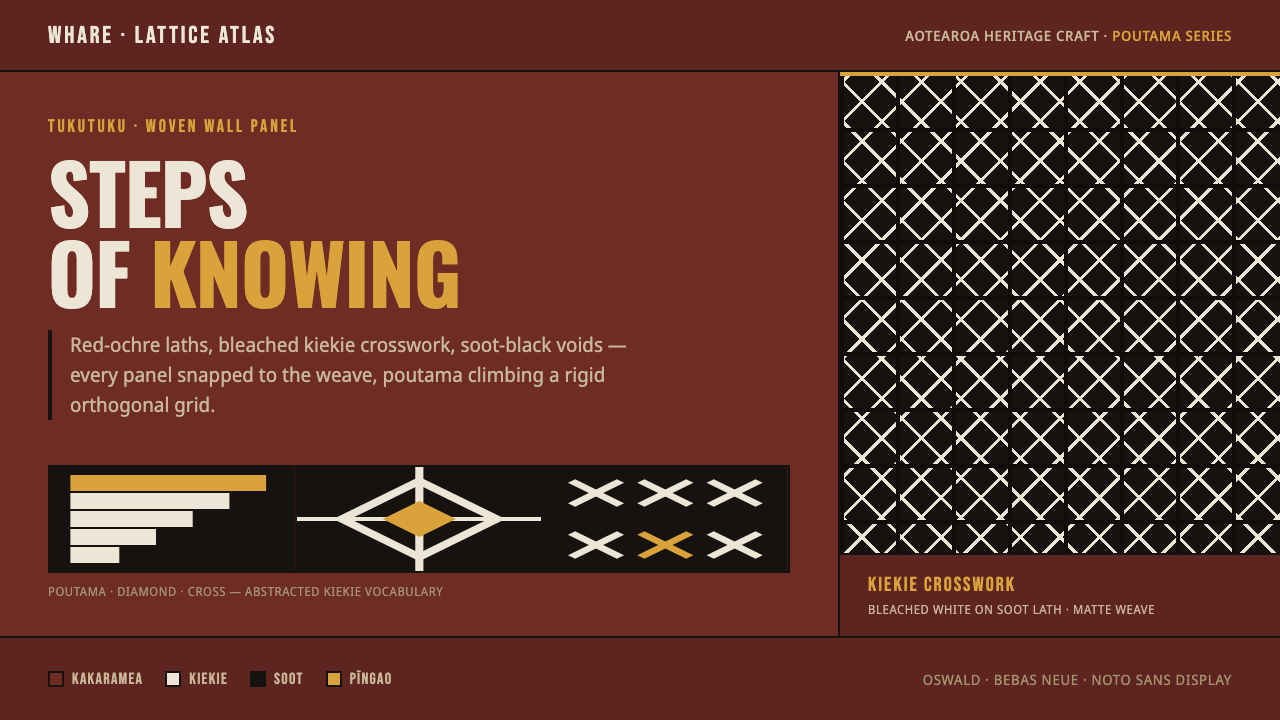 Māori Tukutuku PanelTukutuku weave, rendered strict. Bleached kiekie crosswork laces poutama step…
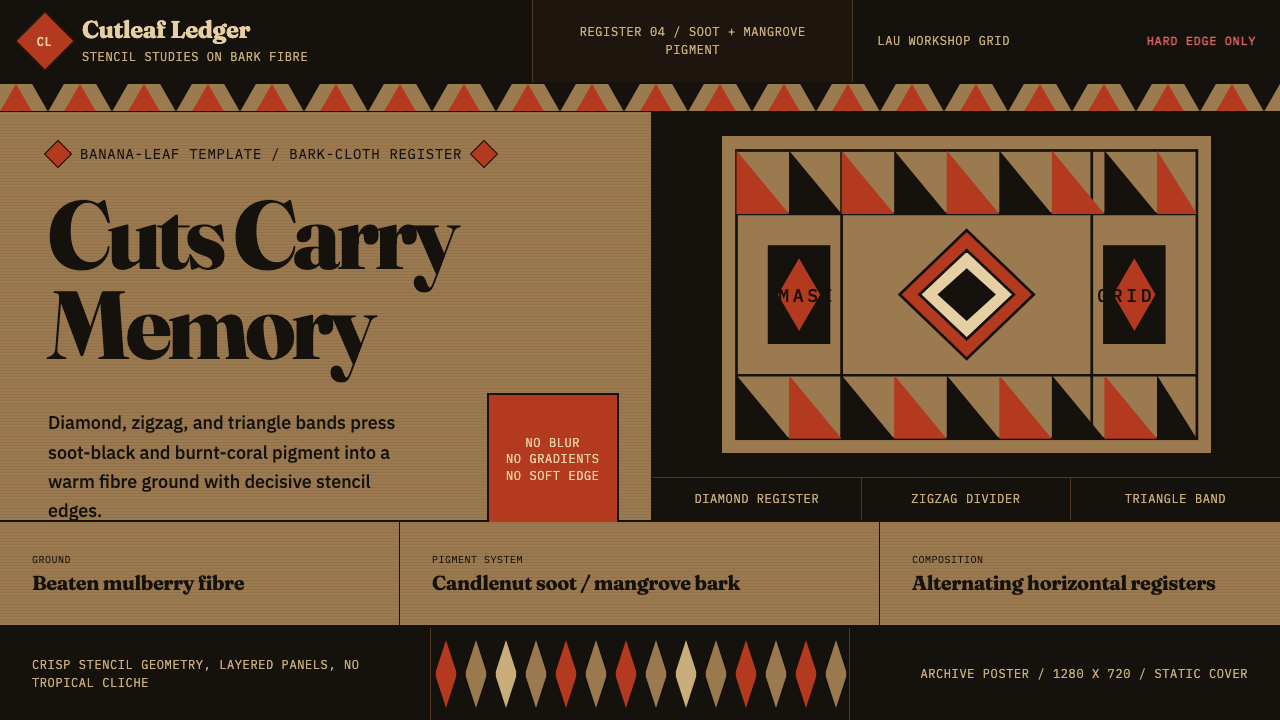 Fijian Masi (Bark Stencil)Stencil memory stays sharp. Soot black and burnt coral strike bark-fibre band…
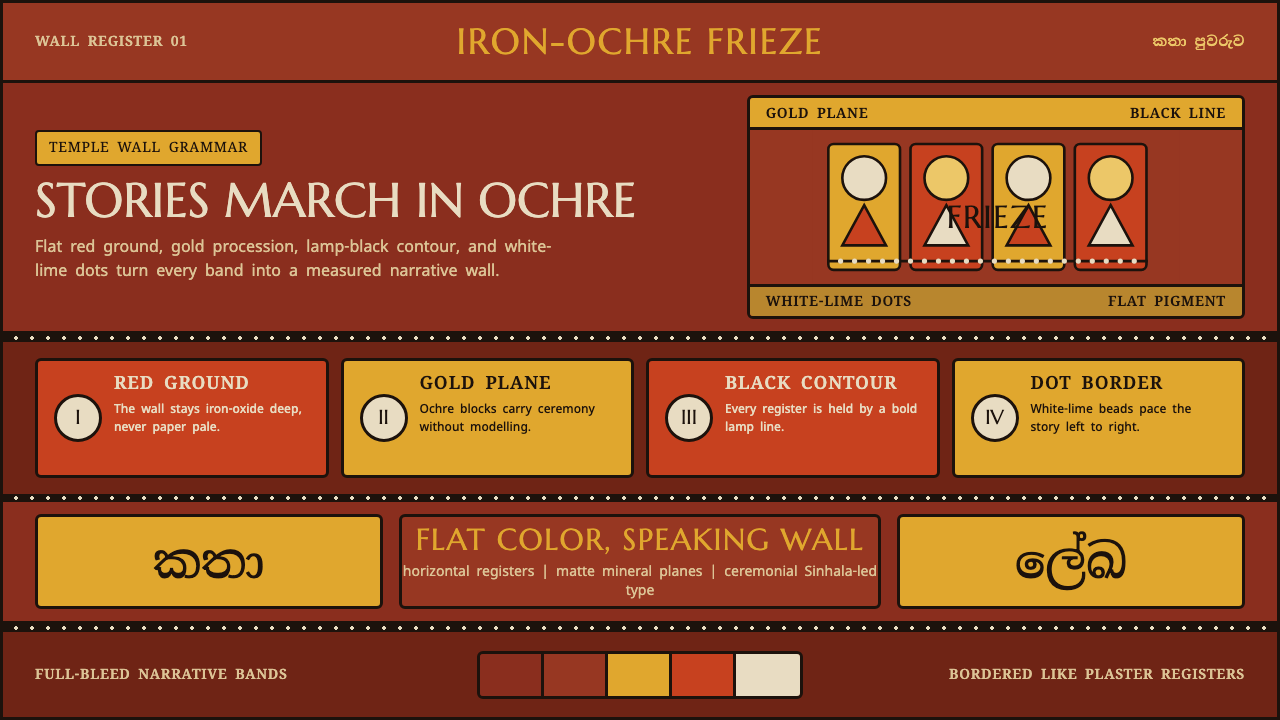 Kandyan Temple Mural FriezeTemple-wall gravity. Red ochre, gold planes, black contours, white-dot regist…
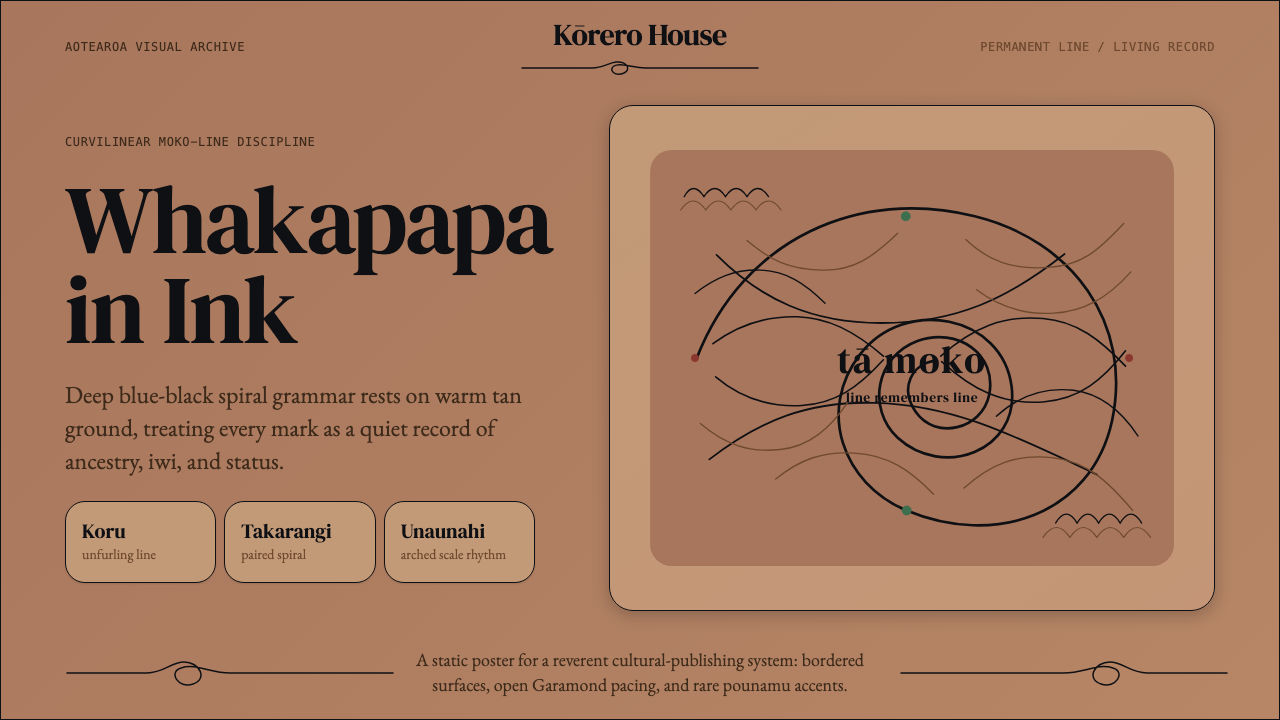 Māori Tā Moko (Facial Tattoo)Ancestry feels carved. Blue-black spirals on tan ground carry a restrained Ga…
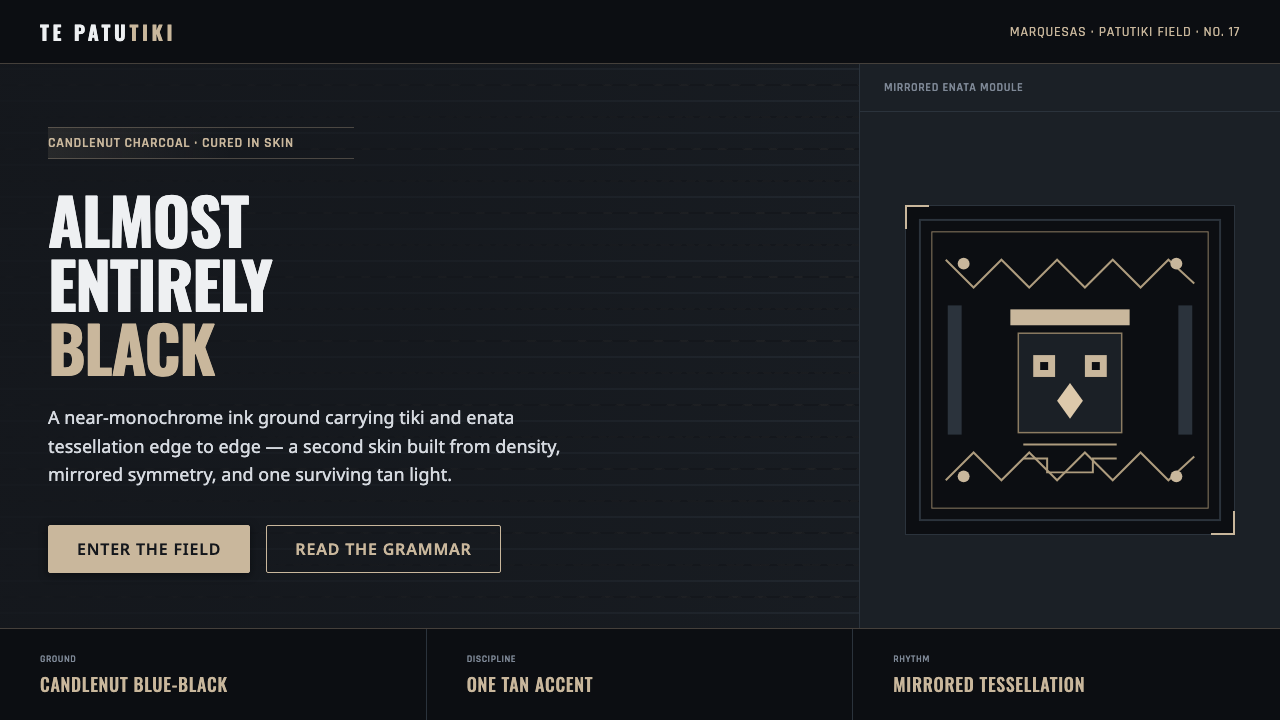 Marquesan Tatu PatternDensity as authority. Tiki and enata tessellation inked into blue-black, lit…
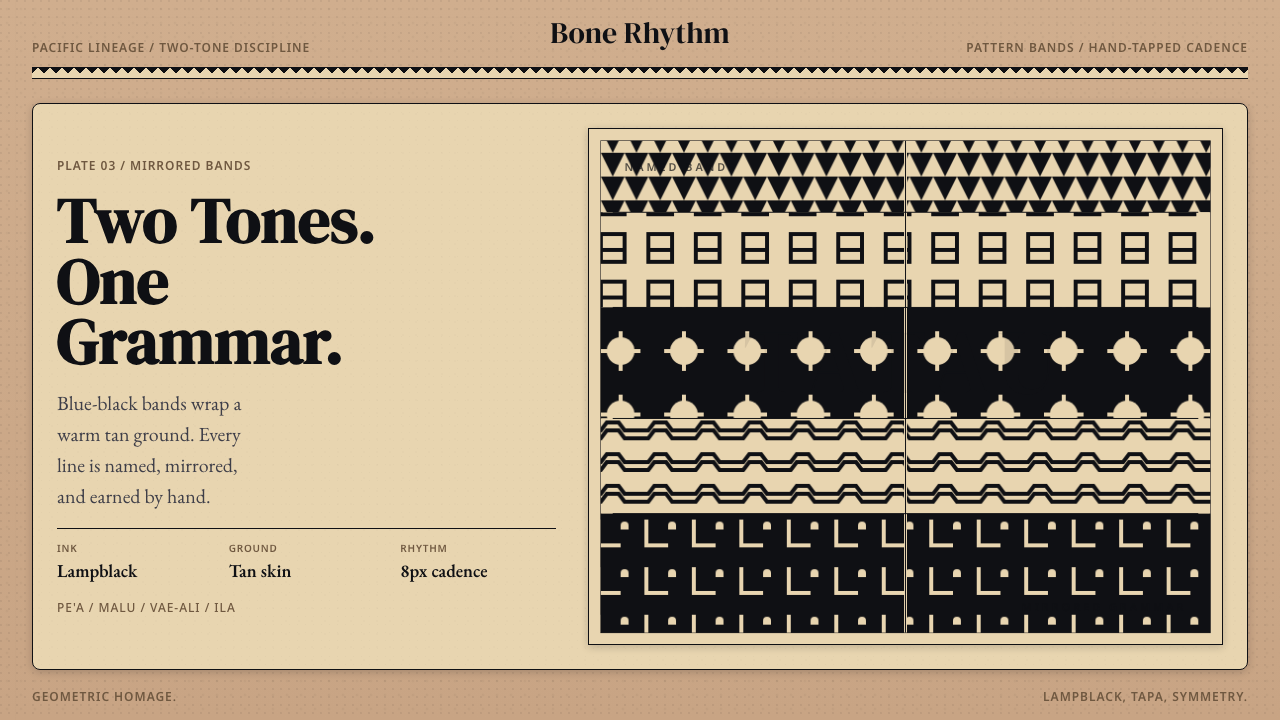 Samoan Tatau (Traditional Tattoo)Strict two-tone discipline. Tan ground, blue-black bands, hand-tapped symmetr…