What is Māori Tā Moko (Facial Tattoo)?
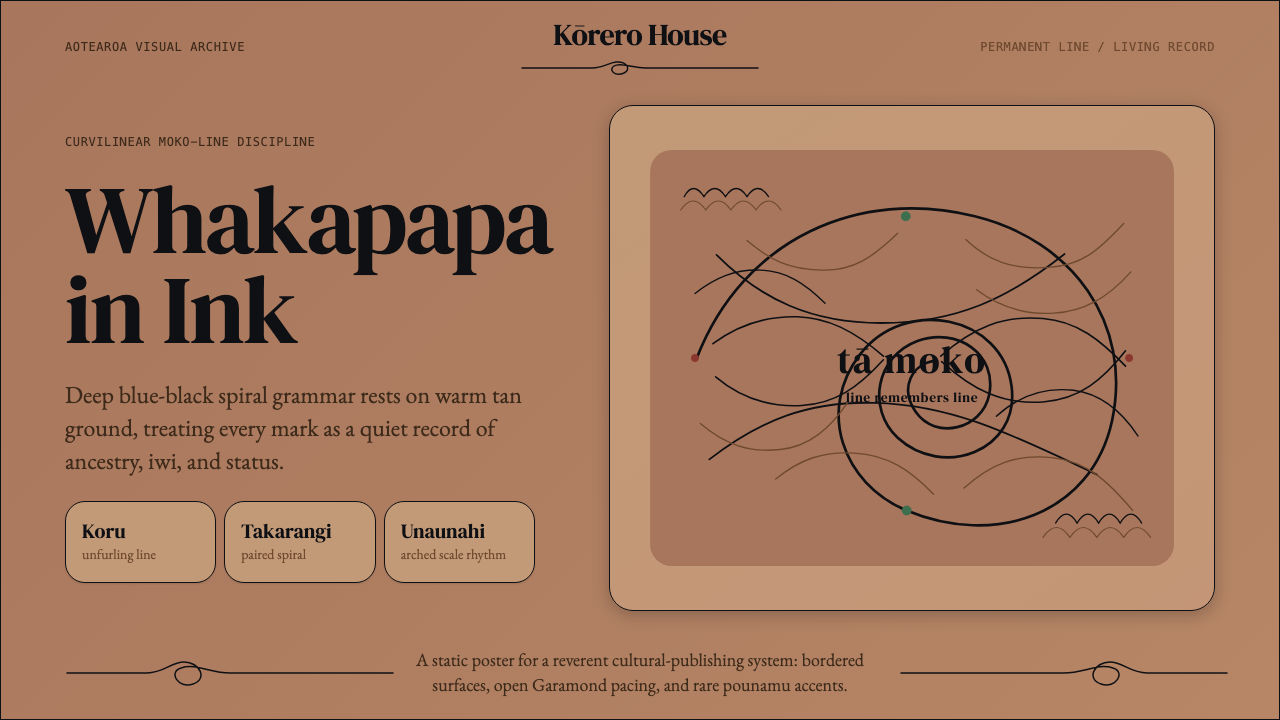
Tā moko turns the face into a living archive — every spiral a sentence of ancestry, every curve a chapter of whakapapa carved in blue-black ink on warm earth.
Māori Tā Moko (Facial Tattoo) in brief
Tā moko is the traditional Māori practice of facial and body tattooing from Aotearoa New Zealand, distinguished from broader Polynesian tatau traditions by its wholly unique curvilinear-spiral grammar. Where other Pacific tattooing traditions employ geometric rectilinear patterns, tā moko works almost entirely in curves: the koru (an unfurling fern frond), the takarangi (a double helix), the unaunahi (interlocking fish-scale arcs), and the niho taniwha (the serrated fang of a supernatural guardian). These motifs are not decorative choices but structural sentences — each element encodes the wearer's genealogy, tribal affiliation, rank, and life accomplishments in a visual language that trained eyes read with the same specificity a reader brings to text.
As a design system adapted for contemporary visual communication, Tā moko speaks in a strict two-tone discipline: deep blue-black moko ink against a warm tan ground that evokes the tonal range of living skin. Headings and display text flow in generous, broadly-spaced serif letterforms that echo the unhurried gravity of traditional oral recitation. Curvilinear hairlines — echoing koru spirals — replace conventional ruled borders and dividers. The palette is almost entirely bilateral, with pounamu (greenstone jade) and red-ochre appearing only as rare ceremonial accents, never as background fields. The overall character is dense, deliberate, and narrative-rich: every element earns its place by carrying meaning.
What separates authentic tā moko aesthetics from superficial borrowing is the relationship between ornament and identity. In the tradition, no two moko are identical because no two whakapapa (genealogical histories) are identical. This principle translates directly into design practice: the system resists templated repetition and favors compositions that feel hand-drawn and individualized even when produced digitally. The spiral grammar implies continuous flow rather than hard stops — designs based on this tradition breathe and curve where other historical styles grid and snap.

Where does Māori Tā Moko (Facial Tattoo) come from?
Tā moko's roots extend back more than a thousand years, arriving with the Polynesian voyagers who settled Aotearoa from the Pacific around 1300 CE, bringing with them the broader tatau tradition common across the Pacific. Over generations of geographic and cultural separation, Māori practitioners developed the curvilinear spiral vocabulary that distinguishes tā moko from all other Pacific tattooing. The tools themselves marked a critical divergence: while most Polynesian traditions used combed implements that punctured the skin, traditional tā moko artists used a uhi — a chiseling implement of albatross bone or obsidian — to groove the skin rather than simply pierce it, creating a textured, ridged surface that catches light differently from smooth tattooed skin. This grooved technique is the literal origin of moko's distinctive raised topography.
In pre-European Māori society, moko functioned as a form of living identity document and social credential. A rangatira (chief) without moko was considered to have no face — te kanohi paruparu, a plain face — and could not be taken seriously in formal proceedings. The patterns recorded the wearer's iwi (tribe), hapū (sub-tribe), descent from particular ancestors, rank achieved through warfare and oratory, and major life events. When a rangatira pressed their facial pattern into a document as a signature — a practice that continued into the nineteenth century as Māori leaders signed land treaties — the moko functioned literally as a personal seal. Early European officials who encountered these signatures described being struck by the specificity and elegance of each individual pattern.
The arrival of European colonizers in the nineteenth century, along with Christian missionary influence and successive land confiscations, severely disrupted moko practice. By the early twentieth century, full facial moko had nearly disappeared, partly because of colonial social pressure and partly because the contexts — the elaborate formal ceremonies, the chiefly systems, the tribal legal frameworks — in which moko carried institutional meaning were being systematically dismantled. The tradition did not vanish entirely; kuia (female elders) continued wearing moko kauae (chin tattoos) into the twentieth century, preserving a living thread.
The Māori Renaissance — Te Ao Māori — beginning in the late 1960s and gathering force through the 1980s and 1990s, brought tā moko back as a conscious act of cultural reclamation. Artists including Mark Kopua, Inia Taylor, Gordon Toi, and activist Tame Iti worked to revive both the practice and its underlying grammatical logic, studying museum collections, consulting tohunga tā moko (tattoo specialists), and developing contemporary practice that honors the ancestral tradition while acknowledging that the social contexts in which it is received have changed. The revival also brought productive debate: the question of who has the right to wear moko — whether non-Māori adoption constitutes cultural appropriation — became one of the most closely argued questions in contemporary Pacific cultural politics. Today, tā moko is practiced openly and with institutional support; the debate itself is considered part of the tradition's living vitality.
What defines the Māori Tā Moko (Facial Tattoo) look?
Curvilinear Spiral Grammar
The most distinctive quality of tā moko aesthetics is its commitment to continuous curves. Straight lines and sharp angles are almost entirely absent; instead, every element flows through koru spirals, takarangi double helixes, and unaunahi fish-scale arcs. Negative space is itself curved — the ground between motifs is shaped by the curves that bound it, never left as simple rectangular voids. This creates compositions that read as alive and breathing rather than static and gridded, with movement implied in every line.
Two-Tone Ink Discipline
Authentic tā moko works in an almost entirely bilateral palette: deep blue-black — the color of traditional plant-based moko ink — set against warm tan or earthy ochre grounds that approximate the tonal range of Māori skin. This is not a neutral palette but a charged one: the blue-black carries the weight of the incised mark, of ancestry made visible, while the warm ground provides a living context rather than a clinical white field. Introducing cooler or more saturated hues dilutes this charge immediately.
Ceremonial Accent Colors
Beyond the core blue-black and warm ground, two accent colors appear — pounamu greenstone jade and red-ochre — but only in the way that a single ceremonial object punctuates an otherwise austere ritual space. Neither is used as a fill or background; both appear as fine linear detail or isolated marks. Pounamu green carries associations of prestige, permanence, and the sacred; red-ochre (kōkōwai) carries associations of protection and life-force. Their restraint is deliberate: overuse collapses the hierarchy these colors are meant to signal.
Serif Type with Oral Weight
Typography in tā moko-inspired design leans toward broad, generously spaced serif letterforms — the kind whose proportions echo unhurried recitation rather than rapid scanning. This is consonant with a tradition where oral transmission of genealogy (whaikōrero, formal oratory) was the primary vehicle of knowledge. Letters should feel weighty and deliberate, as if each word carries the duration of a spoken story. Compressed or condensed display faces contradict the spirit of the system; narrow columns of body text feel too mechanical against the flowing motif vocabulary.
Dense Narrative Layering
Unlike austere minimalist systems that prize generous empty space, tā moko-inspired design tolerates — and even requires — a degree of intricacy. The visual field can carry multiple simultaneous readings: a main motif in the foreground, secondary spirals in the mid-ground, and hairline details in the background, all operating at different weights without collapsing into noise. This layered density mirrors the nature of whakapapa itself, which tracks multiple genealogical lines simultaneously. The discipline is not in reduction but in legibility: each layer must remain individually readable.
Individuation Over Standardization
Tā moko's deepest principle — that no two moko are alike because no two genealogies are alike — translates in design into a strong resistance to templated symmetry and cookie-cutter repetition. Compositions derived from this tradition should feel developed rather than applied: motif placements should respond to the specific content they accompany, curves should adapt to the field they occupy, and no two pieces in a series should be interchangeable. This is a demanding requirement that distinguishes thoughtful application from superficial borrowing.
Bilateral Reflection and Facial Mapping
Traditional moko follows the bilateral symmetry of the face while differentiating the left and right sides to encode distinct aspects of lineage — typically paternal ancestry on one side and maternal ancestry on the other. This creates compositions that are simultaneously symmetrical in structure and asymmetrical in content: the overall silhouette mirrors itself, while the specific motifs do not. In design applications, this principle suggests building layouts on a centerline framework but varying the detail vocabulary on each side to prevent monotonous mirroring.

Who shaped Māori Tā Moko (Facial Tattoo)?
One of the foremost figures in the contemporary revival of tā moko, Kopua is a tohunga tā moko (tattoo specialist) of Ngāti Kahungunu and Rongowhakaata descent who has been instrumental in re-establishing the practice's grammatical integrity. Working from deep engagement with ancestral knowledge systems, Kopua emphasizes that moko cannot be separated from whakapapa — the design process begins with genealogical research, not with aesthetic preference. His practice has been central to debates about cultural stewardship and has helped establish protocols for who designs moko and on whose terms.
A Māori tattoo artist of Ngāti Porou descent who has worked to document and systematize the motif vocabulary of tā moko, making the tradition's grammatical logic accessible to practitioners and scholars while insisting on its cultural specificity. Taylor's work bridges traditional knowledge and contemporary application, demonstrating how the spiral grammar can evolve without losing its genealogical anchoring. He has been an important voice in discussions about the difference between authentic moko practice and the aesthetic adoption of Polynesian-inspired patterns by non-Māori designers.
A Tūhoe activist and artist whose fully moko'd face became one of the most recognized images of Māori cultural assertion in the late twentieth and early twenty-first centuries. For Iti, wearing moko was explicitly a political act — a refusal of the colonial pressure to present an assimilated face to the world. His public presence helped shift moko from a practice associated with elders and the historical past to one recognized as a living political and cultural statement. Iti's image circulated internationally, bringing the visual power of tā moko to audiences with no prior knowledge of its grammatical depth.
A practitioner and advocate who contributed significantly to the documentation of regional moko traditions across different iwi, recognizing that tā moko was never a single unified style but a family of related regional dialects — Ngāti Porou moko differs visibly from Waikato or Ngāpuhi work in its spiral density, its use of particular motifs, and its facial mapping conventions. Toi's documentation work has been critical in preventing the homogenization of moko into a generic Māori-pattern aesthetic and in preserving the specificity that gives the tradition its authentic power.
While not an individual practitioner, Te Papa — the national museum of New Zealand — has functioned as the primary institutional guardian and educator of tā moko's visual and cultural grammar for a general audience. Its collections of taonga (treasured objects) including carved meetinghouses, woven textiles, and historical moko documentation provide the most comprehensive public archive of the tradition's visual vocabulary. Te Papa's approach to displaying and contextualizing tā moko — insisting on cultural context and discouraging aesthetic-only appreciation — has set the standard for how the tradition is introduced to non-Māori audiences worldwide.
How do you use Māori Tā Moko (Facial Tattoo) today?
Applying tā moko aesthetics to contemporary design work requires understanding the difference between the system's visual grammar and its cultural substrate. The visual grammar — curvilinear spirals, blue-black on warm ground, layered narrative density, generous serif type, ceremonial accent restraint — is transferable to design contexts. The cultural substrate — specific genealogical encoding, the right to wear moko, the identification of particular motifs with particular iwi — is not transferable and should never be simulated. The practical rule: use the visual logic without claiming the cultural authority.
For presentation slides, tā moko's visual vocabulary performs exceptionally well on covers and section dividers. A cover built on this system places the title in broad, unhurried serif type against a warm tan ground, with a koru-derived spiral hairline element arcing across a corner — not as a decorative afterthought but as the primary organizing gesture. Section dividers work well as full-bleed warm-ground panels with a single fine curvilinear rule rather than a straight horizontal line. Content slides should be understood as quieter than the cover: the spiral grammar recedes to background texture at low contrast while text occupies the primary field. Data slides translate well because the system tolerates intricacy — multi-series charts can carry line work that echoes the layered-depth principle without reading as noise.
For web interfaces, the style is especially well suited to dashboards, editorial platforms, and cultural institution sites where richness of content and respectful depth of presentation are primary values. The approach: set the background to a warm off-white or tan rather than a neutral cool white, use near-black for all body text, and deploy the blue-black as the primary interactive and heading color. Navigation can carry fine curvilinear decorative rules without tipping into kitsch — the key is keeping them as thin hairlines rather than heavy borders. Pricing pages benefit from the system's tolerance for layered information: tiered plans can be distinguished through the ceremonial accent colors — a pounamu-green indicator for a premium tier, a red-ochre accent for an active state — used sparingly enough that they carry the status weight the tradition assigns them.
For editorial and marketing work, tā moko's narrative density makes it ideal for long-form content that needs to feel both weighty and culturally grounded. An article layout built on this system uses a warm-ground column for body text, with a margin reserved for koru-spiral drop-cap treatments and call-out annotations. Pull quotes feel appropriate here as standalone elements in display-size serif type, given enough vertical breathing room to suggest the pacing of oral recitation. Marketing covers and posters work best as bold two-tone compositions — deep blue-black motif over warm ground, or warm text over a deep blue-black field — with the pounamu or red-ochre accent used for a single call-to-action element only. Avoid full-bleed photography backgrounds: the tradition's visual logic depends on the quality of the ground itself, not on imagery behind it.
A common mistake when applying this style is reaching for surface-level Polynesian pattern libraries — generic tribal tattoo vectors that carry none of tā moko's specific grammatical logic. These tend to be rectilinear where tā moko is curvilinear, static where tā moko implies flow, and generic where tā moko is specific. A second frequent error is introducing too many colors: the moment a full CMYK palette appears against the warm ground, the bilateral discipline collapses and the compositions begin to look like festival branding rather than ancestral record. A third mistake is using the spiral motifs as decorative borders framing otherwise conventional layouts — in authentic tā moko, the motifs are the layout, not decoration applied to it. The spirals should organize the space, not frame it.

Māori Tā Moko (Facial Tattoo) — FAQ
Is it culturally appropriate to use tā moko aesthetics in design work?
This question requires careful distinction between the visual grammar and the cultural practice itself. Using the visual system — curvilinear spirals, blue-black palette, warm ground, layered density — as a design language in work that acknowledges its Māori origins is widely considered acceptable, particularly when the work does not claim cultural authority or misrepresent specific genealogical motifs. What is not appropriate is reproducing specific moko patterns worn by living or historical individuals, presenting generic tribal-pattern vectors as authentic tā moko, or using the aesthetic in contexts that mock or trivialize the tradition. The clearest guidance comes from Māori cultural practitioners themselves, many of whom distinguish between appreciative engagement and exploitative appropriation based on whether the work displays cultural understanding or merely visual appetite.
How does tā moko differ from other Polynesian tattoo traditions visually?
The most immediately visible distinction is curvilinearity versus rectilinearity. Samoan pe'a, Tongan tatau, and Hawaiian kakau traditions rely heavily on geometric rectilinear patterns — triangles, straight-line hatching, grid-based fills. Tā moko works almost entirely in curves and spirals. A second distinction is the degree of individualization: most Polynesian traditions employ broadly shared motif vocabularies that identify group membership, while tā moko is customized to the specific individual's genealogy to a degree that makes each piece effectively unique. Thirdly, the surface technique differs: the traditional uhi chisel creates grooved rather than smooth-skin tattoos, giving authentic historical moko a three-dimensional quality that purely pigment-based traditions do not have.
Can this design system work in digital-dark or night-mode interfaces?
A direct inversion — putting blue-black motifs on a neutral dark background — tends to undermine the system's essential warmth. The warm tan ground is not an arbitrary background color but an active participant in the palette's cultural logic; removing it changes the emotional register significantly. A more successful dark variant keeps the warm quality of the ground by shifting toward a deep warm brown or dark ochre background rather than a cold near-black. In this variant, the motif lines shift to a lighter parchment or warm cream, maintaining the two-tone bilateral logic at lower overall luminance. The ceremonial accents — pounamu and red-ochre — remain usable at slightly elevated contrast to compensate for the reduced ground brightness.
How should spiral motifs be scaled — are very small or very large spirals both effective?
Scale affects legibility and reading hierarchy in ways specific to this system. Very large spirals — covering most of a panel or slide — work well as structural organizing elements when treated at low contrast against the ground, functioning like a watermark beneath the primary content layer. At medium scale, spirals work as section identifiers or decorative rules between content zones. At very small scales, the curvilinear complexity of koru and takarangi motifs begins to degrade: hairline widths cannot be maintained, curves lose their defining quality, and the result reads as generic texture rather than identifiable motif. A practical floor: motifs should be large enough that their specific curvilinear grammar remains readable, or they should be simplified to their basic spiral gesture rather than reproduced at full complexity.
Is this design system appropriate for brands outside New Zealand or Māori cultural contexts?
The visual system is culturally specific in origin but has been adopted — with varying degrees of sensitivity — by institutions and brands worldwide that value its particular combination of ancestral depth, narrative richness, and visual distinctiveness. The strongest applications tend to occur in contexts where the brand's values genuinely align with what the visual language expresses: depth of tradition, individual narrative, respect for process, and unhurried seriousness. Contexts that feel misaligned include fast-moving consumer goods, entertainment brands, or any context where the primary brand value is speed, novelty, or disposability — these values sit in direct tension with what the visual system is built to express. The most important question a designer should ask before applying this system is not whether it is beautiful but whether it is honest: does the brand or project carry the weight this visual language implies?
Related design styles
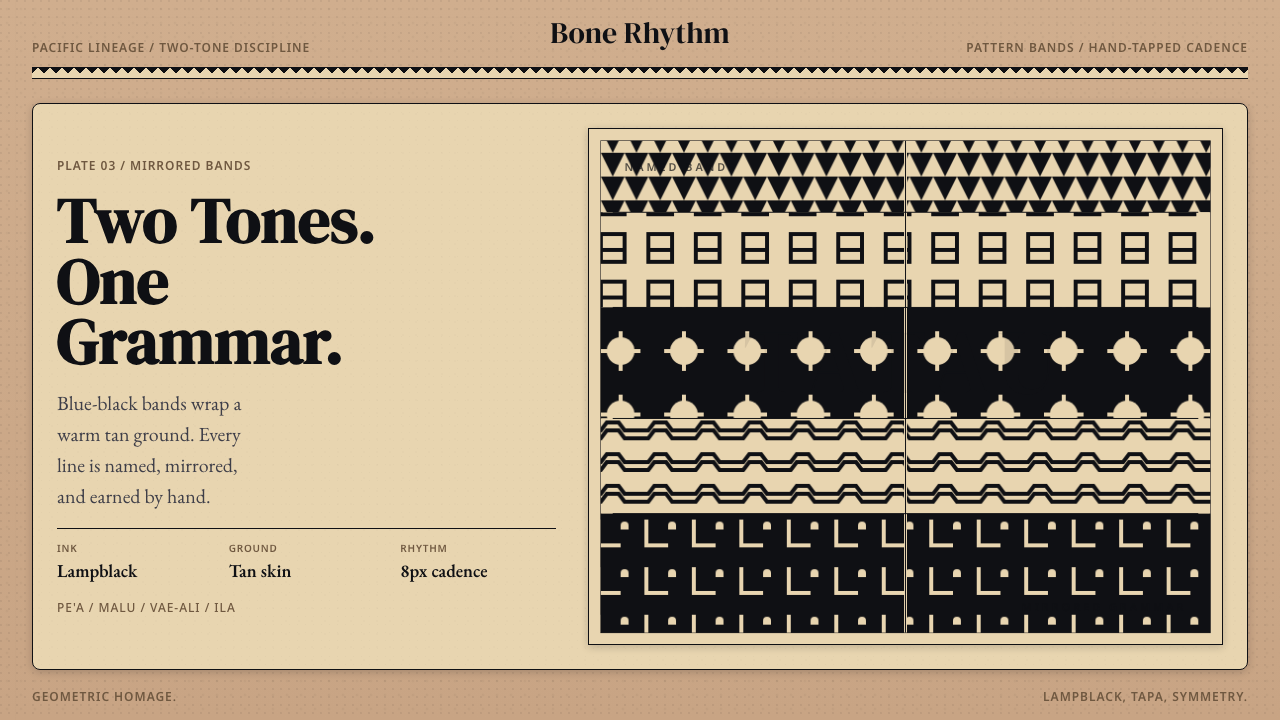 Samoan Tatau (Traditional Tattoo)Strict two-tone discipline. Tan ground, blue-black bands, hand-tapped symmetr…
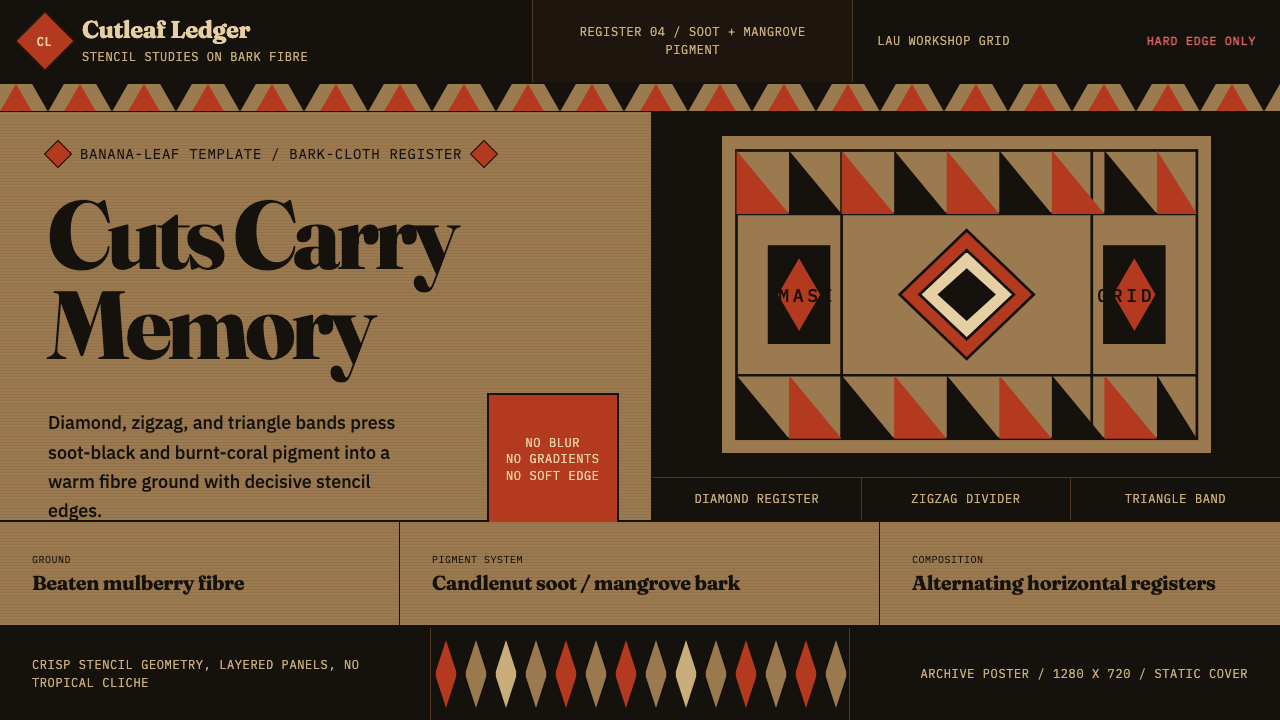 Fijian Masi (Bark Stencil)Stencil memory stays sharp. Soot black and burnt coral strike bark-fibre band…
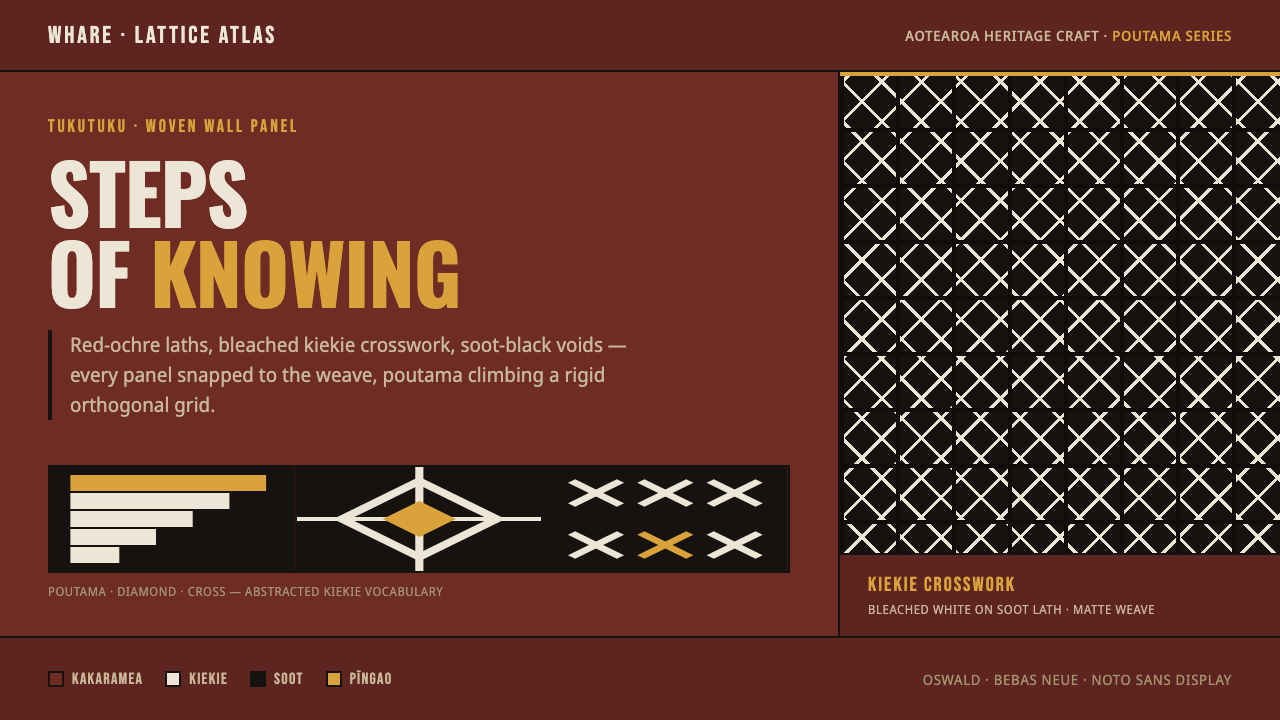 Māori Tukutuku PanelTukutuku weave, rendered strict. Bleached kiekie crosswork laces poutama step…
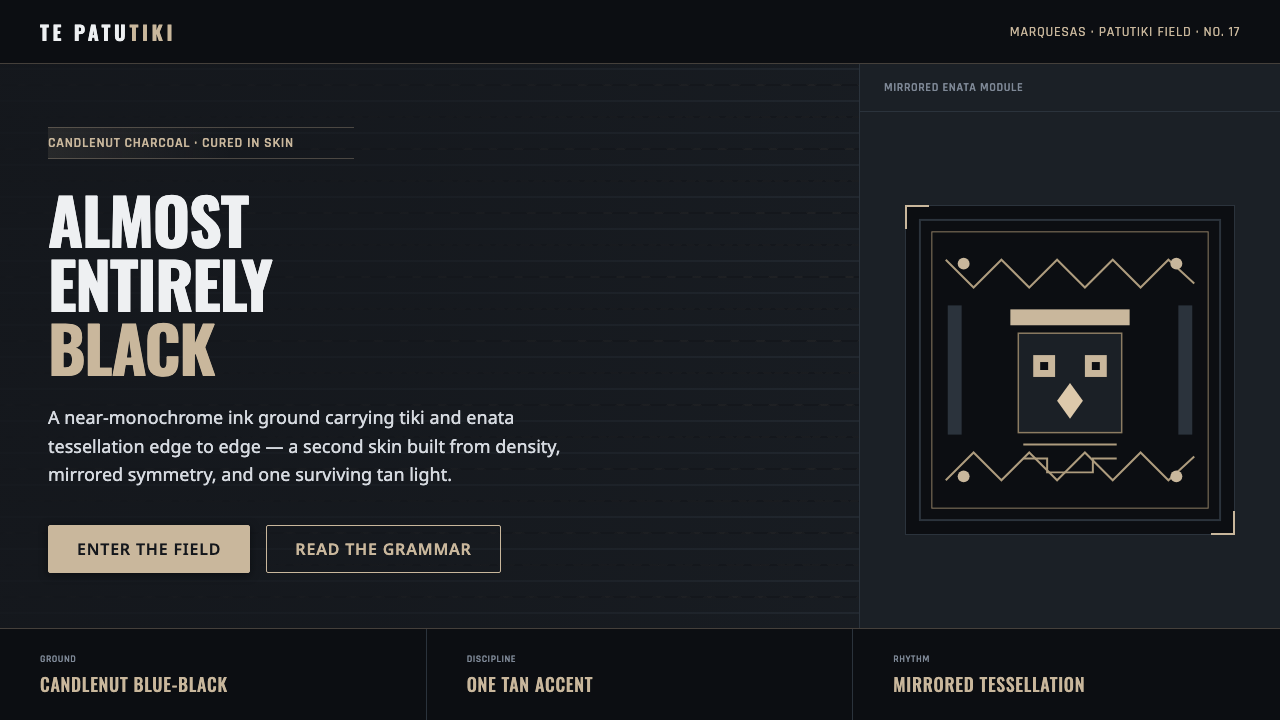 Marquesan Tatu PatternDensity as authority. Tiki and enata tessellation inked into blue-black, lit…
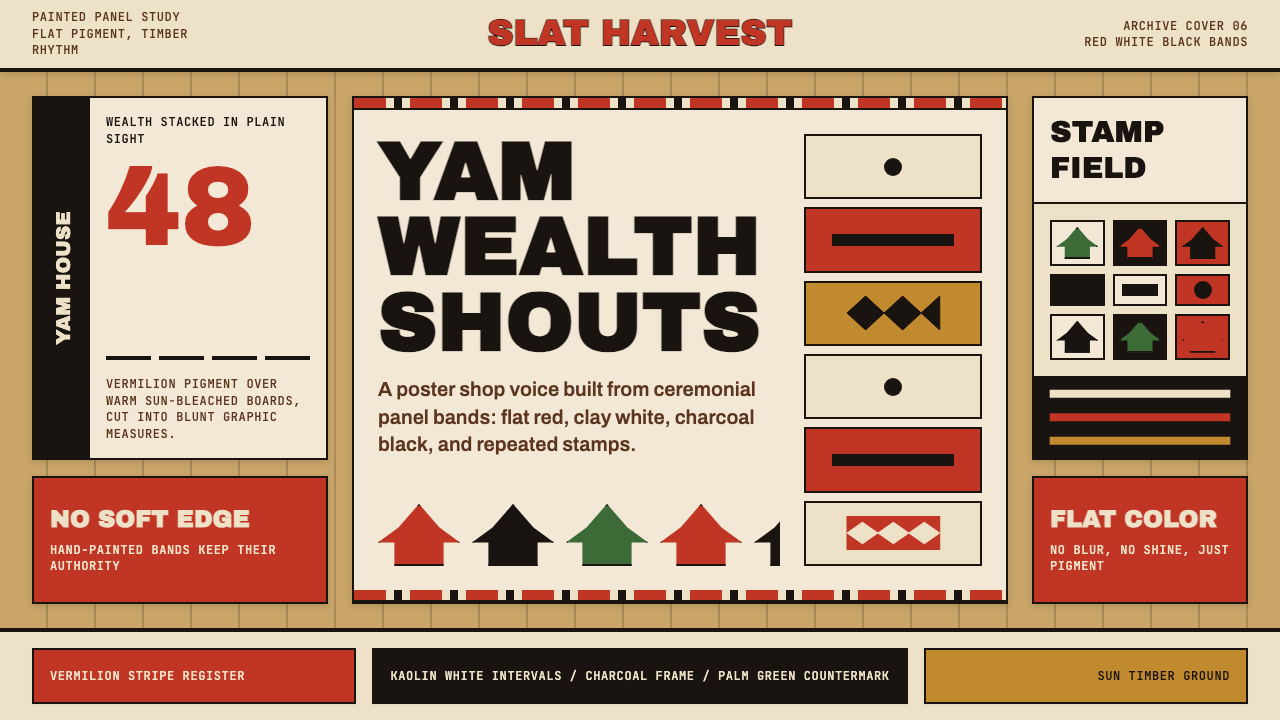 Trobriand Yam House PaintPainted wealth speaks loud. Vermilion bands and black stamp silhouettes hit t…
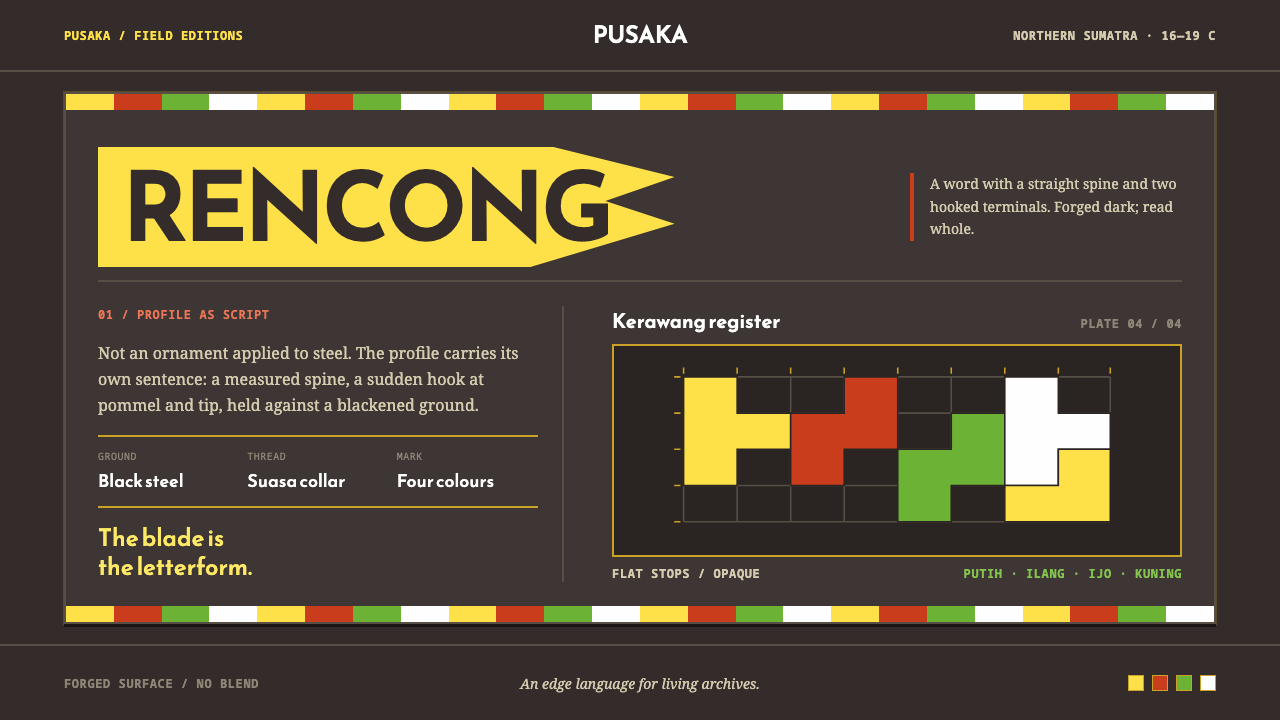 Acehnese Rencong MotifA blade that reads as a word. Flat kerawang red, white, green and yellow lock…