What is Balochi Mirror Embroidery (Shisha)?
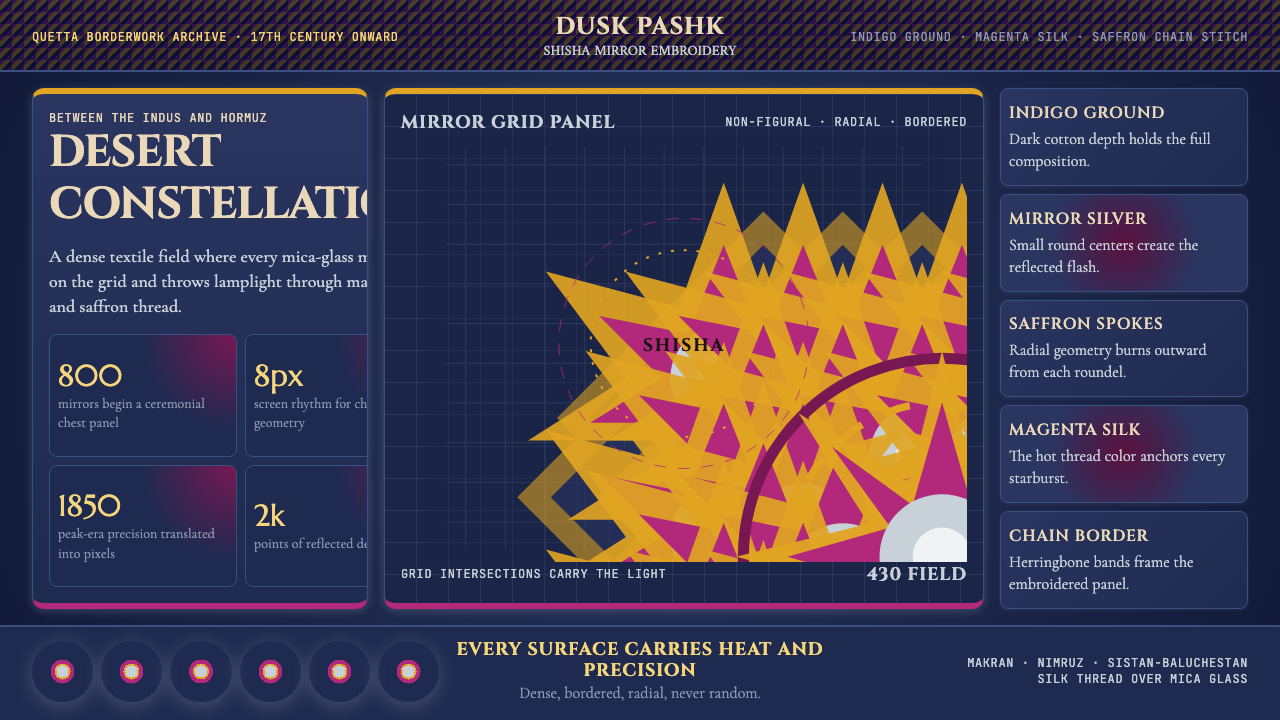
Hundreds of tiny mirrors sewn into silk thread starbursts — Balochi embroidery transforms a garment into a constellation, throwing lamplight across the room with every step.
Balochi Mirror Embroidery (Shisha) in brief
Balochi mirror embroidery — known as shisha in the broader South Asian textile tradition — is one of the most visually arresting handcraft traditions to emerge from the arid highlands between the Indus Valley and the Strait of Hormuz. Practiced primarily by women in the Balochistan region spanning parts of present-day Pakistan, Iran, and Afghanistan, it involves the meticulous stitching of small circular or geometric pieces of reflective mica glass into dense, radiating compositions of silk thread on deeply saturated ground fabrics.
The aesthetic logic of shisha is one of controlled radiance. A single garment might carry hundreds of mirrors, each surrounded by a starburst frame of silk thread worked in contrasting colors — magenta set against indigo, saffron beside deep madder, white against black — so that the piece functions simultaneously as textile and light-catcher. At rest, the embroidery reads as a complex geometric surface of jewel-like color blocks; in motion or under lamplight, each mirror fragment activates, turning the garment into something close to a wearable chandelier.
As a design system, Balochi shisha translates into a visual language of high-contrast depth, luminous accent, and tight geometric repetition. The foundation is a dark ground — deep indigo or madder — against which bright, densely patterned starburst elements fire like points of light. Typography and layout draw from the carved geometry of chain-stitch borders: regular, rhythmic, and precise, with no wasted space and no purely decorative gap. The visual effect is both ancient and immediately compelling — a system built not for minimalism but for maximum presence.
Where does Balochi Mirror Embroidery (Shisha) come from?
The practice of embedding reflective materials into embroidered textiles is ancient across the Indo-Iranian world, with roots traceable to at least the seventeenth century. Historians of material culture, including Jasleen Dhamija and Sheila Paine, have documented how mica and polished metal inserts were used along trade routes connecting Central Asia, Persia, and the Indian subcontinent centuries before European glass became available. The specific form that Balochi shisha took — a systematic grid of mirror-bordered starbursts on indigo or madder grounds — appears to have reached its mature expression sometime between the mid-eighteenth and mid-nineteenth centuries, coinciding with the relative stability of the Balochi confederacy system under the Khans of Kalat.
The geographic sweep of Balochistan — from the Makran coast to the highland plateau around Quetta, and across the border into Iran's Sistan-Baluchestan province and Afghanistan's Nimruz — meant that shisha traditions developed in regional variants while sharing a common grammar. Coastal Makrani embroidery tends toward denser mirror concentration and warmer color grounds; highland Quetta work often shows more open starburst spacing and cooler indigo dominance. Across these variants, the underlying commitment to reflective intensity and geometric precision remained constant.
The craft occupied a central position in Balochi social life, particularly in relation to marriage ceremonies. Bridal garments (the pashk dress tradition) could take months or years to complete, with the number of mirrors serving as a tacit indicator of a family's investment in the bride's trousseau. Scholarship by Anita Spertus and others has documented that major ceremonial pashk dresses from the late nineteenth and early twentieth centuries sometimes carried between eight hundred and two thousand individual mirror pieces — each one anchored by a multi-step needle technique requiring both structural precision and color judgment.
The arrival of inexpensive machine-made mirror glass in the early twentieth century democratized the practice, making shisha embroidery more widely accessible but also gradually displacing the older mica and hammered-metal inserts that had characterized the most traditional work. Mid-century garments show a shift toward slightly larger mirror fragments and somewhat looser thread framing, reflecting both the changed material and the economic pressures on highly skilled embroiderers. By the late twentieth century, scholars and collectors — including those working through museum programs in Karachi, Quetta, and Tehran — had begun systematic documentation of the older mica-based work, recognizing it as a craft tradition under pressure from industrial production and migration. That documentary effort, alongside a growing international market for traditional South Asian textiles, has sustained interest in shisha embroidery as both a living practice and a design reference.
What defines the Balochi Mirror Embroidery (Shisha) look?
Color Ground
The foundation of Balochi shisha work is a deeply saturated dark ground — most commonly indigo, though madder red, black, and occasionally deep green also appear. This darkness is not neutral; it is an active visual field that makes every element placed on it appear to glow rather than merely sit. The dark ground is the functional equivalent of a night sky, giving the starburst accents and mirror reflections somewhere to radiate from. When translating this logic to screen, the darkness of the canvas is as important as the brightness of the accents.
Starburst Accent
The dominant motif is the starburst: a central mirror or focal point surrounded by radiating threads in two or three contrast colors. These bursts are not soft or gradient — they are hard-edged, precise, and assertive. The thread colors typically involve a warm-cool pairing (magenta with white, or saffron with indigo highlights) that maximizes the sense of light being thrown from the center. In screen applications, this translates to a design language where accent elements radiate rather than float: pointed highlights, angular glow, and deliberate chromatic contrast rather than ambient warmth.
Mirror as Highlight
The embedded mirror is not decoration in the conventional sense — it is a functional light-capture device. Its reflective surface catches and redistributes ambient light unpredictably, so no two moments of viewing are identical. In the design system, this principle translates to highlights that behave like catches of light: small, intense, and positioned at points of visual tension rather than uniformly distributed. Mirror-silver as an accent color carries this meaning — used sparingly at intersections or focal points, never as a fill or background.
Grid Density
Balochi shisha compositions are dense. Mirrors and their surrounding threadwork are packed into the surface with near-total coverage, leaving the dark ground visible only in the structured intervals between motif clusters. This is not chaos — it is a system of repeating geometric units that tile across the fabric in a manner closer to a crystal lattice than to free arrangement. The density communicates abundance, care, and the investment of skilled time. In screen design, this translates to layouts that fill their space deliberately: tight leading, generous content density, and borders that serve as visual breathing gaps rather than empty decoration.
Chain-stitch Geometry
Beyond the mirror work, Balochi embroidery relies heavily on chain stitch for borders, fills, and structural outlines. Chain stitch produces a raised, rope-like line with an inherent rhythm — each loop is the same size and the same shape, creating a visual cadence that reads as both handmade and mathematically regular. This rhythm is the design system's equivalent of a grid rule or a baseline grid: it organizes space, defines boundaries, and provides a sense of underlying order beneath the apparent richness of the surface.
Chromatic Contrast
Balochi shisha relies on high chromatic contrast rather than tonal subtlety. Warm and cool colors are placed in direct adjacency — saffron next to indigo, magenta beside turquoise — so that each color appears more intense than it would in isolation. This optical effect, familiar from color theory as simultaneous contrast, is not accidental in traditional shisha work: the embroiderers learned through practice which color pairings produced the most visually arresting results. The design system inherits this principle: accent colors should be chosen not only for their individual quality but for how they interact at their shared edges.
Seriality and Repetition
Individual shisha motifs are rarely unique — they are serial elements, repeated across the garment's surface with slight natural variation introduced by the handwork itself. This seriality is structural: it creates the visual rhythm that makes the overall surface legible as a system rather than as a collection of individual ornaments. The slight irregularity of handwork — each mirror slightly different, each starburst with its own minor idiosyncrasies — is precisely what prevents the density from becoming oppressive. In screen applications, this tension between system-level repetition and unit-level variation is worth preserving: components should share a common grammar but carry enough visual specificity to avoid feeling generated.

Who shaped Balochi Mirror Embroidery (Shisha)?
An Indian textile scholar and UNESCO expert on traditional crafts, Dhamija produced foundational documentation of handcraft traditions across the Asian subcontinent, including the mirror embroidery practices of Balochistan. Her work established the regional taxonomy of shisha variants and positioned Balochi embroidery within the broader continuum of reflecting-glass techniques that stretch from Gujarat through Sindh into the Iranian plateau. Her scholarship created the reference framework that later collectors and designers have drawn on when working with this tradition.
A British textile researcher whose fieldwork across rural communities in South and Central Asia produced some of the most detailed photographic and technical records of embroidered traditions, including Balochi shisha. Paine's documentation was particularly valuable for recording the technical aspects of mirror attachment — the specific needle sequences that anchor each piece of reflective glass within its thread surround — knowledge that was largely oral and at risk of loss as younger generations moved away from the craft.
An American textile scholar and collector who specialized in the embroideries of Pakistan, Spertus assembled and documented significant collections of Balochi embroidered work, with particular attention to the major ceremonial pashk dresses of the late nineteenth and early twentieth centuries. Her analysis of the compositional logic of bridal garments — how mirror density, color sequencing, and border geometry related to regional identity and ceremonial function — provided the most rigorous design analysis of the tradition available in English-language scholarship.
No single named designer governs the shisha tradition — it is a collective, feminine, and largely anonymous practice. Workshop collectives in Quetta and the Makran coastal region, some supported by Pakistani craft development organizations from the 1970s onward, became important nodes for standardizing quality, training younger embroiderers, and connecting traditional makers to urban and export markets. These collectives preserved certain techniques — particularly the multi-step mirror anchoring method — that individual family transmission might have allowed to simplify or degrade under economic pressure.
The mirror embroidery traditions of Sindh and Balochistan form a related but distinct design continuum that textile historians treat as a connected regional school. Sindhi shisha tends toward looser, more flower-based compositions with more open ground showing; Balochi work is denser and more geometric. The exchange of techniques, motifs, and materials between these overlapping communities over centuries created a layered tradition that cannot be attributed to any single inventor or design lineage — it is the product of sustained cultural conversation across a geographic region.
How do you use Balochi Mirror Embroidery (Shisha) today?
Balochi mirror embroidery translates most directly into screen contexts that call for depth, luminosity, and a sense of cultural richness without decoration for its own sake. The core principle — brilliant accents radiating from a dark ground — is structurally well-suited to interfaces and presentations that need to communicate premium quality, visual intensity, or a connection to craft traditions. The style rewards confidence: half-measures produce neither the brightness of the embroidery nor the clarity of a restrained approach.
For presentation slides, the system works best as a full-commitment visual theme. Cover slides benefit from a deep indigo or near-black canvas with a single starburst composition centered on the slide's focal point — title text in a light, slightly warm tone, with a mirror-silver accent element at the intersection of grid lines. Content slides should maintain the dark ground and use the starburst accent color — saffron, magenta, or warm white — selectively for emphasis: pull quotes, key data points, or section headers. Data slides read well when chart elements are treated as geometric light-points on the dark field, with warm accent hues marking the primary data series and the background functioning as a visual depth cue rather than a neutral void.
For web UI, the style is well-matched to dashboard environments where data density and visual hierarchy need to coexist, and to landing pages for premium products where intensity and distinctiveness are valued over approachability. The approach on a dashboard: deep indigo or near-black primary background, with card surfaces slightly lighter but still within the dark range, light body text for legibility, and starburst-derived accent colors reserved for active states, alerts, and key metrics. Navigation and typographic elements should feel precise and grid-locked; the visual richness comes from the color relationships, not from additional ornament.
For editorial and marketing applications, shisha's visual grammar supports bold, poster-quality compositions. A full-bleed dark ground with a large geometric accent in saffron or magenta anchors a cover or hero section with unmistakable intensity. Pull quotes and section breaks can use simplified chain-stitch-inspired line elements — a repeated small geometric border or a bold ruled line — to introduce the craft sensibility without literal illustration. Marketing pages benefit from alternating content blocks that maintain the dark ground throughout, varying only in accent color temperature between sections to create rhythm without abandoning the system's core identity.
A common mistake when applying this design language is treating the mirror and starburst accents as the primary visual content and neglecting the quality of the dark ground itself. The depth and saturation of the ground color is what makes the accents function as light — a desaturated or inconsistent dark background produces accents that simply sit on a dark surface rather than appearing to radiate from it. Similarly, distributing accent colors evenly across a layout dilutes the system's logic: the accents work precisely because they are concentrated, not because they are everywhere. Reserve the warmest and brightest elements for the moments that most need to command attention.
Balochi Mirror Embroidery (Shisha) — FAQ
Is shisha embroidery the same across the entire Balochistan region?
No — regional variation is significant and systematic. The most commonly cited distinction is between Makrani coastal work and highland Quetta-area work. Makrani shisha tends toward denser mirror coverage, warmer ground colors, and compositions where the mirrors crowd toward the garment's center; Quetta-area work often has more deliberate open spacing between star clusters and a cooler indigo dominance. Cross-border variants in Iran's Sistan-Baluchestan province and Afghanistan's Nimruz region add further variation in motif proportion and thread palette. These regional differences do not represent a hierarchy of authenticity — they reflect the distributed, community-specific nature of a tradition transmitted through households rather than centralized workshops.
Does this design system work on light-background layouts, or does it require a dark ground?
The dark ground is structurally central to how the system works — without it, the mirror-and-starburst logic loses its defining metaphor. A light-background inversion is technically possible but produces a fundamentally different result: accent colors that pop forward rather than glow from within, and a visual effect closer to vibrant folk art than to the specific quality of shisha radiance. If a light background is required by context — for example, a document that will be printed on white paper — the system adapts more cleanly by reducing to a single warm accent color on a neutral field, reserving the full dark-ground treatment for cover pages, section dividers, or feature callouts where the complete visual system can operate as intended.
What makes Balochi shisha different from Gujarati or Sindhi mirror embroidery?
All three traditions belong to the broader shisha family and share the practice of mica-glass mirror attachment, but they differ significantly in composition, color ground, and motif vocabulary. Gujarati shisha — particularly the work of communities like the Rabari and Ahir — tends toward lighter backgrounds, more floral and animal motifs, and a more open, airy spacing between embroidered elements. Sindhi shisha is intermediate: denser than Gujarati work but typically with more visible ground fabric than Balochi. Balochi shisha is the darkest-grounded, most geometrically rigorous, and densest of the three — the one in which the mirror work comes closest to covering the entire fabric surface and in which geometric abstraction consistently dominates over figural representation.
How should motion and animation be approached if animating a shisha-inspired interface?
The primary motion reference from shisha is the quality of reflected light — unpredictable, intermittent, and activated by ambient conditions rather than mechanical trigger. Animation in a shisha-inspired system should feel caught rather than constructed: highlights that appear briefly and then recede, accent elements that respond to scroll or hover with a shimmer rather than a slide or fade, transitions that suggest the redistribution of light rather than the movement of solid objects. Duration should be short and acceleration curves should be sharp and then settle — mimicking the fast catch and slow fade of light on a reflective surface. Sustained, looping animations or animations that move entire content blocks break the metaphor.
Is this style appropriate for consumer-facing products, or does it suit only premium and cultural contexts?
The style's visual intensity means it communicates premium, artisanal, and culturally specific values — which is an asset in certain contexts and a mismatch in others. It works well for products whose identity depends on distinctiveness, depth, and a connection to tradition: jewelry, luxury goods, cultural institutions, craft platforms, premium food and beverage brands, or any product positioning itself as an antidote to generic digital aesthetic. It is less well-suited to contexts requiring broad immediate approachability — mass-market applications, children's products, or interfaces where neutral legibility is the primary value. Like any style with strong cultural roots, it is also worth asking whether the design use is substantively connected to the tradition it references, or whether it is borrowing visual intensity without engagement — a question of design ethics as much as aesthetics.
Related design styles
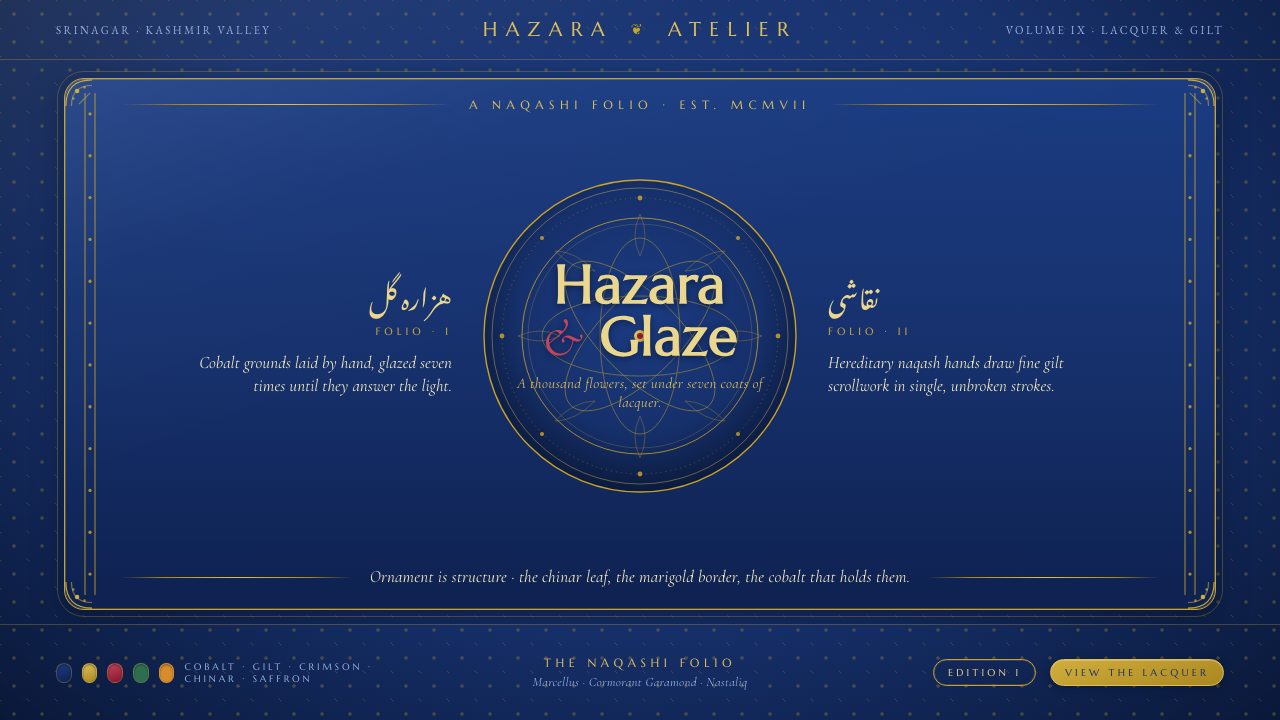 Kashmiri Papier-MâchéOrnament is structure. Cobalt lacquer ground, fine gold hazara scrollwork, gl…
 Punjabi Phulkari (Floral Bagh)Joyful density wins. Gold chevrons, rust borders, fuchsia-pistachio butis fil…
 Basotho Seanamarena BlanketRank made visible. Cobalt wool, gold maize diamonds, and chestnut borders rea…
 Bengali Jamdani MuslinBreathes like woven air. Indigo ground, ivory butis, and threadline borders s…
 Bohemian Cut CrystalOpulence glows in shadow. Ruby and cobalt facets sit on velvet under gilt rim…
 Bukhara Gold-Embroidered ChapanGold is the figure, velvet the night. Bullion arabesques blaze on royal-purpl…