What is Punjabi Phulkari (Floral Bagh)?
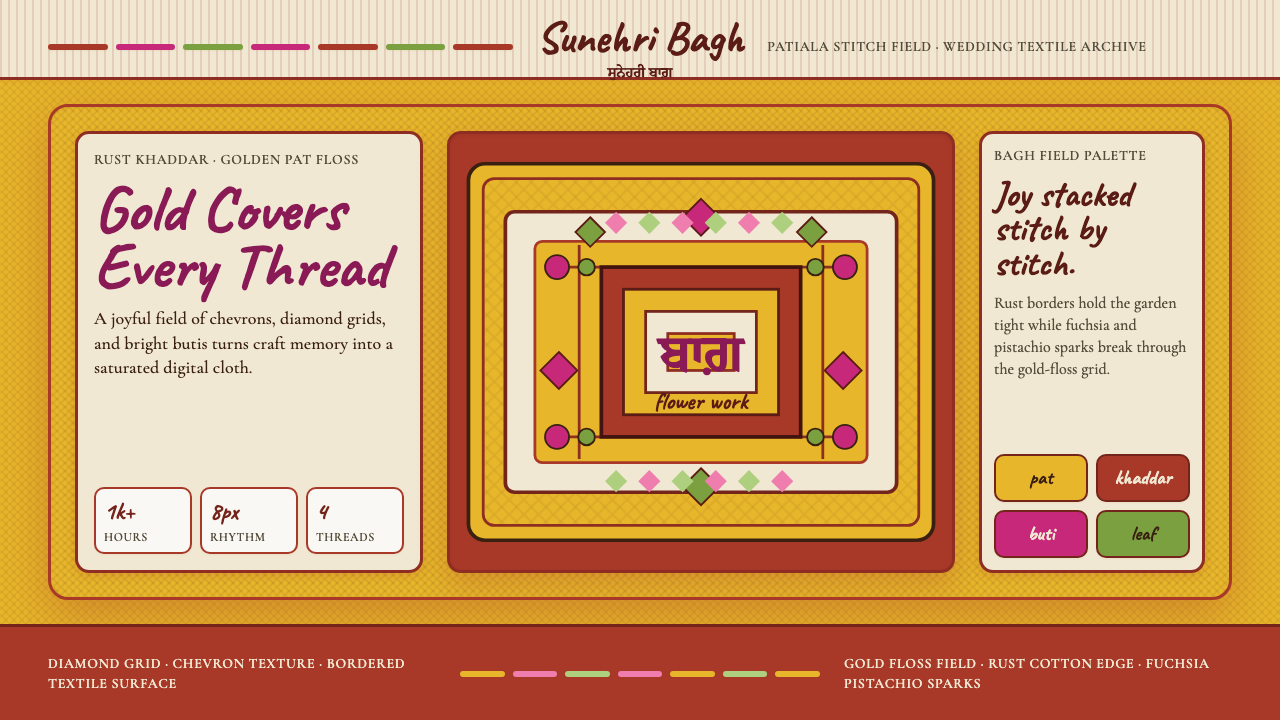
Phulkari — 'flower work' — transforms rust-red cotton into a blazing field of golden silk stitches, where every thread of the base cloth disappears beneath a joyful, geometric density that took Punjabi women thousands of hours to create.
Punjabi Phulkari (Floral Bagh) in brief
Phulkari is the traditional embroidery art of Punjab, practiced across both the Indian and Pakistani sides of a region whose textile heritage predates the colonial boundaries that divided it in 1947. The word itself — phul meaning flower, kari meaning work — describes a tradition far more architectural than its name implies. At its most fully realized, phulkari becomes bagh, meaning garden: a densely embroidered shawl or head covering in which the entire surface of coarse handspun cotton cloth is obscured beneath thousands of diagonal silk darning stitches, arranged into interlocking diamond grids, chevron fields, and stylized floral motifs called butis.
What distinguishes phulkari from other South Asian embroidery traditions is its structural logic. The embroiderer works from the reverse side of the fabric, counting the warp and weft threads of the khaddar cotton to produce perfectly aligned stitches on the face. The result is a surface that is simultaneously textile and geometry — each gold-floss chevron row interlocking with the next to build patterns that read as both organic and mathematical. The palette is concentrated and purposeful: golden silk thread dominates, supported by fuchsia, pistachio green, and ivory accents that punctuate the field like blossoms in a formal garden.
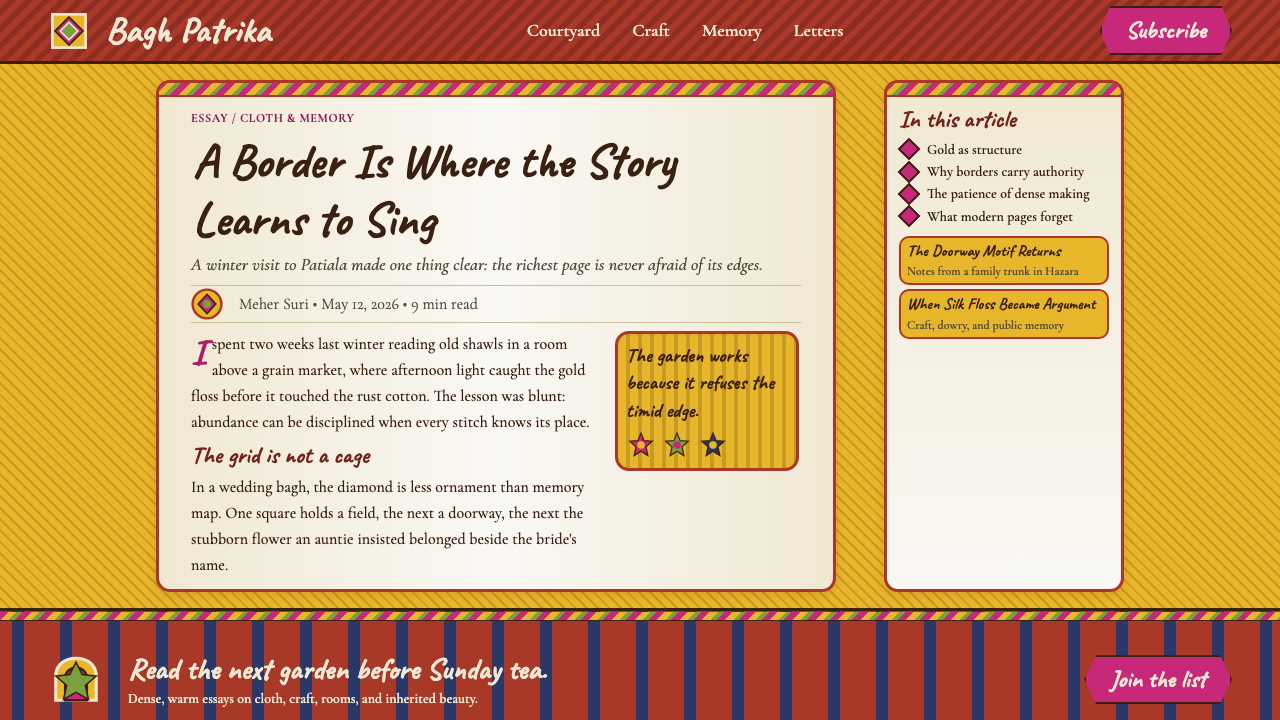
A complete bagh is a ceremonial object. Wedding trousseaus in Punjab traditionally included multiple phulkari pieces — head coverings, shawls, and dupattas — that represented the accumulated labor of a woman's female relatives over years of preparation. The cultural weight of the object was inseparable from its visual density: the more completely the gold thread covered the ground cloth, the richer and more auspicious the piece. This equation between coverage and value gives phulkari its most distinctive design principle — fullness is the goal, and every empty thread of cloth is something still to be filled.
Where does Punjabi Phulkari (Floral Bagh) come from?
The roots of phulkari reach back to at least the fifteenth century, though the tradition almost certainly draws on much older regional textile practices. Persian and Central Asian darning-stitch techniques entered the Punjab region through the trade routes that connected the subcontinent to the wider Islamic world, and local weavers absorbed these influences into a distinctly Punjabi idiom. The name and its associated cultural meanings are recorded in the poetry of Waris Shah's eighteenth-century Punjabi classic Heer Ranjha, where phulkari appears as a symbol of domestic virtue and bridal preparation — evidence that by the 1700s the tradition had already achieved its central place in Punjabi feminine culture.
The pre-Partition peak of phulkari, roughly from 1850 to 1947, coincided with the region's greatest prosperity and its deepest integration into both Punjabi and wider British Indian commercial networks. During this period, the tradition diversified into regional sub-styles: the Hazara phulkari of what is now Pakistan's northern Punjab featured bolder geometric abstractions, while Patiala, Sangrur, and Amritsar in the eastern Punjab developed their own vocabulary of gateway arches, called darshan-dwar, and peacock-feather buti patterns. The embroidery also evolved commercially — workshops in larger towns produced phulkari for sale beyond the domestic gift economy, and the introduction of imported Chinese and Japanese silk threads brought new colors and lustres into what had previously been a more locally sourced material culture.
Partition in 1947 fractured the tradition across a newly drawn international border. Punjabi refugees who fled to both sides carried their embroidery skills with them, but the disruption to family networks, regional craft communities, and the material supply chains that had sustained the tradition meant that the pre-Partition bagh culture never fully reconstituted itself. In East Punjab — the Indian side — the post-Partition decades saw phulkari persist primarily as a folk survival, practiced by older women and associated with a lost world. By the 1980s and 1990s, however, a revival was underway: craft organizations, government cultural agencies, and individual collectors began documenting, teaching, and marketing phulkari as a heritage object, and younger practitioners trained in the older techniques began producing work for urban and export markets.
Key figures in the modern scholarly and revival context include Sarbjit Kaur Kang, whose documentation work helped formalize the typology of phulkari regional styles, and Pepin van Roojen, whose published pattern archives made the visual vocabulary of bagh embroidery accessible to international designers and researchers. Anu Bala has worked with younger craftswomen to sustain the practice as a living tradition rather than a museum object, emphasizing the transmission of technique through active making rather than archival reproduction. Today, phulkari holds GI tag status in India, and its visual motifs — particularly the chevron-stitch texture and the gold-on-rust palette — have entered global design vocabularies through fashion, textile design, and digital aesthetics.
What defines the Punjabi Phulkari (Floral Bagh) look?
Color Field
The dominant ground in a bagh is warm gold — the color of the silk floss that covers the entire surface. Against this luminous field, the base rust-red of the khaddar cloth appears only at the selvedge edges and in the broad border bands that frame the composition. Accent colors — deep fuchsia, pistachio green, ivory, and occasionally cobalt — appear as buti flowers and border stripes. The overall effect is one of saturated warmth: no cool neutrals, no desaturated backgrounds, every tone contributing to an atmosphere of celebratory abundance.
Chevron and Diamond Geometry
The fundamental unit of phulkari is the diagonal darning stitch, and when these stitches are repeated row upon row across the cloth, they naturally generate chevron and diamond patterns. A bagh is organized around a central field of interlocking diamond lozenges, each diamond composed of stitches running in alternating diagonal directions. This geometric order is not imposed from outside — it emerges directly from the counting logic of the textile itself. The result is a surface that feels simultaneously hand-made and mathematically precise.
Border Architecture
A well-composed phulkari is framed by a hierarchy of border bands: an innermost narrow stripe, a broader middle band carrying the main decorative motifs, and an outermost guard stripe. These borders are often the most visually complex areas of the piece, where embroiderers placed their most elaborate darshan-dwar gateway arches, peacock fans, and tree-of-life columns. The border system gives the composition a formal architecture — it functions like the frame of a painting, simultaneously containing the central field and announcing it.
Buti Floral Motif
Scattered across the gold field, butis are small, stylized flower forms — rosettes, petals arranged around a central point, or simplified plant forms — that punctuate the geometric ground with organic variation. They are positioned at regular intervals within the diamond grid, giving the surface a rhythm that alternates between geometric rigor and floral relief. Different regional traditions developed distinct buti vocabularies: the Hazara tradition favored more angular, abstract flower forms, while the Patiala and Amritsar traditions used rounder, more naturalistic petal arrangements.
Silk-on-Cotton Contrast
The material contrast between the worked silk surface and the coarse khaddar cotton ground is a defining quality of phulkari. The silk floss catches light differently from every angle, creating a subtle iridescence that shifts as the fabric moves. Against the matte, rough-textured background of the cotton selvedges and border areas, this lustrous quality becomes dramatic. In digital and graphic applications of the style, this contrast is translated through the juxtaposition of glossy or metallic gold surfaces against flat, matte rust-toned fields.
Celebratory Density
Unlike traditions that value negative space and visual breathing room, phulkari treats emptiness as incompleteness. A bagh is finished when no ground cloth is visible — every square thread of the fabric has been covered. This principle of maximum coverage is not incidental but culturally intentional: the density of stitching is literally a measure of love, labor, and auspiciousness. In design terms, this translates to a philosophy of generous abundance — full bleed backgrounds, closely spaced elements, pattern that reaches to every edge.
Gateway Arch Motif
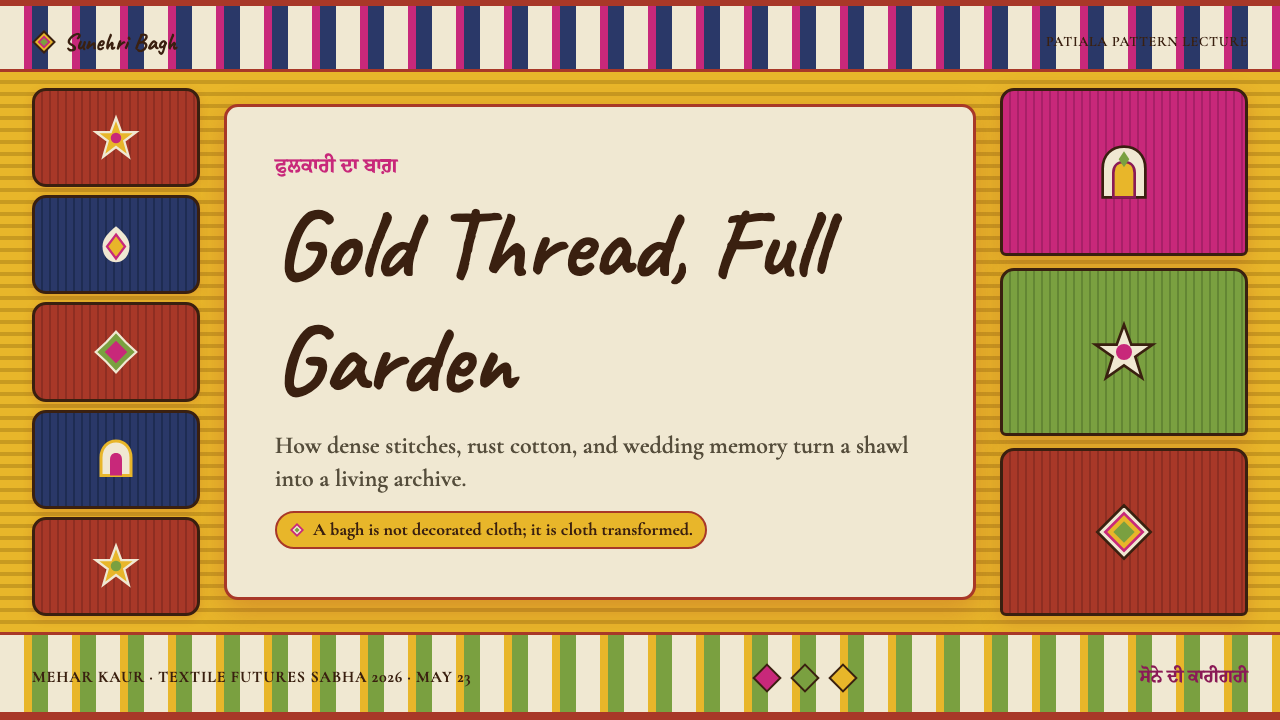
The darshan-dwar — literally 'viewing gate' or 'gateway to the sacred' — is a distinctive compositional element unique to certain phulkari traditions, particularly those from Patiala and Amritsar. These gateway arch forms appear at the ends of shawls and as central panels in the largest bagh pieces, constructed from hundreds of parallel stitches that outline stepped or rounded arch profiles. They give the textile a monumental quality, transforming a domestic fabric into something that reads like architectural decoration — a textile building.

Who shaped Punjabi Phulkari (Floral Bagh)?
Sarbjit Kaur Kang is among the most important scholars of phulkari's regional typology. Her documentation work systematized the distinctions between Patiala, Amritsar, Sangrur, and Hazara sub-styles, providing the analytical framework that later revival efforts and museum collections depended upon. By establishing a scholarly basis for the tradition's geographic and technical variations, she helped transform phulkari from an undifferentiated folk practice into a recognized heritage category with distinct regional identities.
Pepin van Roojen, the Dutch publisher and pattern archivist, made phulkari's visual vocabulary accessible to international designers and researchers through his published pattern collections. His archival work documented the geometric and floral motif systems of bagh embroidery with enough precision that designers working far from Punjab could engage seriously with the tradition's formal principles. His publications contributed significantly to the internationalization of South Asian textile aesthetics in graphic and digital design contexts.
Anu Bala has been a central figure in the contemporary revival of phulkari as a living practice rather than a museum artifact. Working with craftswomen across rural Punjab, she has emphasized the transmission of technique through active making — training new practitioners in the counting methods, thread-handling, and regional stitch vocabularies that constitute the tradition's technical core. Her approach distinguishes between heritage documentation (preservation for its own sake) and heritage practice (keeping the tradition alive by keeping it useful), positioning phulkari as a continuing cultural production rather than a historical survival.
The eighteenth-century Punjabi poet Waris Shah did not create phulkari, but his epic poem Heer Ranjha contains some of the earliest literary references to the tradition, establishing it as a recognized cultural symbol long before modern documentation efforts. In the poem, phulkari appears as an emblem of feminine virtue, bridal preparation, and domestic labor — evidence that by the mid-1700s the tradition had achieved iconic status in Punjabi culture. Shah's poem effectively guaranteed that phulkari would be recorded as part of the literary heritage of the region, not merely as an object of material culture.
How do you use Punjabi Phulkari (Floral Bagh) today?
Phulkari's visual logic — gold-dominant warmth, geometric surface density, celebratory color, and structured border framing — translates into contemporary design contexts best when the full system is engaged rather than just individual motifs borrowed. The most effective applications treat the underlying principle of abundant coverage as the organizing idea, letting pattern reach every edge and allowing color to operate at high saturation rather than pulling back toward neutral.
For presentation slides, phulkari's palette and density work exceptionally well on cover pages oriented toward celebration, cultural richness, or festive occasions. A gold-dominant field as the primary background, with rust-red as a border or accent band and fuchsia as a headline color, establishes the register immediately. Content slides should maintain the grid discipline that underlies bagh composition — organizing information into regular intervals and using the chevron or diamond as a subtle background texture rather than a full-surface pattern. Data visualizations in this style benefit from warm, high-saturation bars and segments: gold for primary data, fuchsia for secondary, pistachio for tertiary comparisons.
For web interfaces and dashboards, phulkari-derived design is best suited to platforms that want to communicate cultural warmth, festivity, or artisanal richness — hospitality brands, cultural institutions, wedding and events platforms, and luxury goods interfaces. The approach works least well for clinical, analytical, or minimal-trust contexts where visual busyness can undermine confidence. On web, the border architecture of phulkari translates naturally into section framing: a rust-red rule at the top and bottom of a content section, a gold interior, and a narrow pistachio guard stripe create the layered border vocabulary of the original textile in structural page terms.
For editorial and marketing work, the full-coverage principle supports feature pages, campaign headers, and rich social graphics where the goal is visual impact rather than quiet sophistication. A full-bleed gold background with fuchsia headline type and rust-red subheads creates a poster-like quality that recalls the luminous bagh surface. Marketing applications work best when the chevron or diamond pattern is used as a large-scale background texture rather than a small repeating tile — scale communicates the textile origin and gives the design physical presence. One effective editorial pattern is to alternate between a gold-dominant spread and a rust-red-dominant spread, using the opposite color as the accent in each case, echoing the call-and-response between ground cloth and thread in the original embroidery.
The most common mistake when applying phulkari aesthetics is treating the motifs as surface decoration rather than structural logic. Placing a few scattered buti flowers on an otherwise minimal layout, or adding a narrow chevron border to a flat white page, produces a decorative pastiche that misses what makes the tradition visually powerful. The style requires commitment to fullness: if the coverage principle is not engaged, the design reads as half-finished, and the warm-festive quality of the palette can tip into garish without the geometric framework that gives it order.
Punjabi Phulkari (Floral Bagh) — FAQ
What is the difference between phulkari and bagh?
Phulkari is the broader term for the Punjabi darning-stitch embroidery tradition, encompassing a wide range of pieces from partially embroidered shawls to ceremonial head coverings. Bagh — meaning garden — is the most fully realized form: a phulkari piece in which the silk stitching has been worked so densely that the entire ground cloth is completely covered, with no rust-red cotton visible except at the borders. A bagh takes significantly more labor than an ordinary phulkari and carries greater ceremonial importance. In contemporary design usage, the bagh is the canonical reference point because its total-coverage principle is the most visually distinctive feature of the tradition.
Is phulkari only associated with weddings?
Wedding and dowry contexts were historically the most important occasions for phulkari production, but the tradition encompassed a broader range of ceremonial and everyday uses. Specific phulkari types were made for the birth of a child, for religious occasions, and for gifts between families. Simpler phulkari pieces — with partial rather than complete coverage — were worn as everyday head coverings and shawls. The bagh, with its extraordinary labor investment, was reserved for the most significant life events. In contemporary usage, the aesthetic has moved well beyond its original ceremonial context into fashion, interior design, and digital applications where the celebratory quality of the palette is deployed without specific ritual reference.
How does phulkari relate to other South Asian embroidery traditions?
Phulkari shares the darning-stitch technique with several neighboring traditions, but its visual identity — particularly the total-coverage bagh and the gold-on-rust palette — is distinctive within the broader South Asian embroidery landscape. Gujarat's Rabari embroidery uses a related repertoire of geometric forms but with a very different thread material and color sensibility. Sindhi embroidery, particularly from the regions now in Pakistan, shares some geometric motif vocabulary with Hazara phulkari but differs in its use of mirror work and surface embellishment. Chikankari from Lucknow is a pulled-thread white-on-white tradition that represents almost an opposite aesthetic pole — a study in restraint and shadow against phulkari's abundance and blaze. What unites South Asian embroidery traditions is less technique than the cultural framework of women's labor as both aesthetic production and social communication.
Can phulkari-derived design work in minimal or monochrome contexts?
Minimized or monochrome applications of phulkari are possible but require accepting a fundamental tension: the tradition's core value is abundance, and a minimal phulkari-derived design is working against the grain of its source. That said, specific elements can be extracted and used with restraint. The chevron-stitch texture, rendered in a single tonal variation against a near-matching ground, produces a tactile surface quality that reads as crafted and warm without the full chromatic complexity. A gold-on-ivory palette with only the geometric grid — no buti accents, no border hierarchy — references phulkari through its warmth and coverage pattern while reducing the festive intensity. These approaches work for contexts that want textile warmth without cultural specificity, but they should not be presented as phulkari — they are reductions that lose most of what makes the tradition distinctive.
How do I avoid the cultural pastiche trap when using phulkari references?
The pastiche trap with phulkari typically takes one of two forms: either superficial motif borrowing — scattering a few buti flowers or chevron borders as decoration on an otherwise unrelated design — or reductive exoticism, where the aesthetic is used to signal 'South Asian' or 'Indian' without engaging the specific formal principles of the tradition. The most responsible approach is to engage with phulkari's structural logic rather than its surface imagery. The coverage principle, the border hierarchy, the gold-warm palette, and the chevron geometry are all formal ideas that can be deployed in new contexts without appropriating the specific ceremonial or cultural content of the tradition. Attribution also matters: in commercial contexts, acknowledging the Punjabi textile tradition that the design draws from is a minimum courtesy that transforms borrowing into reference.
Related design styles
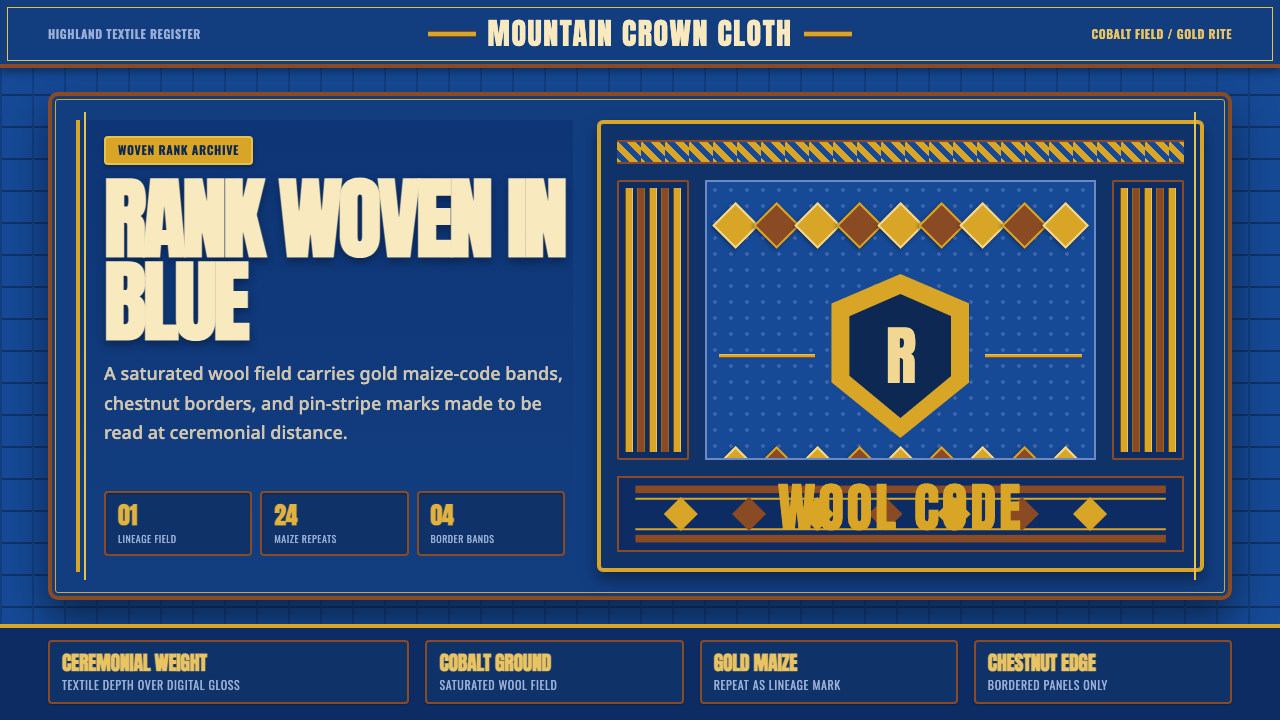 Basotho Seanamarena BlanketRank made visible. Cobalt wool, gold maize diamonds, and chestnut borders rea…
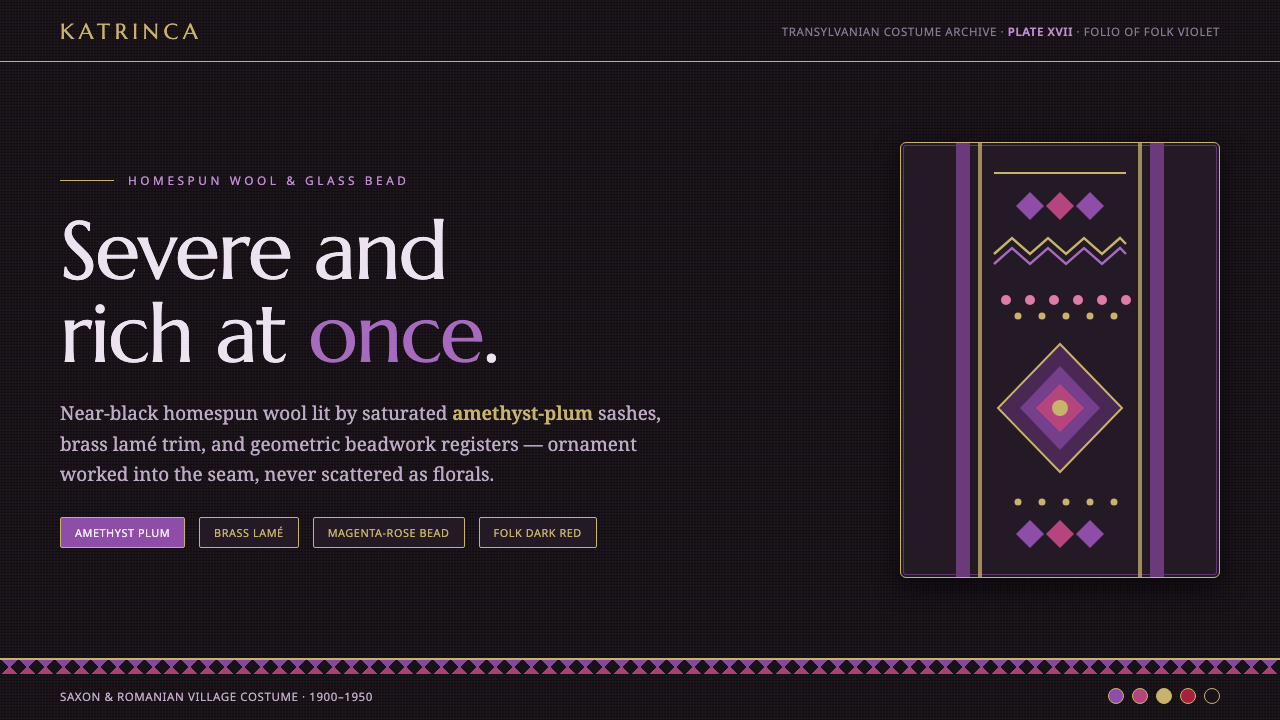 Romanian Folk VioletSevere and rich at once. Near-black homespun wool lit by amethyst-plum and br…
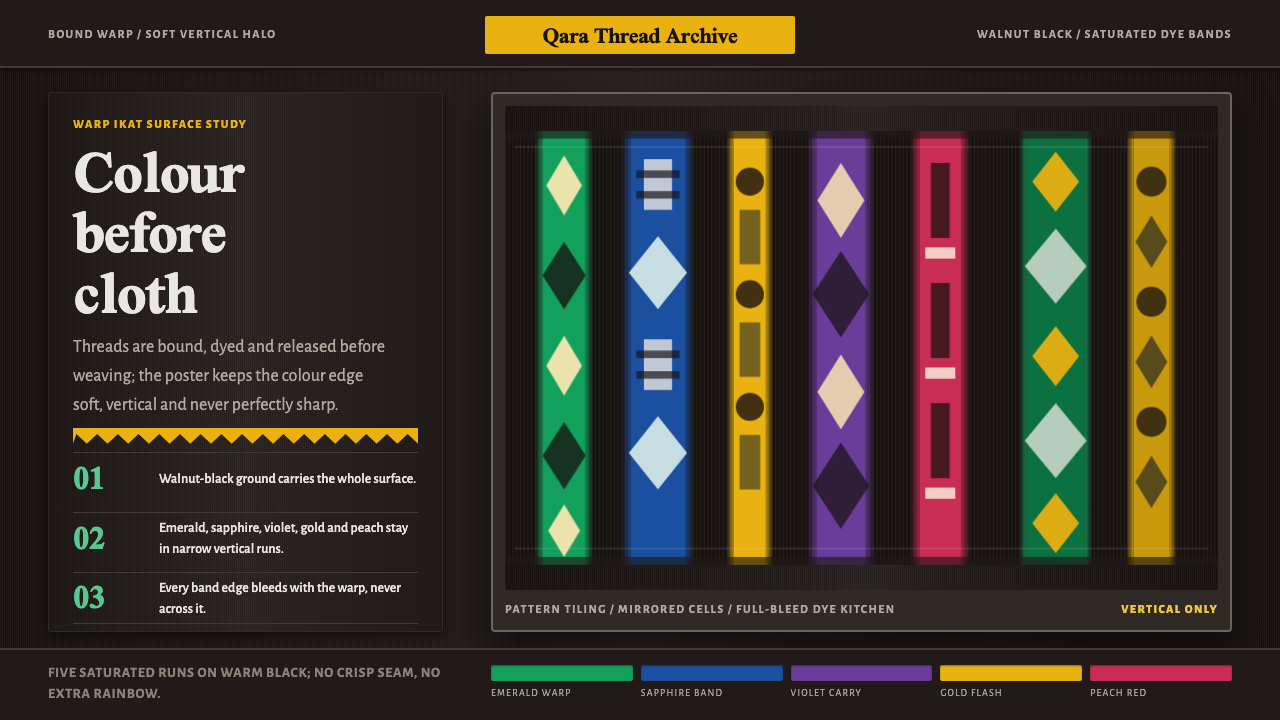 Atlas Silk (Etles)Soft before it is woven. Walnut-black silk holds vertical emerald and gold dy…
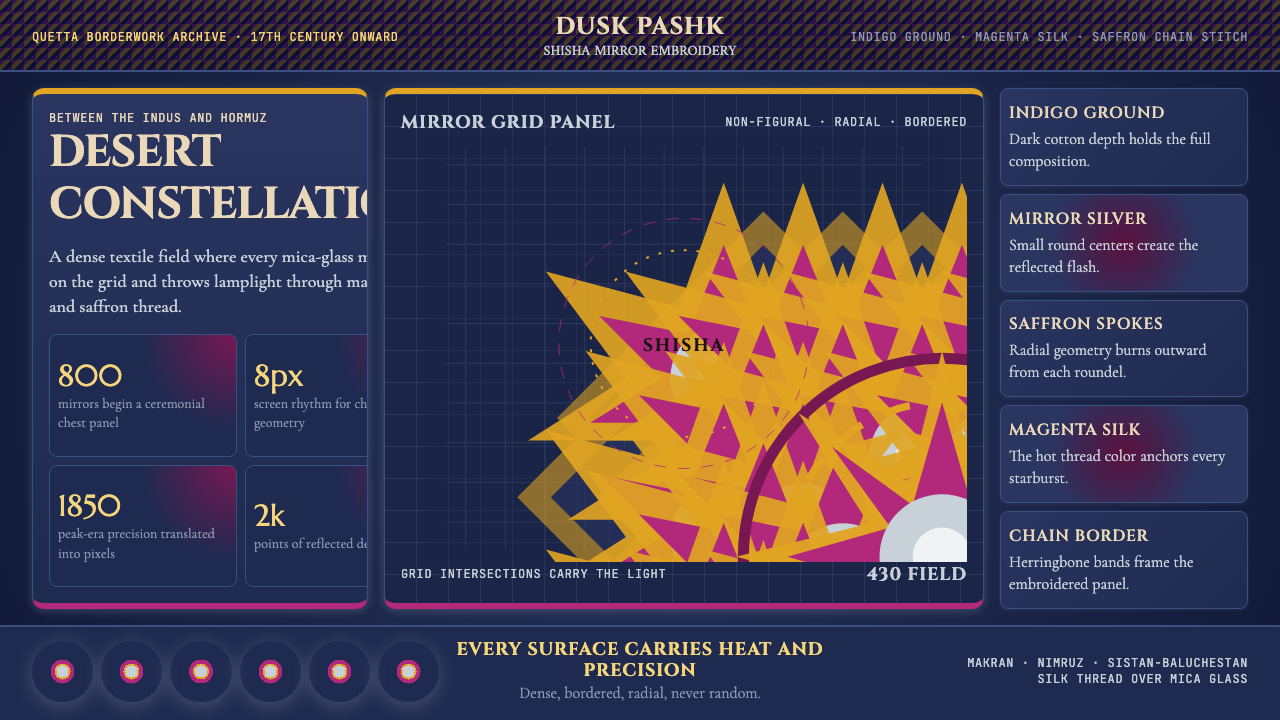 Balochi Mirror Embroidery (Shisha)Desert light made dense. Indigo grids flash with magenta, saffron, and mirror…
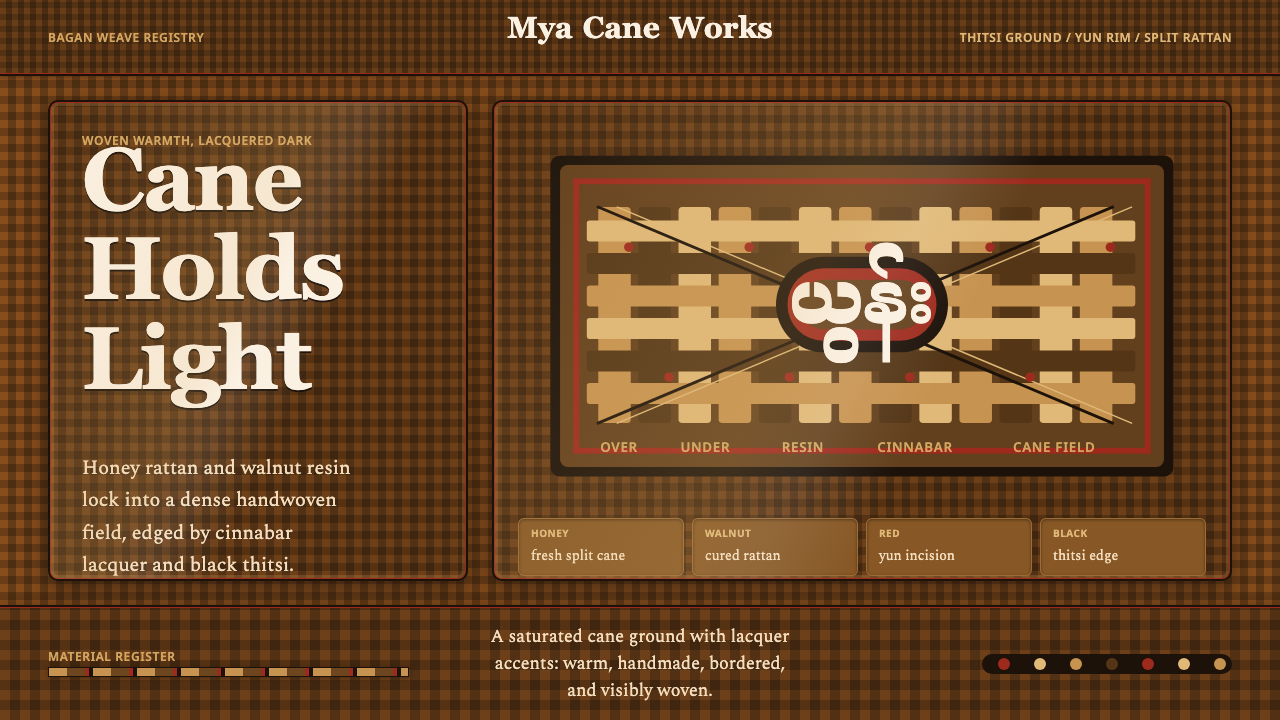 Burmese Cane RattanWoven warmth holds the page. Walnut cane lattice glows with cinnabar rim line…
 Kuchi Nomad Silver JewelryWeight becomes protection. Matte silver frames carnelian and teal stones on b…