What is Mongolian Deel & Ger Felt?
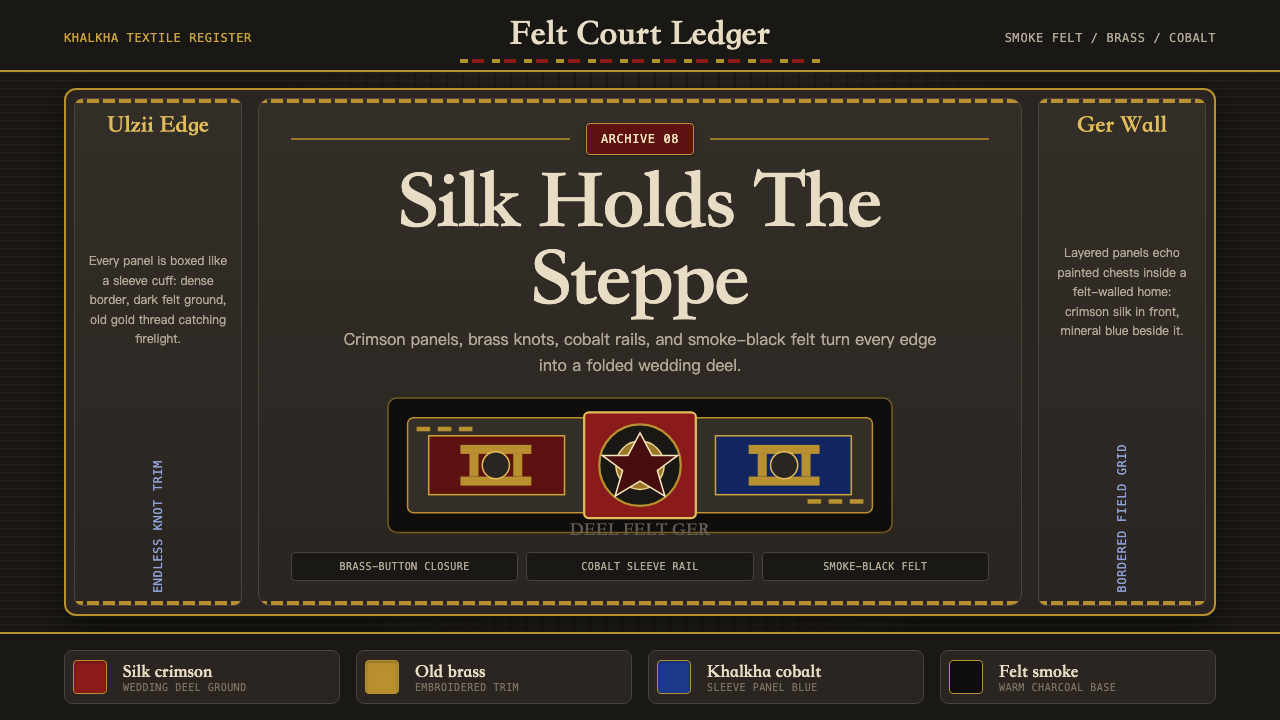
Mongolian Deel & Ger Felt weaves the layered material gravity of the steppe — smoke-dark felt, crimson silk, old gold embroidery, and endless-knot trim — into a digital design language that feels less like a screen and more like a ceremonial robe folded for a great occasion.
Mongolian Deel & Ger Felt in brief
Mongolian Deel & Ger Felt is a design system rooted in the layered material culture of the Mongolian steppe — the silk deel robe with its burnt-orange sash, the felt-walled ger lined with painted wooden chests, and the soyombo emblem pressed in deep crimson and old gold. It translates these tactile, ceremonially weighted forms into a coherent visual language for digital surfaces.
Where many historical-revival styles borrow only the surface palette, this system draws on structural principles: the way a deel's embroidered border frames the garment rather than decorating it, the way a ger's painted furniture uses symmetry and geometric motif as symbolic encoding rather than mere ornament. The result is a dark-ground aesthetic dense with cultural signal — brass-button closures rendered as UI affordances, ulzii endless-knot patterns shaping decorative frames, cobalt accent rails echoing the painted chest-bands that ring a ger's interior.
Visually, the system reads as opulent restraint. The palette is deep and warm — smoke black as the dominant ground, crimson as the primary chromatic anchor, old gold for hierarchy signals, and cobalt as a cool counterpoint. Surface texture is implied through layering rather than photographic simulation, keeping the system legible on screen while preserving the felt-and-silk weight of its source material.
Where does Mongolian Deel & Ger Felt come from?
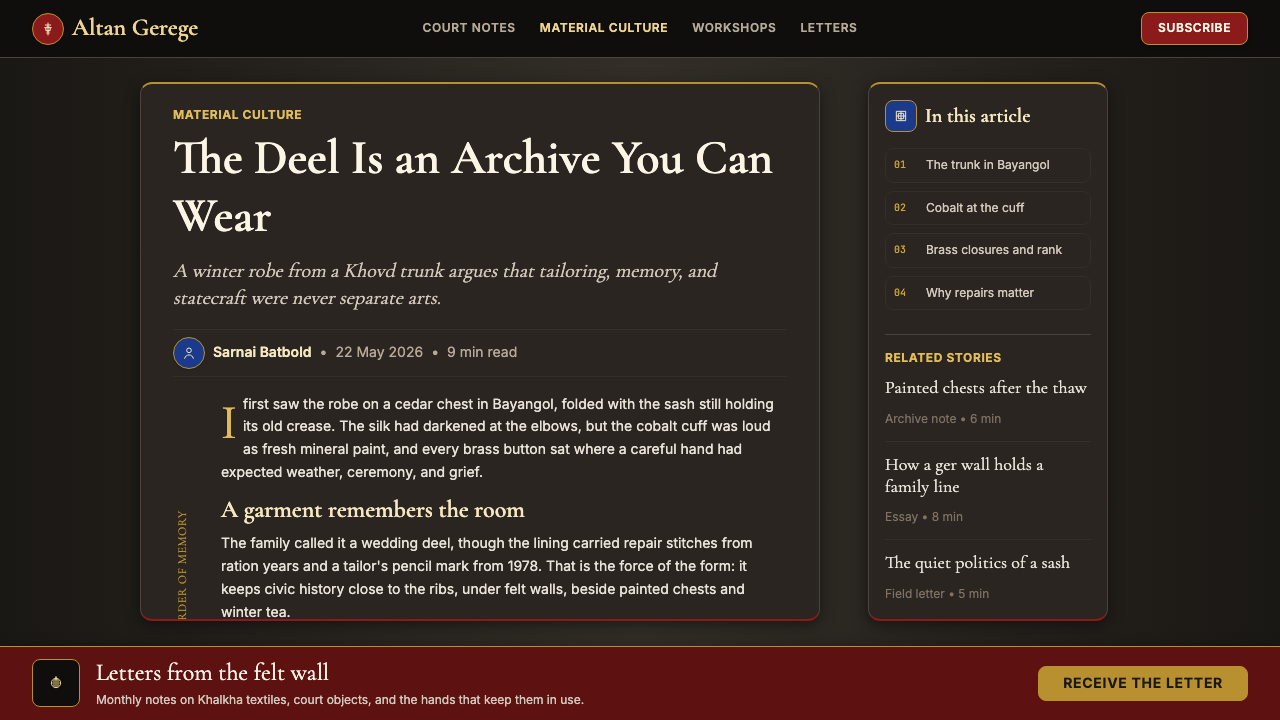
The visual vocabulary of this design system spans seven centuries of Mongolian material culture. The deel robe — a wrapped garment with a distinctive asymmetric front closure fastened by knotted buttons — appears in court paintings from the Yuan dynasty (1271–1368), when the Mongol empire governed the largest contiguous land mass in history. The robe's palette of deep reds, blacks, and gold embroidery was not decorative whim but heraldic encoding: color and trim announced rank, clan affiliation, and ceremonial context to anyone who could read the system.
The felt ger — the circular dwelling assembled from a lattice frame and thick wool felt panels — is an older form still, documented in texts and tomb figures from at least the first millennium. Its interior painting tradition reached a visual high point under the patronage of the Bogd Khan VIII (1869–1924), Mongolia's last theocratic ruler, whose Ulaanbaatar palace accumulated lacquered chests, embroidered hangings, and ritual objects whose color and pattern density represent one of the most concentrated archives of traditional Mongolian decorative arts.
The soyombo symbol — a vertical column of geometric forms representing fire, sun, moon, earth, and water — was created by the scholar-monk Zanabazar in 1686. It functions simultaneously as a religious cipher, a national emblem, and a design motif. Its graphic economy — a complex idea rendered through the clear stacking of geometric shapes — anticipates the concerns of twentieth-century information design, and its appearance in this system anchors the aesthetic to Mongolian sovereignty rather than generalized Central Asian ornament.
The post-1990 cultural revival in Mongolia, following the end of Soviet-era restrictions on traditional dress and practice, generated a new wave of craft workshops and fashion houses in Ulaanbaatar. Designers including Bolortuya Damdinjav and others working in the contemporary Mongolian fashion scene recontextualized the deel for urban wear, recombining traditional materials — cashmere, silk, embroidered felt — with contemporary silhouettes. This revival is the proximate source for translating steppe material culture into a design system legible to international audiences: it gave the tradition a contemporary visual language without erasing its ceremonial weight.
What defines the Mongolian Deel & Ger Felt look?
Palette
The palette operates in the register of dyed textiles and lacquered wood rather than screen luminosity. Smoke black functions as the dominant ground — not a pure digital black but a slightly warm, depth-suggesting dark that recalls charred felt and night-sky ger silhouettes. Crimson anchors the system as the primary chromatic voice, derived from the silk of ceremonial deel robes and the lacquer of painted chests. Old gold signals hierarchy and boundary, appearing at embroidered borders, knotted closures, and heading levels. Cobalt serves as a cool accent, echoing the blue rails and painted medallions found in ger interiors. Together the palette reads as warm, weighty, and heraldically precise.
Texture and Surface
Texture is referenced rather than simulated. The system evokes the weight of compressed wool felt and woven silk through layering depth, tonal variation within dark grounds, and the suggestion of woven structure in border patterns — but it does not apply photographic fabric scans or realistic weave overlays. The tactile memory is carried by the color relationships and the density of decorative framing, not by surface noise. This keeps the system crisp and legible on screen while preserving the material register of its source culture.
Decorative Borders and Framing
Where the Bauhaus system uses negative space as the primary organizational device, this system uses the active border. The embroidered hem of a deel, the painted frame of a lacquered chest, the woven band at a ger's crown ring — all operate as structural demarcators that announce content zones and assign ceremonial weight to what they contain. In digital application, this translates to richly bordered containers, decorative section rules derived from endless-knot geometry, and headers that carry the visual density of embroidered trim rather than the lightness of a ruled line.
Geometric Pattern and Symbolic Motif
Mongolian decorative arts carry a grammar of symbolic geometry: the ulzii endless knot represents good fortune and continuity; the soyombo's stacked forms encode cosmological hierarchy; the interlaced meander patterns that ring painted furniture establish visual cadence and territorial boundary simultaneously. In this design system, these motifs appear as framing elements, background registers, and icon-scale glyphs rather than as purely decorative fill. Their presence signals cultural specificity — distinguishing the system from generic dark-luxury aesthetics — while their geometric discipline keeps them compatible with digital legibility requirements.
Typography Hierarchy
The system treats type with the same ceremonial weight it brings to textiles. Display headings carry the heaviness of embroidered script — substantial, confident, and spaced with deliberate generosity — while body text is set at a comfortable reading size against the dark ground with sufficient contrast to sustain long reading. The tonal relationship between old-gold headings, lighter-value subheadings, and near-white body text mirrors the hierarchy of a deel's trim: the gold border reads first, the silk body second, the lining last. No element competes for attention; the reading order is enforced by chromatic weight.
Compositional Density
Unlike minimalist systems that use generous white space as a signal of refinement, this system reads its density as richness. A ger interior is not sparse — every surface carries painted motif, embroidered panel, or lacquered object. The design system inherits this tolerance for visual fullness: interfaces built in this language can carry more information per viewport than a spare Swiss-derived system without feeling cluttered, because the layering logic itself provides organizational coherence. The key constraint is that every element must belong to an established visual register — border, ground, accent, or motif — rather than floating without structural assignment.
Dark Ground as Foundation
The dark ground is not a mode or a variant — it is the system's canonical state, in the same way that a felt ger's interior is naturally dim and the night sky over the steppe is the primary celestial reference. Elements are designed to emerge from the dark rather than sit on a light field: gold and crimson read as luminous rather than saturated, cobalt pulses against the dark rather than receding into it. This inversion of the light-ground convention produces an interface that feels enclosed and ceremonial rather than open and neutral — appropriate to a design system whose source culture treats interiors as sacred, bounded, and warmly lit.
Who shaped Mongolian Deel & Ger Felt?
The eighth Jebtsundamba Khutughtu (1869–1924), Mongolia's last theocratic ruler, presided over the Bogd Khan Palace in Ulaanbaatar, now a museum. His court accumulated the most concentrated archive of traditional Mongolian decorative arts in existence: lacquered furniture, embroidered throne covers, ritual objects, and painted pavilions whose color and pattern density constitute a living reference for the visual system. The Bogd Khan era (roughly 1911–1924) represents a final flowering of classical Mongolian court aesthetics just before Soviet influence restructured the country's cultural production.
Balduugiin Sharav (1869–1939), known as Marzan (meaning 'the witty one'), is the most celebrated painter of classical Mongolian art. His large-format scroll paintings — particularly the encyclopedic 'One Day in Mongolia' — document the full visual world of the pre-Soviet steppe: deel robes in accurate heraldic color, ger interiors with their painted chests and embroidered hangings, festival gatherings where pattern and palette are on maximal display. His work is the primary documentary source for the color relationships and compositional density that define this design system's source culture.
Zanabazar (1635–1723) was a scholar, sculptor, and theologian who created the soyombo script and its eponymous symbol in 1686. The soyombo — a vertical composition of geometric forms encoding fire, sun, moon, two triangles (pointing up for victory, down for defeat of enemies), two horizontal bars, a yin-yang, and two vertical bars — demonstrates how a complex symbolic argument can be expressed through rigorously geometric visual means. As a sculptor, Zanabazar also produced some of the finest Buddhist bronze casting in Central Asian history, combining Tibetan iconographic conventions with distinctly Mongolian formal sensibilities.
A leading figure in contemporary Mongolian fashion design, Damdinjav has been central to the post-1990 revival of the deel as a form suitable for urban and international contexts. Her work combines traditional Mongolian materials — cashmere, embroidered felt, silk — with contemporary construction, demonstrating that the formal vocabulary of steppe dress is not a historical artifact but a living system capable of absorbing new contexts without losing its cultural specificity. The visual logic she applies to garments — maintaining heraldic color relationships and geometric trim while updating silhouette — is the same logic this design system applies to digital surfaces.
A contemporary Mongolian jewelry and craft designer whose work has focused on the translation of traditional Mongolian metalworking techniques — filigree silver, coral inlay, gilded brass — into contemporary objects. Her practice documents the material logic of traditional Mongolian ornamentation at a scale where individual techniques become legible: how a brass clasp is formed, how a knotted toggle is assembled, how coral beads are strung against silver wire. The micro-level material grammar she works with informs the detail-scale design decisions — closure shapes, border weights, accent densities — that distinguish this system from surface appropriation.
How do you use Mongolian Deel & Ger Felt today?
Mongolian Deel & Ger Felt is a high-specificity system — it brings a strong cultural and aesthetic point of view that works best when that point of view is an asset rather than an interference. The clearest fit is for products positioned around heritage, craft, depth, or ceremonial significance: luxury goods platforms, cultural institutions, premium editorial, high-end travel experiences, or any brand where the user is expected to spend time with the interface rather than scan and exit.
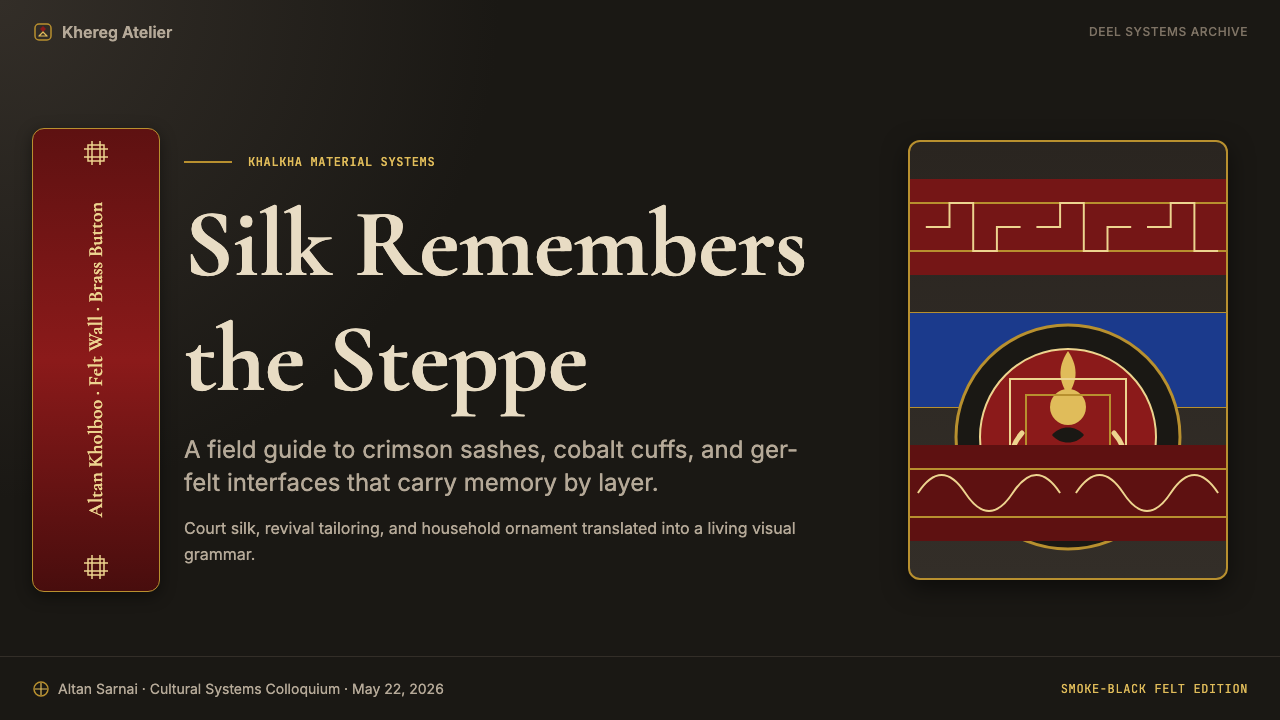
For presentation slides, the system performs best in contexts where visual authority and memorability matter more than neutrality. A cover slide benefits from the system's capacity for heraldic boldness: a crimson ground with old-gold display type and a soyombo-derived geometric motif in the corner will stop attention in a way that no light-background deck can. Content slides should be treated as lacquered panels — borders define the content zone, a consistent dark ground holds all text, and hierarchy is navigated by color weight (gold for headings, lighter values for subheadings, near-white for body) rather than by decorative bullets or dividers. Data visualization slides should use the chromatic register purposefully: the primary data series in crimson, comparison series in cobalt, annotations in gold.
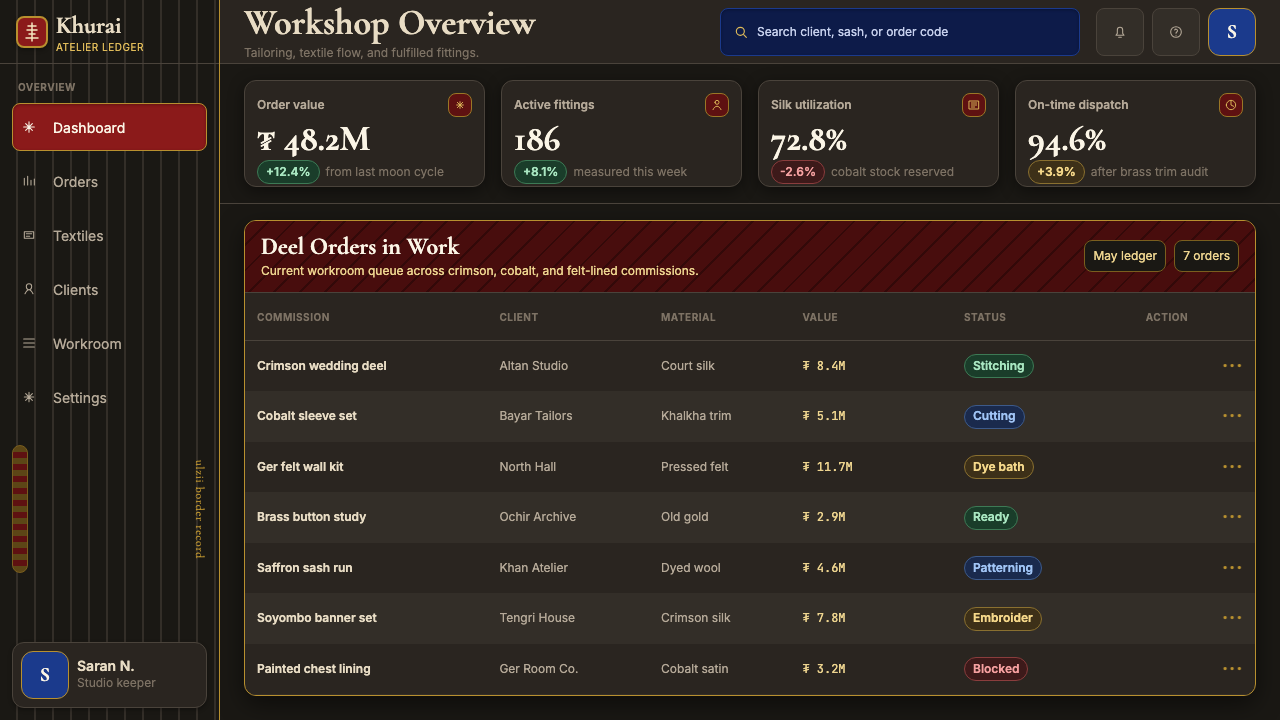
For web interfaces, the system is well-suited to landing pages, editorial surfaces, and premium product showcases where the intention is to project depth and cultural specificity. Dashboard and productivity applications are harder contexts — the high decorative density can reduce scanning speed in data-intensive environments. When using the system for a dashboard, restrict decorative border elements to navigation and section headers, and keep data-display areas close to the ground color with only accent-level chromatic marking. Pricing pages work well: the ceremonial weight of the system maps naturally onto the register of presenting options of different value.
For editorial and marketing work, the system's richness is an advantage. Long-form editorial pages built in this language have a sense of occasion that rewards careful reading — the visual density signals that what is inside is worth the attention the format asks for. Marketing pages can deploy the system's boldness in full: hero sections with crimson grounds and gold display type, feature blocks with cobalt accent rails, and call-to-action elements that use the brass-button closure logic (solid fill, weighty border, ceremonial placement) to signal irreversibility and value.
The most common mistake when applying this system is treating the decorative elements as interchangeable ornament rather than structured vocabulary. The endless-knot border and the soyombo glyph are not generic Asian motifs — they carry specific cultural valence that should be used precisely. Placing them arbitrarily as background texture or fill decoration is visually incorrect and culturally disrespectful. Similarly, fighting the system's dark-ground premise by introducing large light-ground sections destroys the enclosed, ceremonial quality that makes the system distinctive. If a use case genuinely requires a predominantly light interface, this system is not the right choice — there are better tools for that job.
Mongolian Deel & Ger Felt — FAQ
Is this system appropriate for non-Mongolian brands, or does it risk cultural appropriation?
The question is genuine and worth taking seriously. The system works best when the cultural register is earned or contextually appropriate — a platform serving Mongolian users, a brand with demonstrated material connection to Central Asian craft traditions, a cultural institution mounting an exhibition, or a product whose values (heritage, craft, depth, ceremony) authentically align with the system's source culture. The risk of appropriation increases when the decorative elements are used as pure exotic ornament without any contextual grounding. A reasonable heuristic: use the geometric structure and chromatic grammar freely, but deploy specific motifs like the soyombo or the ulzii knot with intentionality — knowing what they mean and choosing them because that meaning serves the work.
How does this system handle light-mode requirements?
The system is canonically dark-ground. A light inversion is possible but requires significant re-calibration: on a cream or parchment ground, crimson remains workable but old gold nearly disappears (it reads as pale straw rather than warm metal), and the sense of enclosed ceremonial depth that defines the system is substantially reduced. If a light-mode variant is required, the most successful approach is to treat it as a fundamentally different visual register — using the same geometric motifs and border logic but rebuilding the chromatic relationships from scratch for the light context. The dark and light modes should not be generated by simple color inversion; they should be designed as parallel systems that share motif vocabulary but not color relationships.
Can this system work alongside a more neutral or minimal system in a multi-brand context?
Yes, but the combination requires a clear hierarchy of contexts. Mongolian Deel & Ger Felt is a high-signal system — it broadcasts cultural identity loudly and continuously. In a multi-brand or multi-product context, it works best as the governing system for one defined context (a premium tier, a cultural sub-brand, a specific product line) rather than as a component layer mixed with neutral systems across the same surface. The boundary between the systems should be absolute: where the ceremonial dark-ground language ends, the neutral system begins, with no gradual transition or mixed-register elements.
How should the decorative border elements be scaled across different viewport sizes?
The border logic of this system is structural rather than decorative, so it should scale with content rather than being fixed at an absolute weight. At large viewport sizes, borders can be generous — mirroring the wide embroidered hems of a formal deel. At mobile or small viewport sizes, borders should thin proportionally, but they should not disappear: the border is the organizational device, and removing it entirely to 'clean up' a mobile view destroys the system's compositional grammar. A useful rule of thumb: the border should remain visible and rhythmically consistent at all sizes, but its visual weight relative to the content area should remain roughly constant across breakpoints.
What distinguishes this system from other dark-luxury or ornamental dark aesthetics?
The distinguishing factor is cultural specificity and symbolic precision. Generic dark-luxury aesthetics typically draw on Art Deco geometry, Western haute couture black, or undefined 'premium dark' conventions — they signal luxury without cultural content. This system signals a specific place, time, and material culture: the Mongolian steppe, several centuries of textile and lacquerwork tradition, and the heraldic color logic of deel robes and ger painting. The motifs are not interchangeable with other ornamental systems — a soyombo is not a mandala, an ulzii knot is not a Celtic knot, a Mongolian border band is not a Greek meander. Used with knowledge and intention, this specificity is the system's primary differentiating value.
Related design styles
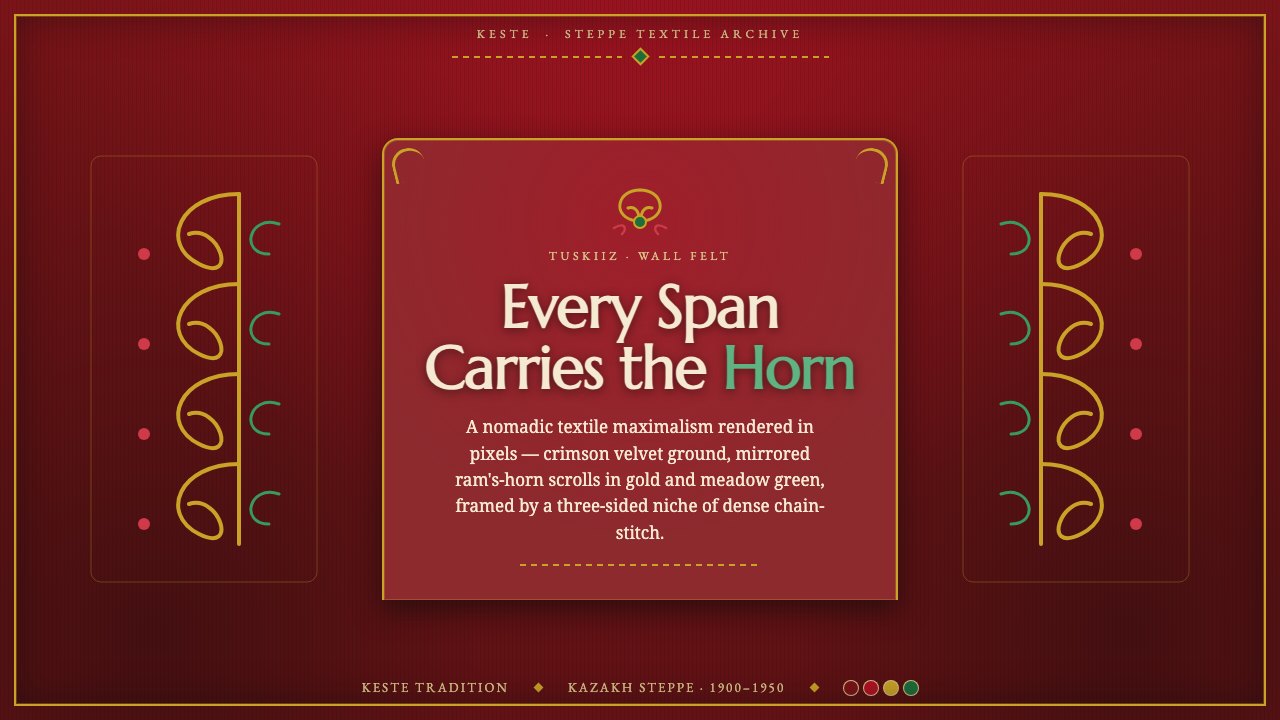 Kazakh Tuskiiz Wall HangingNothing flat, nothing empty. Crimson velvet, gold-green ram's-horn scrolls, a…
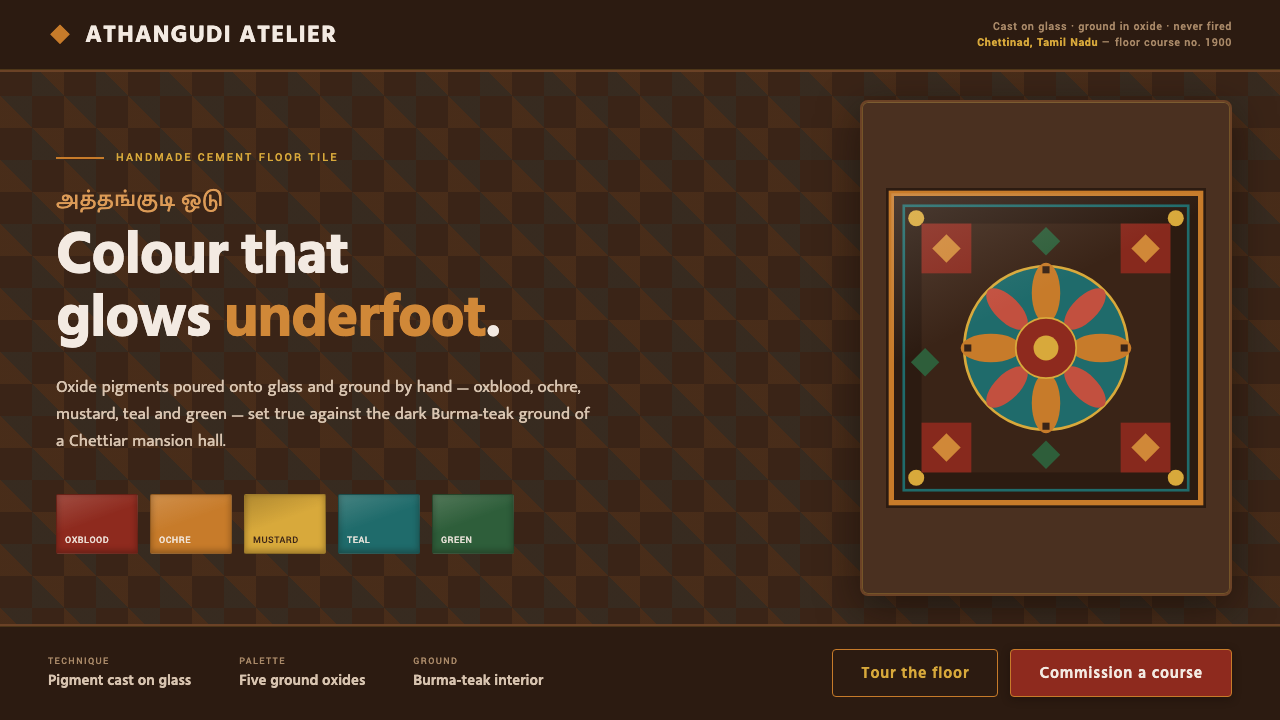 Chettinad Athangudi TilesColour that glows underfoot. Five ground-oxide tones on dark teak in bordered…
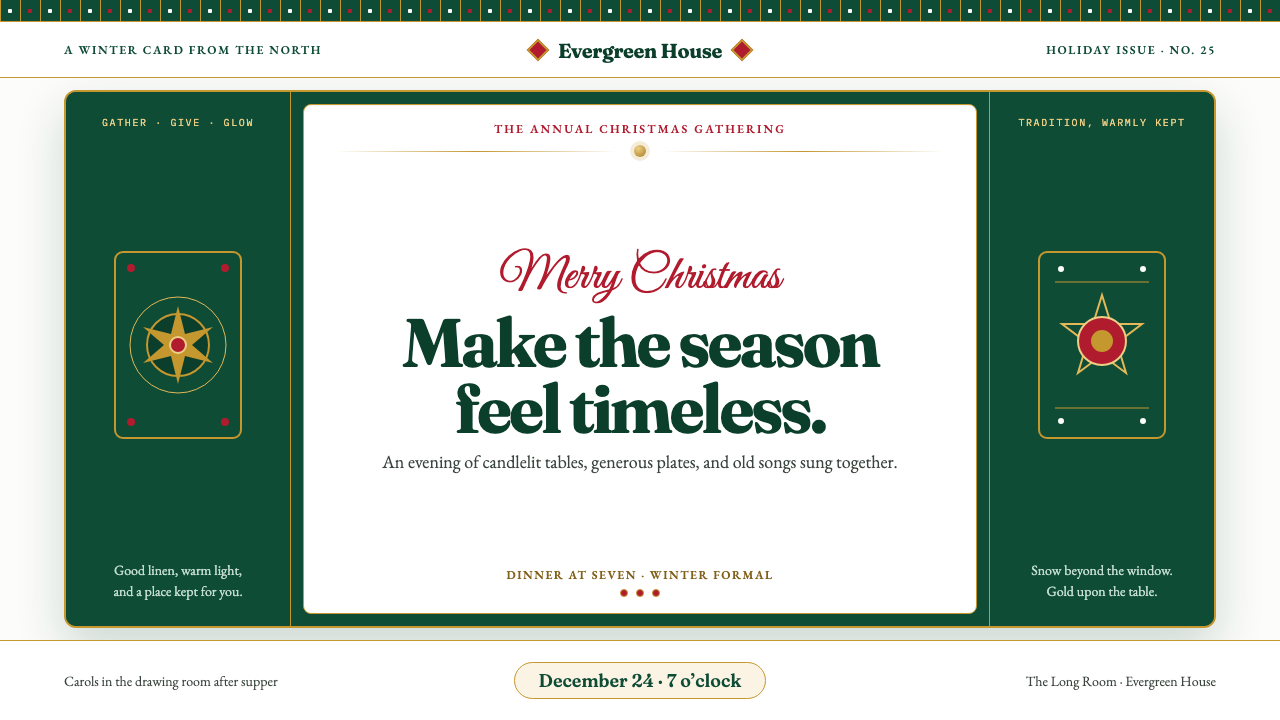 Christmas ClassicTradition glows warmly. Evergreen panels, berry-red notes and burnished-gold…
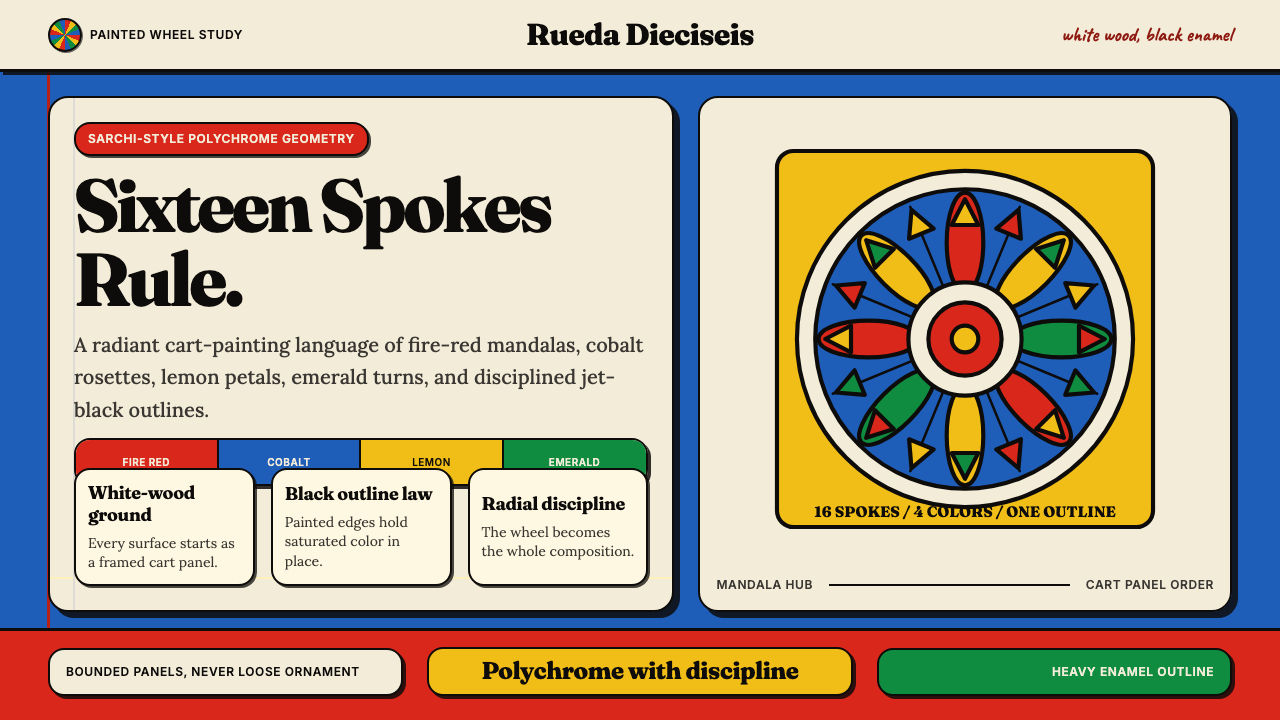 Costa Rican Oxcart Sarchí 1900Geometry sings. Fire red, cobalt, lemon and black outlines turn the wheel int…
 Karakalpak Kimeshek DressA cloth worn red. Crimson keste cross-stitch on indigo wool, set with silver-…
 Maldivian Liye Laa Jehun LacquerThree lac colours, nothing else. Glossy oxblood scraped through to yellow scr…