What is Art Deco Jazz Age?
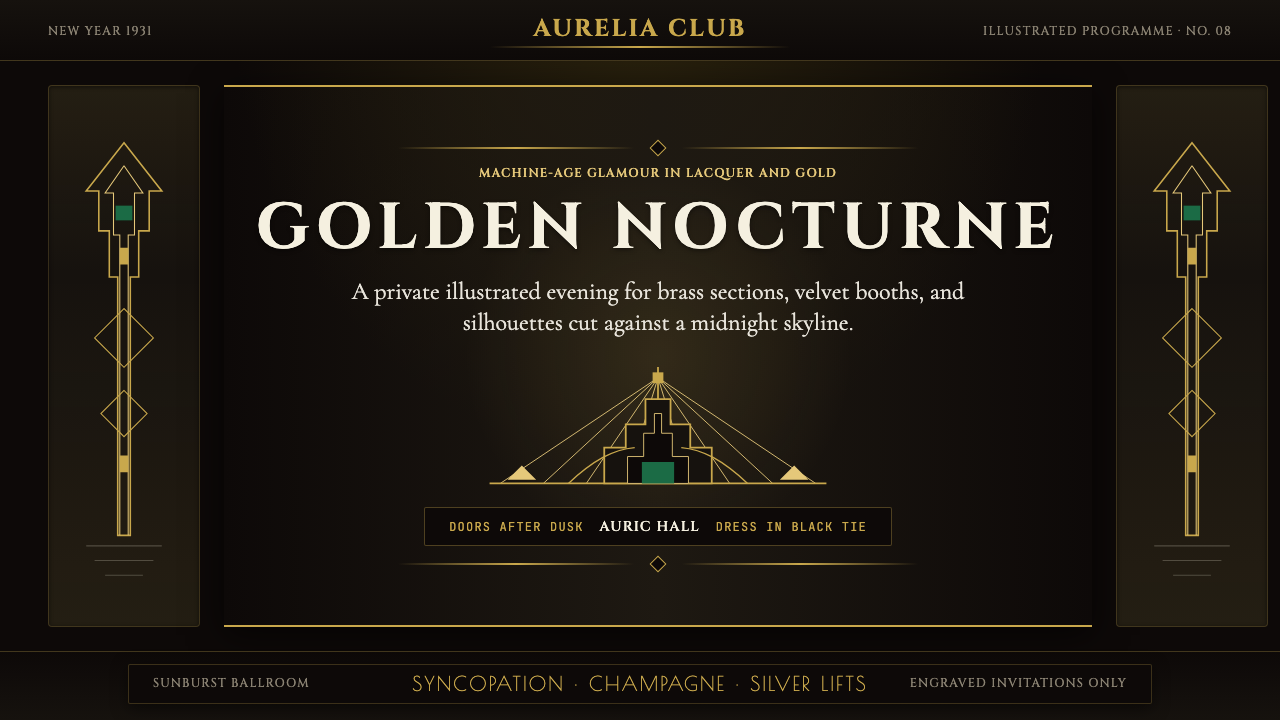
Art Deco is the visual grammar of the Jazz Age — a gilded collision of machine-age geometry and ancient ornament that turned the 1920s and 1930s into the most glamorous decade in the history of designed objects.
Art Deco Jazz Age in brief
Art Deco is a design movement that flourished between roughly 1920 and 1939, characterized by bold geometric symmetry, rich metallic palettes, and an unapologetic love of luxury. Unlike the reform movements that preceded it — Arts and Crafts, Jugendstil, Wiener Werkstätte — Deco did not position itself against the machine. It embraced industrial production and used it to manufacture opulence at scale: the Chrysler Building's stainless-steel crown, Cassandre's lithographed ocean liner posters, and the lacquered ebony dashboard of a Bugatti could all be considered expressions of the same aesthetic ambition.
Visually, Art Deco is instantly legible. Its signatures are sunburst rays radiating outward from a central point, stepped pyramid silhouettes borrowed from Mesoamerican and Egyptian architecture, chevron zigzag borders, and bilateral symmetry so precise it feels ceremonial. Color is unapologetically theatrical: warm gold against near-black grounds, jade green, oxblood red, and ivory — the palette of a Manhattan hotel lobby at midnight. Type is tall, geometric, and serif, set with wide letter-spacing and frequent uppercase transforms that give even ordinary labels the weight of engraved inscription.
The movement's fundamental tension — between handcraft glamour and machine production, between historical reference and modernist aspiration — is precisely what gives it its distinctive richness. Art Deco did not choose between the ancient and the new; it layered them. A Deco skyscraper might borrow the massing of an Egyptian ziggurat and finish it in machine-rolled stainless steel. That audacious synthesis, not any single motif, is the movement's deepest character.

Where does Art Deco Jazz Age come from?
The name Art Deco is a twentieth-century coinage, derived from the full title of the landmark 1925 exhibition in Paris: the Exposition Internationale des Arts Décoratifs et Industriels Modernes. But the style had been gestating for years before the exposition gave it a name. From around 1910, Parisian designers were already synthesizing the bold color palettes of Fauvism, the fractured geometric planes of Cubism, and the crisp silhouettes of the Ballets Russes costumes designed by Léon Bakst into something more decorative, more accessible, and more commercially viable than any of those avant-garde sources.
The 1922 opening of Tutankhamun's tomb by Howard Carter ignited an Egyptomania that ran through Deco's visual vocabulary for the rest of the decade: lotus-capital columns, scarab motifs, the stepped ziggurat form that appears everywhere from cigarette cases to skyscraper crowns. Alongside Egypt, designers drew on Aztec and Mayan pyramidal geometry, the symmetrical patterns of ancient Mesopotamia, and the lacquerwork of East Asian craft traditions. Deco was never a purist movement; it was an omnivorous synthesis that felt entirely of its moment precisely because the 1920s — with their jazz clubs, transatlantic airships, and Hollywood movie palaces — were themselves a culture of flamboyant collage.
The movement crossed the Atlantic with remarkable speed. By the late 1920s, New York had become as significant a center as Paris. The skyscraper race gave Deco its most monumental expression: William Van Alen's Chrysler Building (1930), with its seven radiating arches of stainless steel, was the movement's most photographed monument; the Empire State Building, Radio City Music Hall, and the lobbies of dozens of mid-Manhattan office towers completed the picture. Miami's South Beach district, developed intensively in the 1930s, applied the vocabulary to a gentler domestic scale — pastel-tinted apartment blocks with porthole windows and eyebrow moldings that softened the style's more imperial tendencies.
The Depression did not kill Art Deco immediately; it refined it. The streamlining movement of the early 1930s — led by industrial designers Raymond Loewy, Norman Bel Geddes, and Henry Dreyfuss — shaved away the more elaborate surface ornament and extended Deco's logic into product and transportation design. The bullet-shaped locomotives, aerodynamic radio cabinets, and chrome-trimmed domestic appliances of the mid-1930s represent a late Deco synthesis that remained dominant in American commercial design until the Second World War decisively reordered industrial priorities.
What defines the Art Deco Jazz Age look?
Color
The canonical Deco palette is built around metallic warmth against extreme dark grounds. Warm gold — the color of gilded elevator doors and engraved cigarette cases — anchors the system as its sole commanding accent. Deep, near-black backgrounds (not cool blue-black, but the warm black of lacquered ebony) give the gold maximum contrast and theatrical presence. Jade green, oxblood red, and ivory appear as secondary accents, evoking the jewel tones of vintage accessories: a green jade cufflink, the red enamel on a cocktail shaker. Pastels and earth tones are categorically absent — Deco's palette is metallic, jewel-like, and deliberate.
Typography
Deco typography treats the letterform as an architectural element. Display typefaces are tall geometric serifs with high contrast between thick strokes and hairline thins — the visual DNA of inscriptional Roman capitals filtered through Art Deco's love of precision and grandeur. Headlines are set wide, in uppercase, with generous letter-spacing that makes each title feel like a marquee or a carved fascia board. Body text, when it appears, is set in high-contrast old-style or Didone serifs that supply elegance without fussiness. The underlying logic is monumental: type should feel permanent, weighty, and worthy of the gold that surrounds it.
Geometry and Symmetry
Where Bauhaus used asymmetric tension to create dynamic balance, Art Deco insists on bilateral symmetry and vertical emphasis. Compositions are centered, formal, and ceremonial — the left side mirrors the right with the precision of a stage set. The dominant geometric motifs are the sunburst fan (radiating lines expanding outward from a central point), the stepped ziggurat (a form that reads simultaneously as pyramid, skyscraper silhouette, and crown), and the chevron zigzag (a pattern that implies movement and speed). These are not decorative afterthoughts; they are structural elements that organize space and signal luxury.
Materials and Surface
In the physical world, Art Deco is defined by its material palette: stainless steel, polished brass, lacquered ebony, Bakelite, terrazzo, and veined marble. Every surface is either highly polished or precisely matte — nothing is rough, organic, or ambiguous. In digital translation, this materialness becomes a contrast of layered opaque surfaces: near-black grounds with warm-charcoal card panels, separated by gold hairline borders. The visual metaphor is a Manhattan elevator interior — obsidian and brushed gold, hard reflective edges, no soft textures, no gradients. Depth is expressed through surface stacking rather than through shadow diffusion.
Motifs and Ornament
Art Deco is the only major twentieth-century style that fully embraced ornament as a structural — not merely decorative — component of design. Its ornamental vocabulary is precise and codified: sunburst ceiling rosettes, stepped-pyramid column capitals, chevron-bordered panels, fan-shaped balustrades, and stylized animal forms (leaping gazelles, coiled serpents, exotic birds) rendered in geometric silhouette. These motifs are used at multiple scales simultaneously — a chevron pattern might appear as a border on a poster, a tile arrangement on a lobby floor, and a metal grille on an elevator door in the same building. Deco's ornamental density is never chaotic because it is always governed by the same geometric logic.
Proportion and Verticality
Art Deco inherited the skyscraper's proportional logic and applied it everywhere. Elements are stretched vertically: letterforms are tall and narrow, column spacings are deep, and panels are portrait-oriented. This verticality is not merely compositional preference — it communicates aspiration, authority, and the forward momentum of the machine age. Even horizontal elements, like Cassandre's ocean liner posters, often use converging perspective lines that drive the eye toward a vanishing point on the horizon, creating a sense of upward or forward surge. Nothing in Art Deco sits comfortably at rest; everything leans into the future.
Light and Metallic Sheen
Deco's defining atmospheric quality is the warm, focused luminescence of metal in low light — gold leaf, polished brass, chrome — against a dark, absorptive ground. This is not the cool reflectivity of glass or the soft glow of ambient lighting; it is the hard, warm gleam of a surface that has been polished to a precise finish. In digital environments, this translates to a gold accent color used for focus rings, borders, active states, and hover effects — elements that 'catch light' against a near-black field. The interaction model should feel like running a finger along a gilded railing: immediate, physical, and just slightly warm.

Who shaped Art Deco Jazz Age?
The Ukrainian-born French poster artist Cassandre produced the movement's most iconic two-dimensional works between the late 1920s and mid-1930s. His ocean liner posters — Normandie (1935), L'Atlantique (1931), and others — compressed vast machines into bold geometric silhouettes viewed from extreme perspective, making speed and scale viscerally present on a flat surface. His design method was to identify the single most powerful visual truth about a subject and render it at maximum graphic intensity. As a typographer, Cassandre later designed the Bifur, Acier Noir, and Peignot typefaces, each extending Deco's geometric aesthetic into letterform.
The Polish-born painter Tamara de Lempicka became the movement's defining figurative artist, creating a body of portraiture that fused Post-Cubist geometry with an atmosphere of psychological cool and erotic intensity. Her figures — typically women in metallic fabrics, gloves, and sports cars — are painted with the same precision and surface quality as machine parts: smooth, hard-edged, and powerfully contoured. De Lempicka's work demonstrates that Art Deco was not merely a surface style but could carry genuine psychological weight. Her most celebrated painting, Auto-Portrait (Tamara in the Green Bugatti, 1929), remains the movement's most reproduced image.
As the architect of the Chrysler Building (completed 1930), William Van Alen gave Art Deco its most enduring three-dimensional monument. The building's crown — seven radiating arches of stainless steel, each punctuated by eagle gargoyles and triangular windows — was assembled in secret inside the building and raised in a single day to surpass the Bank of Manhattan's height and briefly claim the title of world's tallest structure. The gesture was Deco in spirit as well as form: theatrical, precisely engineered, and fundamentally about the drama of the reveal. The lobby, with its amber onyx walls, marble floors, and gilded murals, extends the exterior vocabulary into an interior of sustained luxury.
The Russian-born fashion illustrator and designer Erté defined the visual language of Jazz Age glamour through decades of Harper's Bazaar covers and stage costume designs that translated Art Deco's geometric vocabulary into the human figure. His characteristic style — elongated silhouettes, precise outlines, fan-shaped headdresses, and the use of negative space as an active compositional element — influenced not only fashion illustration but the broader visual grammar of Deco ornament. Erté's work represents the movement's most refined application of bilateral symmetry at a human scale.
The French-born American industrial designer Raymond Loewy represents the movement's evolution into streamlined modernity. Working through the 1930s and beyond, Loewy applied Deco's formal logic — symmetry, metallic surfaces, precise geometric profiling — to trains, automobiles, refrigerators, and corporate identities, extending the style's visual authority from architecture and fashion into the everyday industrial landscape. His Pennsylvania Railroad GG1 locomotive (1934) and Coldspot refrigerator are exemplary Deco-derived objects that demonstrate how the movement's glamour could be made functional and mass-producible without losing its essential character.
How do you use Art Deco Jazz Age today?
Art Deco translates into contemporary design work with unusual fidelity, because its visual rules are explicit and structural rather than merely atmospheric. The core commitment — gold on near-black, bilateral symmetry, geometric serif type, stepped ornamental motifs — produces recognizable results even when applied to formats that did not exist in the 1920s. The key is to treat it as a coherent system rather than a grab-bag of vintage motifs.
For presentation slides, Art Deco rewards a strong two-phase approach: the cover and section-title slides carry the full ornamental weight, while content slides work as clean dark-ground grids that let the gold accent do the work. A Deco cover should be centered, symmetrical, and typographically monumental — headline in a tall geometric serif, set large, uppercase, with wide letter-spacing. A thin gold hairline rule above and below the title is enough ornament for a content slide. For data slides, use the gold accent color for the active or highlighted series in charts, and keep all axes, gridlines, and supporting text in a muted warm gray. The result reads as purposefully theatrical without overwhelming the data.
For web UI — dashboards, pricing pages, and marketing landing pages — Deco's deep-black ground with gold accents creates an immediate premium signal. The practical approach: set the page background to a very dark warm black (not a flat neutral black — something with a slight brown undertone), use gold for primary buttons, focus rings, active navigation states, and decorative border accents, and set all body text in an ivory near-white. Cards and panels should be slightly warmer than the page ground — layered opaque surfaces rather than frosted glass. Avoid drop shadows with colored tint; use deep, diffuse neutral shadows that suggest depth without introducing color contamination. Pricing tiers benefit from a centered layout with stepped visual hierarchy: the recommended tier slightly larger, flanked by two equally-sized alternatives.
For editorial and marketing work — printed or digital — Deco justifies a heavier hand with ornament than most contemporary styles permit. Section dividers can use gold horizontal rules flanked by small diamond or chevron accents. Pull quotes benefit from being framed by stepped geometric borders. Cover imagery and feature photography should be treated with high contrast and warm color grading, emphasizing sharp contours and suppressing mid-tone softness. The underlying grid should be strong and symmetrical; a centered single column for body text, with wider margins for metadata or captions, produces Deco's characteristic proportional gravity.
The most common mistake when applying Art Deco is confusing ornamental richness with ornamental quantity. Authentic Deco work is dense but disciplined: every motif is geometrically precise, consistently scaled, and placed according to a clear structural logic. The failure mode is decorative chaos — chevrons, sunbursts, and gold lines scattered without organizational intent, producing an effect closer to a Halloween party than a Manhattan lobby. A second common error is temperature drift: using a cold, blue-tinted black rather than a warm near-black, or choosing a bright lemon gold rather than a warm amber gold. The entire palette depends on warmth; a single cool element can dissolve the period atmosphere entirely.

Art Deco Jazz Age — FAQ
What is the difference between Art Deco and Art Nouveau?
Art Nouveau (roughly 1890–1910) and Art Deco (roughly 1920–1939) are often confused because they are sequential decorative movements that both drew on historical and exotic sources. But their formal values are nearly opposite. Art Nouveau is characterized by sinuous, organic curves derived from plant and animal forms — tendrils, lily petals, dragonfly wings — and a soft, flowing line quality. Art Deco is rectilinear, geometric, and hard-edged, with ornament derived from machine forms, ancient architecture, and crystalline structure rather than nature. Art Nouveau looked backward to a craft ideal; Art Deco looked sideways at the machine and forward toward modernity. When you see a curved, flowing decorative border, that is Art Nouveau. When you see a stepped ziggurat or a sunburst of straight radiating lines, that is Art Deco.
Can Art Deco work in a light-background digital design?
Yes, but with significant adjustments. The canonical Deco palette is dark-ground because the movement's material language — polished metal against lacquered ebony — depends on the contrast of luminous metal against a dark absorptive surface. On a light ground, gold reads as brown or mustard rather than as metal, which undermines the whole atmospheric premise. A viable light-ground Deco variant works best with a warm ivory or aged-parchment background (never pure white), black or very dark brown as the structural color, and gold used only at borders, dividers, and emphasis points rather than as a broad fill. The ornamental vocabulary — sunbursts, stepped motifs, chevrons — transfers well regardless of ground color, and geometric serif type retains its Deco character in any palette.
How should I handle gold in digital design — which format is most faithful?
Screens cannot reproduce the reflective warmth of physical gold leaf or polished brass, but they can approximate it. The key is warmth and saturation: a desaturated or too-bright gold reads as yellow, while a too-dark gold reads as brown. A hue in the amber-gold range — roughly 40–45° on the HSL wheel, saturation 50–60%, lightness 50–60% — reads credibly as gold on a dark background. Avoid pure lemon yellow and its relatives, which skew too bright and modern. CSS gradients can simulate the directional luminescence of metal: a subtle linear gradient from a slightly lighter gold tone at the top to a slightly darker one at the bottom on a button or card border will read as more physically present than a flat fill. Gold-tinted box shadows and focus rings — a soft glow in a translucent warm amber — are the digital equivalent of a warm highlight catching the edge of a brass fitting.
Is Art Deco appropriate for digital products outside luxury branding?
The style is most naturally at home in contexts where the audience expects a sense of occasion: luxury e-commerce, hospitality and events, entertainment and nightlife, editorial publishing, and portfolios for architects, jewelers, and fashion designers. But it can work outside those categories when the intention is clear. A fintech app targeting high-net-worth users can deploy a restrained Deco vocabulary — dark ground, gold accents, geometric serif numerals — to signal premium positioning without pastiche. A music streaming service focused on jazz or classic Hollywood could use Deco consistently as an identity system. Where the style tends to fail is in mass-market consumer products, children's applications, wellness and health contexts, and anywhere that the user experience requires warmth, softness, and approachability. Art Deco is magnificent but it is not warm, and that limit is as much an asset as a liability.
What distinguishes authentic Art Deco from a nostalgic pastiche?
The difference lies in structural commitment versus surface decoration. Pastiche borrows the ornamental vocabulary — zigzags, sunbursts, gold trim — and applies it to a layout that has no underlying Deco logic: an asymmetric web layout with rounded cards, soft shadows, and a pastel palette with a gold border stuck on top. Authentic Deco design is governed by the system first: the bilateral symmetry, the vertical emphasis, the dark metallic ground, and the spare geometric type precede the ornament and give it meaning. The sunburst over a Deco doorway is not decoration applied to a building; it is the expression of the building's proportional logic at a human scale. When in doubt, strip the ornament away and ask whether the underlying composition, palette, and type still read as Deco. If they do not, the ornament is carrying too much weight.
Related design styles
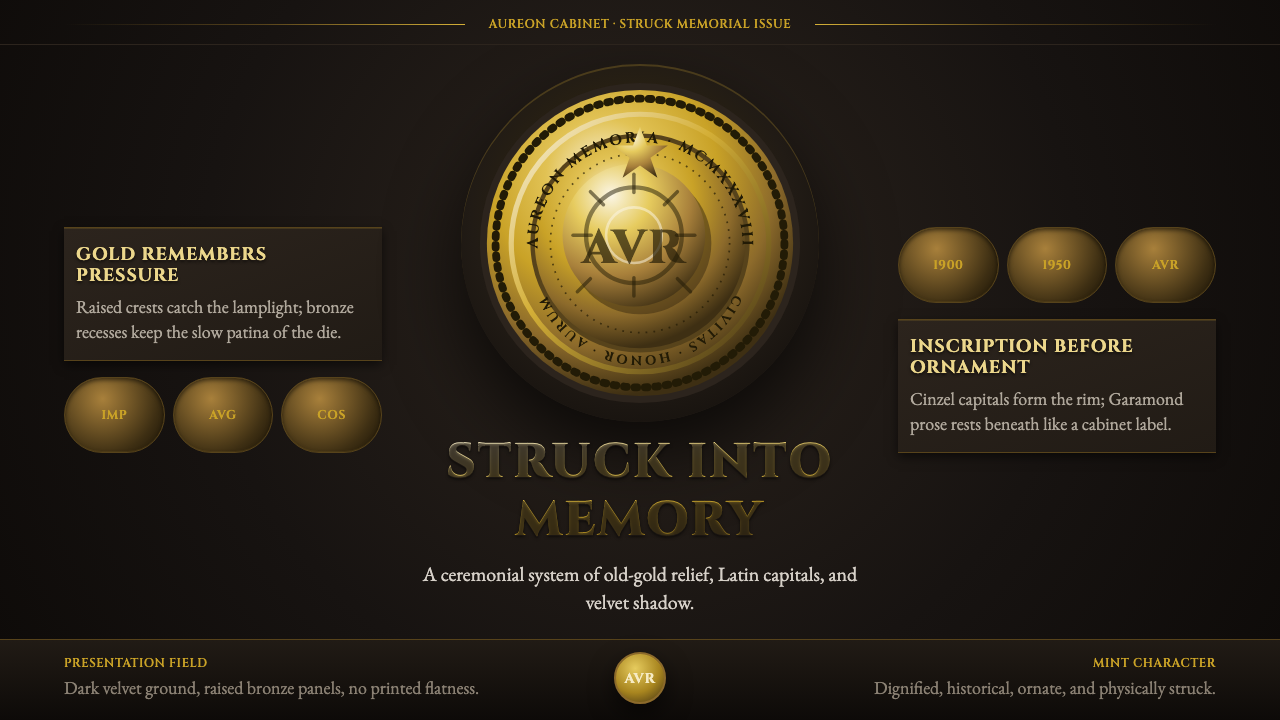 Commemorative CoinAuthority struck in metal. Old-gold relief, denticled rims, and Cinzel capita…
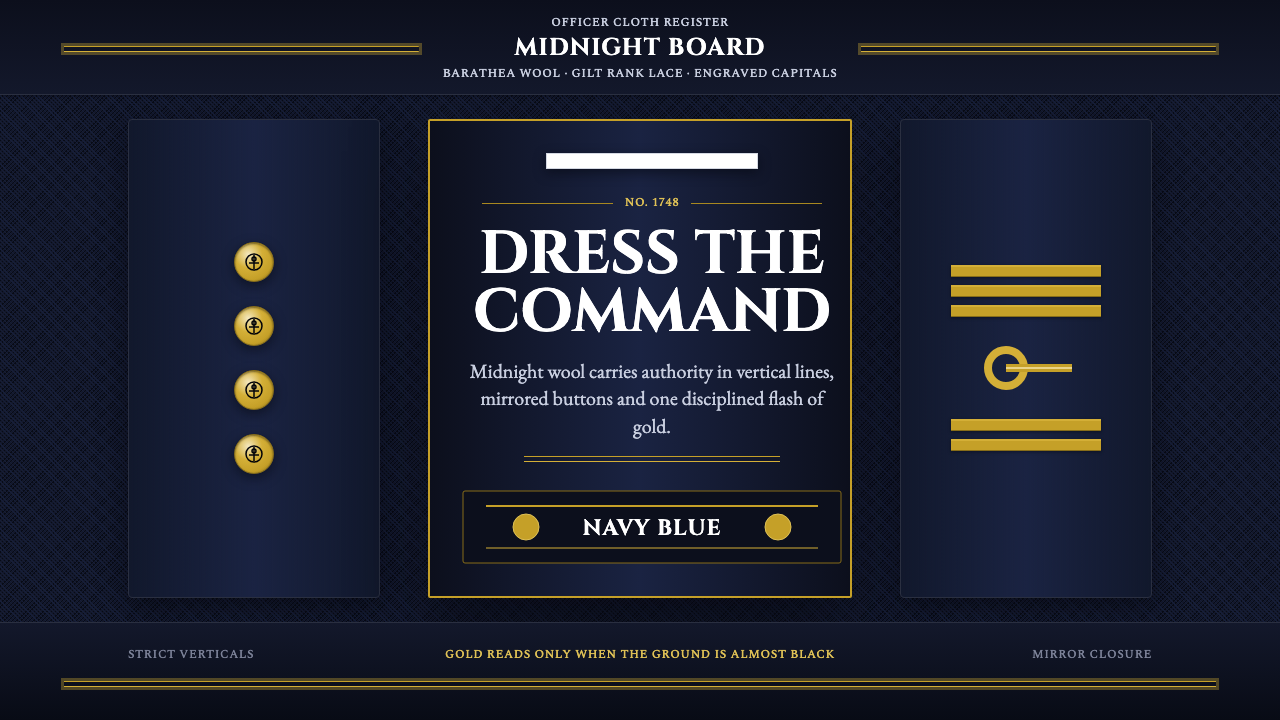 Naval Dress UniformAuthority in midnight wool. Cinzel capitals, gold lace and button symmetry ho…
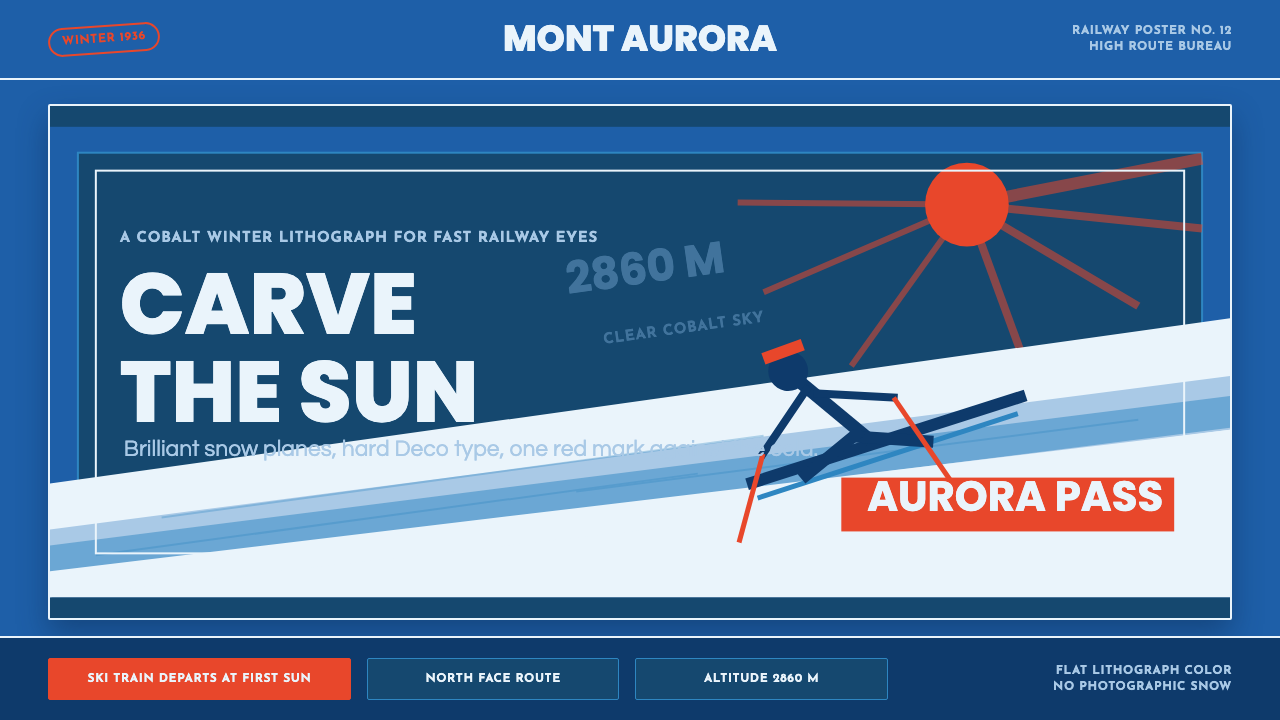 Alpine Ski PosterCold speed sells winter. Cobalt sky, snow planes, sun rays, and one resort-re…
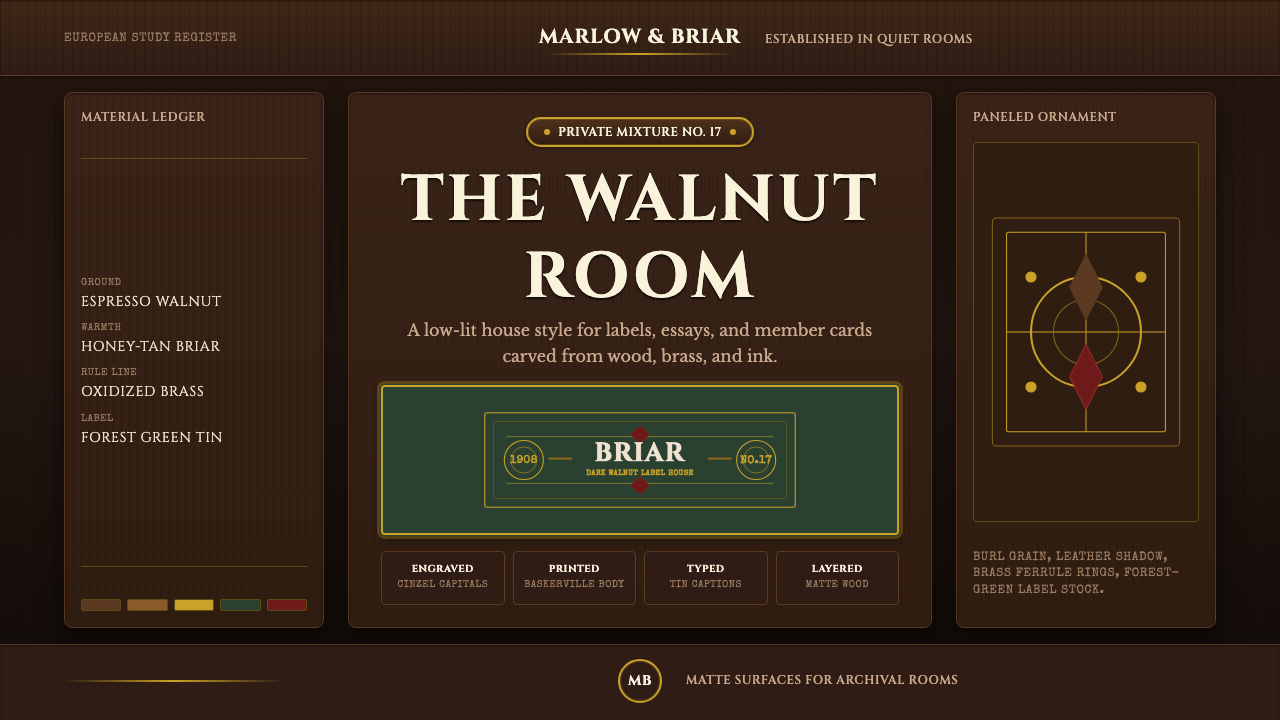 Briar Pipe & TobaccoWarm gloom, precisely aged. Brass rules and Cinzel capitals sit on espresso w…
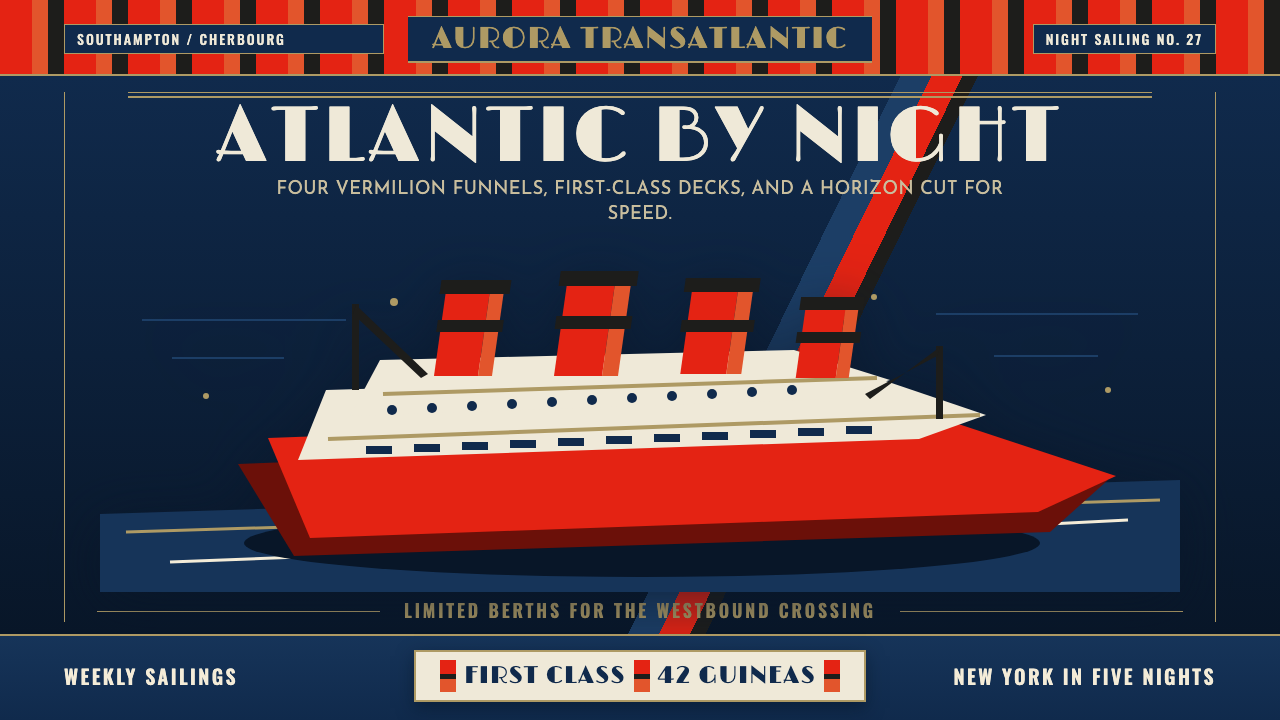 Cunard Liner PosterOceanic grandeur. Vermilion funnels, teak-gold caps, and a marine-blue poster…
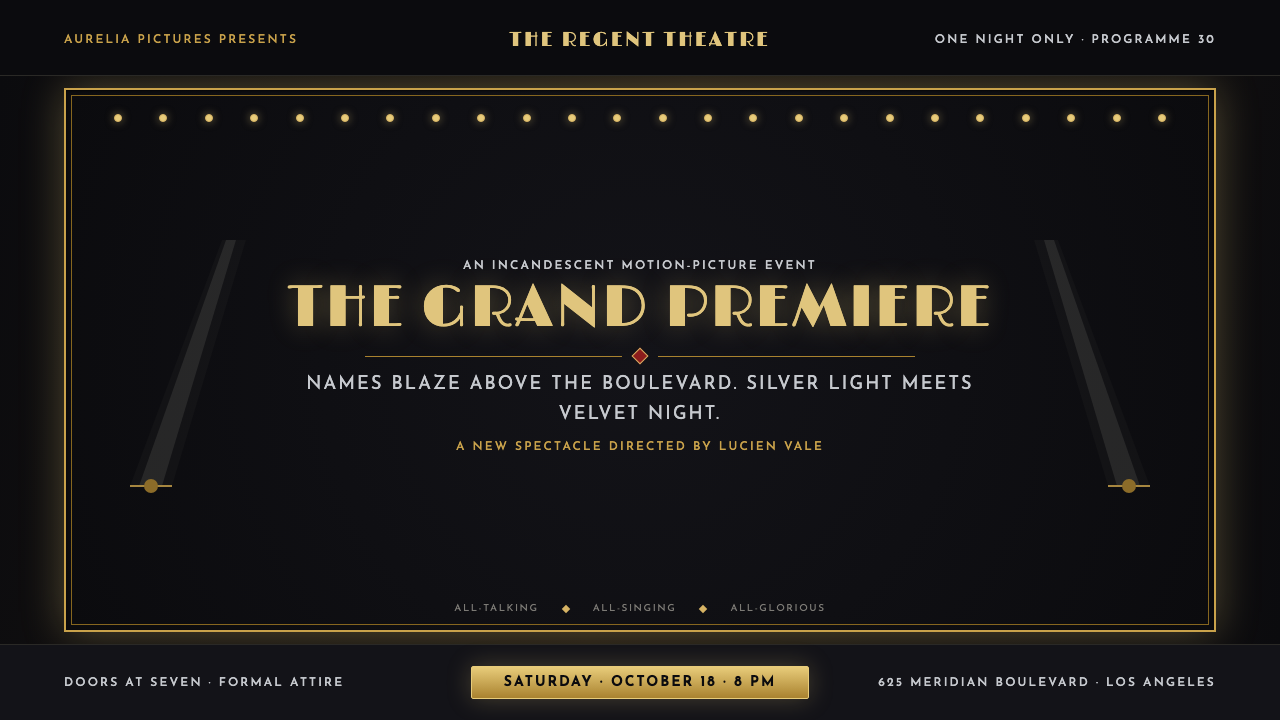 Hollywood Golden Age (1930)Black-and-gold spectacle commands the night. Marquee bulbs frame monumental D…