What is Met Gala?
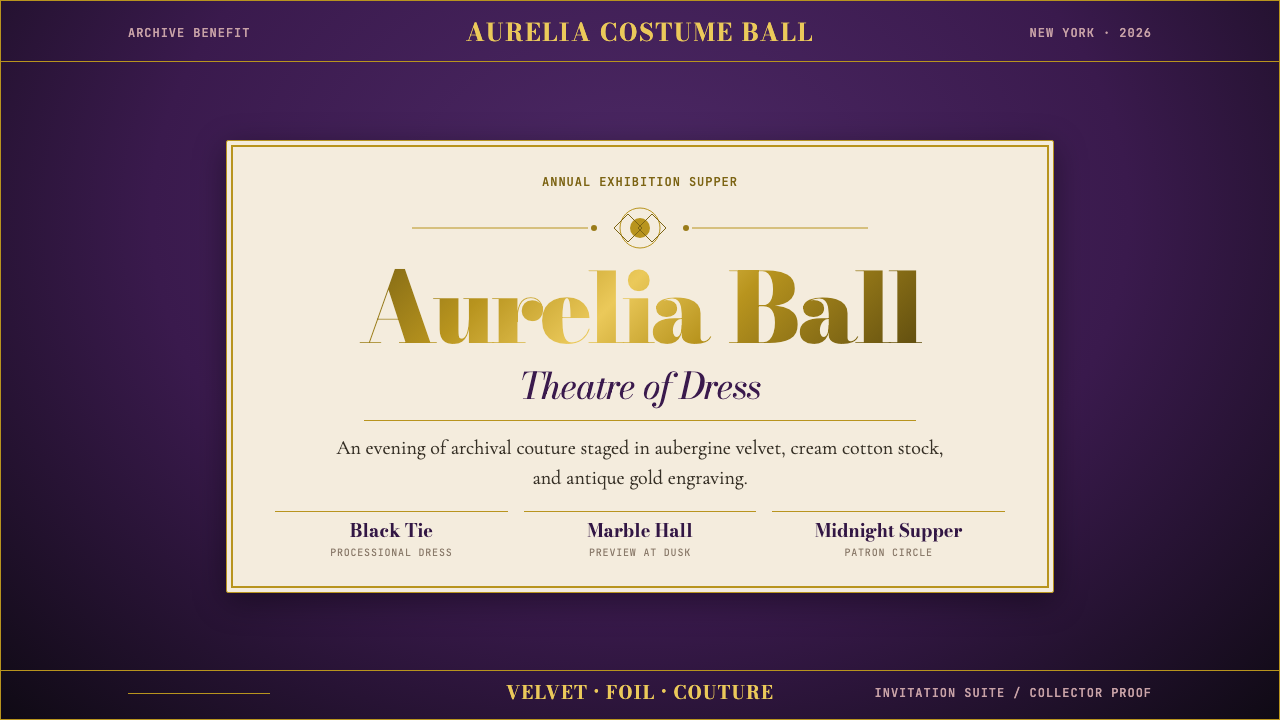
The Met Gala dresses fashion in the authority of a museum — deep velvet backdrops, gold-foil ceremony, and couture photography treated like canonical art.
Met Gala in brief
The Met Gala design language is what happens when haute-couture editorial collides with museum exhibition catalog sensibility. Its visual identity is built on a foundation of deep, saturated jewel tones — aubergine, midnight, and richly darkened gold — combined with the typographic formality of high-contrast Didone serifs. The result is a style that reads simultaneously as archival and theatrical: reverential enough to belong in a glass case, dramatic enough to stop a red carpet cold.
At its core, the aesthetic operates on ceremonial contrast. Dark, heavy backgrounds assert gravitas; against them, gold foil, cream paper stock, and full-bleed couture imagery gain extraordinary luminosity. Text is set in centered, symmetrical compositions that echo the traditions of official proclamations and exhibition placards. Every layout decision communicates that what is being shown belongs to the category of the important — that the viewer is in the presence of something consecrated.
Unlike streetwear or tech-forward design languages that court informality, the Met Gala aesthetic actively cultivates distance. It does not invite the eye to linger casually; it commands attendance. This makes it one of the few contemporary design registers that draws equally from nineteenth-century engraving traditions and the controlled spectacle of twenty-first-century luxury fashion photography.

Where does Met Gala come from?
The Metropolitan Museum of Art's Costume Institute Benefit — commonly known as the Met Gala — was founded in 1948 by fashion publicist Eleanor Lambert, the same figure who created the International Best Dressed List. Lambert's original event was a modest midnight supper designed to raise funds for what was then a struggling department of the museum. The visual identity of these early decades was understated and conventional, reflecting the philanthropic formality typical of mid-century New York society fundraisers rather than any distinct aesthetic ambition.
The transformation of the event into a genuine visual spectacle began gradually during the 1970s and accelerated when Vogue editor-in-chief Anna Wintour assumed the chairmanship in 1995. Wintour brought with her the full apparatus of Vogue's editorial and production apparatus: the relationships with couture houses, the authority to shape the guest list as a deliberate aesthetic statement, and — crucially — the understanding that a gala's visual identity extends far beyond the evening itself into the photographic record it produces. Under her direction, the event's graphic identity began to borrow from exhibition catalog design, developing the characteristic language of Didone serifs, symmetrical centered compositions, and gold-foil printing that now defines the Met Gala look.
The Costume Institute's exhibition themes have played a central role in shaping the design language over time. Each year, the gala's visual materials — invitations, programs, backdrop treatments, press photography environments — are designed to serve as an extension of the accompanying exhibition. Landmark exhibitions such as 'China: Through the Looking Glass' (2015), 'Heavenly Bodies: Fashion and the Catholic Imagination' (2018), and 'In America: A Lexicon of Fashion' (2021) generated distinct visual treatments that nevertheless adhered to the same ceremonial grammar: dark ground, gold accent, museum authority, couture scale.
The visual figures most responsible for shaping the contemporary Met Gala identity include Costume Institute curator Andrew Bolton, whose scholarly exhibition concepts define the thematic frame each year; makeup artist Pat McGrath, whose work on the models and celebrities photographed in Met Gala editorial contexts has established a visual register of extreme, sculptural beauty that the style's photography must contain; and photographer Sølve Sundsbø, among others who have contributed to the high-contrast, dramatically lit couture imagery that the event's press materials rely upon. Together, these collaborators have produced a visual standard that individual years' design executions must aspire to meet.
What defines the Met Gala look?
Color Palette
The Met Gala palette is anchored in deep jewel tones that signal luxury and institutional weight. Aubergine — a dark, blue-leaning purple with the richness of velvet — functions as the signature ground color. Against it, antique gold operates not as a bright accent but as a warm, burnished presence reminiscent of metal type and engraved invitations. Cream appears in text fields and paper-stock evocations, providing the sole lightness in an otherwise heavily saturated palette. This combination creates the impression of a formal document issued under candlelight — precious, weighted, and deliberate.
Typography
High-contrast Didone serifs — characterized by an extreme difference between thick vertical strokes and almost hairline-thin horizontal ones — are the typographic backbone of the Met Gala visual identity. These letterforms carry centuries of associations with proclamations, title pages, and the formal apparatus of European cultural institutions. Type is set in centered arrangements with generous letter-spacing that slows the eye and forces deliberate reading. Capitals used at headline scale suggest monumental inscriptions; smaller text in tightly set lines evokes the captions and footnotes of scholarly catalogs. Italic variants appear sparingly and with great effect, as though marking an exception to a rule.
Composition and Symmetry
Where Bauhaus embraced asymmetric tension, the Met Gala aesthetic reaches for classical, centered symmetry. Compositions are organized along a central vertical axis: headline above image above caption, or image flanked by equal margins of ground color. This symmetry is not the static equality of indifference but the deliberate balance of ceremony — the way a triumphal arch or a stage is arranged to frame what passes through it. Even full-bleed couture photography, when integrated into the layout system, is anchored to this central gravitational pull.
Photography Treatment
Couture photography within the Met Gala aesthetic is treated with museum-wall reverence: single images given extraordinary scale, framed by substantial borders of dark ground color, lit with theatrical directional light that separates subject from background. The photographic subjects — garments, details of construction, portraits of wearers — are rendered with the same degree of attention given to documentary photographs of sculpture or painting. Close-cropped details of embroidery, beading, or structural construction appear as their own compositions, valued for their formal properties as much as their fashion content.
Gold and Foil Accent
Gold in the Met Gala aesthetic is never the bright, clean gold of contemporary luxury branding — it is antique, burnished, and slightly muted, the color of old metal type or the gilded capitals in an illuminated manuscript. It appears on invitations as literal foil embossing, in layouts as decorative rules and frames, and in editorial photography as the metallic surfaces of garments and accessories. This particular quality of gold functions as a historical signal: it connects the contemporary event to the long tradition of official ceremony and European courtly elegance that the Costume Institute's exhibitions frequently excavate.
Scale and Gravitas
The Met Gala aesthetic consistently operates at a scale larger than comfortable reading distance implies — invitations feel weighty in the hand, printed programs have the heft of art catalogs, backdrops dwarf their subjects. This insistence on physical scale is not incidental; it is a legible argument that the occasion is of historic consequence. In digital and print layouts, this translates to generous white space (or dark space) around key elements, type that is never crowded, and a layout rhythm that breathes slowly rather than rapidly scanning.
Ceremonial Restraint
Despite the theatrical intensity of the event itself, the graphic identity is conspicuously restrained. There are no gradients, no busy patterns competing with imagery, no playful illustration that undercuts the seriousness of tone. Decorative elements, when present — thin ruled lines, simple geometric frames, engraved ornamental borders — are drawn from the vocabulary of formal print culture rather than contemporary graphic design trends. This restraint is itself a form of communication: it signals that the subject matter is serious enough to require no embellishment.

Who shaped Met Gala?
As chairwoman of the Met Gala since 1995, Wintour has been the single most consequential figure in shaping the event's contemporary visual identity and cultural authority. Her background as editor-in-chief of American Vogue brought the full editorial and production infrastructure of fashion's most influential publication to bear on the gala's execution. Under her direction, the guest list became as deliberate a design decision as the invitation's typography, and the event's photographic output — distributed globally through Vogue's channels — established the visual standard that the design language must serve. Wintour's collaboration with the Metropolitan Museum's curatorial team transformed a philanthropy dinner into an annual exhibition of what the Costume Institute's themes could generate as lived, dressed spectacle.
As curator in chief of the Costume Institute since 2006, Bolton is the scholarly intelligence behind each year's exhibition concept and, by extension, each year's visual theme. His exhibitions — which have ranged from China's influence on Western fashion to Alexander McQueen's savage beauty to the complex relationship between fashion and religious iconography — consistently frame clothing as a subject worthy of the same curatorial depth applied to painting or sculpture. Bolton's influence on the Met Gala design language is structural: he defines the intellectual territory the visual identity must inhabit, ensuring that the aesthetic registers as genuine scholarship rather than styled spectacle.
McGrath's work as a makeup artist — most visibly in editorial and runway contexts that feed directly into the Met Gala's visual ecosystem — has established a particular register of beauty that the event's aesthetic now requires: monumental, sculptural, color-saturated, and operating at a scale legible in a full-page photograph. Her collaborations with nearly every significant fashion house, combined with her role in defining the beauty looks that accompany each year's theme, make her as much a contributor to the event's visual grammar as any graphic designer. McGrath's work insists that the human face and body are design surfaces as consequential as any typographic choice.
The Norwegian fashion photographer Sundsbø has contributed substantially to the high-contrast, dramatically lit visual vocabulary that the Met Gala's editorial output relies upon. His work is characterized by extreme control of light, a preference for black or very dark grounds, and the transformation of garments into almost sculptural presences through lighting choices that flatten texture while emphasizing form. Sundsbø's images — appearing regularly in Vogue and aligned publications in the context of Met Gala coverage — have helped cement the photographic conventions that the event's graphic identity both reflects and reinforces.
Lambert founded the event in 1948 and served as its guiding force for several decades before Wintour's assumption of the chairmanship. As the publicist who also created the International Best Dressed List and co-founded New York Fashion Week, Lambert understood fashion as a system that required its own institutional infrastructure and its own formal occasions. Her founding of the Costume Institute Benefit established the template — a dinner that doubles as a cultural statement — that Wintour would later amplify into a global visual event. Lambert's instinct that fashion deserved the ceremonial gravitas typically reserved for fine art created the conceptual ground on which the entire Met Gala aesthetic rests.
How do you use Met Gala today?
The Met Gala aesthetic is one of the most legible signals available to designers working on projects that must communicate luxury, cultural authority, and ceremonial significance. Its visual grammar — dark grounds, antique gold, Didone serifs, centered symmetry, high-contrast couture photography — translates cleanly to both print and digital contexts when the underlying design values are understood rather than merely borrowed. Applying it correctly means understanding what the system communicates: that the content is important, that the occasion is formal, and that the viewer is expected to attend with deliberate attention.
For presentation slides, the Met Gala aesthetic excels in contexts where the presentation is itself an event — a keynote for a luxury or cultural institution, a creative brief for a fashion or editorial client, or a pitch document that must establish authority before a single word is spoken. A cover slide benefits from a dark, jewel-toned ground with a large-scale centered title in a high-contrast serif, flanked by thin ruled lines or a simple rectangular frame. Content slides work best when they resist the temptation to crowd information: one key idea per slide, generously spaced, with any supporting photography treated at large scale and given meaningful dark-ground borders. Data slides should translate charts and tables into compositions that feel as considered as the rest of the deck — use the gold accent for emphasis sparingly, reserve the aubergine ground for aggregate or summary views, and avoid decorative chart elements that compete with the information's own visual weight.
For web interfaces, the Met Gala style is best suited to landing pages, event microsites, and editorial-style product pages for high-end fashion, jewelry, or cultural institution platforms. A dark ground with gold and cream type establishes immediate authority; the layout should feel spacious rather than information-dense, with navigation elements kept to a typographic minimum. Full-bleed hero photography, when used, should occupy genuine visual scale rather than being cropped into a standard card or banner format. Dashboard and pricing applications are less natural fits for the style — its ceremonial gravity resists the utilitarian clarity those contexts require — but premium tier differentiations within a pricing structure can borrow the gold accent and Didone serif for their highest tier labels.
For editorial and marketing work, the Met Gala style supports content that positions itself as culturally significant rather than merely commercially available. A print editorial layout in this register uses wide margins, a single carefully chosen image per spread, and typography that insists on being read rather than scanned. Marketing campaigns for fashion houses, cultural institutions, and luxury lifestyle brands translate the style into environmental and digital contexts by maintaining the dark-ground, gold-accent ratio and resisting the addition of any element that would read as casual or approachable. Invitations, event programs, and press materials are perhaps the most natural home for the style: the physical weight of the paper, the foil finish, and the engraving-evocative typography combine into an object that communicates value before its content is read.
The most common mistake when applying the Met Gala aesthetic is treating it as a dark-mode luxury template — simply inverting a standard layout to a dark background and adding a gold color — rather than as a system built on specific relationships between typographic formality, photographic scale, and ceremonial composition. Applied without understanding, the result often feels heavy without feeling authoritative, theatrical without feeling considered. A second common error is distributing the gold accent too liberally: in authentic applications, gold is used at the same restraint as a museum label — it marks, it does not decorate. A third pitfall is using contemporary sans-serif typefaces, which break the historical continuity that the Didone serif provides; the formal register of the style depends on type that carries institutional memory, not type that signals modernity.

Met Gala — FAQ
Is the Met Gala aesthetic appropriate for tech or startup products?
Rarely, and only in very specific contexts. The Met Gala visual language communicates institutional age, ceremonial formality, and cultural authority — values that work against the expectations of most technology products, which signal accessibility, speed, and forward momentum. The exception is in luxury or high-end positioning within technology: a fintech product targeting ultra-high-net-worth users, a heritage fashion platform, or a cultural institution's digital experience might borrow elements of the language selectively. In those cases, the dark ground and Didone serif can establish premium differentiation, but the full ceremonial grammar — centered composition, restricted palette, gold-foil restraint — should be applied with care, since it may communicate exclusivity at the expense of usability clarity.
How do you maintain the Met Gala aesthetic in a light or white-ground version?
A light-ground version of the Met Gala aesthetic is possible but requires deliberate inversion. The cream or ivory ground — rather than pure white — preserves the warmth that the style depends on; pure white can feel clinical and undermine the archival quality. On a light ground, the Didone serif in deep charcoal or black retains its typographic authority, and gold transitions from a luminous accent against darkness to a more literal metallic presence — appearing in decorative rules, frames, and the occasional display headline. Aubergine can function as a deep accent in this version. The critical requirement is that the typography and composition remain formally centered and deliberate; it is the typographic structure, not only the dark ground, that communicates the style's ceremonial intention.
What distinguishes the Met Gala aesthetic from general luxury branding?
General luxury branding tends toward minimalism — light grounds, generous white space, restrained sans-serif or geometric serif typefaces, and the communication of quality through absence and refinement. The Met Gala aesthetic is luxury operating in a different register: it is theatrical and institutional rather than quietly confident. Where luxury branding whispers, the Met Gala style announces. The deep, saturated ground colors, the high-contrast Didone typography, the gold-foil formalism, and the centered ceremonial composition are all signals of cultural authority rather than commercial exclusivity. A useful distinction: the Met Gala aesthetic would look at home in a museum catalog; contemporary luxury branding would look at home in an architect's monograph. Both communicate quality, but through fundamentally different vocabularies.
Can the Met Gala aesthetic accommodate playful or thematic variations without losing its identity?
Yes, and this is precisely what the annual theme structure demonstrates. Each year, the visual materials serve a different exhibition theme — from maximalist Chinese embroidery to stark American denim to elaborate Catholic iconography — while maintaining the same foundational grammar of dark grounds, formal typography, and gold-foil ceremony. The lesson for designers is that the style's identity resides in its structural commitments, not in any single palette or imagery choice. A playful or culturally specific variation can be introduced through the imagery, the choice of accent color within the dark-jewel-tone register, or the specific decorative vocabulary of the borders and frames — but the typographic formality, the centered composition, and the ceremonial scale must remain intact. When those structural elements are compromised, the result is thematic variation without identity.
How does the Met Gala aesthetic handle motion and animation?
Motion within the Met Gala aesthetic should be slow, deliberate, and gravitational — matching the ceremonial cadence of the static style. Appropriate motion treatments include slow reveals where dark grounds part to disclose couture imagery (as though a curtain opening or a vitrine being illuminated), type that appears letter-by-letter at a pace that insists on being watched rather than skimmed, and gold-accent elements that emerge with a brief, controlled shimmer suggesting foil catching light. What the style resists is kinetic energy for its own sake: rapid transitions, bouncy easings, scroll-triggered animations that prioritize engagement metrics over ceremonial intention. The guiding test for any motion decision is whether it would look at home in the opening sequence of a museum documentary — considered, unhurried, and aware of its own gravity.
Related design styles
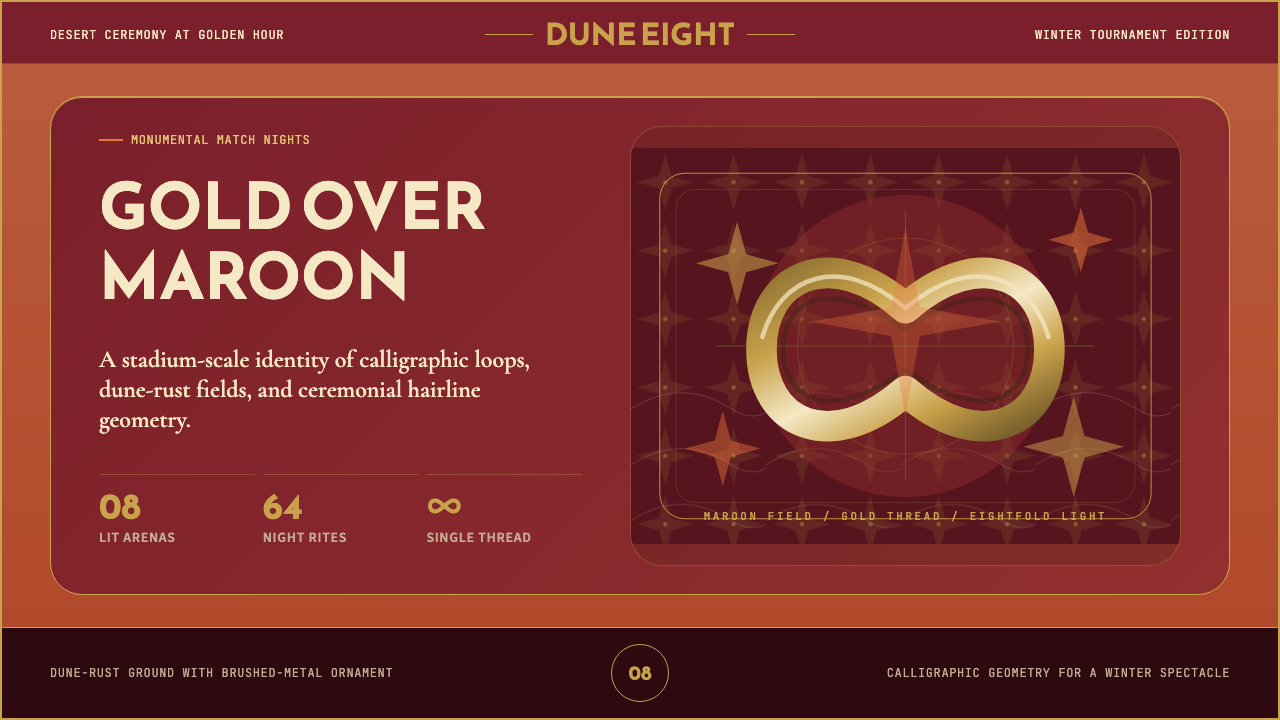 Qatar World Cup 2022Desert spectacle in gold. Maroon fields, Reem Kufi scale, and eightfold star…
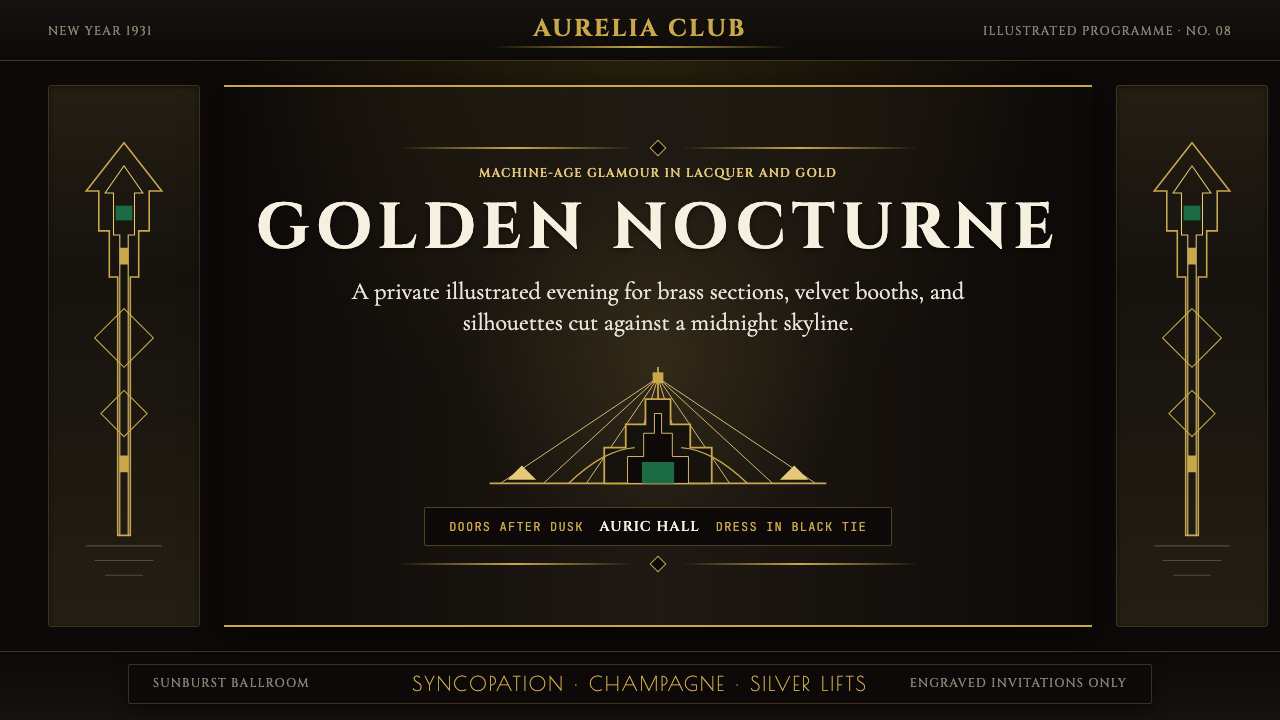 Art Deco Jazz AgeJazz Age glamour. Sunburst rays, stepped ziggurats, gold on black — Chrysler…
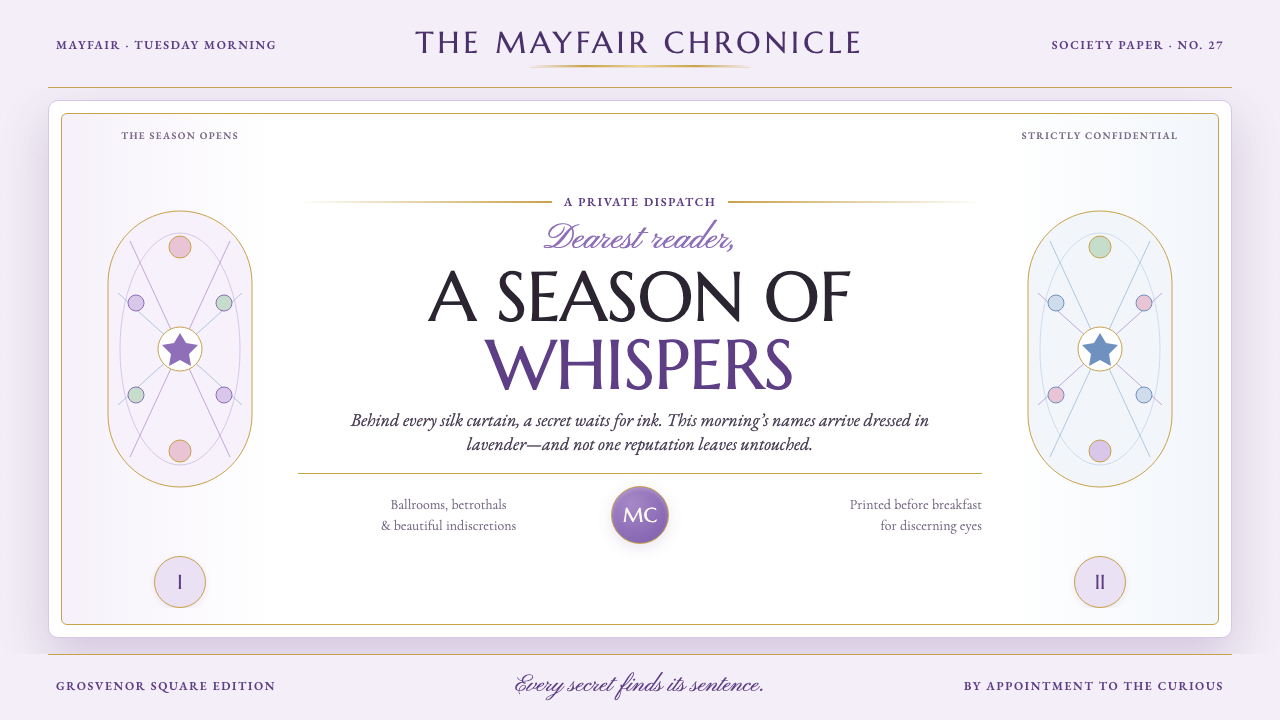 Bridgerton Regency (2020)Scandal wears lavender. Wisteria pastels and gilt rules frame a sharp letterp…
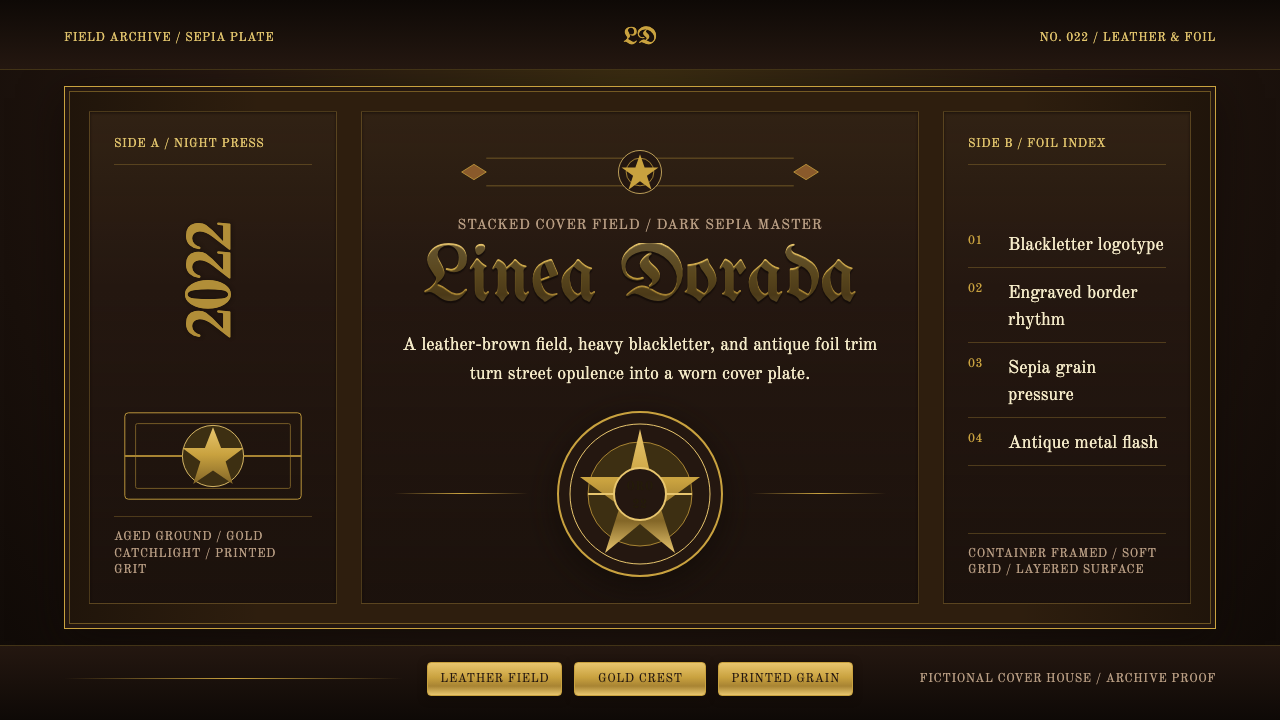 Corridos TumbadosOpulence with dust on it. Sepia leather, blackletter, and antique-gold foil f…
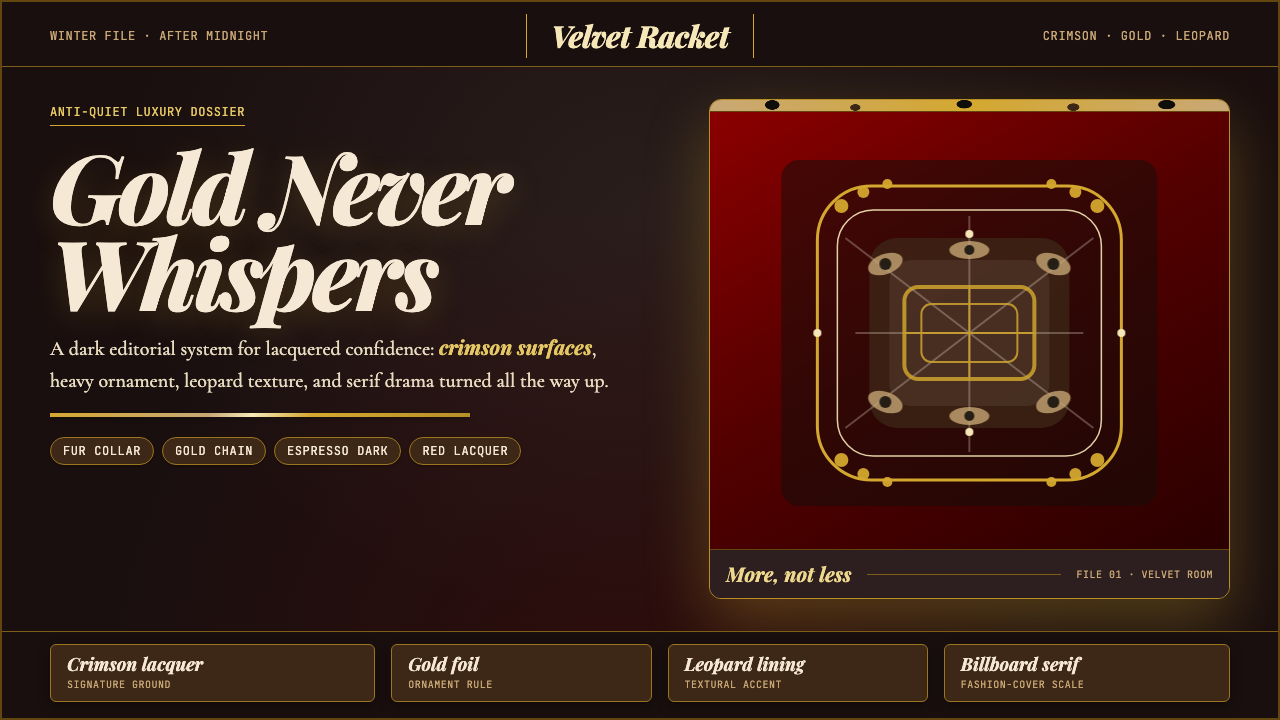 Mob Wife AestheticGlamour refuses restraint. Crimson lacquer, gold foil, leopard texture, billb…
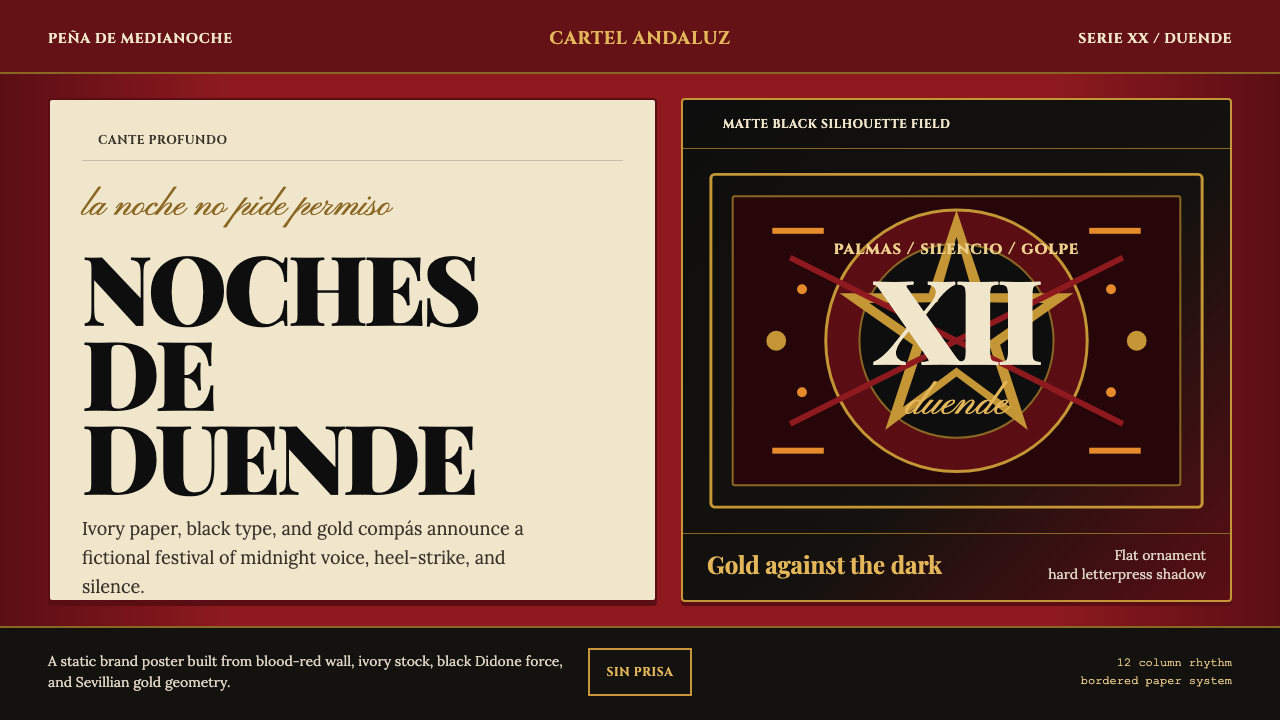 Spanish Flamenco PosterPassion printed as ritual. Blood red, ivory paper, Didone type, and flat gold…