What is Spanish Flamenco Poster?
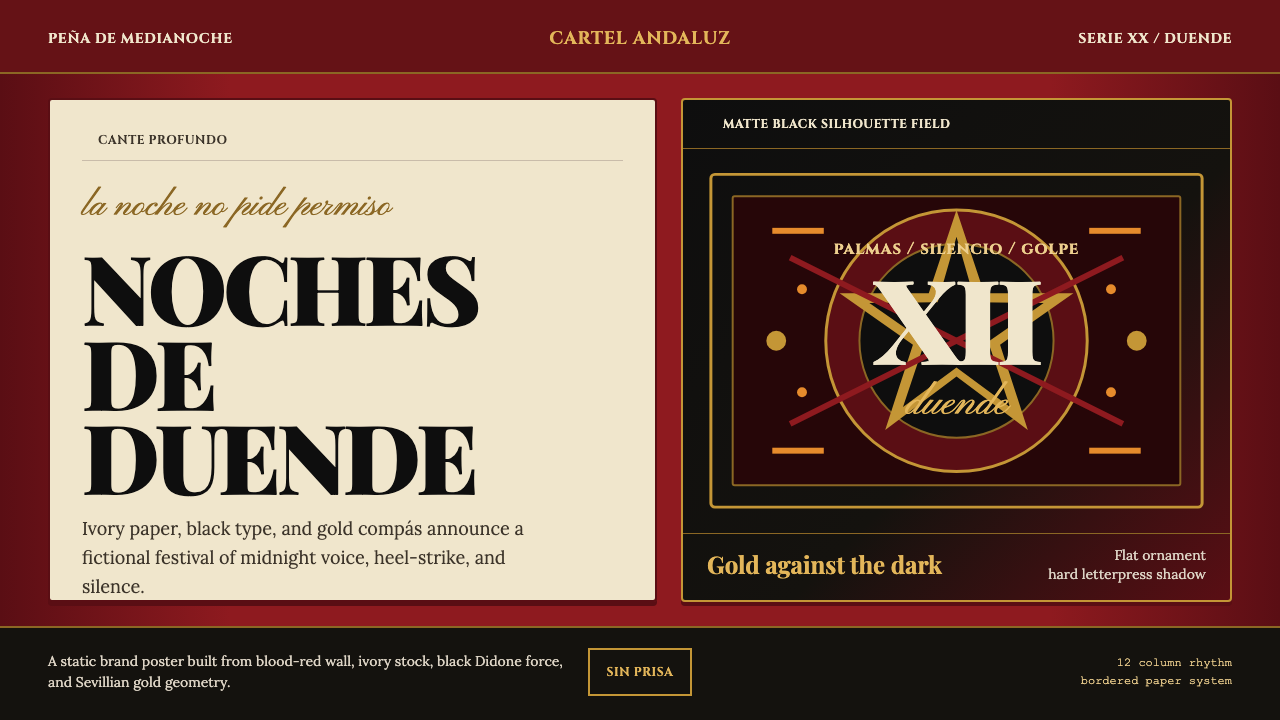
Spanish Flamenco Poster distills a century of Andalusian festival graphics into a visual language of raw passion — blood-red walls, matte silhouettes, ivory letterpress paper, and the electric tension of duende made visible.
Spanish Flamenco Poster in brief
Spanish Flamenco Poster is a design system rooted in the visual culture of Andalusian festival promotion — the printed matter that has announced cante jondo performances, Semana Santa processions, and the world-famous Bienal de Sevilla from the late nineteenth century through the present. It is not a single designer's invention but a collective visual tradition refined over generations of festival printers, bullfighting promoters, and flamenco impresarios working in Seville, Jerez de la Frontera, Madrid, and Granada.
The aesthetic is built around several irreducible contrasts. A deep blood-red — the color of Andalusian plaster walls, of corrida capes, of passion itself — anchors the composition against ivory or cream stock that speaks of aged letterpress paper and candlelit peña walls. Against this ground, dense black silhouettes of dancers, guitarists, and cantaores assert themselves with the flat, graphic authority of woodcut prints. Gold accents — derived from the gilded balcony ironwork and altar ornament of Andalusian baroque architecture — provide the only warmth in an otherwise confrontational palette.
The system carries the spirit of Federico García Lorca's concept of duende: that mysterious force, half ecstasy and half anguish, which distinguishes a performance that merely happens from one that truly lives. In design terms, duende translates to controlled tension — the feeling that the composition is barely containing its own energy, that the typeface is cracking under the weight of the announcement it must carry, that the silhouette is caught in the exact fraction of a second before the dance tips into stillness or frenzy.
Where does Spanish Flamenco Poster come from?
The roots of Spanish flamenco poster graphics reach back to the café cantante culture of the 1880s and 1890s, when flamenco first became a commercial performance art rather than a private social ritual. The cafés cantantes of Seville and Cadiz — intimate venues where cante jondo singers, bailaoras, and guitarists performed for paying audiences — required printed announcements. These early posters borrowed from the Spanish theatrical broadside tradition: bold display type, stark contrast, and a format legible at distance even in dim street lighting. The woodcut-derived aesthetic of dense black on pale stock was already established here.
The late nineteenth and early twentieth centuries brought lithographic printing to Andalusian festival promotion, allowing for broader color ranges and the introduction of photographic portraiture. By the 1920s and 1930s, flamenco posters had absorbed elements of Art Nouveau floral ornament while retaining their essential confrontational energy — the decorative curves of modernismo sat uneasily beside the raw directness that flamenco itself demanded. The tension between the refined international style of the period and the vernacular urgency of the art form produced a hybrid that was neither fully cosmopolitan nor fully folk.
The modern form of the system crystallized around the founding of the Bienal de Sevilla in 1980. The biennial, which quickly became the most prestigious flamenco festival in the world, commissioned graphic designers to produce annual promotional materials at a level of ambition previously unknown in the genre. These commissions — many executed by designers trained in the rigorous graphic traditions of Spain's design schools — pushed flamenco poster aesthetics toward a more self-conscious formal language while insisting on the retention of the tradition's emotional core. Blood red, ivory ground, Didone headline type, and flat black silhouette became canonical elements.
The Festival de Jerez, founded in 1995, and dozens of smaller regional festivals in Granada, Cordoba, and Madrid reinforced this visual language through repetition and variation. By the 2010s, the flamenco poster tradition had achieved global recognition as a distinctive Spanish graphic idiom — instantly legible from Tokyo to New York as signifying Andalusian culture, passion, and craft. Contemporary designers working in this tradition since 2020 engage it with full awareness of its history, often pushing its conventions into digital contexts while preserving the essential emotional vocabulary.
What defines the Spanish Flamenco Poster look?
Color
The palette is anchored by a deep blood-red — not the bright vermilion of commercial printing but the dark, matte crimson of Andalusian plaster walls — set against ivory or aged-cream grounds. Black is used for silhouettes and primary type, never for background. Gold appears as accent: in ornamental rules, in border elements, in the gilded treatment of performer names that signals both expense and reverence. The overall effect is of restrained intensity — three colors that should not work together at this saturation but do, because each occupies a distinct role in a hierarchy of heat.
Silhouette and Figure
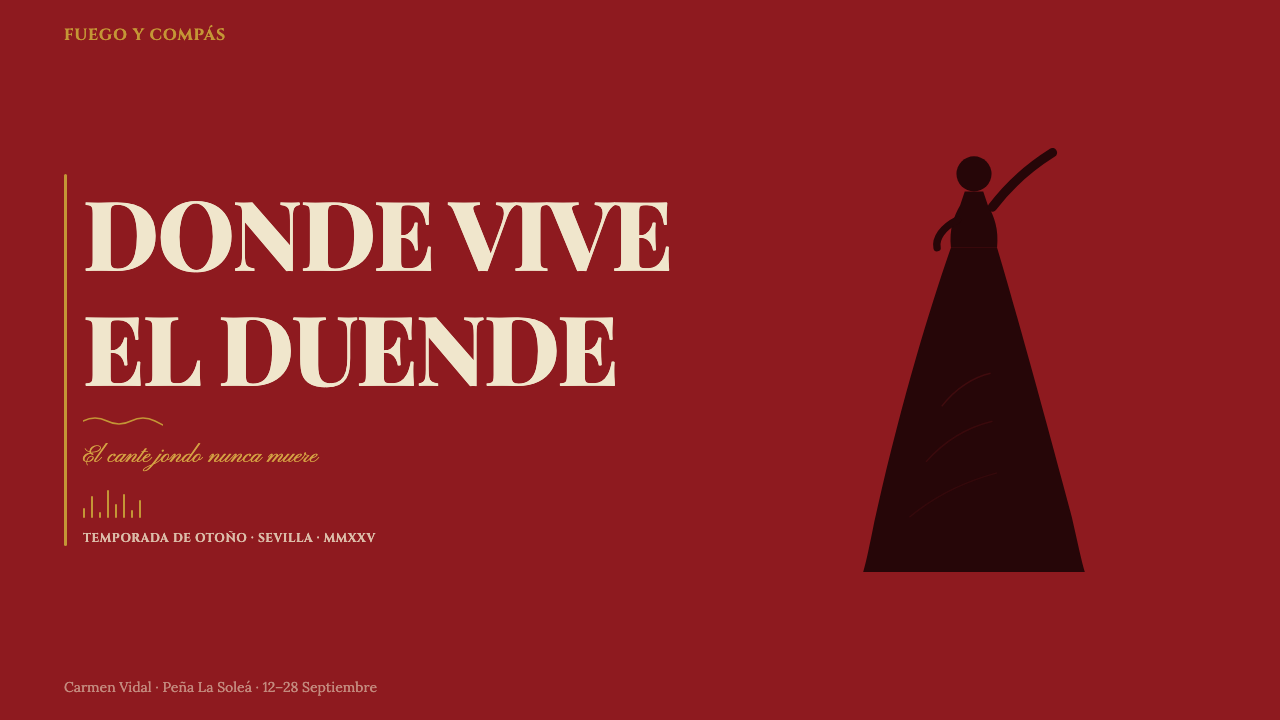
The defining visual motif is the flat black silhouette — a dancer caught mid-turn, a guitarist bent over his instrument, a cantaor with head thrown back. These figures derive from the woodcut tradition but carry a photographic immediacy: they are specific, gestural, and charged with motion. The silhouette is never soft-edged or gradated; it asserts itself as a graphic decision, not a rendering. The figure's posture is always at a point of maximum expressive tension — the moment before the heel strikes the floor, the breath held before the cry.
Typography
Headline type in this tradition is Didone in character — letterforms with extreme contrast between thick and thin strokes, delicate hairline serifs, and a vertical stress that gives the page an almost architectural quality. The type is set large, densely packed, and with intentional tightness in spacing that creates a feeling of compressed urgency. Secondary information — venue, date, supporting performers — appears in a condensed or narrow roman face, maintaining hierarchy while fitting the density of names that festival billing demands. Type is never playful or casual; even in its decorative moments, it maintains a formal gravity appropriate to an announcement of cultural importance.
Ornament and Rule
Unlike modernist design systems that eliminate ornament entirely, flamenco poster tradition uses it with deliberate excess — but only certain kinds of ornament. Typographic rules, borders, and decorative bands are drawn from the vocabulary of Spanish baroque: Moorish geometric interlace, wrought-iron scrollwork, floral dividers derived from Mudéjar tile patterns. These ornaments frame and contain the composition without filling the interior space. They function as the architectural border of a stage — the proscenium that defines where the performance happens — rather than as surface decoration competing with the content.
Paper and Texture
The material culture of flamenco poster printing is inseparable from its visual identity. Historically printed on heavy uncoated or matte-coated stock in warm ivory or cream tones, the poster carried the physical evidence of its craft: slight ink impression, subtle texture, and the sense that it had been made by hand and meant to be touched. In contemporary digital applications of the system, this quality is evoked through textured backgrounds, deliberately uneven ink coverage, and a studied imperfection that signals authenticity. The print artifact's warmth and weight are aspirational qualities — the system insists on feeling crafted even when it is not.
Composition and Tension
Flamenco poster compositions are typically vertical — a format inherited from theatrical broadside printing — and organized around a central focal axis that the silhouette figure dominates. But the organization is never static or symmetrical. The figure leans, reaches, or spins off-center. Type is stacked asymmetrically to one side or forced into narrow vertical columns that echo the dancer's vertical thrust. Negative space is used sparingly and deliberately: the white or cream ground only appears where the composition has earned its pause, lending those areas an intensity proportional to their rarity.
Gold and Ceremony
Gold in the flamenco poster tradition is never casual or decorative in a light sense — it carries the weight of religious and civic ceremony. Andalusian culture is saturated with gold: the gilded retablos of baroque churches, the gold-embroidered shawls of festival dress, the trophy cups presented at peñas. In the poster, gold appears as the most elevated typographic treatment — reserved for the headliner's name or the festival title — and as the material of ornamental frames and dividers. Its warmth against red and black reads simultaneously as luxurious and solemn, the aesthetic correlate of a world where celebration and mourning are never far apart.
Who shaped Spanish Flamenco Poster?
Lorca was the poet and playwright who gave the flamenco aesthetic its most articulate theoretical framework. His 1933 lecture 'Play and Theory of the Duende' defined duende as the spirit of authentic artistic inspiration — a dark, earthy force that distinguishes genuine artistic expression from mere technical accomplishment. Lorca argued that true flamenco, true art of any kind, required the presence of death as a creative catalyst. This philosophy permeates the visual tradition of flamenco poster design: the compression, the darkness, the controlled urgency, the sense that something is at stake. Lorca was killed in 1936 at the outset of the Spanish Civil War, becoming himself a figure of the duende he described.
Carmen Amaya was the most celebrated female flamenco dancer of the twentieth century, whose ferocious footwork and transgressive stage presence transformed what audiences expected of the form. Born in the Barcelona gypsy quarter of Somorrostro around 1913, she rose to international fame and performed across Europe and the Americas. Her image — the dramatic silhouette of her in traje de gitana or, more startlingly, in trousers — appeared on posters and publicity materials that helped define the visual language of flamenco promotion. Her physical intensity and the stark drama of her performances provided a living model for what the graphic tradition sought to capture.
Camarón de la Isla — born José Monje Cruz in 1950 in the gypsy quarter of San Fernando, Cádiz — is widely regarded as the greatest flamenco singer of the modern era. His partnership with guitarist Paco de Lucía in the 1970s produced recordings that redefined the emotional and technical boundaries of cante jondo. Camarón's face and voice became cultural icons of Andalusia: his image appeared on posters, murals, and album covers with the graphic intensity of a religious icon. The visual conventions that festivals used to represent him — stark contrast, minimal color, a quality of almost unbearable expressiveness — fed directly back into the poster tradition.
Paco de Lucía, born Francisco Sánchez Gómez in 1947 in Algeciras, was the guitarist who modernized flamenco and brought it to global audiences without sacrificing its Andalusian roots. His technical innovations on the flamenco guitar — exploring new rhythmic structures, incorporating jazz harmony, and demanding a level of virtuosity that redefined what the instrument could do — paralleled the formal ambitions of the graphic designers who worked on festival promotion during the same decades. His partnership with Camarón produced some of flamenco's most celebrated recordings, and his own concert appearances generated poster commissions that represent high points of the modern tradition.
How do you use Spanish Flamenco Poster today?
Spanish Flamenco Poster is among the most emotionally specific design systems available for contemporary applications — which means it is both powerfully evocative and potentially limiting. Applying it correctly demands understanding the emotional register it commands: gravity, passion, craft, and the compressed energy of something performed rather than merely produced. It suits contexts where those values align with the product's or event's identity.
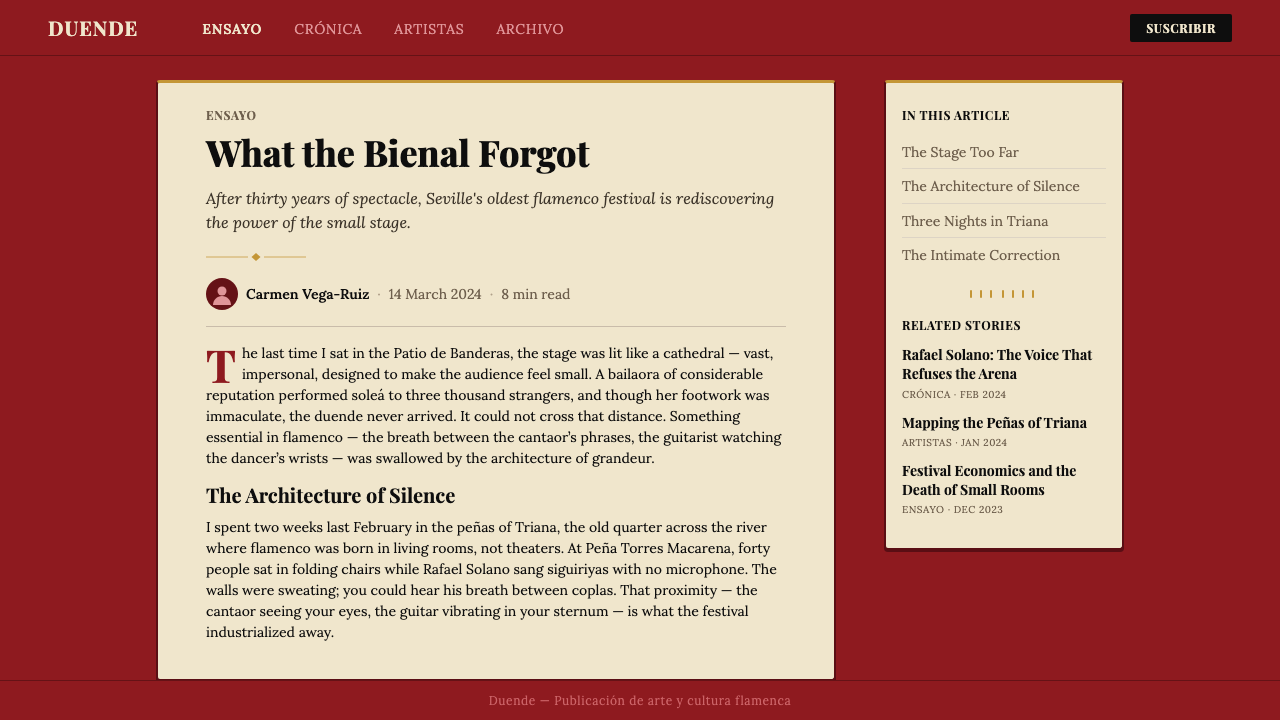
For presentation slides and event materials, the system works exceptionally well for anything requiring dramatic impact: keynote covers, cultural event programs, promotional materials for festivals, performing arts organizations, or premium consumer brands with roots in craft tradition. A cover slide benefits from the full visual vocabulary — deep red ground, centered or slightly off-center silhouette figure, headline type set at compressed scale in a Didone-character face, and a thin gold rule or ornamental border to frame the composition. Content slides should strip back to essentials: ivory or cream ground, dense black type in a narrow-set serif, and red used only for the most critical hierarchy marker. Data slides take their cue from the tradition's graphic authority — charts and diagrams rendered in the system's palette read as deliberate and confident rather than decorative.
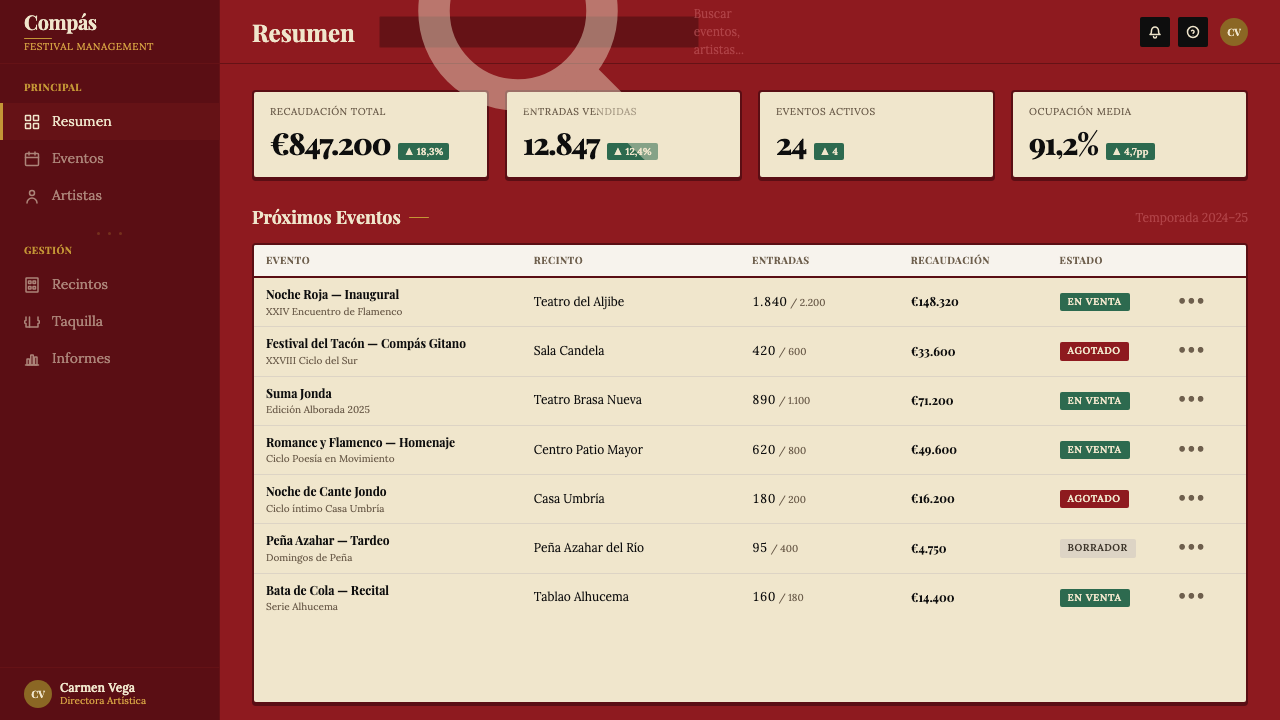
For web interfaces, the system is best suited to contexts with a clear cultural or artisanal identity: wine brands, luxury hospitality, performing arts booking platforms, cultural institutions, and heritage fashion. A homepage or landing page built in this register should use a full-bleed deep red section for the primary hero, with a large silhouette or photographic figure in high-contrast treatment against it. Navigation and supporting text should sit on ivory or near-white, using the system's typographic hierarchy. Gold accents work well for interactive elements — hover states, active indicators, selected states — where they carry the same ceremonial weight they carry in the print tradition. Dashboards and data-heavy interfaces are not natural territory for this system; the visual density and emotional intensity that make it powerful in promotional contexts create friction in contexts requiring calm and continuous scanning.
For editorial and marketing work, the system is a natural fit for cultural journalism, arts coverage, festival guides, and brand identities in the premium artisanal sector. A feature article layout in this register uses the red as a section-defining color — pull quotes in red, section openers with a red band behind white type — while the body sits on white or cream. Marketing campaigns benefit from the system's poster-like boldness: a single image reduced to high-contrast black on red, a performer name treated as a typographic object in itself, and supporting information subordinated to a hierarchy that insists on what matters most.
A common mistake when applying this system is confusing passion with excess. The flamenco poster tradition achieves its intensity through discipline, not accumulation: one strong silhouette, not a crowd; one dominant color, with gold as measured accent; type that commands rather than fills the space. Applying every element simultaneously — heavy ornament, multiple silhouettes, all three colors at full saturation, elaborate borders — produces visual noise rather than duende. The system's power lies in what it withholds. Similarly, softening the palette by moving the red toward orange or the black toward dark grey dissolves the tradition's emotional specificity and produces something that reads as vaguely Mediterranean rather than specifically Andalusian.
Spanish Flamenco Poster — FAQ
How does Spanish Flamenco Poster differ from other Iberian graphic traditions?
Spain has several distinct regional graphic traditions — the modernisme of Catalan Art Nouveau, the cool rationalism of Basque and Castilian institutional design, and the exuberant folk graphics of various regional festivals. Flamenco poster tradition is specifically Andalusian: it draws on the cultural synthesis of Christian, Moorish, and Romani influences that characterize the deep south. Its palette and ornamental vocabulary are noticeably warmer and more theatrical than northern Spanish graphic traditions, and its connection to live performance gives it a quality of urgency that institutional design lacks. It should not be confused with generic 'Spanish' style — treating a sangria label as stylistically equivalent to a Bienal de Sevilla poster would be a significant cultural misread.
Can this system work for digital interfaces, or is it inherently a print tradition?
The system translates well to digital contexts when certain adaptations are made. The most important is handling the texture and material quality that printed stock provides — in digital work, this requires deliberate textural treatments in backgrounds and a willingness to allow slight imperfection rather than perfect vector crispness. The palette transitions well: deep red and near-black read powerfully on screens. The typographic conventions require some adjustment, since the very tight spacing and compressed scale that works in poster format can create readability problems at body-text scale on screen. For web and app interfaces, the best approach is to use the system's vocabulary for major compositional moments — hero sections, section headers, calls to action — while keeping supporting text in a more neutral register.
What is duende, and how does it inform the design system?
Duende is a concept articulated most famously by Federico García Lorca in his 1933 lecture as the dark, authentic force that makes art genuinely move its audience — as opposed to mere technical mastery or prettiness. Lorca associated it with a confrontation with mortality, an earthy directness that cannot be faked or learned. In design terms, duende is the quality that prevents a composition from feeling merely competent: the tension that makes you feel something is at stake, that the figure might break free of the frame, that the announcement carries urgency beyond its literal meaning. The design system pursues this through controlled visual tension — compressed space, high contrast, a palette that provides no comfort, and typography that commands rather than invites.
Is it appropriate to use this system for non-flamenco contexts?
The system's visual vocabulary is specific enough that using it indiscriminately for unrelated contexts risks a kind of cultural appropriation that reduces a living tradition to surface decoration. That said, the emotional register it commands — gravity, passion, craft, the weight of something genuinely performed — is applicable to any context where those values are authentic. A brand with deep roots in Spanish culture, a premium artisanal food producer, a performing arts organization, or a cultural institution working with Andalusian heritage can deploy the full system with integrity. A technology startup using blood-red and Didone type for no reason grounded in the product's actual values would be borrowing style without substance — producing something that feels unearned and potentially hollow.
How should this system handle light mode versus dark mode contexts?
The canonical form of the flamenco poster tradition is light-ground — ivory or cream stock with black type and red accent — not dark. A full dark-mode inversion requires careful recalibration. On a black ground, the deep red risks losing the distinction between itself and the background, becoming muddy rather than intense. Ivory type on black with red as accent works better than attempting to replicate the full palette inverted. The gold element translates well to dark contexts, where it reads as genuinely warm against the near-black. The ornamental elements — rules, borders, Moorish interlace — retain their effectiveness in dark contexts because they operate as structural elements rather than surface color. For interfaces that must support both modes, treat the dark version as a formal evening register of the same system rather than a mechanical inversion.
Related design styles
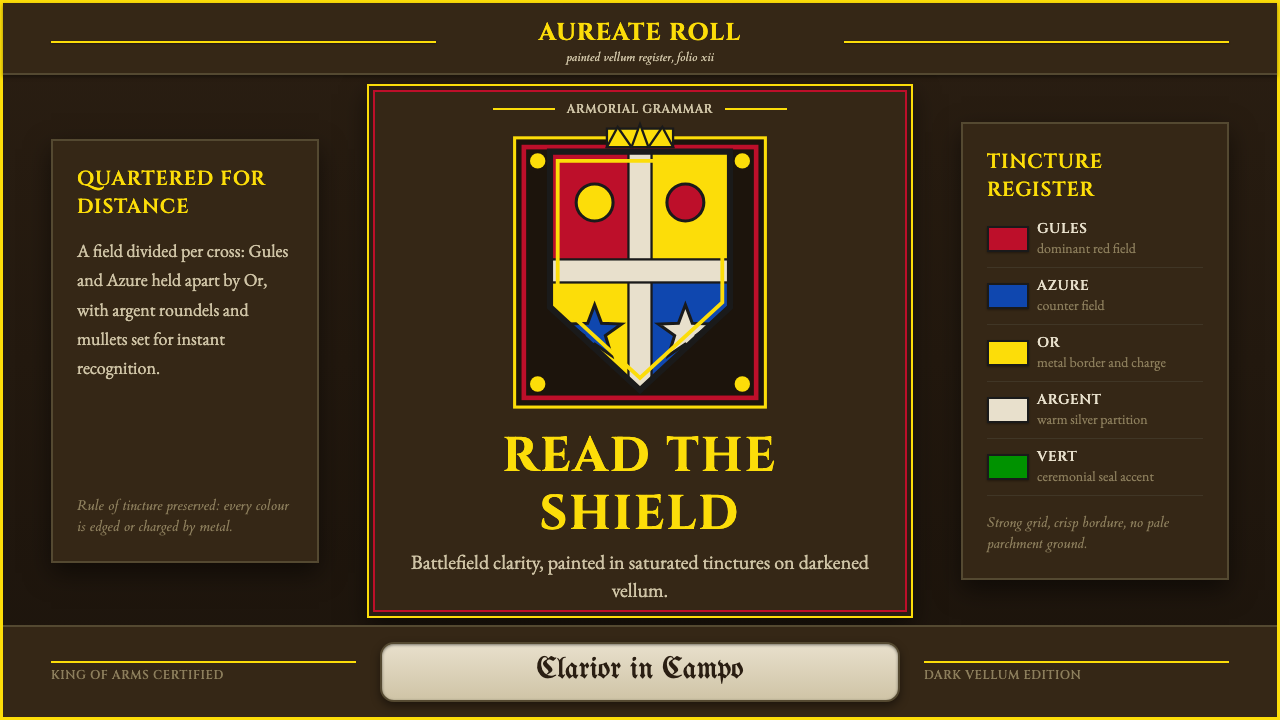 Heraldic BlazonCommand at a glance. Gules, Azure and Or quartering lock into a gilt shield o…
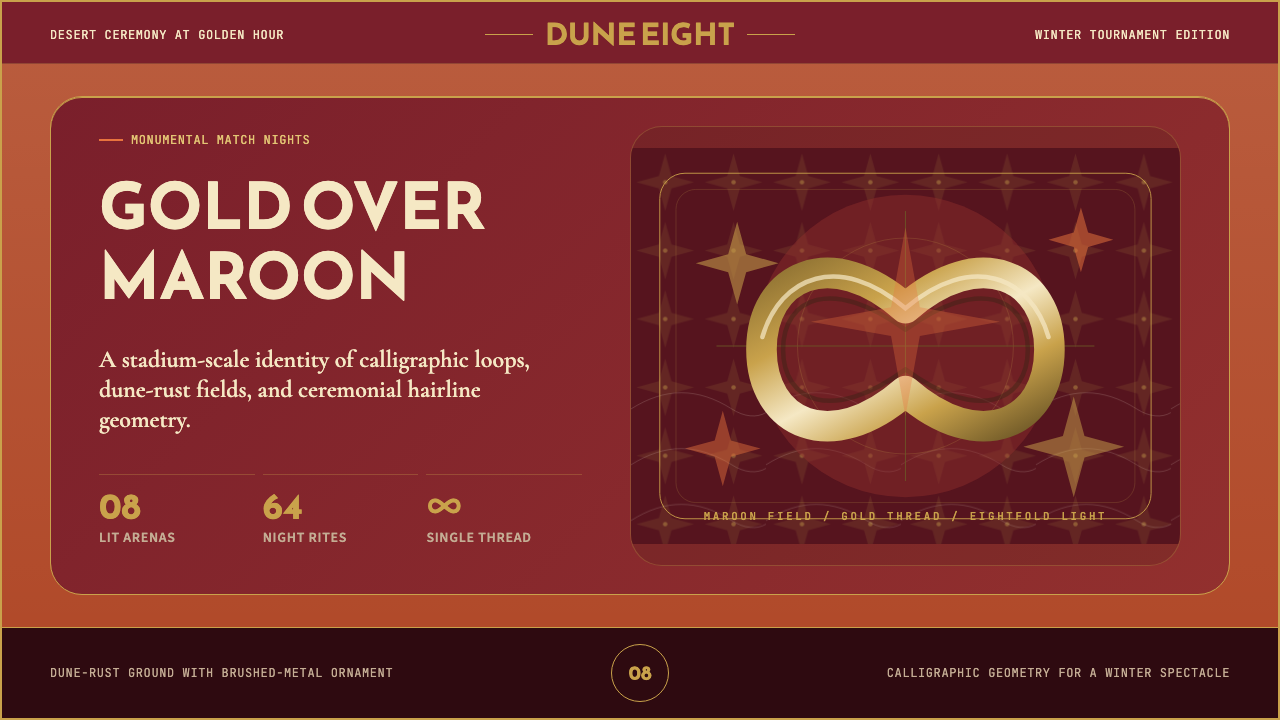 Qatar World Cup 2022Desert spectacle in gold. Maroon fields, Reem Kufi scale, and eightfold star…
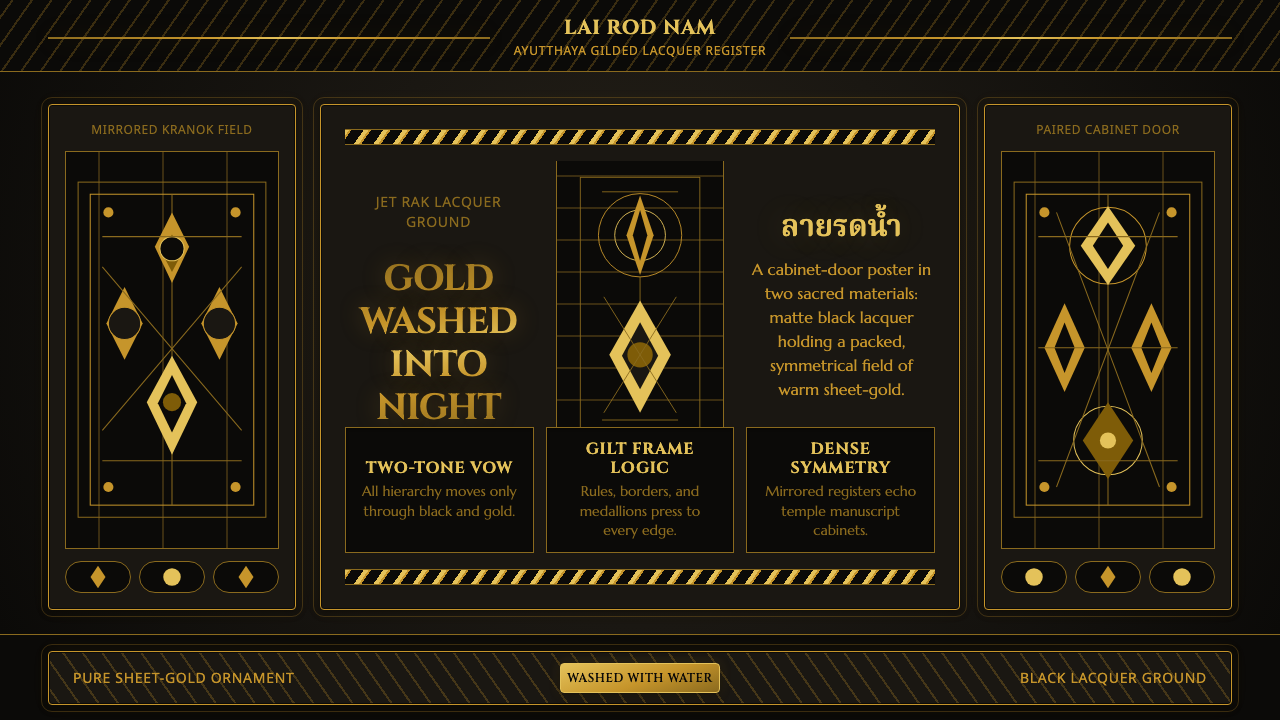 Thai Lai Rod Nam Gold-Black LacquerGold leaves no silence. Warm leaf gradients and mirrored borders pack a black…
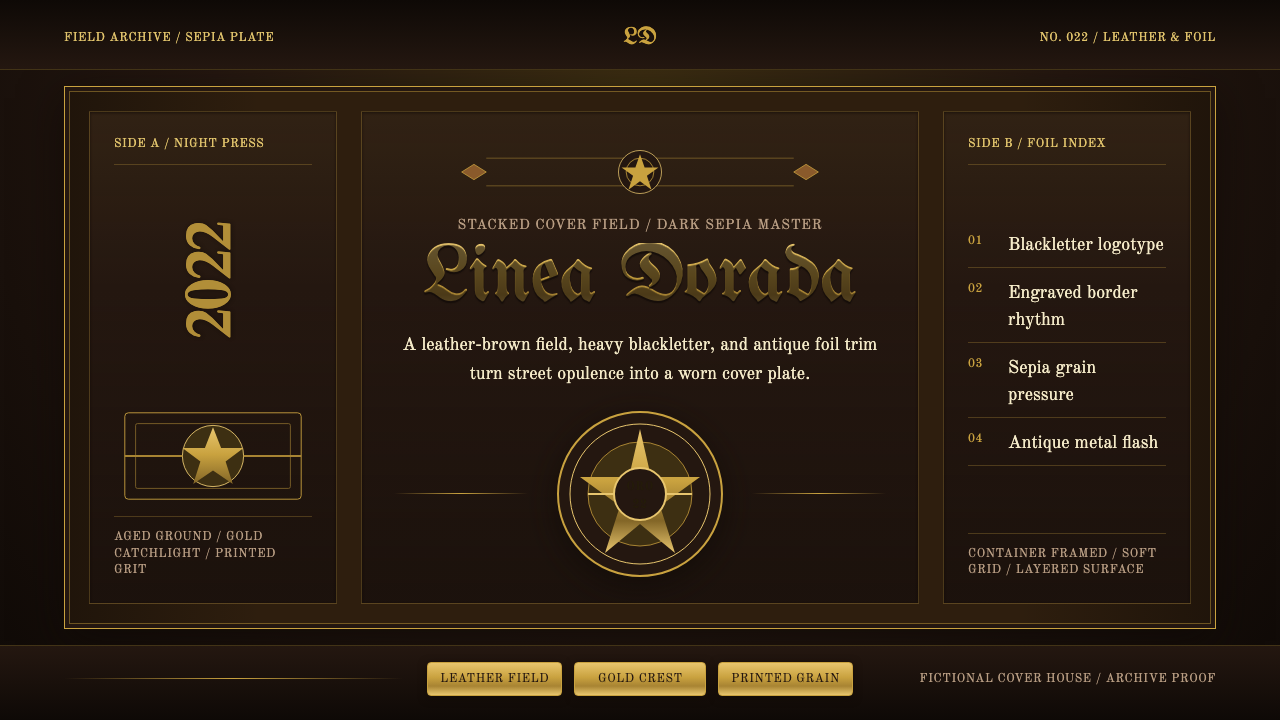 Corridos TumbadosOpulence with dust on it. Sepia leather, blackletter, and antique-gold foil f…
 Egyptian PharaonicRegal permanence. Gold rules and Cinzel capitals carve papyrus registers into…
 Khmer Aksar MulCeremony held in gold. Moul type glows on black lacquer with panel-by-panel g…