What is Egyptian Pharaonic?
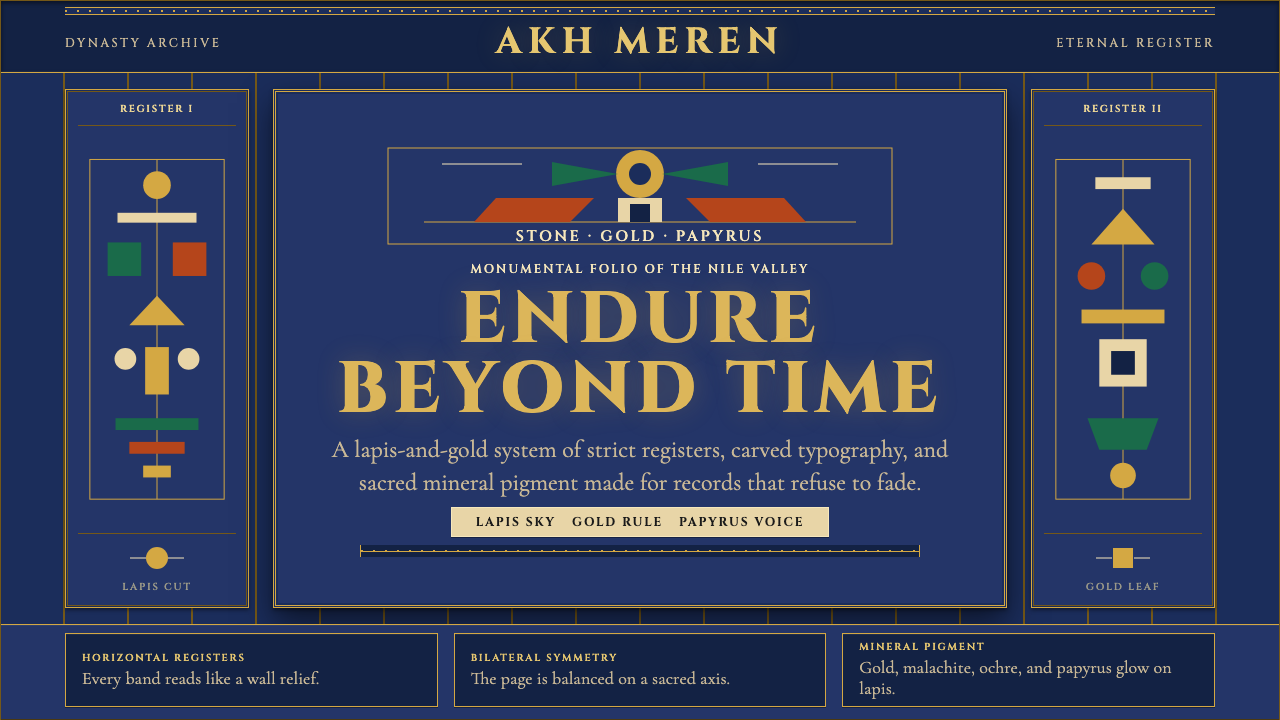
Egyptian Pharaonic design is the visual language of permanence — three thousand years of hieroglyphs, gold, lapis lazuli, and stone-carved symmetry that still commands authority on any surface.
Egyptian Pharaonic in brief
Egyptian Pharaonic design is the visual language of the oldest monumental civilization on record. It encompasses hieroglyphs carved into temple walls, golden sarcophagi, lapis lazuli inlays, and human figures rendered eternally in profile — a system of representation so coherent and so deliberately maintained that it persisted with near-total visual consistency for roughly three millennia, from the early dynastic period through the Ptolemaic era.
The temperament of the style is regal, not macabre. It is a design language oriented entirely toward permanence and authority. Everything in it — strict horizontal registers dividing a composition into narrative bands, bilateral symmetry anchoring major elements, bold outlines containing flat fields of mineral color, letterforms that combine pictorial legibility with architectural weight — communicates a single overriding idea: this will endure beyond time itself.
As a contemporary design system, Egyptian Pharaonic draws on that visual vocabulary to project power, solemnity, and institutional confidence. Its palette centers on deep gold against a ground of midnight blue or dense black, with accents of warm terracotta and the specific vivid blue-green of Egyptian faience. Its compositional logic favors symmetry, horizontal banding, and the kind of dense, ordered complexity that rewards close reading rather than quick scanning. It is a style suited to occasions that demand gravitas.

Where does Egyptian Pharaonic come from?
The visual tradition we call Egyptian Pharaonic design emerged in the Nile Valley around 3100 BCE with the unification of Upper and Lower Egypt under the first pharaohs. The administrative center at Memphis — where the court, temple workshops, and scribal schools converged — became the birthplace of a unified representational canon. Artists and craftsmen working under royal patronage developed consistent rules for depicting the human figure, organizing a composition, and inscribing hieroglyphic text that would remain binding for century after century. This was not artistic stagnation; it was a deliberate policy of visual continuity meant to reinforce the eternal legitimacy of the divine kingship.
The Old Kingdom period (roughly 2700–2200 BCE) established the monumental scale and compositional grammar that defines the style. The great pyramid complexes at Giza, built under the Fourth Dynasty pharaohs including Khufu and Khafre, demonstrated what the culture could accomplish when visual ambition, administrative organization, and material resources were aligned. The pyramid itself — a perfect geometric solid pointing toward the sky — became the defining architectural emblem of the tradition. Alongside it, the relief carvings and painted tomb chambers of the Old Kingdom fixed the conventions of horizontal register, frontal-eye-in-profile-body figure drawing, and color symbolism that later periods would inherit.
Imhotep, the polymath vizier and architect credited with designing the Step Pyramid complex at Saqqara for Pharaoh Djoser around 2650 BCE, represents the earliest named designer in the tradition. His innovation — stacking mastaba tomb forms into a stepped pyramid — introduced a formal vocabulary that would evolve over centuries. Imhotep was later deified, a rare honor that reflects how deeply ancient Egyptian culture identified great acts of design and construction with divine authority. The tradition he inaugurated reached its fullest expression in the New Kingdom period (1550–1070 BCE), when the Valley of the Kings near Thebes became the burial ground for pharaohs whose tomb chambers were covered floor to ceiling with painted hieroglyphic programs of extraordinary density and color.
The style's influence did not end with the pharaohs. When Egypt fell to Alexander the Great in 332 BCE and the Ptolemaic dynasty subsequently ruled from Alexandria, Egyptian visual conventions were absorbed into a hybrid Hellenistic-Egyptian aesthetic that carried the essential vocabulary — gold, hieroglyphs, the profile figure, the registers — into a new cultural context. The Roman conquest of 30 BCE ended the pharaonic state, but Egyptian imagery had by then so thoroughly fascinated the ancient world that it spread across the Mediterranean through trade, war, and cultural exchange. The nineteenth-century European fascination with Egypt — crystallized by Napoleon's 1798 Egyptian campaign, the subsequent publication of the Description de l'Égypte, and the discovery of Tutankhamun's tomb by Howard Carter in 1922 — translated the ancient visual language into the Egyptian Revival movement, which seeded Pharaonic motifs into Neoclassical architecture, Art Deco design, and ultimately the contemporary design vocabulary that the style draws on today.
What defines the Egyptian Pharaonic look?
Color
The palette is built on a foundation of deep, saturated contrasts: gold against midnight blue or dense black, warm terracotta against cream, and the distinctive vivid blue-green of Egyptian faience — a color unlike any European pigment — used as a precise accent. These are mineral colors derived from lapis lazuli, malachite, ochre, and gold leaf, and they carry specific symbolic weight in the original tradition. Gold signifies divine radiance and immortality; blue-black grounds represent the primordial void; terracotta and ochre refer to the earth and skin. In contemporary application, the palette reads as simultaneously archaic and commanding — it projects authority without softness.
Symmetry and Register
Egyptian compositions are organized by two dominant structural principles operating simultaneously: bilateral symmetry anchoring the central axis, and horizontal registers dividing the picture plane into parallel narrative bands stacked one above another. The registers are as important as the symmetry — they impose a reading order (typically top to bottom), separate scenes or text blocks from each other, and give the composition its characteristic quality of ordered density. Dividing lines between registers are thin but absolute; they function like ruled stone courses in a temple wall. This banded structure is the single most transferable compositional device the style offers.
Typography and Hieroglyphic Weight
Egyptian type sensibility is monumental and lapidary — it looks carved rather than printed. Letterforms appropriate to the style have high contrast between thick and thin strokes, strong serifs with architectural weight, and an overall impression of having been cut into a hard surface rather than drawn on a soft one. Display text benefits from wide letterspacing that reinforces the register-and-column grid. Where actual hieroglyphic elements are introduced, they function as visual texture and symbolic density rather than readable script — the eye reads them as pattern before it reads them as language.
Figure and Profile
The Egyptian convention of showing the human figure with head and legs in profile but chest and eye facing forward is not an anatomical error — it is a deliberate compositional decision to show each part of the body from its most legible angle simultaneously. This creates a figure that is both immediately readable and fundamentally schematic: a visual shorthand so refined over millennia that it reads as dignified authority rather than stylized distortion. In contemporary design applications, the profile figure serves as a powerful motif for representing human presence without photographic realism.
Gold and Material Opulence
Gold is the organizing material of Egyptian Pharaonic design — not as mere decoration but as the literal substance of divinity. In ancient Egypt, the gods were believed to have golden skin; pharaohs were divine by nature, and their golden regalia embodied that status. In the design system, gold functions as the primary accent tone, the outline color for major elements, and the highlight treatment for the most important typographic elements. It should feel weighty and specific rather than generic or metallic-by-default. The distinction matters: gold applied lavishly reads as kitsch; gold applied as a structural choice reads as gravitas.
Outline and Flat Fill
Egyptian painting and relief work uses a consistent technique: a strong, even outline defines the boundary of each element, and the interior is filled with a flat, unmodulated field of color. There is no shading, no cast shadow within the form, no gradation from light to dark. Depth is communicated by overlapping figures and by vertical position in the register — elements higher in the register are understood as more distant — rather than by any atmospheric or tonal illusion. This flat-fill-within-outline technique gives the style its characteristic quality of confident, declarative flatness.
Ordered Density
Unlike minimalist design systems that achieve clarity through reduction, Egyptian Pharaonic design achieves clarity through meticulous organization of abundance. A fully realized Egyptian composition is dense with hieroglyphs, figures, borders, registers, and symbolic objects — yet it reads as ordered rather than chaotic because every element occupies a precisely assigned position in a grid-like structure. Empty space is not a goal; it is a resource deployed only where the visual program requires a pause. This principle of ordered density distinguishes authentic applications of the style from underworked interpretations that deploy only the color palette and miss the compositional richness.

Who shaped Egyptian Pharaonic?
Imhotep served as vizier and chief architect to Pharaoh Djoser of the Third Dynasty, and is credited with designing the Step Pyramid complex at Saqqara around 2650 BCE — the world's oldest surviving large-scale stone structure. His genius lay in translating forms previously executed in perishable materials (mud brick, bundled reeds, wood) into cut limestone, creating a permanent architectural vocabulary that would define Egyptian monumental design for the next two millennia. He was later worshipped as a god of medicine and wisdom, one of only a handful of non-royal Egyptians to be deified, a measure of how profoundly his contributions were recognized.
Tutankhamun reigned as pharaoh during the Eighteenth Dynasty (around 1332–1323 BCE) and died young, likely at eighteen or nineteen years of age. His historical significance would be modest were it not for the extraordinary circumstance that his tomb in the Valley of the Kings was left largely undisturbed for over three thousand years. The contents discovered by Howard Carter in 1922 — golden death mask, nested sarcophagi, funerary furniture, jewelry, chariots — constitute the most complete surviving snapshot of New Kingdom royal material culture. The aesthetic of those objects, circulated worldwide through photographs, exhibitions, and the Egyptian Revival they helped ignite, is the primary source from which most contemporary designers draw when working in this style.
Howard Carter was the British archaeologist who, after years of methodical searching supported by patron Lord Carnarvon, discovered the sealed entrance to Tutankhamun's tomb in the Valley of the Kings on November 4, 1922. His subsequent meticulous excavation — which took nearly a decade to complete — documented and preserved the tomb's contents with a scientific rigor unprecedented in Egyptian archaeology. The global media coverage of the discovery triggered an Egyptian Revival across decorative arts, architecture, fashion, and graphic design throughout the 1920s and 1930s, embedding Pharaonic visual motifs directly into the Art Deco movement. Carter thus stands as the conduit through whom ancient Egyptian design entered modern visual culture.
Queen Nefertiti, chief consort of Pharaoh Akhenaten during the Eighteenth Dynasty (around 1370–1330 BCE), is represented in the painted limestone bust discovered at Amarna in 1912 — now in the Neues Museum in Berlin — that has become one of the most recognized faces in art history. The bust demonstrates the Egyptian tradition at its most refined: the bilateral symmetry of the composition, the precise containment of flat color fields within strong outlines, and the combination of formal idealization with individual specificity. Nefertiti's reign coincided with the Amarna period, a brief artistic interlude of unusual naturalism that softened the canonical rigidity of Egyptian representation, and the tension between that naturalism and the prevailing monumental style is legible in the surviving work.
Ramesses II, who ruled Egypt for approximately sixty-six years during the Nineteenth Dynasty (1279–1213 BCE), is the pharaoh most responsible for the monumental scale at which Egyptian visual design operated at its peak. His building program — including the temples at Abu Simbel, the hypostyle hall at Karnak, and the Ramesseum at Thebes — produced some of the largest stone structures ever constructed, covered with relief carvings and hieroglyphic inscriptions of extraordinary density. The visual system he deployed in these buildings — colossal scale, rigorous symmetry, saturated color on carved surfaces, the consistent use of his own image as a compositional anchor — represents Egyptian Pharaonic design at its most maximally realized and most politically self-conscious.
How do you use Egyptian Pharaonic today?
Egyptian Pharaonic is a high-commitment style that rewards precision and punishes approximation. Applying it correctly requires understanding what the visual system is doing structurally — using bilateral symmetry and horizontal registers to impose order, using gold as a functional hierarchy marker rather than a decorative coating, using flat outlined forms to achieve a quality of carved permanence — rather than simply overlaying a gold-and-dark-blue palette on a standard layout template.
For presentation slides, Egyptian Pharaonic works most powerfully on cover and section divider pages where the full compositional logic can be deployed. A cover benefits from strict bilateral symmetry: a central title in lapidary, high-contrast display type, flanked by symmetrical ornamental registers or thin horizontal rules, set against a ground of midnight blue or near-black with gold used sparingly for the most important words or a central emblem. Content slides should simplify the register principle to a practical level — a strong horizontal rule dividing the header zone from the body zone, body text in a clear secondary typeface with generous line spacing, and data elements treated as contained objects within ruled borders. Full Pharaonic density on every content slide risks overwhelming the information hierarchy.
For web interfaces and dashboards, the style suits applications that need to communicate institutional authority and precision — financial platforms, analytics tools, archival systems, or premium tier experiences. The approach: a very dark ground approaching black, a header and navigation zone treated as a distinct register with a fine gold dividing line, card components with explicit ruled borders rather than soft shadows, and gold accents used exclusively for primary calls to action and critical status indicators. Typography should rely on strong contrasts between a monumental display face and a functional, highly legible body face. Avoid applying the full density of ornament to interactive states — reserve the visual richness for structural chrome, not per-element decoration.
For editorial and marketing work, the style supports a specific register of brand voice: commanding, culturally referential, and unhurried. A feature layout in this style might use a full-bleed dark ground with a single centered headline in wide-tracked gold capitals, body text in cream at a comfortable measure, and visual punctuation provided by thin horizontal rules rather than imagery. Marketing pieces work well structured as triptych or symmetric multi-panel compositions — the pharaonic register principle translates naturally into alternating content bands. The style is appropriate for luxury goods, cultural institutions, financial services, and any context where the association with enduring value serves the brand argument.
A common mistake when applying Egyptian Pharaonic design is treating it as a texture theme — adding gold color, a few hieroglyphic decorative elements, and a dark background without internalizing the compositional logic. The result reads as costume rather than system. The second common mistake is using gold at too high a proportion of the total surface area; gold reads as authoritative when it is selective and reads as gaudy when it is abundant. A third pitfall is failing to commit to the flatness principle — introducing soft shadows, gradients, or glows in a misguided attempt to modernize the style actually destroys its essential character. The style's power comes from its absolute refusal of atmospheric illusion, not despite it.

Egyptian Pharaonic — FAQ
Is Egyptian Pharaonic design the same as Egyptian Revival style?
They are related but distinct. Egyptian Pharaonic refers to the original visual language of ancient Egypt itself — hieroglyphs, registers, bilateral symmetry, mineral palette, the profile figure convention — developed over three millennia in the Nile Valley. Egyptian Revival is the nineteenth and early twentieth century European and American response to that language: architects, decorators, and graphic designers appropriating Egyptian motifs and incorporating them into the Neoclassical and Art Deco movements. Egyptian Revival tends to be lighter, more eclectic, and filtered through a European sensibility; authentic Pharaonic design is denser, more structurally committed, and more demanding of the compositional logic that makes the style coherent rather than merely decorative.
Can Egyptian Pharaonic design work on a light background?
It can, but requires careful handling. The canonical Pharaonic ground is dark — lapis blue, near-black, or deep terracotta — because the mineral pigments of ancient Egyptian painting were luminous against a dark stone or plaster surface, and because the gold accents read with far greater authority against darkness than against light. A light-ground variant is possible, and some contexts call for it: a cream or warm white ground with black outline forms and gold used for select highlights can work well for editorial applications where heavy dark grounds would be oppressive over long reading sessions. However, a light-ground Pharaonic layout loses the quality of solemnity that is the style's primary asset, and risks reading as merely decorative rather than architecturally organized.
How does Egyptian Pharaonic handle photography and realistic imagery?
With deliberate tension. The ancient Egyptian visual system had no photography and no interest in naturalistic representation — everything was schematic and symbolic. Contemporary applications face a choice: avoid photography entirely and commit to the flat illustrated world of the style, or use photography in a way that subjects it to the style's visual logic rather than allowing it to import photographic naturalism. The second path works when photography is heavily treated — extreme contrast with no midtones, duotoned with one palette color as the highlight and near-black as the shadow, cropped aggressively into a geometric shape and contained within a ruled border. Soft-lit, full-color, naturalistic photography placed against a Pharaonic layout is a compositional contradiction; it will read as an error rather than an intentional juxtaposition.
What kinds of brands or products suit this style, and where does it fail?
Egyptian Pharaonic works best when the brand or product genuinely benefits from associations with permanence, authority, institutional depth, and cultural significance. Strong fits include luxury goods, financial institutions, cultural organizations, premium software platforms, archival or research tools, and any context where the user needs to trust that the thing in front of them has been built to last. It struggles in contexts that require warmth, approachability, playfulness, or organic texture — children's products, food and wellness brands, community platforms, and any experience where the user's emotional state needs to be lightened rather than awed. The style's severity can also read as exclusionary if deployed carelessly in consumer contexts; its power comes with a cost in accessibility of tone.
How do I avoid making Egyptian Pharaonic look like a Halloween or kitsch aesthetic?
The kitsch reading happens when designers use only the thematic surface of the style — mummy imagery, cartouche clip-art, scarab icons, pyramid silhouettes used as mere decoration — without committing to the compositional logic that makes ancient Egyptian design coherent. The solution is to work structurally: establish the bilateral symmetry and register structure first, apply the color palette second, and introduce specific Pharaonic motifs last and sparingly, only where they are structural rather than decorative. Gold must be reserved rather than abundant. Typography must be monumental rather than novelty. The compositional grid must be as rigorous as the ornament. When the structure is right, even a single Egyptian-derived motif reads as a meaningful citation of an ancient tradition rather than a costume element.
Related design styles
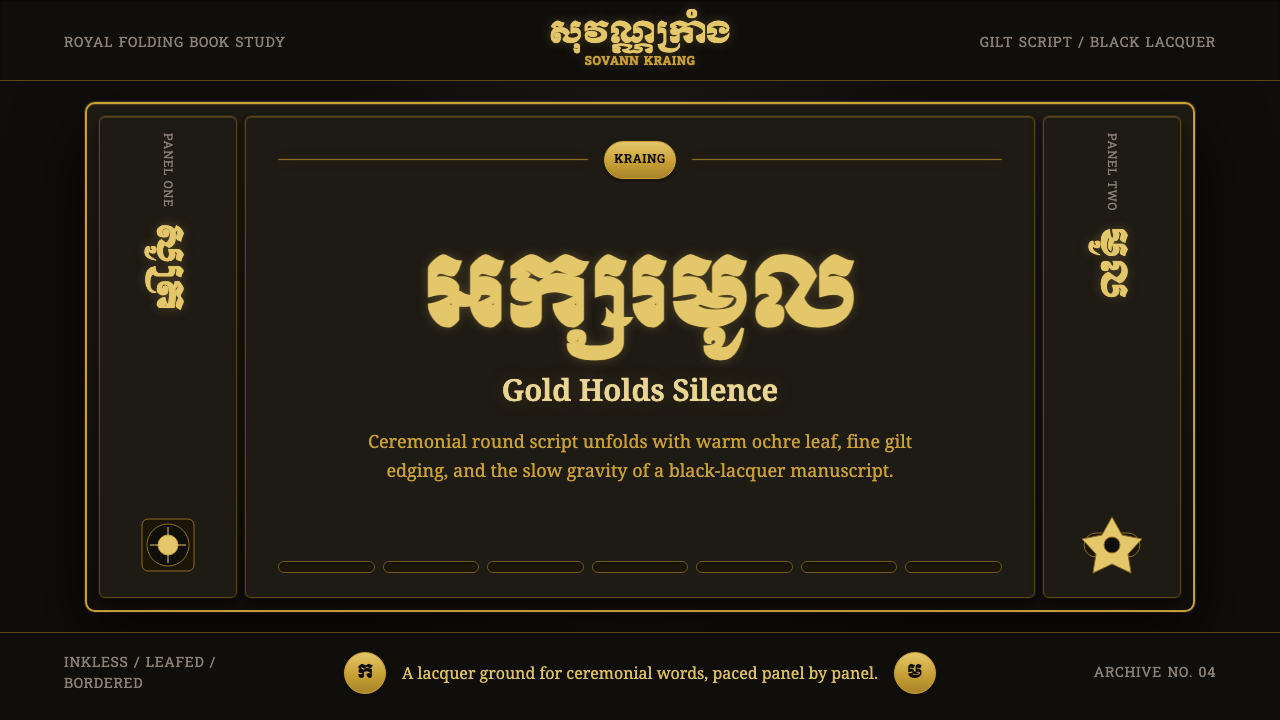 Khmer Aksar MulCeremony held in gold. Moul type glows on black lacquer with panel-by-panel g…
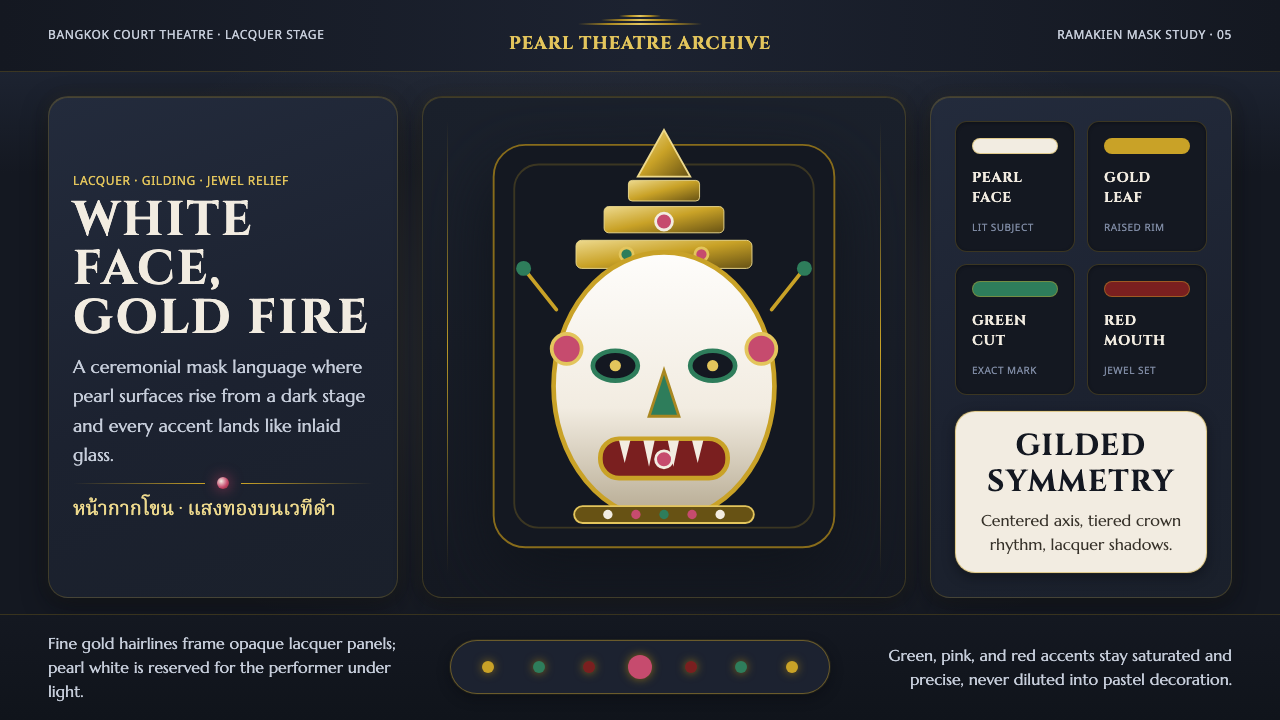 Thai Khon Hanuman MaskThai court theatre, digitized. A pearl-white mask and gilt coronet rise from…
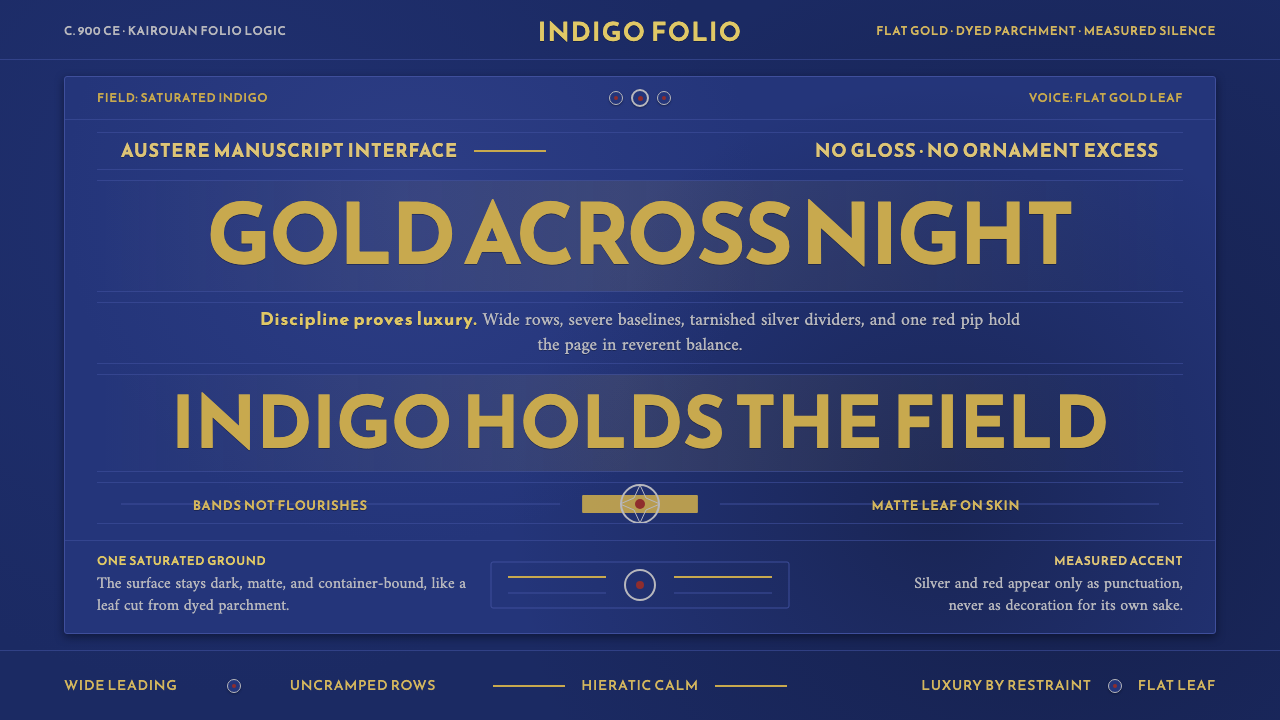 Abbasid Blue QuranLuxury by restraint. Flat gold Kufic bands cross an indigo parchment field.
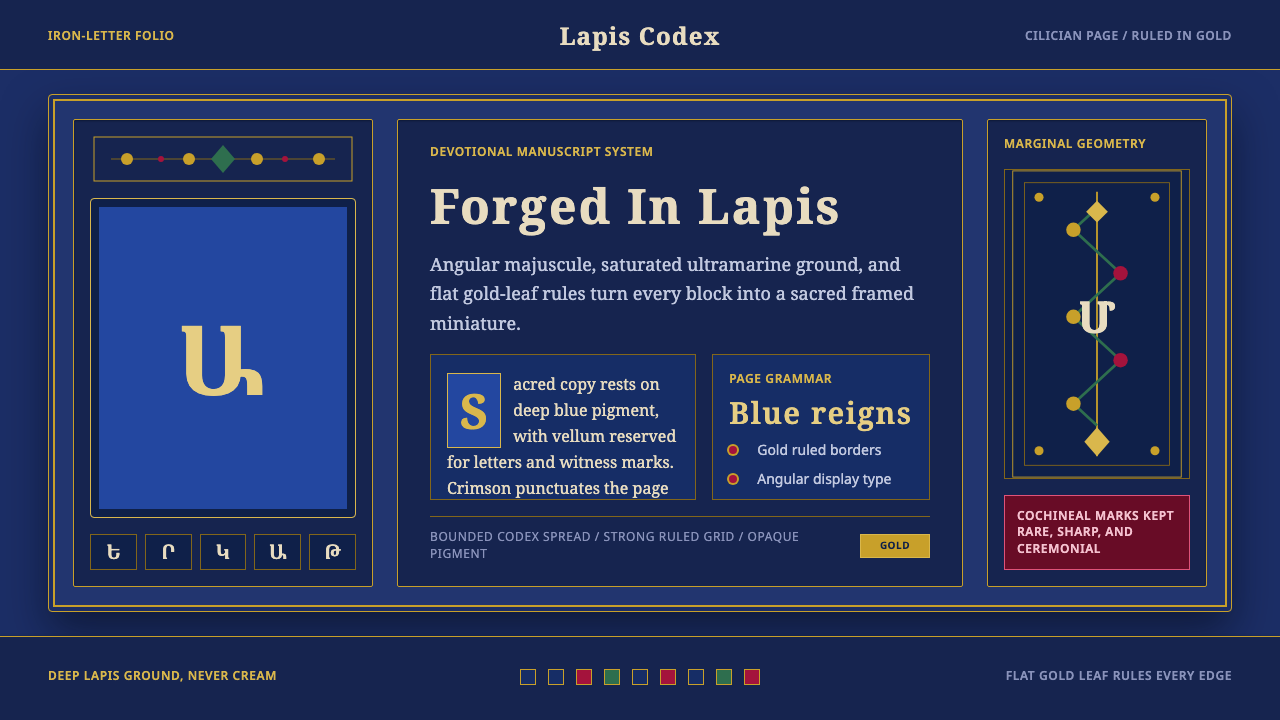 Armenian ErkatʿagirDevotional lapis reigns. Gold rules and angular serif glyphs frame a sacred g…
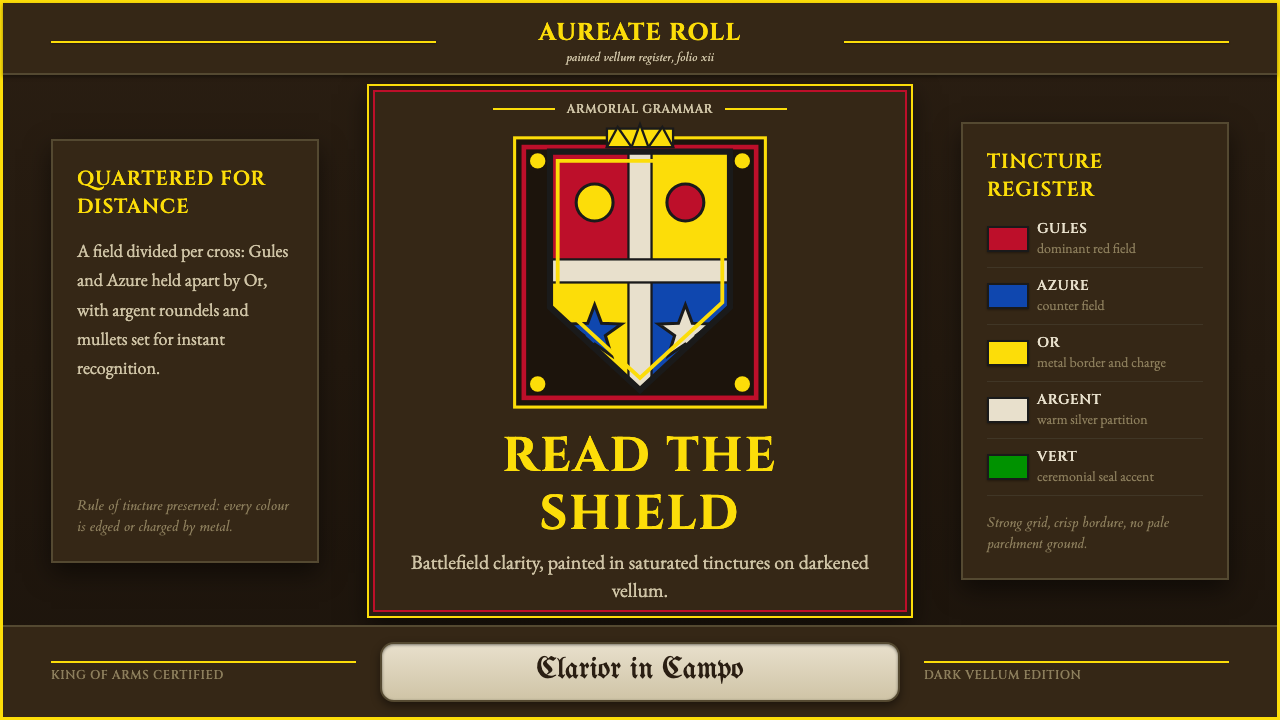 Heraldic BlazonCommand at a glance. Gules, Azure and Or quartering lock into a gilt shield o…
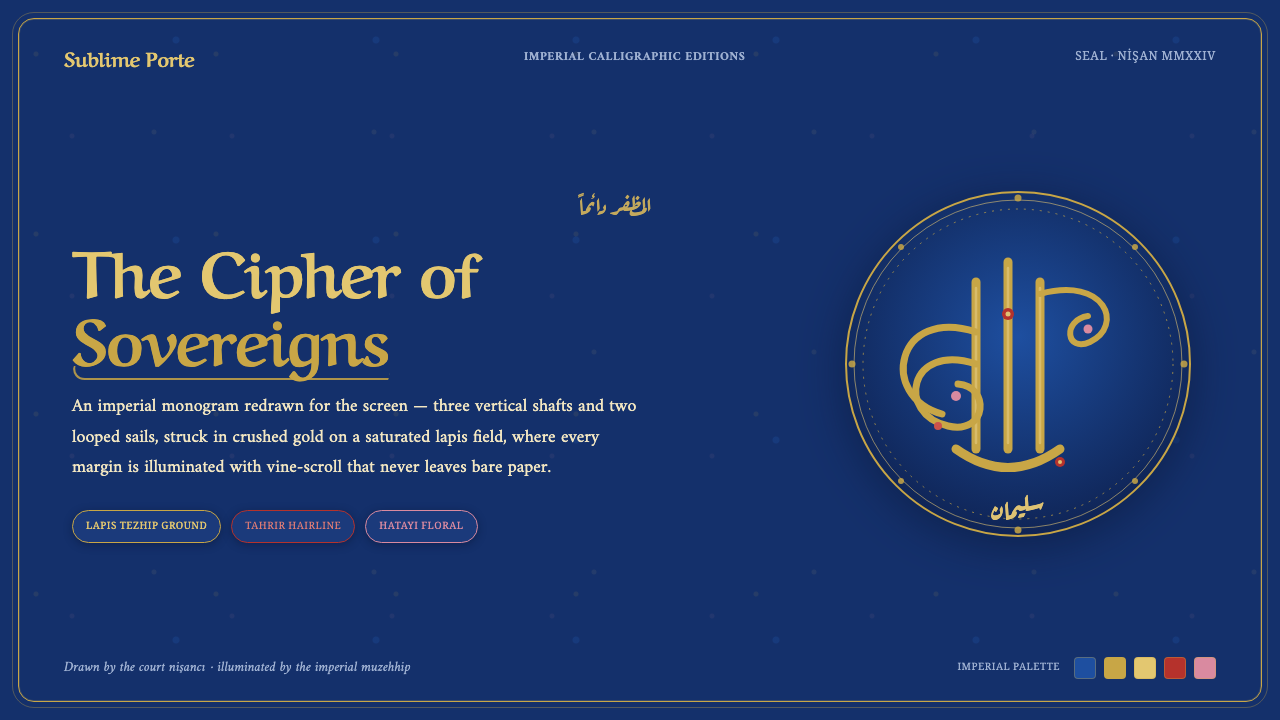 Ottoman Tughra SealEvery surface is a state seal. Gold tughra cipher on lapis, Aref Ruqaa script…