What is Saudi Asiri Qatt Wall Painting?
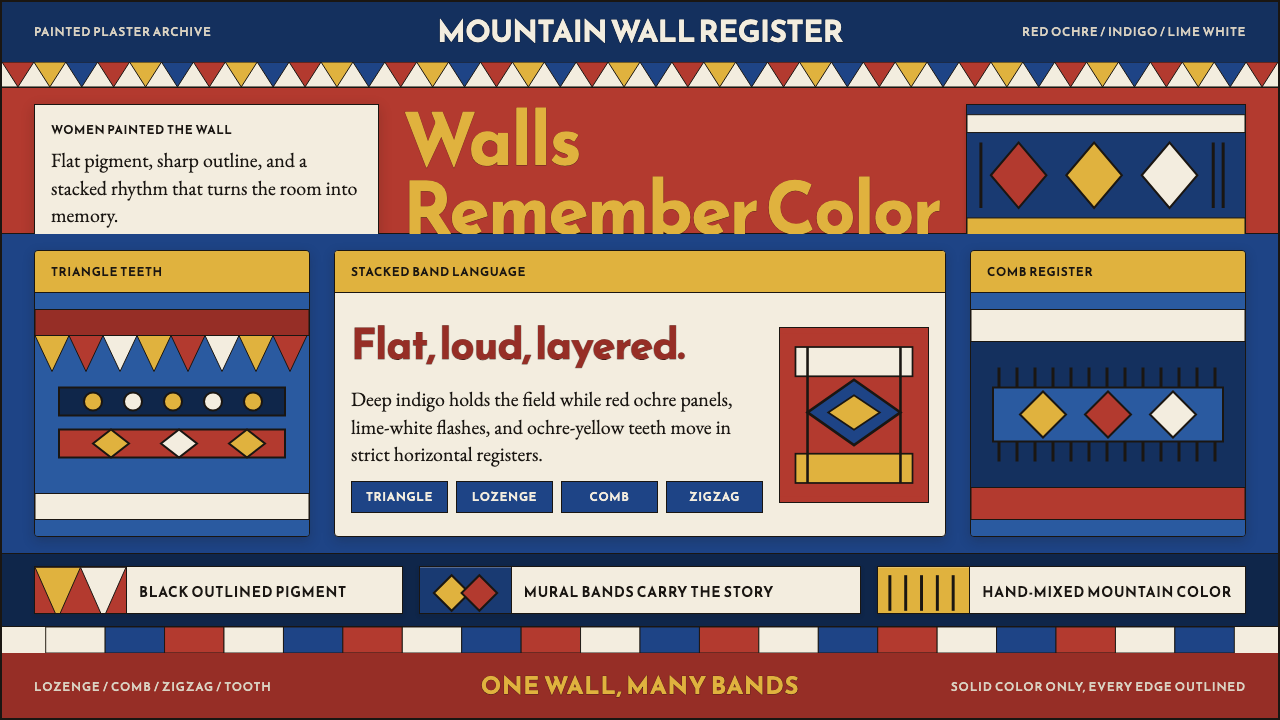
In the mountain villages of southwestern Saudi Arabia, women have painted their walls with stacked bands of triangle, lozenge, and zigzag for generations — a tradition so vital it earned UNESCO recognition in 2017.
Saudi Asiri Qatt Wall Painting in brief
Al-Qatt al-Asiri is the geometric wall-painting tradition of Asir province, the mountainous southwestern corner of Saudi Arabia. Women of the region — particularly in multi-story stone houses clustered in villages like Rijal Almaa — transform interior plaster walls into dense horizontal bands of repeating motifs: triangles, lozenges, combs, zigzags, and stepped diamond forms. The composition runs floor to ceiling, band stacked upon band, with each register bordered by a sharp black outline that separates fields of saturated color. The overall effect is loud, exuberant, and entirely deliberate.
The visual language of Qatt painting is geometric in the strictest sense: every mark is angular, repeated, and rhythmically interlocked. There are no representational figures, no botanical curves, no calligraphic flourishes. Color is applied in flat, opaque fields — deep indigo grounds, red ochre surfaces, ochre-yellow accents, and lime-white highlight bands — with black contour lines defining every boundary. The palette is mountain-bright and hand-mixed, drawn historically from locally available mineral pigments. Nothing softens, blends, or fades; the walls announce themselves.
Qatt is emphatically a women's practice. It is passed down from mother to daughter within households, each family accumulating its own repertoire of motifs and color combinations. Painting is done freehand, without templates or mechanical guides, which means no two walls are identical even when they share the same vocabulary of forms. The tradition belongs to domestic space — reception rooms, sleeping chambers, the walls that define a home's interior life — and carries social meaning as an expression of a household's identity, prosperity, and care.
Where does Saudi Asiri Qatt Wall Painting come from?
The precise age of Qatt painting is difficult to establish because the medium — hand-mixed mineral pigments applied to interior plaster — does not survive in datable archaeological contexts in the way that ceramics or inscriptions do. Oral tradition and the regional distribution of related geometric decorative practices suggest roots that pre-date the Islamic period, though the tradition as documented in the twentieth century is fully integrated with the social and religious life of Asiri Muslim households. The UNESCO nomination process, completed in 2017, acknowledged this long history while focusing on the living practice.
The Asir region's relative geographic isolation — steep mountain terrain, limited road access until the mid-twentieth century — helped preserve the tradition against outside influence and commercial disruption. Stone tower houses, some rising five or six stories, were built for defense and prestige; their interiors were the primary canvas for Qatt painting. The paintings were not permanent installations but were refreshed for significant occasions — weddings, the birth of a child, the return of a family member from pilgrimage — giving the tradition a cyclical, living character rather than a monumental one.
Key figures associated with the tradition's recent documentation and preservation include Fatima Abou Gahas, a Qatt practitioner whose work has been photographed and exhibited internationally, bringing the form to audiences far outside Asir province. Khaled Al-Qahtani has worked on documenting and contextualizing the tradition's visual grammar, helping to articulate how the motif system operates. Effat Fadag represents a generation of practitioners navigating the tradition's continuity at a time when its practice is under pressure from changed domestic architecture and modernized building materials that replace traditional plaster with surfaces less suited to mineral-pigment painting.
In 2017, Al-Qatt al-Asiri was inscribed on UNESCO's Representative List of the Intangible Cultural Heritage of Humanity — the same list that includes practices such as the Mediterranean diet and Japanese Noh theater. The inscription brought international attention to a tradition that had previously circulated primarily among specialists in Arabian Peninsula material culture and among the Asiri communities themselves. The UNESCO recognition also prompted new institutional interest in documentation, training programs, and efforts to adapt the visual vocabulary to new surfaces and contexts without severing its connection to the living households that originated it.
What defines the Saudi Asiri Qatt Wall Painting look?
Stacked Horizontal Bands
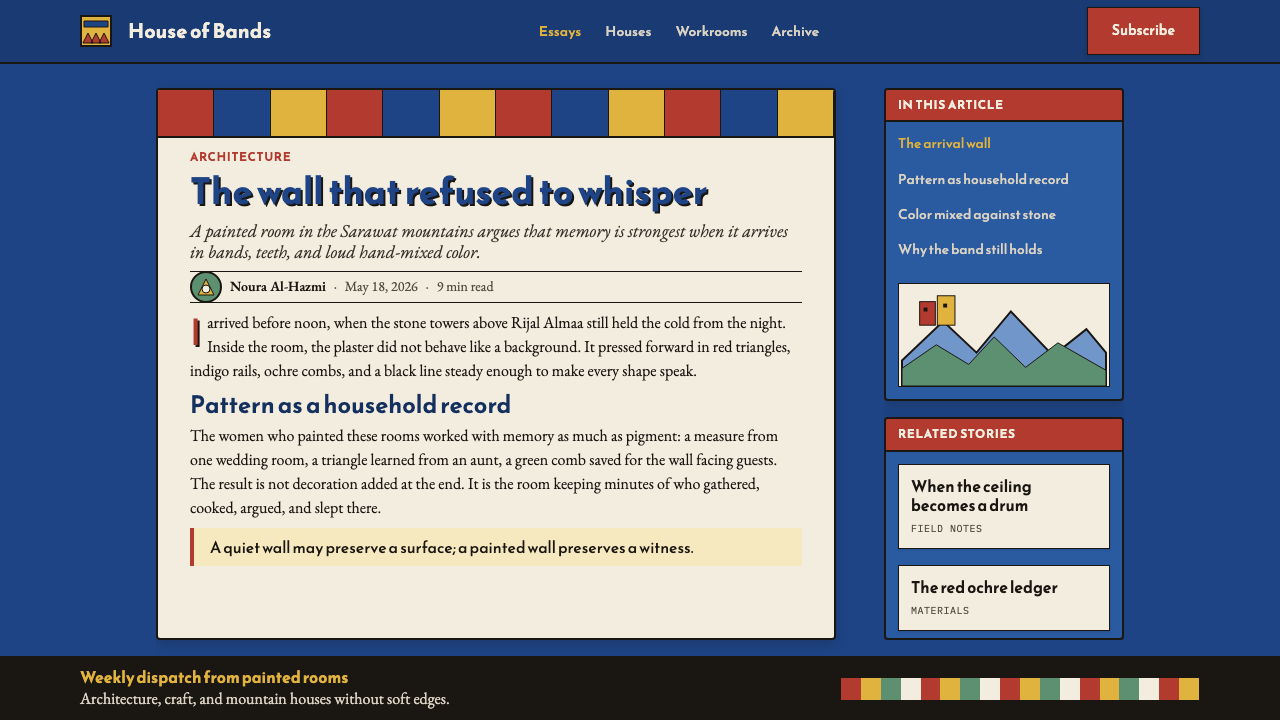
The defining compositional structure of Qatt painting is the horizontal band, repeated from floor to ceiling. Each band contains a single repeating motif — rows of triangles, zigzag teeth, diamond grids, or comb forms — and is separated from neighboring bands by a thin black line. The bands do not blend or transition; they stack like registers in a hieroglyphic inscription, each self-contained and equally weighted. The wall becomes a dense typographic column of pattern rather than a single image.
Hard Geometric Motifs
Every form in the Qatt vocabulary is strictly angular: the isosceles triangle, the lozenge, the stepped diamond, the comb (a row of short vertical teeth projecting from a baseline), and the zigzag. Curves are absent. Diagonal lines are used to construct triangles and lozenges but never appear as freestanding curves or arcs. This geometric strictness is not a technical limitation — it is a deliberate aesthetic commitment to the language of pattern rather than representation or naturalistic ornament.
Mountain Palette
The canonical Qatt palette draws on mineral pigments historically available in the Asir highlands: a deep indigo that functions as ground or shadow register, a red ochre that gives the tradition its characteristic warmth, an ochre-yellow used for accent bands, and lime-white for the brightest highlight registers. All four colors are applied flat and opaque, without mixing or blending. Black is used exclusively for outlines. The palette is warm overall — earth and mineral rather than synthetic — but bold rather than subtle, with high contrast between neighboring registers.
Black Outline as Structure
Every color field in a Qatt painting is bounded by a black outline. These outlines are not added as decoration — they are the structural skeleton of the composition. They separate triangles from their ground, define the precise width of each band, and give the whole surface its graphic clarity from a distance. The outlines also provide a visual rhythm independent of color: even in a black-and-white photograph, the structural logic of a Qatt wall reads clearly as a pattern of bounded registers.
Freehand Precision
Qatt painting is produced without mechanical guides, stencils, or printed templates. Practitioners develop their precision through years of practice, learning to draw repeated triangles and zigzags at consistent size and spacing using only eye, hand, and experience. This means that while the motifs are strictly geometric, they carry a quality of handmade rhythm — a slight variation in triangle height, a subtle asymmetry in a comb row — that distinguishes authentic Qatt painting from mechanical reproduction of the same forms. The imprecision is the presence of the maker.
Maximalist Coverage
Qatt walls are not accented; they are saturated. The painting tradition does not leave blank plaster as negative space or breathing room — it fills the entire wall surface from baseboard to ceiling beam, band upon band, with no register left empty. This maximalism is the opposite of sparse modernist interior decoration. It reads as abundance, celebration, and mastery: a fully painted interior is a statement of the painter's skill and the household's investment in beauty.
Domestic and Festive Scale
Unlike monumental public murals, Qatt painting operates at domestic scale — the width of a room, the height of a story. Its intended viewers are household members and guests, not distant passersby. The tradition is also tied to festive occasions: walls are repainted for weddings, births, and other significant milestones rather than maintained as permanent fixtures. This gives the style a quality of concentrated effort and renewed vividness, as each repainting is a fresh act of care rather than a restoration of something old.
Who shaped Saudi Asiri Qatt Wall Painting?
Fatima Abou Gahas is among the most internationally visible practitioners of Qatt painting, whose work has been documented and exhibited beyond the Asir region. Her paintings have appeared in cultural expositions and photographic surveys that introduced the tradition to audiences outside Saudi Arabia. Her visibility helped establish Qatt painting as a subject of serious curatorial attention rather than ethnographic footnote, and her continued practice represents the living transmission that UNESCO recognition sought to protect.
Khaled Al-Qahtani has contributed to the scholarly documentation of Qatt's visual grammar, helping to articulate how its system of motifs operates — which forms cluster together, how bands are sequenced, and what the internal rules of the tradition's composition actually are. This kind of systematic documentation is essential for a tradition that has always been transmitted through practice rather than written instruction, making explicit the tacit knowledge that practitioners carry.
Effat Fadag represents a generation of Qatt practitioners working in a changed environment where traditional plaster interior walls are increasingly replaced by concrete or tile surfaces that do not readily accept mineral pigments. Her practice navigates the challenge of adapting the tradition's visual vocabulary to new surfaces — paper, canvas, architectural panels — without losing the qualities that make Qatt recognizable: the flat geometry, the banded structure, the hard outlines, the saturated earth palette.
While not an individual practitioner, the 2017 UNESCO inscription of Al-Qatt al-Asiri on the Representative List of Intangible Cultural Heritage of Humanity was a pivotal institutional event for the tradition. It required the production of a formal dossier documenting the practice's history, social function, transmission methods, and the communities involved — creating a reference document that has since been widely cited. The inscription also connected Qatt to a global network of recognized living heritage, providing leverage for funding, institutional support, and international exhibition.
How do you use Saudi Asiri Qatt Wall Painting today?
Saudi Asiri Qatt Wall Painting is a high-energy, maximalist visual system. Applied well, it brings a bold geometric authority and a warm earthy richness that few other historical styles can match. Applied carelessly, it becomes visual noise — dense pattern without rhythm, saturated color without hierarchy. The key to using it productively is understanding that Qatt's apparent density is actually highly organized: every band has one motif, every motif has one direction, and the black outlines hold everything legible.
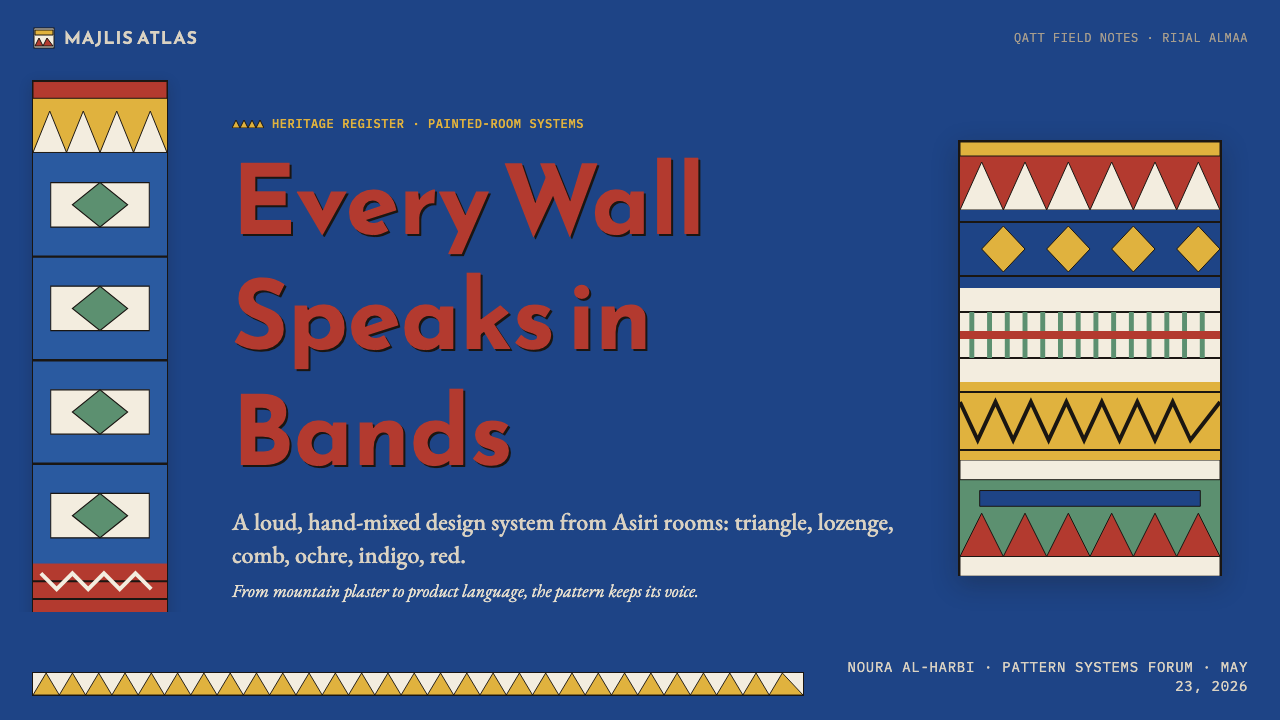
For presentation slides, the style works best on slides that are meant to make a strong impression rather than communicate complex data. A Qatt-inspired cover slide uses the deep indigo as a full-bleed background, overlays a single horizontal band of triangles or zigzags as a structural divider, and places the title in the lime-white or ochre-yellow register above it. Content slides should be treated with more restraint: pick one band of pattern as a header accent, use the earth palette for section labels, and keep the body text area free of motif density. The style suits festival programs, cultural event materials, and any presentation context where warmth and visual confidence are the primary message.
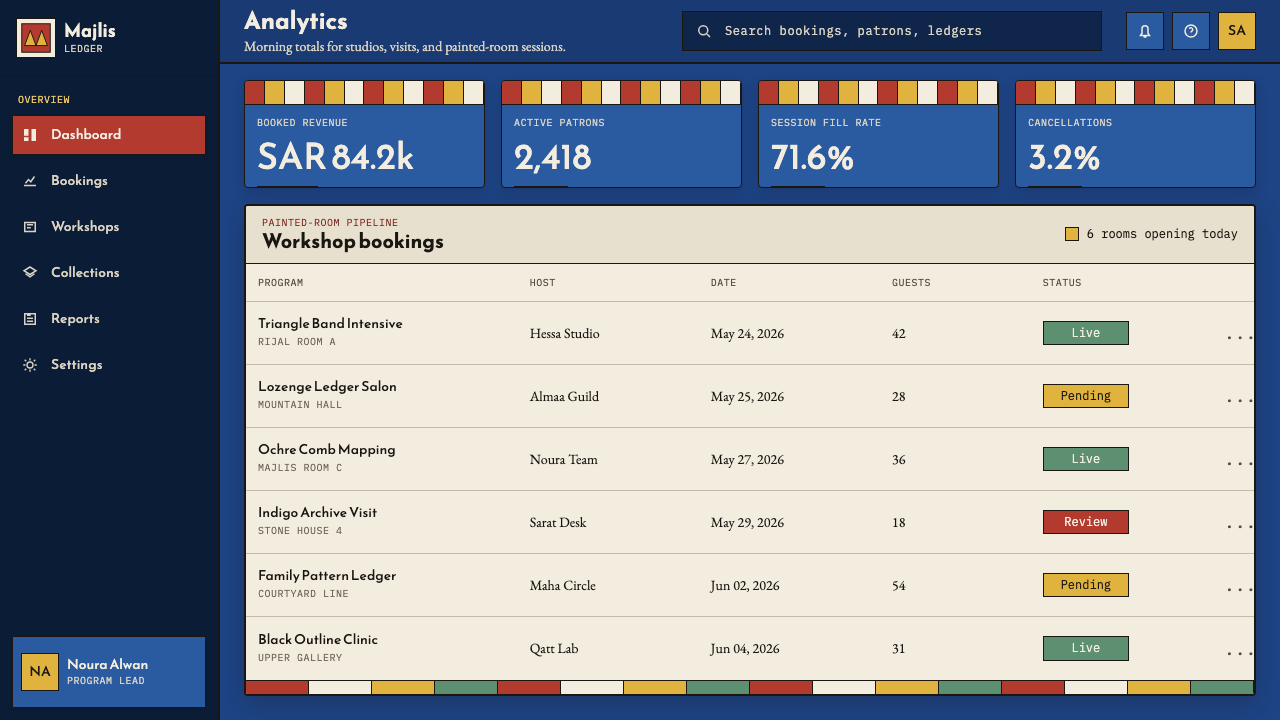
For web interfaces, the style is best suited to hero sections, landing pages, and marketing banners rather than functional dashboards or data-heavy interfaces. A Qatt-inspired hero uses banded pattern as a decorative frame — a horizontal register of triangles running across the top or bottom of a section — with a clean neutral center for text and calls to action. Navigation and body areas should use the palette's neutrals (deep indigo, cream, black) without the pattern density, letting the geometric motifs appear as accent elements rather than wallpaper. Buttons and interactive elements work well in the red ochre or indigo, with white text providing the same high-contrast clarity the tradition values.
For editorial and marketing work, the style excels in contexts associated with craft, culture, travel, and artisanal quality. A feature article on traditional architecture, a travel brand targeting the Arabian Peninsula, a cultural institution promoting regional heritage — these are natural homes for Qatt's visual vocabulary. In editorial layout, use the banded geometry as a section divider or pull-quote frame rather than a full-bleed pattern. In marketing materials, the palette's warmth and the motifs' handmade quality signal authenticity and depth in ways that synthetic or trend-driven visual systems cannot.
A common mistake when applying this style is treating it as a general-purpose exotic decoration — scattering isolated triangles across a layout without committing to the banded logic that makes Qatt legible. The tradition's power comes from compression and repetition within a register, not from individual motifs floating freely. Equally, using the full palette at equal intensity simultaneously — indigo, red, yellow, and white all at high saturation, all competing — produces chaos rather than richness. Authentic Qatt painting works because each band is internally consistent; the contrast happens between bands, not within them. Borrow that structural discipline and the style becomes both bold and readable.
Saudi Asiri Qatt Wall Painting — FAQ
Is Qatt painting the same as other Arabian Peninsula geometric art forms?
Qatt is specifically an Asiri tradition, geographically and culturally distinct from other Arabian Peninsula decorative practices. The geometric art of the Najd region to the north uses different motif vocabularies and materials; the architectural ornamentation of coastal Hijaz cities like Jeddah draws on a different history of trade and influence. Qatt is also specifically a women's interior domestic practice, which distinguishes it from the architectural carving and plasterwork found on building exteriors throughout the region. The UNESCO inscription was careful to frame it as a tradition of specific communities in Asir province, not as a pan-Arabian form.
Can this style work in digital design without looking like a costume or caricature?
Yes, but it requires restraint in where the pattern appears, not in how bold it is when it does. The mistake is scattering isolated motifs across an interface as decoration — that reads as superficial cultural borrowing. A more honest approach uses the style's structural logic: band a single register of pattern across a section break, use the palette as a genuine color system, and let the motifs appear concentrated in one zone rather than diffused everywhere. The boldness is the point; diluting it is what produces the caricature.
How does Qatt handle dark versus light backgrounds?
The tradition historically uses the deep indigo as a ground register — a dark foundation on which lighter bands of red, yellow, and white read as luminous. This is effectively a dark-background system, which makes it somewhat unusual among decorative traditions that more often use light grounds. Applying the style with a light background is possible but requires inverting some of the relationships: lime-white becomes the ground, the earth tones become the pattern, and the indigo appears as a contrast band or accent. Both approaches can work; the original dark-ground orientation produces the most dramatic depth.
Is this style appropriate for brands unconnected to Saudi or Asiri culture?
The question of cultural borrowing is real and worth taking seriously. Qatt is a living tradition with specific practitioners, communities, and cultural meaning — it is not an extinct or anonymous decorative system. Using its visual vocabulary responsibly means understanding what it is, acknowledging its source rather than presenting it as a generic 'Middle Eastern' or 'global geometric' aesthetic, and applying it in ways that do not flatten its specificity into mere exoticism. Brands with genuine cultural connections to the region have the clearest claim; other brands should ask whether the style's values — handcraft, boldness, domestic warmth, geometric mastery — align with their identity in ways they can articulate honestly.
What makes this style different from other geometric folk art traditions around the world?
Qatt shares its commitment to geometric repetition and saturated color with many folk traditions — Andean textiles, Ukrainian pysanka, Moroccan zellige, Scandinavian rosemaling — but its specific combination of features is distinctive. The strict horizontal banding as the sole compositional structure (rather than medallion, diagonal, or radial organization) is particular to Qatt. So is the use of black outline as the primary organizational device rather than as contour or detail line. And the tradition's specific status as a women's interior domestic practice — repainted for life events, alive in households rather than preserved in museums — gives it a social and temporal character that distinguishes it from traditions that have moved primarily into craft markets or decorative archives.
Related design styles
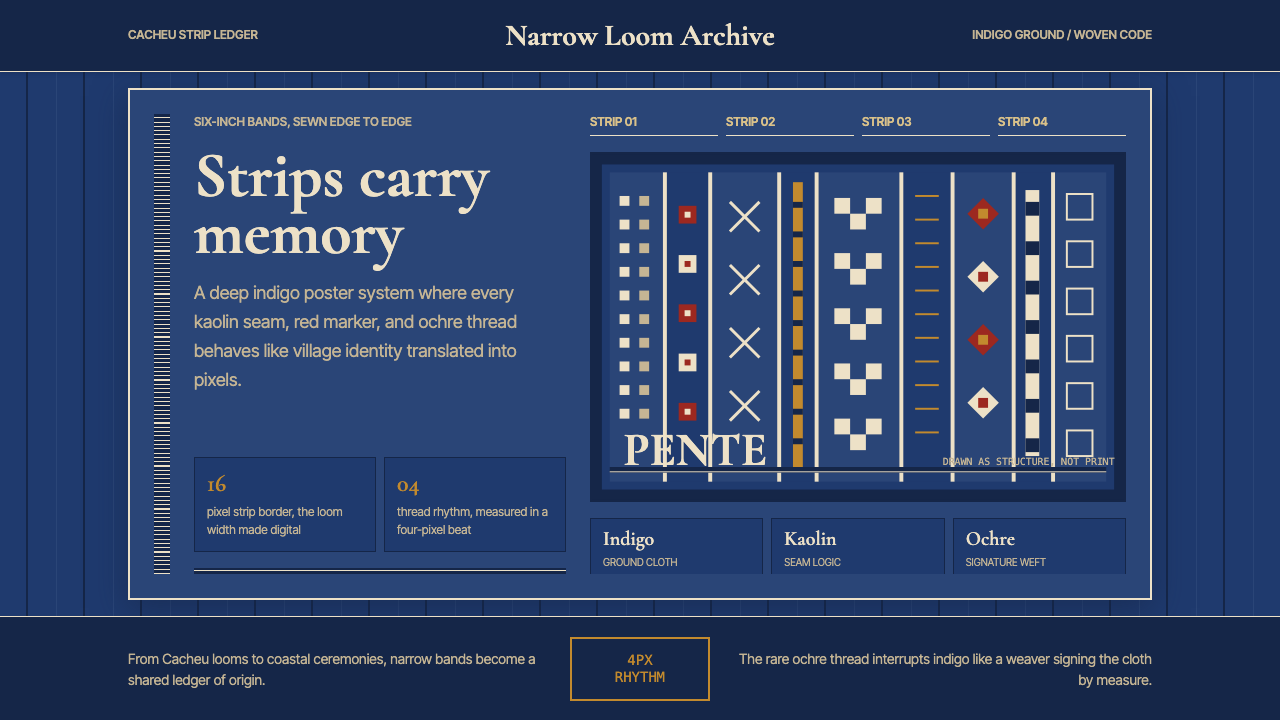 Bissau-Guinean Pano de PenteIndigo remembers. Narrow bands and kaolin seams turn weave grammar into pixel…
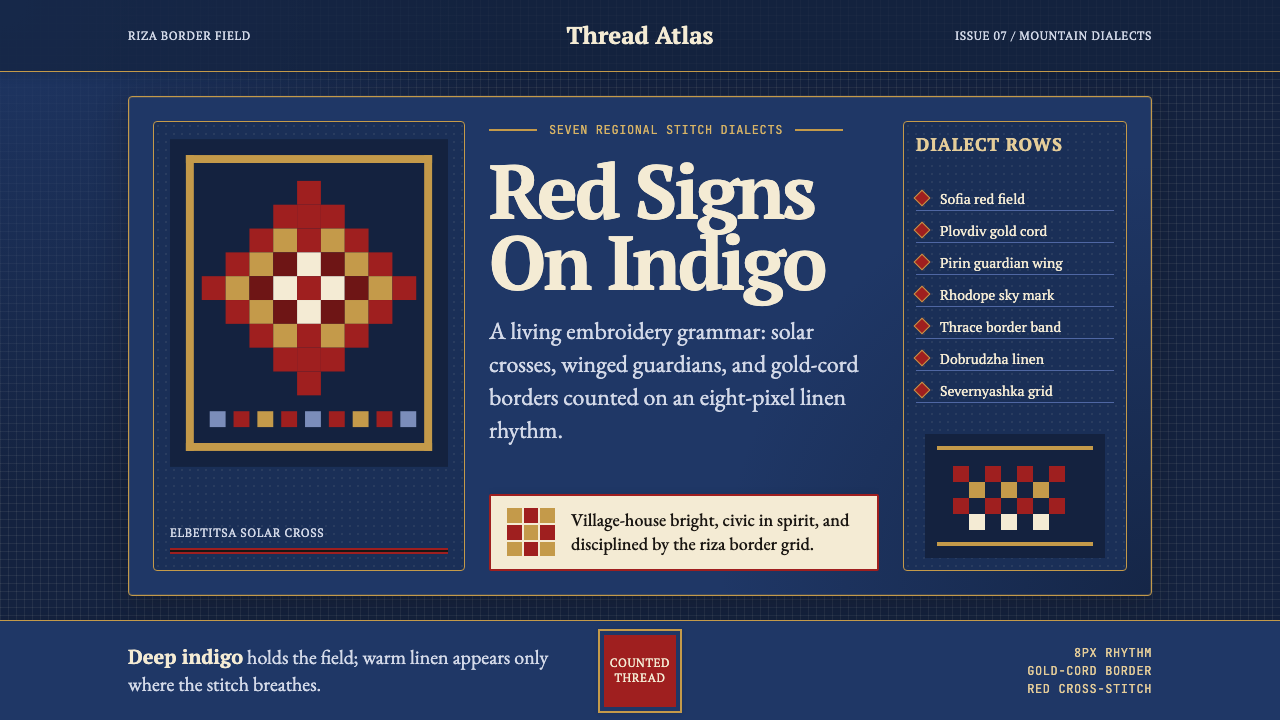 Bulgarian Shevitsa Folk EmbroideryVillage-bright code. Deep indigo carries shevitsa red crosses and gold-cord b…
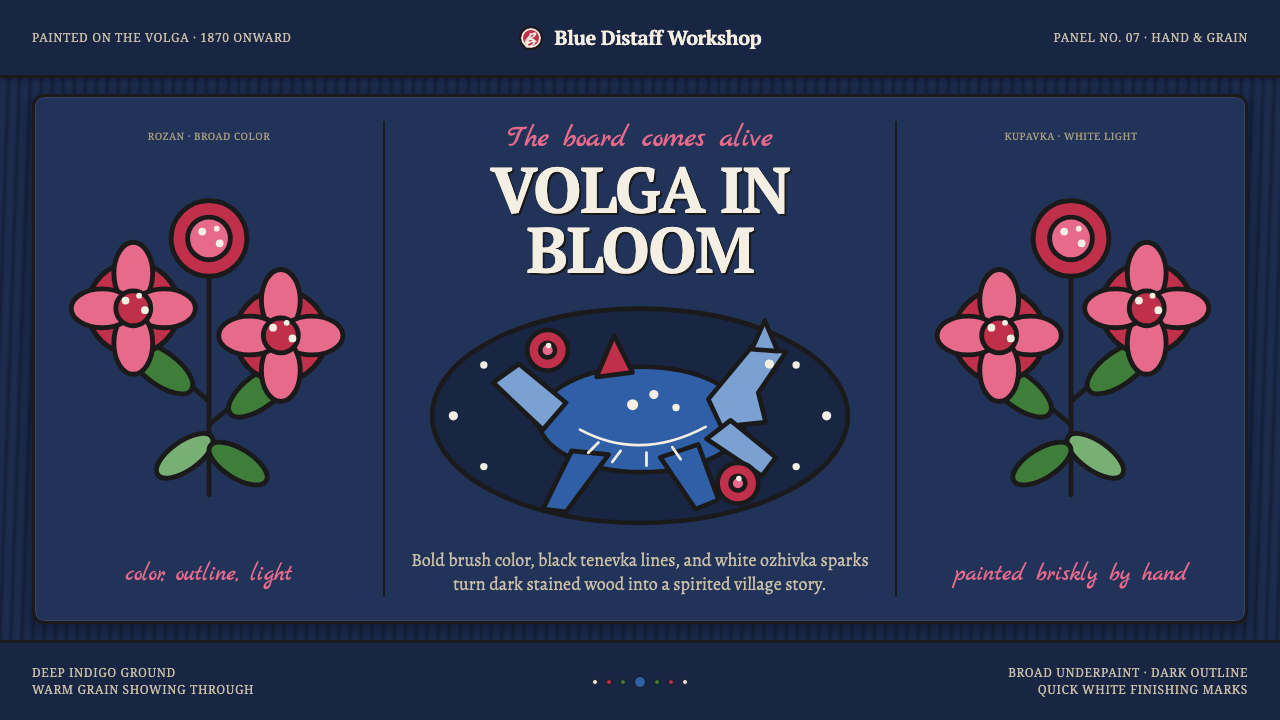 Gorodets Folk Panel PaintingFolk color moves at a gallop. Blue forms, red roses and white dots spark on i…
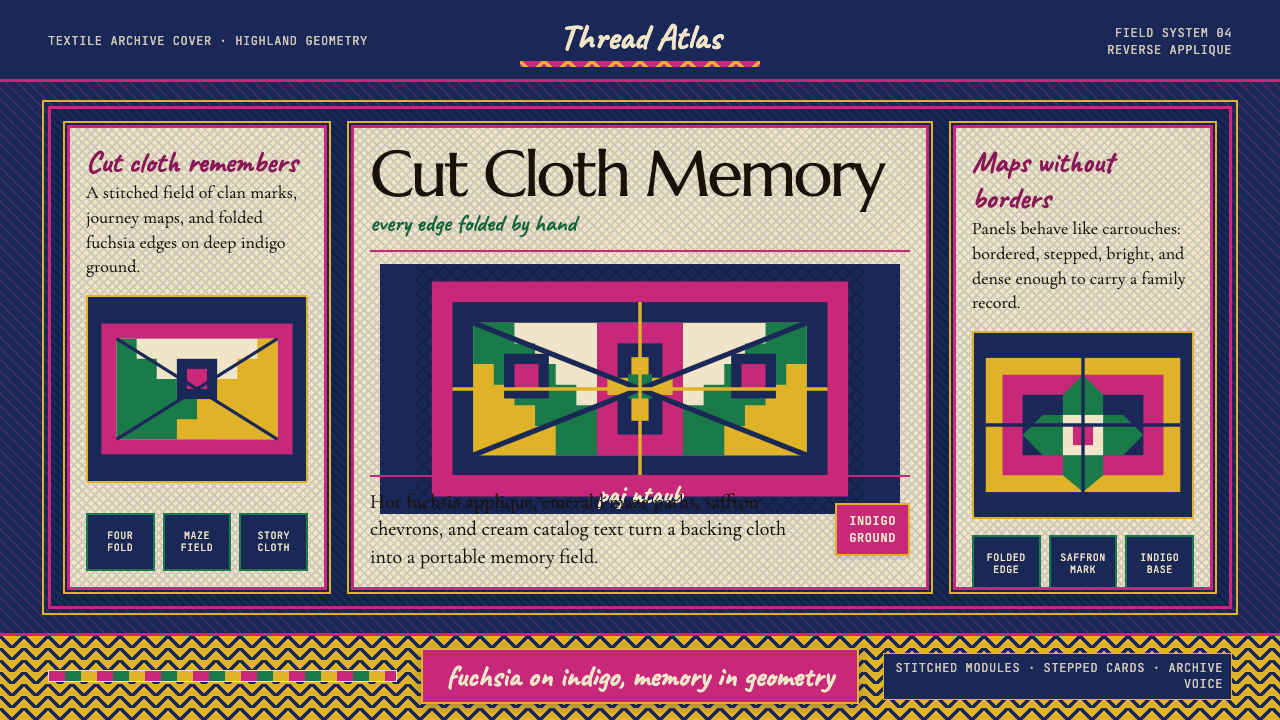 Hmong Paj Ntaub (Flower Cloth)Memory is geometric. Fuchsia applique on indigo forms stepped maze panels.
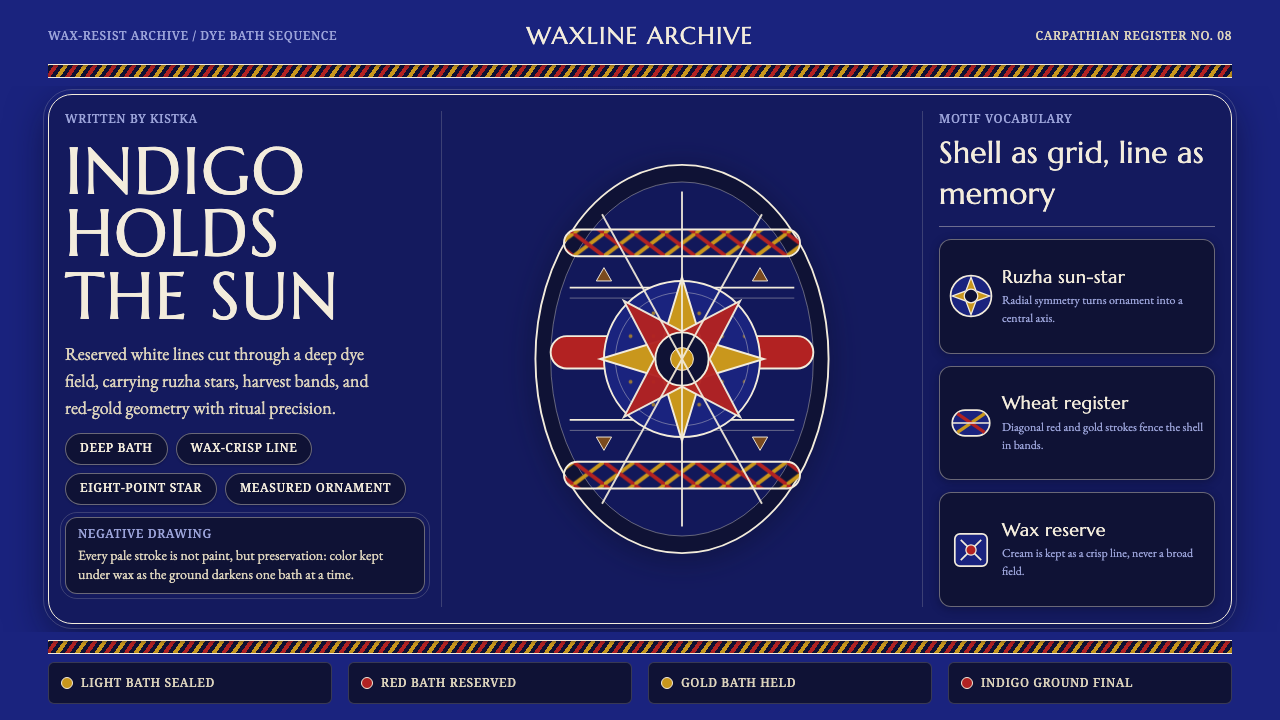 Ukrainian Pysanka Wax-Resist EggIndigo preserves ritual geometry. Wax-white lines hold red-gold stars and whe…
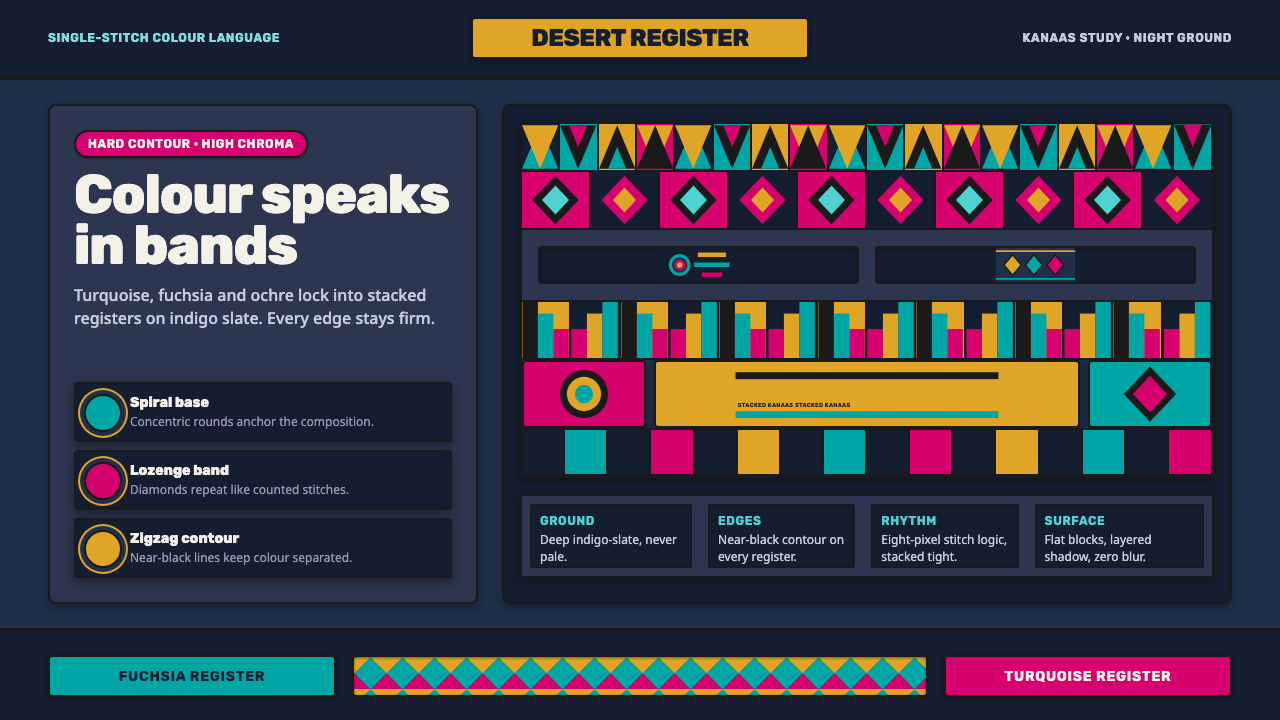 Wayuu Mochila CrochetColour speaks in bands. Turquoise, fuchsia and ochre stack on indigo-slate.