What is Qatar World Cup 2022?
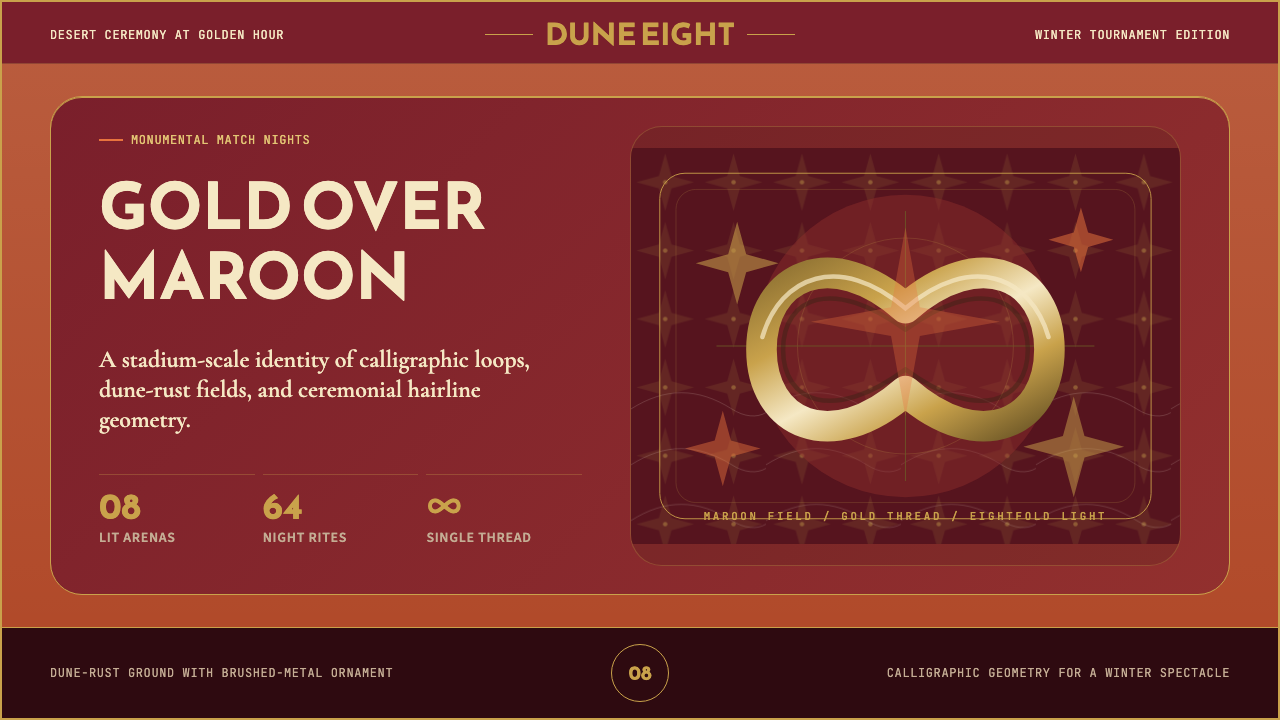
Qatar 2022 fused calligraphic infinity loops, hammered-gold surfaces, and desert-dune geometry into the most ornate and geopolitically charged visual identity in World Cup history.
Qatar World Cup 2022 in brief
Qatar World Cup 2022 is the visual identity system built around the twenty-second FIFA World Cup, hosted in Qatar from November to December 2022. It is distinguished by a deep burgundy drawn from the Qatari flag, an emblem shaped like a calligraphic figure-eight that evokes both an Arabic infinity symbol and the profile of a stadium bowl, and a supporting decorative language built from eight-pointed star geometry and desert-dune organic curves. The system was created by Lisbon-based studio Brandia Central and deployed across eight purpose-built or renovated stadiums, tens of thousands of wayfinding surfaces, broadcast graphics, and a merchandise ecosystem that reached a global audience of billions.
Unlike the clean international minimalism that had come to dominate major sporting event branding — the smooth gradients and logotype-driven identities of recent Olympic Games — Qatar 2022 chose deliberate richness. It embraced texture, layering, and ornament as cultural affirmations rather than visual failures to be corrected. The system was read by its designers and commissioners as an argument: that Arab aesthetic tradition, with its geometric complexity and calligraphic fluidity, belongs on the world stage alongside Helvetica-clean Swiss rationalism or Scandinavian restraint.
Visually, the identity operates in two registers simultaneously. At large scales — stadium facades, ceremonial banners, broadcast title sequences — it is monumental and almost architectural, with gold and burgundy deployed in saturated masses and the emblem reproduced at sizes that dwarf the human figure. At intimate scales — credential lanyards, hospitality menus, referee equipment — the same geometry becomes intricate and jewel-like, recalling the craft traditions of Islamic tilework and Arabic manuscript illumination that the system explicitly references.
Where does Qatar World Cup 2022 come from?
The formal origin of the Qatar 2022 visual identity is the emblem launched in September 2019, three years before the tournament began. FIFA and the Supreme Committee for Delivery and Legacy — the Qatari government body overseeing the tournament's construction and operations — commissioned Brandia Central to create an identity that would simultaneously function as international event graphics and as a cultural statement about Qatar's place in the global imagination. The brief was explicit: the emblem should draw on Islamic visual tradition without reducing it to stereotype, and it should be legible both in Arabic script contexts and in Latin-script broadcast environments.
The emblem's form encodes multiple symbolic layers. The central loop traces an Arabic calligraphic gesture that the designers described as representing the number eight — for the eight host cities — while also reading as an infinity symbol and as the silhouette of a stadiums' structural arc when viewed in section. Below and flanking the central form, a base element was interpreted as a trophy, a traditional Qatari headdress (the gahfiya), or stadium seating tiers depending on the viewer's cultural frame. This deliberate polyvalence — the ability of a single mark to carry different meanings for different audiences — is a characteristic ambition of major international event design, and the Qatar emblem executes it with more cultural specificity than most.
The color language was anchored in burgundy — specifically the maroon of the Qatari national flag, a color that carries a distinct weight in Gulf state heraldry. It has historical associations with pearl-diving cultures and with the ruling Al Thani dynasty's identity. Around this primary maroon, the palette assembled gold (in reference to the Gulf's oil wealth and the material register of Islamic ceremonial arts) and a white that appears most prominently in typographic contexts. Sand and warm neutral tones enter the system as secondary textures rather than structural colors, evoking the desert landscape and the vernacular earth-tone architecture of traditional Qatari buildings.
The organizational context matters for understanding the identity's visual ambition. Qatar 2022 was the first World Cup held in the Middle East and the first in a Muslim-majority country. The Al Thani government had campaigned for the tournament across fourteen years and invested what independent economists estimated at over two hundred billion dollars in infrastructure, including the construction of entirely new stadiums in a country that had hosted no major international football before. The visual identity was consciously designed to hold this weight — to be the aesthetic face of a geopolitical and cultural argument that Qatar was making about Arab modernity, Gulf soft power, and the universal hospitality of Islam. Every design decision, from the choice of calligraphic script style to the decision to use the Reem Kufi typeface for wayfinding, was embedded in this larger argument.
What defines the Qatar World Cup 2022 look?
Color Architecture
The palette is hierarchical and culturally coded. Qatari maroon — a deep burgundy — functions as the primary structural color, covering stadium seating, credential systems, and large-scale environmental graphics. Gold operates as the ceremonial register, appearing in the emblem's metallic treatments, in ceremonial banners, and in broadcast highlight sequences. White serves typographic clarity, and sand-tone neutrals provide textural warmth in secondary applications. The system deliberately refuses the clean tonal neutrality of much international sports branding in favor of a palette with explicit cultural heritage weight.
Calligraphic Emblem Form
The central emblem is structured as a continuous calligraphic gesture — a flowing figure-eight loop whose proportions derive from Arabic script writing conventions rather than from the geometric construction logic of most Western sports marks. The stroke weight varies through the loop, mimicking the thick-thin rhythm of a calligrapher's broad-nibbed pen, and the terminals taper into the pointed endings characteristic of Naskh and Thuluth script traditions. This choice of calligraphic logic over geometric logic is the identity's most culturally legible design decision.
Eight-Pointed Star Geometry
Beyond the emblem, the secondary decorative language of Qatar 2022 is built on the eight-pointed star — the Rub el Hizb and related geometric forms found throughout Islamic architectural ornament, from Moroccan zellij tilework to Anatolian muqarnas vaulting. In the Qatar system, this geometry is used as a watermark layer beneath color fields, as a structural scaffold for repeating surface patterns on merchandise and signage, and as a motif that connects the contemporary mega-event to centuries of Arab mathematical and decorative tradition. The star appears at multiple scales simultaneously, creating a fractal-like visual depth that rewards closer inspection.
Metallic Surface Treatment
A defining textural signature of the identity is the treatment of gold as a physical surface quality rather than a flat color value. Across print applications, the gold appears as brushed or hammered metal, with directional catch-light suggesting the micro-texture of worked sheet metal. This treatment is intentional: it references the material culture of Gulf goldsmithing and traditional Islamic metalwork, where hammered and engraved surfaces on ewers, trays, and incense burners communicated prestige and craft excellence. Applied to event graphics, it gives the identity a haptic quality — even on a flat printed surface, the eye perceives the suggestion of physical texture.
Wayfinding Typography
The tournament's wayfinding typography was built around Reem Kufi, an Arabic type revival designed by Khaled Hosny. Reem Kufi is a geometric Kufic typeface — rooted in the angular monumental script tradition of early Islamic inscriptions on coins, tombstones, and architectural friezes — adapted for screen and signage legibility at contemporary viewing distances. Its choice was as culturally deliberate as the emblem's calligraphic structure: it placed an authentically Islamic type tradition at the visual front of an event communicating to a global audience, rather than defaulting to the Arabic versions of international humanist sans-serifs that typically appear in multilingual wayfinding.
Dune and Desert Organic Forms
Alongside the geometric rigor of the star patterns and emblem, Qatar 2022 introduces a counterpoint of organic flowing curves drawn from desert dune formations. These undulating forms appear in stadium silhouettes, in the sweeping curve of the emblem's tail, and in graphic elements that soften the overall system. They provide breathing room against the density of geometric pattern and connect the identity to the specific physical landscape of the Arabian Peninsula — the ergs of rolling sand that surround Doha — in a way that purely geometric systems could not.
Bilingual Visual Integration
The system was designed from the outset for bilingual Arabic–English operation rather than treating Arabic as a typographic afterthought. In typographic hierarchies, Arabic and English carry equivalent visual weight; neither is subordinated to the other by size or placement. The emblem itself communicates in neither script exclusively — its calligraphic form is legible as a meaningful mark to Arabic readers while functioning as a purely abstract logo to international audiences. This bilingual parity was not merely a FIFA regulatory requirement but a central design intention of the identity's commissioners.
Who shaped Qatar World Cup 2022?
The Lisbon-based brand consultancy that created the complete Qatar 2022 visual identity, including the emblem, color system, typographic framework, and the principles governing its application across environmental, digital, broadcast, and merchandise contexts. Founded in Portugal, the studio had prior experience with national and major institutional identity projects across Southern Europe and Latin America. Their appointment to a Gulf-state mega-event commission was notable — it brought a non-Arabic design perspective into dialogue with cultural material that required deep research and close collaboration with Qatari cultural advisors. The studio's central creative achievement was embedding genuine calligraphic logic into the emblem's construction rather than approximating it geometrically.
Secretary General of the Supreme Committee for Delivery and Legacy, and the Qatari government official most visibly associated with the tournament's overall vision. Al Thawadi was the central spokesperson for Qatar's bid through fourteen years of campaigning and controversy, and he served as the primary client-side voice shaping what the World Cup's identity should communicate culturally and politically. His public statements consistently framed the tournament as an opportunity to demonstrate Arab hospitality, Islamic values of welcome, and Qatar's capacity to organize an event of global complexity — all values the visual identity was tasked with expressing.
Egyptian type designer and software developer who created Reem Kufi, the geometric Kufic Arabic typeface adopted for Qatar 2022 tournament wayfinding. Hosny is a figure in the open-source Arabic typography movement, and Reem Kufi is distributed as an open-source font. Its selection for the World Cup brought a typeface rooted in the angular epigraphic traditions of early Islamic inscriptions into a contemporary mass-visibility context — one of the highest-profile deployments of a geometric Kufic revival in modern event design. Hosny's work represents a broader project of reviving and adapting historically significant Arabic script traditions for contemporary digital and wayfinding use.
Norman Foster's London-based architectural practice designed the Al Bayt Stadium — one of the eight Qatar 2022 venues — whose tent-like structure directly inspired the silhouette motifs in the identity system. Al Bayt's swooping fabric canopy, modeled on the bayt al sha'ar (the traditional Bedouin tent), provided the curvilinear counterpoint to the identity's geometric patterns and became one of the tournament's most photographed architectural symbols. The dialogue between the architectural forms of the venues and the visual language of the brand is tighter in Qatar 2022 than in most World Cup identities.
The Qatari government body responsible for delivering the infrastructure and operational systems for Qatar 2022, and the primary client organization for the visual identity commission. Established in 2011, two years after Qatar won the bid, the Supreme Committee oversaw the construction of eight stadiums, an expanded metro system, hundreds of kilometers of new road infrastructure, and the complete hospitality and wayfinding ecosystem for which the visual identity was designed. Their identity brief was unusual in the degree to which it specified cultural authenticity requirements — not merely visual preferences — reflecting the political stakes attached to the tournament's self-presentation.
How do you use Qatar World Cup 2022 today?
Qatar 2022's visual language is applicable beyond sports event design, but it demands a careful understanding of what makes it work: the system succeeds because it operates through authentic cultural grammar, not merely through the surface effects of gold color and geometric pattern. Borrowing the surface effects without that underlying logic produces decoration, not design. The most valuable insight the system offers contemporary designers is not its palette but its demonstration that ornamental complexity can be structurally rigorous.
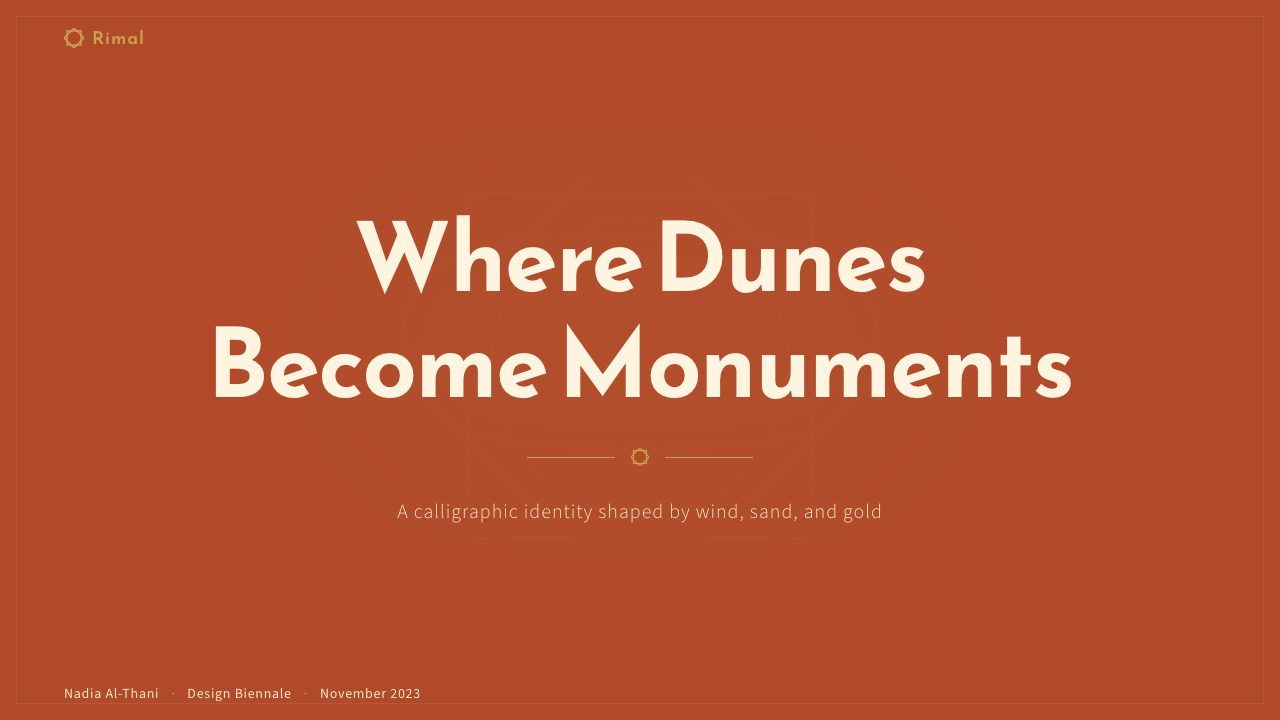
For presentation slides, the Qatar aesthetic works well on high-stakes ceremonial or institutional contexts — launch decks, annual reports, cultural institution presentations — where visual richness signals investment and authority. A cover page benefits from the deep burgundy field with a gold-treated central emblem or wordmark; supporting geometry in the eight-pointed star form can function as a full-bleed background watermark. Content slides should reduce the color range dramatically: burgundy for headings, near-black or very dark neutral for body, with gold as a single accent reserved for data callouts or key statistics. The common mistake is filling content slides with the same density of decoration as the cover — the rich surface pattern belongs to ceremonial contexts, not information-dense ones.
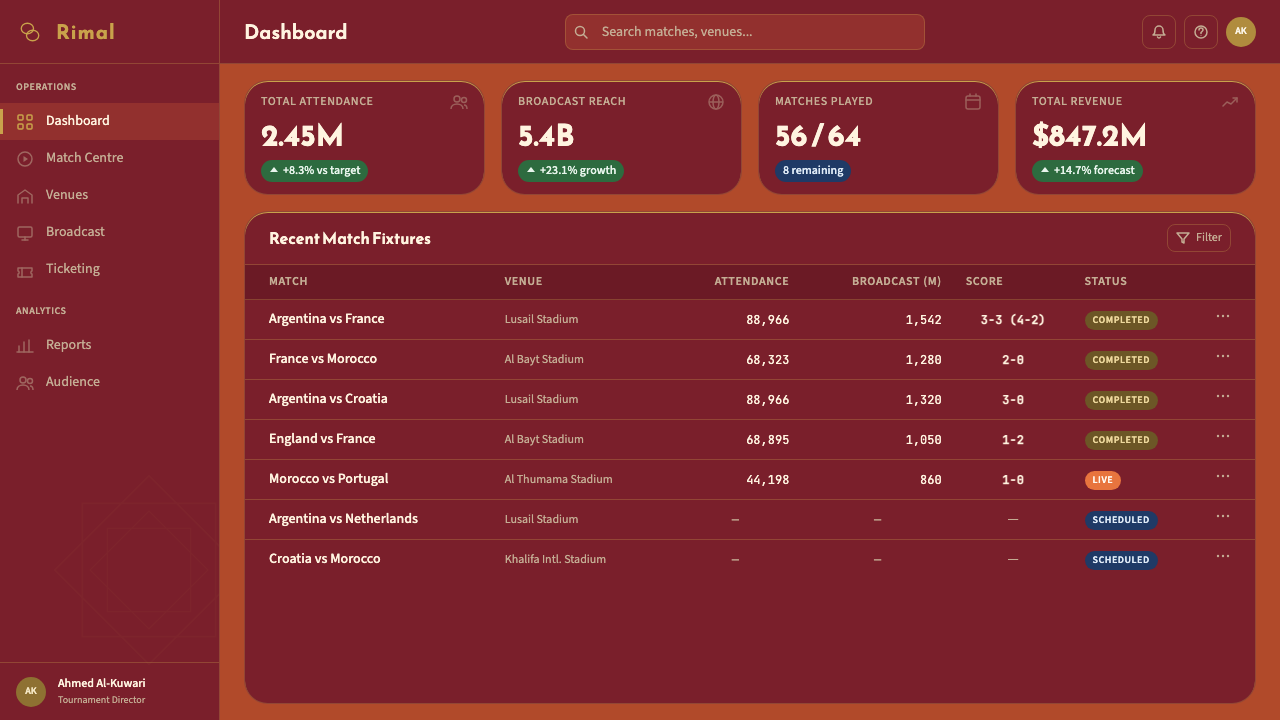
For web interfaces and dashboards, the system translates best when treated as an art direction reference rather than a literal template. Pull the color hierarchy — primary rich dark, secondary gold as accent, white or near-white for readable fields — and use the geometric vocabulary sparingly as a motif in non-interactive areas. Navigation bars, section dividers, and background tiles can carry a low-opacity star pattern; interactive elements — buttons, inputs, data visualizations — should remain clean to preserve usability. The metallic gold should appear in typographic accents or static hero elements only; hover and active states work better with tonal shifts within the primary dark.
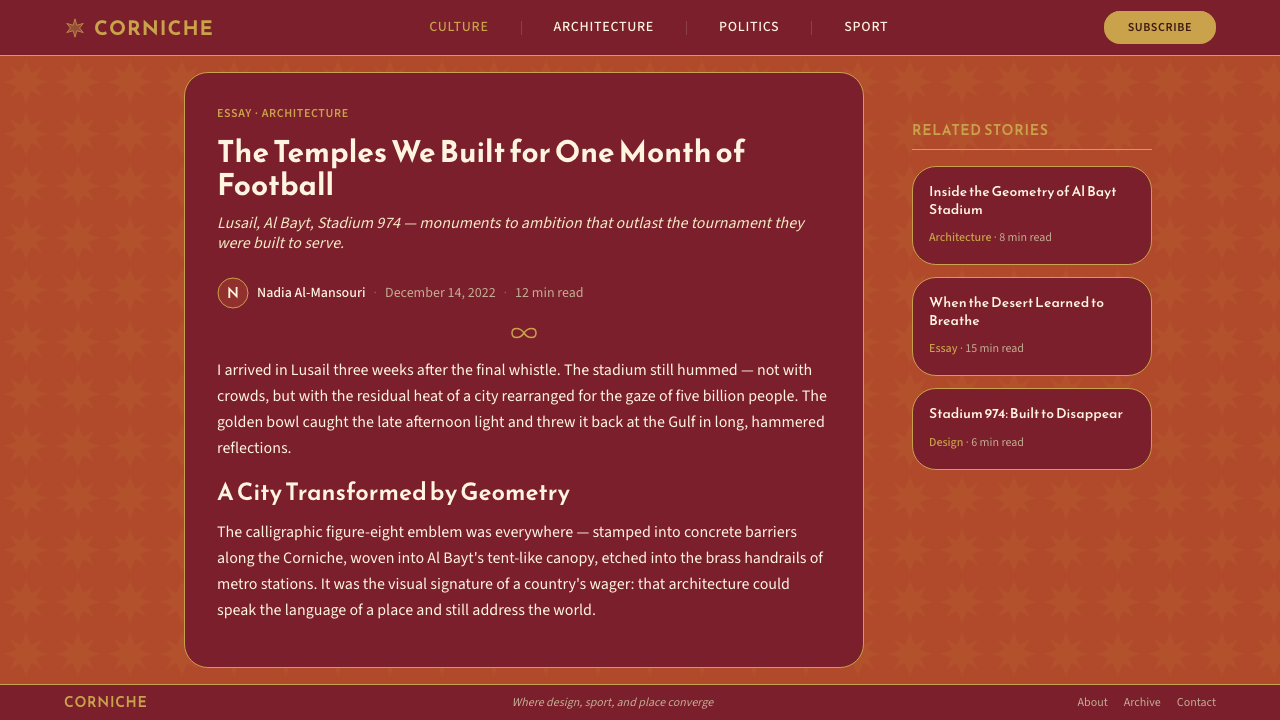
For editorial and marketing work, the Qatar 2022 register is especially effective for content celebrating cultural specificity, heritage brands, or events with ceremonial weight. Feature story layouts can use a full burgundy cover field with reversed-out gold or white type, then transition to a light-background interior treatment where the geometric motifs appear as subtle structural dividers. Marketing pages for luxury, cultural institution, or government communications can adopt the layered metallic richness of the system directly — provided the design is produced at sufficient quality that the metallic treatments read as material rather than as flat screen color.
The most common misapplication is treating the identity as a generic 'Middle Eastern aesthetic' shorthand — deploying the geometric patterns, the gold, and the calligraphic gesture in contexts unrelated to any actual cultural engagement with the traditions they reference. The Qatar system works because it is specific: specific calligraphic tradition, specific flag color, specific architectural heritage, specific typeface choice. Designers applying it as a generic 'richness' or 'luxury' signal, detached from its cultural roots, produce work that reads as pastiche at best and as appropriation at worst. The productive application is to use the system as a model for how to develop culturally grounded visual density rather than as a set of transferable surface effects.
Qatar World Cup 2022 — FAQ
Is Qatar 2022's visual style specific to sports events, or can it work in other contexts?
It is not sports-specific. The visual grammar of Qatar 2022 — calligraphic emblem forms, geometric star patterns, layered metallic surfaces, and a palette anchored in a strong national color — belongs to the broader tradition of Gulf-state ceremonial design, which predates and will outlast any single sporting event. These conventions appear in the visual identity of Qatari, UAE, Saudi, and Bahraini government institutions, in luxury hospitality design across the Gulf, and in the ceremony design of major Islamic commemorations. Designers working with any of these institutional or cultural contexts can draw on the system productively.
How does Qatar 2022's approach to ornament differ from 'maximalism' in contemporary design?
Contemporary maximalism tends to accumulate visual elements for expressive or ironic effect — layering patterns, typefaces, and colors in ways that deliberately exceed readability or compositional harmony. Qatar 2022's ornamental density is structurally different: every decorative element has a cultural source, a geometric logic, and a hierarchical place within the system. The eight-pointed star pattern does not appear because it is visually busy but because it carries specific resonance in Islamic geometric tradition. The discipline of the system is invisible from a distance but rigorous in practice — knowing which forms to include is as important as knowing which to exclude. This is structured richness, not accumulated excess.
Why was a Portuguese studio chosen to design the identity rather than an Arab or Gulf-based one?
FIFA's selection process for major event identities typically involves an international pitch, and Brandia Central won the commission on the strength of their work and their proposed creative direction. The selection was not uncontroversial — it drew commentary from design critics who noted the choice of a European studio to represent Arab cultural heritage. The studio addressed this by conducting extensive research trips to Qatar, working with Qatari cultural advisors throughout the process, and grounding every design decision in documented cultural references rather than generalized 'Middle Eastern' aesthetics. The resulting identity is generally regarded as a culturally literate outcome, though the debate it sparked about who should tell whose visual story remains alive in design discourse.
How does the Qatar 2022 identity handle the tension between Islamic decorative tradition and a global audience unfamiliar with its grammar?
The system resolves this tension through the layered reading principle: every element communicates at two levels simultaneously. To an audience familiar with Islamic visual grammar, the eight-pointed star is a Rub el Hizb, the script is recognizable as Kufic in the geometric tradition, and the calligraphic emblem reads as a culturally embedded mark. To an audience unfamiliar with that grammar, the same emblem reads as an elegant abstract logo, the star patterns as sophisticated decorative geometry, and the overall register as ceremonial richness. This dual legibility is not accidental — it is a core design strategy. The mark does not require cultural knowledge to function, but it rewards it.
Can this visual language be applied to digital products, or is it fundamentally a print and environmental system?
The system was designed with broadcast graphics and digital applications in mind alongside print and environmental design, so it has genuine digital DNA. The metallic treatments translate to screen through carefully managed highlight and shadow ranges rather than literal screen-rendered metallics, which tend to look synthetic. The geometric patterns work well as SVG elements in web contexts, where they can animate subtly without becoming distracting. The primary challenge for digital applications is color: the deep burgundy and metallic gold can look heavy or muddy on lower-quality screens. The solution used in Qatar's own digital properties was to lighten the neutral grounds, increase the contrast between color fields, and treat the gold as a typographic accent rather than a background fill in screen contexts.
Related design styles
 Met GalaTheatrical reverence. Aubergine velvet, cream stock, and Bodoni gold foil fra…
 Art Deco Jazz AgeJazz Age glamour. Sunburst rays, stepped ziggurats, gold on black — Chrysler…
 Spanish Flamenco PosterPassion printed as ritual. Blood red, ivory paper, Didone type, and flat gold…
 Argentine Malbec WineAltitude turned austere. Burgundy panels, engraved Garamond, oxidized copper.
 Corridos TumbadosOpulence with dust on it. Sepia leather, blackletter, and antique-gold foil f…
 Egyptian Political PosterState power shouts. Red poster grids, black keylines, kufic type, gold-green…