What is Mob Wife Aesthetic?
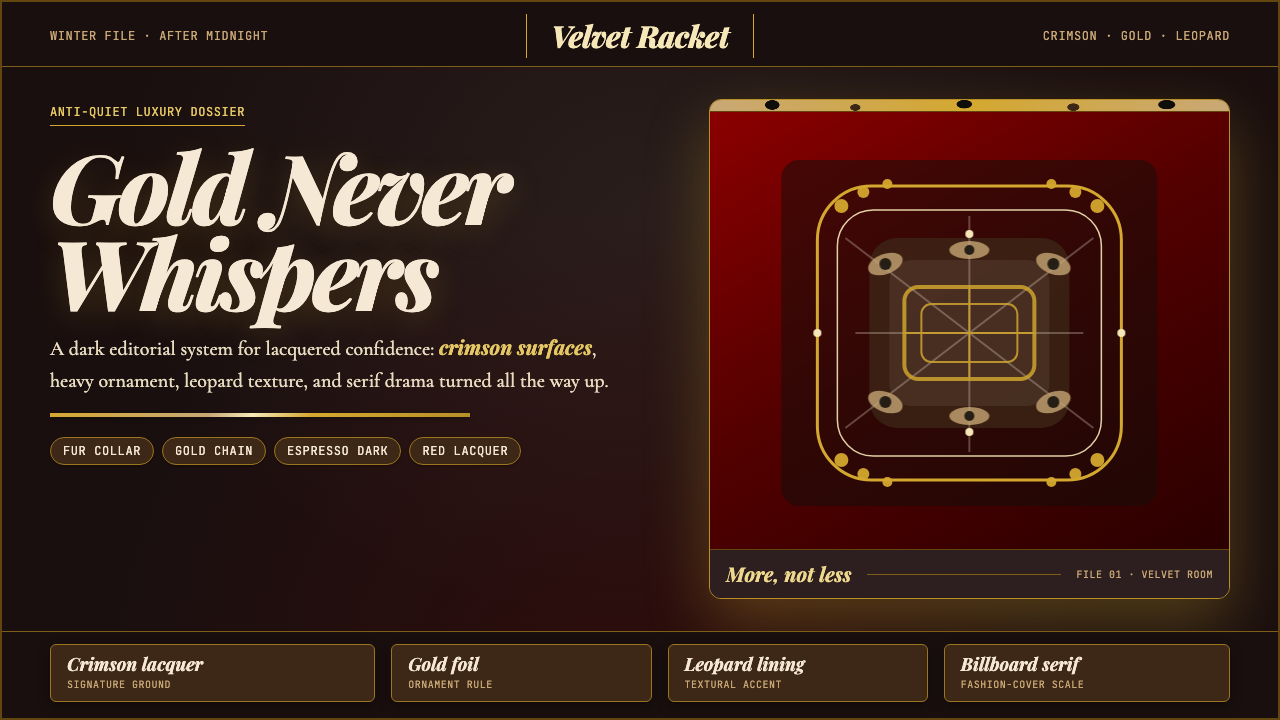
Mob Wife Aesthetic is the unapologetic maximalist counter-movement that declared fur, gold, and leopard print the only honest response to a decade of beige minimalism.
Mob Wife Aesthetic in brief
Mob Wife Aesthetic is a maximalist visual style that surfaced on TikTok in January 2024, rapidly spreading across fashion, interior design, and digital media. Named and popularized by creator Kayla Trivieri as a direct antidote to Clean Girl minimalism, it draws its vocabulary from the Italian-American screen glamour of the 1990s — specifically the wardrobes and attitudes of characters like Carmela Soprano from The Sopranos and Karen Hill from Goodfellas. The defining mood is unapologetic opulence: heavy gold jewelry, fur-trimmed coats, deep crimson lacquer, leopard print, and an overall refusal to be subtle.
As a design language, the aesthetic translates that cultural energy into a coherent visual system built on dark, jewel-toned and lacquered surfaces, gold-foil ornamental detail, dramatic Didone serif typography set at bold, commanding scales, and richly layered photographic texture. The palette runs toward deep reds, near-blacks shot through with warmth, burnished golds, and animal print patterns. Every compositional decision pushes toward more presence, not less — a foundational inversion of the restraint-as-virtue principle that dominated digital design in the preceding decade.
Though it arrived as a fashion and lifestyle moment, Mob Wife Aesthetic carries genuine design system coherence. It is not mere nostalgia or pastiche; it is a deliberate reclamation of glamour as a legitimate expressive register, one that has found traction in luxury branding, editorial photography, hospitality visual identity, and high-end digital product interfaces where warmth, richness, and cultural specificity are desired rather than avoided.

Where does Mob Wife Aesthetic come from?
The immediate origin is a single TikTok moment. In early January 2024, creator Kayla Trivieri posted a video framing Mob Wife Aesthetic as the deliberate rejection of the Clean Girl trend that had dominated aspirational lifestyle content since roughly 2022. Clean Girl — characterized by slicked-back buns, bare skin, neutral earth tones, and a studied nonchalance about visible effort — had by late 2023 begun to feel culturally exhausted. Trivieri's reframe was immediate and viral: instead of quiet, loud; instead of neutral, saturated; instead of restraint, excess. The video sparked a naming moment that crystallized a visual sensibility many creators had been building toward independently.
The deeper source is the Italian-American popular culture of the 1990s, particularly the prestige television and film that dramatized organized-crime-adjacent New Jersey and New York communities. The Sopranos (1999–2007) is the central reference — not for its subject matter but for its visual production design. Carmela Soprano's home, wardrobe, and personal presentation embodied a specific strain of aspirational working-class luxury: designer labels worn at maximum visibility, gold jewelry layered heavily, interior spaces decorated with theatrical abundance. Lorraine Bracco, Aida Turturro, and Edie Falco each brought versions of this aesthetic to screen. Martin Scorsese's Goodfellas (1990) is a parallel touchstone, particularly in its costuming and the visual grammar of Karen Hill's apartment and wardrobe.
These screen references themselves were grounded in a real subculture. Italian-American communities in New York and New Jersey had developed a distinct visual identity over the postwar decades — one that absorbed Mediterranean influences (gold jewelry as tangible wealth, rich fabrics as status markers) and filtered them through American consumer abundance. This was a community aesthetic that did not share mainstream Anglo-American anxieties about visible display of prosperity. Where WASP taste codes demanded understatement, this tradition demanded statement.
The naming as an internet aesthetic microgenre in January 2024 placed Mob Wife in explicit dialogue with the taxonomy of TikTok aesthetics that had been proliferating since roughly 2020 — Cottagecore, Dark Academia, Coastal Grandmother, Quiet Luxury. Each of these named styles functioned as a shorthand for a coherent mood board, a recognizable visual grammar, and an implied set of consumer choices. Mob Wife Aesthetic's particular cultural timing gave it additional resonance: it arrived as Quiet Luxury (the understated, old-money aesthetic popularized by shows like Succession) was reaching peak cultural saturation, making the maximalist counter-position feel urgent and energizing rather than merely retro.
What defines the Mob Wife Aesthetic look?
Color Palette
The palette anchors in deep crimson and lacquered burgundy — colors that read simultaneously as expensive and dangerous. These darks are countered by burnished gold and warm champagne tones that recall jewelry and candlelight rather than sunshine or neon. Near-blacks carry undertones of warmth rather than cool neutrality. Animal print — most characteristically leopard — functions not as a color but as a texture pattern that introduces a second layer of visual complexity over the base palette. Highly saturated emerald green and chocolate brown appear as occasional accent alternatives for brands wanting the maximalist opulence without the red-and-gold literalism.
Typography
The typographic backbone is the Didone serif — a category of typeface characterized by extreme contrast between thick strokes and hair-thin hairlines, vertical axis stress, and unbracketed serifs. This style of letterform was the prestige print typography of nineteenth-century Europe, appearing on opera programs, luxury goods catalogs, and society announcements. At large display sizes, Didone type has an almost sculptural quality: the hairlines catch light like jewelry, and the stroke contrast creates visual drama without relying on color. Body text may soften to a transitional or humanist serif to maintain readability while staying within the ornate register.
Texture and Surface
Where Bauhaus insists on flatness, Mob Wife Aesthetic insists on richness. Photographic and illustrative textures — the sheen of satin, the grain of aged velvet, the pattern repeat of fur, the glint of faceted stone — are applied as surface layers that deepen visual weight. Gold-foil ornamental borders, decorative cartouche frames, and engraving-style line patterns recall the material culture of luxury print: jewelry catalogues, casino interiors, vintage Italian fashion magazines. The goal is not to simulate a specific material but to evoke the sensory experience of being surrounded by expensive things.
Composition and Density
Mob Wife layouts embrace density. Negative space is not eliminated but is filled with intent — a large headline, a decorative border, a secondary texture, a gold ornamental divider. The compositional logic is closer to editorial luxury magazine spreads or film poster design than to the minimal breathing-room layouts of contemporary digital defaults. Hierarchy remains readable — the eye is guided — but the path is lined with richness rather than emptiness. Layering is deliberate: type sits over texture, ornament frames the image, the background itself is patterned rather than flat.
Ornament and Decoration
Ornament is not incidental — it is structural. Decorative borders, cartouche frames, laurel-and-scroll motifs, diamond-point dividers, and engraving-style line fillers all carry compositional weight. They define zones, separate sections, and signal register. The decorative tradition being cited is predominantly nineteenth-century European commercial printing — the visual language of theater broadsheets, perfume packaging, and jewelry house stationery — filtered through the Italian-American vernacular. Unlike kitsch, which applies ornament randomly, Mob Wife Aesthetic uses decoration with consistent visual grammar: gold ornament at corners and borders, pattern texture at background, sculptural typography at the center.
Photography and Imagery
Photography in this aesthetic tends toward high-drama, low-key lighting — the kind of chiaroscuro that makes a woman in a fur coat look like a Renaissance portrait or a 1960s Italian film still. Shadows are used expressively rather than documentarily. Subjects are often photographed against dark, richly textured backgrounds. Post-processing favors warm color grading that deepens reds and golds while desaturating cooler tones. Close-cropped details — a jeweled hand, a flash of satin lining, a leopard-print cuff — function as visual luxe signals without requiring full-figure fashion photography.
Attitude and Register
The emotional register of Mob Wife Aesthetic is confidence without apology. Copy and caption voice — when the design system extends to written content — tends toward direct, declarative, slightly theatrical. There is no hedging, no quiet understatement, no ironic self-deprecation. The tone is that of someone who arrived in a fur coat and is not taking it off. This attitudinal quality shapes decisions at every level: a headline is not a suggestion, it is an announcement; a price is not listed, it is displayed; a brand is not present, it is presiding.

Who shaped Mob Wife Aesthetic?
The TikTok creator credited with naming and framing Mob Wife Aesthetic in January 2024. Trivieri's video positioned the style as a conscious counter-movement to Clean Girl minimalism, providing the critical vocabulary that allowed a diffuse visual sensibility to coalesce into a nameable, shareable, replicable aesthetic genre. Her role was less that of inventor than of articulator — giving language to a mood that had been building in adjacent corners of the internet. The naming moment transformed a loose cluster of visual references into a design system that brands, stylists, and creators could deliberately apply.
Falco's portrayal of Carmela Soprano in The Sopranos (1999–2007) is the single most cited visual reference for Mob Wife Aesthetic. Carmela — deeply religious, relentlessly domestic, and immaculately presented — embodied a particular vision of Italian-American feminine aspiration: designer suits, heavy gold jewelry, impeccable nails, and a home decorated with theatrical abundance. The production design of the Soprano household, combined with Falco's costuming across eight years of television, created an enduring visual archive that Mob Wife creators consistently return to as their primary source material.
Bracco's performance as Karen Hill in Martin Scorsese's Goodfellas (1990) provides the cinematic vocabulary for the Mob Wife Aesthetic's relationship to aspirational working-class luxury. Karen's wardrobe across the film — from the early dating scenes through the peak-prosperity sequences — traces an arc of accumulation that mirrors the aesthetic's own logic: more jewelry, more fur, more visible wealth, with each upgrade framed not as excess but as rightful arrival. The film's visual grammar of close-cropped luxe detail and chiaroscuro lighting is a recurring reference in Mob Wife editorial photography.
Turturro's role as Janice Soprano in The Sopranos offers a complementary register within the aesthetic's reference universe — louder, more confrontational, and more overtly theatrical than Carmela's restrained version of the same tradition. Janice's styling pushed the leopard print, layered gold, and dramatic makeup toward their most maximalist expressions, making her character a particularly useful reference for design applications that want to reach the bolder end of the Mob Wife spectrum rather than its more polished, aspirational center.
Though operating in a different context, Versace's design philosophy of the 1980s and 1990s is the nearest high-fashion parallel to Mob Wife Aesthetic's visual logic. Versace believed that beauty should announce itself — that gold, print, and dramatic silhouette were not guilty pleasures but confident declarations. The Versace Medusa emblem, the baroque print, the plunging neckline cut in silk — all express a value system in which visible luxury is virtue. Mob Wife Aesthetic, operating entirely outside haute couture, shares this fundamental premise: wealth and glamour are not things to be hidden.
How do you use Mob Wife Aesthetic today?
Mob Wife Aesthetic is among the most distinctive and directive styles available in contemporary design work, precisely because it has strong opinions about everything — surface, type, color, density, and attitude. Applying it well requires committing to its logic rather than borrowing its surface tokens. The system does not accommodate minimalist editing; reducing it to one or two elements while preserving a clean layout produces not a tasteful hybrid but an incoherent result. The question to ask is not which elements to include but how far into the logic to go.
For presentation slides, the aesthetic delivers particular power on cover and section-break pages. A cover should be treated as a luxury poster: a deep jewel-toned or near-black background, a large Didone display headline in gold or cream, and at least one ornamental border or decorative framing element. Photography — if used — should be dramatically lit and tightly cropped to a face or detail rather than a wide scene. Content slides benefit from the same orientation but pulled back: a dark background with warm-toned text, a subtle texture or pattern at the background layer, and gold dividers or ornamental rules between sections rather than plain lines. Data slides should treat chart elements as graphic objects — bars in deep crimson or burnished gold against a near-black field — rather than the default pastels of presentation software.
For web interfaces, Mob Wife Aesthetic is most coherently applied to contexts where luxury positioning and cultural specificity are explicit goals: hospitality brands, high-end e-commerce, premium services, and editorial or cultural institutions. Dashboard and pricing page applications should anchor the background in deep, warm-toned darks, use gold or cream for primary text and pricing numbers, and reserve crimson or animal-print texture for accent and differentiation. Navigation should be typographic and bold — wordmarks set in Didone or similarly high-contrast serif, with ornamental separators between sections. Component shadows should be warm rather than cool-neutral, suggesting candlelight rather than fluorescent overhead.
For editorial and marketing work, the style produces its strongest results in full-page or full-screen applications — situations where the density and richness of the system can breathe at scale. A Mob Wife editorial spread uses the full page as a surface: background texture extends to the edges, decorative borders frame the entire field, and the headline is set so large it becomes a compositional element as much as a textual one. Marketing pages work well with alternating full-width blocks — deep crimson with gold type, then near-black with cream text, with leopard or velvet texture underlying each — creating a rhythm of opulence that rewards sustained attention. Email design in this mode should commit fully to the dark palette and rich ornament; a single isolated Mob Wife element against a standard white email background will read as accidental rather than intentional.
The most common mistake when applying Mob Wife Aesthetic is treating it as a color choice rather than a system commitment. Adding gold typography to a clean, light-background layout does not produce a Mob Wife design — it produces a confused one. The style requires its surface richness, its typographic drama, and its ornamental confidence to operate together. A secondary error is over-literal reference: using fur-coat imagery and cigarette iconography as visual shorthand produces costume rather than design. The correct approach is to abstract the underlying values — unapologetic density, tactile richness, sculptural typography, declarative presence — and apply them as structural principles rather than as props from a specific era or setting.

Mob Wife Aesthetic — FAQ
Is Mob Wife Aesthetic just a trend, or does it have lasting design value?
The naming is recent, but the underlying visual logic is not. The combination of dark jewel-toned grounds, gold ornament, high-contrast Didone typography, and rich surface texture has been a recurring mode in luxury design for over a century — appearing in Art Deco interiors, Italian fashion house identity, Hollywood golden-age poster design, and French perfume packaging. What the 2024 TikTok moment did was give a specific cultural framing and popular name to something with deep precedent. Designers who understand the style's historical depth can apply it well beyond the fashion moment that named it.
How do I keep Mob Wife Aesthetic from looking like a costume or parody?
The difference between authentic application and parody lies in structural commitment versus prop selection. Parody borrows the most recognizable surface tokens — leopard print, a fur-coat image, a gold script font — and places them in a design that is otherwise neutral or modern. The result reads as costume. Authentic application, by contrast, starts from the underlying values: unapologetic density, tactile surface richness, sculptural typography, declarative presence. Every element — background, type, ornament, photography — is chosen in service of those values. The leopard and fur may or may not appear; what must appear is the logic they represent.
Can Mob Wife Aesthetic work on a light background?
It can, but it requires care. The aesthetic's natural home is dark — deep crimson, near-black with warm undertones, richly textured backgrounds. A light-background variant is possible when the other system elements are fully committed: Didone typography at bold display scale, heavy gold ornamental borders, high-density composition, and rich photographic imagery. Cream or aged ivory reads better than pure white, as the warmth connects to the gold palette. Pure white backgrounds tend to strip the warmth from the gold and reduce the system to looking merely decorative rather than genuinely opulent. Think of a light variant as a daytime version of the same character — the jewelry is still on; the coat is draped over the chair.
How does Mob Wife Aesthetic differ from Art Deco?
They share visual ancestry — both use gold ornament, jewel-toned palettes, high-contrast typography, and a commitment to surface richness. The key differences are in geometry, source culture, and emotional register. Art Deco is rigidly geometric: its ornament is based on chevrons, sunbursts, stepped forms, and angular symmetry. Mob Wife Aesthetic's ornament is more organic — cartouche curves, leopard-print organic randomness, fur texture — and asymmetry is felt rather than architecturally constructed. Art Deco also has a coolness: it is glamour that has been resolved into order. Mob Wife Aesthetic is glamour that refuses order — the gold is layered, not arranged; the texture is abundant, not curated.
Are there contexts where Mob Wife Aesthetic is clearly the wrong choice?
Several. The style struggles in contexts where simplicity, clinical clarity, or institutional neutrality are core values: healthcare interfaces, financial tools that emphasize analytical transparency, government or civic communications, and children's educational products. It also works against brands whose equity depends on restraint — any positioning built on the idea that quality speaks quietly will be undercut by a system that insists quality should shout. Finally, accessibility considerations place real limits: the dark, richly layered surfaces with fine ornamental detail can reduce legibility at standard text sizes, and the dense, high-contrast compositions can cause difficulty for users with visual processing differences. These are solvable but require deliberate effort rather than assuming the style's defaults will accommodate all users.
Related design styles
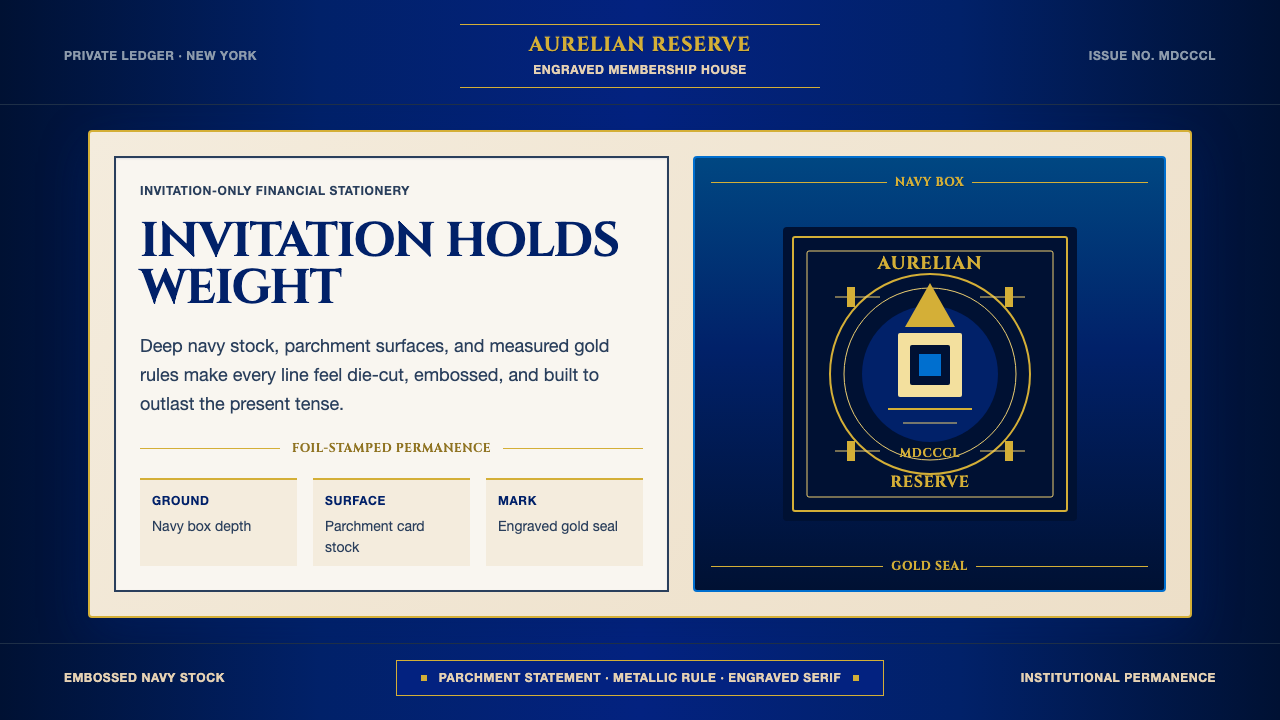 American Express CenturionInstitutional luxury. Deep navy, parchment panels, and gold rules feel engrav…
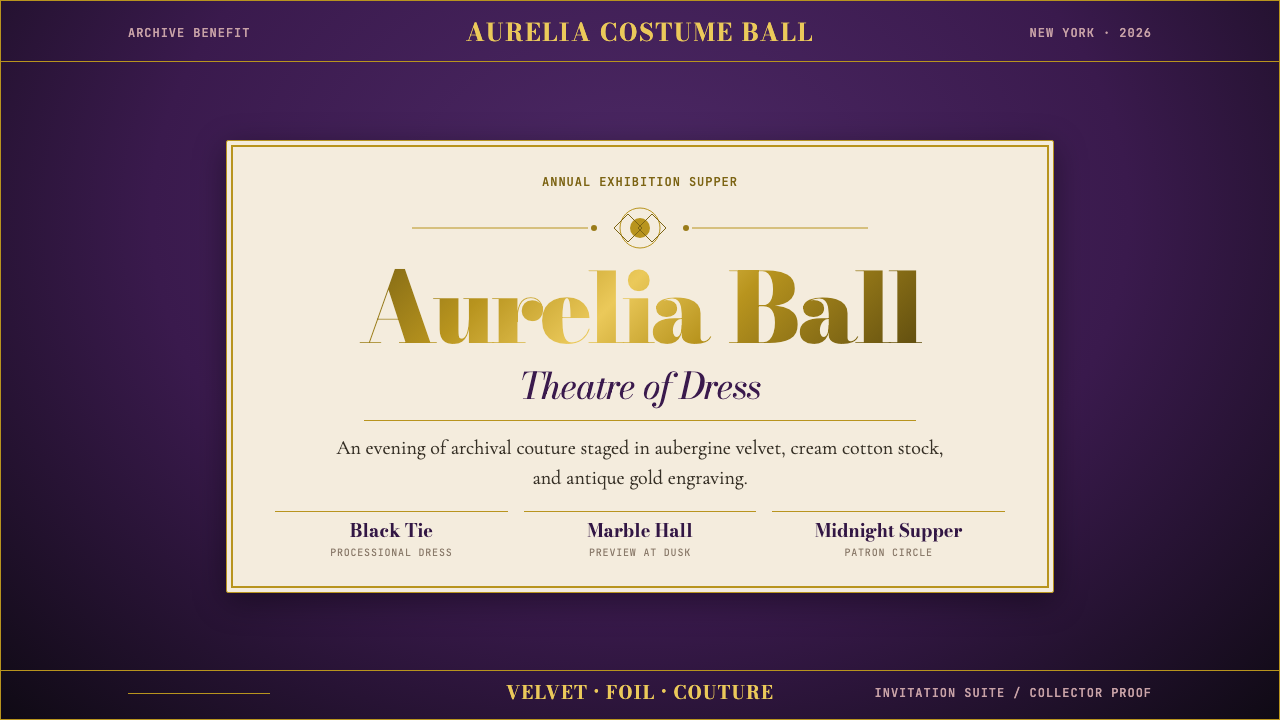 Met GalaTheatrical reverence. Aubergine velvet, cream stock, and Bodoni gold foil fra…
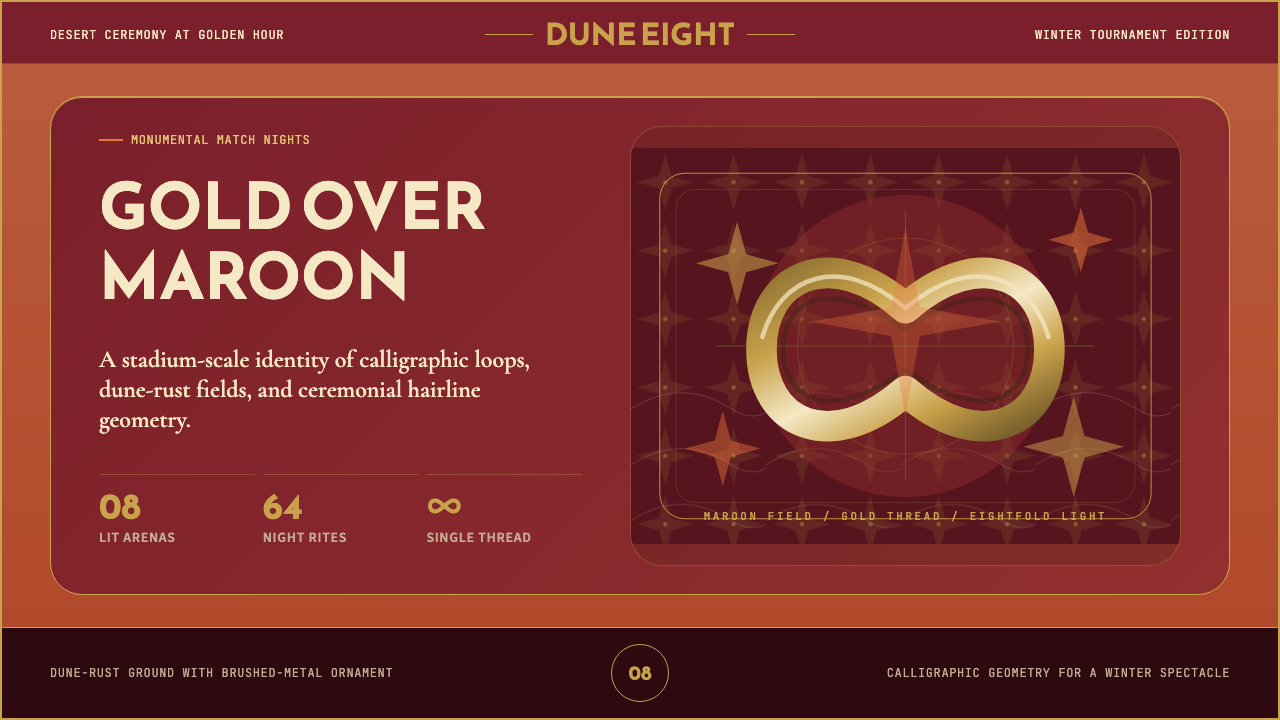 Qatar World Cup 2022Desert spectacle in gold. Maroon fields, Reem Kufi scale, and eightfold star…
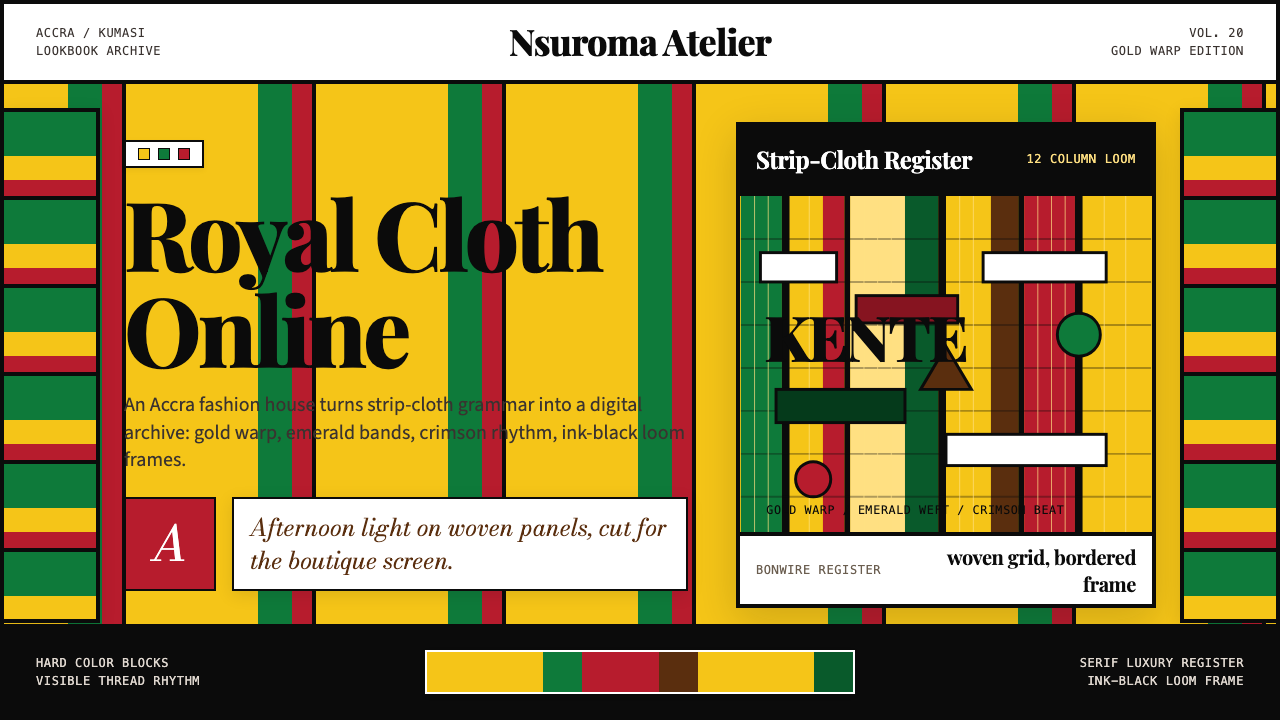 Ghana Kente Fashion 2020Royal cloth, digitized. Kente-gold grid, emerald bands, crimson stripes, seri…
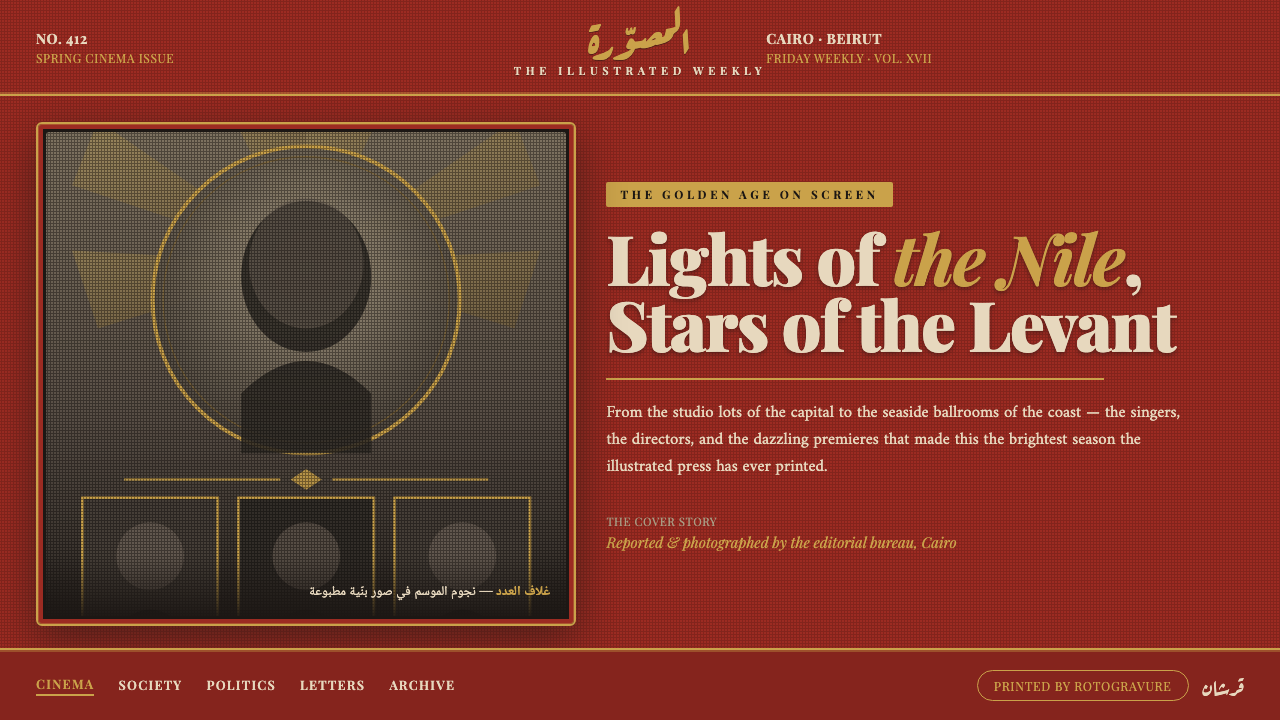 Pan-Arab Illustrated MagazineMid-century Arab press glamour. Brick-red fields, sepia halftone montage, gol…
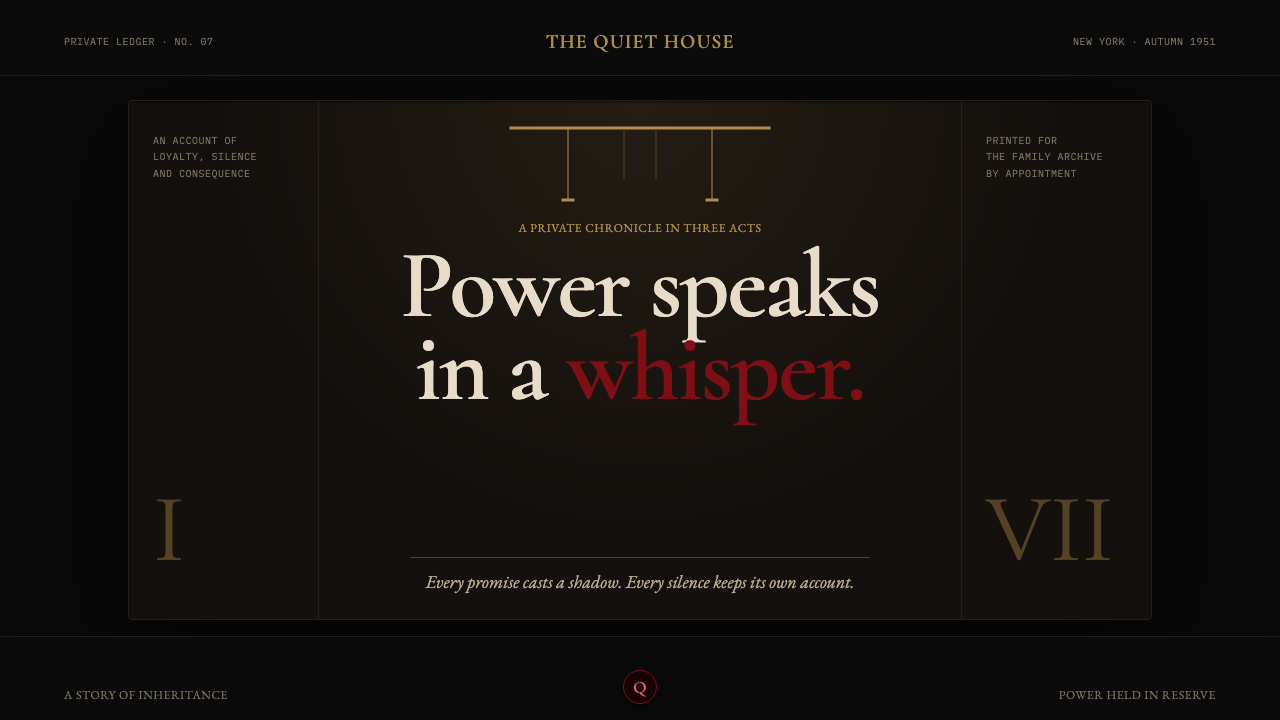 The Godfather (1972)Quiet authority becomes menace. Near-black shadow, brass rules, and one oxblo…