What is Ghana Kente Fashion 2020?
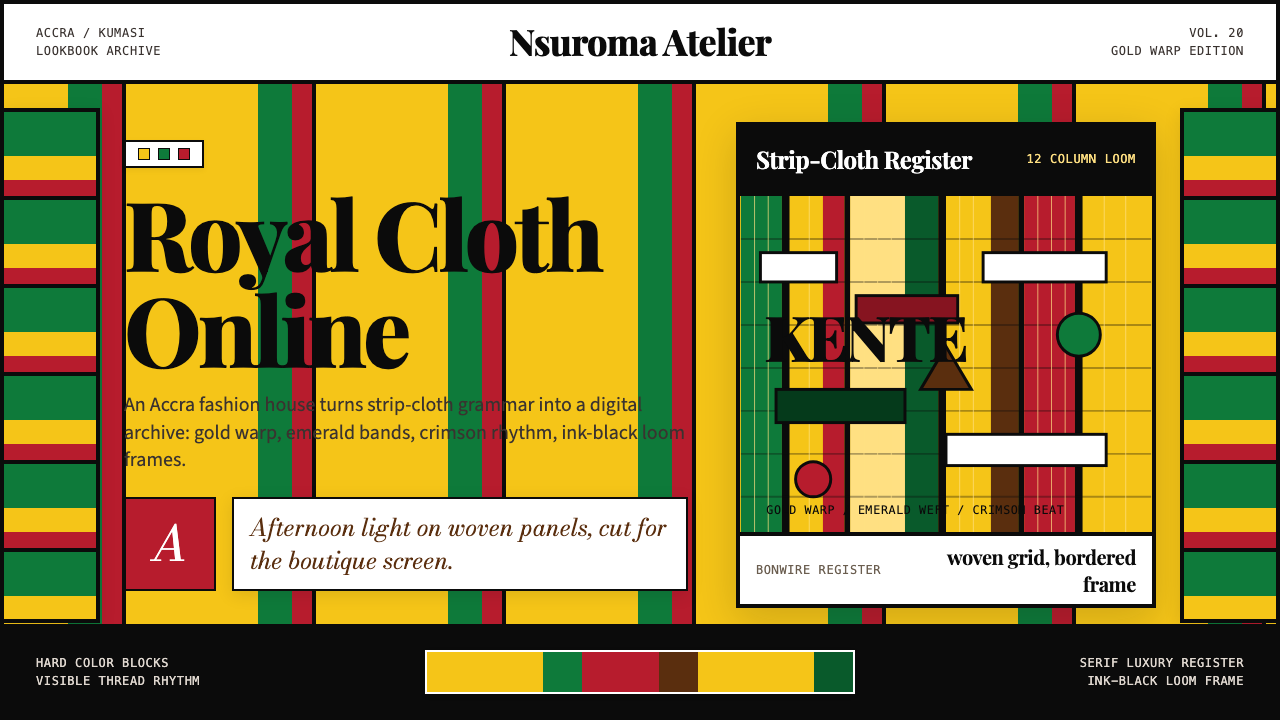
Royal cloth meets the digital storefront — kente's gold-and-emerald strip grammar becomes the structural language of West Africa's most ambitious luxury e-commerce identity.
Ghana Kente Fashion 2020 in brief
Ghana Kente Fashion 2020 is the contemporary design language that emerged from the Accra and Kumasi fashion scenes as Ghanaian designers translated the centuries-old grammar of kente strip-cloth into visual identity systems fit for global e-commerce, editorial photography, and luxury brand presentation. The style is rooted in Ashanti weaving tradition — the interlocked warp-and-weft geometry of hand-woven kente strips — and transforms that heritage into a rigorously structured, color-forward aesthetic that reads simultaneously as craft archive and international fashion editorial.
Visually, the style is defined by hard, opaque color blocks arranged in strict vertical or grid formations that echo the alternating colored bands of woven kente cloth. Gold-yellow and emerald green anchor the palette as primary structural forces, with deep crimson providing accent and rhythm. Serif typefaces in commanding weights carry the luxury register that Accra's leading fashion houses require, while a disciplined column grid — where every other column functions as a colored band — ensures the textile metaphor extends from fabric to screen. Texture is present but controlled: a subtle suggestion of thread weave reads through flat color fields without disturbing surface clarity.
What separates this system from simple Afrocentric decoration is its structural discipline. The color decisions are not ornamental; they map directly to the symbolic vocabulary of kente, where specific color combinations carry encoded cultural meaning — gold for royalty and wealth, green for growth and renewal, red for sacrifice and political power. A layout using this system is therefore not merely visually striking; it carries the same communicative weight that a master kente weaver encodes into cloth for a chief's ceremonial wear.

Where does Ghana Kente Fashion 2020 come from?
Kente cloth — called 'nwentoma' in Akan — is a hand-woven silk and cotton textile produced in narrow strips on horizontal looms in the Ashanti and Ewe communities of present-day Ghana. The craft is documented to the seventeenth century at minimum, with oral tradition placing its origins even earlier among the Asantehene's court weavers in Kumasi. Each strip, no wider than a hand's span, is woven separately, then stitched edge-to-edge to form a complete cloth. The geometric patterns that result from interlocking warp and weft are not random — each named pattern carries a specific meaning, making kente one of the world's most sophisticated examples of textile as written language.
The contemporary fashion movement that gives this design system its DNA began consolidating in Accra in the early 2010s, with Christie Brown — founded by Aisha Obuobi in 2008 — emerging as its most internationally visible institution. Obuobi's approach was to treat kente and other traditional Ghanaian textiles not as ethnographic artifacts but as luxury materials in direct conversation with Paris, Milan, and New York. Her collections appeared at Lagos Fashion Week, at London's Victoria and Albert Museum, and in editorial spreads in international fashion media. At the same time, Abrima Erwiah and Rosario Dawson launched Studio One Eighty Nine in New York and Accra, building a supply-chain model that sourced directly from Ghanaian and broader West African artisans, bringing handcraft production into e-commerce and global retail.
The period between 2018 and 2024 marked peak global visibility for this movement. Beyoncé's 2019 film 'Black Is King' featured multiple looks referencing Ghanaian textile traditions, placing kente-derived aesthetics before an audience of tens of millions worldwide. Highlife and Afrobeats artists, with their growing global fanbases, adopted the visual grammar of contemporary Accra fashion for album artwork, music video set design, and merchandise. Simultaneously, the Pan-African luxury e-commerce sector — smaller platforms aggregating designers from Lagos, Accra, Dakar, and Nairobi — needed visual identity systems that could communicate craft heritage and digital sophistication simultaneously. The Ghana Kente Fashion 2020 aesthetic became the answer.
Kumasi's Kente Weavers Association and the KNUST (Kwame Nkrumah University of Science and Technology) School of Art, Design and Technology contributed a critical scholarly and craft infrastructure to the movement. KNUST graduates who had trained in both traditional Ashanti craft practices and international design methods provided the bridge between the weaving village of Bonwire — the historic center of Ashanti kente production — and the Accra design studios producing digital identities for the fashion houses. Larry Jay and Nana Yaw Sika, working at the intersection of textile art and graphic identity, helped formalize the visual principles that translate the strip-cloth grid into screen and print applications. The result is a design system with genuine genealogical roots, not a surface-level cultural reference.
What defines the Ghana Kente Fashion 2020 look?
Color Architecture
The palette is built on three structural anchors drawn directly from Ashanti kente symbolism: a warm gold-yellow that reads as luminous and authoritative, a deep forest green that carries weight and permanence, and a saturated crimson that provides accent and cultural resonance. These three interact at high saturation, but they are not treated equally — gold functions as the dominant ground or primary structural band, green defines secondary rhythm, and crimson appears as a controlled accent. The overall effect reads as opulent without being chaotic: rich color fields bounded by clear edges.
Strip-Cloth Grid
The defining structural feature is a column grid in which alternating vertical columns are filled with solid color, directly translating the physical structure of kente strip-cloth onto a screen or print surface. A twelve-column layout becomes a rhythm of colored and neutral bands; a full-width section becomes a field of alternating gold and green verticals. This grid is never merely decorative — it functions as the organizing skeleton of every composition, determining where content sits, how imagery is cropped, and how white space breathes between dense color passages.
Textile Texture
Unlike design systems that prize perfect flatness, Ghana Kente Fashion 2020 deliberately introduces a restrained woven texture into color fields. The texture recalls the visible thread structure of hand-woven kente without imitating it literally — it reads as warmth and craft rather than digital decoration. The key calibration is restraint: texture must be subtle enough that it enriches rather than clutters, and it must appear consistently across all color bands rather than as an accent applied to only one element.
Serif Authority
Where the Bauhaus tradition rejected serifs as vestigial ornament, Ghana Kente Fashion 2020 embraces commanding serif typefaces as markers of the luxury register that the Accra fashion houses occupy. Serifs here carry historical weight — they reference the formal registers of both colonial-era Ghanaian print culture and contemporary luxury fashion publishing. Headlines are set at large, confident scales with generous letter-spacing; body text uses the same family at a more modest scale to maintain typographic kinship. The effect is editorial authority rather than institutional stiffness.
Hard-Edge Color Blocking
Every color transition in the system is hard-edged — there are no gradients, no color bleeds, no soft transitions between one band and another. This discipline comes directly from the physical structure of woven kente, where color changes occur at a precise thread count and are never blurred. In screen applications, this means full-saturation color blocks with crisp boundaries, flat fills rather than textured overlays for structural divisions, and imagery cropped to sit within a defined field rather than bleeding across color boundaries.
Ceremonial Symmetry
Unlike Bauhaus asymmetry, which uses compositional tension as its organizing principle, Ghana Kente Fashion 2020 draws on the ceremonial bilateral symmetry of kente cloth itself, where left and right halves of a full cloth often mirror each other in pattern. Layouts in this system tend toward balanced, centered compositions for hero moments — a cover slide, a masthead, a product hero — while allowing asymmetric grid play in content sections. This ceremonial quality reinforces the system's luxury register and its connection to formal Ghanaian cultural contexts.
Cultural Legibility
The most important non-visual characteristic of this design system is its insistence on cultural legibility — the requirement that anyone familiar with Ghanaian textile tradition can read the specific cultural references in the visual choices, not merely appreciate them as decorative patterns. Gold bands that reference royal kente for the Asantehene, green passages that echo the 'Oyokoman' pattern associated with the Oyoko clan, crimson accents with their established symbolic weight — these are not generic African-pattern motifs. Designs in this system should reward cultural literacy rather than simply deploy its aesthetics.

Who shaped Ghana Kente Fashion 2020?
Obuobi founded Christie Brown in Accra in 2008 and built it into the most internationally recognized Ghanaian fashion house of the contemporary era. Her practice centers on the integration of traditional Ghanaian textiles — kente, kaba, batakari — with silhouettes drawn from both West African ceremonial dress and international luxury fashion conventions. Christie Brown's lookbooks and campaign imagery established the editorial visual language that Ghana Kente Fashion 2020 codifies: hard color blocking, serif authority, and the strip-cloth grid translated into art direction. Obuobi's work has been exhibited at the Victoria and Albert Museum and featured in international fashion media, demonstrating that Ghanaian fashion can operate at full parity with European luxury brands.
Erwiah co-founded Studio One Eighty Nine with actress Rosario Dawson in 2013, establishing a model that would prove influential across the Pan-African fashion sector. The studio functions simultaneously as a fashion label, a craft production hub, and an advocacy platform for artisan communities across West Africa. Erwiah's contribution to the design system is primarily structural: she demonstrated that the luxury e-commerce visual language of kente-derived aesthetics could support a supply chain rooted in Ghanaian and Ivorian artisan communities, creating alignment between visual identity and production ethics. Studio One Eighty Nine's online presence established benchmarks for how the Ghana Kente Fashion 2020 aesthetic functions in digital retail environments.
Working at the intersection of Ghanaian textile art and graphic identity design, Larry Jay has contributed to formalizing the translation principles between kente strip geometry and digital layout systems. His work explores how the counting logic of a kente weaver — where pattern is determined by precise intervals of warp and weft — maps onto grid-based screen design, and how the color symbolism embedded in named kente patterns can be preserved rather than stripped out when the textile reference moves into digital application. Jay's practice represents the discipline that prevents Ghana Kente Fashion 2020 from collapsing into generic Afrocentric surface decoration.
Sika's practice bridges traditional Ashanti textile knowledge and contemporary visual communication, with particular focus on the ceremonial contexts in which kente cloth accrues meaning. His understanding of how specific kente patterns are assigned to specific social roles — royal wear, funeral cloth, wedding cloth — informs a design philosophy that treats the Ghana Kente Fashion 2020 system as context-sensitive rather than universally applicable. Sika has articulated the principle that the visual system should be reserved for contexts where its cultural weight is appropriate — luxury fashion, cultural celebration, institutional representation — rather than applied indiscriminately to all commercial categories.
How do you use Ghana Kente Fashion 2020 today?
Ghana Kente Fashion 2020 is a context-specific design system, not a universal one. It performs best when the project it serves has a genuine relationship to West African fashion, craft heritage, Pan-African cultural identity, or the luxury tier of the contemporary African creative economy. Applied without that relationship, the system risks reading as cultural appropriation rather than cultural conversation. The first question to ask before applying this system is not 'does it look good?' but 'does it belong here?'
For presentation slides, the system works with particular force on cover and section-break pages. A cover built in this system uses the strip-cloth grid as its primary architectural move: alternating vertical color bands — gold, neutral, green, neutral, crimson — create the immediate visual signature, with a commanding serif headline centered or anchored to a specific band. Section breaks use a single full-width color band with reversed-out text. Content slides pull back the color, using one band color as a thin left-margin rule while the remaining surface stays near-white, ensuring that body text remains legible while the system's visual identity remains present. Data slides translate the color system directly into chart fills: bar charts use the three structural colors to distinguish categories, maintaining the hard-edge, flat-fill discipline throughout.
For web interfaces, the system is well-suited to fashion e-commerce, cultural institution sites, luxury brand presentation pages, and Pan-African platform identity. The implementation approach is to treat the colored column bands as structural navigation infrastructure rather than decoration — a persistent vertical strip in gold or green along one edge of the viewport signals the system's identity without overwhelming content. Product pages use hard-shadow card components rather than soft-drop-shadow equivalents, with product photography cropped to sit within defined color-band frames. Pricing or membership tier pages benefit from the system's inherent hierarchy: each tier occupies a distinct color band, with the premium tier claiming the gold band as its visual space.
For editorial and marketing materials — campaign photography art direction, lookbooks, brand identity systems — this is where the system reaches its fullest expression. A lookbook built on these principles alternates full-bleed color-band spreads with tighter editorial grid pages: a gold-ground page shows a single product image cropped to a geometric frame, followed by a green-and-neutral-striped spread with product copy set in commanding serif at large scale. Marketing emails use the same alternating band logic in a single-column mobile-native format, where each section of the email is its own color band. The system's ceremonial symmetry suits brand identity applications — a logo lockup centered on a gold ground with green and crimson flanking bands carries immediate formal authority.
The most common mistake when applying Ghana Kente Fashion 2020 is treating the three structural colors as interchangeable or as simultaneous equals. Authentic kente composition is hierarchical — specific colors lead in specific pattern contexts, and the supporting colors respond rather than compete. A layout that places gold, green, and crimson in equal-weight adjacent bands without a clear hierarchy loses the structural logic and reads as generic African pattern rather than as a kente-literate design. The second common mistake is pairing the system with sans-serif typefaces for headline use — the luxury and authority that the system communicates depends on the serif. Using a geometric sans undermines the system at its most load-bearing typographic moment.

Ghana Kente Fashion 2020 — FAQ
Is Ghana Kente Fashion 2020 appropriate for non-Ghanaian brands?
The answer depends on the nature of the relationship. A Pan-African luxury platform with authentic connections to West African designers and artisan communities can use this system with integrity. A European or American brand with no substantive African connections using the system purely for its visual appeal risks cultural appropriation — borrowing the aesthetic without the accountability. The question to ask is whether the use of the system deepens or obscures the cultural relationship. Brands that can answer that honestly are in a position to make a principled decision; those who cannot should consider other design directions.
How does this system differ from other African-inspired design approaches?
The key difference is specificity. Many design systems described as 'African-inspired' draw on a generalized pool of geometric patterns, bright colors, and animal or nature motifs that reference the continent at large rather than any specific tradition. Ghana Kente Fashion 2020 draws from a precisely identified source — Ashanti and Ewe kente weaving — and preserves the internal symbolic logic of that source rather than treating it as a decorative vocabulary. The color meanings, the grid structure, the bilateral symmetry, and the hierarchy of color application all have specific kente antecedents. This specificity is what distinguishes culturally literate design from surface-level Afrocentric decoration.
Can the system work in a light or monochromatic version?
A reduced-color version is possible and sometimes practically necessary — for single-color printing, embossed applications, or contexts where the full three-color palette would be too visually intense. The most successful monochromatic version uses gold-yellow as the sole color against a near-white ground, preserving the strip-cloth grid structure while reducing the visual weight. Green or crimson alone are less successful as the sole color — gold carries the system's identity most efficiently because it is the color most immediately associated with kente's royal register. What cannot be reduced without losing the system's essential character is the hard-edge color blocking and the serif typography.
What kind of photography works within this design system?
Photography within this system works best when it is treated as a designed element rather than a naturalistic window. The most compatible imagery is fashion editorial photography — models wearing kente or kente-derived garments, shot in controlled lighting that produces strong tonal contrast and clear silhouette. Craft and process photography — a weaver's hands at the loom, close-up details of kente thread structure — carries the same visual weight as the system's color blocks and integrates naturally. Photography should be cropped to geometric frames that align with the column grid, placed within color-band fields rather than floating freely, and reproduced with high tonal contrast. Lifestyle photography with soft, ambient lighting, loose compositions, and naturalistic color grading works against the system's formal discipline.
Does this system suit digital products beyond fashion, such as fintech or education platforms?
It can, but with care and a clear rationale. The system's visual authority and structural clarity make it genuinely functional for contexts beyond fashion — a Ghanaian fintech platform, a Pan-African educational institution, or a cultural organization might apply it with complete coherence. The requirement is that the brand's values and audience genuinely align with the system's cultural register: West African craft heritage, luxury, and formal authority. A generic productivity app or a consumer wellness platform would find the system's weight inappropriate — it communicates ceremony and significance, not casual utility. The design question is always whether the system's cultural signals serve or distract from the product's core promise.
Related design styles
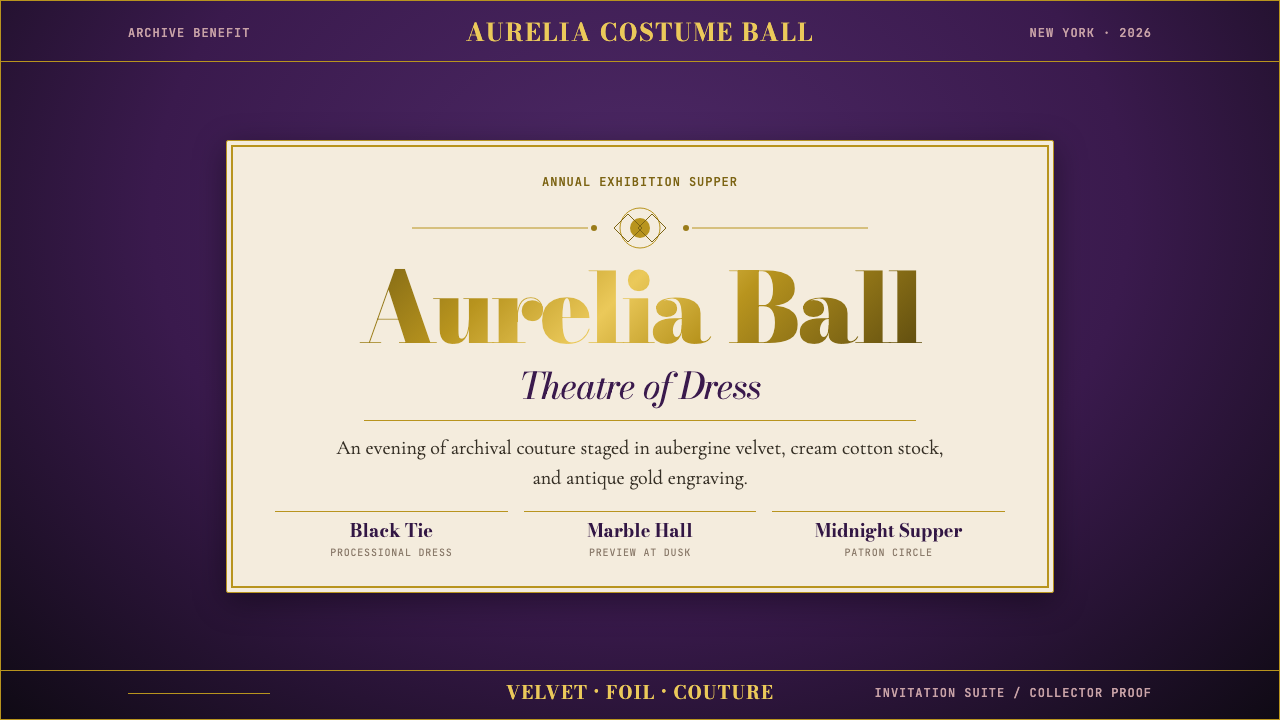 Met GalaTheatrical reverence. Aubergine velvet, cream stock, and Bodoni gold foil fra…
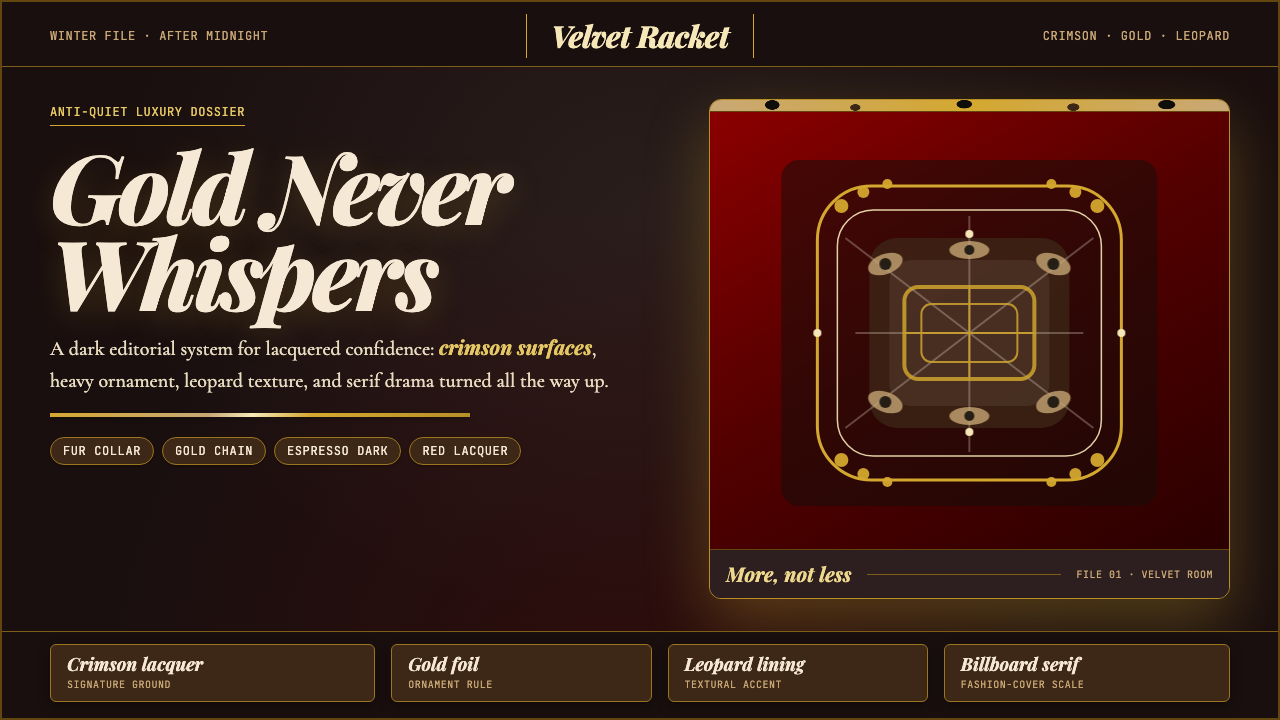 Mob Wife AestheticGlamour refuses restraint. Crimson lacquer, gold foil, leopard texture, billb…
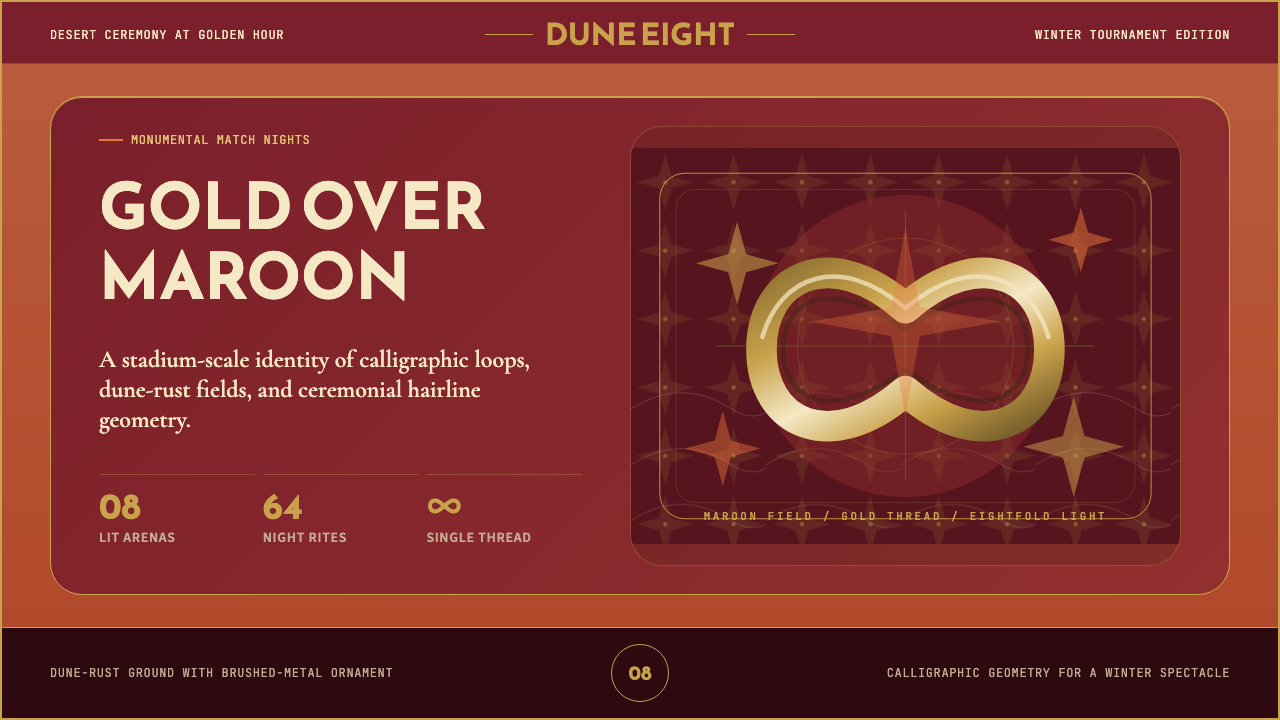 Qatar World Cup 2022Desert spectacle in gold. Maroon fields, Reem Kufi scale, and eightfold star…
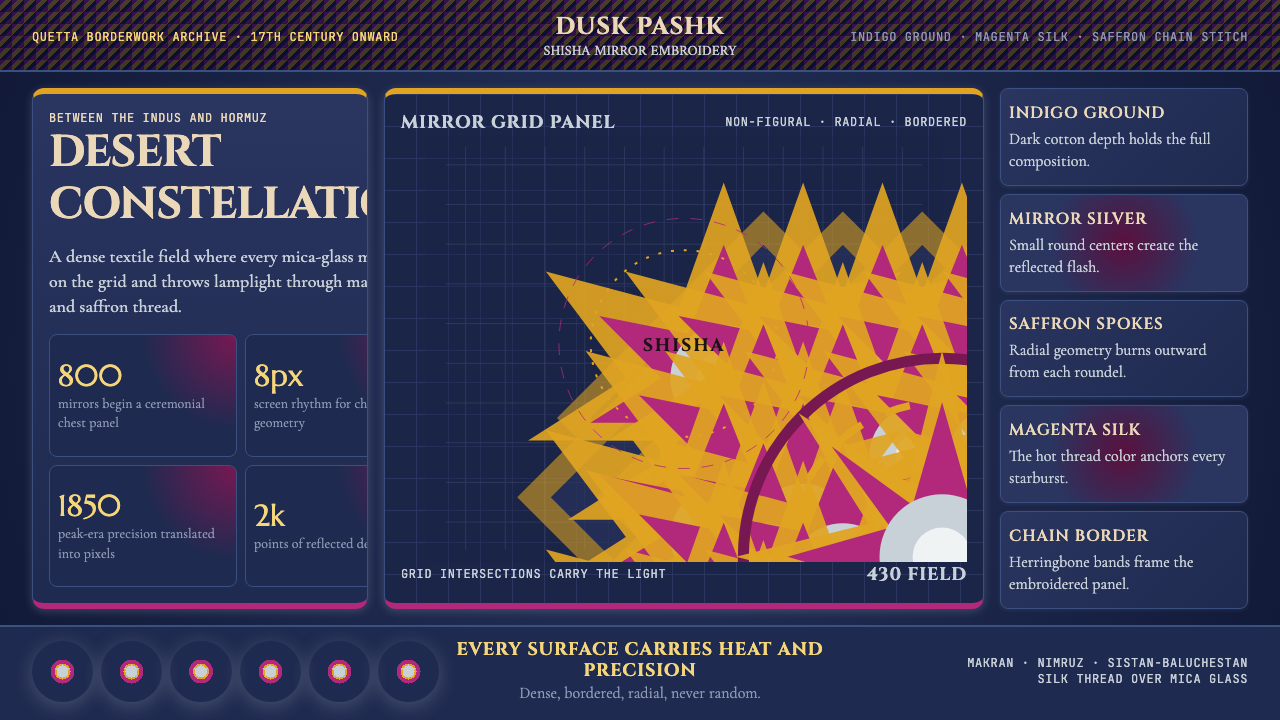 Balochi Mirror Embroidery (Shisha)Desert light made dense. Indigo grids flash with magenta, saffron, and mirror…
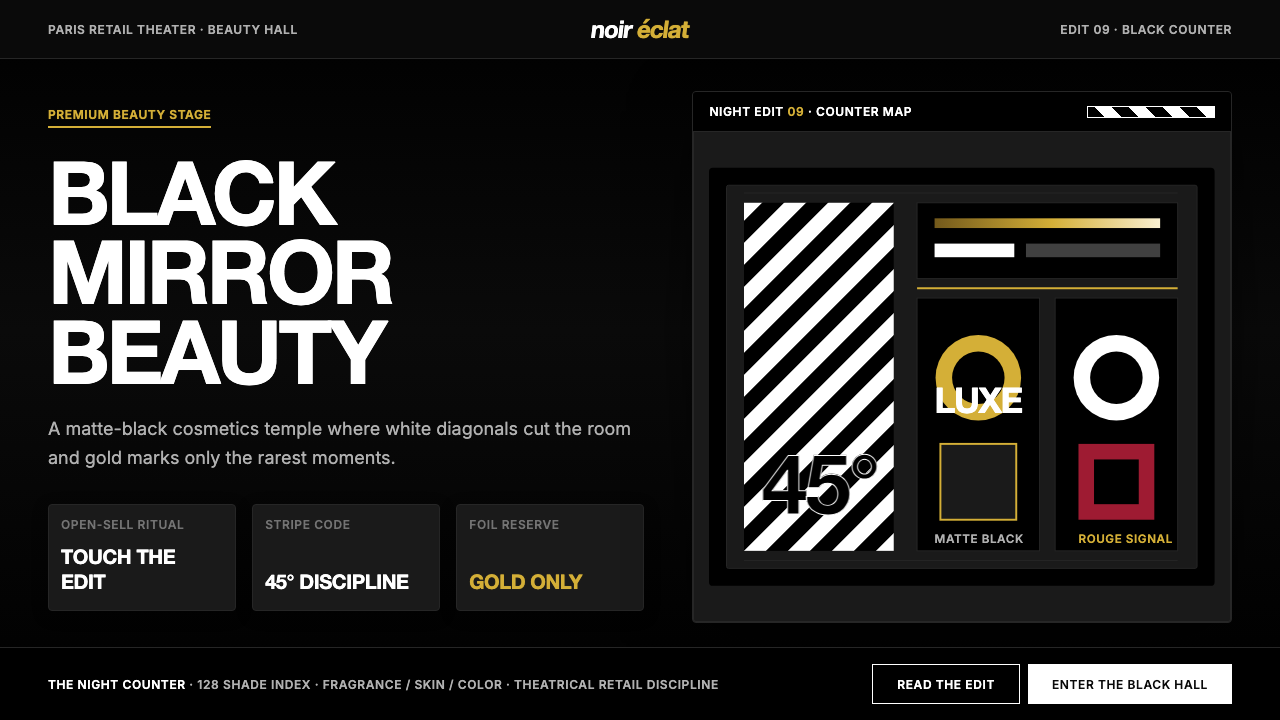 SephoraBlack is the stage. White 45° stripes and restrained gold foil make cosmetics…
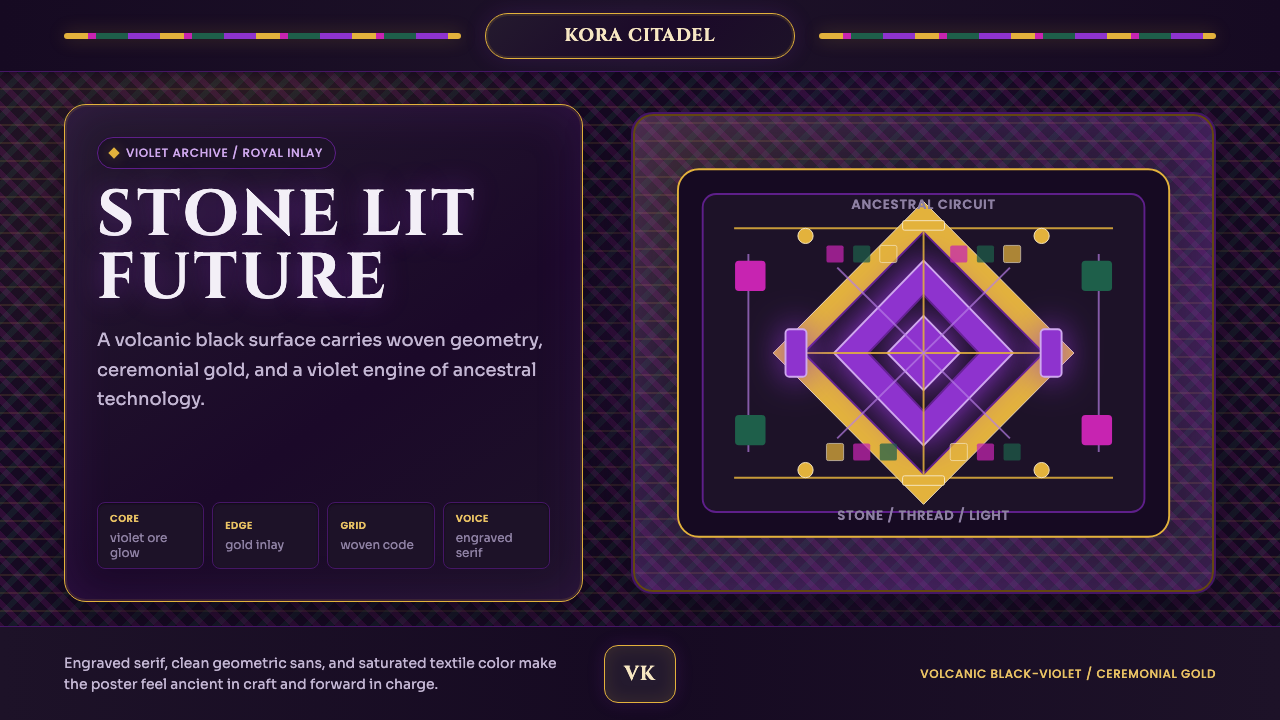 Africanfuturism VibraniumCeremony goes electric. Violet glow and gold inlay thread a volcanic textile…