What is Sephora?
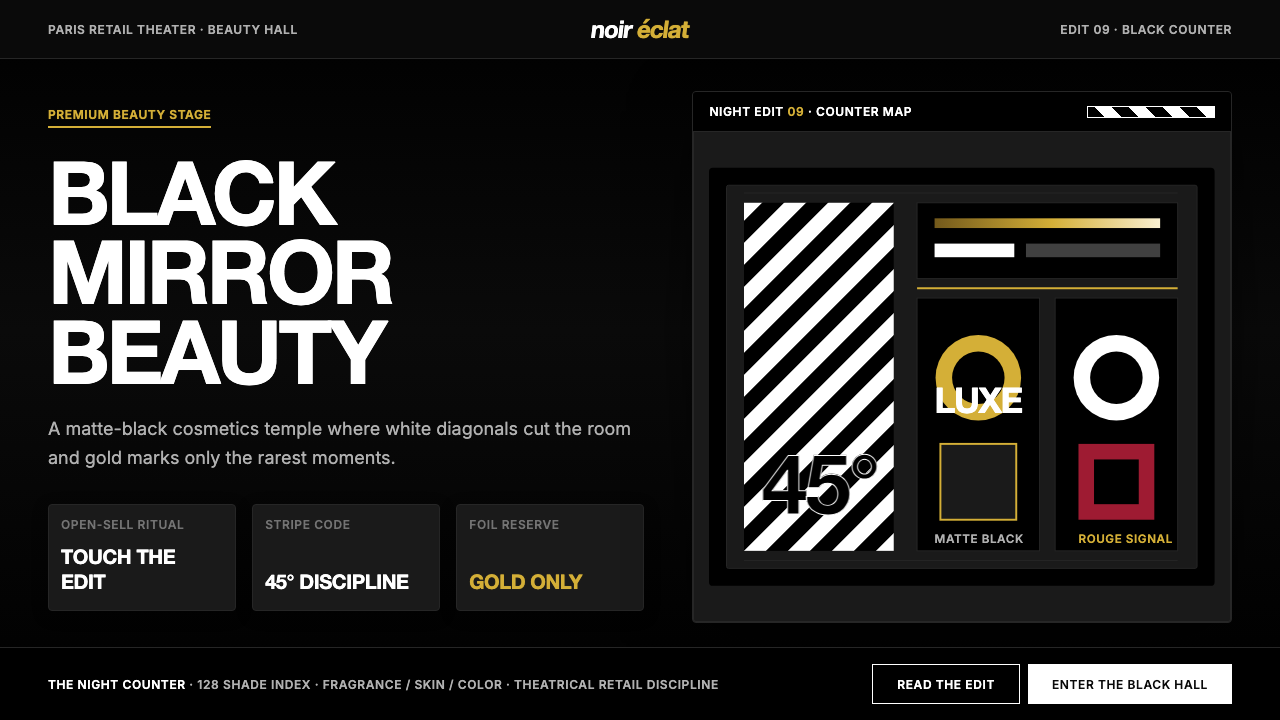
Sephora turned a beauty store into a theatre: matte-black walls, a diagonal stripe motif, and a single restrained flash of gold make purchasing lipstick feel like entering a Parisian grand spectacle.
Sephora in brief
Sephora Black Luxe is the visual identity system of Sephora, the LVMH-owned French beauty retail empire. Its defining elements are near-black backgrounds, crisp white typography, the iconic forty-five-degree diagonal stripe pattern, and gold foil accents used with deliberate restraint. Together these elements produce a theatrical, high-contrast aesthetic that signals Parisian luxury while remaining legible and bold at every scale — from flagship store interiors to a lip gloss carton.
The system is built on a single dramatic conviction: black is not absence, it is stage. Where most luxury brands reach for pale neutrals or blush tones, Sephora commits to depth. The near-black ground makes every product placed against it glow, every white word snap into focus, and every gold detail read as genuinely precious rather than merely decorative. The result is an environment — digital or physical — where the customer is the protagonist and the brand is the theatrical house around them.
This is not a maximalist aesthetic despite its drama. The stripe motif, the sole recurring ornamental element, is deployed sparingly and at a precise angle that gives it kinetic energy without becoming chaotic. Gold appears only at moments of premium emphasis — award callouts, VIP tiers, limited edition labels — and is never used simply to fill space. The discipline is as important as the boldness.

Where does Sephora come from?
Sephora was founded in 1969 by Dominique Mandonnaud in Limoges, France, under the name Shop 8. Mandonnaud's founding insight was retail-experiential rather than visual: he let customers touch, test, and browse products freely at a time when beauty counters were staffed by brand representatives who controlled access to merchandise. The open-sell model was radical. When Mandonnaud rebranded the concept as Sephora — a name fusing the Greek word for beauty with a reference to Zipporah, the wife of Moses — he had assembled a chain of stores built around the premise that beauty discovery should feel empowering rather than intimidating.
LVMH, Bernard Arnault's luxury conglomerate, acquired Sephora in 1997. The acquisition was transformative. Arnault understood that luxury was a performance as much as a product, and under LVMH stewardship, the Sephora interior became a designed experience. The black-and-white diagonal stripe — which had appeared in some form in earlier iterations — was codified and elevated. The matte black environment was deepened. Gold, already present in the wordmark, was systematized as a premium signal. By the time Sephora opened its New York flagship on Fifth Avenue in the early 2000s, the visual identity was recognizable from the sidewalk: a black box striped like a stage set, lit from within.
The visual language owes acknowledged debts to French graphic and fashion traditions. The diagonal stripe resonates with the candy-stripe patterns of classic Parisian packaging — think Ladurée, think the chevrons of the French military — but rotated and hardened into a bold, branded motif rather than a heritage ornament. The italic wordmark echoes the confident slant of fashion magazine mastheads. Jean-Paul Goude, the photographer and art director celebrated for his work with brands including Cacharel and his iconic imagery for the 1989 bicentennial parade in Paris, influenced the theatrical, high-contrast visual culture that the brand drew from. Design agency Carbone Smolan contributed to the systematization of the identity for the American market in the early expansion years.
The period from approximately 2003 to the mid-2010s saw Sephora refine its digital expression. The stripe translated into web headers and app icons; the near-black became a standard background for digital product photography; the gold foil became a hover state and a loyalty-tier badge. By 2024 the identity had accumulated enough equity that its components — the stripe angle, the wordmark italic, the precise relationship between white type and black ground — were themselves brand assets, recognizable without the logo. What had begun as a retail environment had become a complete, portable visual language.
What defines the Sephora look?
Near-Black Ground
The foundation of the system is a background that stops just short of absolute black — deep enough to absorb ambient light and create visual weight, but with enough warmth to avoid the cold harshness of pure black. This near-black acts as a theatrical stage: it makes white typography crackle with contrast, causes product photography to appear lit from within, and transforms gold accents into genuinely luminous details. Nothing in the composition competes with the content placed on this ground; the background is self-effacing so that what sits atop it is elevated.
Forty-Five-Degree Stripe
The diagonal stripe is the system's sole recurring ornamental motif, and its angle is not arbitrary. A true forty-five-degree diagonal is the most kinetically energetic angle in a rectangular composition — steeper diagonals feel aggressive, shallower ones feel merely slanted. Applied as alternating dark and light bands of equal width, the stripe creates a visual rhythm that reads simultaneously as modern pattern and classic French packaging heritage. Its power comes from restraint: the stripe appears at structural boundaries, on carrier bags, packaging edges, and section dividers, never flooding an entire composition.
Restrained Gold
Gold in this system functions as punctuation, not wallpaper. It appears exclusively at moments that require a signal of premium status: a loyalty tier badge, a bestseller crown, an award annotation, a limited-edition label. The restraint is deliberate and essential — because gold is used so sparingly, its every appearance registers as meaningful. A system where gold appeared on every heading would be gaudy; a system where it appears only once per composition reads as genuinely luxurious. The gold tone itself is warm and slightly muted rather than the bright yellow-gold of gilding, aligning it with the seriousness of the overall palette.
High-Contrast Typography
Type in this system is treated as an architectural element: white on near-black creates a contrast ratio that demands attention and projects confidence. The wordmark's italic slant carries the energy of fashion editorial mastheads — it is neither the upright stability of a bank nor the casual lean of a lifestyle brand, but the decisive, forward-moving confidence of a Parisian house. Body copy is set in clean, legible forms with generous line spacing, ensuring that even long beauty descriptions remain inviting rather than dense. Headlines are given room to breathe and are rarely crowded by supporting elements.
Theatrical Product Staging
Products photographed within this system are not neutrally documented — they are staged. Against the deep background, lipsticks and palettes and serums are lit to emphasize surface quality: the sheen of a compact, the matte finish of a powder, the translucency of a serum bottle. Photography is high-contrast rather than flat, with directional lighting that creates sculptural depth without soft diffusion. This approach treats every product as a jewel in a display case rather than an item in a catalogue, reinforcing the theatrical premise of the entire system.
Systematic Hierarchy
Despite its bold appearance, Sephora Black Luxe is a highly ordered system. Information is organized into clear tiers: the brand mark at the apex, product names in prominent display type, descriptors and claims in secondary type, and fine print at the base. Each tier has its own weight and spatial relationship to the others, and these relationships are consistent across packaging, digital, print, and environmental applications. A customer encountering the system for the first time at a pop-up learns the same hierarchy that a loyal app user reads every day — the system teaches itself.
Warm-Black Materiality
The physical manifestation of the system — in store interiors, shopping bags, and premium packaging — relies on matte rather than glossy black surfaces. Matte black absorbs light and reads as serious and considered; it also makes the white stripe and gold foil elements pop by contrast without competing for reflective attention. Gloss appears selectively on product packaging where it signals a different tier or texture, not as a default surface choice. This material discipline extends into digital contexts, where background tones are chosen to evoke the same depth and warmth as physical matte black rather than the cooler, flatter quality of a true screen black.

Who shaped Sephora?
Mandonnaud founded Sephora and established its open-sell model, which broke the convention of brand-controlled beauty counters and allowed customers to freely browse and test products. This experiential premise — the idea that beauty retail should feel like discovery, not gatekeeping — became the philosophical foundation that the entire visual identity was later built to serve. Without the open-sell model, there would have been no need for a theatrical, immersive environment to support it.
As chairman of LVMH, Arnault oversaw the 1997 acquisition of Sephora and the subsequent transformation of the brand into a global luxury beauty platform. His conviction that retail environments must be as designed and considered as the products sold within them drove the deepening of Sephora's visual identity. Under LVMH ownership, the brand received the investment and discipline necessary to codify its black, stripe, and gold vocabulary into a rigorous, scalable system rather than a collection of loosely related store aesthetics.
Goude, the French photographer and art director renowned for his theatrical, high-contrast imagery and his direction of the Paris bicentennial parade in 1989, is part of the broader visual culture tradition that Sephora's aesthetic draws from. His work demonstrates the principle that luxury beauty communication is most powerful when it stages its subjects rather than simply documenting them — a sensibility visible in how Sephora shoots products, its advertising campaigns, and its in-store environmental design.
This New York-based design agency contributed to the systematization of Sephora's visual identity for the American market during the brand's significant international expansion in the late 1990s and early 2000s. Their work helped translate a French retail aesthetic into a coherent brand system legible across diverse contexts — packaging, retail environments, print, and early digital — ensuring that the identity scaled without losing its essential character as Sephora grew from a regional European chain into a global platform.
How do you use Sephora today?
Sephora Black Luxe translates well to any designed artifact where authority and theatrical presence are desired values. Applying it correctly requires understanding that the system's drama is structural rather than decorative — the darkness of the ground, the precision of the stripe angle, the restraint of the gold — and that departing from any of these structural decisions tends to produce results that look dramatic without reading as premium. The first question to ask before applying this system is whether the product genuinely warrants a theatrical register; dark luxury aesthetics serve brands in beauty, fragrance, high-end retail, premium digital products, and aspirational lifestyle, but they can feel overwrought in contexts that call for approachability, warmth, or technical clarity.
For presentation slides, the system works powerfully on both cover and content pages. A cover built in this style centers the presentation title in large, confident white display type against a near-black ground, with the stripe motif appearing as a structural border element — along the bottom edge, or diagonally across one corner — rather than flooding the background. Content slides should commit to the high-contrast palette: dark backgrounds with white body text, gold reserved for a single callout or key data point per slide. Data visualizations — charts, graphs, comparison tables — gain presence when treated as if products in a display case: high contrast, generous whitespace around each element, and color limited to one accent per chart. The stripe can mark section transitions or act as a progress indicator in a deck without overpowering the content.
For web and app interfaces, the system suits dashboards, pricing pages, loyalty tiers, and premium product detail pages where conveying quality at first glance is essential. The structural approach: commit to a deep background as the default canvas, use white and near-white exclusively for type and interactive elements, and reserve the gold accent for the single most premium action or status indicator on any given screen — typically a top-tier membership badge, a featured product crown, or a call-to-action button on a conversion-critical page. Navigation and secondary UI elements should remain typographic and restrained; the stripe motif works well as a separator or as a branded loading indicator, but should not appear as a background texture for content areas. On mobile, the near-black ground reduces eye strain in low-light environments while maintaining the visual authority of the system.
For editorial layouts, marketing materials, and printed collateral, the system delivers high-impact results when the stripe is used architecturally. A magazine spread in this style might use the stripe as a full-width band separating a dark feature image from a cream or white body-copy section below — giving the layout a stage curtain quality. Marketing flyers and event posters benefit from the poster-like boldness: a single hero product shot in dramatic lighting on a near-black ground, product name in large white type with a gold accent line beneath, and minimal supporting copy. The stripe should appear at most once per composition, at a boundary rather than as a background fill. Campaign materials using the system tend to succeed when they adopt the theatrical staging principle: every visual element is placed deliberately, nothing decorates without purpose.
A common mistake when applying Sephora Black Luxe is treating the gold as a general highlight color rather than as a reserved premium signal. Designs that apply gold to every subheading, every icon, and every border begin to read as costume jewelry rather than fine gold — the signal degrades through overuse. A related error is diluting the contrast by choosing a very dark gray instead of committing to the near-black; a dark-but-not-dark-enough background makes the system look underpowered and uncertain rather than theatrical. The stripe is frequently misused as a background texture by scaling it down to a fine repeated pattern across a large area — this eliminates its graphic impact entirely. And the system does not tolerate the addition of warm, lifestyle photography or illustrated elements without significant adjustment; organic imagery introduced at full color on a dark ground typically fights rather than integrates with the visual language.

Sephora — FAQ
Does Sephora Black Luxe work for non-beauty brands?
Yes, with deliberate adaptation. The system's core principles — theatrical staging, high-contrast hierarchy, restrained premium accents — are not beauty-specific; they are luxury communication principles that apply wherever a brand wants to signal premium positioning. Fragrance, jewelry, high-end spirits, luxury digital products, and premium fashion retail have all employed variations of this vocabulary effectively. The key is whether the brand's value proposition genuinely warrants theatricality; applying a dark luxury aesthetic to a brand built on approachability or affordability produces cognitive dissonance rather than aspiration. The stripe motif is the element most associated with Sephora specifically and should be reimagined rather than copied directly if the system is being adapted for a different brand.
How should gold be deployed to avoid looking cheap?
Gold reads as luxurious only when it is rare within a composition. The rule of thumb: use gold for one thing per context, and make that thing worth the signal. In a pricing page, gold marks the top tier only. In a product card, gold appears on the bestseller badge only. In a presentation, gold highlights the single most important number on a data slide. Beyond frequency, the tone of gold matters enormously — a warm, slightly desaturated gold with depth reads as precious; a bright, fully saturated yellow-gold reads as gilded plastic. When rendering gold digitally, lean toward warmth and restraint; bright and vivid will undermine the premium intent regardless of how sparingly it is used.
Can this system be used with a light background instead of dark?
A light-background inversion is possible but fundamentally changes the character of the system. On a white or cream ground, the diagonal stripe reads as a heritage pattern rather than a theatrical motif, and gold accents lose much of their luminous quality because they no longer contrast against darkness. The result tends toward classic French luxury — refined, historic, approachable — rather than theatrical contemporary luxury. This inversion is appropriate for print materials, editorial contexts, or product lines positioned as lighter and more accessible within a broader brand family. It is not a substitution for the dark system when theatrical premium presence is the goal; it is a different register for a different purpose.
How does this system handle product diversity — what if products span many colors?
This is one of the system's genuine strengths. Because the near-black background is neutral against virtually any product color — coral lipstick, violet eyeshadow, copper highlighter — it functions as a universal display surface. Product colors are allowed to be fully themselves without competing with the background's own chromatic identity. The system's structure — typography, stripe, gold accents — remains constant while product photography introduces the full chromatic variety of the range. This is a fundamentally different approach from light-background beauty systems, where product colors must be curated against a background color that has its own personality.
What makes the stripe feel like a premium motif rather than a sports or candy-store pattern?
Three factors: angle, proportion, and restraint. A forty-five-degree diagonal communicates direction and dynamism without the casual associations of horizontal stripes or the aggressive energy of near-vertical ones. Equal-width bands of deep dark and bright white create maximum graphic contrast without feeling playful — the proportions are decisive rather than whimsical. And the motif's power depends entirely on appearing rarely: as a structural border, a packaging edge, a carrier bag panel, not as a background texture repeated across every surface. When the stripe floods a composition, it reads as decoration. When it appears once, at a boundary, it reads as a signature — the mark of a house rather than a pattern from a pattern library.
Related design styles
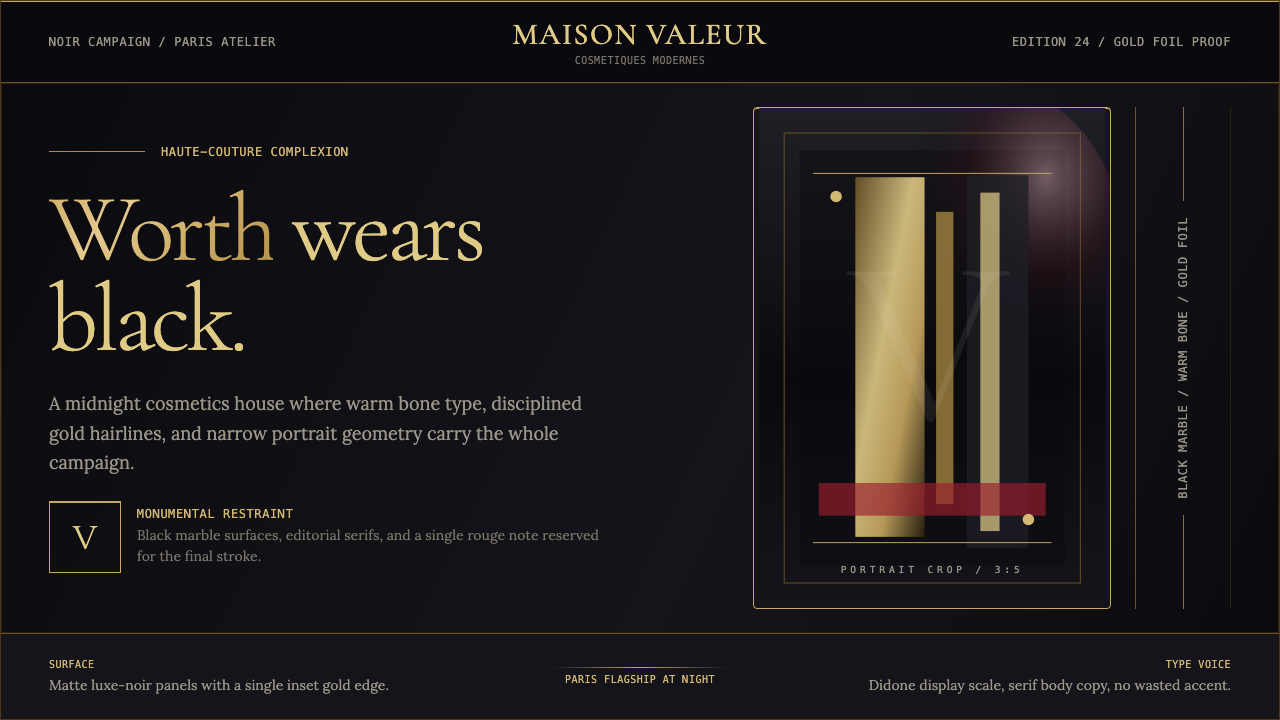 L'Oréal Paris CosmeticsMonumental restraint. Black marble fields, gold Didone type, and narrow portr…
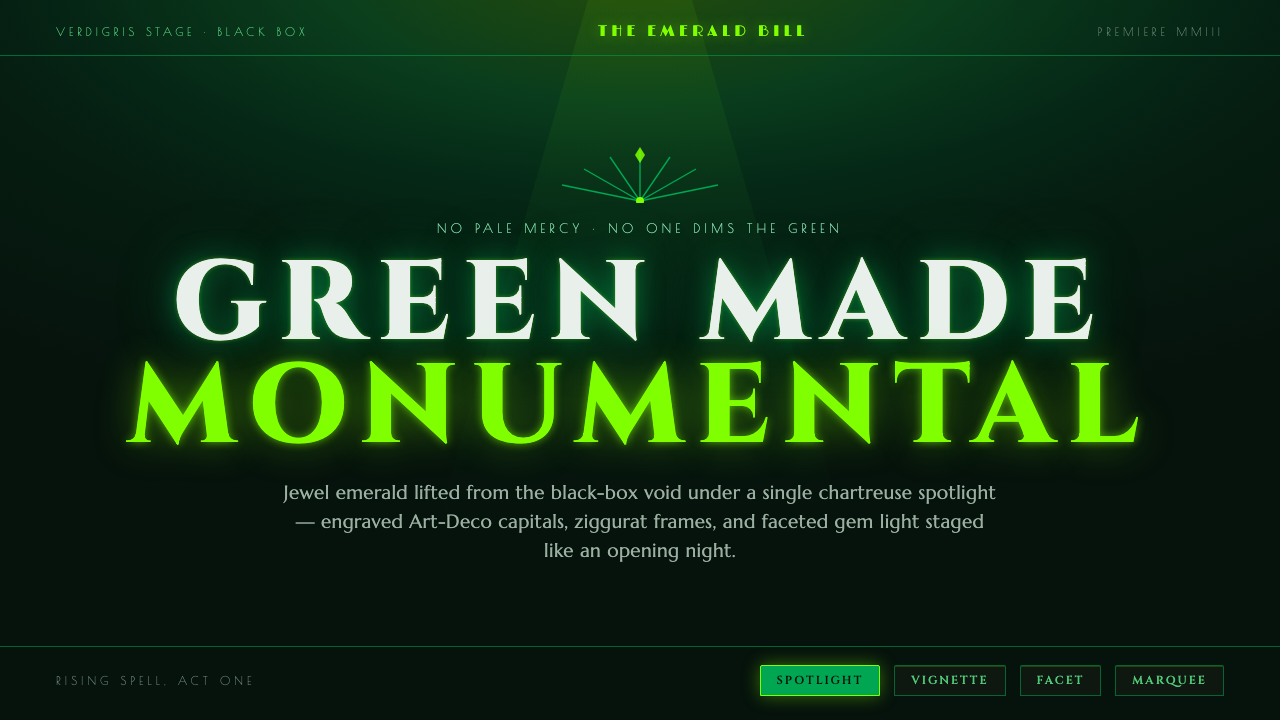 Wicked Elphaba EmeraldGreen made monumental. Jewel emerald spotlit on a black-box void, in engraved…
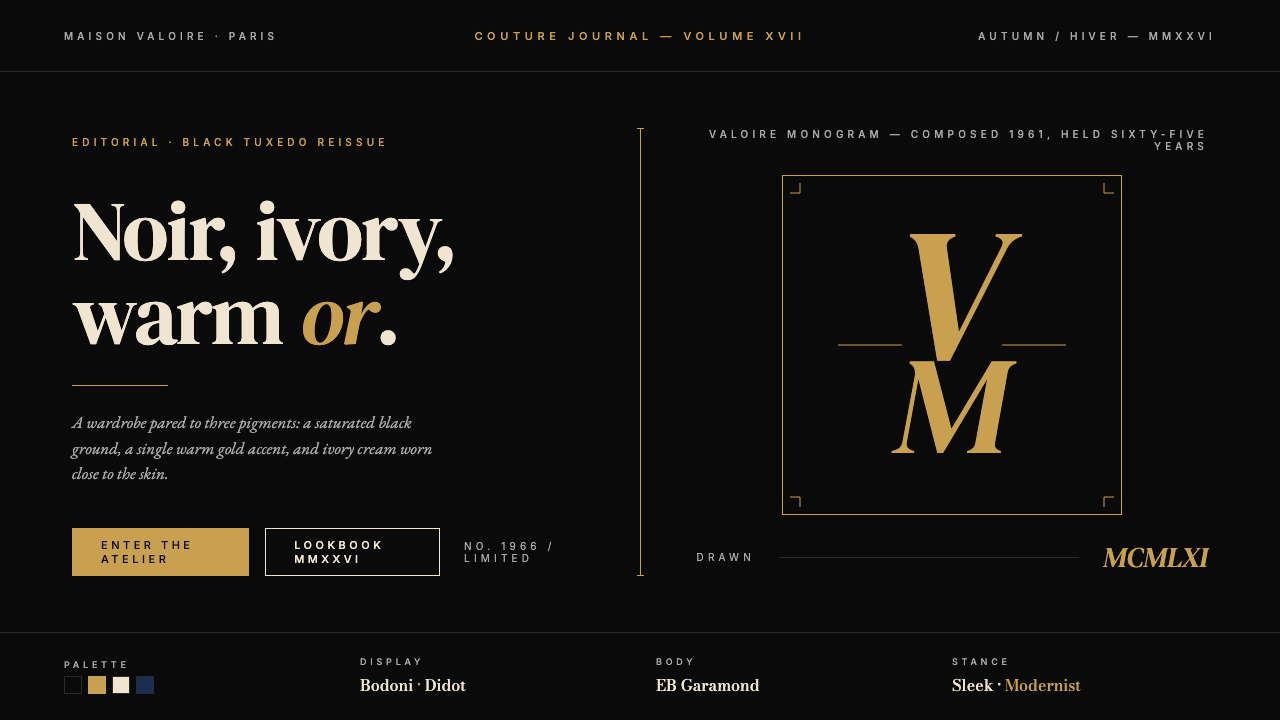 Yves Saint Laurent (YSL)Couture chiaroscuro. Saturated black ground, warm gold accent, Didot serif at…
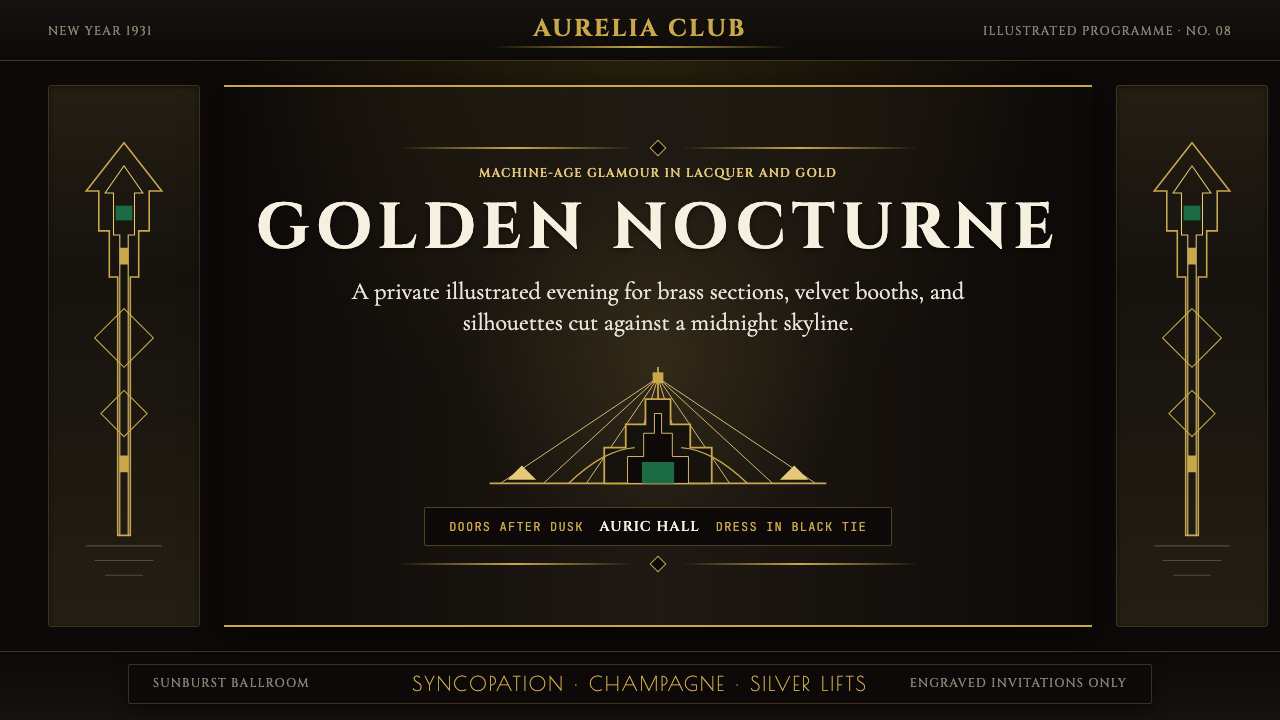 Art Deco Jazz AgeJazz Age glamour. Sunburst rays, stepped ziggurats, gold on black — Chrysler…
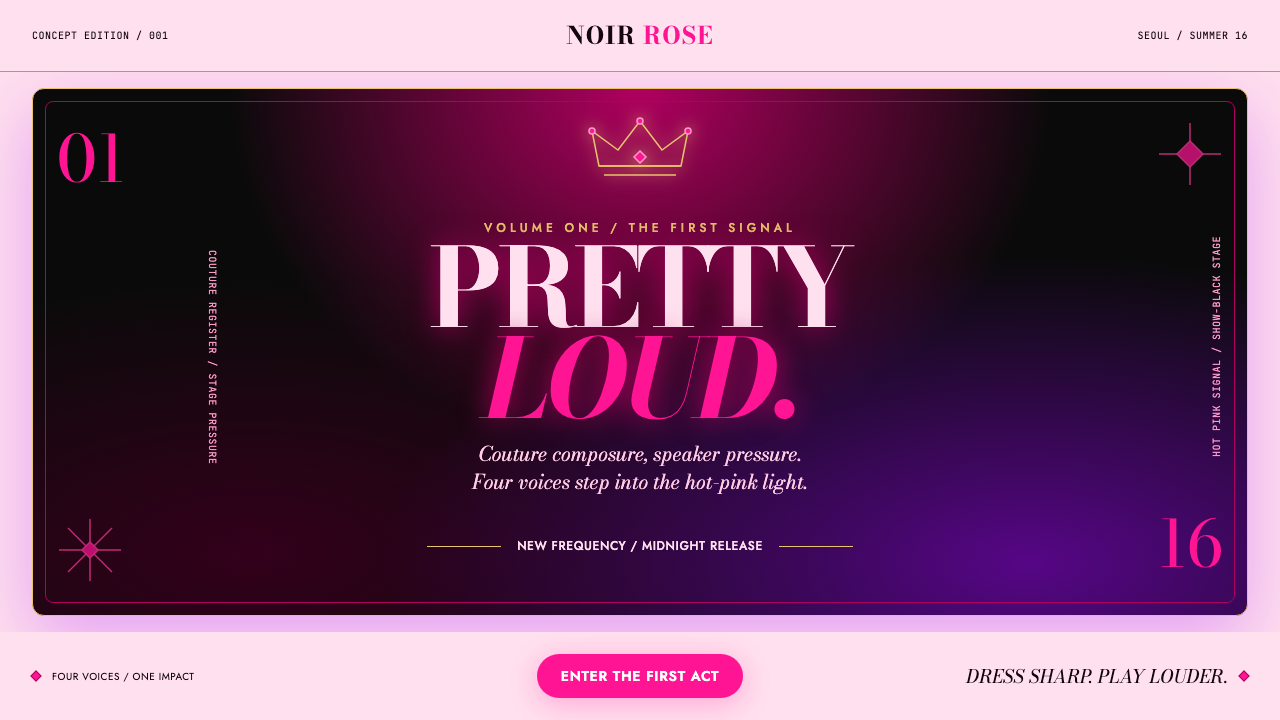 BLACKPINK (2016 Debut Era)Couture hits at full volume. Hot pink, show-black and Bodoni lock onto a spot…
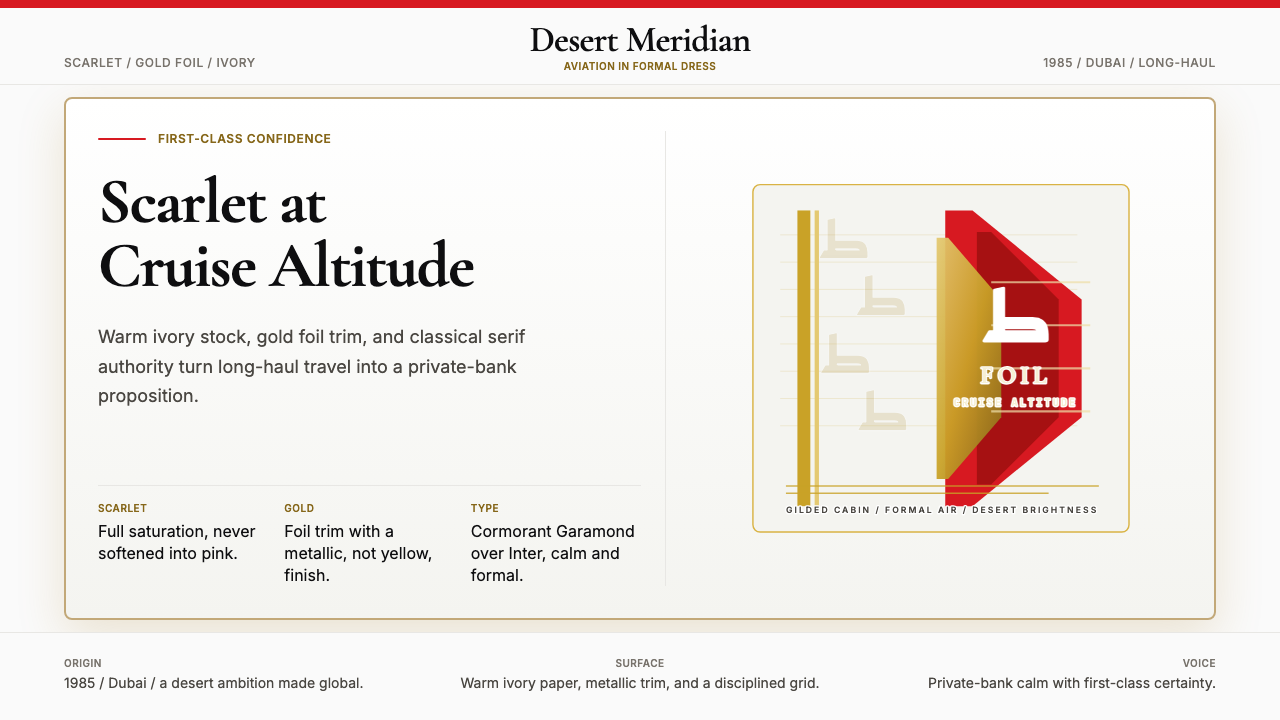 Emirates Airline (Red-Gold)Scarlet confidence, never casual. Ivory stock, gold foil, and serif restraint.