What is L'Oréal Paris Cosmetics?
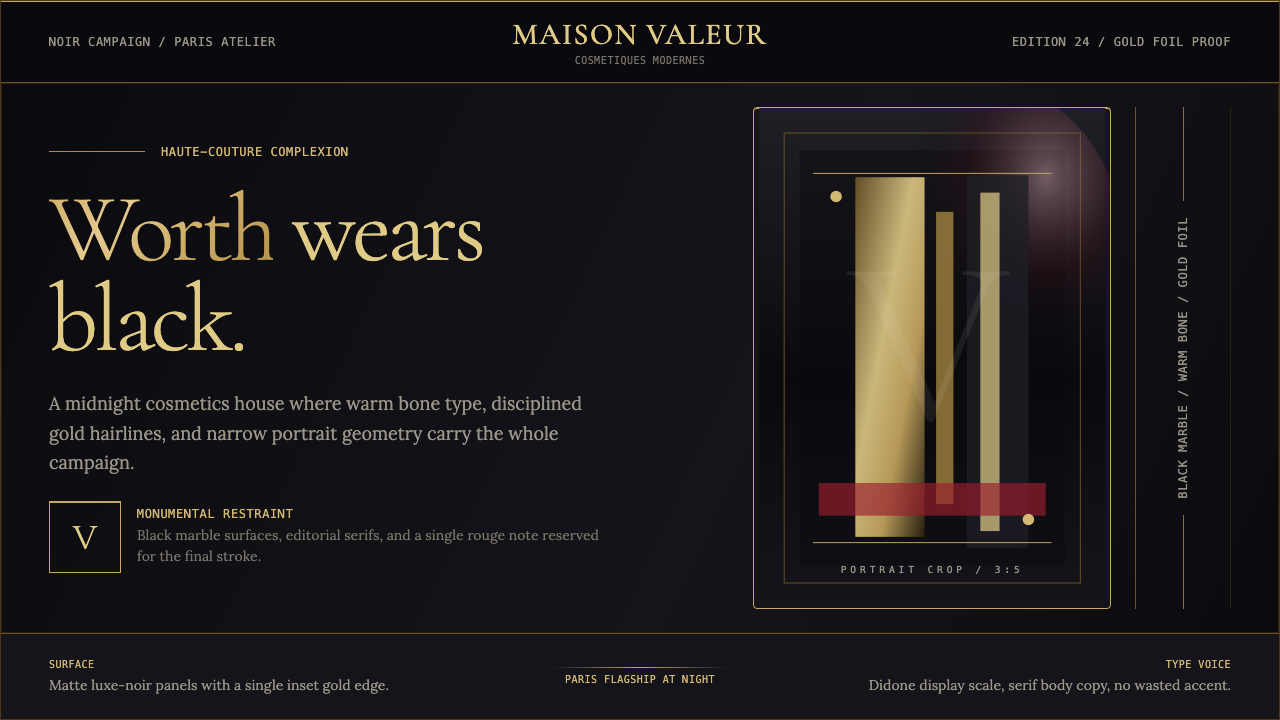
L'Oréal Paris translates a century of Parisian haute-couture authority into a design language built on the deepest black, the warmest gold, and a portrait orientation that turns every surface into a monument.
L'Oréal Paris Cosmetics in brief
L'Oréal Paris is the visual language of monumental Parisian luxury translated into interface, packaging, and campaign. The system draws on the blackest-black marble of a Champs-Élysées flagship store, gold-foil monograms pressed into matte surfaces, and the Didone serif headline tradition inherited from a century of haute-couture editorial photography. The result is a design vocabulary that simultaneously communicates prestige, authority, and feminine self-determination.
At its core, the aesthetic is built on radical restraint within a narrow range of highly charged signals. Deep, near-absolute black serves as the primary field — not as darkness or absence, but as the material analogue of expensive lacquered surfaces and photographic shadow. Against this black, a warm burnished gold reads as the accent of royalty and earned luxury, while high-key portrait photography — often a single face filling the entire frame — provides the human connection that prevents the system from feeling cold.
The design tradition absorbs and reflects L'Oréal Paris's 1909-to-now arc: the scientific precision of founder Eugène Schueller's chemist origins, the feminist declaration embedded in the 'Because I'm worth it' campaign of 1973, and the modern celebrity-portrait tradition in which international ambassadors carry the brand's values across cultures. Every compositional choice — the narrow portrait format, the gold Didone headline, the minimal color range — encodes this history into a system that feels simultaneously timeless and sharply contemporary.

Where does L'Oréal Paris Cosmetics come from?
The story begins in 1909 in a Paris still governed by Belle Époque aesthetics, when a young chemistry graduate named Eugène Schueller synthesized a new type of hair dye in his apartment and founded what would become L'Oréal. Schueller's instinct from the start was to marry scientific innovation with communicative confidence — he gave his formula a confident trade name (Auréale, later contracted to L'Oréal) and began selling it to Parisian hairdressers with a simplicity and directness that anticipated the brand's future advertising register. The company's early visual materials were modest — typeset trade cards and professional journals — but they already projected authority through sparse, legible typography rather than the ornate flourishes common in period advertising.
The brand's visual identity underwent its most consequential transformation in alignment with the rise of French fashion photography and the expansion of glossy magazines in the mid-twentieth century. As Vogue Paris, Elle, and Marie Claire created a new visual grammar of female aspiration in the 1950s and 1960s, L'Oréal Paris positioned itself squarely within that world — its packaging, advertising, and communications adopting the same high-contrast, editorial-photograph-and-headline formula that defined luxury magazine pages. The Didone serif tradition, with its extreme contrast between thick and thin strokes, was central to this moment: it was the typeface category of Parisian prestige, the letterform of couture house mastheads and glossy fashion spreads.
The critical cultural turning point came in 1973, when American copywriter Ilon Specht wrote the line 'Because I'm worth it' for a L'Oréal Paris hair color advertisement. Specht, then twenty-three years old and a junior creative at McCann Erickson, wrote the line deliberately in the first person — a radical departure from the second-person address that dominated advertising at the time — as an assertion of women's autonomy and self-defined value. The phrase became one of the most recognized advertising lines of the twentieth century and reoriented the brand's entire identity around the concept of female self-worth rather than external approval. The visual language had to carry this weight: it became more bold, more portrait-driven, and more structured around the face as the site of confidence rather than merely the surface for product demonstration.
The contemporary luxe-noir identity — the system most recognizable today — consolidated through the late 2010s and early 2020s under creative direction that leaned more aggressively into dark, monumental formats. International celebrity ambassadors including actors, athletes, and musicians from dozens of countries were photographed in consistent high-contrast portrait formats against near-black grounds, their images paired with the brand's gold typography and the 'Because you're worth it' tagline adapted across cultures. This ambassador tradition, under the executive leadership of Nicolas Hieronimus (who became CEO in 2021), extended the brand's earlier editorial logic into a globally coherent campaign system while preserving the Parisian flagship's core signals: black, gold, and the singular commanding face.
What defines the L'Oréal Paris Cosmetics look?
Black as Primary Field
Unlike systems that use black as an accent or a border, L'Oréal Paris deploys near-absolute black as the dominant ground across packaging, campaign imagery, and digital surfaces. This black is not neutral — it reads as the material equivalent of lacquered luxury goods, deep-pile velvet, or the polished marble of a flagship boutique interior. It functions as an assertion of weight and permanence, ensuring that every element placed upon it — gold type, a luminous face, a product silhouette — inherits a sense of precious value by proximity.
Warm Gold as the Singular Accent
Gold in this system is not a decorative flourish applied liberally to signal luxury — it is a disciplined accent held in reserve for the highest-hierarchy elements: the brand name, the campaign headline, the product monogram. The gold used is warm and burnished rather than bright or metallic-cool, evoking antique gilding and the enduring weight of historical prestige rather than contemporary metallic trends. Its sparing use against the deep black ground creates an immediate reading hierarchy: the eye goes to gold first, then to the face, then to secondary information.
Didone Serif Typography
The typeface tradition at the heart of L'Oréal Paris communications belongs to the Didone or Modern Serif category — letterforms characterized by an extreme contrast between hairline thin strokes and broad thick strokes, with horizontal serifs and a strong vertical axis. This typographic tradition originated in late-eighteenth-century Paris and became the standard face of French prestige publishing and high fashion editorial for over two centuries. In the L'Oréal Paris system, Didone headlines carry the brand's editorial authority; they communicate that what follows is not casual information but a pronouncement.
Portrait Orientation and the Singular Face
The compositional signature of L'Oréal Paris campaigns is the close-cropped portrait in a tall, narrow frame — a format that echoes both the proportions of high-fashion magazine spreads and the shape of a physical perfume bottle or product column. The face in these compositions is never incidental; it fills the frame almost entirely, making direct eye contact, and is lit to emphasize the luminosity and precision of skin rather than to create atmospheric mood. This centrality of the face is the visual embodiment of 'Because I'm worth it' — the human subject is not a vehicle for demonstrating product but the protagonist of the image.
Restrained Monochromatic Range
Where most cosmetics brands rely on a wide spectrum of product colors to animate their visual identity, L'Oréal Paris maintains a remarkably narrow range in its identity system: near-black, warm gold, and the natural tones of skin and hair photography. Occasional use of deep burgundy or cool ivory appears in product-specific campaigns, but always subordinated to the dominant black-gold axis. This restraint means the identity never competes with the product's own color — the lipstick, the eyeshadow, the nail color remains visually primary while the identity system frames it with consistent authority.
Gold-Foil Material Logic
The surface quality of L'Oréal Paris packaging — whether a foundation bottle, a mascara tube, or a fragrance cap — frequently uses physical gold-foil stamping or metallic lacquering as a material reference point. In digital and print contexts, this material origin informs the way gold tones are rendered: not as flat color blocks but as tones that suggest reflective depth and surface weight. The metaphor of the gold-foil stamp — pressed into material, catching light at an angle, implying durability and investment — runs through the entire visual system as a material honesty principle that connects the physical product to its two-dimensional representations.
Editorial Minimalism in Layout
L'Oréal Paris layouts — in campaigns, packaging, and digital interfaces — share a compositional discipline derived from high-fashion editorial: generous clear space around every element, type set in a single dominant size against secondary information at a clearly smaller scale, and an absence of decorative borders or embellishments. The hierarchy is established through scale contrast and color contrast alone. This editorial minimalism means the system scales gracefully from a full-page magazine advertisement to a thumbnail social media post without losing its essential character — the black-and-gold axis and the face read at any size.

Who shaped L'Oréal Paris Cosmetics?
The founder of L'Oréal in 1909, Schueller was a chemist who understood that scientific innovation required communicative confidence to reach the market. His instinct to give his hair-dye formula a memorable, aspirational trade name — and to present it with directness rather than period ornament — established the brand's early register of intelligent authority. The scientific precision he embedded in the company's DNA persists in the visual system as a preference for clarity, structure, and the impression of rigorously formulated quality over decorative excess.
A young copywriter at McCann Erickson, Specht wrote 'Because I'm worth it' in 1973 as a deliberate first-person declaration of feminine self-determination at a time when advertising universally addressed women in the second person ('Because you're worth it' came later). The phrase permanently reoriented the brand's identity from product performance to self-worth, and this shift is legible in the visual language: the face became the primary subject rather than the product, the portrait became monumental rather than aspirational, and the system's entire weight moved toward empowerment rather than aspiration-by-comparison.
The daughter of Eugène Schueller, Liliane Bettencourt inherited control of L'Oréal and through her stewardship of the company guided its expansion from a French brand into a global conglomerate while preserving the Parisian identity as its prestige anchor. Her influence ensured that the brand's French cultural capital — the association with Parisian beauty, haute couture, and editorial sophistication — remained central to the visual language even as the company diversified across mass-market and luxury segments. The black-and-gold identity system's insistence on a specifically Parisian register owes much to the continuity she maintained.
Hieronimus became CEO of L'Oréal in 2021 and has presided over the consolidation of the luxe-noir visual identity into a globally coherent system. Under his leadership, the brand's ambassador program — encompassing actors, athletes, musicians, and public figures from across the world — has been organized around a consistent visual grammar: high-contrast portrait photography, the black-ground-and-gold-type formula, and the 'Because you're worth it' tagline adapted across languages and cultures. His era represents the phase in which the Parisian editorial aesthetic became genuinely global while retaining its signature monumental restraint.
From the mid-twentieth century onward, L'Oréal Paris built its global recognition not through abstract brand symbols but through a curated roster of human faces — movie stars, supermodels, and later athletes and musicians — photographed in a consistent high-prestige editorial register. The visual discipline required to make this system work is considerable: each ambassador's image must read immediately as 'L'Oréal Paris' rather than as individual celebrity photography, which demands that the black-field composition, the gold typographic hierarchy, and the portrait orientation remain non-negotiable constants regardless of who is photographed.
How do you use L'Oréal Paris Cosmetics today?
The L'Oréal Paris luxe-noir system is among the most architecturally specific of contemporary brand aesthetics — it achieves its effect through the precise interaction of black, warm gold, and portrait photography, and it requires a disciplined fidelity to all three elements simultaneously. Applying it correctly means resisting the instinct to lighten, diversify the palette, or substitute the Didone editorial headline with a more contemporary geometric sans-serif. The system earns its power precisely through its severity.
For presentation slides, the style demands a black or very deep charcoal background as the non-negotiable starting condition. Cover slides work best with a single dominant close-cropped portrait image that fills most of the frame, the title set in a tall, high-contrast serif with a warm gold tone, and the remaining text reduced to a single secondary line at a markedly smaller size. Content slides should maintain the dark ground, using warm gold for slide headers or key data labels and reserving light or near-white tones only for body text. Data visualization in this system should treat chart elements as luminous against darkness — glowing lines, bright bars — rather than imposing hard geometric shapes on a pale background.
For web user interfaces, the style suits premium product pages, editorial e-commerce, and landing pages for prestige brand campaigns where conversion is secondary to brand impression. The approach calls for a full-width dark hero section with a high-resolution portrait photograph and a gold typographic headline, a strict single-column or narrow two-column content grid below, and product photography presented against a matching dark or softly lit neutral ground. Dashboard applications can adopt the palette for a high-authority read: dark backgrounds, gold as the active-state and alert-state accent, light text on dark fields for all primary information. Navigation should be typographic and minimal — the weight of the identity is carried by the hero section, not by interface chrome.
For editorial and marketing materials — catalogues, campaign prints, social cards, and press kits — the system's portrait-and-headline logic translates directly. Full-bleed portrait photography occupies the primary real estate; the brand name and campaign headline appear in warm gold Didone at a scale that commands the remaining space; all secondary copy retreats to a significantly smaller size in a light neutral tone. The vertical format should be preferred wherever the medium allows — it echoes both the magazine spread and the product packaging. Marketing emails and social content work best in the tall portrait format that the mobile screen naturally accommodates, with the face and the gold headline as the only above-the-fold information.
A common mistake when applying this aesthetic is treating it as general 'luxury dark mode' — adding a black background and some gold text to any design without committing to the portrait orientation, the Didone headline character, and the radical reduction of palette. The result is a dark-and-gold design that reads as generic nightclub or spirits-brand branding rather than Parisian cosmetics authority. An equally common error is softening the contrast — using charcoal rather than true black, or warm amber rather than gold — in an attempt to make the system feel more approachable. Both mistakes undermine the fundamental principle: the power of this visual language comes from its commitment to the extreme. True near-black and warm gold together, in the right proportions and with portrait photography at the center, is what produces the specific effect. Compromise at either end collapses the system into something merely dark and decorated.

L'Oréal Paris Cosmetics — FAQ
How is L'Oréal Paris different from other luxury cosmetics visual identities?
Most luxury cosmetics brands anchor their identity in a heritage color — Chanel in cream and black, Dior in grey and silver, Guerlain in midnight blue and gold. L'Oréal Paris distinguishes itself by pushing the black further toward absolute darkness, making the near-black field itself the primary luxury signal rather than a supporting neutral. The second distinction is the centrality of the human face: where heritage luxury brands often rely on abstract symbols, monograms, or architectural photography, L'Oréal Paris makes the face non-negotiable — this keeps the system warm and aspirationally accessible in a way that pure luxury abstraction cannot achieve.
Can this aesthetic work for products that are not cosmetics or beauty?
The core signals of the system — deep black, warm gold, portrait orientation, high-contrast serif headline — are transferable to any context where prestige, authority, and human-centered luxury are the desired values. Fragrance, jewelry, premium hospitality, high-end fashion, and financial services products that emphasize personal achievement have all successfully adopted versions of this visual language. It struggles wherever the product's emotional register requires lightness, approachability, or playfulness — children's products, casual lifestyle brands, food and beverage outside the premium spirits category, and wellness brands that emphasize organic softness would all be poorly served by the severity of the black-and-gold formula.
How should skin-tone diversity be handled within this visual system?
The deep black ground is, by design, a neutral that holds all skin tones with equal clarity and luminosity — a fair complexion, a medium olive tone, and a deep melanin-rich skin all read as luminous and high-prestige when lit correctly against near-absolute black. This is one of the system's structural strengths: the black field does not favor any particular skin tone the way a warm cream or cool grey background might. The challenge is in the lighting and photography direction: every skin tone requires its own lighting setup to achieve the high-contrast, luminous quality that the system demands. Applying a single lighting formula across all ambassadors undermines the system's promise of universal self-worth.
Is it possible to create a light-background version of this identity without losing the system's character?
A light inversion is possible but requires significant rebalancing. On a near-white or ivory background, the black-and-gold formula reverses: deep near-black type replaces the gold headline as the primary reading element, while warm gold is reduced to a single accent — a rule, a monogram, a product name. The portrait photography must be lit differently to maintain drama on a light ground: high-contrast against soft grey or ivory rather than the luminous-against-black effect of the primary system. This light version reads as the daytime or editorial context of the identity rather than its campaign-facing monumental register, and is best used for packaging inserts, product sheets, and editorial contexts where the full dark-ground treatment would be too heavy.
What is the most important single principle for someone applying this style for the first time?
Commit to the black. The single most common failure mode when attempting this aesthetic is hedging on the background — using a deep grey instead of near-absolute black, a charcoal instead of true dark, a dark navy instead of the neutral darkness that the system requires. Any color in the background field competes with the warm gold and dilutes the identity's fundamental contrast logic. The black must be as close to absolute as the medium allows; everything else in the system derives its value from that commitment. Once the black is right, the warm gold accent and the portrait photography will find their correct register almost automatically.
Related design styles
 Lima Nuevo Andino CuisineAltitude turns luxurious. Charcoal fields, copper hairlines, and saffron-red…
 Al Jazeera Arabic NewsAuthority, stripped bare. Gold seal, dense Arabic type, matte charcoal.
 Argentine Malbec WineAltitude turned austere. Burgundy panels, engraved Garamond, oxidized copper.
 Lagos Fashion WeekBlack luxury speaks plainly. Matte ink, bone serif, and one gold hairline set…
 SephoraBlack is the stage. White 45° stripes and restrained gold foil make cosmetics…
 Yves Saint Laurent (YSL)Couture chiaroscuro. Saturated black ground, warm gold accent, Didot serif at…