What is Lima Nuevo Andino Cuisine?
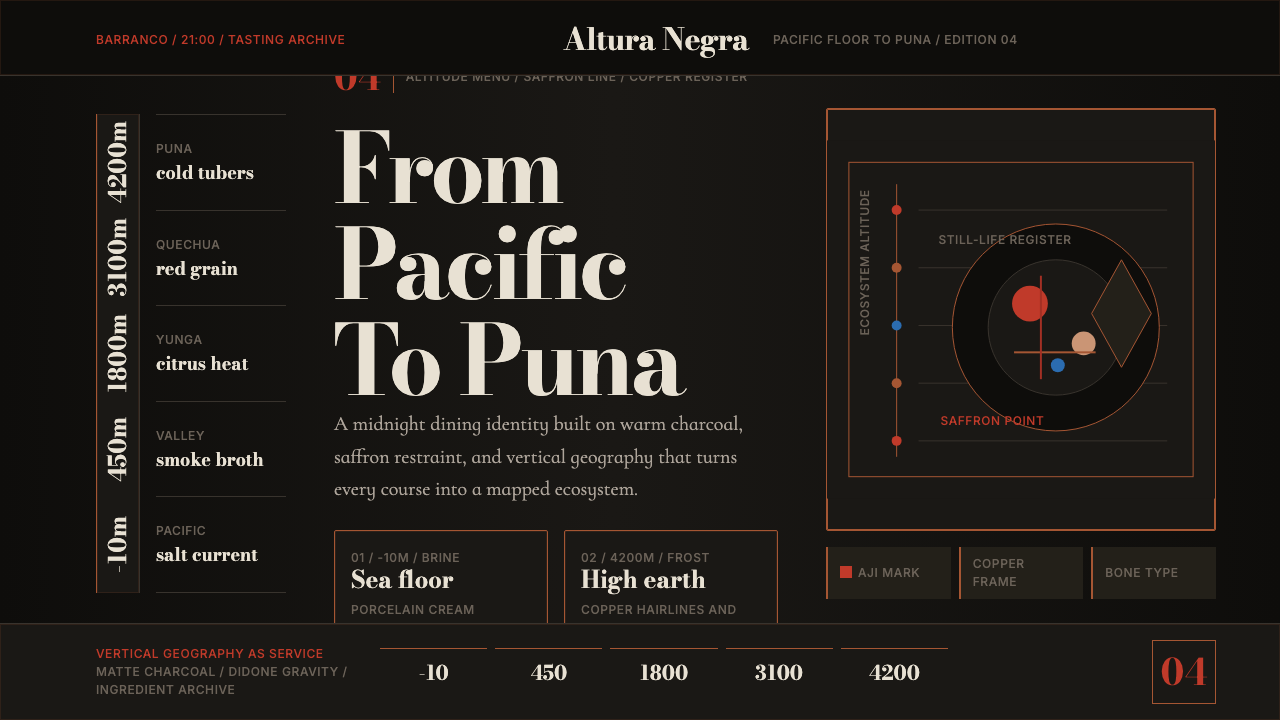
Lima's nuevo andino restaurants built a visual language as exacting as their tasting menus — matte-dark surfaces, saffron-red accent lines, and vertical diagrams that map every dish to its precise altitude in the Andes.
Lima Nuevo Andino Cuisine in brief
Lima Nuevo Andino Cuisine is a visual design system born from the gastronomic renaissance that transformed Lima into one of the world's foremost dining cities between roughly 2008 and the mid-2020s. It draws directly from the atmosphere and graphic identity cultivated by landmark restaurants — Central, Maido, Astrid y Gastón — whose dining rooms, menus, and plating philosophies established an entirely new visual register for South American haute cuisine.
The aesthetic is editorial and ingredient-obsessed. Where earlier Peruvian restaurant design leaned on folk motifs, woven textiles, or Inca iconography, nuevo andino stripped those references away and replaced them with something more surprising: the rigorous, altitude-indexed diagrammatic language of scientific field study. Menus become geographic documents. Walls read like data visualizations. Every visual decision reinforces the kitchen's core argument that the Andean landscape — from the Pacific ocean floor to the alpine puna — is the most biodiverse food pantry on earth.
The result is a design vocabulary that feels simultaneously luxurious and intellectual. Warm-black and charcoal surfaces create a sense of depth and nocturnal intimacy; copper hairline borders introduce a metallic warmth that reads as precious without being ostentatious; saffron-red accent lines provide the single note of color that punctuates an otherwise restrained palette. Vertical rhythm — running floor-to-ceiling in both physical space and on the printed page — enacts the altitude gradient that is the cuisine's defining concept.
Where does Lima Nuevo Andino Cuisine come from?
The roots of this visual system lie in the Peruvian gastronomic renaissance triggered by Apega — the Peruvian Society of Gastronomy — and accelerated by the early international success of Gastón Acurio's Astrid y Gastón in Lima's Miraflores district. Acurio, who trained at Le Cordon Bleu and El Bulli, returned to Lima in the 1990s with a conviction that Peruvian ingredients were among the most varied and extraordinary on earth and had been systematically undervalued. His restaurants and cookbooks began making that argument publicly, and by the mid-2000s, Lima was attracting culinary journalists and food tourists from across the world.
The visual turn came with the next generation, particularly Virgilio Martínez and his restaurant Central, which opened in Miraflores in 2009 and relocated to Barranco in 2021. Martínez, trained in London and New York before returning to Peru, introduced the altitude-gradient menu format that became the system's defining visual conceit: each tasting-menu course was labeled not just by ingredient but by the precise elevation at which it was foraged or farmed — 'Extreme Altitude' at over four thousand meters, 'Amazon Jungle' near sea level, 'Pacific Ocean' at negative depths. The menu was simultaneously a meal plan and a topographic map.
Mitsuharu 'Micha' Tsumura's Maido brought a second visual influence: nikkei aesthetics, the fusion sensibility developed by Japanese-Peruvian communities whose Meiji-era immigrants arrived in Peru in 1899. Nikkei cooking places Japanese precision and minimalist presentation against Peruvian ingredient diversity. The visual language Maido cultivated — Japanese-influenced negative space, meticulous plating geometry, monochromatic tableware — reinforced the editorial restraint that the broader nuevo andino system shared.
By 2015, Lima's dining rooms had converged on a recognizable visual register: darkened interiors that directed all attention to the plate, printed materials that used altitude diagrams as structural devices, and a color palette anchored in warm blacks and copper metallics with deliberate saffron-red or amber accents. The 2020s solidified this as a transferable design system — one that could travel from restaurant branding into digital menus, culinary event identities, food-focused editorial layouts, and premium hospitality interfaces well beyond Peru itself.
What defines the Lima Nuevo Andino Cuisine look?
Surface and Ground
The foundational layer is a warm, near-black — not a cold digital black but a charcoal that carries traces of warmth, evoking the texture of fired ceramic or matte concrete. Against this ground, everything else reads with heightened clarity. The darkness is not minimalist in the Scandinavian sense; it is atmospheric, suggesting the intimate dining rooms of Barranco at nine in the evening, lit more by candlelight than overhead illumination. Content appears to float on this surface rather than rest upon it.
Accent Color and Restraint
Saffron red — rich, earthy, and deeply associated with Andean dye traditions — appears in a single sustained role: the accent line that marks hierarchy, divides sections, or signals interactive elements. It is never used as background fill or applied broadly. Its power comes from scarcity. Copper appears alongside in a similarly disciplined way, used for hairline borders and rule lines where gold would feel excessive and silver would feel cold. The interplay of the two warm metallics against the dark ground is the system's most distinctive visual signature.
Vertical Rhythm and Altitude Mapping
The system's most intellectually distinctive feature is its use of vertical orientation to enact geographic hierarchy. Just as the altitude-gradient menu charts the landscape from ocean floor to alpine summit, design layouts in this system tend to organize information along a vertical axis, with higher-altitude or more-refined content positioned at the top and earthier, more raw material at the bottom. This is not a rigid rule but a compositional instinct that permeates every layout — information descends like elevation, and the eye is trained to read the vertical dimension as meaningful.
Typography as Document
Typography in this system draws on the gravitas of high-contrast serif letterforms — the kind associated with luxury editorial publishing and scientific taxonomy — paired with light, open sans-serif type for secondary information. The contrast is not between typefaces in the decorative sense but between registers: the headline announces authority and finality; the annotation invites close reading. This combination reflects the cuisine's dual identity — it is simultaneously a fine-dining experience and a rigorous academic inquiry into Andean biodiversity.
Material Warmth and Anti-Gloss
Unlike the glossy lacquer finishes of earlier luxury hospitality design, nuevo andino surfaces are matte or satin at most. The dining-room walls are raw concrete or limewash; the ceramics are unglazed or lightly so; printed materials use uncoated stock. This deliberate rejection of gloss communicates authenticity over opulence — it says the value is in the substance, not the surface treatment. In digital contexts, this translates to flat or very lightly textured surface treatments, no high-gloss gradients, and careful attention to matte states over hover-glow effects.
Diagrammatic Precision
Data and information are visualized with the disciplined clarity of scientific illustration rather than the expressiveness of infographic design. Altitude diagrams, ecological zone maps, and ingredient provenance charts are drawn in spare linework — thin rules, minimal labels, precise positioning. Nothing is decorative; every mark carries informational weight. This diagrammatic sensibility extends beyond actual charts: even layout grids and typographic hierarchies are conceived as systems of notation, with each element assigned a position in a logical schema rather than arranged for purely aesthetic effect.
Geographic and Ecological Identity
The system is inseparable from its geographic specificity. References to named Andean ecosystems — the altiplano, the cloud forest, the coastal lomas — function as organizational and emotional anchors throughout a composition. This is not generic 'nature inspiration' but a very particular epistemology: the landscape is the menu, the menu is the landscape. This specificity gives the design vocabulary an authenticity that cannot be borrowed without reference to its source — when used in contexts unrelated to Andean food culture, it reads as appropriation rather than homage.
Who shaped Lima Nuevo Andino Cuisine?
Martínez is the chef most directly responsible for codifying the altitude-gradient format that defines the system's visual identity. At Central — ranked among the world's top restaurants throughout the 2010s and 2020s — he developed the practice of labeling each tasting course by elevation, turning the menu into a topographic document. His collaborative projects with biologists and field researchers reinforced the scientific-document aesthetic, treating the dining room as a site of ecological inquiry. His wife and co-chef Pía León shared and deepened this vision, particularly through her solo restaurant Kjolle, where ingredient-sourcing storytelling reached an even more intimate register.
Acurio is the movement's most influential evangelist. He did not create the nuevo andino visual language in its mature form, but he established the cultural and institutional conditions that made it possible. By demonstrating that Peruvian cuisine could occupy the same international prestige as French or Japanese cooking, he shifted the frame of reference for Lima's chefs, freeing them to build a visual identity grounded in Andean geography rather than European precedent. His media presence — television series, bestselling cookbooks, restaurant chains across Latin America — spread Peruvian food culture globally and created an audience educated enough to receive the more conceptually rigorous aesthetics of the next generation.
Tsumura, known as Micha, is the defining figure of nikkei cuisine — the Japanese-Peruvian fusion tradition whose visual sensibility contributed the system's commitment to negative space, geometric plating, and monochromatic restraint. Maido, his Lima restaurant, consistently ranked alongside Central on the world's top restaurant lists, giving nikkei aesthetics global visibility. His background in Tokyo and his deep familiarity with both Japanese precision cooking and Peruvian biodiversity produced a synthesis that is neither Japanese nor Peruvian but distinctly of Lima — a city shaped by over a century of Japanese-Peruvian exchange.
León co-led Central alongside Martínez and in 2018 opened Kjolle, her solo restaurant within the same Barranco building complex. If Central's visual language is topographic and scientific, Kjolle's is more intimate and sensory — an extension of the same vocabulary at a smaller, more personal scale. León's sourcing work, which took her into remote highland and jungle communities to document ingredients unknown even to most Peruvian chefs, deepened the system's claim to geographic authenticity. Her recognition as the World's Best Female Chef in 2021 brought additional international attention to the Lima school's visual and culinary identity.
Muñoz, the chef behind Amaz in Lima's Miraflores district, extended the altitude-zoning visual language specifically toward Amazonian ingredients and ecosystems. Where Central charts vertical altitude, Amaz charts the horizontal reach of the Amazon basin — its visual identity uses river-network diagrams and jungle-canopy motifs in place of the altiplano. Muñoz's contribution expanded the system's geographic vocabulary beyond the Andes and demonstrated that the underlying logic — place as menu, diagram as identity — could absorb multiple ecosystems without becoming generic.
How do you use Lima Nuevo Andino Cuisine today?
The Lima Nuevo Andino system is well-suited to any design context where authority, geographic specificity, and intellectual depth are desired values — premium hospitality branding, culinary editorial, food-focused web interfaces, and event identities for gastronomic or cultural institutions. It is particularly powerful when the content itself has a geographic or provenance story to tell, because the system's core vocabulary — altitude mapping, ecological zonation, diagrammatic precision — gives that story a visual structure it can inhabit.
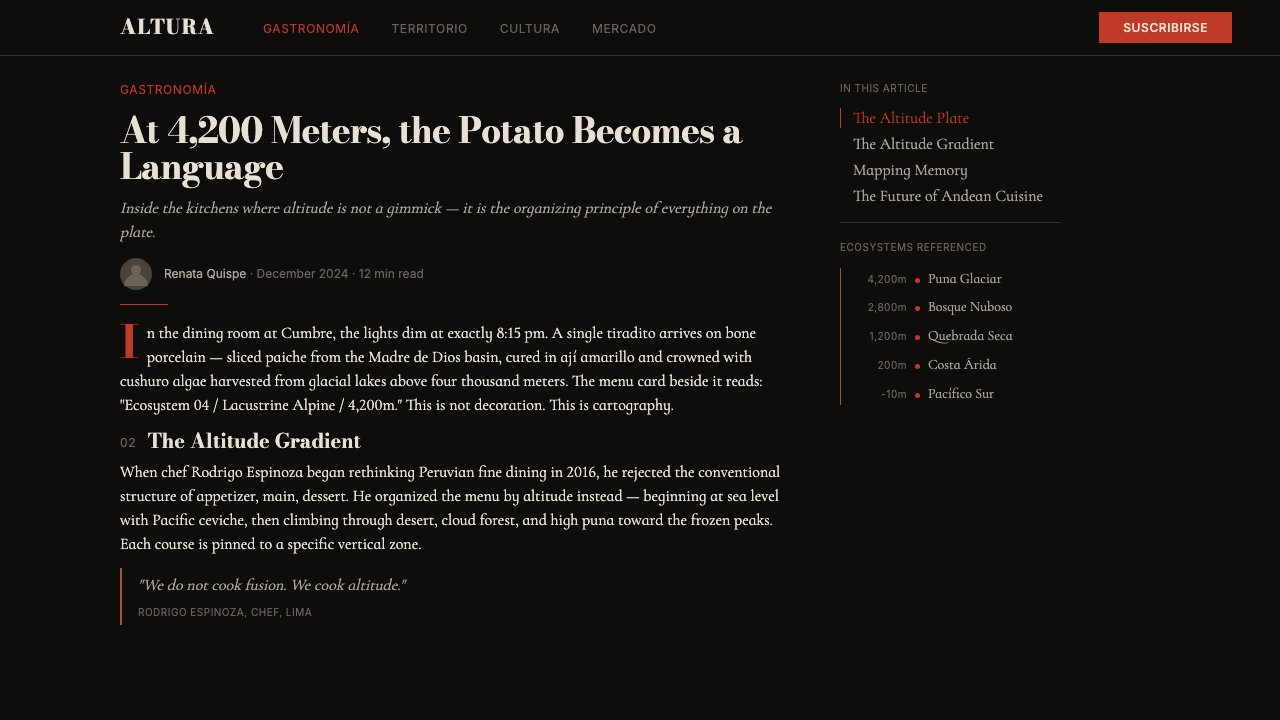
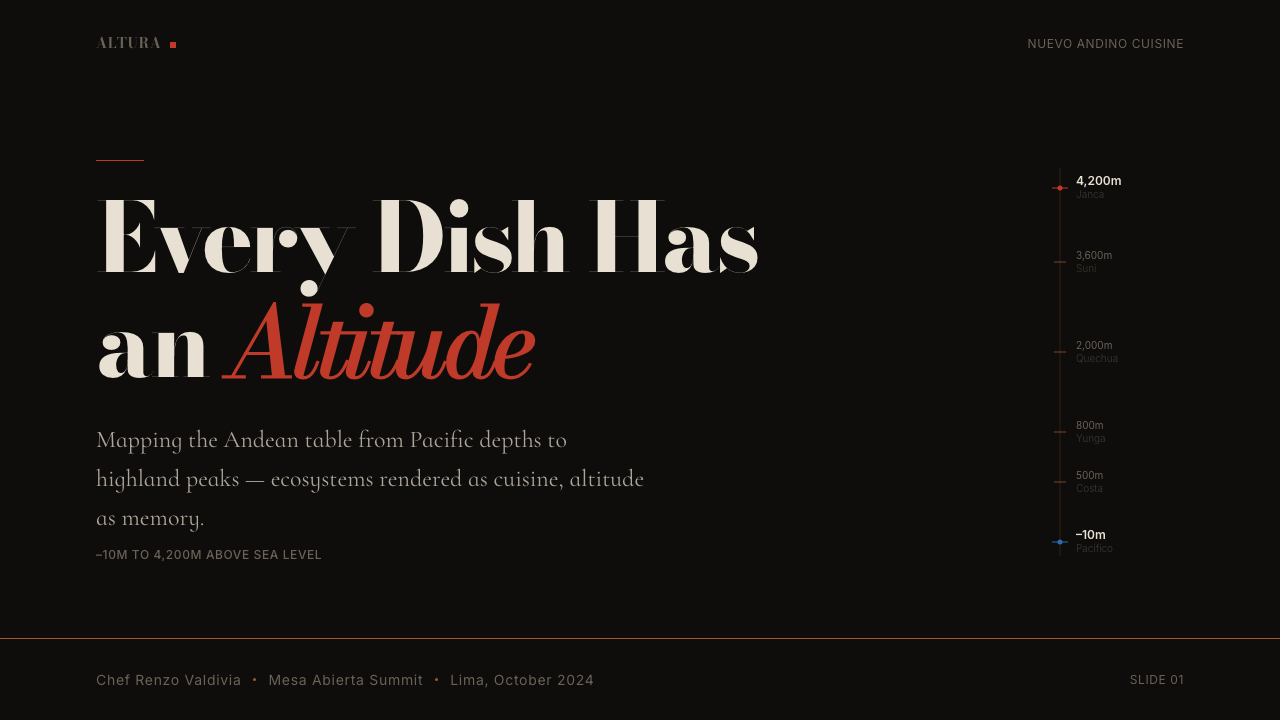
For presentation slides, the system works best on a dark ground with a warm-black or deep charcoal field. Cover slides benefit from an altitude diagram used as the primary composition device: a vertical gradient line running the full height of the slide, with ecosystem labels positioned at corresponding altitudes. Content slides should use a narrow left-margin column for hierarchy labels or altitude-zone tags, with the main body in a high-contrast lighter weight. Data slides take on a scientific-illustration quality — charts should be sparse, labeled with the same restraint as a field-research document, and colored only with the saffron-red or copper accent for the single most important data series.
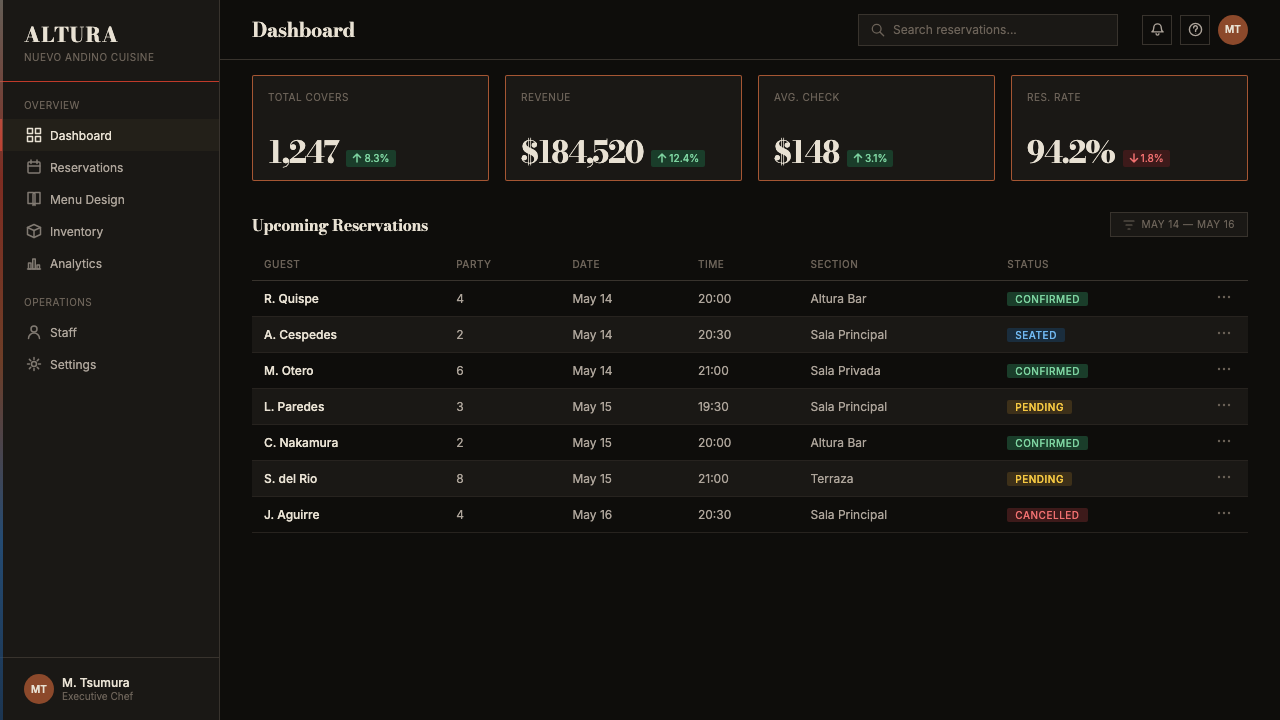
For web interfaces — particularly restaurant websites, food-platform dashboards, or premium e-commerce in the food and hospitality sector — the system rewards commitment. A half-hearted application that borrows only the dark background without the vertical rhythm or the diagrammatic typography will feel generic rather than grounded. The system needs its geographic organizing logic to work: section headings that establish a vertical zone, accent lines that mark transitions, and a typographic scale that reads as authoritative documentation rather than decorative layout.
For editorial and marketing work, the style supports long-form storytelling with visual authority. A feature article about a chef, a culinary region, or an ingredient can use altitude diagrams as section dividers, with each chapter labeled by its ecological context. Marketing pages for food events or gastronomic experiences work well with the system's poster-like restraint: full-width feature blocks in warm charcoal, with saffron-red headlines and copper rule lines, conveying the kind of gravitas that signals serious culinary purpose rather than casual dining.
The most common mistake when applying this system is using it as a generic dark-luxury aesthetic — pulling the warm blacks and copper tones without the underlying geographic and diagrammatic logic. The result is expensive-looking but empty. The system's power comes from specificity: if the content is not about place, provenance, or ecological context, the visual vocabulary has nothing to anchor to, and it defaults to being merely atmospheric. A second common error is treating saffron-red as an available accent color for any purpose. In authentic applications, it signals a single level of hierarchy or a single interactive state — the moment it appears on more than one or two elements simultaneously, its scarcity value collapses.
Lima Nuevo Andino Cuisine — FAQ
How does Lima Nuevo Andino differ from other dark-luxury hospitality aesthetics?
Most dark-luxury aesthetics — steakhouse noir, European fine dining, Japanese omakase — use darkness to signal exclusivity without a specific geographic or intellectual claim. The Lima Nuevo Andino system is distinguished by its diagrammatic logic: the darkness is not mood alone, it is the field against which scientific illustration becomes legible. The altitude gradient, the ecological zone labels, the copper hairlines are not decorative — they are a visual argument about the landscape as the source of value. Remove the geographic specificity and you have a handsome dark layout; retain it and you have a system with genuine content.
Can this aesthetic work for non-food brands?
With significant adaptation, yes — but the designer should be clear-eyed about what is being transferred and what is being left behind. The formal qualities — warm-black grounds, copper metallics, saffron-red accents, vertical rhythm, diagrammatic precision — can transfer to any brand communicating geographic provenance, scientific authority, or craft depth. Natural ingredients, field-research platforms, cartography tools, cultural heritage institutions, and premium outdoor equipment have all successfully borrowed elements of this register. What cannot transfer without strain is the altitude-mapping conceit itself — using it without connection to actual ecosystems reads as stylistic appropriation.
Is nikkei a separate style or part of the same system?
Nikkei aesthetics are a significant source layer for the Lima Nuevo Andino system but are not identical to it. Nikkei design — rooted in the Japanese-Peruvian community's century-long synthesis — brings the negative space, geometric plating, and monochromatic tableware that characterize restaurants like Maido. Nuevo andino in the broader sense adds the altitude-mapping logic, the Andean color palette anchored in saffron and copper, and the diagrammatic documentation approach. A nikkei-specific design language is cooler and more overtly Japanese in influence; nuevo andino proper is warmer, more geographically declarative, and more concerned with ecological specificity.
How do you handle light-background or print contexts where the dark ground is not practical?
The system inverts with reasonable grace. On a light ground — uncoated cream or warm white — the copper and saffron-red accents retain their character and the diagrammatic precision reads even more clearly. The vertical altitude lines become bolder graphic objects against light fields. What is lost is the nocturnal intimacy that gives the dark-ground version its dining-room atmosphere; the light inversion reads as more clinical and documentary, closer to the field-research journal end of the spectrum than the Barranco dining room. For print collateral — menus, event programs, editorial features — this is often the appropriate register: authoritative and legible rather than atmospheric.
Why did this particular visual language emerge from Lima rather than from another gastronomic capital?
Lima's gastronomy is unusual in that its claim to distinction rests almost entirely on geographic uniqueness — the sheer biodiversity of Peru's overlapping climatic zones — rather than on technique, history, or cultural prestige in the European sense. French cuisine claims authority through centuries of codification; Japanese cuisine through precision and ritual. Lima had to make a different argument: the landscape itself is the authority. A visual system built around diagrammatic geography — altitude maps, ecosystem labels, provenance documentation — is the most direct way to make that argument in design. Other food capitals had less need to assert geographic uniqueness because they could rely on inherited prestige; Lima invented a visual language because it needed one.
Related design styles
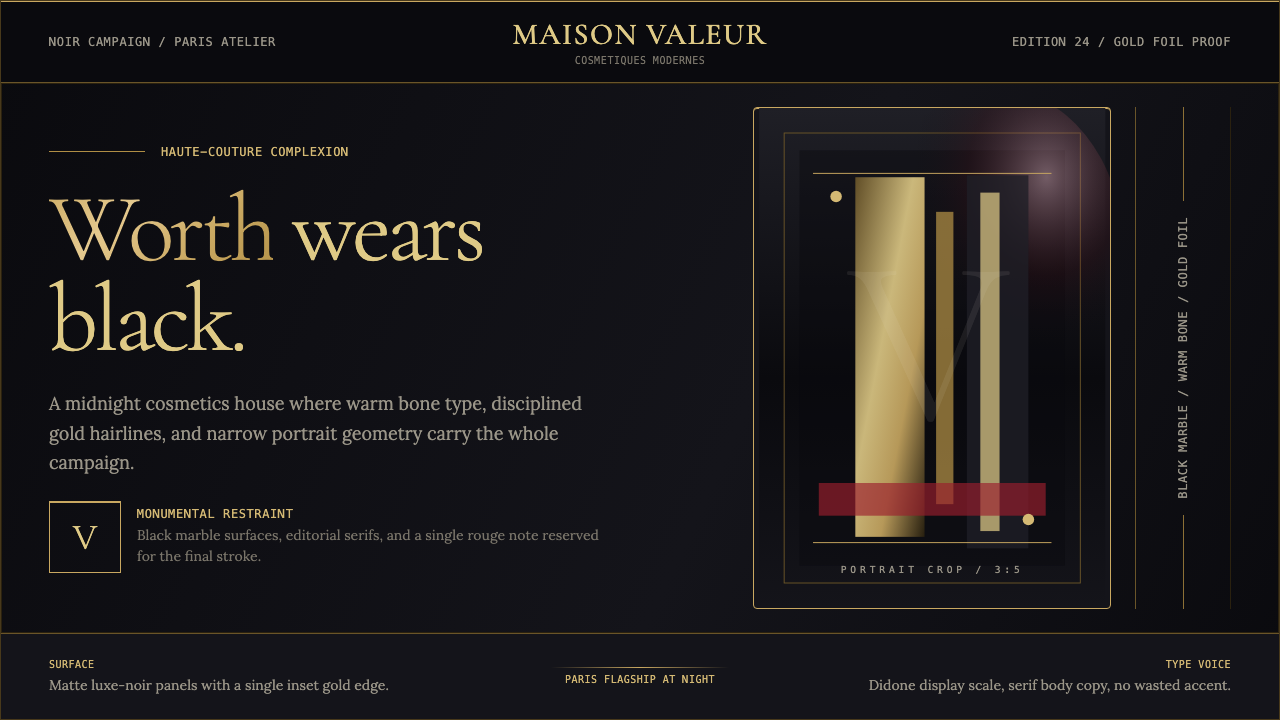 L'Oréal Paris CosmeticsMonumental restraint. Black marble fields, gold Didone type, and narrow portr…
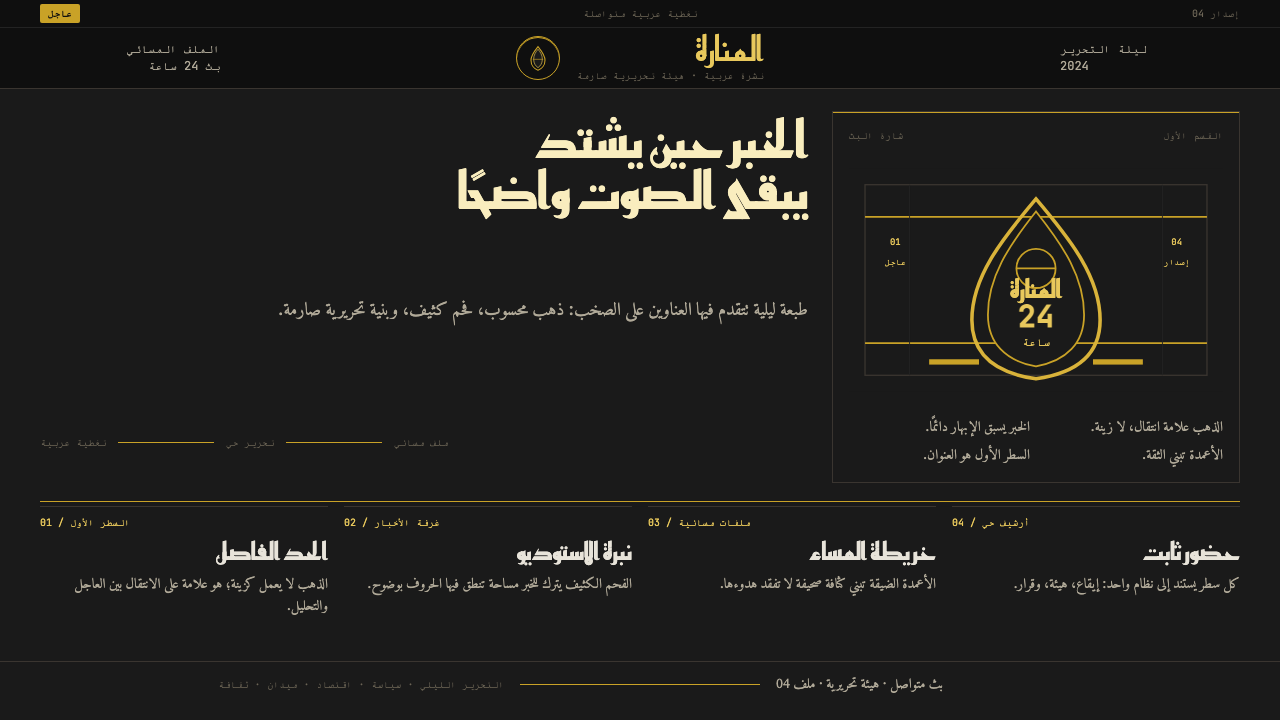 Al Jazeera Arabic NewsAuthority, stripped bare. Gold seal, dense Arabic type, matte charcoal.
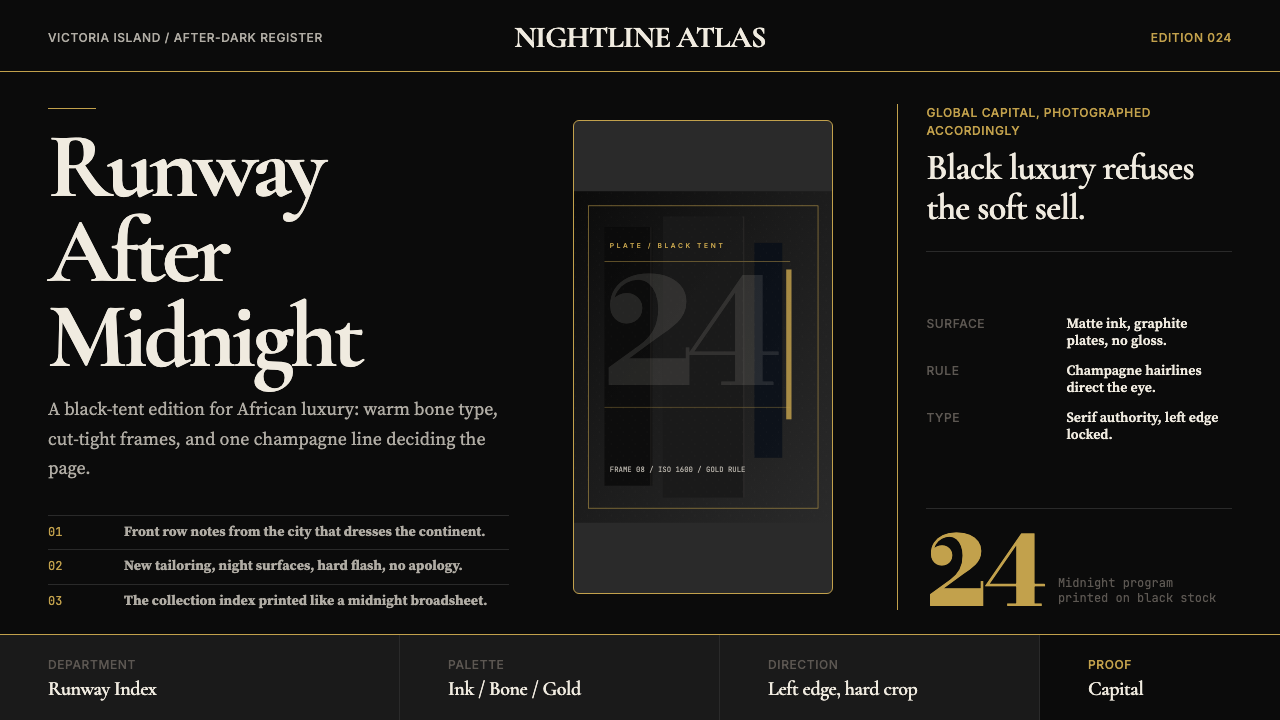 Lagos Fashion WeekBlack luxury speaks plainly. Matte ink, bone serif, and one gold hairline set…
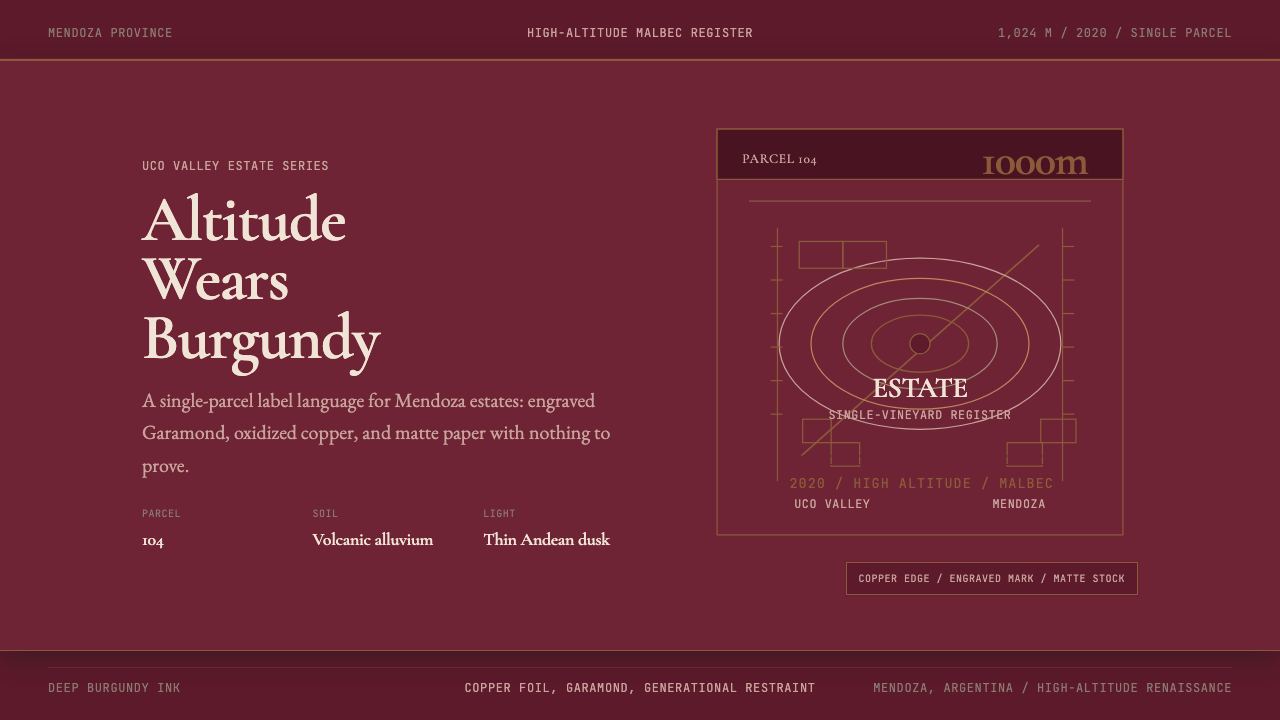 Argentine Malbec WineAltitude turned austere. Burgundy panels, engraved Garamond, oxidized copper.
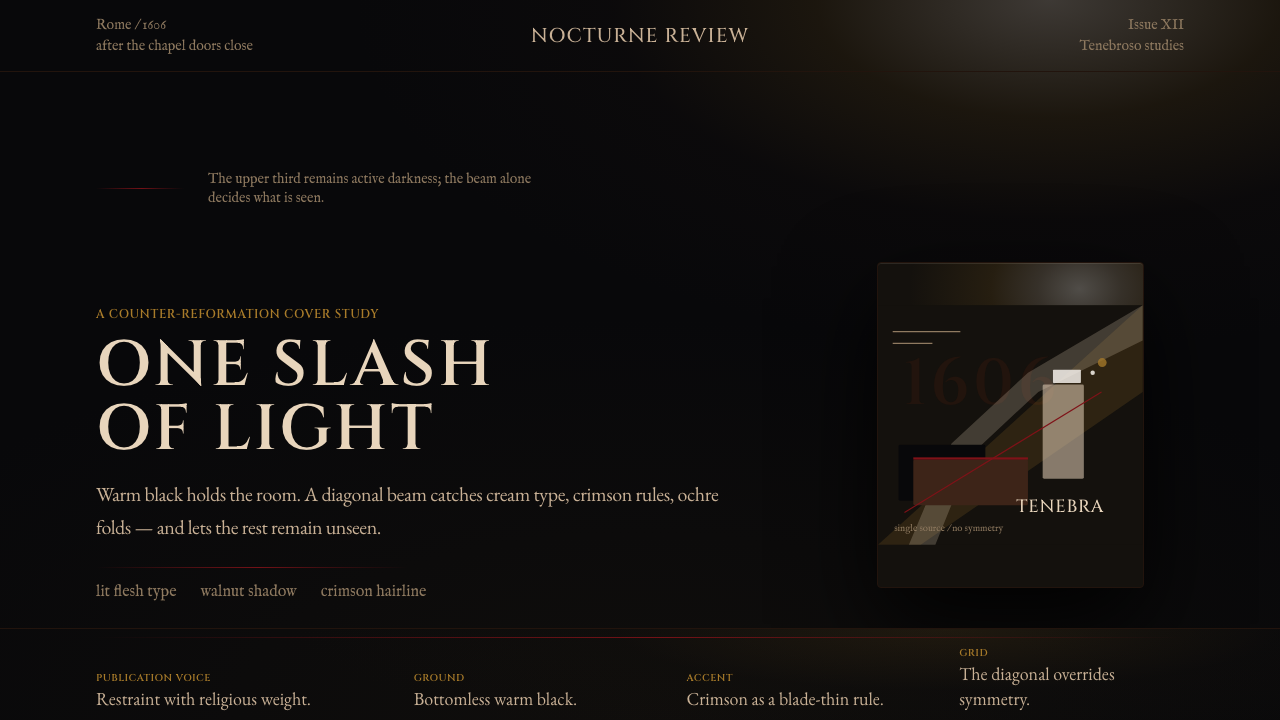 Caravaggio TenebrismDarkness acts first. Warm-black voids, Cinzel capitals, and one ochre raking…
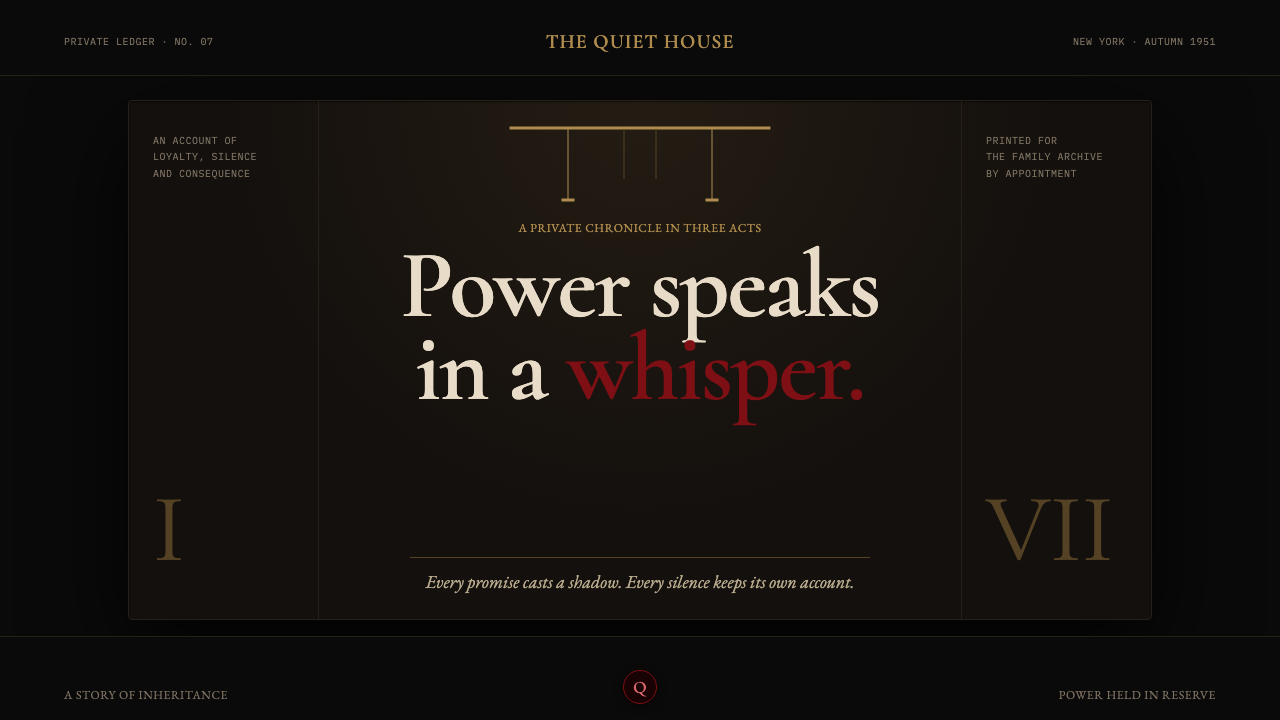 The Godfather (1972)Quiet authority becomes menace. Near-black shadow, brass rules, and one oxblo…