What is Bolivian Cholita Fashion?
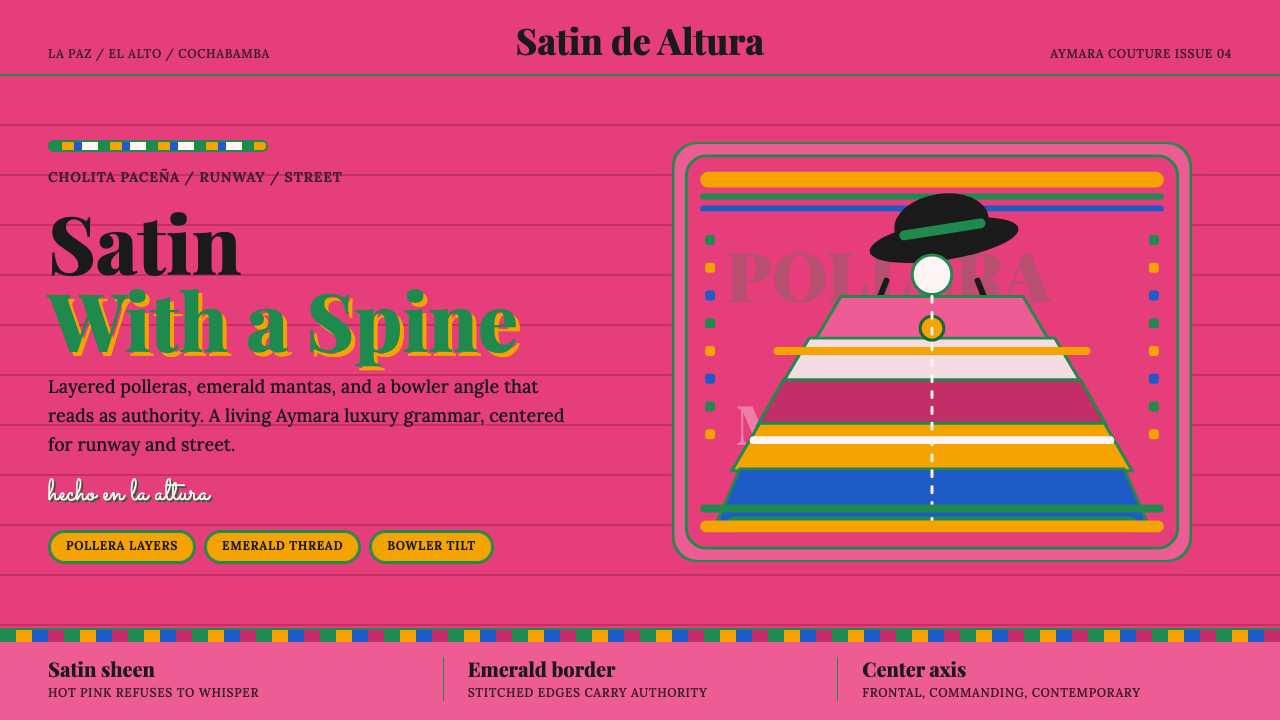
Cholita fashion transforms indigenous Aymara dress into a living declaration of sovereign beauty — layered pollera skirts in saturated jewel tones, embroidered mantas, and a tilted bowler hat that signals everything.
Bolivian Cholita Fashion in brief
Bolivian Cholita Fashion is the visual and cultural system of dress worn by cholita paceña — Aymara and Quechua indigenous women of La Paz, El Alto, and the surrounding altiplano. The silhouette is unmistakable: multiple layers of voluminous, mid-calf pollera skirts fanning outward from the waist, a richly embroidered or solid-color manta draped over the shoulders, a delicate blouse with lace trim at the collar and cuffs, a shawl fastened with a decorative pin called a tupo, and always the bombín — the small bowler hat worn tilted to one side. This is not archaic costume preserved behind glass. It is a live, evolving luxury dress code actively worn in markets, political chambers, wrestling rings, and on international runways.
The visual grammar of cholita dress is built on extreme color saturation and deliberate contrast. Hot pink paired with emerald, electric blue alongside burnt orange, deep violet meeting gold embroidery — combinations that refuse the muted palette of European fashion convention. Satin and velvet surfaces amplify light and signal material investment. Embroidery borders at hemlines and cuffs function like signature details: dense floral and geometric motifs in contrasting thread that announce craftsmanship and regional identity simultaneously. The pollera's layering creates a conical, centered silhouette that reads as both monumental and festive.
What distinguishes this system aesthetically from other indigenous textile traditions is its unapologetic maximalism operating within a coherent internal logic. Every element — color choice, fabric weight, embroidery density, hat angle — is legible within the community as a signal of status, occasion, regional origin, and personal expression. The bowler hat alone carries a code: its tilt angle, color, and the presence or absence of a band communicate whether the wearer is married, the occasion's formality, and sometimes political affiliation. This semiotic density, combined with the visual boldness of saturated satin and layered volume, makes cholita dress one of the most visually complex and culturally precise dress systems in the contemporary world.

Where does Bolivian Cholita Fashion come from?
The pollera — the gathered, layered skirt that forms the structural core of cholita dress — was introduced to the Andes by Spanish colonial administrators in the eighteenth century as a garment of enforced distinction, meant to mark indigenous and mestiza women as subordinate to colonial Spanish women who wore European fashion. The word cholita itself derives from cholo, a term used pejoratively in colonial and post-colonial Bolivia to denote people of mixed or indigenous heritage who had migrated from rural areas to cities. Wearing the pollera was, for much of Bolivian history, a marker of social exclusion from urban Spanish-descended elite spaces.
The transformation from imposed marker to claimed identity began in earnest in the early twentieth century, particularly in La Paz and the satellite city of El Alto — a city that grew dramatically from rural Aymara migration and became a center of indigenous political organization. Women who wore the pollera were barred from many establishments, excluded from certain professions, and denied entry to spaces reserved for those in European dress. The systematic refusal to abandon the pollera, even under these conditions, converted the garment into an act of cultural resistance. By the mid-twentieth century, pollera-wearing women had become a visible political force in Bolivian labor movements and street protests.
The aesthetic elaboration of the cholita silhouette — the shift toward richer fabrics, more layers, more elaborate embroidery, and bolder color combinations — accelerated through the latter decades of the twentieth century as Aymara economic power grew in El Alto and La Paz commercial markets. Successful market women, known as comerciantes, reinvested in dress as a demonstration of prosperity and civic standing. The bombín hat, originally introduced by British railway workers in the 1920s and initially marketed to men, was adapted by cholita women and became the most recognizable element of the silhouette — its small scale and precise tilt transformed into an assertion of composed authority.
The global visibility of cholita fashion expanded dramatically from the 2010s onward, driven by several converging forces: the political ascendance of Evo Morales's MAS government (2006–2019), which centered indigenous identity in Bolivian national culture; the international fashion industry's growing (if complicated) interest in non-European dress systems; and the viral spread of images of cholita wrestlers — women in full traditional dress performing lucha libre in El Alto's weekly fights, a tradition dating to the early 2000s. By the mid-2010s, designers such as Eliana Paco Paredes were showing cholita-inspired collections in international fashion weeks, and the aesthetic began appearing in editorial photography, luxury brand campaigns, and cultural institutions worldwide as a reference for saturated, politically charged, non-Western luxury.
What defines the Bolivian Cholita Fashion look?
Saturated Color Architecture
The cholita palette operates at maximum saturation, combining colors that in European fashion convention would be considered incompatible: screaming hot pink against emerald green, electric blue against burnt orange, deep fuchsia against gold. These pairings are not accidents — they are learned through community practice and carry regional and seasonal meaning. The key aesthetic principle is that no color recedes or functions as a neutral background; every hue competes for presence with equal force. Satin fabric amplifies this by catching and reflecting light differently at each movement, making the color appear to shift and intensify.
Layered Skirt Volume
The pollera is never a single skirt. Multiple underskirts — typically three to five layers of fabric in contrasting colors — build the characteristic conical volume that fans outward from a fitted waistband. Each layer is visible at the hem, creating a stacked border of color. The sheer quantity of fabric involved means the pollera carries significant physical weight, and the way it moves — swaying as a unified mass rather than fluttering individually — is itself a visual signature. This volume is not incidental: it communicates prosperity (more fabric equals greater investment) and frames the wearer's presence as monumental rather than minimal.
Embroidery as Signature
Dense floral and geometric embroidery at the hem, cuffs, and collar edges is one of the most labor-intensive and culturally specific elements of the dress. Thread colors are chosen in deliberate contrast to the ground fabric — gold thread on deep purple, emerald on hot pink, white on midnight blue — so that the embroidered border reads as a distinct visual layer rather than blending with the base. Regional embroidery styles differ in motif density, scale, and the specific floral forms used, making the embroidery a literal geographic signature. The investment in high-quality embroidery is understood within the community as a measure of seriousness and self-respect.
The Bowler Hat Code
The bombín — a small, hard-crowned bowler hat — is worn perched and tilted rather than pulled down firmly, and this tilt is not casual. Its angle, position (toward the front, center, or back), and the color of any decorative band communicate information within the cholita community about the wearer's social status and the occasion's register. Black and dark brown hats are standard; white hats appear for special ceremonies. The hat's small scale relative to the elaborate skirt volume creates a deliberate visual counterpoint — a precise, controlled element anchoring an otherwise exuberant silhouette. This compositional relationship between the tiny disciplined hat and the vast layered skirt below is one of the most aesthetically distinctive features of the entire system.
Satin and Velvet Surface
The choice of fabric is as significant as the choice of color. Satin — particularly the high-sheen, lightweight satin used for polleras — catches light and creates visible highlights and shadow gradients as the skirt moves, giving the otherwise flat color a sense of internal luminosity. Velvet, used for mantas and occasionally for the bodice, creates the opposite effect: a light-absorbing depth that makes color appear darker and richer than it would in a matte textile. The deliberate alternation between satin's reflective surface and velvet's absorptive surface is a sophisticated material contrast that elevates the overall visual register from folk dress toward luxury.
Centered Silhouette Axis
Unlike many Western fashion silhouettes that emphasize diagonal, asymmetric, or directional line, the cholita silhouette is radially symmetrical from the waist down. The pollera radiates outward from a central axis — the wearer's midline — creating a form that reads as complete and self-contained from any viewing angle. This radial composition gives the dress a quality closer to architecture than to typical garment construction: the wearer becomes the center of a structured, expanding form. The manta and hat above the waist introduce slight asymmetry and individualism, but the skirt below asserts a stable, monumental base that grounds the entire composition.
Accessory as Punctuation
Beyond the hat and shawl, cholita dress is completed by a precise set of accessories that function as visual punctuation: the tupo pin that fastens the manta (often a large, ornate silver disc or crescent form), long braided hair with elaborate wool tassels (ch'uspas), and sometimes gloves. Each accessory has a prescribed logic — not any pin, not any tassel — and the completeness of the ensemble signals intention and attention. In contemporary cholita fashion, accessories have become a site of creative elaboration: younger cholitas experiment with designer-branded pins, custom-dyed tassels, and bespoke tupos that bridge artisan metalwork with contemporary jewelry design.

Who shaped Bolivian Cholita Fashion?
Eliana Paco Paredes is Bolivia's most internationally recognized cholita fashion designer, based in La Paz. Her work takes the traditional cholita silhouette — pollera, manta, bombín — and develops it through experimental fabric choices, unexpected color combinations, and structural elaborations that push the form toward high fashion without severing its roots in Aymara dress tradition. She has shown collections during New York Fashion Week and received coverage in international fashion media, making her a central figure in the argument that cholita dress is a fully developed, living luxury fashion system rather than a folk heritage artifact requiring outside validation.
Carmen Rosa, known by her fighting name La Campeona (The Champion), is the most famous of the cholita wrestlers of El Alto — women who perform lucha libre in full traditional cholita dress, including layered pollera, manta, and bowler hat. The cholita wrestling phenomenon, which began in the early 2000s at El Alto's weekly events, became a global visual phenomenon through documentary film, international journalism, and photography. Carmen Rosa's image — a fighter in saturated traditional dress executing acrobatic moves — became one of the most widely reproduced representations of cholita visual culture internationally, demonstrating the dress system's capacity for physical performance and dramatic presence.
Bartolina Sisa (circa 1750–1782) was an Aymara leader and military commander who co-led the great indigenous uprising against Spanish colonial rule alongside her husband Túpac Katari. Captured and executed by colonial authorities in 1782, she became a foundational martyr figure in Bolivian indigenous political memory. Her name was given to the Federación Nacional de Mujeres Campesinas Indígenas Originarias de Bolivia — Bartolina Sisa (FNMCIOB), a powerful indigenous women's organization, and she is invoked in contemporary cholita political identity as an ancestor who resisted colonial impositions, including the original imposition of European dress codes. Her historical presence gives contemporary cholita fashion an explicit political genealogy connecting dress to decolonial resistance.
Rosario Aguilar is a leading contemporary cholita fashion figure based in La Paz who has worked at the intersection of traditional dress practice and entrepreneurial fashion business. She represents the class of commercially successful cholita businesswomen — comerciantes — whose economic power in El Alto and La Paz markets enabled the material elaboration of cholita dress through the late twentieth and early twenty-first centuries. Her work embodies the relationship between Aymara economic autonomy and aesthetic investment: the increasingly luxurious pollera fabrics, the more elaborate embroideries, and the investment in signature accessories that characterize contemporary cholita fashion are inseparable from the economic empowerment of the women who wear them.
How do you use Bolivian Cholita Fashion today?
Bolivian Cholita Fashion as a design reference is appropriate for projects that want to work with saturated color, layered textile visual complexity, and the political grammar of reclaimed indigenous aesthetics — but it demands a level of intentionality that goes beyond simply borrowing its color palette. The system's visual logic is inseparable from its cultural meaning: the boldness of the colors, the volume of the layering, and the precision of each detail carry encoded significance. Designers working with this reference should treat it as a complete visual argument rather than a set of decorative surface effects.
For presentation slides, the cholita visual vocabulary translates most effectively in contexts that call for celebratory, high-presence visual communication — cultural institution presentations, fashion and textile brand decks, editorial pitch materials, or any context where bold aesthetic confidence is an asset rather than a risk. A cover slide can use the saturated layering principle: a dominant background in a deep jewel tone, a contrasting accent color for the headline, and a textural detail — woven or embroidered pattern — along one edge. Content slides should carry the color forward but reduce the layering complexity: a consistent strong accent color for headers against a near-white or cream field preserves the saturation energy without overwhelming informational content. Data visualizations take on a jewel-toned quality when bars and segments are drawn from the cholita palette — emerald, deep fuchsia, gold, electric blue — rather than standard corporate chart colors.
For web interfaces and digital products, this aesthetic works best for fashion brands, cultural platforms, artisan marketplaces, and editorial publications where material richness and cultural specificity are values rather than liabilities. A dashboard or pricing page in this system commits to a strong background color — a deep saturated hue rather than near-white — and uses contrasting warm and cool accent colors to differentiate tiers or states. Card components benefit from visible border treatments that reference the embroidery-border logic: a consistent colored edge or rule that separates card from field. Typography in this system should be confident and generous in scale — large, well-leaded headings that give the text the presence the saturated color surrounds demand.
For editorial and marketing applications, the cholita aesthetic is particularly well-suited to materials celebrating craft, cultural identity, textile, or luxury fashion. A magazine spread or brand lookbook working in this register commits to full-saturation color across spreads rather than contained color in small elements: the background itself becomes a color field rather than a neutral container. Photography treated in this mode favors rich, saturated natural light — the look of Andean afternoon sun on satin — over studio neutrality. Embroidery-derived pattern borders can frame page edges or section dividers, providing a decorative layer that rewards close viewing. Marketing materials for fashion or cultural organizations can use the layering principle in layout: multiple overlapping content zones in contrasting colors, echoing the pollera's stacked visible hems.
A common mistake when applying this aesthetic is reducing it to a single hot pink and using it as an accent on an otherwise neutral or white layout. This misses the system's fundamental principle: saturation is the ground, not the accent. Cholita visual logic requires that the whole field be alive with color, with contrast coming from the interplay of equally saturated hues rather than from the contrast between a bold color and a neutral background. Similarly, applying this aesthetic without acknowledging its cultural origins and political significance risks misrepresentation — particularly in commercial contexts where the reference is recognizable but the source community's agency is not honored. The most effective uses of this visual system are those that engage its full depth rather than extracting its surface energy.

Bolivian Cholita Fashion — FAQ
Is cholita fashion a fixed historical style or a living contemporary practice?
It is emphatically a living practice. While the core silhouette elements — pollera, manta, bombín — have maintained continuity since at least the early twentieth century, the specific fabrics, colors, embroidery styles, and accessory choices evolve continuously. Contemporary cholita designers in La Paz actively experiment with new material combinations and extend the dress system into fashion-week contexts. The bowler hat, now regarded as quintessentially traditional, was itself a twentieth-century adaptation of an imported British style. What remains stable is the system's logic and internal grammar, not any specific configuration of materials.
What distinguishes authentic cholita fashion from cultural appropriation in design?
The distinction lies primarily in acknowledgment, depth of engagement, and the flow of benefit. Using cholita color combinations or layering principles as a superficial surface effect — a hot-pink brand palette described as 'vibrant' with no acknowledgment of origin — is extraction. Engaging the system with historical awareness, naming its sources, crediting specific designers and communities, and ideally creating economic relationships with Bolivian artisans or designers is engagement. In design contexts, the minimum threshold is: know what you are referencing, say where it comes from, and ensure the visual work does not reduce a politically complex living tradition to a costume.
How does the cholita palette differ from general maximalist or tropical color systems?
The cholita palette is saturated but not warm-dominant. Tropical color systems tend to cluster around warm hues — coral, yellow, lime green, turquoise — with a brightness that evokes sun and heat. Cholita color is more likely to include deep, jewel-toned cools — emerald, cobalt, deep violet — alongside its hot pinks and golds. This is partly a reflection of the Andean environment: the high-altitude altiplano light is intense and clear, not humid and diffuse. The palette also has a formal, almost heraldic quality — colors are chosen for contrast and legibility rather than for warmth or organic harmony. It reads as ceremonial and declarative rather than casual and festive.
Can this aesthetic work for digital interfaces, or is it primarily suited to print and fashion?
It can work for digital interfaces, but it requires adaptation rather than direct translation. The saturated palette reads well on modern displays, which can reproduce deep jewel tones with fidelity. The challenge is that cholita dress is fundamentally a tactile, material system — satin sheen, embroidery texture, layered fabric weight — and these qualities do not have direct digital equivalents. In interface design, the system's color logic and silhouette principles translate well, but the material richness must be suggested through typographic weight, generous spacing, and strong border treatments rather than simulated texture. The aesthetic suits products that benefit from visual boldness and cultural specificity — fashion e-commerce, cultural organization sites, editorial publications — more than it suits utility-first tools.
Why does the bowler hat appear in so many representations of cholita fashion?
The bombín has become visually dominant in representations of cholita fashion for several reasons. Its form — a hard, small, precisely shaped hat worn at a deliberate angle — provides a strong compositional counterpoint to the vast, soft, color-saturated mass of the pollera skirts below. Photographically and graphically, it is an immediately readable symbol: you cannot mistake it for any other cultural hat form. Its origin story — a European hat style adapted and claimed by indigenous women — also makes it a compact symbol of the entire process by which cholita fashion transformed imposed colonial markers into statements of indigenous-femme power. In this sense, the hat does cultural work that goes beyond its visual impact: it carries the whole history of the dress system's transformation in a single recognizable form.
Related design styles
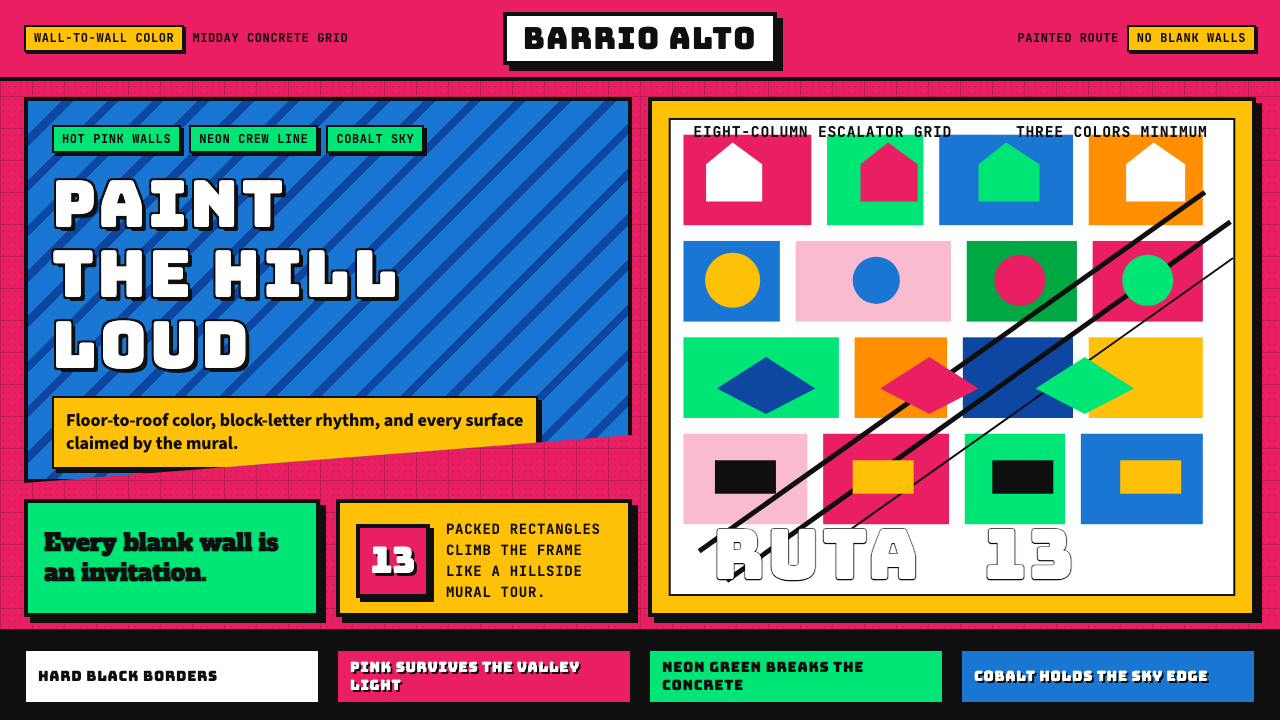 Medellín Comuna 13 MuralsRefuses blank walls. Hot pink, neon green, and cobalt blocks pack the grid li…
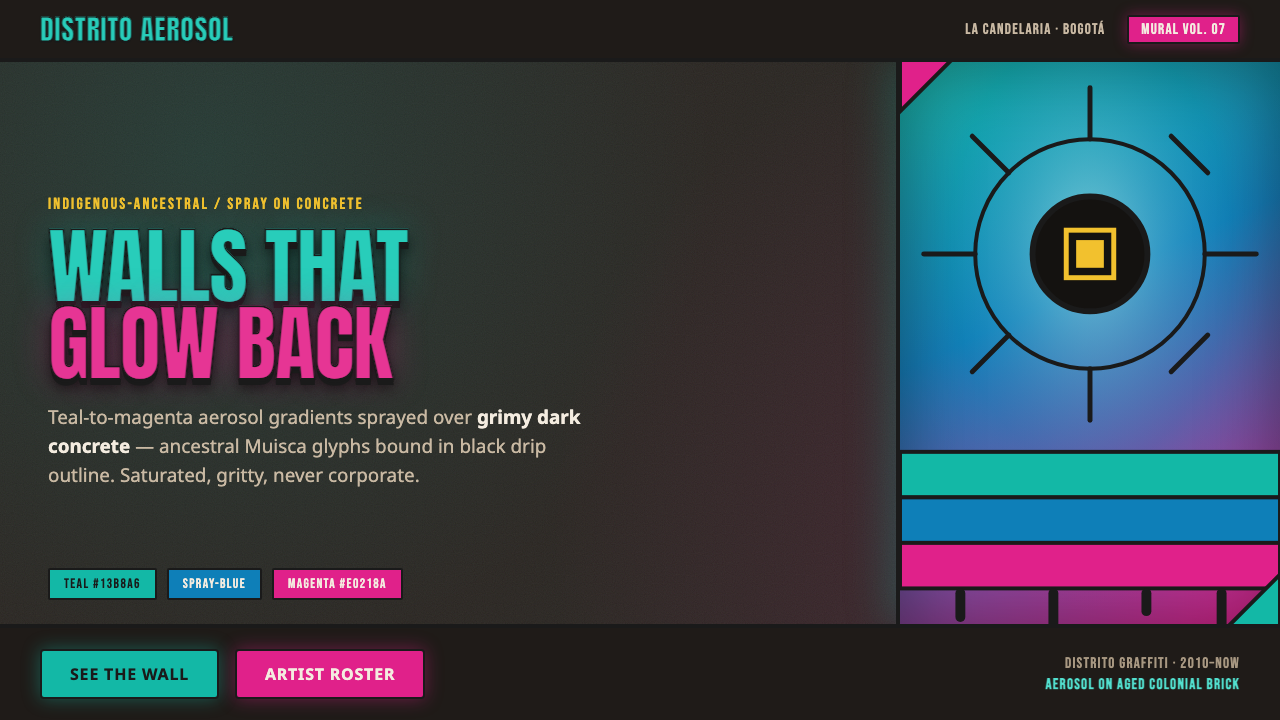 Bogotá Street MuralismNeon spray glowing off the wall. Teal-to-magenta aerosol on grimy concrete, i…
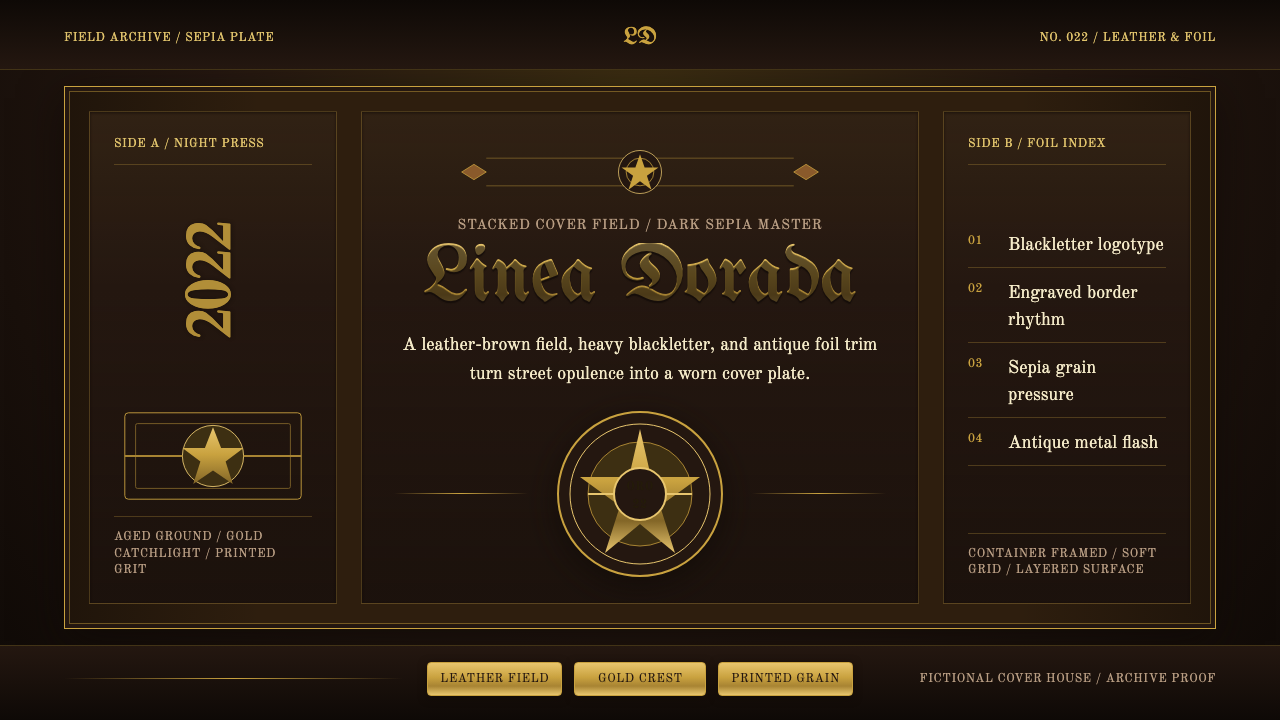 Corridos TumbadosOpulence with dust on it. Sepia leather, blackletter, and antique-gold foil f…
 Oaxaca Indigenous-ModernActivist woodblock graphics. Cochineal carmine-fuchsia struck in black relief…
 Rick Owens DarkstarRestraint has gravity. Charcoal concrete, bone type, and one ochre drape hold…
 Africanfuturism VibraniumCeremony goes electric. Violet glow and gold inlay thread a volcanic textile…