What is BTS Army Purple 2020?
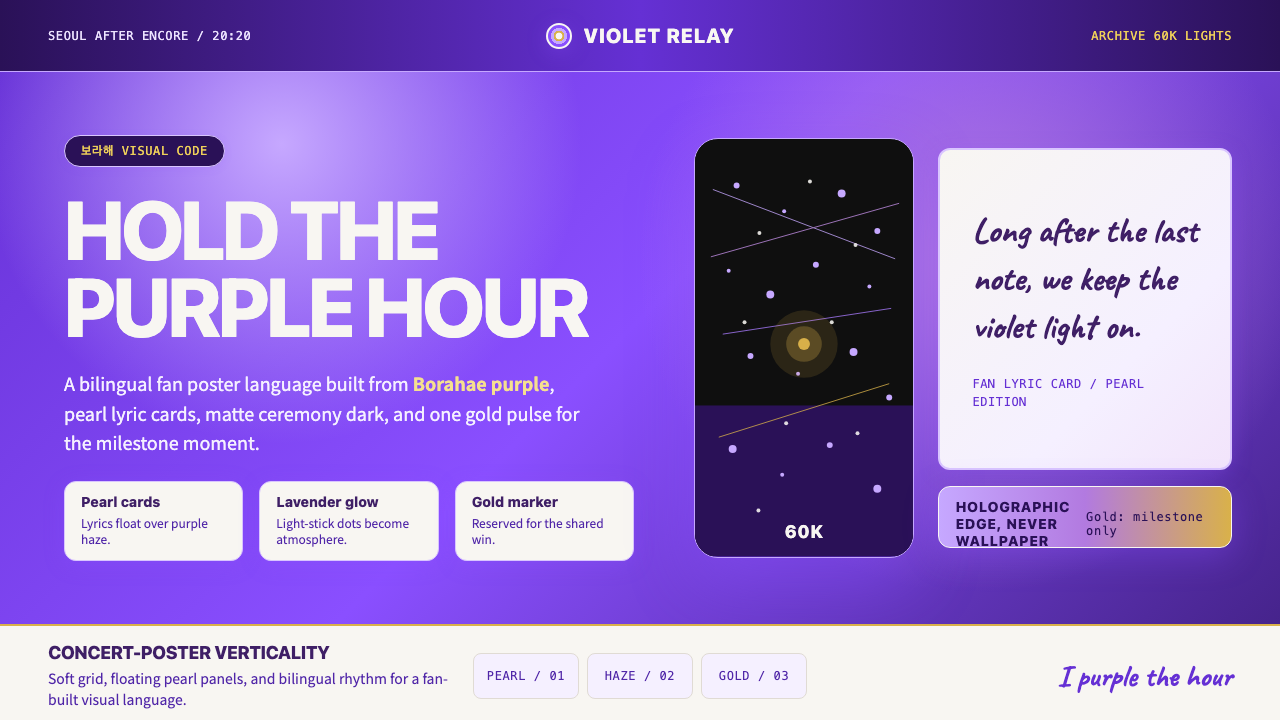
Sixty million fans turned a single phrase — 'I purple you' — into a complete visual language, and that language turned out to be a fully usable design system.
BTS Army Purple 2020 in brief
BTS Army Purple 2020 is the visual system that crystallized around the global BTS fandom between 2018 and 2020. It draws from the specific aesthetic register that sixty million fans — the ARMY — collectively built through fan art, lyric cards, concert imagery, and social media. The anchor is Borahae purple: not a corporate color chosen by a branding agency, but the particular deep violet that V (Kim Taehyung) named in 2016 when he told fans 'I purple you,' explaining that purple is the last color of the rainbow and represents a promise to trust and love each other forever. That single utterance gave a color an emotional grammar and, by extension, gave an entire design system its soul.
The system layers this signature purple with pearl-white surfaces recalling the handwritten lyric cards fans trade at concert venues, matte-black ceremonial grounds evoking the darkened stadium before the encore begins, and holographic lavender glows that mimic the Army Bomb — the synchronized light stick that turns sixty thousand concert-goers into a single constellation. One warm gold accent, reserved and precise, marks milestone moments: the achievement unlocked, the anniversary commemorated, the limited edition released. The result is a palette that can read as intimate and handmade at small scale and as vast and atmospheric at large scale.
Typography in this system bridges Korean and Latin scripts with the fluency of a generation raised on bilingual pop culture. The default workhorse combines a contemporary Korean geometric sans-serif — the kind of clean, post-2020 industrial standard that Korean design studios adopted en masse — with a neutral Latin counterpart that holds up equally well in English and romanized Korean. A secondary handwritten script voice, loose and personal, carries the register of the fan-made lyric card: informal intimacy inside a formally organized system. Every spacing and sizing decision is built around the vertical poster composition that defines K-pop visual culture, with generous leading that lets Hangul breathe alongside Latin letterforms.

Where does BTS Army Purple 2020 come from?
BTS debuted on June 13, 2013, under Big Hit Entertainment (now HYBE), a relatively small Seoul agency at the time. The group — seven members from diverse Korean cities — launched into a domestic market dominated by established agencies, with none of the institutional support that typically guaranteed survival. What set their early trajectory apart was a decision to engage fans not as passive recipients of content but as active co-creators: BTS logged their practice sessions, shared their doubts and struggles, and addressed fans directly through platforms that allowed unmediated communication. The ARMY fandom name was established in July 2013, and within the first year the fan community had developed its own visual vocabulary for supporting the group.
The color purple entered the story on November 13, 2016, during the final night of the HYYH On Stage: Epilogue concert tour in Seoul. V — Kim Taehyung — held up a purple ARMY Bomb and told the audience that purple was the last color of the rainbow, representing a promise to trust each other 'for a long time.' The phrase '보라해' (Borahae) — a portmanteau of 'purple' (보라) and 'I love you' (사랑해) — spread immediately through the global ARMY network. Within hours, fan accounts across Twitter, Weibo, and Tumblr had begun building a vocabulary of purple-forward visual content: purple gradients in header images, purple lyric overlays, purple concert photography edits. The color did not originate from a design brief; it originated from an emotional moment that millions of people simultaneously decided to render visual.
The ARMY Bomb — the official light stick, which debuted in its first version in 2016 and reached its third generation in 2019 — became the physical anchoring object for the color system. Unlike many K-pop light sticks, the ARMY Bomb can be synchronized via Bluetooth to arena-controlled lighting sequences, meaning entire stadiums could simultaneously shift from white to purple to lavender. Concert documentation photography from the 2017 Wings Tour and the 2018—2019 Love Yourself world tour generated millions of images featuring this synchronized purple light at stadium scale, and those images became primary reference material for the fan design community. The aesthetic of Borahae was not a flat digital color but a glowing, atmospheric, slightly hazy light phenomenon — which is why holographic gradients, soft bloom effects, and light-leak textures became the characteristic expressive vocabulary of ARMY fan design.
Visual codification accelerated substantially between 2018 and 2020. The 2018 Love Yourself: Answer album era and the associated Speak Yourself stadium tour introduced more polished, high-budget official visuals — pearl and cream textures, gold foil accents on physical album packaging, matte black ceremonial aesthetics — that the ARMY absorbed and reinterpreted. By 2020, when pandemic conditions moved fan expression almost entirely online, the community had produced enough shared visual language that individual fan artists across dozens of countries were producing work that was identifiably part of a single coherent aesthetic system. The Curio design system crystallizes this community-built vocabulary into a structured, deployable set of design decisions.
What defines the BTS Army Purple 2020 look?
Borahae Purple Dominance
The palette centers on a deep, saturated violet — luminous but not neon, rich but not muddy — that carries the emotional weight of the Borahae narrative. It occupies large surface areas: full-bleed backgrounds, wide header bands, dominant illustration fills. Secondary tones shift toward lavender and soft violet for glow and ambient light effects, creating a sense of depth within the purple family rather than introducing contrasting hues. The overall impression is immersive and atmospheric, like being inside a lit arena.
Pearl-White Lyric Card Surface
A soft, slightly warm off-white — evoking pearl and parchment rather than clinical white — serves as the primary neutral ground. This tone references the physical lyric cards (fan-made and official) that are central to ARMY culture, where printed Hangul and English lyrics on slightly textured card stock became a tactile form of affection. In digital application, this surface reads as gentle and handmade, softening the drama of the purple and preventing the overall palette from tipping into severity.
Holographic Glow and Light Bloom
Unlike design systems that reject soft gradients, BTS Army Purple actively deploys them — but in a specific register: holographic, light-emanating, atmospheric rather than decorative. Glow effects radiate outward from focal points like a light stick in darkness. Gradients shift from deep violet through lavender to near-white, simulating the actual optical quality of synchronized concert lighting. This makes soft transitions and bloom textures structural elements of the system rather than violations of it.
Matte Black Ceremonial Ground
Matte black functions as the high-stakes surface — the awards ceremony, the world tour announcement, the milestone achievement. It evokes the darkened stadium in the moments before the light show begins: charged anticipation, collective held breath. Against black grounds, the Borahae purple reads as luminous and the pearl-white as radiant; gold accents achieve maximum impact. This pairing of deep black and Borahae purple is the system's most formal register, reserved for content that carries real ceremonial weight.
Gold Milestone Accent
A single warm gold functions as the system's scarcity signal: it appears for achievements, anniversaries, chart records, and limited-edition releases — never for routine content. Its restraint is its power. Used sparingly, gold reads as genuinely significant; used liberally, it collapses into background noise. In the BTS visual world, gold carries the specific weight of recognition — a chart milestone, a certification, a sold-out run — and the design system preserves that specificity by treating gold as a resource to be spent, not scattered.
Vertical Poster Composition
The native compositional orientation of this system is vertical: tall portrait formats that read naturally on mobile screens and as physical wall posters. Content is arranged in a layered, center-weighted manner — unlike the asymmetric tension of Bauhaus or Swiss Grid — with the central image, text, or light source pulling the eye inward and downward. This composition mirrors the visual grammar of K-pop album art and the concert poster tradition, where the human figure (often flooded with light from above) anchors a surrounding atmospheric field.
Bilingual Korean-English Typography
The system is inherently bilingual, with Korean (Hangul) and English treated as co-equal typographic voices rather than one primary and one subordinate. Contemporary Korean geometric sans-serif forms — the design-industry standard that emerged as Korea's visual identity modernized in the post-2010 era — carry body text and headlines in both scripts. A handwritten accent layer introduces personal intimacy: the fan who copies lyrics by hand, the message written on a fan letter, the caption that breaks out of the formal grid. Type sizing is generous, with expressive scale contrast between headline and body that references concert screen and poster traditions.

Who shaped BTS Army Purple 2020?
V coined the Borahae phrase on November 13, 2016, during the final Seoul night of the HYYH On Stage: Epilogue tour, holding up a purple Army Bomb and explaining that purple — the last color of the rainbow — symbolized a promise to trust and love fans 'for a long time.' The phrase became immediately and globally viral. By giving a color an emotional origin story specific enough to be remembered and retold, V created the founding myth of a design system. Every purple surface in this aesthetic traces its emotional authority to that single stadium moment.
As BTS's leader and primary voice in English-language interviews and social media, RM has been the most consistent articulator of the group's relationship with visual culture, art, and fandom. His own interests — contemporary art, museum visits documented on social media, thoughtful engagement with design and space — shaped the intellectual register that distinguishes ARMY fan culture from casual fandom. The bilingual, artistically literate sensibility of the design system reflects, in part, the standard RM modeled for how to engage seriously with aesthetics.
The HYBE (formerly Big Hit Entertainment) design team produced the official album packaging, concert visual systems, merchandise, and promotional materials that provided the professional design scaffolding the ARMY aesthetic was built around. The pearl-and-cream textures of the Love Yourself album era packaging, the matte-black ceremonial surfaces of award show visuals, and the gold foil certification aesthetics of milestone releases all originated from official HYBE production. Fan designers absorbed, reinterpreted, and democratized these high-production-value references into a community-accessible visual language.
The dispersed global network of ARMY fan artists — active primarily on Twitter, Weibo, Instagram, and Tumblr from 2016 onward — collectively produced the visual grammar that distinguishes this design system from any top-down corporate aesthetic. Working individually but cross-pollinating constantly, fan artists from South Korea, the United States, Brazil, the Philippines, Indonesia, and dozens of other countries developed shared conventions around purple glow effects, lyric card formats, vertical concert edits, and gold accent usage. No single figure created this vocabulary; it emerged from millions of acts of creative response to shared emotional experience.
The ARMY Bomb — the official BTS light stick, which reached its Bluetooth-synchronized third generation in 2019 — is the physical object that transformed Borahae from a spoken phrase into a mass visual experience. At synchronized concerts, sixty thousand light sticks could shift from white to deep purple to lavender on command, creating a stadium-scale color performance that generated the millions of documentary photographs that became the primary visual reference for the ARMY aesthetic. The light stick's glow quality — soft, atmospheric, surrounded by slight haze — established the holographic bloom as the system's characteristic expressive texture.
How do you use BTS Army Purple 2020 today?
BTS Army Purple is a system built for emotional resonance at scale — its deepest competency is making digital surfaces feel like they belong to a lived experience rather than a product specification. Applying it correctly requires working with the atmospheric logic of the palette rather than against it: this is a system that earns its soft gradients and glow effects because they reference something real (stadium lighting, handmade objects, synchronized community acts) rather than using them as default polish.
For presentation slides, the system delivers maximum impact on cover pages and milestone announcement slides. A cover built in this language layers the deep Borahae purple as the full-bleed background, places the title in large, clean sans-serif type in pearl-white, and adds a radiant glow or bloom effect emanating from behind the title block — evoking a light source in darkness. Section opener slides work well with a vertical center-weighted composition and a restrained gold accent for the section number or label. Data and content slides should calm down considerably: use the pearl-white surface as the primary ground, reserve purple for accent bars in charts and active state indicators, and let generous white space carry the structural clarity. The risk in data slides is over-applying the atmospheric textures — glow effects on every chart bar will read as decorative noise rather than emotional signal.
For web interfaces — particularly dashboards, fan community platforms, K-pop themed services, and music streaming contexts — the system provides a strong visual identity that distinguishes the product immediately. Dashboard layouts work well with a deep purple left navigation rail against a near-white or pearl content area, with gold used exclusively for achievement badges, streak indicators, or premium tier markers. Pricing pages benefit from the matte-black ceremonial register for premium tiers and the pearl surface for standard tiers, with Borahae purple reserved for the recommended or most-popular plan border and call-to-action button. Interactive states (hover, focus, active) should use the lavender-to-purple gradient to create a sense of light response rather than a simple flat color flip.
For editorial and marketing work, the system's poster sensibility translates directly into hero imagery, announcement graphics, and social media assets. Full-bleed vertical compositions with a central light source (a glow, a beam, a star) work for announcements and events. Lyric-card aesthetics — white or pearl surfaces with large expressive type in Hangul or English, generous leading, and a single purple or gold accent element — work for quote graphics, testimonial callouts, and feature highlights in editorial layouts. Marketing emails in this system should use the pearl surface as the primary canvas, Borahae purple for the header block and primary call-to-action, and gold only for a single high-priority element per email (a launch date, a limited-availability notice, a milestone figure).
The most common mistake when applying this system is conflating atmospheric with decorative. Glow effects, gradients, and light blooms in ARMY Purple are atmospheric because they reference the specific optical experience of a concert light stick in a dark arena — they carry meaning. The same effects applied indiscriminately to every element in a layout stop being atmospheric and become visual clutter. Discipline is: ask what each soft transition is referencing. If the answer is nothing, replace it with a flat surface. A second common error is using all four colors — deep purple, pearl, matte black, and gold — simultaneously at full saturation on the same screen. Authentic applications of this palette commit one surface to dominance per context: this is a purple moment, or a black-and-gold moment, or a pearl moment — not all four at once.

BTS Army Purple 2020 — FAQ
Is BTS Army Purple appropriate for projects with no connection to K-pop or fan culture?
Yes, with clear eyes about what you are borrowing. The system's emotional register — intimate at small scale, atmospheric and immersive at large scale, with a ceremonial high mode and a warm everyday mode — is genuinely useful for a wide range of contexts: music and entertainment platforms, community-driven products, wellness and mindfulness applications, creative agency portfolios, event promotion, and premium consumer goods where aspiration and warmth need to coexist. The primary risk is applying the palette without understanding the light-and-atmosphere logic that gives it coherence. Used purely as a 'purple and gold' color scheme without the atmospheric depth, it reads as generic luxury rather than as the specific emotionally resonant system it actually is.
How does this system handle light mode versus dark mode?
The system has two native modes rather than a simple light-dark inversion. The everyday mode uses the pearl-white surface as the primary ground — this is warm, accessible, and readable for long-form content. The ceremonial mode uses matte black as the primary ground — this is high-contrast, dramatic, and appropriate for milestone content, product launches, and high-stakes moments. In web interface terms, a typical application might default to the pearl mode for standard navigation and content, then switch to the matte-black ceremonial mode for modal announcements, achievement celebrations, or premium gate moments. The Borahae purple works in both modes but behaves differently: against pearl it reads as accent and emphasis; against black it reads as the primary light source.
Can this system work for printed materials, or is it primarily digital?
The system has strong print roots — the lyric card, the album liner note, the concert program, and the promotional poster are all physical print objects that shaped the aesthetic's development. For print applications, the key adjustments are: the holographic glow effects that work in screen-backlit contexts need to be handled as soft gradients or foil treatments in print; the matte-black ceremonial surface works beautifully in print and benefits from actual matte coating or soft-touch lamination; pearl-white surfaces translate well as uncoated or lightly textured stock; and gold, which is a screen-simulated warm accent digitally, reaches its natural home in print as foil stamping or metallic ink. Editorial spreads, event programs, album-style booklets, and luxury packaging are all strong use cases for this system in print.
How is this different from generic 'purple and gold' luxury aesthetics?
The difference is specificity of origin and atmospheric logic. Generic purple-and-gold luxury (think traditional royalty palettes, certain wine and spirits brands, legacy jewelry advertising) uses purple as a signifier of rarity and gold as a signifier of value — they are symbolic stand-ins. Borahae purple has a specific emotional etymology: it was named in a stadium by a person, at a specific moment, with a specific meaning, and sixty million people internalized that meaning simultaneously. The design system's atmospheric elements — the glow, the lavender haze, the synchronized light quality — reference that specific origin. A system built correctly in this aesthetic feels like fandom and community and collective experience; a generic purple-and-gold layout feels like a product claiming to be premium. The distinction shows up most clearly in the glow textures: if they look like light sticks in a darkened arena, you are in the right register. If they look like a jewelry brand's website background, something has gone wrong.
Is the handwritten typography layer optional, or essential to the system?
Optional but meaningful. The handwritten layer references the fan-made lyric card — a physical object central to ARMY culture — and introduces a register of personal intimacy that the clean geometric sans-serif cannot achieve. In contexts where warmth and personal connection are important (community platforms, social content, fan-facing communications), including the handwritten accent enriches the system considerably. In contexts where authority and formality are primary (financial dashboards, data-heavy reports, B2B interfaces), the handwritten layer can be omitted entirely without breaking the system's coherence — the Borahae purple, pearl surface, and atmospheric glow logic carry the identity on their own. Think of the handwritten voice as the system's warmth dial: present when you need intimacy, absent when you need authority.
Related design styles
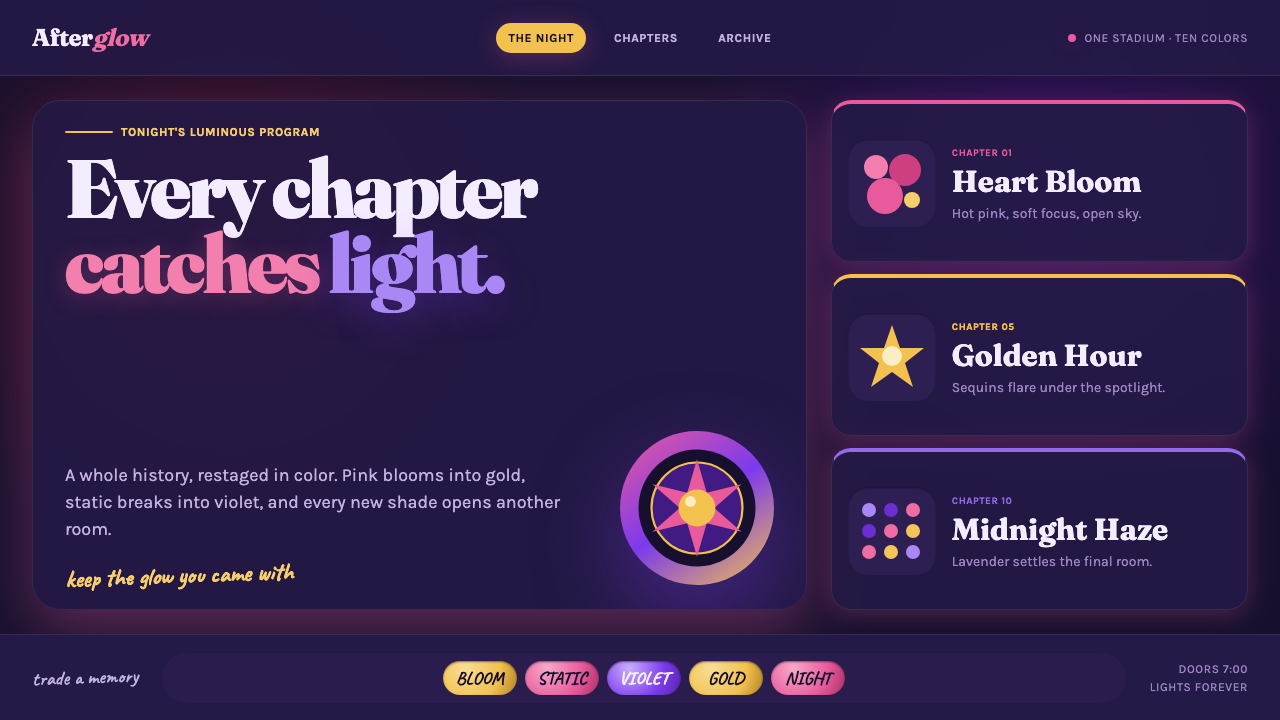 Taylor Swift Eras (2023)Every chapter catches light. Hot pink, lavender, gold and beadwork glow on mi…
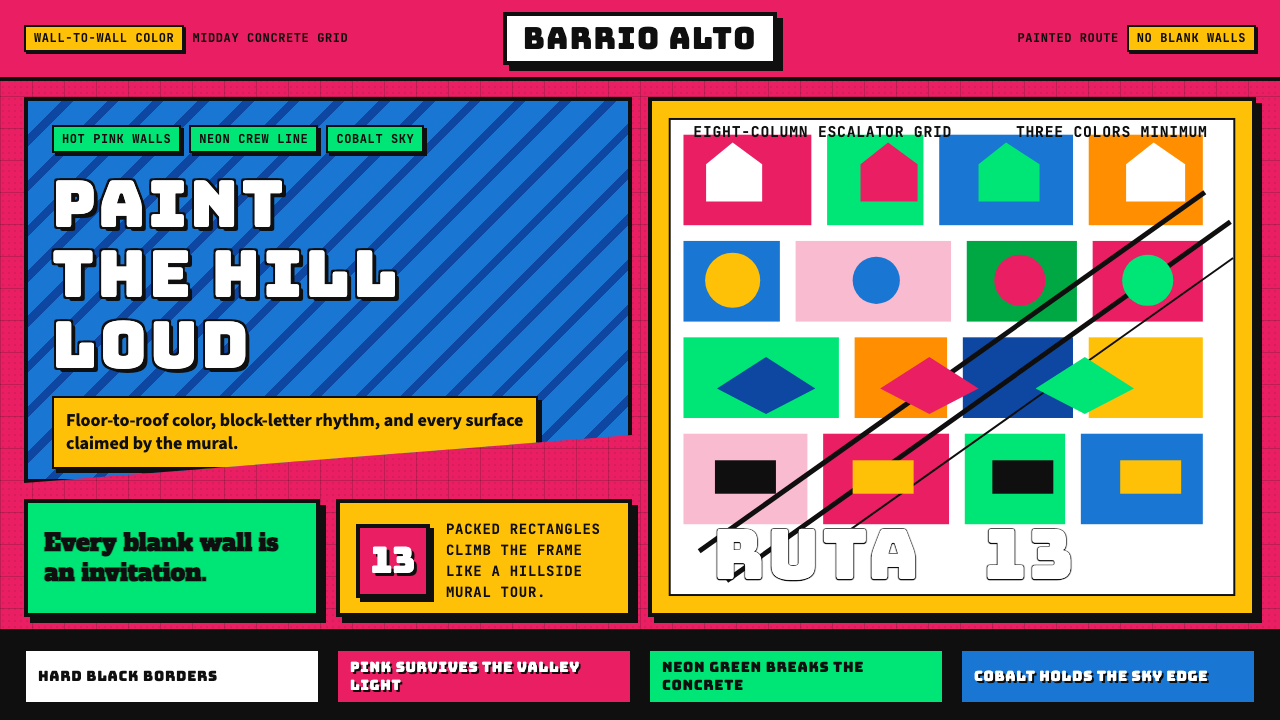 Medellín Comuna 13 MuralsRefuses blank walls. Hot pink, neon green, and cobalt blocks pack the grid li…
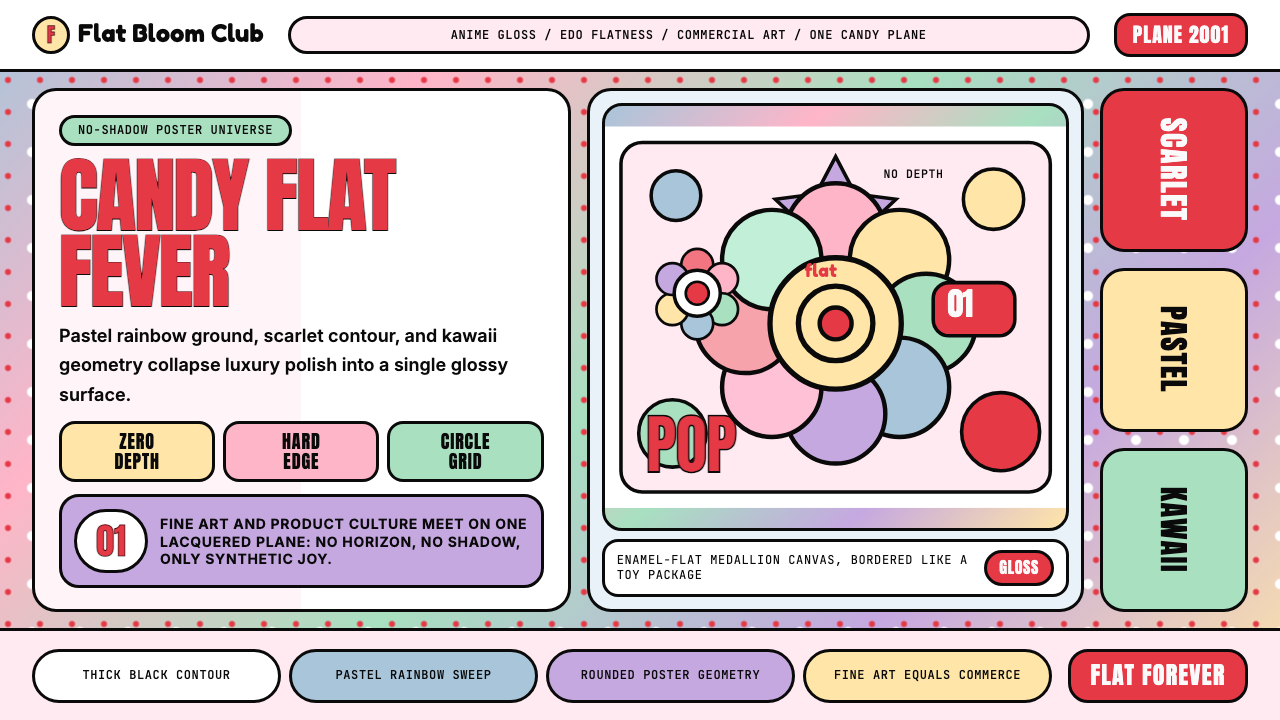 Takashi Murakami SuperflatJoy has no depth. Pastel rainbow, scarlet accents, and black contours flatten…
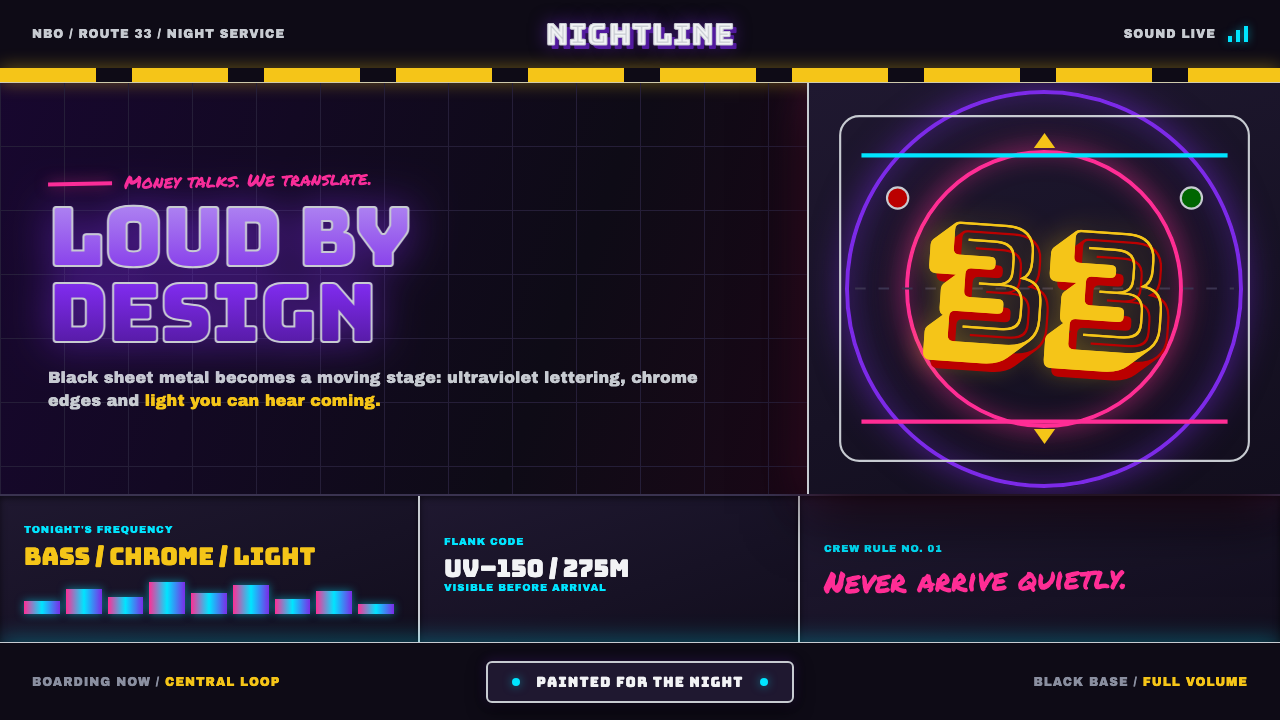 Nairobi Matatu ArtBuilt to be unmissable. Neon airbrush and chrome blaze across night-black hor…
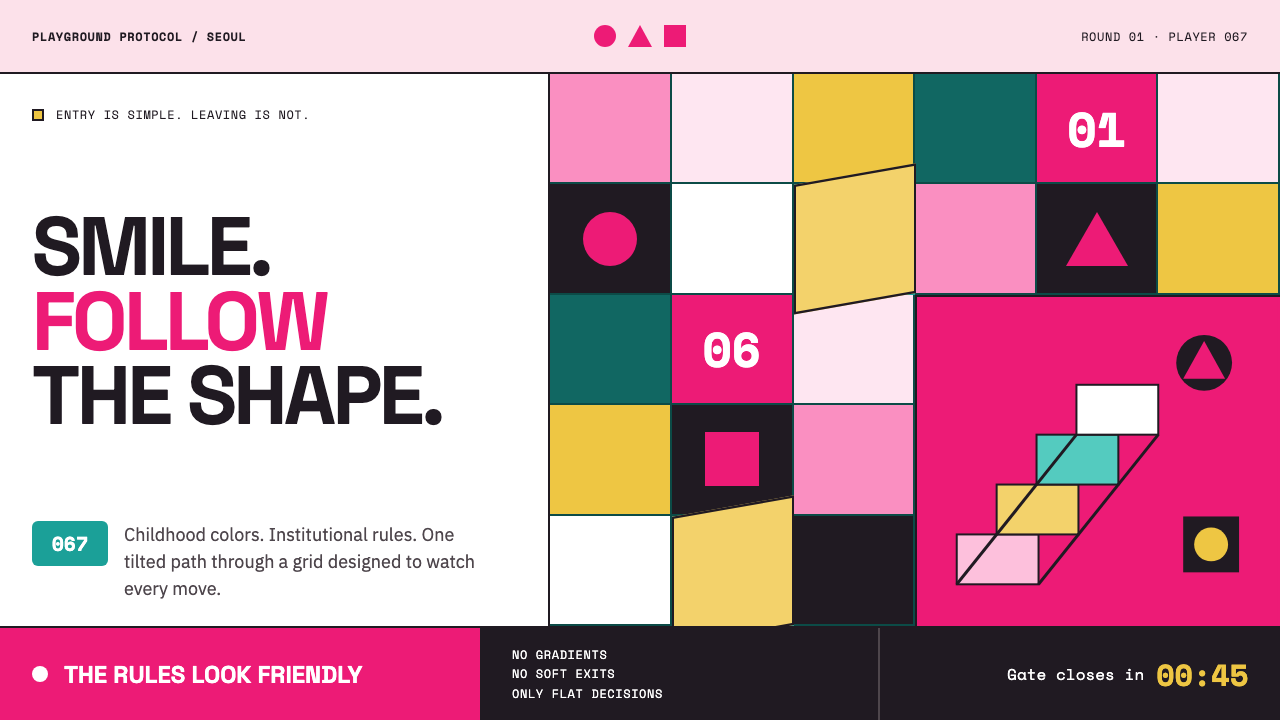 Squid Game (2021)Childhood color turns menacing. Fuchsia, teal, and rigid shape grids enforce…
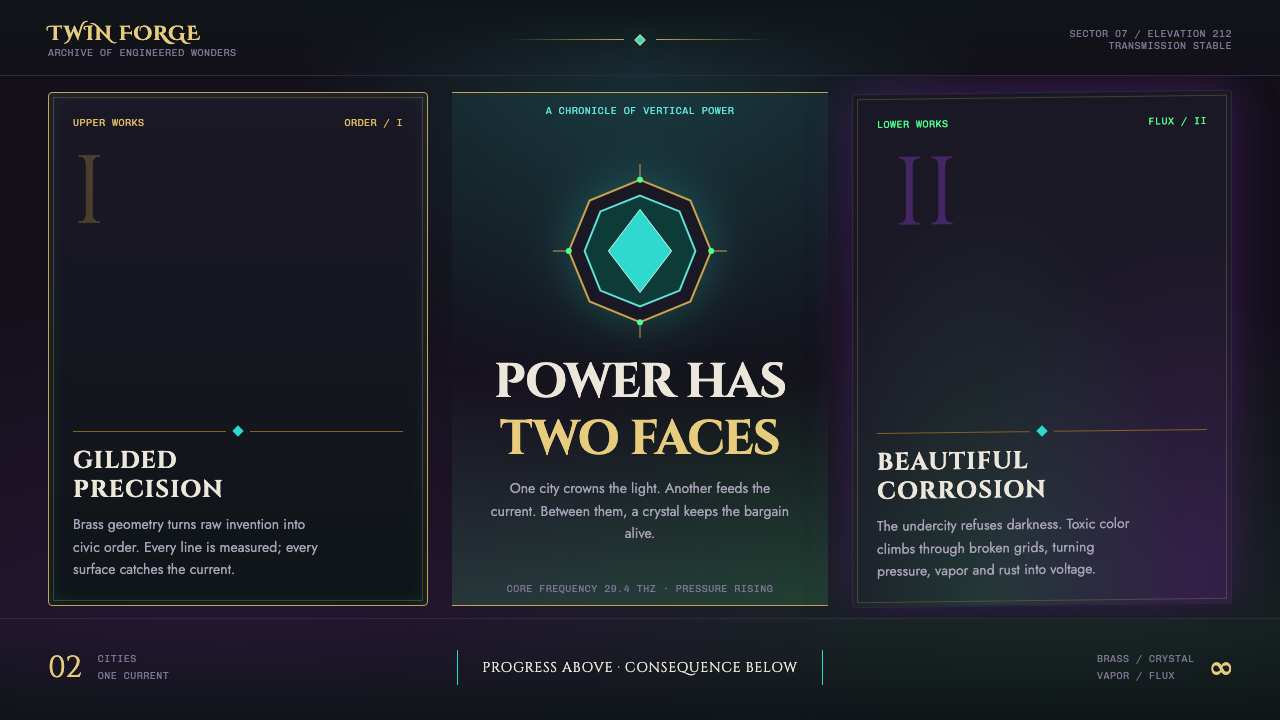 Arcane Hextech (2021)Progress and rot share a current. Brass symmetry meets teal crystal and toxic…