What is Takashi Murakami Superflat?
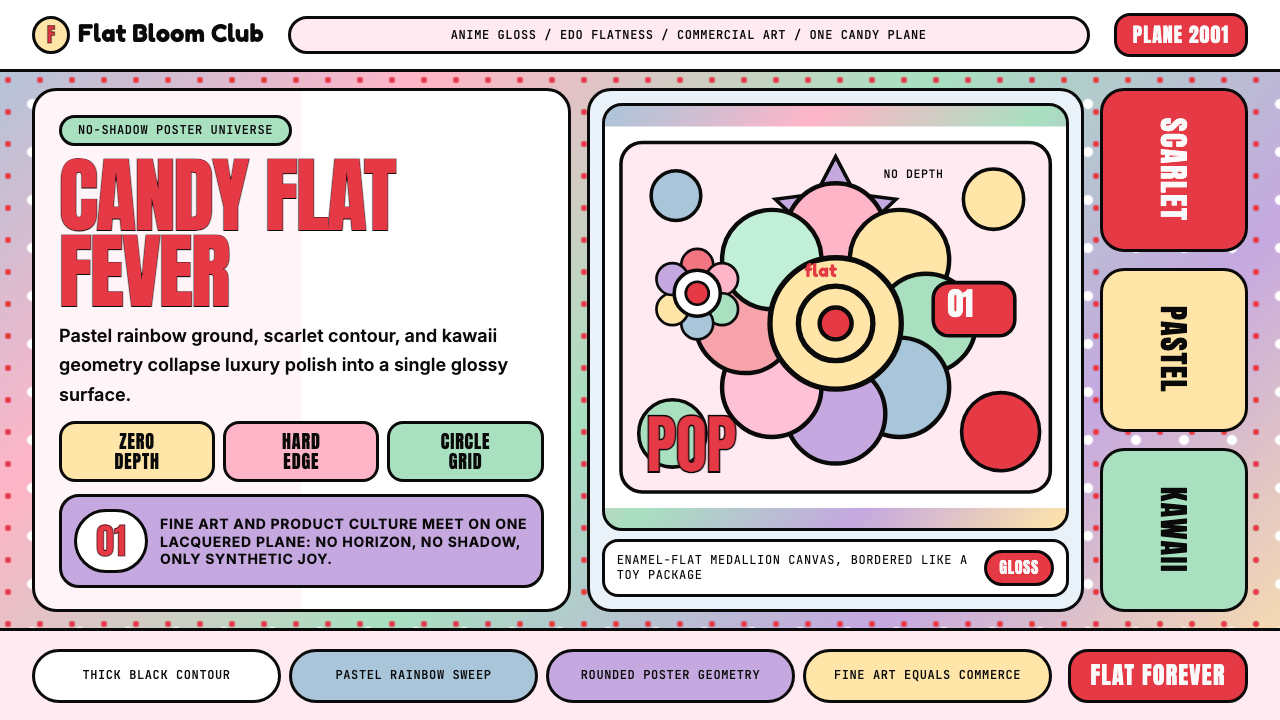
Takashi Murakami collapsed the boundary between high art and commercial pop culture into a single lacquered-flat surface — where smiling flowers, anime eyes, and luxury brand logic coexist without contradiction.
Takashi Murakami Superflat in brief
Superflat is an art and design movement coined by Japanese artist Takashi Murakami around the year 2000, taking its name from the radical flatness of its visual language — a surface without shadow, without illusionistic depth, without the perspective conventions that Western academic painting spent five centuries perfecting. Every element exists on the same plane: background and foreground merge into a continuous decorative field.
The movement draws equally from two traditions that Western critics once kept strictly apart. On one side, the refined lineage of Japanese Edo-period woodblock prints (ukiyo-e), with their bold contour lines, flat color fills, and cropped compositions. On the other, the mass-produced imagery of postwar Japanese manga and anime — characters with disproportionately large eyes, candy-saturated palettes, and designs engineered for maximum emotional impact at minimal visual complexity. Murakami's insight was that these two traditions were not opposites but expressions of the same underlying Japanese visual sensibility.
Superflat is also a cultural critique. Murakami argued that postwar Japanese society had itself become 'superflat' — that the trauma of defeat and occupation had produced a culture in which depth, ambiguity, and historical gravity were suppressed beneath an endless surface of kawaii (cute), consumer goods, and entertainment. The smiling flowers are not innocent; they are knowingly synthetic. The glossy finish is armor as much as decoration.

Where does Takashi Murakami Superflat come from?
The immediate trigger for the Superflat movement was Murakami's 2000 exhibition of the same name, held at the Parco Gallery in Tokyo. The accompanying catalogue — a small paperback Murakami co-edited — functioned as the movement's manifesto. It placed Murakami's own paintings alongside Edo woodblock masters, anime production cels, and examples of contemporary otaku collector culture, arguing for a continuous lineage rather than a series of discrete art-historical ruptures. The exhibition toured to Los Angeles and Minneapolis in 2001, bringing the movement to international attention.
Murakami was born in 1962 in Tokyo and trained within the traditional Japanese system, eventually earning a doctoral degree in Nihonga — the form of Japanese painting that self-consciously preserves pre-Western techniques, mineral pigments, and pictorial conventions. This rigorous classical training gave him both a command of the historical materials he was deconstructing and a certain institutional credibility that allowed critics to take his mass-culture references seriously. He founded his production studio Kaikai Kiki in 2001 — initially in Asaka, Saitama, later expanding to New York — organizing it deliberately on the model of Andy Warhol's Factory, with teams of assistants executing works to exacting specifications.
The intellectual foundation of Superflat draws on a longer Japanese critical tradition. The art critic Koji Taki had argued in the 1960s that Japanese visual culture possessed an inherent flatness rooted in the absence of the chiaroscuro tradition. Murakami pushed this argument in a new direction: rather than treating flatness as a limitation to be overcome, he claimed it as an aesthetic resource and a form of cultural resistance — a refusal to import Western depth conventions that carried their own ideological freight.
The movement's international breakthrough came partly through Murakami's collaborations with the luxury fashion industry. His 2003 partnership with Marc Jacobs for Louis Vuitton — producing the multicolored monogram canvas and the Cherry Blossom bag — demonstrated that Superflat's visual vocabulary could operate at the highest levels of commercial luxury without losing its identity. This was the practical proof of Murakami's theoretical claim that no meaningful boundary separated fine art from commercial design. Subsequently, his collaboration with Kanye West on the album artwork and music videos for 'Graduation' (2007) extended the movement's reach into music and global youth culture. Yoshitomo Nara, though never formally a Superflat member, developed a parallel practice in the same period — solitary children with large eyes and unsettling expressions — that became internationally associated with the movement's sensibility.
What defines the Takashi Murakami Superflat look?
Radical Flatness
The defining formal property of Superflat is the total elimination of illusionistic depth. There are no cast shadows, no atmospheric perspective, no vanishing points, no gradients that suggest receding space. Every element — foreground figure, background fill, decorative pattern — occupies the same visual plane. This flatness is not a simplification but a positive aesthetic claim: the surface is the whole truth of the image.
Thick Contour Lines
Every form in Superflat is bounded by a firm, unmodulated outline — a direct inheritance from ukiyo-e woodblock tradition as well as anime cel animation, where the ink contour defines the character and allows flat color to be filled within it. The line weight is consistent and confident, never tapered or brush-sensitive. These contours give the style its enamel-like, hard-edge quality: shapes look cut out and placed rather than drawn or painted.
Candy-Saturated Palette
Superflat color is intensely saturated and deliberately synthetic — pastel rainbow grounds layered with vivid primaries, punctuated by a signature scarlet red. The palette references the bright printing inks of manga and anime production rather than any natural or painterly color tradition. Colors read as signals rather than representations: they denote category, mood, and energy rather than depicting light falling on a surface. The overall effect is simultaneously festive and slightly unreal.
Kawaii Iconography
The visual vocabulary of Superflat is populated by characters and motifs drawn from the kawaii aesthetic: Mr. DOB (Murakami's signature character, a hybrid of Mickey Mouse and Japanese yokai), smiling multi-petaled flowers with faces, large-eyed figures expressing uncanny cuteness, and mushrooms with exaggerated proportions. These icons operate simultaneously as commercial branding and as art-historical gestures — they are designed objects that also carry critical content about the nature of design.
Seamless Pattern Fields
Superflat compositions frequently use a repeating or near-repeating decorative field as the background — flowers tiling edge to edge, rainbow gradients stacked in equal bands, or abstract organic forms densely packed without negative space. This pattern logic comes from both textile design and wallpaper traditions and from the visual density of manga pages. The pattern is not subordinate to the central figure; it is a co-equal element of the composition.
Art-Commerce Equivalence
One of Superflat's most distinctive operating principles is the deliberate erasure of any hierarchy between fine-art production and commercial design. A Murakami painting produced in a limited edition for a gallery and a Murakami pattern printed on a luxury handbag are treated as categorically equivalent — not as compromise or contamination, but as proof that the supposed boundary was always fictional. This principle has direct implications for how the visual language behaves across different media and scales.
Glossy, Lacquered Surface Quality
Whether realized as a large-scale painting, a printed object, or a digital asset, Superflat work carries a sense of high-gloss finish — surfaces that reflect rather than absorb, that appear coated rather than textured. This quality is achieved through the combination of clean color fills, the absence of painterly marks, and the use of contours that read as crisp and decisive. The effect is simultaneously industrial and precious, recalling both mass-produced plastic goods and traditional Japanese lacquerware.

Who shaped Takashi Murakami Superflat?
Murakami is the originator and most prominent practitioner of Superflat. His dual career — as a gallery artist whose works sell for millions at auction and as a commercial collaborator with luxury houses and pop musicians — is itself the demonstration of the movement's central thesis. His studio Kaikai Kiki, organized on an industrial production model, has trained a generation of Japanese artists and operates as both a production facility and an artist-management organization. His Mr. DOB character, first developed in the early 1990s, remains the most recognized icon of the Superflat visual language.
As creative director of Louis Vuitton in the early 2000s, Marc Jacobs initiated the collaboration with Murakami that produced some of the most commercially successful luxury goods of the decade. The multicolored LV monogram and the Cherry Blossom collection demonstrated that Superflat's visual language was not merely an art-world proposition but a viable commercial aesthetic at the highest level of consumer markets. Jacobs's willingness to treat an artist's visual system as a design system — rather than simply licensing an image — validated Murakami's theoretical framework in practice.
Nara, born in 1959 in Aomori Prefecture, developed an independent body of work in the same period as Murakami that is frequently grouped with Superflat in critical discussion. His iconic motifs — solitary children with oversized heads, large unfocused eyes, and expressions hovering between innocence and menace — share Superflat's debt to manga iconography and its strategy of deploying kawaii imagery as a vehicle for ambivalent emotional content. Nara has maintained a more clearly personal and lyrical practice than Murakami's studio operation, but his international profile has been inseparable from the movement's critical framing.
West's invitation to Murakami to design the artwork and animated sequences for the 'Graduation' album (2007) extended Superflat's reach from the gallery and luxury-goods contexts into global popular music and youth culture. The bear mascot Murakami designed for West — rendered in full Superflat visual language — became one of the most widely circulated images associated with the movement outside Japan. The collaboration demonstrated that Superflat's visual grammar was legible and compelling to audiences with no art-historical background, confirming Murakami's claim that the supposed divide between high and popular culture was a Western critical construction.
Hokusai (1760–1849) is not a Superflat figure but an essential ancestor. His woodblock series, including the celebrated Thirty-Six Views of Mount Fuji, established the visual conventions that Murakami explicitly cites as Superflat's lineage: bold contour lines defining flat areas of unmodulated color, compositional cropping that treats the picture edge as an active decision, and the treatment of natural forms (waves, clouds, mountains) as stylized decorative patterns rather than naturalistic representations. Understanding Hokusai clarifies what Superflat is claiming about the continuity of Japanese visual culture.
How do you use Takashi Murakami Superflat today?
Superflat is a high-energy, high-identity style — applying it well means committing to its logic rather than borrowing its surface appearance. The style works best when a project can sustain its characteristic density and color intensity across all touchpoints, and when the brand or content benefits from a sense of controlled synthetic joy. It is not a neutral background style; it carries strong cultural associations with Japanese pop art, youth culture, and the deliberate collapse of high-low distinctions.
For presentation slides, Superflat offers a genuinely distinctive approach to both cover and content design. A cover slide benefits from a single iconic centered motif — a large smiling flower, a bold rounded mascot, a repeating pattern field — surrounded by a saturated flat color ground, with title typography set in a rounded, heavy face at substantial size. The thick-outline, flat-color aesthetic means titles read clearly even against patterned backgrounds. Content slides should embrace the visual density rather than fight it: use bold rounded card containers for data points, let charts read as flat geometric objects within the composition, and define hierarchy through scale and outline weight rather than shadow or subtle gradient. Data slides are particularly well served by the style's enamel-like clarity — bars and segments colored from the candy palette are immediately legible and visually memorable.
For web interfaces and digital products, Superflat is most effective in contexts where expressive identity is a primary goal — consumer-facing apps, creative platforms, gaming interfaces, youth-oriented commerce, and cultural or entertainment brands. The approach should be consistent: flat card components with visible borders and rounded corners replace elevation-based shadows; accent color is used boldly for interactive states and calls to action; navigation uses rounded pill shapes and high-contrast type; illustration and iconography follow the flat-fill, thick-outline grammar. Dashboards built in this style benefit from the palette's natural category differentiation — multiple data series can be distinguished by pure color without ambiguity, because the hues are distinct enough to be unambiguous even without secondary cues.
For editorial and marketing applications, Superflat's poster-like quality makes it highly effective for visual hierarchy. A Superflat-influenced editorial layout uses full-bleed color fields to separate sections, places pull quotes or key statistics inside bold rounded containers that read as standalone graphic elements, and treats any illustration or photography as a flat element — removing backgrounds, applying consistent contour treatment, or cropping to remove spatial depth cues. Marketing pages work well with alternating full-width blocks in different saturated ground colors from the palette, with consistent use of the signature rounded motifs as graphic punctuation. Event posters, social cards, and campaign visuals particularly benefit from the style's combination of visual density and instant readability at small sizes.
A common mistake when applying Superflat is treating the style as simply 'colorful and cute' and applying it without structural discipline. Authentic Superflat has a rigorous internal logic: every element has a clear contour, color is flat and unmodulated (no soft blends within a shape), and the overall composition is intentionally dense rather than airy. Designers who borrow the palette but retain soft shadows, gradient fills, or delicate thin-line typography undermine the style's core character. Similarly, mixing many different icon or illustration styles within a single application breaks the consistency that gives Superflat its distinctive lacquered unity. The style demands commitment: either the surface is fully flat and fully saturated, or it is something else.

Takashi Murakami Superflat — FAQ
How is Superflat different from general anime or manga aesthetics?
Anime and manga are production categories with highly variable aesthetics — there is no single anime visual style, and manga ranges from precise realistic draftsmanship to abstract minimalism. Superflat is a specific critical and artistic position that uses selected elements of anime and manga iconography (large eyes, thick outlines, flat color, kawaii characters) as material for a gallery art and design practice that also draws on ukiyo-e, Warhol-era commercial art, and luxury brand strategy. Superflat is self-conscious about its sources in a way that anime production is not; it is simultaneously inside and outside pop culture, commenting on it while participating in it. Practically, Superflat work is characterized by a specific density, color intensity, and contour discipline that distinguishes it from casual anime-inspired design.
Can Superflat work for serious or professional contexts, or is it inherently playful?
Superflat's origins in both fine art and luxury commerce demonstrate that 'playful' and 'serious' are not mutually exclusive in this visual language. The style has appeared in major gallery exhibitions, internationally recognized publications, and global luxury campaigns simultaneously. That said, it does carry strong associations with joy, youth culture, and pop energy, which means it is not well suited to contexts that require conveying institutional gravity, clinical neutrality, or somber subject matter. A financial services firm communicating risk, a medical information platform, or a government regulatory body would find the style's energy misaligned with its communication needs. The key question is whether the product's values and the style's values overlap — not whether the category is 'serious' in the abstract.
What makes Superflat different from other flat design styles like Material Design or Swiss Style?
All three share the label 'flat' but have fundamentally different values. Material Design uses flatness as a system for communicating interactive affordance and hierarchy across digital interfaces, retaining subtle elevation shadows and a restrained color system. Swiss Style uses flatness in service of rational grid-based information organization, with typography as the primary expressive tool. Superflat uses flatness as an aesthetic and cultural statement — it is not primarily a functional system but an artistic position. Where Material Design and Swiss Style are reductive, Superflat is additive: it fills the surface with pattern, character, and color rather than clearing the surface for content. The cultural references are also entirely different: Superflat points toward Japanese art history and global pop culture; Swiss Style points toward European modernist rationalism; Material Design points toward physics and tactile intuition.
Is Superflat only appropriate for East Asian audiences, or does it translate globally?
Superflat has demonstrated significant cross-cultural legibility since the early 2000s, primarily through the global penetration of Japanese anime and manga, which gave audiences worldwide a baseline familiarity with the visual vocabulary. The Louis Vuitton collaboration, the Kanye West album, and the subsequent adoption of kawaii iconography in Western streetwear and social media culture all suggest that the style communicates effectively far beyond its culture of origin. However, some nuances carry differently: Western audiences may read the style primarily as energetic and decorative without recognizing the critical subtext about postwar Japanese cultural identity. For most commercial design applications, this loss of critical depth is not a significant problem — the style's surface energy is its primary practical value in those contexts.
How should photography be handled in a Superflat design system?
Photography presents a challenge for Superflat because naturalistic photographs import depth, shadow, and representational complexity that directly contradict the style's flatness principle. The most consistent solutions are: removing backgrounds and placing subjects against flat color fields, which isolates the subject and allows it to exist on the same plane as other flat elements; applying high-contrast or duotone treatment that reduces tonal complexity to two or three distinct color values; or tracing and converting photographic subjects into flat vector illustrations with contour outlines — treating the photograph as source material for an illustration rather than a finished element. Photographs used without treatment tend to read as foreign objects within a Superflat composition and break the surface unity that gives the style its distinctive quality.
Related design styles
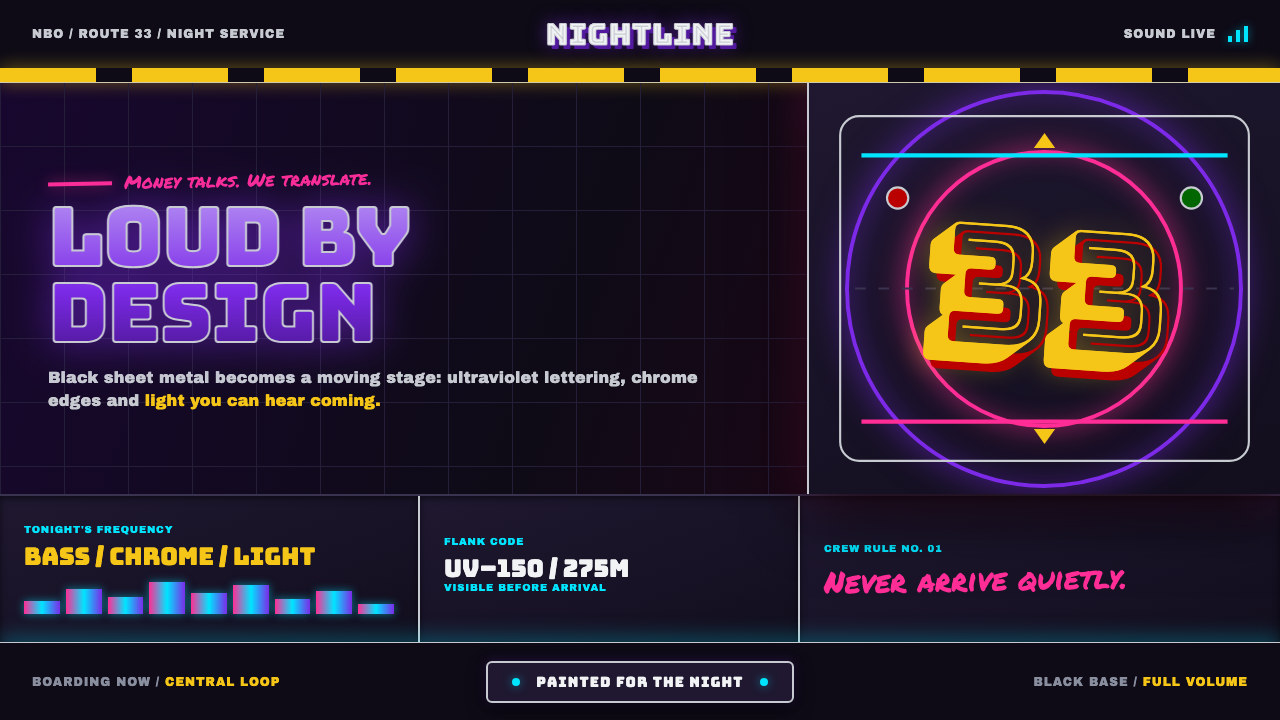 Nairobi Matatu ArtBuilt to be unmissable. Neon airbrush and chrome blaze across night-black hor…
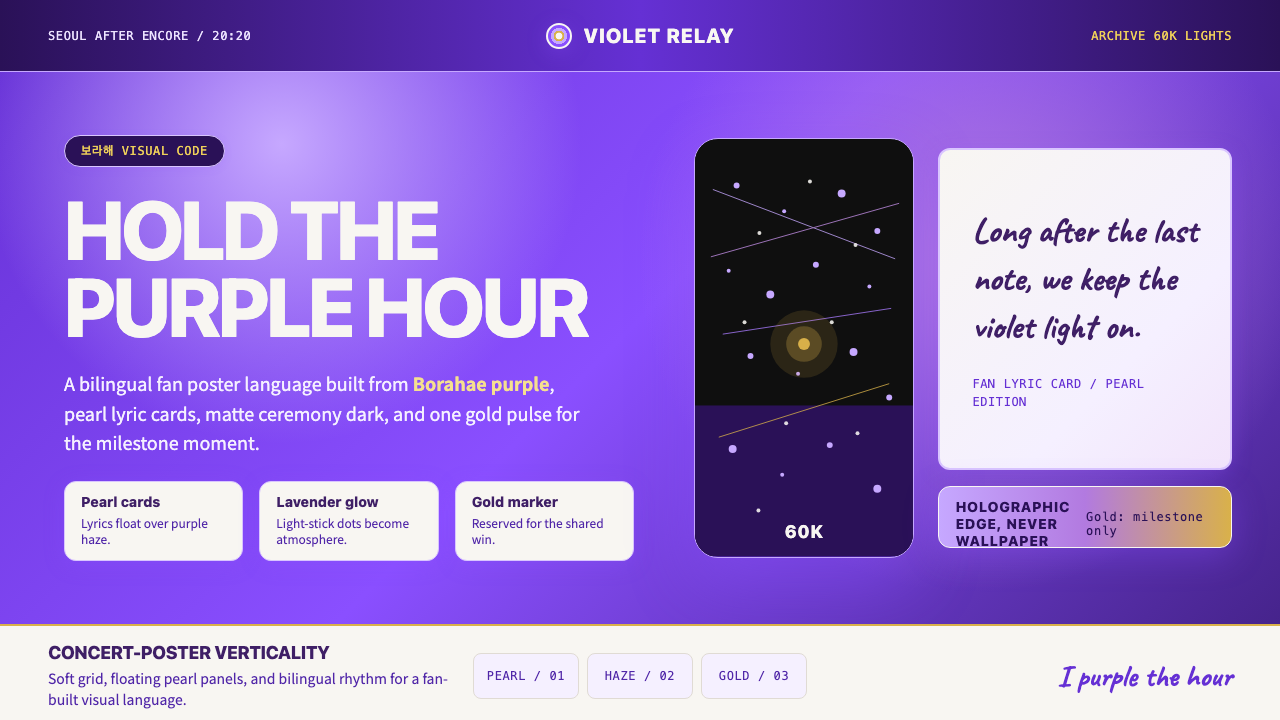 BTS Army Purple 2020Fandom becomes atmosphere. Borahae purple, pearl cards, lavender glow, one go…
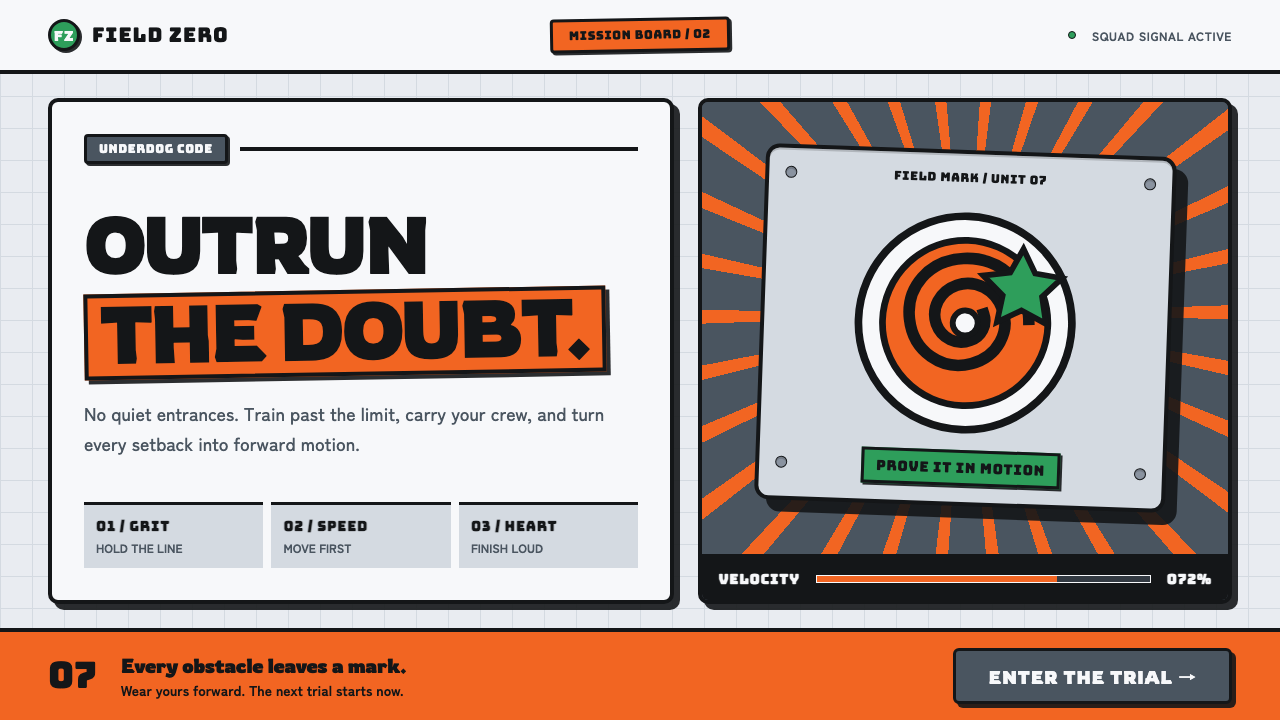 Naruto (2002 anime era)Underdog energy refuses the background. Hazard orange strikes steel-gray grid…
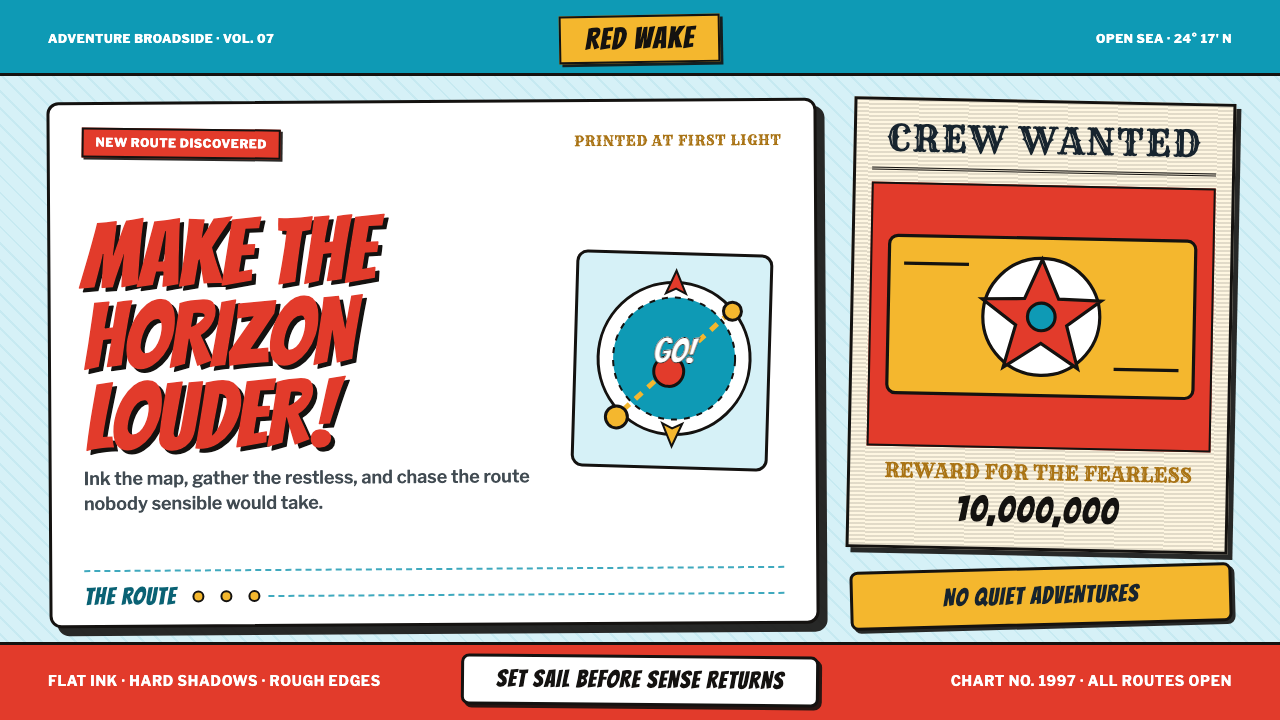 One Piece (Grand Line Adventure)Adventure shouts first. Vermilion splash type and cyan charts collide in hard…
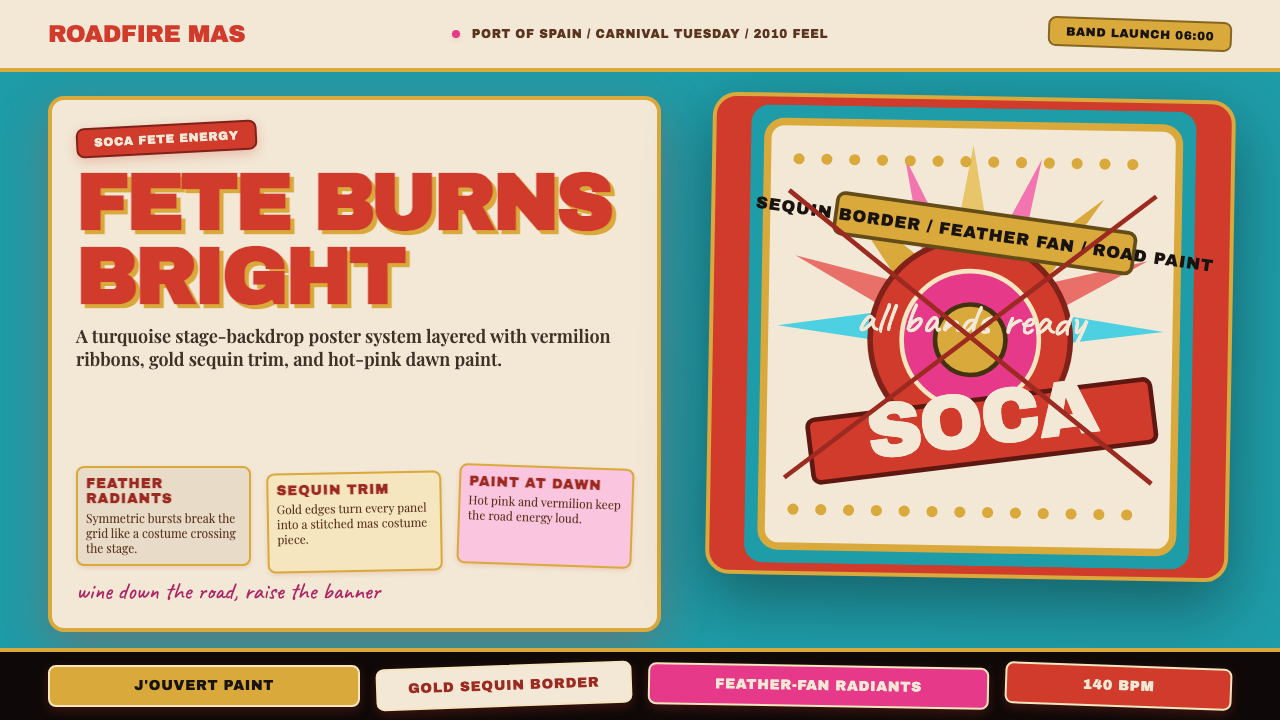 Trinidad Carnival Soca (2010)Joy overload. Turquoise field, vermilion banners, gold sequins, feather-fan g…
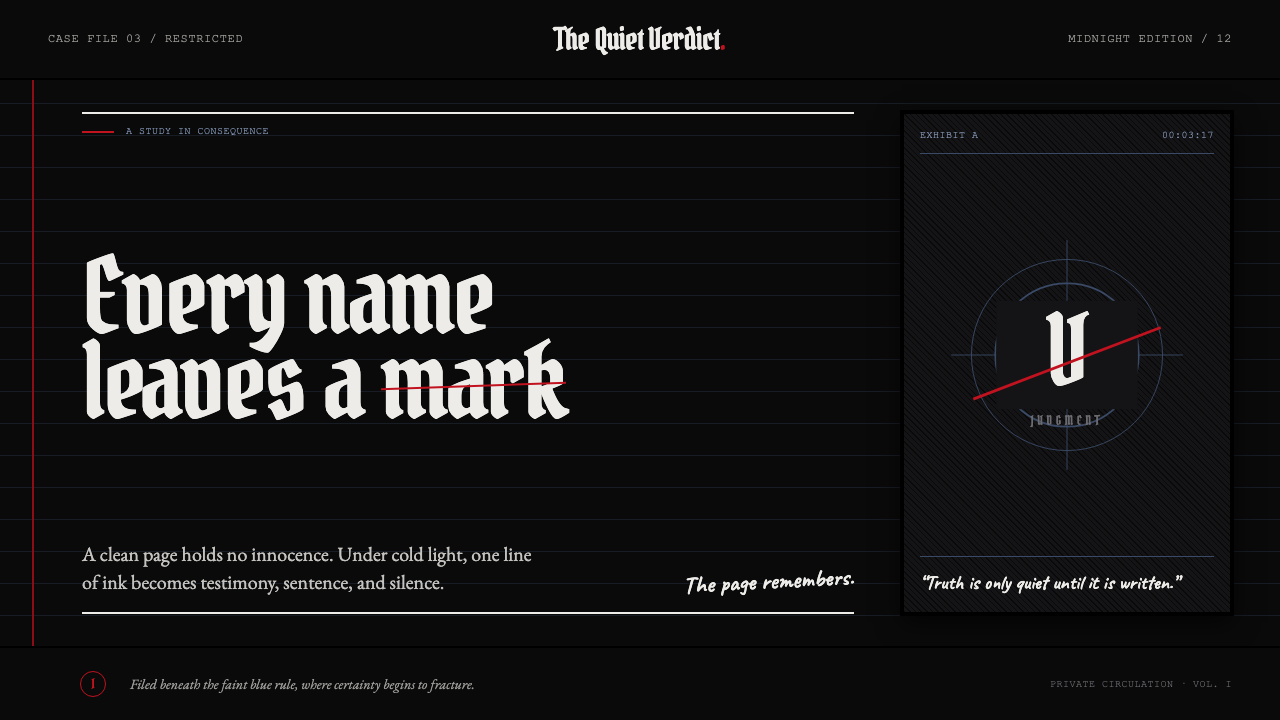 Death Note (2003)Silence becomes judgment. Bone-white blackletter and blue rules break under o…