What is Trinidad Carnival Soca (2010)?
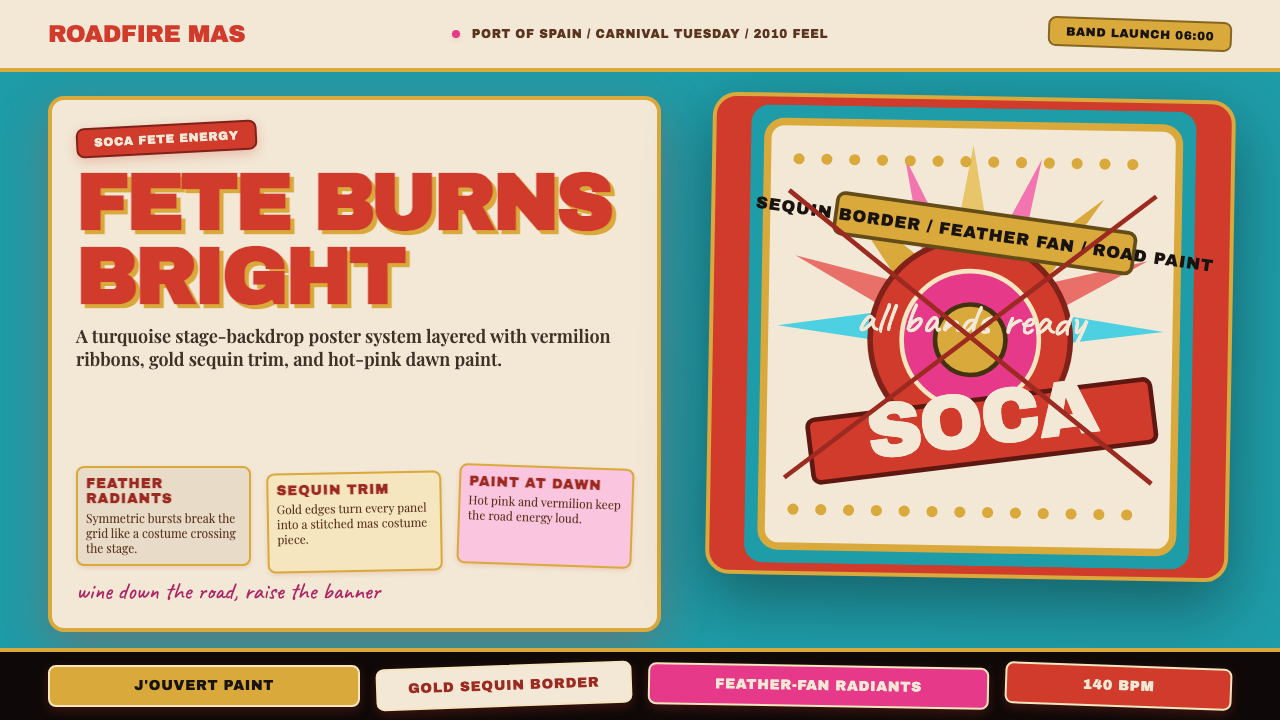
Trinidad Carnival circa 2010 is controlled chaos made gorgeous — sequined feathers, turquoise fields, vermilion banners, and the overwhelming confidence of a people who decided joy is an art form.
Trinidad Carnival Soca (2010) in brief
Trinidad Carnival Soca (2010) is a design aesthetic rooted in the visual culture of Port of Spain's annual carnival celebration at the height of its modern pretty-mas era. It translates the theatrical excess of mas band costume design into a coherent graphic language: a dominant turquoise-and-gold palette, feather-fan radiant geometry, sequin border textures, and a layered maximalism that feels earned rather than accidental.
Where many festive aesthetics tip into visual noise, this one maintains internal logic. The compositions are densely layered but organized around strong radiating structures — burst forms and fan silhouettes that create natural focal points within the complexity. Bold vermilion and gold read as celebratory signals against the cooler turquoise ground, and everything is coated in the implied shimmer of rhinestone and sequin — a tactile quality that digital surfaces can evoke through surface treatment and contrast patterning.
This is emphatically not a shy or restrained aesthetic. It belongs to a tradition that views visual restraint as a failure of imagination. The design philosophy behind it is closer to theatrical costume than to modernist graphic design: the goal is to overwhelm the senses in a structured, intentional way, so that the viewer feels the heat and sound of the Savannah stage even when encountering it on a screen.
Where does Trinidad Carnival Soca (2010) come from?
The roots of Trinidad Carnival reach back to the late eighteenth century, when French Creole planters brought masquerade traditions from Europe to the island. After emancipation in 1838, formerly enslaved Africans transformed the celebration into their own — the Canboulay torch processions of the 1830s, later suppressed by colonial authorities, became the symbolic origin story of a festival whose very existence was an act of cultural resistance. By the 1880s, carnival had settled into its modern street parade form, governed by mas bands competing in costume and music.
The visual aesthetic of the 2010 era descends directly from the mas design renaissance of the late twentieth century. Peter Minshall, widely regarded as the most significant carnival designer in the tradition's history, began his groundbreaking work in the 1970s and 1980s, introducing theatrical narrative, wire-bending sculpture, and a conceptual seriousness that elevated mas to fine art. His influence can be seen in the large-scale geometric forms and the sense that each costume section is part of a larger visual argument. Brian Mac Farlane, another major figure of the period, brought exuberant color fields and featherwork to prominence, contributing to what became the dominant pretty-mas vocabulary.
Soca music, the sonic engine of modern carnival, was formalized by Ras Shorty I in the 1970s as a fusion of soul and calypso. By the 2000s, it had evolved into the fast, bass-heavy road march sound associated with artists like Machel Montano, who became the face of the genre and whose fete posters and stage productions directly shaped the era's visual identity. The energy of soca — relentlessly forward, physically demanding, collectively euphoric — maps directly onto the aesthetic: nothing hesitates, nothing recedes.
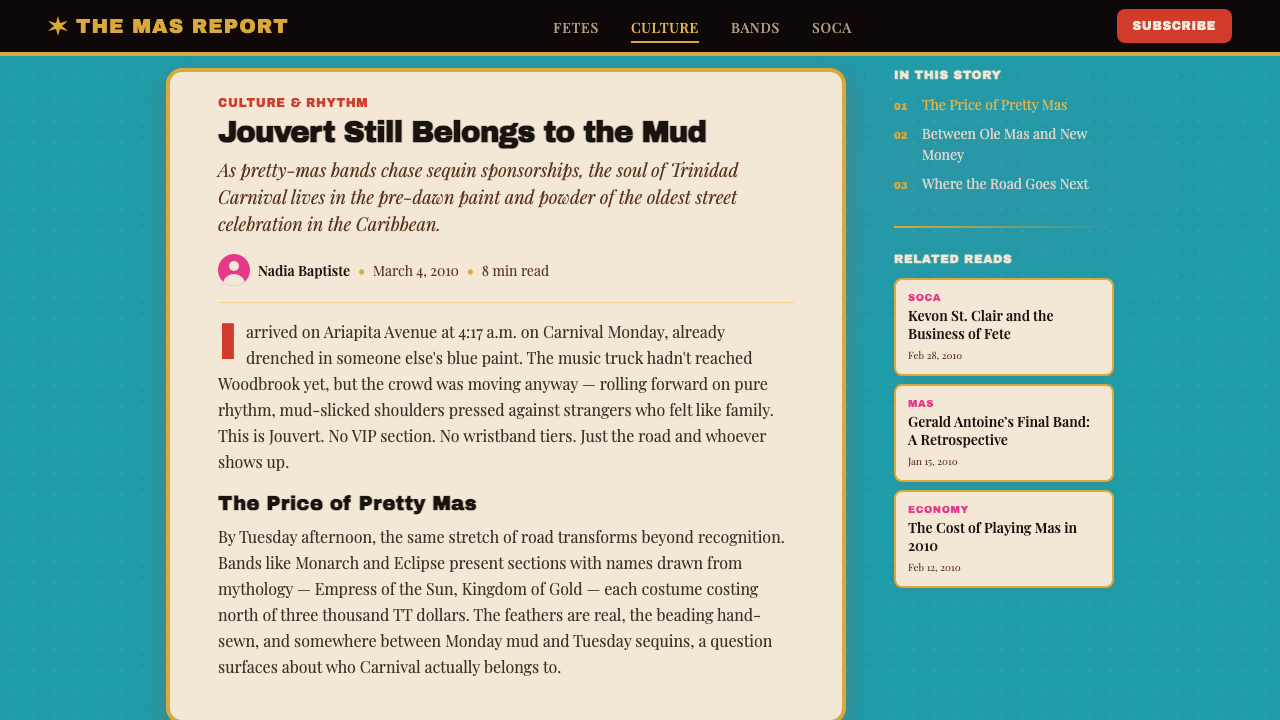
The years between roughly 2005 and 2015 represent the visual peak of this tradition, the moment when costume construction techniques, dye and sequin technology, and the commercial scale of the mas bands converged to produce the most elaborately beautiful costumes in the festival's history. The J'ouvert tradition — the pre-dawn street celebration where revelers cover themselves in paint, mud, and oil — provided a counterpoint within the same cultural moment: raw, dark, deliberately anti-pretty. The 2010 aesthetic this system captures is the daytime Tuesday parade side of that duality, the glittering apex that makes J'ouvert's rawness meaningful by contrast.
What defines the Trinidad Carnival Soca (2010) look?
Color Field
The palette is organized around a warm-cool tension: a vivid tropical turquoise serves as the dominant ground, against which hot vermilion, deep gold, and bright white compete for attention. These are not subtle colors — they are chosen for maximum visibility in direct sunlight at a distance of tens of meters, which is the original context for which carnival costumes are designed. In digital applications, this palette retains its intensity; colors are saturated and unmodulated, applied in broad, confident fields rather than as gradients or washes.
Radiant Geometry
The organizing visual structure of the style is the burst or fan — forms that radiate outward from a central point in a display of directed energy. This comes directly from the feather-fan headdresses and backpacks of pretty-mas costuming, where enormous semicircular fan structures extend behind and above the wearer. In graphic applications, this translates to layouts that use radial or sunburst patterns as compositional anchors, with elements arranged to suggest explosive outward movement from a center of gravity.
Sequin Surface Texture
Trinidad Carnival costumes are covered in sequins, rhinestones, metallic thread, and glitter — surfaces that catch and scatter light in constant motion. This shimmer quality is one of the most distinctive characteristics of the visual style. In static design work, it is evoked through high-contrast repeated pattern — dense fields of small geometric units, scalloped borders, mosaic-like texture overlays, and surface treatments that imply reflectivity without literally being reflective. The overall effect is one of radiant, energetic surface — nothing sits flat.
Layered Maximalism
Where modernist aesthetics eliminate layers to reach clarity, this style adds layers to reach fullness. A carnival costume might include a base bodysuit, sequined briefs, wire-frame wings, feather collar, jeweled headpiece, and accessories — each element complete in itself and yet part of an integrated whole. In graphic terms, this means compositions willingly carry multiple simultaneous pattern registers: a background field, a midground border system, and a foreground focal element can all be visually active at the same time without any one reading as decorative noise, because each layer operates at a different scale.
Banner and Proclamation Typography
Text in this visual tradition is never quiet. Mas band names, soca song titles, and fete posters all employ bold, compressed letterforms at maximum scale — type that announces rather than informs. The typographic register is closer to a fair banner or a movie title card than to editorial body text. Letters are often given decorative treatment: outlined in contrasting colors, filled with gradient or texture, or given dimensional depth through shadow stacking. Type exists in this system to be seen from a distance and felt immediately, not read carefully.
Warm Gold Accents
Gold functions as the system's premium signal — it appears on borders, jewelry motifs, filigree details, and crown elements within costume design. Against the turquoise ground, gold reads as both warm contrast and as cultural prestige, evoking the crown, the trophy, and the sun simultaneously. In digital design, gold is used sparingly as the accent that marks hierarchy and emphasis within an already saturated composition — it is the last layer added, the element that says this is the most important thing here.
Bilateral Symmetry with Festive Excess
Unlike the deliberate asymmetry prized by modernist traditions, carnival costume design is fundamentally symmetrical — the human body as armature demands bilateral balance. Wings spread equally on both sides; feather fans mirror left and right; headpieces rise symmetrically from the center. This symmetry is not corporate or static, however — it is the symmetry of a butterfly or a peacock display, alive with bilateral ornament and motion. Graphic applications can honor this by organizing compositions around a strong vertical axis while loading both sides with equal but visually rich detail.

Who shaped Trinidad Carnival Soca (2010)?
Minshall is the most conceptually ambitious designer the Trinidad Carnival tradition has produced. Beginning in the 1970s, he reimagined the mas band presentation as a form of total theater — each band a narrative, each section a chapter, each costume a character with psychological depth. His designs introduced large-scale wire sculptures, kites, and mobile constructions to the parade ground, and his work on the 1992 Barcelona Olympics opening ceremony brought the aesthetic vocabulary of carnival to a global audience. His influence on the 2010 era is indirect but foundational: the idea that a mas band should have a point of view, and that carnival design deserves the same seriousness as fine art, is his legacy.
If the visual aesthetic of 2010-era carnival has a sonic equivalent, it is the road march music of Machel Montano. Beginning his career as a child performer in the 1980s, Montano became the dominant soca artist of his generation, winning the Road March title multiple times and shaping what contemporary carnival sounds like at every level — from fete stage lighting rigs to the banner graphics plastered across Port of Spain in the weeks before carnival. His fete posters and stage production designs, with their explosive color fields, bold photographic portraits, and maximum-energy typography, are direct visual antecedents of this design system.
Mac Farlane is one of the central architects of the pretty-mas visual vocabulary that defines the 2010 aesthetic. His mas bands — particularly Barbarossa, which he founded — became renowned for their lavish featherwork, jeweled bikini costuming, and the sheer opulence of their color fields. Where Minshall sought conceptual weight, Mac Farlane sought sensory abundance, and the tension between these two traditions shapes the design culture of the era. His productions demonstrated that extreme visual richness and structural coherence were not mutually exclusive — that a costume could be both overwhelming and organized.
Born Garfield Blackman, Ras Shorty I is the acknowledged inventor of soca music, which he developed in the early 1970s by fusing the lyrical traditions of calypso with the rhythmic energy of soul and funk. Though he later embraced a spiritual life and moved away from commercial carnival, his foundational work established the genre that would become the driving soundtrack of the aesthetic era this system represents. The qualities of soca — communal, kinetic, relentlessly forward-moving, built for crowds rather than individual listening — are precisely the qualities that characterize the visual system it inspired.
How do you use Trinidad Carnival Soca (2010) today?
The Trinidad Carnival Soca (2010) aesthetic is best deployed in contexts that call for uninhibited celebration, cultural warmth, and maximum visual energy. It is not a background style — it demands to be the primary visual event. This means it works best for hero moments: a conference keynote title slide, an event landing page header, a product launch announcement, or a brand campaign where the goal is to stop the scroll and generate an immediate emotional response.
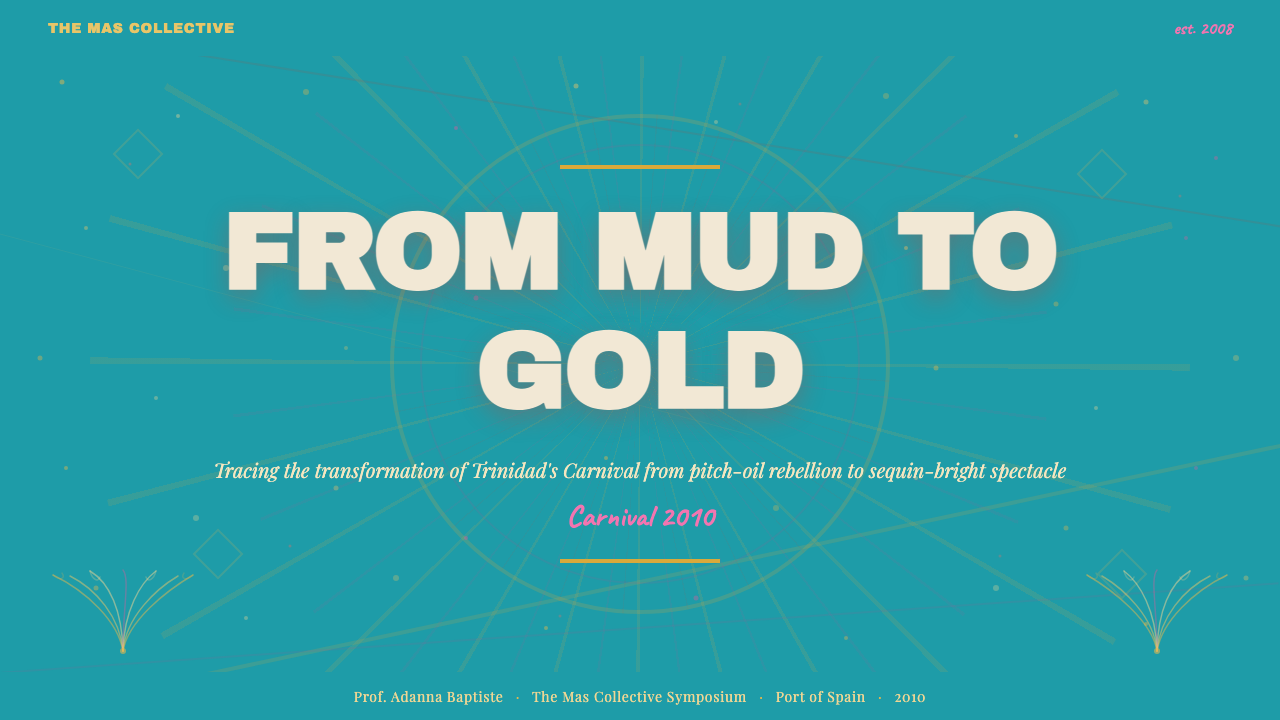
For presentation slides, the approach differs between cover and content pages. A cover built in this style uses a full-bleed turquoise or deep gold field, a central burst or fan motif as the compositional anchor, and title type set large enough to read across a room — outlined or given shadow treatment for maximum presence. Content slides should simplify dramatically: use the color palette for headers and accent elements, but work on a near-white ground so the content breathes. Data slides can adopt carnival geometry for chart accents and dividers — arc shapes and fan segments make pie charts feel native to the style — but keep data labels legible by ensuring adequate contrast against the vivid backgrounds.
For web interfaces, this aesthetic suits event ticketing pages, cultural organization homepages, music streaming landing pages, and entertainment brands. The practical approach: reserve the full palette intensity for the hero section and allow it to reduce in saturation as the user scrolls deeper into utility content. Navigation should be crisp and functional — let the hero carry the visual weight so that the user is not fatigued by the time they reach pricing or contact forms. Interactive states (hover, active) are an opportunity to introduce the shimmer quality through brief animation or a shift to a more saturated variant of the base color.
For editorial and marketing work, this style excels at event programs, festival posters, cultural magazine spreads, and social content. A poster built in this vocabulary uses a symmetrical burst composition with the subject at the center, surrounded by increasingly ornate concentric rings of pattern and color. Social content benefits from the palette's native high contrast — images and graphics in these colors read well against both light and dark feed backgrounds. In marketing copy and headlines, the typographic register should match the visual energy: bold, compressed, declarative. Qualifiers and hedges have no place in a headline designed to feel like a carnival banner.
A common mistake is applying the palette while suppressing the layering. Turquoise, gold, and vermilion on a white field without the structural density of the style looks incomplete — like carnival without the feathers. The other frequent error is treating this as an all-purpose loud aesthetic and deploying it in contexts that require trust, calm, or precision: medical interfaces, financial dashboards, productivity tools. This style communicates festivity and cultural pride with great clarity, but it communicates analytical rigor with none. Match the aesthetic to the emotional register of the use case before applying it.
Trinidad Carnival Soca (2010) — FAQ
Is this style only appropriate for Caribbean or festival-themed content?
Cultural specificity is a feature, not a limitation. The style carries authentic visual authority precisely because it comes from a real, living tradition rather than a generic tropical aesthetic. That said, it is not exclusive to Caribbean content — it works well for any context that benefits from its core qualities: communal celebration, uninhibited joy, cultural confidence. A global brand launch, a music event, an art exhibition, a sports campaign — all of these can carry the visual register of this style credibly. The key is that the content's emotional register should match: do not apply this to a context that requires restraint, formality, or analytical detachment.
How do I reference this aesthetic without it reading as cultural appropriation?
The most useful distinction is between appropriation and appreciation. Appropriation extracts visual surface while erasing or ignoring the source culture; appreciation acknowledges the source while applying the visual language honestly. If you use this style, be direct about where it comes from — in project documentation, in presentations, in any context where the reference is relevant. Avoid hollow pastiche: do not use the palette and geometry while removing all the energy that makes the style meaningful. The worst outcome is a design that borrows the colors but loses the joy. The best outcome is work that genuinely honors the tradition by applying its principles with care and specificity.
Can this style work in a dark-background version?
Yes, and the tradition actually supports it through J'ouvert aesthetics — the pre-dawn carnival celebration that deliberately inverts the day parade's glamour with raw, dark, paint-covered energy. A dark variant of this system places the palette on a near-black or very deep navy ground, where gold and vermilion read as incandescent accents against the darkness. Turquoise on black has a luminous, almost neon quality that captures a different phase of the carnival experience. The key difference from the light variant: dark versions work best when the radiant geometry is kept tight and contained — enormous burst forms on a black field tend to feel diffuse rather than energetic, so the compositions should be more concentrated.
How much layering is too much when applying this style digitally?
The practical test is whether the functional content — the information the user needs to act on — remains legible and findable within the visual richness. Carnival costumes work at maximum layering because the costume itself is the content; there is nothing to read, only something to see. Digital interfaces always have a second layer of purpose: getting users to click, read, understand, or complete a task. The rule of thumb is to use maximum layering intensity in decorative zones (headers, hero sections, borders, backgrounds) and to reduce it significantly in functional zones (body text, form fields, data displays, navigation). Treat the layered maximalism as the frame, not the painting.
What is the difference between this style and other Caribbean or tropical aesthetics?
The most important distinction is structural: this style's organizing principle is radiant geometry and layered theatrical excess, not the loose organic curves and watercolor washes associated with generic tropical aesthetics. Generic tropical design uses palm fronds, flamingos, and soft gradients — organic, holiday-resort imagery with no particular cultural depth. Trinidad Carnival Soca comes from a specific artistic tradition with named designers, documented history, and precise visual conventions developed over decades of competitive mas design. It is dense, structured, bilateral, and built around a specific cultural moment in a specific place. The palette overlaps with other Caribbean traditions but the formal vocabulary — the burst forms, the sequin texture, the banner typography, the radiant symmetry — is distinctly its own.
Related design styles
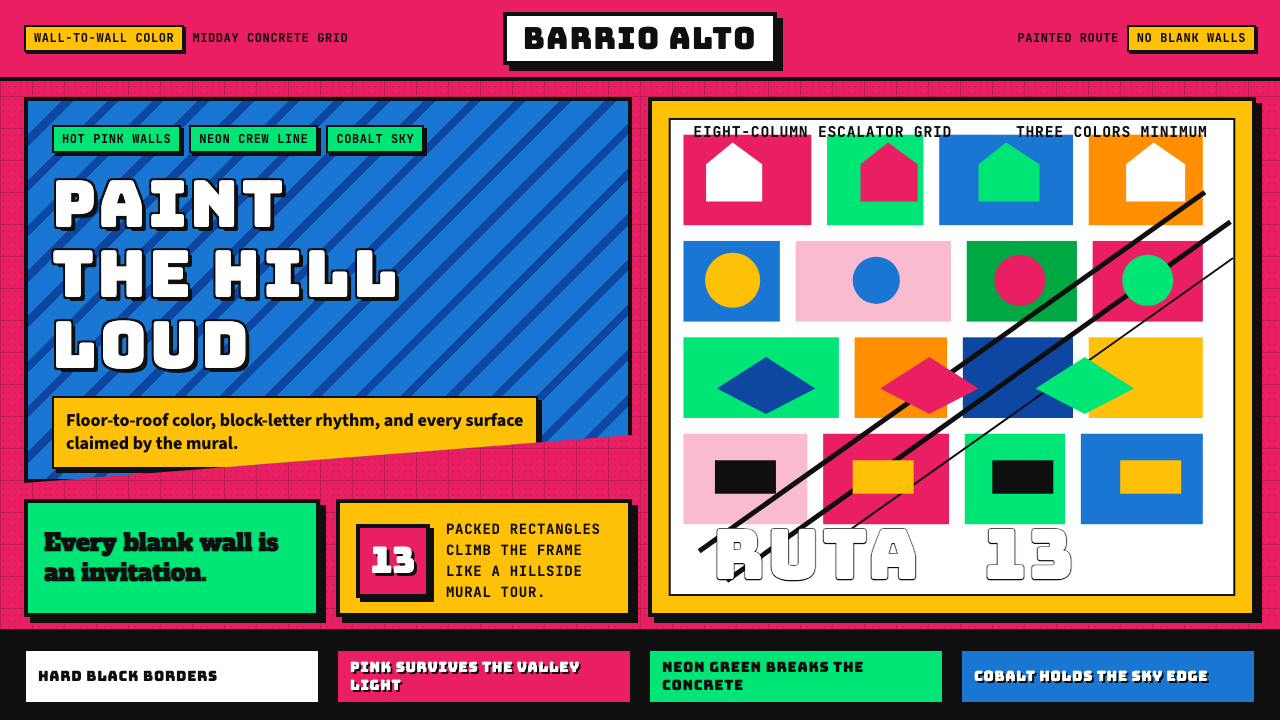 Medellín Comuna 13 MuralsRefuses blank walls. Hot pink, neon green, and cobalt blocks pack the grid li…
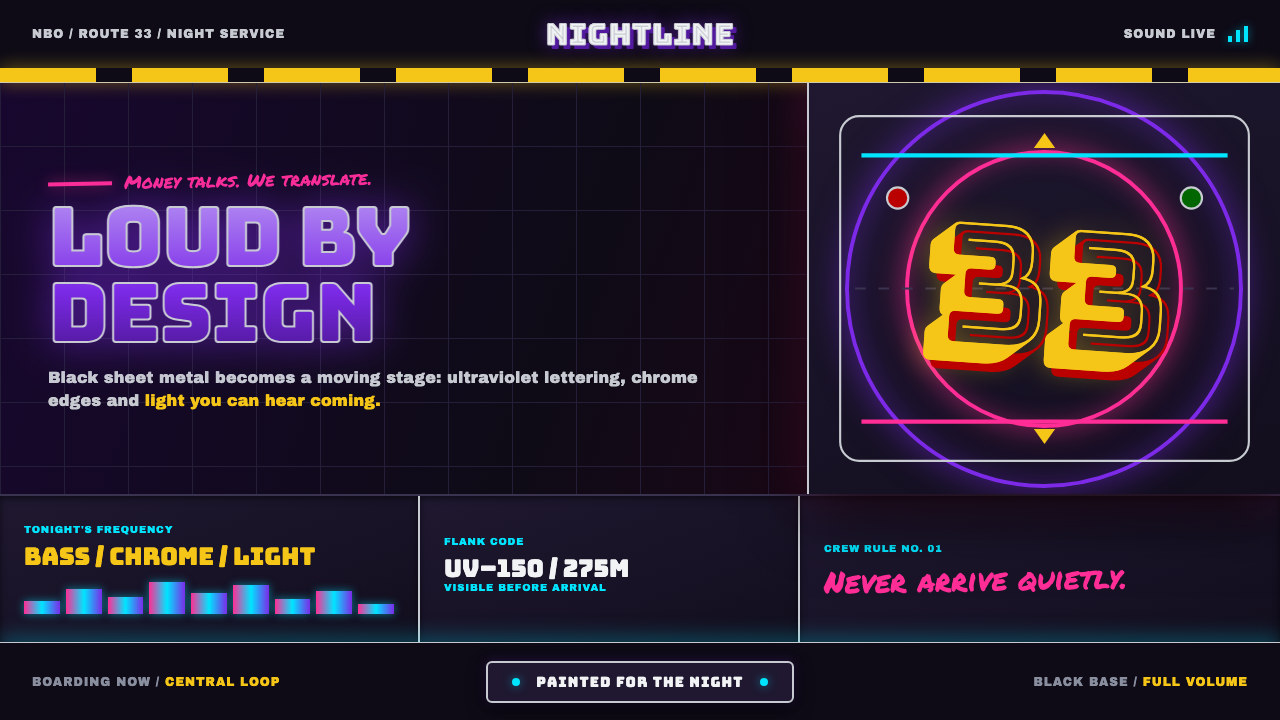 Nairobi Matatu ArtBuilt to be unmissable. Neon airbrush and chrome blaze across night-black hor…
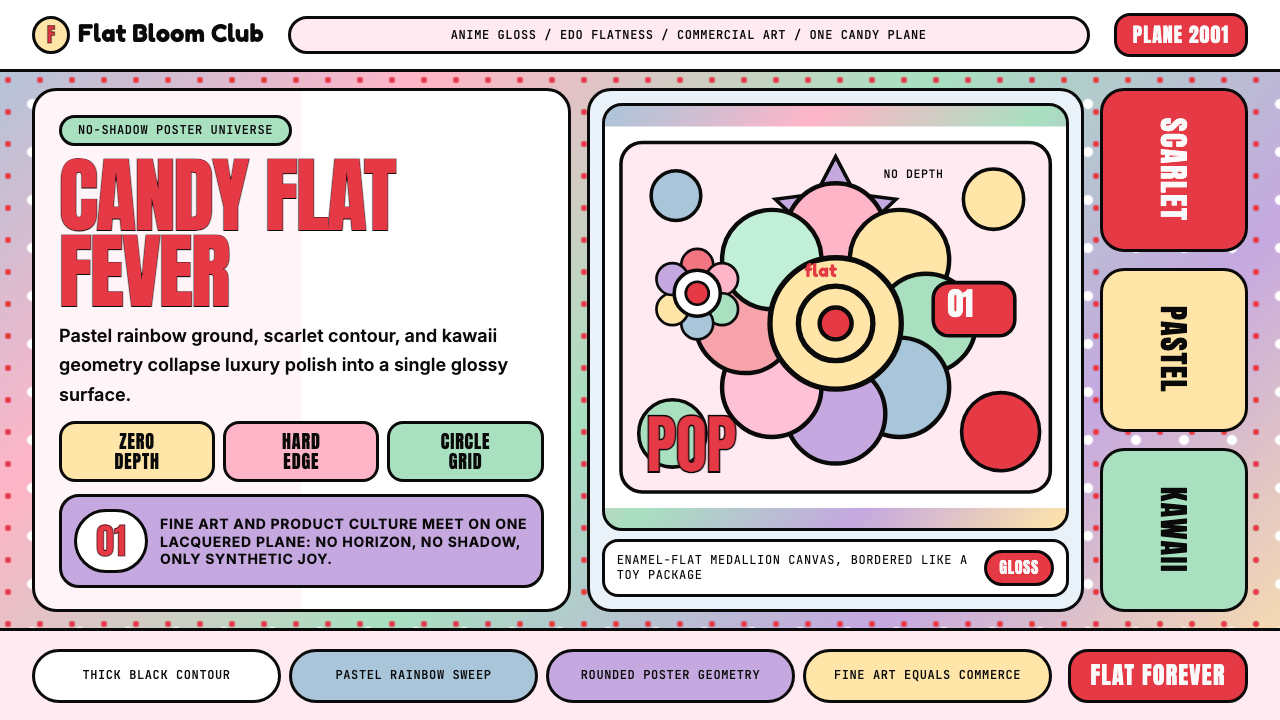 Takashi Murakami SuperflatJoy has no depth. Pastel rainbow, scarlet accents, and black contours flatten…
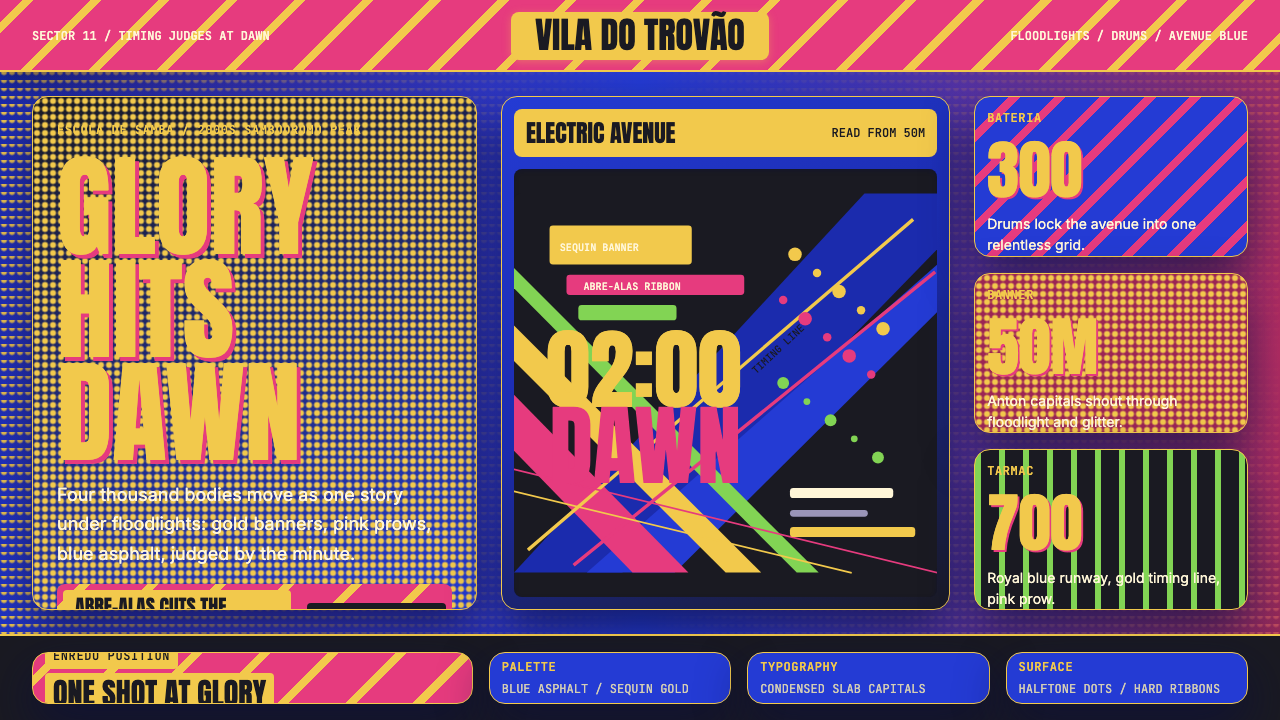 Brazilian Samba School (2000s Carnaval)Parade at floodlight volume. Royal blue asphalt, sequin gold type, pink ribbo…
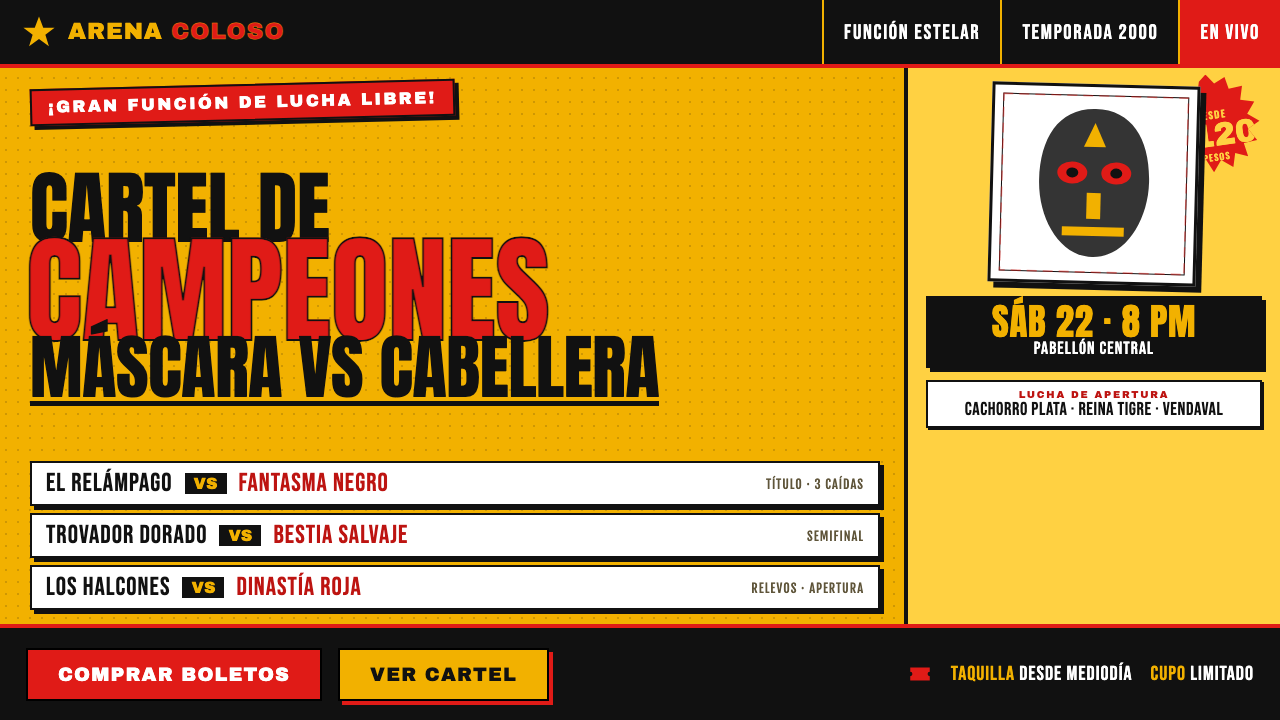 Lucha Libre Fight CartelTwo inks, maximum volume. Blood red on chrome-yellow, fat condensed type, sta…
 Sindhi Truck CalligraphyKarachi truck art, digitized. Hot fuchsia and chamak green blaze on deep coba…